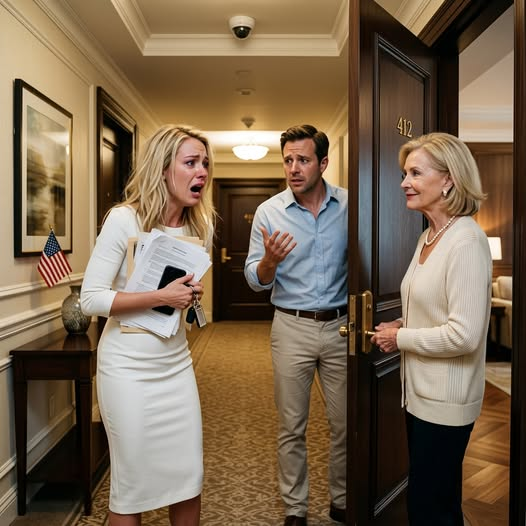
The key slid into the lock like it always had, but this time it stopped dead, refusing to turn, as if the door itself had decided I no longer belonged in my own life. I stood in the bright, silent hallway of the Maples, a luxury high-rise in Lincoln Park, holding a tape measure in one hand and a shopping bag full of curtain samples in the other, staring at the brand-new deadbolt shining on my condo door. My condo. The one my parents had spent twenty years saving for. The one I had renovated inch by inch, choosing every tile, every cabinet handle, every warm neutral paint color, imagining Sunday mornings, quiet dinners, maybe children someday curled by the bedroom window while I read them stories. And now the lock had been changed without a word.
For a few seconds, I honestly thought I was mistaken. Maybe I had the wrong floor. Maybe I had grabbed the wrong key. Maybe the contractor had done something temporary after the final inspection. But then I looked at the brass numbers beside the door—13H—and felt the blood drain from my face.
I called my husband, Matthew.
He answered with laughter in the background, the kind of easy noise people make when they are eating lunch and have no idea their marriage is about to split open.
“The lock has been changed,” I said.
Silence.
Not confusion. Not surprise. Silence.
Then Matthew cleared his throat and said, “Oh. Mom thought the old lock wasn’t safe. She had it replaced. I forgot to tell you.”
My grip tightened around the phone. “Who gave your mother permission to change the lock on my condo?”
He gave a small, nervous laugh. “Lauren, don’t make it sound so dramatic. It’s family.”
Family. That word had excused every insult, every boundary crossed, every time his mother walked into a room and acted like my patience was a piece of furniture she owned.
Then he said the sentence that made something inside me go perfectly cold.
“Tyler and Ashley are staying there for a bit. Their lease ended, and Ashley’s about to have the baby. You’re the sister-in-law. Don’t be so stingy.”
I did not scream. I did not cry in the hallway. I did not pound on the door like some desperate woman begging to be let back into her own property. I simply hung up, opened the smart home security app I had almost forgotten existed, and tapped the live feed from the three hidden cameras I had installed during renovation to watch the contractors.
The screen loaded.
And there they were.
Grocery bags on my kitchen island. A pair of men’s sneakers kicked beneath my coffee table. A baby crib assembled in the corner of my living room. My custom sofa cover was gone, replaced by some dark red floral thing I had never seen before. In my bedroom, someone else’s clothes hung in my closet. My bed—my bed—was covered in a gaudy red comforter. The spare room I had planned to turn into a reading nook was now covered in cartoon animal wallpaper and stacked with newborn clothes.
I stood outside that door, looking at the live video of strangers living inside the home my parents had given me, and for the first time in three years of marriage, I understood the truth clearly.
They had not made a mistake.
They had been waiting for me to be weak enough to steal from politely.
My name is Lauren, and when I married Matthew, I believed I was choosing a peaceful life. He worked for the city government, spoke softly, dressed neatly, and never seemed like the kind of man who would bring chaos into a woman’s world. My mother once told me that a reasonable man was better than a rich one. A reasonable man, she said, would protect the family from storms instead of creating them. I believed her. I stood beside Matthew in a white dress, smiling carefully for the wedding photo that hung in my mother’s living room, and thought I had found someone safe.
The condo was my parents’ wedding gift to me. Not to Matthew. Not to his family. To me. My father owned a construction supply business he had built from nothing, and my mother ran a home goods boutique where she worked six days a week for more than two decades. They bought unit 13H at the Maples in cash and put the deed in my name. On the day my mother handed me the folder, she squeezed my fingers and said, “This is yours. Don’t ever let anyone make you feel small inside it.” Matthew stood beside me and smiled. “Don’t worry,” he told them. “I’m marrying Lauren for love, not for a house.”
My mother cried when he said that. I wish now I could go back and tell her that some men do not need to want your house to benefit from your silence. Some men only need to stand aside while their families take it from you.
His mother, Barbara, disliked the condo from the first day she stepped inside it. She walked through the living room, kitchen, balcony, and bedroom like an inspector evaluating property she planned to seize. The walls were too light. The cabinets were impractical. The walk-in closet was a waste of space. She said the spare room should become a nursery immediately, because a married woman who delayed children was “thinking too much like a single girl.”
I smiled through it. I always smiled through it.
But as we left that day, I heard her whisper to Matthew, “A woman who gets married and still keeps saying mine, mine, mine is going to be hard to train.”
Matthew did not defend me. He just gave that soft little laugh of his and said, “Mom, don’t take it the wrong way. Lauren is just like that.”
Just like that.
Meaning what? Too aware of ownership? Too attached to dignity? Too unwilling to be absorbed into his family like furniture moved from one house to another?
For three years, I swallowed things like that. When Barbara criticized my career plans, Matthew said she meant well. When she shamed me for not having children yet, Matthew said she was old-fashioned. When she hinted that Tyler, his younger brother, needed help more than I did because his wife Ashley was pregnant, Matthew said family helped family.
But family, I learned, only seemed to flow in one direction.
After our wedding, Matthew and I stayed with my parents while the condo renovation was being finished. My mother cooked for him. My father let him drive the family SUV to work. He slept under my parents’ roof, ate at their table, benefited from their kindness, and still allowed his mother to talk about me as if I were a selfish outsider hoarding resources from his bloodline.
The day the condo passed final inspection, I was happier than I had been in months. I sent my mother a picture of the occupancy permit. She replied, “A new house needs a woman’s warmth to become a home.” I remember standing in my office bathroom with tears in my eyes, imagining the quiet life I had tried so hard to build.
The next day, I found the changed lock.
That night, I drove straight to my parents’ house. Matthew came by after dinner carrying three new keys like they were flowers after a minor argument. He placed them on the coffee table and explained that his mother had only been trying to help. Tyler and Ashley would stay for a month. Maybe two. It was temporary. They were struggling. Ashley was pregnant. Why was I making everything ugly?
My father had been sitting silently with the newspaper folded in his lap. He set it down with a hard slap against the table.
“Whose house is it?” he asked.
Matthew blinked. “Lauren’s.”
“Then why is your mother deciding who lives there?”
Matthew looked at me as if I had forced him into an impossible position. But that was the moment I finally saw him clearly. He was not cruel in the dramatic way villains are cruel. He did not shout. He did not hit. He did not threaten. He simply chose the easiest side every time, and somehow the easiest side was never mine.
“If your mother and Tyler’s family are not out by tomorrow,” I said, “I’m calling the police and my attorney.”
Matthew shot up from the couch. “You’d really make both families look bad?”
I laughed once. It sounded strange even to me. “There comes a point where a woman stops caring about looking bad because she has already been disrespected past repair.”
That night, in my childhood bedroom, I opened the camera footage again. Barbara stood in my living room with her hands on her hips, smiling while speaking on the phone.
“Sooner or later, this place will belong to my son anyway,” she said. “When a woman marries, what she has belongs to her husband’s family.”
I replayed it three times.
By the fourth time, I was no longer shaking.
At eight the next morning, I called Mr. Henderson, an old family friend and real estate agent who had helped my parents buy the condo. He listened quietly while I explained everything.
Then he said, “Lauren, if you’re going to take this all the way, you cannot waver.”
“I won’t,” I said.
My parents were waiting in the kitchen when I came downstairs. My mother had made soup and grilled cheese, the way she always did when worry replaced language. My father sat with a mug of black coffee, his jaw tight. I laid everything out on the table: the deed, the purchase agreement, renovation invoices, screenshots from the camera feed, Matthew’s messages, Barbara’s recorded statement from the living room.
My father’s eyes reddened as he reviewed the documents. “We gave you that home so you would have security,” he said. “Not so his family could treat it like an emergency fund.”
Mr. Henderson arrived at nine with a brown leather briefcase and a serious expression. He explained that the condo had a history I had never known. The previous owner, Mrs. Higgins, had sold it to my parents below market value because she needed money quickly, but she had asked for one thing: if I ever decided not to live there, her granddaughter Megan would have the first chance to buy it. My parents had agreed quietly, never thinking it would matter.
“Megan has been looking for a place in Lincoln Park,” Mr. Henderson said. “She still loves that unit. If you want to sell, she’s ready.”
Sell.
At first the word hurt. That condo had been my dream. But then I pictured Tyler’s shoes under my table, Ashley’s baby bags in my reading room, Barbara’s voice claiming my future as her family’s property. A home can be rebuilt. A violated dream cannot always be cleaned.
“I want it back first,” I said. “Empty. Documented. Legal. Then I’ll sell.”
Mrs. Cohen, the attorney my mother trusted, agreed to handle the notice. She was calm, precise, and absolutely terrifying in the way competent women can be. “Do not yell,” she told me. “Do not touch their belongings. Do not let them provoke you. We document everything. The law is on your side, and we will keep it there.”
That afternoon, I returned to the Maples with Mrs. Cohen’s paralegal, the HOA property manager, and Mr. Henderson as witness. The elevator ride to the thirteenth floor felt endless. When the doors opened, I saw Barbara’s flip-flops neatly placed outside my door, as if she had already made herself queen of the hallway.
The manager rang the bell.
Ashley opened the door. Her face went pale.
“Lauren,” she whispered.
“Call Barbara,” I said.
Barbara appeared moments later, her slippers smacking against my hardwood floor. She looked angry until she saw the people standing behind me. Then her eyes flickered.
“What is this?” she demanded. “Family matters should be handled inside the family.”
“This is my property,” I said. “You changed the locks and moved people in without my permission. I’m here to serve formal notice.”
Barbara scoffed. “You got brave, didn’t you? Nickel-and-diming your in-laws over square footage. Aren’t you embarrassed?”
“The only thing that embarrasses me,” I said, “is the thought of my parents crying because I let someone steal the home they worked twenty years to give me.”
For once, she had no quick answer.
Then Tyler came out of the bedroom red-faced and defensive. “My wife is about to give birth. Where are we supposed to go?”
I looked at him, remembering every unpaid favor, every excuse, every time his emergencies became my responsibility. “You are about to be a father. Providing a roof for your family is your job, not mine.”
Ashley lowered her head. I did feel something when I saw her hand resting over her belly. But compassion is not the same thing as surrender. A pregnant woman deserves care. She does not get to become the emotional shield for theft.
The paralegal placed the notice on the kitchen island. They had twenty-four hours to vacate.
Barbara snatched the paper. “You wouldn’t dare.”
I looked around the room that used to feel like hope. “Yes,” I said. “I would.”
Then her phone rang.
I saw the name on the screen before she turned away: Mr. Barrett.
She hurried to the balcony, but her voice carried through the glass.
“Stop calling me,” she hissed. “I said I’ll get the money. I just need time.”
The money.
When she came back inside, the arrogance had drained from her face. That was when I realized this was not only about Tyler needing a place to stay. There was something rotten underneath it all.
The next day, Megan came to see the condo while Tyler and Ashley were packing. She was a university professor, composed and kind, and when she stepped inside, she looked at the walls with a tenderness I no longer felt. “I remember this place when my grandmother’s friend lived here,” she said softly. “I never thought I’d get the chance to buy it.”
Barbara sat at the dining table, watching in horror as Megan walked from room to room.
When Megan said she wanted to make an offer immediately, Barbara exploded.
“No. You cannot sell this house.”
I turned to her. “Matthew has no say in it. Neither do you.”
“If you sell it,” Barbara said, her voice shaking, “my family will make your life hell.”
The room froze.
Mr. Henderson stepped slightly closer to me. The paralegal lifted her phone as if ready to record.
I smiled at Barbara. “Then I’ll add threats to the file.”
She went silent.
The sale moved quickly. Megan and her husband were prepared, the paperwork was clean, and Mr. Henderson handled the details. The day I signed the earnest money contract, Matthew texted me: “Do you really want to tear everything apart like this?”
I stared at the message and felt nothing but exhaustion.
No, Matthew. I thought. I am only refusing to hold together what your family broke.
After closing, I gave part of the proceeds back to my parents and used the rest to rent a small one-bedroom apartment closer to work. For the first time in years, every item in my space belonged to me. No one criticized the curtains. No one asked when I would give my husband a baby. No one told me I was selfish for wanting peace.
Then Mr. Barrett called.
We met at a coffee shop near my office. He was in his late fifties, silver-haired, careful with his words. He told me he had known Barbara for years through a small lumber and hardware investment. At first it had been business. Then Barbara started borrowing money to cover old debts, then more money to help Tyler, then more money to hide the fact that everything was collapsing.
“How much?” I asked.
“Over fifty thousand dollars,” he said.
The number sat between us like a loaded weapon.
Then he told me the part that made my stomach turn. Barbara had mentioned my condo before. She believed that if she could get control of it long enough, she could pressure Matthew and me into selling it, then use the proceeds to pay down her debt.
So the changed locks had not been a misunderstanding. It had been strategy.
I went home that night and deleted every old text thread from Matthew. Not because I hated him, but because I no longer wanted proof of a woman I had stopped being.
He called later.
“Did you really sell it?” he asked, breathless.
“Yes.”
“My mother is losing her mind.”
“When did you know about her debt?”
Silence.
“A few months ago,” he admitted.
I closed my eyes. “And you still let her break into my home.”
“I thought it would be temporary.”
“You always think things are temporary,” I said. “But consequences are permanent.”
A few days later, Matthew came to my parents’ house looking destroyed. His shirt was wrinkled, his eyes bloodshot, his voice thin.
“I need your help,” he said.
I already knew.
“How much?”
“Fifteen thousand.”
I laughed, not because it was funny, but because the nerve of it was almost beautiful. “You let your mother take my condo, lie to me, threaten me, and now you want me to finance the cleanup?”
“She’s my mother,” he whispered.
“Exactly,” I said. “She’s yours.”
He begged. My mother looked worried. My father watched in silence. But I did not move. If I gave him that money, I would return to the role they had built for me: the understanding wife, the forgiving daughter-in-law, the woman who paid the emotional and financial bill for everyone else’s irresponsibility.
“Go home, Matthew,” I said.
Three days later, the hospital called. Barbara had been admitted after a panic attack and severe blood pressure drop. Against my better judgment, I went—not to rescue her, but because I wanted to see the truth reach its natural end.
She looked smaller in the hospital bed. Without her sharp clothes and sharper voice, she was just an exhausted woman attached to an IV, staring at the ceiling.
“Why did you come?” she asked.
“To see if you were alive,” I said.
She gave a dry laugh. “Are you happy now?”
“No,” I said. “I just want peace.”
For a long time, she said nothing. Then, in a voice barely above a whisper, she said, “I was wrong.”
I looked at her.
“I was wrong to think your house would become ours. Wrong to think you’d keep tolerating it. Wrong to think I could fix my mistakes with someone else’s money.”
There was no dramatic forgiveness in that room. Her apology did not rebuild my marriage. It did not erase the locks, the threats, the humiliation. But it gave me one thing I had not expected: confirmation.
The next morning, I filed for divorce.
Matthew called at noon. “We haven’t reached that point.”
“We passed that point miles ago,” I said. “You just never looked at the map.”
He tried to tell me he didn’t want to lose me. But he had lost me slowly, in pieces, every time he chose silence over protection. By the time he noticed I was gone, there was nothing left to save.
A week before mediation, Ashley asked to meet. She looked exhausted, heavily pregnant, and afraid. At Starbucks, she told me Barbara had begun spreading a new story: that my father had secretly borrowed money from Matthew’s family years ago and promised them part of the condo’s equity.
It was absurd. My parents had paid cash. Every wire transfer, every closing document, every legal record proved it. But Barbara was desperate, and desperate people do not always need truth. Sometimes they only need noise.
The rumor reached the HOA board at the Maples. Barbara demanded a meeting, claiming I had stolen “family equity.” I arrived with a binder of documents: deed, bank records, closing disclosures, renovation invoices, security footage, legal notices.
Barbara sat across the table from me, trembling with rage.
“The deed may be in her name,” she said, “but the money was ours.”
I slid the documents to the board president. “Every cent came from my father’s business account. If Barbara has proof otherwise, she should present it.”
She slammed her palm against the table. “It was a handshake agreement.”
“So no proof,” I said.
Matthew sat beside her, staring at his hands.
I turned to him. “Did you ever see proof that my father owed your family money?”
He swallowed. His face looked gray. For once, he had nowhere to hide.
“No,” he said quietly.
Barbara snapped toward him. “Matthew.”
He stood up slowly, as if the weight of three years had finally crushed the weakness out of him. “Mom, stop. The condo was Lauren’s. Her family paid for it. We had no right to it.”
The room went silent.
Barbara looked at him like he had betrayed blood itself. “You’re not my son anymore.”
Matthew’s voice broke. “I’m just telling the truth.”
The board president closed the folder. “The matter is closed.”
I walked out before Barbara finished screaming.
That afternoon, Matthew called.
“I signed the divorce papers,” he said. “I dropped them off at your lawyer’s office this morning.”
I stood by the window of my little apartment, looking out at Chicago shining under a hard blue sky.
“Thank you,” I said.
“I’m sorry, Lauren.”
“I know.”
And that was all.
The divorce hearing lasted less than ten minutes. No fight over assets. No dramatic courtroom speech. No final embrace in the hallway. The judge asked the required questions. Matthew and I answered. The gavel came down, and just like that, three years of marriage became a closed file.
Outside the courthouse, Matthew paused near the marble steps.
“I hope you have a good life,” he said.
I looked at him and realized I no longer wanted him to suffer. I simply no longer wanted to stand close enough to be damaged by his weakness.
“You too,” I said.
Then I walked away.
Months later, I heard Megan had moved into 13H with her family. She sent me one photo—not of the whole condo, just the bedroom window corner where I had once imagined placing my bookshelf. She had put a small reading chair there, a lamp, and a stack of children’s books.
For a moment, it hurt.
Then it didn’t.
Because I finally understood that losing that condo had not made me homeless. Staying in that marriage would have.
Home was not a thirteenth-floor unit with a lake view. It was not a deed, a sofa, a chandelier, or a perfectly renovated kitchen. Home was the place where no one changed the locks on your dignity and expected you to knock politely.
And when I turned the key in the door of my small apartment that night, it opened easily.
No resistance.
No fear.
No one inside who did not belong.
Just me, standing in the quiet, finally able to breathe.