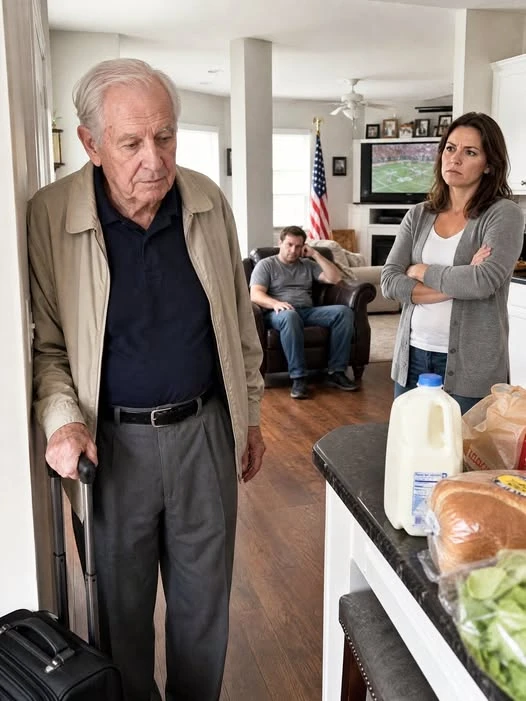
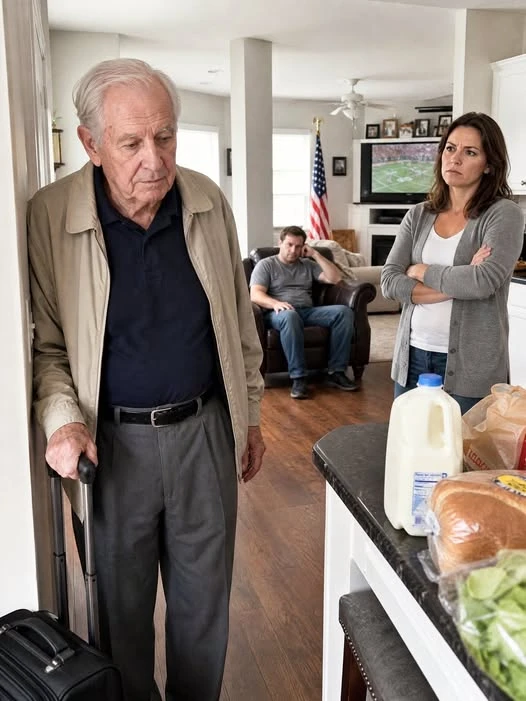
My daughter gave me a choice: stay and wait on her husband hand and foot, or leave the house for good. I smiled, packed a suitcase, and walked away without arguing. Seven days later, I woke up to twenty-two missed calls and a message I never thought I’d see.
When my daughter told me I had to choose between obeying her husband and leaving the house, I didn’t raise my voice. I didn’t argue, slam doors, or remind her of the countless bills I had paid over the years. I simply smiled, picked up my suitcase, and prepared to walk away from the home I had spent decades working to afford.
Elise assumed I would do what I had always done. She expected me to cool off, apologize, and return to keeping the peace no matter how I was treated. But something inside me had changed that afternoon, and for the first time in years, I felt completely certain about what I needed to do.
The grocery bags were still cutting into my hands when I stepped through the front door. Warm spring sunlight filtered through the living room windows and stretched across the hardwood floors that Jocelyn and I had refinished together more than twenty years earlier. Outside, everything looked normal. Inside, my life was about to shift in a way I never expected.
Aiden was sprawled across my favorite leather recliner, the chair my late wife had given me for my birthday before cancer took her away. For years, it had been the place where I sat with my morning coffee and remembered her. Now my son-in-law occupied it like a king on a throne, a half-empty beer dangling from one hand while a basketball game blasted from the television.
He didn’t even look up when I entered.
“Old man,” he called out, eyes fixed on the screen, “grab me another beer while you’re standing there.”
I slowly lowered the grocery bags to the floor. The plastic handles had already left red marks across my palms, and exhaustion settled heavily on my shoulders.
“Excuse me?” I asked.
“You heard me,” Aiden replied casually. “A Corona. Not that cheap stuff you usually drink.”
The irony wasn’t lost on me. I had purchased those beers specifically for him with money from my Social Security check because Elise once mentioned he enjoyed them after work. At the time, I told myself it was a small kindness. Standing there now, it felt more like another piece of myself I had quietly given away.
“I just got home,” I said evenly. “I need to put these groceries away first.”
That finally got his attention.
Aiden turned toward me with the same expression I had seen countless times before: annoyance mixed with entitlement. He looked genuinely offended that someone had dared tell him no.
“What’s the problem?” he asked. “You’re already standing.”
“The problem,” I replied, “is that this is my house.”
He stood up slowly and set his beer aside. At thirty years old, he was bigger than me and knew it. He often relied on his size the way other men relied on threats. But after three decades in banking, I had spent enough time dealing with bullies to know confidence and character were not the same thing.
“My house?” he repeated with a laugh. “That’s funny, considering Elise and I live here.”
“You live here because I allowed it.”
“We pay bills.”
“With my money.”
He shrugged as if that detail didn’t matter.
“Listen, Gavin,” he said. “You can make life easy or difficult. If you want to keep living here comfortably, then cooperate. That’s all.”
Before I could answer, Elise walked into the room carrying a dish towel. She looked from Aiden to me and immediately sensed the tension.
“What’s going on?” she asked.
“Your father is making a big deal out of nothing,” Aiden said. “I asked for one beer and suddenly he’s acting offended.”
I waited for Elise to defend me. Instead, she sighed and looked directly at me.
“Dad, just get him the beer,” she said. “This really isn’t worth arguing about.”
For a moment, I searched her face for the little girl who used to run into my arms whenever she was scared. I searched for the daughter I had spent years protecting.
I couldn’t find her.
Aiden smiled and folded his arms.
“See?” he said. “That’s how things work around here. You live in our house now, so when I ask for something, you do it.”
I stared at him.
“Our house?” I repeated.
“That’s right,” Elise said quietly.
Then she moved to stand beside her husband.
“Dad, you need to decide what you want,” she continued. “Either you help Aiden and stop causing problems, or you pack your things and leave.”
The words hung in the air.
Aiden’s smile widened immediately. He was already celebrating his victory.
I looked at my daughter one last time and realized she fully expected me to surrender.
“All right,” I said.
Relief flashed across her face.
“Good,” Aiden said with a grin. “Now about that beer—”
I picked up the grocery bags, carried them into the kitchen, and carefully placed them on the counter.
Then I turned toward the hallway.
“I’ll start packing.” …
I’ll start packing.
The smile on Aiden’s face didn’t just falter; it vanished entirely, replaced by a look of profound, stupid bewilderment. Beside him, Elise’s relieved expression froze, a sharp gasp escaping her lips as I turned away from the kitchen counter and walked toward the master bedroom with a steady, unhurried stride. They had spent three years treating me like a ghost in my own hallways, gradually convincing themselves that my quiet, grieving demeanor after my wife Jocelyn’s passing was a sign of total submission. They genuinely believed that a man who had survived thirty-five years of corporate banking politics and managed multi-million-dollar risk portfolios would be broken by the threat of an empty nest. They forgot that a man who says nothing is usually the man who is counting the cards.
“Dad! Stop being so dramatic!” Elise shouted, her footsteps pounding against the hardwood floor as she followed me into the bedroom. She stood in the doorway, her arms crossed defensively, watching as I pulled a heavy, dust-covered leather suitcase from the top of the closet. “You’re really going to walk out over a beer? You’re acting like a child! Where are you even going to go? You know you can’t afford an apartment on just your Social Security check!”
I didn’t answer her. I didn’t raise my voice or engage in the chaotic emotional theater she and Aiden had perfected over the years. I simply opened the suitcase, neatly folding my shirts, my suits, and the framed photograph of Jocelyn that had sat on my nightstand since the day she died. The silence in the room was deafening, carrying an icy, clinical finality that made Elise shift uncomfortably from foot to foot. Aiden stood just behind her, his large frame filling the hallway, trying to look imposing but failing miserably against the absolute lack of fear radiating from my shoulders.
“Let him go, Elise,” Aiden scoffed, leaning his shoulder against the doorframe, trying to salvage his shattered ego. “He’ll get to the end of the driveway, realize how cold it is outside, and come crawling back by dinner time. He needs us. Who’s going to fix the roof? Who’s going to cut the grass? He’s seventy years old, he’s helpless.”
I zipped the suitcase shut with a sharp, definitive click. I stood upright, adjusting the collar of my jacket, and looked my son-in-law directly in the eye. For three years, I had allowed him to believe he was the alpha in this house because it was easier than fighting the man my daughter had chosen. But standing there now, with Jocelyn’s memory securely tucked under my arm, I felt a surge of pure, unadulterated clarity.
“I bought this house in 1996, Aiden,” I said, my voice dropping into a calm, low register that instantly silenced his mocking grin. “I know exactly how much the roof costs, and I know exactly what it takes to maintain a kingdom. Enjoy the recliner.”
I picked up my suitcase, swept past them without a backward glance, and walked down the grand staircase. The front door clicked shut behind me, the sound echoing through the quiet neighborhood like a gunshot. I climbed into my sedan, tossed the suitcase into the passenger seat, and drove away from the home I had built, leaving behind the two people who believed they had just successfully negotiated a bloodless coup.
What Elise and Aiden didn’t know—what they had never bothered to check because they were too busy spending my money—was the underlying legal architecture of the property they were living in. Three years ago, when Elise begged me to let them move in to “help me with the bills” after her mother died, I had quietly consulted with my former banking estate attorney, a sharp-witted woman named Katherine Vance. I knew Aiden’s history of unstable employment and reckless spending, so before I allowed their names to be added to any utility registry, I structured the property under a highly specialized corporate land trust.
The house didn’t belong to me as an individual. It belonged to *Gavin Mercer Holdings LLC*, a corporate entity whose primary asset was the real estate, and whose operating capital was funded by the private investments I had accumulated over thirty years in commercial finance. My Social Security check wasn’t my only income; it was simply the only income I allowed my daughter to see. The rest of my wealth had been quietly compounding in an off-market portfolio, entirely untouched by the domestic drama unfolding in my living room.
For seven days, I stayed at a luxury hotel downtown, waking up early to drink premium coffee, reading the financial papers, and reconnecting with old colleagues I hadn’t seen since Jocelyn’s funeral. I didn’t call Elise. I didn’t check on the house. I allowed them a full week of absolute, unfettered victory, knowing that the greatest trap you can set for an arrogant person is to give them exactly what they think they want.
Then came the seventh morning.
I awoke at 6:30 a.m. to the violent, relentless buzzing of my phone on the nightstand. I reached over, clicking the screen alive, and stared at the display in mild amusement.
*22 Missed Calls.* All from Elise.
Right below the call log was a single, frantic text message that broke the record for the sheer speed of a narcissistic collapse:
*Dad, please answer your phone. There are three police cruisers and a construction crew outside. They’re boarding up the windows and changing the locks on the garage. Aiden tried to stop them and they threatened to arrest him for commercial trespassing. What did you do to our house?!*
I smiled, a slow, razor-sharp expression that hadn’t graced my face since my days in the boardroom. I took a slow sip of my coffee, dialed my daughter’s number, and placed the phone to my ear. It didn’t even ring a full time before she picked up, her voice high-pitched, breathless, and laced with absolute, unadulterated panic.
“Dad! Oh my god, Dad, thank text! You have to call the police off!” she screamed, the background noise of heavy drilling and shouting men bleeding through the speaker. “There’s a woman here named Katherine Vance claiming she’s the corporate trustee! She says we have forty-five minutes to clear our personal items out before the property is permanently locked down for an estate liquidation! Aiden is losing his mind! Tell them this is a mistake!”
“It’s not a mistake, Elise,” I said, my voice carrying a rhythmic, clinical chill that instantly cut through her hysterics. “You told me seven days ago that I had to decide what I wanted. You told me it was ‘our house’ and that if I didn’t want to wait on your husband hand and foot, I needed to leave. So, I took your advice. I left.”
“Dad, that was just an argument! We were stressed!” she pleaded, her voice cracking as the reality of her situation began to crash down around her. “You can’t just throw your own daughter out onto the street! We don’t have anywhere to go! Aiden’s credit is ruined, we can’t qualify for a lease!”
“Then I suggest Aiden starts cooperating with the real world, Elise,” I replied, leaning back against the plush pillows of my hotel bed. “The corporate trust that owns that house executed a mandatory liquidation clause at midnight. Because the secondary occupants—meaning you and your husband—failed to provide the monthly operational lease payments required by the corporate charter, the trust is legally bound to evict the tenants and prepare the property for public auction. You wanted to play the rulers of the castle, Elise. But you forgot to check who owns the land beneath the moat.”
“Dad, please!” she sobbed, the sound of Aiden screaming obscenities at a police officer visible in the background. “You’re my father! You owe me a place to live! You can’t do this to us!”
“I owed a little girl my protection, Elise,” I said softly, looking at the photograph of Jocelyn resting on the table beside me. “But that little girl died the second she stood beside a bully and told her father he was a servant in the home he paid for. You wanted a man who still matters? Look at your husband. He’s the one currently standing on the sidewalk with his beer collection in a cardboard box.”
I hung up the phone, completely severing the connection before she could utter another word. I opened my banking app, watching the wire transfer notification from *Gavin Mercer Holdings* confirm the multi-million-dollar deposit from the pre-arranged corporate sale of the estate. The house was gone. The memory of the betrayal was settled. I stood up, walked over to the window looking out over the bright, beautiful city skyline, and smiled—knowing that for the first time in three long years, the master of the house was finally, completely free.