Part 1
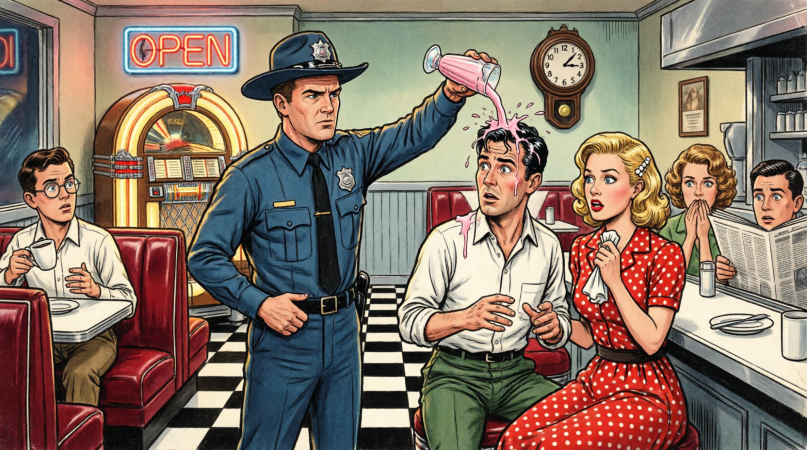
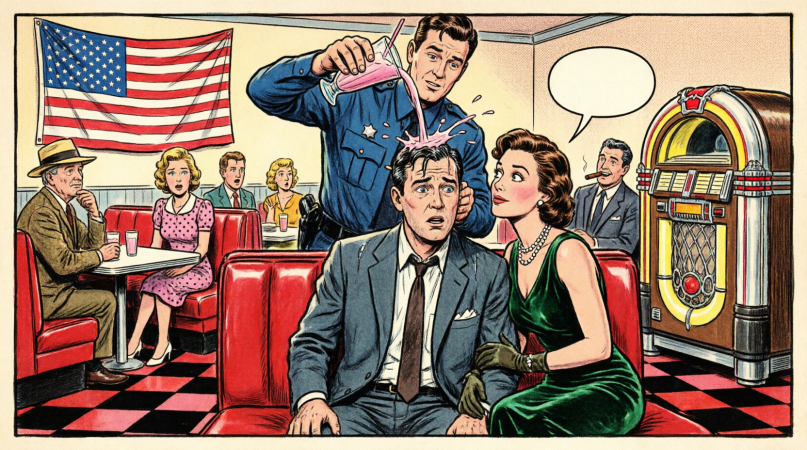
The strawberry milkshake hit the back of my neck like a cold, wet slap.
For one second, everything in the Rusty Spoon diner stopped moving. Forks hung in the air. The old ceiling fan clicked above us. The jukebox in the corner kept playing some country song about leaving home, but even that sounded far away, like it was coming from the bottom of a well.
The shake slid down my hair, over my collar, and soaked into my favorite gray flannel shirt. It was thick, freezing, and sweet enough that the smell made my stomach turn.
Sheriff Dominic Vance stood behind me, holding the empty glass upside down.
Then he laughed.
Not a normal laugh. A loud, barking sound meant for an audience. A sound that said he had done this before, and nobody had ever made him pay for it.
“Well,” he said, loud enough for the whole diner, “looks like the town ghost finally got some color on him.”
Nobody laughed at first. Then one man at the counter forced out a nervous chuckle, and two others followed because fear can sound a lot like agreement when a bully is standing in the room with a badge.
I did not stand up.
I did not grab him.
I did not even wipe my face.
I only looked across the booth at my wife.
Amelia sat with her purse in her lap and her phone still glowing beside her plate. She had ordered a turkey club and only taken two bites. Her dark hair was tucked behind one ear, her lipstick untouched, her eyes sharp as broken glass.
I waited for her anger.
I waited for her to say my name like she still loved me.
Instead, she sighed.
“Logan,” she whispered, tight and embarrassed. “Why do you always have to make things worse?”
That was the moment the cold milkshake stopped mattering.
Outside, October sunlight poured through the diner windows, bright and clean and cruel. We were in a small Montana town where everybody knew everybody, and everybody knew Sheriff Vance ruled the county like it belonged to him. He decided who got tickets, who got warnings, whose business license got delayed, whose son got arrested after a football game, and whose daughter got escorted home with a smile.
I had moved there three years earlier after retiring from the Navy. I wanted quiet. I wanted open sky, black coffee, old trucks, and a wife who looked at me like I was finally home.
At least, that was what I thought I wanted.
Dominic leaned down beside my ear. His cologne was heavy, all spice and arrogance.
“You got something to say, ghost?”
My hands were under the table, relaxed on my knees. I could hear his breathing. I could see his reflection in the chrome napkin holder. Big man. Six-two, maybe two-forty. Right shoulder slightly lower than the left. Old injury or poor posture. Weight balanced wrong. Too confident.
If I moved, he would hit the floor before anyone understood what happened.
But I had spent half my life learning the difference between a threat and bait.
This was bait.
I picked up a napkin and slowly wiped pink milkshake from my eyebrow.
“No,” I said quietly. “I’m done eating.”
Dominic smiled like he had won something. “That’s what I thought.”
Amelia pushed herself out of the booth so quickly her purse strap caught on the table.
“I’ll be in the car,” she snapped. “Try not to embarrass me more than you already have.”
She walked toward the door.
Dominic was still grinning, but as Amelia passed him, something small happened.
Too small for most people.
His smile twitched.
He gave her one brief nod.
And Amelia lowered her eyes like she had expected it.
The bell above the door jingled when she left. The sound cut through me deeper than any insult Dominic had thrown.
I stood, milkshake dripping from my sleeves onto the tile floor. Nobody looked directly at me. The waitress, Nora, stood behind the counter with her hand over her mouth. An old veteran named Clyde stared into his coffee like he wished he had gone blind.
Dominic stepped aside, spreading his arms.
“Careful out there,” he said. “Roads get dangerous for men who don’t know their place.”
I walked past him without touching him.
But as I stepped into the sunlight, one thought settled behind my ribs with the weight of a loaded weapon.
The milkshake had been public.
The nod had been private.
And my wife had not looked surprised.
### Part 2
Amelia drove home with both hands locked around the steering wheel.
Her knuckles were pale. Her jaw was tight. She kept her eyes on the road like the yellow centerline had personally offended her.
I sat in the passenger seat, still sticky, still smelling like sugar and strawberries and humiliation.
For ten miles, she said nothing.
The road out of town passed cornfields, a feed store, a church with a cracked bell tower, and a row of cottonwoods shedding gold leaves into the ditch. On any other October afternoon, I might have noticed the beauty of it. That day, all I could see was Amelia’s reflection in the window.
She looked angry.
Not hurt for me.
Angry at me.
Finally, I said, “He dumped a milkshake on me in front of everyone.”
“I know what happened.”
“Then why are you acting like I caused it?”
She laughed once, but there was no humor in it. “Because you did, Logan. You always do.”
I turned slightly toward her. “By sitting there?”
“By being you.” Her voice cracked on the word, but not with sadness. With disgust. “That silent, judgmental look. Like everyone around you is weak. Like this town is beneath you.”
I watched her profile. She had been the woman who once touched the scar beneath my ribs and whispered that whatever happened before her, I was safe now. She had been the woman who made pancakes at midnight because I couldn’t sleep. She had been the woman who cried when I told her I had trouble remembering the faces of men I saved, but never the ones I lost.
Now she was a stranger with my last name.
“I never thought this town was beneath me,” I said.
“Dominic does.”
The name came out too easily.
Not Sheriff Vance.
Dominic.
I filed that away.
When we reached the house, she parked crooked in the driveway and got out before the engine finished ticking. I followed slower. My boots crunched over fallen leaves. The house looked normal from outside. White porch. Blue shutters. One loose railing I had been meaning to fix. A clay pot of dead mums by the steps because Amelia had forgotten to water them.
Inside, she dropped her purse on the table.
“I can’t do this right now,” she said.
“Do what?”
“Be responsible for your moods.”
“My moods?”
She spun around. “Yes. Your moods. Your silence. Your old war stories you don’t tell but somehow make everyone feel. I married a man, Logan. Not a stone wall.”
The words landed, but I did not let them show.
“You married me knowing exactly who I was.”
“No.” Her eyes flashed. “I married the version of you who still tried.”
Then she walked into the bedroom and shut the door.
I stood in the kitchen, listening to the old refrigerator hum. The clock above the stove ticked once, twice, three times. My hands smelled like fake strawberry.
I went to the bathroom, turned the shower as hot as it would go, and stepped in fully clothed for the first minute.
The water ran pink around my boots.
I peeled off the flannel and let it fall heavy into the tub. Steam filled the room. My skin burned. I scrubbed my neck until it hurt.
But the dirt I wanted gone was not on me.
When I shut the water off, the house was quiet.
Too quiet.
I wrapped a towel around my waist and opened the bathroom door.
That was when I heard Amelia in the bedroom.
Her voice was low.
“No, he didn’t do anything.”
Pause.
“I know. It was bad.”
Another pause.
“No. He suspects nothing.”
My hand tightened around the towel.
Then her voice dropped even softer.
“I’ll see you later. Just be careful. He notices things.”
I stepped back into the bathroom before the floorboard could creak beneath my weight.
For a long moment, I stood there dripping onto the bath mat, listening to my own heartbeat remain steady.
He suspects nothing.
She was wrong about that.
I had noticed the nod. I had noticed the name. I had noticed the smell of Dominic’s cologne lingering near our booth before he ever walked in.
Now I had noticed this.
When I finally walked into the bedroom, Amelia sat on the edge of the bed with her phone face down beside her.
She looked up too fast.
“Feel better?” she asked.
I smiled like a man who had heard nothing.
“Cleaner,” I said.
Her smile twitched.
And for the first time since the diner, I saw fear behind her eyes.
### Part 3
I did not confront her.
Confrontation is what people do when they want relief more than truth.
I wanted truth.
So I sat in the armchair by the bedroom window and watched Amelia pretend not to watch me. She brushed her hair in front of the mirror, each stroke careful, each movement too normal. Her phone sat on the nightstand within reach of her left hand.
“Who were you talking to?” I asked.
“My mom.”
Her answer came instantly.
Too instantly.
Amelia’s mother lived in Arizona and treated phone calls like medical procedures. Scheduled, brief, and never before dinner. I had heard her say more than once that afternoon calls were for emergencies and lonely people.
“Oh,” I said. “Everything okay?”
“She wanted to know if we’re coming for Thanksgiving.”
“In October?”
Her hand paused in her hair for half a second.
Then she recovered.
“She plans early.”
I nodded.
The lie sat between us like a dead animal neither of us wanted to mention.
She put the brush down. “I’m going to the store. We’re out of milk.”
I almost laughed.
Milk.
After the day I’d had, the word felt like a private joke written by a cruel God.
“Need me to go?” I asked.
“No.” She grabbed her keys. “I need air.”
The front door opened and closed. Her car started. Tires rolled over gravel. Then silence came back to the house.
Not peace.
Silence.
I moved fast.
In the garage, behind a rack of socket wrenches and dusty paint cans, sat a red tool chest I had owned since my second deployment. Amelia thought it held old parts. Mostly, it did.
But the bottom drawer had a false panel.
Beneath it was a black waterproof case, scratched from years of travel. I opened it and looked down at things I had promised myself I would never need again.
Small cameras.
Audio bugs.
Signal receivers.
A burner phone wrapped in foil.
And a folded cloth holding a silver trident I had not worn in years.
I touched it once with two fingers.
Not for pride.
For memory.
People thought men like me missed the action. They were wrong. I missed clarity. Overseas, danger came wearing danger’s face. At home, it wore lipstick, a wedding ring, and a sheriff’s badge.
I placed one recorder behind the headboard, another beneath the kitchen table, and a pinhole camera in the living room bookshelf facing the front door. In the driveway, I slid a magnetic tracker beneath Amelia’s rear bumper, working by feel, my shoulder pressed against cold gravel.
Then I put everything back exactly as it had been.
When Amelia returned forty-seven minutes later, she carried one grocery bag.
One carton of milk.
No receipt.
She kissed my cheek as she passed me in the kitchen. Her lips were dry.
That was when I smelled it.
Cigar smoke.
Faint, buried under her perfume, but there.
Dominic smoked cigars. Thick brown ones he chewed more than smoked, leaving wet tobacco flakes near the station steps. I had noticed because noticing had kept me alive long before Amelia ever learned my name.
“Long line?” I asked.
She opened the refrigerator. “What?”
“At the store.”
“Oh. Yeah. A little.”
The nearest grocery store had self-checkout and three cars in the lot at that hour.
I smiled and poured coffee I did not want.
For the next two days, I became exactly what they expected.
Quiet.
Wounded.
Ashamed.
I stayed home. I fixed the loose porch railing. I changed oil in my truck. I let Amelia catch me staring into space. She mistook control for defeat, which told me she had never really understood me at all.
On Thursday afternoon, I drove toward the hardware store.
Halfway there, blue lights flashed behind me.
A young deputy strutted up to my window, one hand on his belt, the other shaking slightly.
“License and registration.”
“What’s the stop?”
“You crossed the centerline.”
“I didn’t.”
His eyes hardened. “Step out of the vehicle.”
For forty minutes, he made me stand beside the road while neighbors slowed down to stare. Wind pushed dust across my boots. A woman from church drove past and quickly looked away.
When the deputy finally handed back my papers, he added a reckless driving ticket.
“Sheriff sends his regards,” he said.
I watched his cruiser pull away.
Then I looked at the ticket.
It was not harassment anymore.
It was construction.
They were building a version of me the town could believe in later.
Unstable Logan.
Dangerous Logan.
The veteran who finally snapped.
That night, while Amelia slept beside me, I listened to the kitchen recorder through one small earpiece.
Her voice came first.
“He’s getting quieter.”
Then Dominic’s.
“Good. Quiet men break loud.”
Amelia laughed softly.
“When do we finish it?”………………………………
Dominic answered, “Soon. I need him to do something violent first.”
I took the earpiece out and looked at the ceiling.
They wanted a monster.
They had no idea they were dealing with a ghost.
### Part 4
I waited until dawn to make the call.
Amelia was still asleep, one hand tucked under her cheek like a child. Morning light slipped through the curtains and painted soft stripes across her face. For one stupid second, I saw the woman I married.
Then I remembered her voice on the recording.
When do we finish it?
I dressed in jeans, boots, and an old Navy sweatshirt with the logo faded nearly white. In the garage, I pulled the burner phone from the black case and walked out behind the shed where the wind through the dry grass would cover my voice.
The number came from memory.
It rang twice.
A man answered, “This line is secure. Identify.”
“Viper Two Actual,” I said. “Logan.”
Silence.
Then the voice changed.
“Logan Reed, you stubborn ghost. I thought you were dead, divorced, or raising goats in Wyoming.”
“Good morning to you too, Preston.”
Eli Preston had once been the calmest man I knew under fire and the most irritating one in peace. After the teams, he went to law school and turned into the kind of attorney rich criminals feared because he understood both paperwork and pressure points.
His tone sharpened. “Why are you calling from a burner?”
“Local law enforcement is hostile.”
“How hostile?”
“The sheriff is sleeping with my wife and trying to frame me so they can take my house and savings.”
Another silence.
Then Preston exhaled. “That’s not a domestic problem. That’s a war.”
“I know.”
“Tell me everything.”
I did.
The diner. The nod. The phone call. The traffic stop. The recordings. I kept my voice even because emotion wastes oxygen when facts will do.
Preston listened without interrupting.
When I finished, he said, “Do not confront either of them. Do not threaten anyone. Do not put your hands on that sheriff even if he begs you to.”
“I know the rules.”
“No, brother. You know combat rules. This is court. Different battlefield. Same stakes.”
A crow landed on the fence post and watched me with black, curious eyes.
“I need financials,” I said. “Dominic Vance. His relatives. Contractors. LLCs. Property. Anything that smells rotten.”
“I’ll start now.”
“I also need you here.”
“I can be there by night.”
I closed my eyes briefly. I had not realized how much I needed to hear that.
“There’s more,” I said. “Dominic mentioned roads getting dangerous for men who don’t know their place. The deputy ticket felt staged.”
“They’re building probable cause history.”
“Exactly.”
Preston’s voice went colder. “Then he’s not just trying to scare you. He’s preparing a file.”
Behind me, inside the house, a door shut.
“I have to go.”
“Logan.”
“Yeah?”
“Do not become useful to their story.”
I looked toward the kitchen window. Amelia stood there, holding a coffee mug, watching the backyard.
“I won’t.”
I ended the call, snapped the SIM card, and buried the pieces beneath loose soil near the shed.
When I walked inside, Amelia was at the counter. Her robe hung off one shoulder. The smell of coffee filled the kitchen, dark and bitter.
“You were outside early,” she said.
“Couldn’t sleep.”
“That happens a lot lately.”
“Yeah.”
She poured coffee into a second mug and slid it toward me. Wife behavior. Normal behavior. A performance with cream and sugar.
I took the mug.
Her eyes stayed on me. “You okay?”
“I’ve been thinking.”
“That sounds dangerous.”
I gave a small, tired smile. “Maybe you were right.”
Her fingers tightened around her mug.
“About what?”
“Dominic. Maybe I should apologize. Clear the air.”
For the first time in days, she looked alive.
“Really?”
“Maybe I need to stop making things harder.”
She stepped closer, touching my arm. “That would be good, Logan. For us.”
For us.
The words tasted like rust.
“I’ll go by the station later,” I said. “Man to man.”
Her smile came slowly, like sunrise over poisoned water.
“I’m proud of you,” she whispered.
That was the moment I understood how deep her betrayal went.
She did not just want me gone.
She wanted me broken first.
At the sheriff’s station that afternoon, the receptionist would not meet my eyes. She pointed down the hall before I said a word.
“He’s expecting you.”
Of course he was.
Amelia had already told him I was coming.
### Part 5
Sheriff Dominic Vance’s office smelled like stale coffee, gun oil, and old power.
The room was too small for his desk, too small for his ego, too small for the walls covered in framed handshakes with men who smiled like they owed him favors. A hunting rifle hung above the filing cabinet. A county map was pinned behind his chair with red dots scattered across it like old wounds.
Dominic sat with his boots on the desk, polishing a chrome revolver he probably thought made him look dangerous.
Real dangerous men rarely cared how danger looked.
“Well,” he said without standing, “trash learned to knock?”
“I didn’t knock.”
His mouth curled.
“No, I guess you didn’t.”
I stepped inside and left the door open behind me. Always leave yourself an exit unless the goal is to trap someone else.
Dominic noticed.
“You scared of closed doors, Logan?”
“I’m careful around unstable men with weapons.”
His smile vanished for half a heartbeat. Then it returned wider.
“That mouth is why people don’t like you.”
“I came to ask what it takes to end this.”
He set the cloth down carefully. “End what?”
“The stops. The public scenes. Whatever this is.”
Dominic leaned back. His chair creaked.
“You really don’t get it, do you?” he said. “This town runs on respect.”
“Fear isn’t respect.”
“It is when it works.”
A radio crackled in the outer office. Somewhere down the hall, a deputy laughed. The sound died quickly.
Dominic rose and came around the desk. He was a big man, heavy through the chest, soft through the middle, built like someone who had once been strong and never stopped telling himself he still was.
He stopped close enough for me to smell cigar on his breath.
“Your problem,” he said, “is that you walk around like you don’t owe anybody anything.”
“I don’t.”
“You owe me peace in my town.”
“Your town?”
His eyes hardened. “That’s right.”
There it was. The crown beneath the badge.
I lowered my voice. “And Amelia?”
The name hit him like a match near gasoline.
His smile turned slow.
“Amelia is tired, Logan.”
I said nothing.
“She’s tired of living with a dead man. Tired of waiting for you to feel something. Tired of being married to a shadow.”
Every word was designed to provoke. Every word told me she had been feeding him private things, twisted versions of late-night conversations I once thought were safe.
Dominic stepped closer.
“She needs a man who knows how to take what he wants.”
“If that were true,” I said, “why are you hiding?”
His face flushed.
For a second, the old instinct moved through my body like electricity. Distance. Angle. Throat. Knee. Wrist. Desk edge.
I let it pass.
Dominic wanted fists.
I brought patience.
His voice dropped. “Here’s what happens next. You leave. You sign the papers when she gives them to you. You give her the house because it’s the decent thing to do. You disappear before people start finding things in your truck, in your garage, maybe in that sad little workshop you love so much.”
I held his gaze.
“What kind of things?”
He smiled.
“Things that put lonely veterans in prison.”
The office felt very still.
Outside the open door, I saw a shadow shift. Someone was listening.
Good.
I made my voice just a little smaller. “Are you threatening me, Sheriff?”
Dominic chuckled. “No. I’m explaining weather. Storms come. Trees fall. Roads close. Accidents happen.”
I nodded once.
“I understand.”
He leaned in. “No, Logan. You don’t. But you will.”
I turned and walked out.
He called after me, “Run home and cry to your wife.”
I kept walking.
In the parking lot, sunlight bounced off windshields. My truck sat alone near the edge of the gravel, dusty and honest and mine. I got in, shut the door, and let my breathing stay slow.
Then I pulled the small recorder from my shirt pocket.
Red light on.
Every word captured.
I drove past my house without stopping and headed toward the edge of town, where an old motel blinked its dying vacancy sign beside the highway.
A black sedan waited behind room twelve.
Preston stepped out wearing a charcoal suit and a grin sharp enough to cut rope.
“Nice town,” he said. “Feels like a place secrets go to breed.”
I handed him the recorder.
“Then let’s sterilize it.”
He listened to the first minute.
By the time Dominic’s threat played through the speaker, Preston was no longer smiling.
“Logan,” he said, “this is bigger than your marriage.”
“I know.”
He opened his laptop on the motel bed.
“Then you need to see what I found.”
### Part 6
The motel room smelled like bleach, old carpet, and rain trapped in the walls.
Preston sat at the small table beneath a flickering lamp, laptop open, files spread around him in neat stacks. He worked the way he had moved through buildings overseas: controlled, quiet, never touching anything twice unless he meant to.
I stood by the window and watched the parking lot through a gap in the curtains.
“You’re pacing,” he said.
“I’m thinking.”
“You pace when you’re trying not to break furniture.”
I stopped.
He turned the laptop toward me. “Dominic Vance makes sixty-five thousand a year. Modest savings. Public salary. Nothing impressive.”
“Okay.”
“Three months ago, a lake property one county over was purchased for cash through a shell company.”
“How much?”
“Just under four hundred thousand.”
I looked at him.
Preston nodded. “Exactly.”
On the screen was a web of names, companies, transfers, signatures. I saw Vance & Sons Construction. I saw county road contracts. School roofing repairs. Courthouse drainage work. All approved. All overpriced. All connected.
“His cousin?” I asked.
“Carl Vance. Licensed contractor. Terrible reviews. Excellent political access.”
Preston tapped one line with his pen.
“Every major municipal project in the last five years went through Carl. Money leaves the county, gets washed through subcontractors, then portions come back through consulting fees, hunting leases, private security payments, and one very lazy charitable foundation.”
“Dominic’s?”
“His mother’s on paper. His in practice.”
I stared at the screen, feeling the shape of the battlefield widen.
This was not just an affair.
This was a machine.
“And Amelia?”
Preston’s expression changed.
Not pity.
Worse.
Caution.
“What?” I asked.
He clicked another file.
A bank statement appeared.
“There’s an account opened under Amelia’s maiden name two weeks ago. Joint access with Dominic.”
My throat tightened.
“How much?”
“Fifty thousand.”
For a moment, the room lost sound.
The old motel air conditioner rattled. A truck passed outside. Somewhere upstairs, a faucet dripped.
Fifty thousand.
Our savings.
The money I thought was sitting safe for the trip Amelia wanted to take through the Pacific Northwest. She had shown me cabins near mountain lakes. She had circled dates on a calendar. She had kissed my shoulder one night and said maybe fresh air would make us feel new again.
She had already been planning my burial.
“She emptied our account,” I said.
“Legally complicated,” Preston replied. “Morally simple.”
I sat on the edge of the bed. The mattress sagged beneath me.
There are different kinds of pain. Sudden pain shocks the body. Betrayal is slower. It enters through the memories first, poisoning them one by one.
The first dance at our wedding.
Her hand in mine at the VA hospital.
Her laughing in the kitchen with flour on her nose.
All of it changed shape.
“How do we bury them?” I asked.
Preston leaned back. “Carefully. We have corruption. We have threats. We have financial patterns. But Dominic owns this county. Local judges, deputies, maybe the prosecutor. We go too early, he buries evidence and turns you into the story.”
“He’s going to plant something.”
“Probably.”
“He said my truck.”
“Then stop driving your truck.”
“No.”
Preston’s eyes narrowed. “I know that tone.”
“He wants to find evidence in my truck,” I said. “So we give him evidence.”
“That is a terrible sentence.”
“Powdered sugar.”
Preston stared at me.
I explained it.
A fake package. Hidden poorly. Enough to look damning at a glance. No actual illegal substance. Dominic’s ego would do the rest. He would arrest me, celebrate too early, skip proper testing, and create the false imprisonment case himself.
Preston stood. “You are gambling your freedom on the assumption that he is stupid.”
“No,” I said. “I’m gambling on the fact that he is arrogant.”
“That’s not better.”
“It’s more reliable.”
He paced now.
“While he has you in custody, what am I doing?”
“Lake house. Office. Safe. Men like Dominic keep records because they trust nobody completely.”
Preston looked at the financial files.
“A ledger.”
“Something like it.”
“And if I find nothing?”
“Then I spend a night in jail for powdered sugar.”
“And if his deputies decide to make that night rough?”
I looked at him.
Preston cursed under his breath.
“You always were calmest right before doing something insane.”
“It’s not insane if it works.”
“That is exactly what insane people say.”
But he was already taking notes.
When I got home that evening, Amelia was cooking roast chicken. The kitchen smelled of rosemary, butter, and betrayal wearing an apron.
“How did it go?” she asked.
I let my shoulders slump.
“I apologized.”
She turned, eyes bright. “And?”
“He said he’d think about leaving us alone.”
Her smile was soft and poisonous.
“See?” she said, kissing my cheek. “Sometimes you just have to know your place.”
I looked at the woman who had stolen my money and sold my name.
“Yeah,” I said. “I’m learning.”
In the garage, beneath the spare tire, five taped bricks of powdered sugar waited like sleeping wolves.
By Monday morning, the trap was ready.
### Part 7
Monday came in gray and wet.
The sky hung low over the town, pressing the roofs and fields into silence. Rain tapped against the kitchen window while Amelia stirred her coffee with a silver spoon, slow circles, eyes on her phone.
I stood at the counter and tied my boot.
“I’m heading into the city today,” I said.
Her spoon stopped.
“For what?”
“Back appointment. Specialist had a cancellation.”
She looked up. “You didn’t mention that.”
“Forgot.”
“You’ve been forgetting a lot lately.”
I gave her the tired smile she expected. “Yeah. I guess I have.”
She studied me, trying to decide whether I was broken enough to be predictable.
Finally, she nodded. “Drive safe.”
“I will.”
I walked outside with my keys in my hand.
The rain had stopped, but the air still smelled metallic. My truck sat in the driveway with mud on the tires and a secret under the spare. I opened the door, paused, and looked back at the house.
Amelia stood in the window.
Phone in hand.
Good.
I drove slowly through town. Past the Rusty Spoon. Past the hardware store. Past the sheriff’s station where two cruisers sat angled like dogs waiting for a command.
I did not speed.
I used my signals.
I kept both hands visible.
Five miles beyond town, the road narrowed between pine woods. The rain had left the asphalt black and shining. In my rearview mirror, a black SUV appeared.
No lights at first.
Just presence.
Then the blue strobes flashed.
I pulled onto the gravel shoulder and parked.
My breathing stayed slow.
Dominic got out of the SUV.
Two cruisers pulled in behind him.
Three officers for one man going to a doctor.
He walked up to my window, hat low, smile lower.
“Step out of the vehicle.”
“What’s the reason for the stop?”
“We received an anonymous tip.”
“About?”
“A vehicle matching this description transporting illegal materials.”
I let a flicker of fear cross my face. Not too much. Just enough to feed him.
“That’s ridiculous.”
“Out.”
I stepped out.
He turned me hard against the truck and cuffed my hands behind my back. The metal bit deep. He wanted pain. He wanted witnesses. He wanted me to twist, curse, shove back.
I rested my cheek against wet steel.
“Search it,” Dominic ordered. “Every inch.”
The deputies tore through my truck with theatrical violence. Floor mats tossed into mud. Glove box emptied. Tool roll dumped. Registration papers trampled beneath boots.
“Nothing inside,” one deputy called.
Dominic’s jaw tightened.
“Check the bed.”
Rainwater dripped from the brim of his hat.
A deputy climbed into the back, lifted the spare, and froze exactly the way I needed him to.
“Sheriff.”
Dominic turned.
“I got something.”
The deputy held up one duct-taped brick wrapped in plastic.
For a moment, Dominic looked like a man seeing God.
Then he looked at me.
“Well, well,” he said. “What were you planning, Logan? Starting a little side business?”
“That’s not mine.”
“Sure.”
“I don’t know what that is.”
“Oh, I believe that.” He leaned close, voice soft. “Men like you never know how the evidence got there.”
He lifted the brick high enough for his deputies to see. High enough for the body camera on one cruiser to catch. High enough for his pride to stand beside him.
“Logan Reed, you are under arrest for possession with intent to distribute illegal substances.”
He shoved me into the back seat of his SUV.
As we pulled away, I watched through the rain-speckled window while Dominic held the package like a trophy………………………
He did not open it.
He did not test it.
He did not question why it was hidden badly enough for a drunk teenager to find.
Perfect.
At the station, they processed me under fluorescent lights that hummed like insects. Fingerprints. Mug shot. Belt removed. Boots taken. Wallet bagged.
They put me in a holding cell with a metal toilet and a bench bolted to the wall.
Dominic came by an hour later with coffee.
“I called Amelia,” he said. “Poor thing is destroyed.”
“I’m sure.”
“She says she had no idea she married a criminal.”
I looked at him through the bars. “I get a phone call.”
He grinned. “Call the president if you want.”
He passed me the phone.
I dialed Preston.
“It’s done,” I said.
His voice came calm and clear. “I’m at the lake house.”
“Status?”
“Empty. Your sheriff brought everyone to celebrate.”
“Find it.”
I heard a lock click through the phone.
Then Preston said the words I needed.
“Logan. There’s a safe.”
Dominic watched me from the hallway, smiling.
He thought I was trapped.
He did not know the cage had been built for him.
### Part 8
Jail has a smell that never leaves a man once he knows it.
Bleach on concrete. Old sweat in thin blankets. Metal warmed by too many hands. Fear pretending to be boredom.
I sat on the bench and listened.
A deputy walked past every eight minutes. Keys on left hip. Slight limp. Radio low. He paused at the water fountain each time, drank twice, cleared his throat, moved on.
Patterns calm me.
Dominic wanted panic. Instead, I counted.
At 3:12 p.m., he came back with two deputies and a grin wide enough to split his face.
“Big day for you,” he said.
“Is it?”
“Press is coming tomorrow. Small-town hero sheriff takes down decorated fraud turned trafficker.” He tapped the bars with his ring. “I might even get my picture in the state paper.”
“You should test your evidence before the cameras show up.”
His eyes sharpened.
“What?”
“Just a thought.”
He laughed, but the laugh had a crack in it. “You’re trying to scare me.”
“I’m in a cell, Dominic. How would I do that?”
He stepped closer.
“You think because you sat quiet in that diner, you’re strong? You’re not strong. You’re empty. Amelia told me everything. You wake up sweating. You check windows. You can’t walk into a crowded room without looking for exits.”
My face stayed still.
“She said being married to you was like sleeping beside a locked door.”
That one hit.
Not because it was cruel.
Because it sounded like something she might have once said with sadness before she learned to say it with contempt.
Dominic saw something in my eyes and mistook it for weakness.
“There he is,” he whispered. “There’s the broken soldier.”
I leaned back against the wall. “You talk too much.”
His smile vanished.
Before he could answer, the phone on the desk outside rang. A deputy picked up, listened, and frowned.
“Sheriff,” he called. “County clerk’s office says state investigators requested contract copies.”
Dominic turned slowly. “What?”
The deputy swallowed. “Municipal contracts. Last five years.”
Dominic looked back at me.
For the first time, his confidence flickered.
I said nothing.
That scared him more.
He walked out fast, boots heavy on concrete.
The deputy resumed his rounds.
At 5:40, the cell block door opened again.
Amelia entered.
She wore a black dress beneath a beige coat. Too formal for a jail visit. Too polished for grief. Her hair was smooth, her makeup careful, but her eyes were restless.
Dominic stood behind her, his hand on the small of her back.
“You have five minutes,” he said.
Then he left us alone, though he stayed where he could watch through the window.
Amelia approached the bars.
For a long moment, she only stared.
“You look awful,” she said.
“Good to see you too.”
Her mouth tightened. “Do you have any idea what you’ve done to me?”
“To you?”
“People are calling. Nora from the diner texted. My mother heard something from someone. Do you understand how humiliating this is?”
I stood slowly.
“Amelia, I didn’t do it.”
She rolled her eyes. “Stop.”
“You know I didn’t.”
Her gaze slid away.
That was enough.
She reached into her purse and pulled out folded papers.
“I can help you.”
“No, you can’t.”
“Yes, I can.” She pushed the papers through the bars. “Divorce agreement. Deed transfer. Sign them tonight. Dominic says if you cooperate, things can go easier.”
I unfolded the documents.
My house.
My savings.
My future.
All reduced to signature lines.
Her voice softened. “Please, Logan. Don’t make this uglier than it has to be.”
I looked at her through the bars. “You brought these here while I’m in a cell.”
“You left me no choice.”
“You put me here.”
Her eyes flashed.
“You put yourself here by being impossible to love.”
There it was.
The truth without costume.
I asked, “Do you remember our vows?”
She closed her eyes. “Don’t do this.”
“For better or worse.”
“Logan.”
“In sickness and health.”
“Sign the papers.”
“Until the sheriff offers a better deal.”
Her face changed.
I tore the papers once.
Then again.
Then again.
Pieces fluttered to the cell floor like dead moths.
Amelia’s mask cracked open, and hatred poured through.
“You useless idiot,” she hissed. “You think this makes you noble? You’re nothing. Dominic will bury you, and I will still get that house.”
I stepped closer to the bars.
“No,” I said quietly. “You won’t.”
Something in my voice made her step back.
Dominic stormed in and grabbed her arm.
“Visit’s over.”
As he pulled her away, she screamed my name like a curse.
The door slammed.
The cell block went silent.
On the floor, the torn deed transfer lay near my boots.
And far away, beyond the walls, I imagined Preston opening Dominic’s safe.
### Part 9
The raid began at 9:17 p.m.
I knew because I had been watching the second hand on the clock outside the cell block door for almost an hour.
The station had gone quiet. The celebration was over. The deputies who had strutted all afternoon now spoke in low voices near the front desk. Dominic had disappeared into his office after three phone calls he did not like.
At 9:17, tires screamed outside.
Not local tires.
Heavy vehicles.
Trained drivers.
Then came the sound that changes every room it enters.
“State police! Hands where I can see them!”
A chair crashed.
Someone cursed.
A deputy shouted, “What the hell is this?”
Another voice, female, sharp as a blade: “Move away from the desk.”
Boots thundered through the station. Not lazy deputy boots. Tactical boots. Coordinated. Purposeful.
The young deputy who had been walking past my cell all evening ran toward the front, then stopped like he remembered I existed.
He looked at me.
I smiled.
His face drained of color.
The cell block door flew open.
A state trooper entered first, rifle low but ready. Behind him came a woman in a navy suit with silver hair cut at her jaw and eyes that could freeze a river.
Behind her stood Preston.
He looked at me through the bars.
“You comfortable?”
“I’ve slept worse places.”
“Always dramatic.”
The woman stepped forward. “Commander Reed?”
“Retired.”
“I’m Deputy Attorney General Marsha Kline. We’ll need your statement.”
“Happy to give it.”
Dominic’s voice erupted from the hallway.
“You can’t do this! I am the sheriff of this county!”
He was dragged into view by two troopers, hands cuffed behind his back. His hat was gone. His hair stuck up on one side. His face was red and wet with sweat.
When he saw me, he twisted hard enough that one trooper shoved him into the wall.
“You,” he snarled.
Deputy Attorney General Kline turned toward him. “Dominic Vance, you are under arrest for racketeering, money laundering, conspiracy, obstruction, and unlawful detention.”
“Unlawful?” Dominic barked. “He had contraband in his truck!”
Preston lifted an evidence bag from a trooper’s hand.
“This?”
Dominic’s mouth snapped shut.
Preston tossed the bag to the evidence technician standing nearby.
“Field test it.”
Dominic’s eyes widened. “That’s already evidence. It needs chain of—”
“Test it,” Kline ordered.
The technician opened the package carefully. White powder poured into a small tray. A field test kit came out. A few drops. A wait.
Everyone watched.
Even the young deputy stopped breathing.
Nothing changed color.
The technician looked up.
“Negative.”
Dominic’s face went blank.
Preston said, “Try tasting it. Actually, don’t. That’s unsanitary.”
The technician glanced at Kline. “Preliminary result is consistent with powdered sugar.”
For one beautiful second, nobody moved.
Then Dominic turned toward me, and I saw realization hit him from the inside.
The badly hidden package.
The easy arrest.
The phone call.
The empty lake house.
“You set me up,” he whispered.
I stood and gripped the bars.
“No,” I said. “I gave you a choice. You chose exactly who you are.”
Kline looked toward the trooper at my cell. “Release him.”
The key turned.
The door opened.
I stepped out slowly, wrists bruised, shoulders stiff, but free.
Dominic lunged.
Two troopers slammed him back before he got three inches.
“I’ll kill you!” he screamed. “You hear me? I’ll—”
Kline nodded to the troopers.
“Add threatening a witness.”
They dragged him down the hall, still shouting my name.
I watched him go.
There should have been satisfaction. There was some. I’m not holy. But beneath it was a tiredness so deep it felt older than me.
Preston handed me my boots.
“You good?”
“No.”
He nodded. “Fair.”
“Where’s Amelia?”
His expression darkened. “At your house.”
“Alone?”
“No. Carl Vance is there.”
I looked at him.
Preston continued, “They don’t know Dominic has been arrested. They think you’re staying here until arraignment.”
I sat on the bench and pulled on my boots.
The leather was cold.
Kline asked, “Do you want a trooper present?”
I stood.
“Yes.”
Preston’s mouth tightened. “Logan, think before—”
“I have thought enough.”
Outside, the night air hit my face clean and cold.
My wrists hurt.
My marriage was dead.
And my wife was celebrating in my home.
### Part 10
The drive back to my house felt longer than it had any right to.
Preston drove. I sat beside him with my bruised hands resting on my knees, watching the dark trees slide past the windshield. A state police cruiser followed close behind us, headlights steady in the rearview mirror.
For years, that road had meant home.
That night, it felt like an approach to a target.
“You don’t have to do this tonight,” Preston said.
“Yes, I do.”
“You’re exhausted.”
“I was exhausted before I married her. This is different.”
He glanced at me. “You know she’ll try to turn it.”
“I know.”
“She’ll cry.”
“I know.”
“She’ll say she loves you.”
I looked out at the darkness.
“That’s the part I’m least worried about.”
When we turned onto my street, I saw the house immediately.
Every light was on.
Living room. Kitchen. Bedroom. Porch.
Music played inside, low but clear enough to hear when Preston parked at the curb. Some smooth jazz Amelia used to play when she wanted the house to feel expensive.
My house.
The one I bought with deployment pay and nights I could not sleep. The one I rewired myself. The one where I had planted apple trees because Amelia once said she wanted pies in autumn.
A shadow moved behind the curtain.
Then another.
Preston killed the engine.
The trooper stepped out behind us.
I walked up the porch steps. The doormat said welcome in Amelia’s handwriting because she had painted it herself our first spring there.
I did not use my key.
I kicked the door beside the lock.
Wood cracked. The door flew open and slammed into the wall.
Inside, the music stopped.
Amelia stood in the living room with a wineglass in her hand.
Carl Vance sat on my sofa, shoes on my coffee table, a plate of cheese and crackers balanced on his stomach. He was smaller than Dominic, with the same greedy eyes and a weaker chin.
They both froze.
The wineglass slipped from Amelia’s fingers and hit the rug. Red spread across white wool like blood in snow.
“Logan,” she whispered.
I stepped inside.
The trooper entered behind me.
Carl jumped up. “Now, hold on—”
“Sit,” the trooper ordered.
Carl sat so fast the plate flipped into his lap.
Amelia stared at my clothes, my face, my wrists.
“You’re supposed to be—”
“In a cage?” I finished. “I didn’t like the room.”
Her mouth opened. Closed.
Then she changed masks.
It was impressive. Terrifying, but impressive.
“Oh my God.” She rushed toward me. “Logan, thank God. Dominic told me they arrested you. I was trying to find help.”
I let her reach me.
Her hands touched my chest.
They trembled. Not with love. With calculation.
“Carl was helping me,” she said quickly. “He knows people. We were going to call a lawyer.”
Preston stepped in through the broken doorway.
“That’s fascinating,” he said. “Because I’m a lawyer, and nobody called me.”
Carl made a small sound.
Amelia pulled away from me.
“Who is this?”
“The man who kept your boyfriend from stealing everything I own.”
Her face hardened, then softened again too quickly.
“Logan, please. You’re confused. You’ve been through trauma.”
“Don’t.”
“I’m your wife.”
“No,” I said. “You’re the woman who brought deed papers to a jail cell.”
Her eyes flicked toward Carl.
I reached into my pocket and took out the recorder Preston had returned to me at the station.
Amelia went still.
I pressed play.
Her voice filled the room.
“I’m tired of pretending to love him.”
Then Dominic’s voice.
“Soon. I need him to snap first.”
Then Amelia again.
“He has no idea.
The recording ended……………………………
The room breathed once.
Amelia’s face emptied.
Then something ugly moved into it.
“You recorded me,” she said.
“I protected myself.”
“You spied on your wife.”
“You conspired against your husband.”
Her hand flew toward my face.
I caught her wrist before she made contact.
Not hard.
Just enough.
Her eyes widened because for the first time, she felt the strength I had spent years never using against her.
I released her.
She stepped back, shaking.
“This is why I hated you,” she spat. “All that control. All that quiet. You made me feel small.”
“No,” I said. “I made you feel seen.”
Preston opened a folder.
“Amelia Reed, the account you opened with Dominic Vance has been frozen. State investigators have copies of the transfers. Carl’s contracts are under review. Dominic is in custody.”
Carl whimpered.
Amelia turned white.
“No,” she whispered. “He said it was protected.”
I looked at her.
“There it is.”
“What?”
“The first honest thing you’ve said all night.”
### Part 11
Amelia did not collapse right away.
People imagine guilty people fall apart when exposed. Some do. Others fight harder because the lie has become the only house they have left.
She lifted her chin.
“This is still my home.”
“No,” I said.
“I lived here for five years.”
“You betrayed me in it.”
“I decorated it. I cooked here. I hosted your boring veteran friends here. I slept beside you when you woke up sweating.”
Her voice cracked, and for half a breath, real pain showed through.
Then she used it like a weapon.
“I gave you years of my life, Logan.”
“And I gave you trust.”
“You gave me silence.”
“I gave you safety.”
“I didn’t want safety!” she screamed. “I wanted life. I wanted passion. I wanted someone people noticed when he walked into a room.”
I looked around the living room.
At the wine stain.
At Carl sweating into my sofa.
At our wedding photo on the wall, both of us smiling like we had beaten the odds.
“You found someone people noticed,” I said. “How did that work out?”
Her face twisted.
Preston stepped beside me. “The deed is in Logan’s name. The mortgage is in Logan’s name. There is no court order granting you occupancy. Given the active investigation and the evidence of conspiracy, you need to leave.”
Amelia laughed sharply. “You can’t just throw me into the street.”
The trooper spoke from the doorway. “Ma’am, you can gather essentials. Then you need to vacate.”
“I have nowhere to go.”
“You had fifty thousand dollars,” I said. “You moved it.”
Her lips trembled. “The state froze it.”
“Consequences are inconvenient.”
She stared at me like she could not believe I was the same man who once drove through a snowstorm to bring her soup when she had the flu.
Maybe I wasn’t.
Or maybe I finally was.
She took one step closer.
“Logan,” she whispered. “Please.”
And there it was.
The begging.
Her eyes filled. Her shoulders folded inward. She became small on purpose.
“I messed up,” she said. “I know I did. Dominic used me. He made me feel special. He told me you looked down on me. He told me I deserved more.”
I said nothing.
“I was lonely.”
The word hit an old bruise. Because maybe she had been. Maybe my quiet had left rooms inside our marriage where resentment grew like mold.
But loneliness does not forge signatures.
Loneliness does not steal savings.
Loneliness does not help put a man in jail.
She reached for my hand.
I moved it away.
Her mouth broke open around a sob.
“I can fix this. I’ll tell them Dominic manipulated me. I’ll testify. We can leave town. Start somewhere else. I’ll be better.”
I looked at the wedding photo.
Then I walked over, lifted it from the wall, and held it in my hands.
The glass reflected the room: Amelia crying, Carl shaking, Preston silent, the trooper waiting, me standing in the wreckage of a life I had mistaken for peace.
In the photo, Amelia’s smile was bright and open.
Mine was softer.
Hopeful.
I remembered that man.
I mourned him.
Then I dropped the frame into the trash can beside the fireplace.
The glass cracked.
Amelia flinched like I had struck her.
“Get your things,” I said.
“Logan—”
“Get. Your. Things.”
She stared at me, searching for a door back into my heart.
There was none.
Finally, she went upstairs.
The trooper followed to make sure she only took what was hers.
Carl remained on the sofa, breathing through his mouth.
“I didn’t know everything,” he said quickly. “Dominic handled the money. I just signed what he told me to sign.”
Preston looked at him. “That was a poor life strategy.”
Carl began to cry.
I left them and walked into the kitchen.
The roast chicken pan from two nights earlier still sat washed and drying beside the sink. Her coffee mug rested on the counter. A grocery list in her handwriting was stuck to the fridge.
Milk.
Eggs.
Laundry detergent.
Normal words from an abnormal life.
Outside, Amelia came down the stairs with two suitcases. Her face was blotchy, but her eyes were dry now. Anger had returned because shame could not survive long in her body.
At the door, she turned.
“You’ll regret this,” she said.
“No,” I answered. “I’ll remember it.”
The trooper escorted her out.
She screamed from the porch. Not apologies anymore. Curses. Threats. My name thrown into the night like broken dishes.
Then the cruiser door shut.
The sound echoed through the house.
Preston came into the kitchen.
“You okay?”
I looked at the grocery list again.
“No.”
He nodded.
Then he said, “There’s something else.”
I turned.
Preston’s face had gone serious in a way I had only seen twice before.
“Dominic’s hatred of you wasn’t only about Amelia.”
“I know.”
His eyes narrowed. “What aren’t you telling me?”
I looked toward the dark window, where my reflection stared back like a man I used to command.
“His brother died under me.”
Preston went still.
“And Dominic believes I got him killed.”
### Part 12
I slept three hours that night.
Not in the bedroom.
I couldn’t.
The sheets still held Amelia’s perfume, and I had no desire to lie beside the ghost of a woman who had tried to destroy me.
I slept in the recliner with a blanket over my chest and woke before dawn to a house that no longer pretended to be a home.
Preston was already in the kitchen making coffee.
“You look like hell,” he said.
“You always say the sweetest things.”
“I save charm for paying clients.”
He slid a mug toward me. Black. No sugar.
I almost smiled.
Outside, the sky was silver, and frost clung to the porch railing. My truck sat in the driveway with mud on the tires and a missing piece of innocence under the spare.
“Dominic’s arraignment is this morning,” Preston said. “State wants your statement before then.”
“I want to see him.”
“No.”
“Yes.”
“Terrible idea.”
“He needs to know.”
Preston leaned against the counter. “About Caleb.”
The name filled the kitchen like smoke.
Caleb Vance had been nineteen. Too young for the things he wanted to prove. He had Dominic’s eyes but none of his cruelty. I remembered him laughing over powdered eggs in a place so hot the air tasted like metal. I remembered him showing me a picture of his older brother in a sheriff academy uniform.
“He thinks you’re Superman,” Caleb had said.
“No,” I’d told him. “He thinks I’m his little brother’s babysitter.”
Caleb laughed.
Three weeks later, he died with my hand pressed against the hole in his chest, apologizing to a brother who would never hear him.
The official report had been clean. Too clean. “Killed during engagement while securing forward position.” It protected the unit. Protected the command. Protected the dead from looking scared.
It did not protect the living from lies.
“I wrote the family,” I said. “Three pages. I told them what happened.”
Preston listened.
“Caleb froze. Then he stood when he should have stayed down. I went after him. I got him back under cover, but it was too late.”
“And Dominic never got the letter?”
“His father burned it.”
“How do you know?”
“Caleb’s mother wrote me years later. Said she found half the envelope in the fireplace. Said her husband refused to believe his boy had panicked. Easier to blame the commander.”
Preston rubbed a hand over his face.
“So Dominic has spent a decade hating you.”
“Yes.”
“And Amelia knew?”
“Yes.”
He went quiet.
That was the part that made even Preston run out of words.
At the courthouse, people gathered like they smelled blood in the water. Reporters from the state paper stood near the steps. Townspeople clustered in coats, whispering. Deputies avoided everyone’s eyes.
When I walked up in my old field uniform, the crowd shifted.
Not dress blues. No medals. No performance.
Just the uniform of the man Dominic had never bothered to understand.
Nora from the diner stood near the entrance. Her eyes filled when she saw me.
“Mr. Reed,” she said softly. “I’m sorry.”
I stopped.
“For what?”
“For not helping. That day. With the milkshake.” She swallowed. “We were scared.”
“I know.”
“He made everybody scared.”
I nodded.
Then I went inside.
Dominic waited in a holding interview room, cuffed to a metal table. His orange jail uniform hung wrong on him. Without the badge, the hat, the gun, and the audience, he looked smaller. Not weak. Smaller.
His lawyer stood beside him, slick and nervous.
“This is inappropriate,” the lawyer said as I entered with Preston.
“I’m not here to discuss the case,” I said.
Dominic lifted his eyes.
The hatred was still there, but now it had nowhere to stand.
I sat across from him.
“Caleb,” I said.
Dominic slammed both cuffed hands against the table.
“Don’t say his name.”
“I was there when he died.”
“You sent him there.”
“No.”
His mouth curled. “That’s what the report said.”
“The report lied by omission.”
His lawyer touched his shoulder. “Sheriff, don’t engage.”
Dominic shook him off.
“You got a medal,” he snarled. “My brother got a flag.”
I leaned forward.
“Your brother got my hand in his until the end.”
The room went silent.
Dominic’s face shifted.
I took a folded photograph from my pocket and slid it across the table. It showed me in a field hospital two days after Caleb died. Bandaged ribs. Purple bruising from shoulder to stomach. Eyes hollow.
“I took two rounds pulling him back,” I said. “The doctors said one inch left, and I would have died beside him.”
Dominic stared at the photo.
His breathing changed.
“No,” he whispered.
“His last words were for you.”
Dominic’s eyes snapped to mine.
“He said, ‘Tell Dom I’m sorry.’”
For a moment, he looked like a boy lost in a grocery store.
Then the truth reached him.
Not all at once.
Truth that big does not enter cleanly. It breaks windows. Kicks doors. Tears down walls.
Dominic bent forward, chains rattling, and made a sound I had never heard from him before.
Not anger.
Grief.
I stood.
“Amelia knew this story,” I said. “I told her years ago. She used your grief to aim you at me.”
He looked up, ruined.
“She knew?”
“Yes.”
I walked to the door.
Behind me, Dominic whispered, “Caleb was scared?”
I stopped.
“We all were.”
Then I left him with the only punishment worse than prison.
The truth.
### Part 13
By noon, the town had changed its face.
Not completely. Small towns do not transform in a day. They rearrange themselves slowly, like old men getting out of chairs. But something had shifted.
Dominic Vance was no longer the sheriff.
He was a defendant.
Carl was cooperating.
The mayor had suddenly developed health problems.
Two council members resigned before dinner……………………………….
And Amelia’s name moved through town in whispers sharp enough to cut glass.
I did not celebrate.
Revenge in stories looks clean. In real life, it leaves paperwork, bruises, empty rooms, and a silence where love used to live.
For two days, I packed.
Preston handled the sale of the house with brutal efficiency. A young couple from Missoula made an offer before the sign had been in the yard twenty-four hours. They were expecting their first child. The wife cried when she saw the apple trees.
That helped.
I donated most of the furniture. The expensive lamps Amelia loved went to a shelter. The rug with the wine stain went into the trash. I kept my tools, my uniforms, a box of photos from before Amelia, and the old trident wrapped in cloth.
On Friday afternoon, I stood on the porch for the last time.
The house was empty behind me.
Empty houses sound different. Every footstep tells the truth. Every wall admits it was only wood, paint, and nails. The life inside had always been ours to build or ruin.
I locked the door and dropped the keys into an envelope for the realtor.
Then a rusted sedan pulled up to the curb.
The engine coughed twice and died.
Amelia got out.
She looked older.
Not dramatically. Life is subtler than that. Her hair was tied back without care. Her jeans were wrinkled. Her sweatshirt swallowed her frame. No sharp lipstick. No polished armor. Just a woman standing in the wreckage of her choices.
“Logan,” she said.
I rested my duffel bag against the truck.
“Amelia.”
She looked at the for sale sign. “It’s really over.”
“Yes.”
“I’m staying at the Pine Motel.”
I said nothing.
“It’s awful.”
“I know.”
She gave a tiny, broken laugh. “Of course you do.”
Wind moved dry leaves across the driveway.
She took one step closer.
“I came to say I’m sorry.”
I watched her carefully. Not because I wanted to catch a lie. Because part of me still wanted one last truth.
“I am,” she said. “I’m sorry for all of it. The affair. The money. The papers. The things I said. I don’t know who I became.”
“You became someone who thought love was weakness.”
Tears filled her eyes.
“I thought you didn’t fight because you couldn’t. But you could have destroyed him anytime. You could have destroyed all of us. And you didn’t.”
“No.”
“Why?”
“Because I didn’t want to become what you needed me to be.”
She covered her mouth.
“I was wrong,” she whispered. “About you. About Dominic. About everything.”
“I know.”
“Is there any chance…” She could barely finish. “Not now. Maybe someday. Could we talk? Could we start over?”
I looked past her at the apple trees.
The branches were bare, but in spring they would bloom for another family.
“I forgive you,” I said.
Her face opened with desperate hope.
“You do?”
“Yes.”
A tear slipped down her cheek.
“But forgiveness is not a door key.”
Her hope faded.
“I don’t hate you, Amelia. I don’t want you homeless. I don’t want you hurt. I don’t want revenge on you anymore.”
“Then why can’t we—”
“Because you tried to bury me.”
She closed her eyes.
“You didn’t make one mistake. You made a thousand small choices and called them unhappiness. You chose him at the diner. You chose him on the phone. You chose him when you moved the money. You chose him when you brought papers to my cell.”
Her shoulders shook.
“I know.”
“And now I choose me.”
She looked at me then, really looked, maybe for the first time in years.
“What am I supposed to do?”
“Live with it. Learn from it. Build something that doesn’t require someone else’s destruction.”
“That sounds lonely.”
“It is.”
I opened the truck door.
“But lonely is not fatal.”
She stepped back as if the words had touched something raw.
“Goodbye, Amelia.”
“Logan.”
I paused.
“I did love you once,” she said.
I nodded.
“I know.”
Then I got in the truck and started the engine.
As I pulled away, I saw her in the rearview mirror standing in the driveway, small beneath the wide Montana sky. She did not chase me. She did not scream. She only watched the house behind her and the truck in front of her, losing both at once.
I turned the corner.
She disappeared.
### Part 14
I drove through town slowly.
Not because I wanted a final look.
Because for the first time since arriving there, I did not feel hunted.
The Rusty Spoon diner sat bright under the afternoon sun. Through the window, I saw Nora wiping the counter. She looked up as my truck passed and lifted one hand.
I lifted mine back.
At the sheriff’s station, the sign still said Vance County Sheriff’s Office, but Dominic’s cruiser was gone. An interim sheriff from the state had parked out front. Two workers were removing Dominic’s campaign poster from the community board.
A man with a badge can make a town afraid.
But fear is not loyalty.
Fear is only a debt people pay until the collector falls.
I drove past the church, the feed store, the park where Amelia and I once watched fireworks on the Fourth of July. Memories rose and passed like birds crossing a field. Some hurt. Some didn’t. All of them belonged to a life I was leaving without asking permission.
At the edge of town, my phone rang.
Preston.
“You out?” he asked.
“I’m clear.”
“How’s it feel?”
I looked at the road ahead, gray asphalt cutting through pine and gold grass.
“Strange.”
“That’s freedom. People oversell it. Mostly it feels strange at first.”
I smiled.
“What happens now?” he asked.
“With Dominic?”
“Plea deal likely. Long sentence. Carl talks, mayor panics, state cleans house, everyone pretends they always hated corruption.”
“And Amelia?”
“Her lawyer called mine.”
“Already?”
“She wants access to unfrozen personal funds and is trying to separate herself from Dominic’s charges.”
“Can she?”
“Maybe partly. Not fully.”
I let that settle.
Once, I would have wanted details. Every charge. Every risk. Every outcome.
Now I only wanted distance.
“Keep me informed if I need to sign anything,” I said. “Otherwise, I don’t want updates.”
Preston was quiet for a second.
“Proud of you, brother.”
“For what?”
“For knowing when the mission is over.”
I watched mountains begin to rise faintly in the west, blue shapes beyond the flat land.
“Where are you headed?”
“West.”
“That’s not a plan.”
“It’s a direction.”
“For you, that’s progress.”
I laughed then.
A real laugh.
It surprised me so much I almost pulled over.
Preston heard it and went quiet.
Then he said, softer, “Good hunting.”
“No hunting,” I said. “Just living.”
I ended the call and tossed the phone onto the passenger seat.
The sky opened wider as the town fell behind me. Clouds broke apart. Sunlight spilled over the road in long golden sheets. I rolled the window down. Cold air rushed in, carrying pine, rain, engine oil, and the clean scent of distance.
For years, I thought peace meant building a life so quiet that the past could not find me.
I was wrong.
Peace was not silence.
Peace was knowing who I was even when people tried to write me as something else.
Coward.
Ghost.
Broken soldier.
Criminal.
Monster.
They had all tried to name me.
Dominic with his badge.
Amelia with her betrayal.
The town with its whispers.
But I had carried my real name beneath all of it.
I was Logan Reed.
I had been a commander, a husband, a target, and a fool.
I had also been patient.
And patience, in the right hands, is sharper than rage.
By sunset, the mountains were no longer distant. They rose ahead of me, dark and steady, their peaks edged in fire. I pulled into a roadside overlook and stepped out of the truck.
The wind hit my face.
No diner.
No sheriff.
No wife waiting with lies behind her eyes.
Just open land and the sound of my own breathing.
I reached into my pocket and took out the folded cloth that held my trident. I did not put it on. I did not need to.
I simply held it for a moment, remembering the men who never got to drive away from their wars.
Then I wrapped it again and placed it in the glove box.
The sun dropped lower.
The road waited.
I got back in the truck, started the engine, and drove west into a life that did not yet know my name.
For the first time in years, I was not disappearing.
I was arriving…………………………..
When I finally walked into the bedroom, Amelia sat on the edge of the bed with her phone face down beside her.
She looked up too fast.
“Feel better?” she asked.
I smiled like a man who had heard nothing.
“Cleaner,” I said.
Her smile twitched.
And for the first time since the diner, I saw fear behind her eyes.
I did not confront her.
Confrontation is what people do when they want relief more than truth.
I wanted truth.
So I sat in the armchair by the bedroom window and watched my wife pretend not to watch me.
She brushed her hair in front of the mirror, each stroke careful, each movement too normal.
Her phone sat on the nightstand within reach of her left hand.
“Who were you talking to?” I asked.
“My mom.”
Too fast.
Amelia’s mother lived in Arizona and treated phone calls like medical procedures.
Scheduled.
Brief.
Never before dinner.
“Oh,” I said.
“Everything okay?”
“She wanted to know if we’re coming for Thanksgiving.”
“In October?”
Her hand paused in her hair for half a second.
Then she recovered.
“She plans early.”
I nodded.
The lie sat between us like a dead animal neither of us wanted to touch.
She put the brush down.
“I’m going to the store.
We’re out of milk.”
I almost laughed.
Milk.
After the day I had, the word felt like a joke written by a cruel God.
“Need me to go?” I asked.
“No,” she said, grabbing her keys.
“I need air.”
The front door opened and closed.
Her car started.
Tires rolled over gravel.
Then silence returned.
Not peace.
Silence.
I moved fast.
In the garage, behind socket wrenches and dusty paint cans, sat a red tool chest I had owned since my second deployment.
Amelia thought it held old parts.
Mostly, it did.
But the bottom drawer had a false panel.
Beneath it was a black waterproof case, scratched from years of travel.
Inside were things I had promised myself I would never use again.
Small cameras.
Audio recorders.
A signal receiver.
A burner phone wrapped in foil.
And a folded cloth holding a silver trident I had not worn in years.
I touched it once with two fingers.
Not for pride.
For memory.
People thought men like me missed the action.
They were wrong.
I missed clarity.
Overseas, danger came wearing danger’s face.
At home, danger wore lipstick, a wedding ring, and a sheriff’s badge.
I placed one recorder behind the headboard.
Another beneath the kitchen table.
A pinhole camera in the living room bookshelf facing the front door.
Then I slid a magnetic tracker beneath Amelia’s rear bumper, working by feel with my shoulder pressed against cold gravel.
When Amelia returned forty-seven minutes later, she carried one grocery bag.
One carton of milk.
No receipt.
She kissed my cheek as she passed me in the kitchen.
Her lips were dry.
That was when I smelled it.
Cigar smoke.
Faint.
Hidden under perfume.
But there.
Dominic smoked cigars.
Thick brown ones he chewed more than smoked.
I had noticed because noticing had kept me alive long before Amelia ever learned my name.
“Long line?” I asked.
She opened the refrigerator.
“What?”
“At the store.”
“Oh.
Yeah.
A little.”
The nearest grocery store had self-checkout and three cars in the lot at that hour.
I smiled and poured coffee I did not want.
For the next two days, I became exactly what they expected.
Quiet.
Wounded.
Ashamed.
I fixed the loose porch railing.
Changed oil in my truck.
Let Amelia catch me staring into space.
She mistook control for defeat, which told me she had never really understood me at all.
On Thursday afternoon, I drove toward the hardware store.
Halfway there, blue lights flashed behind me.
A young deputy strutted to my window, one hand on his belt, the other shaking slightly.
“License and registration.”
“What’s the stop?”
“You crossed the centerline.”
“I didn’t.”
His eyes hardened.
“Step out of the vehicle.”
For forty minutes, he made me stand beside the road while neighbors slowed down to stare.
Wind pushed dust across my boots.
A woman from church drove past and quickly looked away.
When the deputy finally handed back my papers, he added a reckless driving ticket.
“Sheriff sends his regards,” he said.
I watched his cruiser pull away.
Then I looked at the ticket.
It was not harassment anymore.
It was construction.
They were building a version of me the town could believe later.
Unstable Logan.
Dangerous Logan.
The retired soldier who finally snapped.
That night, while Amelia slept beside me, I listened to the kitchen recorder through one small earpiece.
Her voice came first.
“He’s getting quieter.”
Then Dominic’s.
“Good.
Quiet men break loud.”
Amelia laughed softly.
“When do we finish it?”
Dominic answered, “Soon.
I need him to do something violent first.”
I took the earpiece out and looked at the ceiling.
They wanted a monster.
They had no idea they were dealing with a ghost.
Part 2
I waited until dawn to make the call.
Amelia was still asleep, one hand tucked beneath her cheek like she had not spent the night helping another man plan my destruction.
Morning light slipped through the curtains and softened her face.
For one stupid second, I saw the woman I had married.
Then I remembered her voice on the recorder.
When do we finish it?
I dressed quietly.
Jeans.
Boots.
Old Navy sweatshirt with the logo faded nearly white.
I moved through the house without turning on lights.
Every board that creaked, I stepped around.
Every habit she knew, I avoided.
A man who has been watched learns to become boring.
A man who knows he is being hunted learns to become invisible.
In the garage, I opened the false bottom of the red tool chest and took out the burner phone.
I walked behind the shed where the dry grass was tall enough to hide my legs and the wind was loud enough to cover my voice.
The number came from memory.
It rang twice.
A man answered, “This line is secure.
Identify.”
“Viper Two Actual,” I said.
“Logan Reed.”
Silence.
Then the voice changed.
“Logan?”
I closed my eyes.
“Morning, Preston.”
Eli Preston exhaled so hard I heard it through the line.
“You stubborn ghost.
I thought you were dead, divorced, or raising goats in Wyoming.”
“Not yet.”
“That answer worries me.”
“It should.”
Preston had been a Navy JAG officer before he became the kind of attorney powerful men hated.
He knew military law.
Civil law.
Federal pressure.
And the ugly space where local corruption hid behind a badge and a handshake.
More importantly, he knew me before I became Amelia’s quiet husband.
He knew what I was capable of.
He also knew what I refused to become.
His voice sharpened.
“Why are you calling from a burner?”
“Local law enforcement is hostile.”
“How hostile?”
“The sheriff poured a milkshake on me in a diner yesterday.
My wife took his side.
Then I recorded her talking to him at my kitchen table about needing me to do something violent so they can finish whatever they’re planning.”
The line went silent again.
Not confusion.
Calculation.
When Preston spoke, his voice had changed completely.
“That is not a domestic problem.
That is a battlefield.”
“I know.”
“Tell me everything.”
So I did.
The diner.
The nod.
The phone call.
The smell of cigar smoke.
The fake traffic stop.
The reckless driving ticket.
The recording.
The way Amelia said he suspects nothing.
The way Dominic said quiet men break loud.
I spoke in facts.
No drama.
No rage.
Facts are cleaner.
Facts survive cross-examination.
Preston listened without interrupting.
When I finished, he said, “First rule.
Do not touch Dominic Vance.”
“I know.”
“No.
Listen to me.
Do not push him.
Do not threaten him.
Do not even stand close enough for him to pretend he felt afraid.
If he wants violent Logan, you give him paperwork Logan.
Receipts Logan.
Courtroom Logan.”
Despite everything, I almost smiled.
“Courtroom Logan sounds terrible.”
“He is very effective.”
A crow landed on the fence post and watched me with black eyes.
“I need you here,” I said.
“I’m already packing.”
“I also need financials.
Dominic Vance.
His family.
His deputies.
County contracts.
Property records.
LLCs.
Campaign donations.
Anything that smells rotten.”
“You think this is bigger than Amelia?”
“I think Dominic is too confident for this to be his first crime.”
Preston was quiet for a beat.
“That is the first smart thing you’ve said this morning.”
“I’ve said several smart things.”
“You called me before punching a sheriff.
That’s the only one I’m counting.”
Inside the house, a curtain moved.
Amelia stood at the kitchen window with a coffee mug in her hand, watching the backyard.
“I have to go,” I said.
“Logan.”
“Yeah?”
“Do not become useful to their story.”
I looked at Amelia’s face behind the glass.
Beautiful.
Cold.
Waiting.
“I won’t.”
I ended the call.
Then I snapped the SIM card, broke it in half, and buried the pieces beneath loose soil near the shed.
When I walked inside, Amelia was standing at the counter.
Her robe hung off one shoulder.
Her hair was messy in the way she used to know I loved.
The kitchen smelled like coffee and something sweet.
She had made cinnamon toast.
Wife behavior.
Normal behavior.
A performance with butter.
“You were outside early,” she said.
“Couldn’t sleep.”
“That happens a lot lately.”
“Yeah.”
She poured coffee into a second mug and slid it toward me.
Her eyes stayed on my face.
“You okay?”
I took the mug.
“I’ve been thinking.”
“That sounds dangerous.”
I gave her a tired little smile.
“Maybe you were right.”
Her fingers tightened around her mug.
“About what?”
“Dominic.
Maybe I should apologize.
Clear the air.”
For the first time since the diner, something bright moved across her face.
Hope.
Not for me.
For the plan.
“Really?”
“Maybe I need to stop making things harder.”
She stepped closer and touched my arm.
Her hand was warm.
I remembered once thinking that hand could lead me home from any nightmare.
“That would be good, Logan,” she whispered.
“For us.”
For us.
The words tasted like rust.
“I’ll go by the station later,” I said.
“Man to man.”
She smiled slowly.
“I’m proud of you.”
That was the moment I understood the full depth of her betrayal.
She did not just want me gone.
She wanted me bent first.
She wanted me to walk into Dominic’s office carrying my own surrender like a gift.
At noon, I drove to the sheriff’s station.
The building sat beside the courthouse, brick and brown glass, with an American flag snapping hard in the wind.
Two cruisers were parked outside.
One had a cracked taillight.
One had fresh mud on the tires.
The receptionist looked up when I entered, then quickly looked away.
“He’s expecting you,” she said before I gave my name.
Of course he was.
Amelia had told him.
I walked down the hall slowly.
The walls were lined with photos of Dominic shaking hands with mayors, pastors, business owners, and men who looked like they had learned to smile while being robbed.
His office door was open.
Sheriff Dominic Vance sat behind his desk with his boots up, polishing a chrome revolver with a white cloth.
The room smelled like stale coffee, gun oil, and cigar smoke.
A county map hung behind him.
Red pins marked roads, farms, and properties.
Too many pins for a man who claimed to protect people.
Not enough for a man who liked to own them.
Dominic did not stand.
“Well,” he said.
“Trash learned to knock.”
“I didn’t knock.”
His mouth curled.
“No.
I guess you didn’t.”
I stepped inside and left the door open behind me.
Always leave yourself an exit unless the goal is to trap someone else.
Dominic noticed.
“You scared of closed doors, Logan?”
“I’m careful around unstable men with weapons.”
His smile vanished for half a heartbeat.
Then it returned wider.
“That mouth is why people don’t like you.”
“I came to ask what it takes to end this.”
He set the cloth down carefully.
“End what?”
“The stops.
The public scenes.
Whatever this is.”
Dominic leaned back.
His chair creaked.
“You really don’t get it, do you?”
I said nothing.
“This town runs on respect.”
“Fear isn’t respect.”
“It is when it works.”
A radio crackled in the outer office.
Somewhere down the hall, a deputy laughed.
The laugh died quickly.
Dominic rose and came around the desk.
He was a big man.
Heavy through the chest.
Soft through the middle.
Built like someone who had once been strong and never stopped telling himself he still was.
He stopped close enough for me to smell cigar on his breath.
“Your problem,” he said, “is that you walk around like you don’t owe anybody anything.”
“I don’t.”
“You owe me peace in my town.”
“Your town?”
His eyes hardened.
“That’s right.”
There it was.
The crown beneath the badge.
I lowered my voice.
“And Amelia?”
The name hit him like a match near gasoline.
His smile turned slow.
“Amelia is tired, Logan.”
I did not move.
“She’s tired of living with a dead man.
Tired of waiting for you to feel something.
Tired of being married to a shadow.”
Every word was designed to provoke.
Every word told me she had been feeding him private things.
Late-night confessions.
Marriage pain.
Old wounds.
Things I had given her in trust, now sharpened and handed back by another man.
Dominic stepped closer.
“She needs a man who knows how to take what he wants.”
“If that were true,” I said, “why are you hiding?”
His face flushed.
For one second, the old instinct moved through my body like electricity.
Distance.
Angle.
Throat.
Knee.
Wrist.
Desk edge.
I let it pass.
Dominic wanted fists.
I brought patience.
His voice dropped.
“Here’s what happens next.
You leave.
You sign the papers when she gives them to you.
You give her the house because it’s the decent thing to do.
You disappear before people start finding things in your truck, in your garage, maybe in that sad little workshop you love so much.”
The office went very still.
Outside the open door, I saw a shadow shift.
Someone was listening.
Good.
I made my voice smaller.
Just enough.
“What kind of things?”
Dominic smiled.
“Things that put lonely veterans in prison.”
I held his gaze.
“Are you threatening me, Sheriff?”
He chuckled.
“No.
I’m explaining weather.
Storms come.
Trees fall.
Roads close.
Accidents happen.”
I nodded once.
“I understand.”
He leaned in.
“No, Logan.
You don’t.
But you will.”
I turned and walked out.
He called after me, “Run home and cry to your wife.”
I kept walking.
In the parking lot, sunlight bounced off windshields.
My truck sat alone near the edge of the gravel, dusty and honest and mine.
I got in, shut the door, and let my breathing stay slow.
Then I pulled the small recorder from my shirt pocket.
Red light on.
Every word captured.
I drove past my house without stopping.
At the edge of town, an old motel blinked its dying vacancy sign beside the highway.
A black sedan waited behind room twelve.
Preston stepped out wearing a charcoal suit and a grin sharp enough to cut rope.
“Nice town,” he said.
“Feels like a place secrets go to breed.”
I handed him the recorder.
“Then let’s sterilize it.”
He listened to the first minute.
By the time Dominic’s threat played through the speaker, Preston was no longer smiling.
“Logan,” he said, “this is bigger than your marriage.”
“I know.”
He opened his laptop on the motel bed.
“Then you need to see what I found.”
Part 3
The motel room smelled like bleach, old carpet, and rain trapped in the walls.
Preston sat at the small table beneath a flickering lamp, laptop open, legal pads spread around him, files stacked in neat piles.
He worked the way he had moved through buildings overseas.
Controlled.
Quiet.
Never touching anything twice unless he meant to.
I stood by the window and watched the parking lot through a narrow gap in the curtains.
“You’re pacing,” Preston said.
“I’m thinking.”
“You pace when you’re trying not to break furniture.”
I stopped.
He turned the laptop toward me.
“Dominic Vance makes sixty-five thousand a year.
Public salary.
Modest pension contributions.
No inherited wealth that I can find.
No legitimate business interests on paper.”
“Okay.”
“Three months ago, a lake property one county over was purchased for cash through a shell company.”
“How much?”
“Just under four hundred thousand.”
I looked at him.
Preston nodded.
“Exactly.”
On the screen was a web of names, transfers, signatures, and companies.
Vance & Sons Construction.
Blue Ridge Municipal Services.
County Road Improvement Fund.
Cedar Lake Holdings.
Vance Family Outreach Foundation.
The names were clean.
Too clean.
Clean names are often where dirty money goes to shower.
“His cousin?” I asked.
“Carl Vance,” Preston said.
“Licensed contractor.
Terrible reviews.
Excellent political access.”
He tapped one line with his pen.
“Every major municipal project in the last five years went through Carl or a subcontractor tied to Carl.
Road resurfacing.
School roof repairs.
Courthouse drainage.
Bridge inspection.
Emergency storm cleanup.”
“Overpriced?”
“Insultingly.”
“How much?”
“Enough that Dominic’s salary is a costume.”
I leaned closer.
Preston clicked another tab.
Payments moved from county contracts into subcontractors, from subcontractors into consulting fees, from consulting fees into hunting leases, from hunting leases into private accounts.
Then pieces came back through the foundation.
Donations.
Events.
Scholarships.
Community safety grants.
Dominic had built a machine and painted it patriotic.
“And Amelia?” I asked.
Preston’s expression changed.
Not pity.
Worse.
Caution.
“What?”
He clicked another file.
A bank statement appeared.
“There’s an account opened under Amelia’s maiden name two weeks ago.
Joint access with Dominic Vance.”
My throat tightened.
“How much?”
“Fifty thousand.”
For a moment, the room lost sound.
The air conditioner rattled.
A truck passed outside.
Somewhere upstairs, a faucet dripped.
Fifty thousand.
Our savings.
The money I thought was sitting safe for the trip Amelia wanted to take through the Pacific Northwest.
She had shown me cabins near mountain lakes.
She had circled dates on a calendar.
She had kissed my shoulder one night and said maybe fresh air would make us feel new again.
She had already been planning my burial.
“She emptied our account,” I said.
“Legally complicated,” Preston replied.
“Morally simple.”
I sat on the edge of the bed.
The mattress sagged beneath me.
There are different kinds of pain.
Sudden pain shocks the body.
Betrayal is slower.
It enters through memories first and poisons them one by one.
The first dance at our wedding.
Her hand in mine at the VA hospital.
Her laughing in the kitchen with flour on her nose.
Her crying against my chest when she said she was scared she would never understand the parts of me war had kept.
All of it changed shape.
“How do we bury them?” I asked.
Preston leaned back.
“Carefully.”
“I don’t need careful.
I need finished.”
“No.
You need careful because finished without careful gets you buried instead.”
He turned the laptop back toward himself.
“We have corruption indicators.
We have threats.
We have financial movement.
We have a hostile sheriff with local influence.
But Dominic owns this county.
Judges might owe him favors.
Deputies might be loyal.
The prosecutor might be compromised.
We go too early, he destroys evidence and turns you into the story.”
“He’s going to plant something.”
“Probably.”
“He said my truck.”
“Then stop driving your truck.”
“No.”
Preston stared at me.
“I know that tone.”
“He wants to find evidence in my truck,” I said.
“So we give him evidence.”
“That is a terrible sentence.”
“Powdered sugar.”
Preston blinked.
“Excuse me?”
“A fake package.
Hidden poorly.
Enough to look damning at a glance.
No actual illegal substance.
He arrests me.
He celebrates too early.
He skips proper testing because his ego needs the story.
That gives us unlawful detention, evidence manipulation, malicious prosecution, maybe conspiracy depending on what Amelia does next.”
Preston stood.
“You are gambling your freedom on the assumption that he is stupid.”
“No.
I’m gambling on the fact that he is arrogant.”
“That is not better.”
“It is more reliable.”
He paced now.
His expensive shoes moved over motel carpet that had seen too many bad decisions.
“While he has you in custody, what am I doing?”
“Lake house.
Office.
Safe.
Men like Dominic keep records because they trust nobody completely.”
“A ledger.”
“Something like it.”
“And if I find nothing?”
“Then I spend a night in jail for powdered sugar.”
“And if his deputies decide to make that night rough?”
I looked at him.
Preston cursed under his breath.
“You always were calmest right before doing something insane.”
“It’s not insane if it works.”
“That is exactly what insane people say.”
But he was already taking notes.
For the next hour, we built the plan.
Not revenge.
Not violence.
A legal ambush.
Preston contacted a deputy attorney general he trusted from a corruption case in Idaho.
He sent only enough to get attention.
The recording from Dominic’s office.
The financial web.
The account under Amelia’s maiden name.
The fake reckless driving ticket.
The diner witnesses.
He did not send everything.
Never show your full hand to anyone until you know whose table you are sitting at.
By six, the state had agreed to quietly verify county contract records.
By seven, Preston had arranged for a private investigator to photograph the lake property.
By eight, he had two retired federal agents reviewing the money trail.
By nine, I was back at home, standing in my own kitchen while Amelia cooked roast chicken.
The smell of rosemary, butter, and garlic filled the house.
It smelled like marriage.
It smelled like betrayal wearing an apron.
“How did it go?” she asked.
I let my shoulders slump.
“I apologized.”
She turned from the stove.
“And?”
“He said he’d think about leaving us alone.”
Her smile was soft and poisonous.
“See?” she said.
“Sometimes you just have to know your place.”
I looked at the woman who had stolen my money and sold my name.
“Yeah,” I said.
“I’m learning.”
She kissed my cheek.
Her lips were warm this time.
That almost made it worse.
At dinner, she talked more than usual.
She asked about my back appointment even though I had not mentioned one.
She asked if I planned to go into town Monday.
She asked whether I still kept old hunting gear in the truck.
Every question wore casual clothes.
Every answer I gave was tailored.
“Yes.”
“Maybe.”
“Probably.”
“I don’t know.”
She watched me the way a person watches a locked door after stealing the key.
That night, while she showered, I went into the garage.
Beneath the spare tire in my truck bed, I placed five taped bricks of powdered sugar wrapped in plastic.
Not hidden well.
Hidden like a man hiding something under pressure.
I added an old towel.
A roll of duct tape.
A cheap digital scale from the kitchen.
Enough theater to excite an idiot.
Not enough to convict a man who had a lawyer and a plan.
Then I took photographs of everything.
Timestamped.
Uploaded………………………………
Sent to Preston.
His reply came thirty seconds later.
You are a menace.
I typed back.
You are welcome.
On Sunday morning, Amelia made pancakes.
She never made pancakes anymore.
She hummed while she cooked.
I sat at the table and watched syrup slide down a stack of food I did not want.
“You seem better,” she said.
“Do I?”
“A little calmer.”
“Maybe apologizing helped.”
She smiled.
“I told you.”
I cut into the pancakes.
The knife scraped the plate.
“Dominic said something strange.”
Her hand paused over her coffee.
“What?”
“He mentioned papers.”
Her eyes flickered.
“What papers?”
“I don’t know.
Maybe he meant divorce papers.”
She looked down.
“Would that be so terrible?”
There it was.
Not sudden.
Not emotional.
Placed carefully.
Like a knife beside a plate.
I set down my fork.
“Is that what you want?”
She inhaled slowly.
“I don’t know what I want anymore.”
Lie.
She knew exactly.
“I love you, Amelia.”
The words surprised both of us.
Her eyes lifted.
For one second, something real moved across her face.
Pain.
Maybe guilt.
Maybe memory.
Then it disappeared.
“I love you too,” she said.
The lie was almost perfect.
Almost.
That night, I lay beside her and listened to the house breathe.
The recorder beneath the headboard captured everything.
Her breathing.
The old furnace.
A distant dog.
My heart remaining steady.
At 2:13 a.m., Amelia slipped out of bed.
She moved quietly, but not quietly enough.
I kept my eyes closed.
The bedroom door opened.
Soft footsteps down the hall.
The back door clicked.
I waited ten seconds.
Then I put in the earpiece connected to the kitchen recorder.
Her voice came through faintly from outside the back porch.
“He’s going into the city tomorrow.”
Dominic answered, “Good.”
“He said he keeps old gear in the truck.”
“Where?”
“Under the spare maybe.
He was vague.”
Dominic chuckled.
“You did good, sweetheart.”
My jaw tightened.
Sweetheart.
Amelia whispered, “After tomorrow, it’s over?”
“After tomorrow, he signs or he rots.”
“And the house?”
“You’ll get the house.”
“And the money?”
“We already moved enough.”
There it was.
Confirmation.
Not suspicion.
Not theory.
Her voice shook.
“What if he fights?”
Dominic laughed softly.
“Then he proves exactly what I said he was.”
A pause.
Then Amelia said, “Sometimes I think he knows.”
Dominic’s voice hardened.
“He doesn’t know anything.
He’s a trained dog without a war.”
The line went quiet.
I removed the earpiece and stared at the ceiling.
There are insults that make men angry.
There are insults that make men careless.
Then there are insults so wrong they become useful.
A trained dog without a war.
No.
I was a man who had spent years refusing to bring war home.
Dominic had mistaken restraint for emptiness.
Amelia had mistaken silence for weakness.
Tomorrow, both of them would learn the difference.
Monday came in gray and wet.
The sky hung low over the town, pressing the roofs and fields into silence.
Rain tapped against the kitchen window while Amelia stirred her coffee with a silver spoon, slow circles, eyes on her phone.
I stood at the counter and tied my boot.
“I’m heading into the city today,” I said.
Her spoon stopped.
“For what?”
“Back appointment.
Specialist had a cancellation.”
She looked up.
“You didn’t mention that.”
“Forgot.”
“You’ve been forgetting a lot lately.”
I gave her the tired smile she expected.
“Yeah.
I guess I have.”
She studied me, trying to decide whether I was broken enough to be predictable.
Finally, she nodded.
“Drive safe.”
“I will.”
I walked outside with my keys in my hand.
The rain had stopped, but the air still smelled metallic.
My truck sat in the driveway with mud on the tires and a secret under the spare.
I opened the door, paused, and looked back at the house.
Amelia stood in the window.
Phone in hand.
Good.
I drove slowly through town.
Past the Rusty Spoon.
Past the hardware store.
Past the sheriff’s station where two cruisers sat angled like dogs waiting for a command.
I did not speed.
I used my signals.
I kept both hands visible.
Five miles beyond town, the road narrowed between pine woods.
The rain had left the asphalt black and shining.
In my rearview mirror, a black SUV appeared.
No lights at first.
Just presence.
Then the blue strobes flashed.
I pulled onto the gravel shoulder and parked.
My breathing stayed slow.
Dominic got out of the SUV.
Two cruisers pulled in behind him.
Three officers for one man going to a doctor.
He walked up to my window, hat low, smile lower.
“Step out of the vehicle.”
“What’s the reason for the stop?”
“We received an anonymous tip.”
“About?”
“A vehicle matching this description transporting illegal materials.”
I let a flicker of fear cross my face.
Not too much.
Just enough to feed him.
“That’s ridiculous.”
“Out.”
I stepped out.
He turned me hard against the truck and cuffed my hands behind my back.
The metal bit deep.
He wanted pain.
He wanted witnesses.
He wanted me to twist, curse, shove back.
I rested my cheek against wet steel.
“Search it,” Dominic ordered.
“Every inch.”
The deputies tore through my truck with theatrical violence.
Floor mats tossed into mud.
Glove box emptied.
Tool roll dumped.
Registration papers trampled beneath boots.
“Nothing inside,” one deputy called.
Dominic’s jaw tightened.
“Check the bed.”
Rainwater dripped from the brim of his hat.
A deputy climbed into the back, lifted the spare, and froze exactly the way I needed him to.
“Sheriff.”
Dominic turned.
“I got something.”
The deputy held up one duct-taped brick wrapped in plastic.
For a moment, Dominic looked like a man seeing God.
Then he looked at me.
“Well, well,” he said.
“What were you planning, Logan?
Starting a little side business?”
“That’s not mine.”
“Sure.”
“I don’t know what that is.”
“Oh, I believe that.”
He leaned close, voice soft.
“Men like you never know how the evidence got there.”
He lifted the brick high enough for his deputies to see.
High enough for the cruiser camera to catch.
High enough for his pride to stand beside him.
“Logan Reed, you are under arrest for possession with intent to distribute illegal substances.”
He shoved me into the back seat of his SUV.
As we pulled away, I watched through the rain-speckled window while Dominic held the package like a trophy.
He did not open it.
He did not test it.
He did not question why it was hidden badly enough for a drunk teenager to find.
Perfect.
At the station, they processed me under fluorescent lights that hummed like insects.
Fingerprints.
Mug shot.
Belt removed.
Boots taken.
Wallet bagged.
They put me in a holding cell with a metal toilet and a bench bolted to the wall.
Dominic came by an hour later with coffee.
“I called Amelia,” he said.
“Poor thing is destroyed.”
“I’m sure.”
“She says she had no idea she married a criminal.”
I looked at him through the bars.
“I get a phone call.”
He grinned.
“Call the president if you want.”
He passed me the phone.
I dialed Preston.
“It’s done,” I said.
His voice came calm and clear.
“I’m at the lake house.”
“Status?”
“Empty.
Your sheriff brought everyone to celebrate.”
“Find it.”
I heard a lock click through the phone.
Then Preston said the words I needed.
“Logan.
There’s a safe.”
Dominic watched me from the hallway, smiling.
He thought I was trapped.
He did not know the cage had been built for him.
Part 4
Jail has a smell that never leaves a man once he knows it.
Bleach on concrete.
Old sweat in thin blankets.
Metal warmed by too many hands.
Fear pretending to be boredom.
I sat on the bench and listened.
A deputy walked past every eight minutes.
Keys on left hip.
Slight limp.
Radio low.
He paused at the water fountain each time, drank twice, cleared his throat, moved on.
Patterns calm me.
Dominic wanted panic.
Instead, I counted.
At 3:12 p.m., he came back with two deputies and a grin wide enough to split his face.
“Big day for you,” he said.
“Is it?”
“Press is coming tomorrow.
Small-town hero sheriff takes down decorated fraud turned trafficker.”
He tapped the bars with his ring.
“I might even get my picture in the state paper.”
“You should test your evidence before the cameras show up.”
His eyes sharpened.
“What?”
“Just a thought.”
He laughed, but the laugh had a crack in it.
“You’re trying to scare me.”
“I’m in a cell, Dominic.
How would I do that?”
He stepped closer.
“You think because you sat quiet in that diner, you’re strong?
You’re not strong.
You’re empty.
Amelia told me everything.
You wake up sweating.
You check windows.
You can’t walk into a crowded room without looking for exits.”
My face stayed still.
“She said being married to you was like sleeping beside a locked door.”
That one hit.
Not because it was cruel.
Because it sounded like something she might have once said with sadness before she learned to say it with contempt.
Dominic saw something in my eyes and mistook it for weakness.
“There he is,” he whispered.
“There’s the broken soldier.”
I leaned back against the wall.
“You talk too much.”
His smile vanished.
Before he could answer, the phone on the desk outside rang.
A deputy picked up, listened, and frowned.
“Sheriff,” he called.
“County clerk’s office says state investigators requested contract copies.”
Dominic turned slowly.
“What?”
The deputy swallowed.
“Municipal contracts.
Last five years.”
Dominic looked back at me.
For the first time, his confidence flickered.
I said nothing.
That scared him more.
He walked out fast, boots heavy on concrete.
The deputy resumed his rounds.
At 5:40, the cell block door opened again.
Amelia entered.
She wore a black dress beneath a beige coat.
Too formal for a jail visit.
Too polished for grief.
Her hair was smooth.
Her makeup careful.
But her eyes were restless.
Dominic stood behind her, his hand on the small of her back.
“You have five minutes,” he said.
Then he left us alone, though he stayed where he could watch through the window.
Amelia approached the bars.
For a long moment, she only stared.
“You look awful,” she said.
“Good to see you too.”
Her mouth tightened.
“Do you have any idea what you’ve done to me?”
“To you?”
“People are calling.
Nora from the diner texted.
My mother heard something from someone.
Do you understand how humiliating this is?”
I stood slowly.
“Amelia, I didn’t do it.”
She rolled her eyes.
“Stop.”
“You know I didn’t.”
Her gaze slid away.
That was enough.
She reached into her purse and pulled out folded papers.
“I can help you.”
“No, you can’t.”
“Yes, I can.”
She pushed the papers through the bars.
“Divorce agreement.
Deed transfer.
Sign them tonight.
Dominic says if you cooperate, things can go easier.”
I unfolded the documents.
My house.
My savings.
My future.
All reduced to signature lines.
Her voice softened.
“Please, Logan.
Don’t make this uglier than it has to be.”
I looked at her through the bars.
“You brought these here while I’m in a cell.”
“You left me no choice.”
“You put me here.”
Her eyes flashed.
“You put yourself here by being impossible to love.”
There it was.
The truth without costume.
I asked, “Do you remember our vows?”
She closed her eyes.
“Don’t do this.”
“For better or worse.”
“Logan.”
“In sickness and health.”
“Sign the papers.”
“Until the sheriff offers a better deal.”
Her face changed.
I tore the papers once.
Then again.
Then again.
Pieces fluttered to the cell floor like dead moths.
Amelia’s mask cracked open, and hatred poured through.
“You useless idiot,” she hissed.
“You think this makes you noble?
You’re nothing.
Dominic will bury you, and I will still get that house.”
I stepped closer to the bars.
“No,” I said quietly.
“You won’t.”
Something in my voice made her step back.
Dominic stormed in and grabbed her arm.
“Visit’s over.”
As he pulled her away, she screamed my name like a curse.
The door slammed.
The cell block went silent.
On the floor, the torn deed transfer lay near my boots.
And far away, beyond the walls, I imagined Preston opening Dominic’s safe.
At 6:18 p.m., Dominic came back again.
This time, he did not smile.
He walked alone.
No deputies.
No coffee.
No performance.
His eyes were dark, and the vein near his temple pulsed like a warning light.
“What did you do?” he asked.
I looked up from the bench.
“I got arrested, apparently.”
He stepped close to the bars.
“Who is digging into my contracts?”
“Maybe someone who likes roads paved at the right price.”
His fingers wrapped around the bars.
“You think you’re clever?”
“No.”
“You think some out-of-town lawyer scares me?”
I said nothing.
He leaned closer.
“You don’t understand where you are, Logan.
This isn’t your battlefield.
This is my county.
My judges.
My deputies.
My records.
My people.”
“You said that already.”
His face twisted.
“You know what happens to men who think they can embarrass me?”
“They get milkshakes poured on them?”
His hand shot through the bars, grabbing the front of my jail shirt.
He yanked me forward.
The bars hit my shoulder.
Pain sparked across my ribs.
There it was.
The thing he had wanted from me since the diner.
Contact.
Violence.
A reason.
I let my body go loose.
No resistance.
No strike.
No pride.
Just weight.
Dominic’s breathing changed.
He realized too late that the hallway camera was pointed directly at us.
I looked down at his hand.
Then up at his face.
“Careful,” I said.
“You’re on camera.”
He released me like the fabric burned him.
I stepped back, smoothing the shirt.
His face went red.
“You think that matters?”
“It will.”
He jabbed a finger at me.
“I should have ended you years ago.”
That sentence changed the air.
Not because it was a threat.
Because it was history.
I tilted my head.
“Years ago?”
Dominic’s jaw tightened.
The rage had opened a door he meant to keep shut.
I stepped closer.
“Is this about Amelia, Sheriff?”
He said nothing.
“Or Caleb?”
The name hit him like a bullet.
His eyes went flat.
For a long second, I saw the real Dominic beneath the badge.
Not powerful.
Not smug.
Not untouchable.
A grieving brother whose grief had rotted into hate.
“Don’t say his name,” he whispered.
I held his stare.
“Then stop using him as an excuse.”
He slammed his fist against the bars.
The sound cracked through the cell block.
A deputy appeared at the doorway.
“Sheriff?”
Dominic did not look away from me.
“Get out.”
The deputy hesitated.
“I said get out.”
The deputy vanished.
Dominic leaned close again.
“You got my brother killed.”
“No,” I said.
“I tried to bring him home.”
His face twitched.
“You liar.”
“The report was incomplete.”
“The report said enough.”
“The report protected the command.”
His breathing grew ragged.
“You don’t get to rewrite history because you’re in trouble.”
“I’m not rewriting it.
I lived it.”
He stared at me with pure hatred.
Then the phone rang again.
This time, he flinched.
Not much.
But enough.
He walked out without another word.
I sat back on the bench, ribs aching where the bars had caught me.
Caleb Vance.
I had known that name would come sooner or later.
I had hoped later.
Some ghosts wait politely.
Others kick down the door when the living finally run out of lies.
At 7:03 p.m., Preston called the station.
The deputy brought me the phone with a face full of confusion.
“Your attorney.”
I took it.
“Talk.”
Preston’s voice came through low and tight.
“We found the ledger.”
My eyes closed.
“Where?”
“Safe at the lake house.
Along with cash, county contract files, payoff records, photos, and a flash drive.”
“What’s on the drive?”
“Enough that the deputy attorney general is already moving.”
“Good.”
“There’s more.”
Of course there was.
“What?”
“Amelia’s account received fifty thousand, but there’s a note tied to the transfer.
Advance for cooperation and property settlement.”
I stared at the wall.
Property settlement.
So clean.
So ugly.
“They paid her.”
“Yes.”
“She knew it was payment.”
“Yes.”
My hand tightened around the phone.
“And Dominic?”
“Panicking.”
“I noticed.”
“State police are preparing warrants.
Sit tight.”
I almost laughed.
“I’m in jail.”
“Then sit tighter.”
“Preston.”
“Yeah?”
“Caleb came up.”
Silence.
Then his voice softened.
“How?”
“Dominic said I got him killed.”
Preston exhaled.
“You need to be ready.
That truth is coming too.”
“I know.”
“Are you steady?”
I looked at the torn deed pieces on the floor.
At the bars.
At the camera.
At the concrete.
“No.”
“Good.
Steady men lie about pain.”
The line clicked dead.
For the next two hours, nothing happened.
That was how the world prepared to split.
Slowly.
Quietly.
With paperwork moving through fax machines, judges being called at dinner, agents parking without lights, and men like Dominic realizing too late that their county was not the whole country.
At 9:17 p.m., tires screamed outside.
Not local tires.
Heavy vehicles.
Trained drivers.
Then came the sound that changes every room it enters.
“State police!
Hands where I can see them!”
A chair crashed.
Someone cursed.
A deputy shouted, “What the hell is this?”
Another voice, female, sharp as a blade:
“Move away from the desk.”
Boots thundered through the station.
Not lazy deputy boots.
Tactical boots.
Coordinated.
Purposeful.
The young deputy who had been walking past my cell all evening ran toward the front, then stopped like he remembered I existed.
He looked at me.
I smiled.
His face drained of color.
The cell block door flew open.
A state trooper entered first, rifle low but ready.
Behind him came a woman in a navy suit with silver hair cut at her jaw and eyes that could freeze a river.
Behind her stood Preston.
He looked at me through the bars.
“You comfortable?”
“I’ve slept worse places.”
“Always dramatic.”
The woman stepped forward.
“Commander Reed?”
“Retired.”
“I’m Deputy Attorney General Marsha Kline.
We’ll need your statement.”
“Happy to give it.”
Dominic’s voice erupted from the hallway.
“You can’t do this!
I am the sheriff of this county!”
He was dragged into view by two troopers, hands cuffed behind his back.
His hat was gone.
His hair stuck up on one side.
His face was red and wet with sweat.
When he saw me, he twisted hard enough that one trooper shoved him into the wall.
“You,” he snarled.
Deputy Attorney General Kline turned toward him.
“Dominic Vance, you are under arrest for racketeering, money laundering, conspiracy, obstruction, evidence tampering, and unlawful detention.”
“Unlawful?” Dominic barked.
“He had contraband in his truck!”
Preston lifted an evidence bag from a trooper’s hand.
“This?”
Dominic’s mouth snapped shut.
Preston tossed the bag to the evidence technician standing nearby.
“Field test it.”
Dominic’s eyes widened.
“That’s already evidence.
It needs chain of—”
“Test it,” Kline ordered.
The technician opened the package carefully.
White powder poured into a small tray.
A field test kit came out.
A few drops.
A wait.
Everyone watched.
Even the young deputy stopped breathing.
Nothing changed color.
The technician looked up.
“Negative.”
Dominic’s face went blank.
Preston said, “Try tasting it.
Actually, don’t.
That’s unsanitary.”
The technician glanced at Kline.
“Preliminary result is consistent with powdered sugar.”
For one beautiful second, nobody moved.
Then Dominic turned toward me, and I saw realization hit him from the inside.
The badly hidden package.
The easy arrest.
The phone call.
The empty lake house.
“You set me up,” he whispered.
I stood and gripped the bars.
“No,” I said.
“I gave you a choice.
You chose exactly who you are.”
Kline looked toward the trooper at my cell.
“Release him.”
The key turned.
The door opened.
I stepped out slowly, wrists bruised, shoulders stiff, but free.
Dominic lunged.
Two troopers slammed him back before he got three inches.
“I’ll kill you!” he screamed.
“You hear me?
I’ll—”
Kline nodded to the troopers.
“Add threatening a witness.”
They dragged him down the hall, still shouting my name.
I watched him go.
There should have been satisfaction.
There was some.
I’m not holy.
But beneath it was a tiredness so deep it felt older than me.
Preston handed me my boots.
“You good?”
“No.”
He nodded.
“Fair.”
“Where’s Amelia?”
His expression darkened.
“At your house.”
“Alone?”
“No.
Carl Vance is there.”
I looked at him.
Preston continued, “They don’t know Dominic has been arrested.
They think you’re staying here until arraignment.”
I sat on the bench and pulled on my boots.
The leather was cold.
Kline asked, “Do you want a trooper present?”
I stood.
“Yes.”
Preston’s mouth tightened.
“Logan, think before—”
“I have thought enough.”
Outside, the night air hit my face clean and cold.
My wrists hurt.
My marriage was dead.
And my wife was celebrating in my home.
Part 5
The drive back to my house felt longer than it had any right to.
Preston drove.
I sat beside him with my bruised hands resting on my knees, watching the dark trees slide past the windshield.
A state police cruiser followed close behind us, headlights steady in the rearview mirror.
For years, that road had meant home.
That night, it felt like an approach to a target.
“You don’t have to do this tonight,” Preston said.
“Yes, I do.”
“You’re exhausted.”
“I was exhausted before I married her.
This is different.”
He glanced at me.
“You know she’ll try to turn it.”
“I know.”
“She’ll cry.”
“I know.”
“She’ll say she loves you.”
I looked out at the darkness.
“That’s the part I’m least worried about.”
When we turned onto my street, I saw the house immediately.
Every light was on.
Living room.
Kitchen.
Bedroom………………………………
Porch.
Music played inside, low but clear enough to hear when Preston parked at the curb.
Some smooth jazz Amelia used to play when she wanted the house to feel expensive.
My house.
The one I bought with deployment pay and nights I could not sleep.
The one I rewired myself.
The one where I had planted apple trees because Amelia once said she wanted pies in autumn.
A shadow moved behind the curtain.
Then another.
Preston killed the engine.
The trooper stepped out behind us.
I walked up the porch steps.
The doormat said welcome in Amelia’s handwriting because she had painted it herself our first spring there.
I did not use my key.
I knocked once.
Preston’s eyebrows rose behind me.
“That’s new.”
“I’m done breaking doors unless I have to.”
Inside, the music stopped.
Footsteps.
A pause.
Then Amelia opened the door.
Her face froze.
The wineglass slipped from her hand and hit the floor.
Red spread across the entry rug like blood in snow.
“Logan,” she whispered.
I looked past her.
Carl Vance sat on my sofa, shoes on my coffee table, a plate of cheese and crackers balanced on his stomach.
He was smaller than Dominic, with the same greedy eyes and a weaker chin.
He jumped up.
“Now, hold on—”
“Sit,” the trooper ordered.
Carl sat so fast the plate flipped into his lap.
Amelia stared at my face, my wrists, my clothes.
“You’re supposed to be—”
“In a cage?” I finished.
“I didn’t like the room.”
Her mouth opened.
Closed.
Then she changed masks.
It was impressive.
Terrifying, but impressive.
“Oh my God.”
She rushed toward me.
“Logan, thank God.
Dominic told me they arrested you.
I was trying to find help.”
I let her reach me.
Her hands touched my chest.
They trembled.
Not with love.
With calculation.
“Carl was helping me,” she said quickly.
“He knows people.
We were going to call a lawyer.”
Preston stepped in through the doorway.
“That’s fascinating,” he said.
“Because I’m a lawyer, and nobody called me.”
Carl made a small sound.
Amelia pulled away from me.
“Who is this?”
“The man who kept your boyfriend from stealing everything I own.”
Her face hardened, then softened again too quickly.
“Logan, please.
You’re confused.
You’ve been through trauma.”
“Don’t.”
“I’m your wife.”
“No,” I said.
“You’re the woman who brought deed papers to a jail cell.”
Her eyes flicked toward Carl.
I reached into my pocket and took out the recorder Preston had returned to me at the station.
Amelia went still.
I pressed play.
Her voice filled the room.
“I’m tired of pretending to love him.”
Then Dominic’s voice.
“Soon.
I need him to snap first.”
Then Amelia again.
“He has no idea.”
The recording ended.
The room breathed once.
Amelia’s face emptied.
Then something ugly moved into it.
“You recorded me,” she said.
“I protected myself.”
“You spied on your wife.”
“You conspired against your husband.”
Her hand flew toward my face.
I caught her wrist before she made contact.
Not hard.
Just enough.
Her eyes widened because for the first time, she felt the strength I had spent years never using against her.
I released her.
She stepped back, shaking.
“This is why I hated you,” she spat.
“All that control.
All that quiet.
You made me feel small.”
“No,” I said.
“I made you feel seen.”
Preston opened a folder.
“Amelia Reed, the account you opened with Dominic Vance has been frozen.
State investigators have copies of the transfers.
Carl’s contracts are under review.
Dominic is in custody.”
Carl whimpered.
Amelia turned white.
“No,” she whispered.
“He said it was protected.”
I looked at her.
“There it is.”
“What?”
“The first honest thing you’ve said all night.”
Amelia backed away from me as if the room had tilted.
Carl rose halfway from the sofa.
The trooper placed one hand on his shoulder and pushed him back down.
“Don’t,” the trooper said.
Carl sat.
Preston looked at Amelia with the kind of patience that makes guilty people nervous.
“You need to understand your position.
You moved marital funds into an account connected to a sheriff now under state investigation.
You assisted in pressuring Logan to sign a deed transfer while he was unlawfully detained.
You participated in conversations about provoking him into violence.
You may want your own attorney before you say anything else.”
Amelia’s mouth opened.
Closed.
Then opened again.
“I was manipulated.”
Preston nodded.
“That will be your first argument.”
“It’s true.”
“That will be your second.”
Tears gathered in her eyes.
She turned to me.
“Logan, you know me.”
I looked at the wine spreading across the rug.
“I thought I did.”
Her voice cracked.
“Dominic made me feel like I mattered.”
I said nothing.
“He made me feel alive.”
Still nothing.
“You were gone even when you were here.”
That one landed softly, because parts of it were true.
War does not always end when men come home.
Sometimes it sits at the table, sleeps beside your wife, checks windows, refuses parties, and calls it peace.
But truth is not the same as excuse.
I looked at her.
“Maybe I was hard to love.
That doesn’t make betrayal self-defense.”
She cried then.
Not beautifully.
Not like in movies.
Her face crumpled and reddened.
Her shoulders shook.
“I didn’t mean for it to go this far.”
“What did you think would happen?”
“I thought you’d leave.”
“In handcuffs?”
“I thought you’d sign.”
“From a cell?”
She covered her mouth.
That was answer enough.
Carl muttered from the sofa, “I told Dom this was too messy.”
Every head turned toward him.
His eyes went wide.
Preston smiled.
“Did you?”
Carl swallowed.
“I mean—”
The trooper said, “Sir, I would strongly recommend you stop speaking until you have counsel.”
Carl shut his mouth.
Amelia stared at him with sudden panic.
Because now even Carl was leaking truth.
The house felt smaller than it ever had.
The music player sat silent.
A half-eaten cheese plate rested on the coffee table.
Two wineglasses stood beside it.
My wedding photo hung on the wall above the fireplace, both of us smiling like we had beaten the odds.
I walked to it.
Amelia whispered, “Logan.”
I lifted the frame from the wall.
For a moment, I held it.
The man in the photo looked younger.
Softer.
Hopeful in a way I almost resented.
The woman beside him looked radiant.
I wondered if she had loved me then.
I think she had.
That was the cruelest part.
Not every betrayal begins as a lie.
Some begin as love that curdles when it does not get what it wants.
I carried the photo to the kitchen trash.
Then stopped.
No.
I would not give her the drama.
I would not smash glass in my own house to prove a point.
I opened a drawer, removed the photo from the frame, folded it once, and placed it inside a folder from Preston’s bag.
“Evidence?” Preston asked.
“Memory.”
He nodded.
Then I set the empty frame on the counter.
Amelia looked more wounded by that than if I had broken it.
“Get your things,” I said.
“Logan, please.”
“Clothes.
Medication.
Documents.
Nothing from my office.
Nothing from the garage.
Nothing from the safe.”
“This is still my home.”
“No.
It was our home.
Then you turned it into a staging area.”
Her tears vanished.
Anger returned fast because shame could not survive long in her body.
“You can’t throw me out.”
The trooper spoke from the doorway.
“Ma’am, given the active investigation and the presence of state law enforcement, you can gather essentials and leave tonight.
Occupancy questions can be addressed through court.”
Amelia stared at him.
Then at me.
“You planned all of this.”
“No,” I said.
“I planned for the kind
Part 6
The first thing I learned in that holding cell was that metal benches are designed by people who have never needed mercy.
The second thing I learned was that Sheriff Dominic Vance could not hide joy.
He tried.
He walked past my cell twice pretending to check paperwork.
He spoke to deputies in a low voice like a serious lawman.
He frowned at a clipboard.
He adjusted his belt.
But every few minutes, the corner of his mouth twitched upward.
He had me.
That was what he believed.
He had the quiet husband.
The retired soldier.
The man his mistress called a shadow.
The man he had humiliated in a diner.
The man he had threatened in his office.
The man he had turned into a headline before noon.
Retired Navy Veteran Arrested With Narcotics After Anonymous Tip.
That was probably the sentence already forming in his head.
Maybe he would leak it to the local paper.
Maybe he would let Amelia cry in front of a camera.
Maybe he would stand beside her with one hand on her shoulder, looking solemn, saying he had only wanted to protect the town.
Men like Dominic did not just commit crimes.
They staged morality plays around them.
I sat on the bench with my hands folded and my back straight.
My wrists still ached from the cuffs.
My left shoulder burned from the way he had shoved me against the truck.
But pain was information.
Pain told me I was still in my body.
Still calm.
Still waiting.
Across the hall, Deputy Miller leaned against a desk, pretending not to watch me.
He was the young one from the fake traffic stop.
The one with shaking hands and too much swagger.
He kept glancing at the evidence bag on Dominic’s desk.
Inside it sat one duct-taped brick of powdered sugar.
No field test.
No lab seal.
No chain-of-custody discipline.
Just Dominic’s trophy in plastic.
That mattered.
Everything mattered.
The clock above the booking desk read 2:17 p.m.
Preston had been inside the lake house for nearly an hour.
If the safe opened cleanly, he would have what we needed.
If it did not, he would call the state investigators already waiting two counties away.
If Dominic had been smarter than I thought, I would spend the night in a cell while Preston burned the county down with paperwork.
Either way, the trap had teeth now.
Dominic came to my cell with a paper cup of coffee.
He held it out through the bars.
“Thought you might want something warm.”
I looked at the cup.
Then at him.
“No, thank you.”
He smiled.
“Afraid I poisoned it?”
“No.
Afraid you made it.”
Deputy Miller looked down quickly, hiding a laugh.
Dominic’s smile hardened.
“You still think this is funny.”
“No.”
I leaned back against the wall.
“I think you’re enjoying it too much.”
He stepped closer.
“You know what I enjoy, Logan?”
I said nothing.
“I enjoy watching men who think they’re better than everyone else finally meet consequences.”
“You should try it sometime.”
His eyes flashed.
There it was.
That temper.
Always close to the surface.
Always waiting for permission.
He gripped the bars.
“You think because you wore a uniform once, the rules don’t apply to you?”
“I think rules are the only reason you’re still standing.”
For one second, the hallway went silent.
Deputy Miller stopped moving.
The receptionist froze behind her monitor.
Dominic’s face changed.
Not fear.
Recognition.
He understood exactly what I meant.
He understood that I had not been passive at the diner because I was weak.
I had been merciful.
That knowledge enraged him more than any insult.
He leaned in.
“You want to threaten me in my own station?”
“No.
I want you to keep talking.”
His gaze dropped to my shirt pocket.
Empty now.
They had taken the recorder.
But his office recording was already with Preston.
His roadside arrest was already captured by dash camera, body camera, and my own hidden truck camera.
His chain-of-custody mistakes were happening in real time.
He did not know which silence was dangerous.
That made him cautious for half a breath.
Then pride returned.
“Amelia’s filing today,” he said.
I kept my face still.
“Good for her.”
“She’s scared of you.”
“No, she isn’t.”
“She told me she is.”
“She tells you what you need to hear.”
That hit him differently.
A man like Dominic could believe another man’s wife wanted him.
He could believe she admired his badge, his power, his certainty.
What he could not bear was the idea that she might be using him too.
His jaw tightened.
“You don’t know her anymore.”
I looked at him.
“Neither do you.”
Before he could answer, the station phone rang.
The receptionist picked up.
Her face changed.
“Sheriff?”
Dominic did not turn.
“What?”
“It’s the state attorney general’s office.”
The hallway temperature changed.
Deputy Miller straightened.
Dominic’s hand slid off the bars.
“Tell them I’m unavailable.”
“She says it’s urgent.”
“Who says?”
The receptionist swallowed.
“Deputy Attorney General Larkin.”
Dominic stared at her.
Then he looked back at me.
For the first time all day, his smile disappeared completely.
I said nothing.
That was the hardest part.
Not smiling.
Dominic walked to the phone and snatched it from the desk.
“Sheriff Vance.”
A pause.
His back stiffened.
“I don’t know what you’re talking about.”
Another pause.
His eyes moved toward the evidence bag.
“No, ma’am, the substance has not yet been field tested.”
Pause.
“We were about to.”
Pause.
“That is not necessary.”
Pause.
His voice dropped.
“This is my jurisdiction.”
Whatever Deputy Attorney General Larkin said next made the receptionist look at the floor.
Dominic turned away, lowering his voice, but anger makes men careless.
“I don’t need state oversight for a routine narcotics arrest.”
Routine.
That word almost made me laugh.
There was nothing routine about three officers stopping a man after a mistress made an anonymous tip about a truck she had been coached to describe.
Dominic hung up hard enough to rattle the cradle.
“Miller,” he snapped.
“Get the field kit.”
Miller moved too fast, knocking a pen off the desk.
Dominic grabbed the evidence bag and carried it toward the counter.
I stood and walked to the bars.
He saw me watching.
“What?” he barked.
“Nothing.”
“You look pleased.”
“I’m just interested in science.”
He tore open the outer bag.
No gloves.
No clean surface.
No proper evidence handling.
He sliced the tape on the brick with a pocketknife.
White powder spilled onto the counter.
Miller opened the field kit.
Dominic took the swab himself.
He dipped it into the powder.
Snapped the ampoule.
Shook it.
The liquid did not change the way he expected.
He shook it harder.
Still nothing.
Miller stared.
Dominic’s face went red.
“Bad kit,” he said.
He grabbed another.
Same result.
No narcotics reaction.
No blue.
No purple.
No dramatic proof.
Just wet sugar on a swab.
The receptionist whispered, “Sheriff?”
Dominic turned on her.
“Shut up.”
I watched Deputy Miller’s face.
That was where the case began to crack.
Not in Dominic.
Men like Dominic do not crack first.
They double down.
But Miller was young.
Nervous.
Not loyal enough to go to prison without being promised something.
His eyes moved from the powder to Dominic to me.
He understood.
Maybe not everything.
But enough.
Dominic grabbed the phone and dialed.
“Get Amelia here,” he said.
His voice was low and furious.
“Now.”
That was a mistake.
A beautiful one.
He needed her to reinforce the story.
He needed the frightened wife.
The anonymous tip.
The emotional witness.
He needed her before the state arrived and asked why a sheriff had arrested a man over powdered sugar.
I sat back down.
The bench was still hard.
My shoulder still hurt.
But the air had changed.
At 3:08 p.m., Amelia walked into the station.
She wore a cream sweater, jeans, and no makeup except mascara that looked freshly applied for tears.
Her eyes found me immediately.
For one second, something passed between us.
Not love.
Not regret.
Calculation.
Then she turned to Dominic.
“What happened?”
He grabbed her elbow and pulled her into his office.
The door shut.
The recorder beneath the bookshelf in that office was long gone.
But Dominic had forgotten something.
Preston had copied the station’s old maintenance layout from county records.
The air vent above the hallway carried sound better than a confession booth.
Deputy Miller stood near the door, pale.
The receptionist pretended to type.
I leaned my head back against the wall and listened.
Dominic’s voice came muffled but clear enough.
“It tested negative.”
Amelia whispered something I could not catch.
Then Dominic snapped, “I know what you told me.”
Her voice rose.
“I told you what you told me to tell you.”
Silence.
There it was.
Deputy Miller heard it too.
His face went white.
Dominic hissed, “Lower your voice.”
Amelia said, “You said it would be handled.”
“It is handled.”
“No, it isn’t.
If that wasn’t drugs, then what did you arrest him for?”
“For what you reported.”
“You told me to report it.”
Miller looked at me.
I did not move.
Dominic’s office door opened so suddenly Amelia stumbled back.
Dominic stepped out, face red, eyes wild.
“Miller,” he said.
“Take Mrs. Reed’s statement.”
Miller did not move.
Dominic’s eyes narrowed.
“Deputy.”
Miller swallowed.
“Sheriff, maybe we should wait for state.”
Dominic stared at him like he had discovered a snake in his boot.
“What did you say?”
Miller’s voice shook.
“I said maybe we should wait.”
The station door opened.
Three people walked in.
A woman in a dark suit.
Two state investigators behind her.
The woman held up credentials.
“Deputy Attorney General Larkin.
Sheriff Vance, step away from the evidence.”
Dominic’s hand drifted toward his belt.
Not his gun.
Not fully.
But close enough that every person in the room noticed.
One state investigator said calmly, “Do not do that.”
For the first time since I had known him, Dominic Vance obeyed someone else.
Larkin looked at me in the cell.
“Mr. Reed, are you injured?”
“No.”
Dominic barked, “He’s under arrest.”
Larkin did not look at him.
“On what verified charge?”
Dominic said nothing.
The powdered sugar sat open on the counter like a joke that had learned to testify.
Larkin turned to Miller.
“Deputy, who discovered the package?”
Miller swallowed.
“I did.”
“Was it field tested before arrest?”
“No.”
“Was it field tested before booking?”
“No.”
“Did Sheriff Vance instruct you to search the truck based on an anonymous tip?”
“Yes.”
“Do you know the source of that tip?”
Miller looked at Amelia.
Amelia looked at Dominic.
Dominic looked at me.
I looked at nobody.
Larkin said, “Open the cell.”
Dominic exploded.
“You can’t just walk into my station and release my prisoner.”
Larkin finally turned to him.
“Sheriff Vance, this station is now part of an active state corruption investigation.
You are advised to stop speaking unless counsel is present.”
That sentence hit the room harder than any punch.
Miller opened the cell.
The door slid back.
I stepped out slowly.
Dominic’s face twisted.
He wanted me to look triumphant.
He wanted me to smirk.
He wanted any excuse to say, See?
There is the violent man.
So I walked past him without expression.
Larkin handed me my wallet and phone.
“Your attorney is outside.”
“Thank you.”
Amelia stood near Dominic’s office door, trembling.
Her eyes filled when I passed.
“Logan.”
I stopped.
Not because she deserved it.
Because I wanted to remember the exact sound of my name in her mouth after the plan failed.
She whispered, “I didn’t know he would arrest you like this.”
I looked at her.
“You told him where to look.”
Her mouth opened.
No answer came.
I continued.
“You moved the money.
You made the call.
You helped him build the story.”
Tears spilled down her cheeks.
“He said you’d hurt me if I left.”
That one almost reached something in me.
Almost.
Then I remembered her laughing softly on the porch.
After tomorrow, it’s over?
And the house?
And the money?
“No,” I said.
“He said what you needed to hear so you could do what you already wanted.”
She flinched.
Dominic shouted, “Don’t talk to her like that.”
Larkin stepped between us.
“Sheriff, enough.”
I walked out into the gray afternoon.
Preston stood beside his black sedan, holding a file box and wearing the expression of a man who had found a safe and enjoyed what was inside.
“You look terrible,” he said.
“You look expensive.”
“I am.”
“What did you find?”
He opened the back door.
“Enough to make this town develop a sudden interest in ethics.”
Part 7
Preston drove without speaking until the sheriff’s station disappeared behind us.
Rain streaked the windshield in thin silver lines.
The town looked ordinary through the glass.
Hardware store.
Church.
Bank.
Diner.
A woman walking a dog under a yellow umbrella.
A man loading feed bags into a pickup.
Places like this always looked innocent from the road.
That was part of how corruption survived.
It hid behind porch flags, pancake breakfasts, charity auctions, and men who called themselves protectors while learning exactly who could be squeezed.
Preston turned onto the highway.
Only then did he speak.
“The safe was in the lake house closet behind a false panel.”
“Cash?”
“Some.”
“How much?”
“Eighty-two thousand.”
I looked at him.
“That’s not enough to scare Dominic.”
“No.
But this is.”
He tapped the file box in the back seat.
“Ledgers.
USB drives.
County contract copies.
Photos.
Private settlement agreements.
A list of payments to deputies, inspectors, and two county commissioners.”
I stared through the windshield.
“He kept all that?”
“Men like Dominic trust no one.
Blackmail is just record-keeping with bad manners.”
“And Amelia?”
Preston’s face tightened.
“Her account is in the ledger.”
My jaw set.
“How?”
“Payment labeled domestic transition assistance.”
I laughed once.
It came out hollow.
“Beautiful.”
“Fifty thousand transferred from Cedar Lake Holdings into an account under her maiden name.
Two days before the diner.”
Two days before the milkshake.
Two days before she watched Dominic humiliate me and whispered that I was embarrassing her.
She had already been paid.
Not bribed, maybe.
Not in her mind.
Helped.
Rescued.
Compensated for suffering.
People rarely name their own greed honestly.
“What else?”
Preston hesitated.
That told me more than the answer.
“Say it.”
“There were draft divorce documents.”
“I expected that.”
“Not just divorce.
A petition for protective order.”
My hands went still.
“Against me.”
“Yes.”
“Based on what?”
“Emotional instability.
Threatening behavior.
Combat trauma.
Weapons in the home.
Fear for personal safety.”
I closed my eyes.
There it was.
The full shape of the plan.
The diner humiliation.
The traffic stop.
The fake drugs.
The staged fear.
The wife crying.
The sheriff standing close.
The quiet veteran painted dangerous enough to remove.
If the drug arrest worked, I was criminal.
If I fought, I was violent.
If I stayed silent, I was unstable.
Every road they built led to a cage.
Preston’s voice softened.
“Logan.”
“I’m fine.”
“No, you’re operational.
That’s different.”
I opened my eyes.
“Keep going.”
He sighed.
“There was also a statement draft in Amelia’s name.”
“What did it say?”
Preston did not want to answer.
That was rare.
“It said you woke up screaming.
That you kept knives under the bed.
That you once grabbed her wrist hard enough to bruise.
That she feared you would kill Dominic if you discovered the affair.”
I looked out at the wet road.
My reflection in the window looked older than it had that morning.
The knives under the bed were a lie.
The screaming was half-true.
Years ago, after a bad nightmare, I had woken up shouting.
Amelia had held me until dawn.
She had cried with me.
She had told me she was not afraid.
Now that memory had been cut open and rewritten into evidence.
That was the betrayal that finally reached bone.
Not the affair.
Not the money.
Not even the drug setup.
She had taken the night I trusted her with my brokenness and handed it to Dominic as a weapon.
Preston said quietly, “I’m sorry.”
I nodded once.
There was nothing else to do with that.
We went to the motel instead of my house.
The house was contaminated now.
Not physically.
Emotionally.
Legally.
Strategically.
State investigators would likely search it soon.
Dominic might have planted something else.
Amelia might remove evidence.
The place where I had slept beside my wife was now a scene.
Preston ordered coffee from the lobby machine that tasted like burned rope.
Then he spread the safe contents across the motel table.
Ledgers.
Receipts.
Photographs.
Copies of county contracts.
A small black notebook.
Three USB drives.
A sealed envelope labeled REED.
I stared at my name.
“Open it.”
Preston sliced it with a pocketknife.
Inside were printed photos.
Me entering the VA clinic.
Me at the hardware store.
Me fixing the porch railing.
Me sitting alone in my truck outside the lake road turnoff.
Me in the diner two days before the milkshake.
Surveillance.
Dominic had been watching me before the public humiliation.
Behind the photos was a typed note.
Subject demonstrates isolation, limited social support, possible hypervigilance, low community integration.
Useful pressure points:
Marriage dissatisfaction.
Combat history.
Town perception as outsider.
Potential weapons narrative.
I read it twice.
Then I set it down carefully.
Preston watched me.
“Don’t go quiet on me.”
“I’m not quiet.”
“You’re very quiet.”
I looked at the photos.
They had not just wanted me gone.
They had studied how to make people believe I deserved it.
That kind of planning does something strange to a man.
It removes the last childish hope that maybe cruelty was accidental.
This was not a misunderstanding.
It was architecture.
“Who wrote this?” I asked.
Preston pulled another page from the folder.
“Unknown.
But the formatting matches reports from a private security consultant named Martin Vale.”
“Dominic’s man?”
“Former deputy.
Lost his badge after an excessive force complaint.
Now runs background checks and intimidation work for people who prefer not to sign their own threats.”
“Find him.”
“Already sent it.”
A knock sounded at the motel door.
Preston and I both went still.
Three knocks.
Pause.
Two knocks.
The signal Preston had arranged.
He opened the door with his body angled behind it.
Deputy Attorney General Larkin stepped inside with Dana Cho, one of the state investigators.
Larkin looked at me first.
“Mr. Reed, I apologize for what happened today.”
“Not your arrest.”
“No.
But it happened under a badge.
That makes it my concern.”
I respected that answer.
Dana placed a tablet on the table.
“We have Sheriff Vance secured at the station pending formal action.
Deputy Miller is cooperating.
Your wife is being questioned.”
My wife.
The phrase landed wrong now.
Like someone using an old address after a house burned down.
“Amelia needs a lawyer,” Preston said.
“She has asked for one,” Larkin replied.
Of course she had.
The crying wife had become the exposed conspirator.
People become very interested in rights when consequences arrive.
Larkin examined the ledgers.
Her expression did not change, but her eyes sharpened.
“This is more than we expected.”
Preston said, “It usually is.”
Dana tapped the tablet.
“We also recovered the station’s body camera footage from your arrest.
Sheriff Vance attempted to mark the file for deletion.”
Preston smiled without warmth.
“That’s useful.”
“He failed,” Dana said.
“That’s better.”
Larkin looked at me.
“Mr. Reed, I need to ask about the substance in your truck.”
“Powdered sugar.”
“Placed by you?”
“Yes.”
Preston closed his eyes briefly like a man praying for patience.
Larkin’s eyebrows lifted.
“You understand that complicates matters.”
“I understand.”
“Why did you do it?”
“To expose an unlawful search, a staged arrest, and evidence handling misconduct.”
“That is not how civilians are advised to assist investigations.”
“I wasn’t advised.”
Preston muttered, “He absolutely was advised not to do insane things.”
Larkin ignored him.
“Did you intend for Sheriff Vance to believe it was narcotics?”
“Yes.”
“Did you represent it as narcotics?”
“No.”
“Did you possess any illegal substance?”
“No.”
“Did you document placement beforehand?”
“Yes.”
Preston handed over timestamped photos and upload records.
Larkin reviewed them.
Her mouth tightened.
“You are either very lucky or very disciplined.”
“Both have helped.”
She looked at me for a long moment.
“Do not do anything like that again.”
“I don’t plan to.”
Preston snorted.
“He plans everything.”
I almost smiled.
Almost.
Larkin gathered the documents.
“We are moving fast now.
But fast does not mean simple.
Sheriff Vance has allies.
Some will distance themselves.
Some will panic.
Some will destroy evidence.
Some may try to intimidate you.”
“I know.”
“We can arrange protection.”
“I can protect myself.”
Preston cut in.
“He will accept protection.”
I looked at him.
He looked back.
For once, I let someone else win.
“Fine,” I said.
Larkin nodded.
“Good.
Because the strongest thing you can do now is stay alive, stay calm, and stay boring.”
Preston pointed at her.
“That is what I said.”
“Then you were right.”
He looked pleased.
I hated that.
After they left, the motel room felt smaller.
The rain had stopped.
The parking lot shone under yellow lights.
Preston sat across from me, sleeves rolled up, tie loosened.
“You need to decide about Amelia.”
I looked at him.
“There’s nothing to decide.”
“There is.
Divorce.
Civil action.
Criminal cooperation.
Protective orders.
House access.
Joint accounts.
Public statement.
You need a position before she creates one for you.”
“She already did.”
“Then create a better one.”
I stood and walked to the window.
My truck was not there.
My house was not safe.
My wife was at the station with a lawyer.
The sheriff was under investigation.
The town would wake tomorrow hungry for a story.
If I did nothing, they would invent one.
If I spoke too much, they would twist it.
If I disappeared, Dominic’s version would breathe.
“Statement,” I said.
“Short.
No emotion.”
Preston opened his laptop.
“Good.”
I dictated.
I am cooperating fully with state investigators regarding today’s unlawful arrest and related matters.
I have committed no drug offense.
The substance found in my truck was not illegal.
I will not comment on my marriage while legal proceedings are ongoing.
I trust the process and ask the community not to harass any witnesses or public employees as the facts are reviewed.
Preston looked up.
“That’s it?”
“That’s it.”
“No mention of Dominic?”
“No.”
“No mention of Amelia?”
“No.”
“No righteous thunder?”
“That’s your department.”
He smiled faintly.
“It’s clean.”
“Send it.”
He sent it to a regional reporter he trusted, not the local paper Dominic controlled.
Within two hours, the story changed.
Not completely.
Never completely.
But enough.
State Investigators Review Sheriff’s Arrest of Retired Navy Veteran.
Evidence Tests Negative.
County Corruption Probe Expands.
By midnight, Dominic’s supporters were already online calling it a misunderstanding.
By 12:30, people who hated Dominic quietly began sharing old stories.
Tickets that disappeared for friends.
Businesses pressured for donations.
Deputies looking the other way.
County contracts that never made sense.
Fear, once cracked, leaks truth.
At 1:10 a.m., my phone buzzed………………………………..
I stared at her name.
Preston looked up from the laptop.
“Don’t answer.”
“I know.”
The voicemail came a minute later.
I played it on speaker.
Her voice was broken.
“Logan, please.
I know you hate me.
You should.
But you don’t understand everything.
Dominic said he could ruin us.
He said if I didn’t help, he would make sure you went down anyway.
He said the money was to help me leave safely.
I was scared.
I was confused.
I made horrible choices.
Please don’t let them make me sound like some monster.
I loved you.
I did.
I just couldn’t live inside your silence anymore.
Please call me.”
The message ended.
The room went still.
Preston watched me carefully.
“What are you thinking?”
I thought about Amelia making pancakes.
Amelia moving money.
Amelia telling Dominic where to search.
Amelia helping draft fear from memories I had trusted her with.
Amelia saying she loved me in a voice almost good enough to believe.
“I’m thinking she still believes pain is an explanation.”
Preston nodded slowly.
“And?”
“It’s not an excuse.”
“No.”
I saved the voicemail.
Forwarded it to Preston.
Then I turned the phone face down.
For the first time since the diner, I felt tired in a way training could not discipline.
Not sleepy.
Hollow.
The kind of tired that comes when your body realizes the person beside you was never standing on your side of the line.
Preston closed the laptop.
“Get some sleep.”
“I won’t.”
“Try anyway.”
I lay on the motel bed fully dressed, boots beside me, one hand near the floor where I could reach them fast.
Old habits.
Useful habits.
The ceiling had a water stain shaped like a map.
I stared at it until dawn softened the curtains.
At 6:42 a.m., Preston’s phone rang.
He answered, listened, and looked at me.
“What?”
He covered the receiver.
“Dominic’s cousin Carl just flipped.”
I sat up.
Preston smiled.
“Part of the contract money went to a private account in Amelia’s name too.”
The room sharpened.
“How much?”
“Another seventy-five thousand promised after the protective order.”
I stood.
The last piece clicked into place.
Amelia had not only been scared.
She had been paid twice.
Once to leave.
Once to help bury me.
Preston’s smile vanished when he saw my face.
“Logan.”
“I’m calm.”
“No.
You’re not.”
He was right.
For the first time, I was not calm.
Not completely.
Because grief can survive betrayal.
Love can survive shame.
But when the woman who slept beside you prices your destruction in installments, something final happens.
Something quiet dies.
And something colder takes its place.
I picked up my phone.
“Call Larkin.”
Preston stood.
“Why?”
“Because I’m ready to give them everything.”
“What does that mean?”
“It means I’m done protecting Amelia from the consequences she helped write.”
Part 8
By sunrise, the motel room had become a command center.
Preston had three phones on the table, two laptops open, and a legal pad filled with arrows, names, dates, and amounts.
Deputy Attorney General Larkin arrived at 7:20 with Dana Cho and a man from the state financial crimes division named Marcus Bell.
Marcus looked like the kind of accountant people underestimated until their lives collapsed under his spreadsheets.
He wore square glasses, a plain navy suit, and the calm expression of a man who had spent years watching criminals make math emotional.
He placed a folder on the table.
“Carl Vance is cooperating.”
Preston leaned back.
“That was fast.”
Marcus said, “Men who steal through invoices are rarely brave when handcuffs enter the conversation.”
I stood near the window with coffee I had not touched.
“What did he give you?”
Marcus opened the folder.
“County contract padding.
Kickbacks.
Shell companies.
False emergency repair orders.
Payments routed through Cedar Lake Holdings.
And two payments connected to Amelia Reed.”
Hearing her full name in that room felt strange.
Not wife.
Not Amelia.
Not the woman who once fell asleep with her hand on my chest because she said my heartbeat helped her rest.
Amelia Reed.
A line item.
Marcus slid one page forward.
“First payment.
Fifty thousand dollars.
Labeled domestic transition assistance.
Second promised payment.
Seventy-five thousand dollars.
Contingent upon successful protective order and transfer of marital residence.”
The words were clean.
The meaning was filthy.
Successful protective order.
Transfer of marital residence.
They were going to take my home by making me look dangerous enough to remove from it.
Larkin watched my face.
“Mr. Reed, I need to know whether you want to provide a formal statement today.”
“Yes.”
Preston looked at me.
“You are sure?”
“I’m done letting her hide behind my silence.”
Nobody spoke for a moment.
That was the thing about restraint.
People praise it until they realize how much pain it has been carrying.
Then they start worrying about what happens when it ends.
Larkin nodded.
“We will record it properly.”
“Good.”
Preston stood.
“Before that, Logan and I need five minutes.”
Larkin looked between us.
Then she gathered her folder.
“Five.”
When the door closed, Preston turned to me.
“Say it once here before you say it on record.”
“What?”
“Everything you have been refusing to say.”
I looked at him.
“I already told you.”
“No.
You gave me facts.
Facts are not the same as a statement.”
“I thought lawyers liked facts.”
“We do.
But juries understand wounds.
Judges understand impact.
Investigators understand motive.
You keep talking like a mission report because it keeps you from admitting what she did to you.”
I stared at him.
The motel air conditioner rattled in the wall.
Outside, a truck started.
For a second, I wanted to tell him to shut up.
Instead, I looked at the folder on the table.
Amelia’s payments.
Her statement draft.
Her account.
Her voice on the recorder.
Her hands making pancakes.
Her whisper on the porch.
After tomorrow, it’s over?
And the house?
And the money?
“She knew what parts of me were hardest to explain,” I said.
Preston stayed silent.
“She knew I don’t sleep well.
She knew I hate being touched from behind.
She knew I keep tools organized because disorder makes my head loud.
She knew I avoid crowds because I count exits without meaning to.”
My throat tightened, but my voice stayed level.
“She knew all of that because I trusted her enough to let her see it.”
Preston’s expression softened.
“And then?”
“Then she let Dominic turn those things into evidence.”
The room seemed to narrow around the sentence.
“That’s what I can’t forgive.”
I looked up.
“Not the affair.
Not even the money.
People cheat.
People leave.
People get greedy.
But she took the places where I was trying to be human again and helped him call them dangerous.”
Preston nodded once.
“That is the statement.”
I exhaled slowly.
“Then record it.”
The formal statement lasted almost two hours.
Larkin asked questions.
Dana clarified timelines.
Marcus confirmed financial dates.
Preston objected twice, not because Larkin was wrong, but because lawyers object the way soldiers check corners.
I told them about the diner.
The milkshake.
Amelia’s reaction.
The nod between her and Dominic.
The call after the shower.
The fake traffic stop.
The conversation under the headboard recorder.
The visit to Dominic’s office.
The threat about things being found in my truck.
The staged package.
The arrest.
The negative test.
The vented conversation at the station.
Amelia saying, “I told you what you told me to tell you.”
Then I told them about the older things.
The nightmares she had turned into language for a protective order.
The trust she had turned into a weapon.
The marriage she had turned into a case file.
When I finished, Larkin turned off the recorder.
Nobody moved right away.
Marcus removed his glasses and rubbed the bridge of his nose.
Dana looked angry in the quiet way professionals get angry when they have seen too much and still refuse to become numb.
Larkin closed the folder.
“Thank you, Mr. Reed.”
I almost laughed.
Thank you.
Such a small phrase for digging a knife out of your own ribs and handing it over as evidence.
“What happens now?” I asked.
“Amelia will be charged.”
The words landed without surprise.
Still, something in my chest shifted.
“What charges?”
“Conspiracy related to false reporting, financial fraud exposure depending on her role in the payments, obstruction-related issues, and possibly perjury if she submitted or attempted to submit false protective order statements.”
Preston added, “Civil claims too.”
I looked at him.
“The house?”
“We freeze everything.”
“The account?”
“Already flagged.”
“The money?”
“Traceable.”
I nodded.
Larkin stood.
“One more thing.
Dominic is requesting counsel and refusing further questioning.
Carl’s cooperation gives us leverage.
Deputy Miller’s statement helps.
Your recordings help.
But Amelia may try to reposition herself as a coerced victim.”
“She will.”
“You need to be prepared for that.”
“I am.”
But I was not.
Not fully.
Because there is no preparation for watching someone rewrite betrayal into survival while using your love as the reason you should pity them.
By afternoon, the town knew enough to panic.
The regional paper published a careful story.
State Investigation Into Sheriff Vance Expands Following Questioned Arrest.
Evidence Found In Veteran’s Truck Tests Negative.
Financial Records Under Review.
They did not name Amelia at first.
But small towns do not need names.
They survive on shapes.
By three, the diner had become a courtroom without a judge.
Preston told me not to go.
So of course I went.
He drove.
Not because I needed protection.
Because he refused to let me walk into the Rusty Spoon alone while half the county was trying to decide whether I was a victim, a criminal, or a man they had laughed at too soon.
The bell above the diner door rang when we entered.
The same bell.
The same booths.
The same counter.
The same ceiling fan clicking overhead.
For one second, I smelled strawberry milkshake even though none was there.
Conversations died.
Nora stood behind the counter with a coffee pot in her hand.
Old Clyde sat in his usual spot.
Two farmers looked down at their plates.
A woman from church pressed her lips together.
Nobody laughed this time.
Preston murmured, “You sure?”
“Yes.”
I walked to the booth where Amelia and I had sat.
The vinyl seat still had a small tear near the edge.
I sat facing the door.
Preston sat across from me.
Nora came over slowly.
Her eyes were red.
“Coffee?”
“Please.”
Her hand shook when she poured it.
Then she set the pot down and whispered, “I’m sorry.”
The whole diner heard her.
She did not seem to care.
I looked up.
“For what?”
“For not saying anything.”
That was a heavier apology than she knew.
Behind her, Old Clyde turned on his stool.
His voice was rough.
“Me too.”
One by one, eyes lifted.
Not all.
Some people still stared at plates.
Some still chose safety over decency.
That was human.
But enough looked up.
Enough remembered the milkshake.
Enough understood that silence had helped build the room Dominic thought he owned.
I said, “I know why people were afraid.”
Nora shook her head.
“That doesn’t make it right.”
“No.
It makes it understandable.”
Old Clyde said, “Sometimes understandable is still cowardly.”
I looked at him.
He held my gaze.
Then he nodded once.
Veteran to veteran.
Not absolution.
Recognition.
Preston sipped his coffee and muttered, “This place serves terrible coffee.”
Nora laughed through tears.
The sound broke the room open.
A few people chuckled.
The tension loosened.
Not gone.
Just loosened.
Then the door opened.
Amelia walked in.
Every head turned.
She wore a gray coat and sunglasses even though the day was cloudy.
Her hair was pulled back too tightly.
She looked smaller than I remembered.
Or maybe I was finally seeing her without the size love had given her.
A man in a suit followed her.
Her lawyer.
Preston’s posture changed.
Not dramatically.
Just enough.
Amelia removed her sunglasses.
Her eyes found me.
Of course they did.
For a moment, nobody breathed.
Then she walked toward the booth.
Preston stood before she reached it.
“No.”
Amelia stopped.
“I just want to talk to my husband.”
Preston’s voice was calm.
“You can talk through counsel.”
Her eyes flashed.
“Logan, please.”
I looked at her.
The diner around us blurred.
I saw her at twenty-six, dancing barefoot in our kitchen.
I saw her at thirty, asleep on my shoulder during a storm.
I saw her at thirty-four, whispering into the dark to another man.
I saw her in the station saying, “You told me to report it.”
All of them were true.
That was the cruelty.
“I’m not your husband in any way that matters anymore,” I said.
Her face crumpled.
The lawyer touched her arm.
“Amelia.”
She shook him off.
“You don’t know what he had on me.”
Preston said, “Counsel.”
Her lawyer leaned close.
“Stop talking.”
But Amelia was looking only at me.
“Dominic said he would destroy you if I didn’t help.”
I stood slowly.
“Then why did you take the money?”
Her mouth opened.
Closed.
The diner was silent again.
I stepped out of the booth.
Not toward her.
Just upright.
“Why did you ask about the house?”
Her eyes filled.
“Logan—”
“Why did you help draft a statement saying I was dangerous?”
She started crying.
“I was scared.”
I nodded.
“I believe you were scared.”
Hope flickered in her face.
Then I finished.
“I also believe you were greedy.”
The hope died.
“You don’t mean that.”
“I do.”
Her voice broke.
“I loved you.”
“No,” I said quietly.
“You loved the version of me that made you feel noble for staying.”
She flinched as if I had struck her.
I continued.
“When staying stopped making you feel noble, you needed me to become the villain so leaving would feel clean.”
Tears ran down her cheeks.
“That’s not fair.”
“Neither was using my nightmares as paperwork.”
That silenced her.
Even her lawyer looked away.
The whole diner heard it.
The whole town would hear it by dinner.
For once, I did not care.
Amelia whispered, “I don’t know how to fix this.”
“You don’t.”
Her face twisted.
“I can’t lose everything.”
I looked at the woman who had helped plan my arrest, my disgrace, my removal from my own home.
“You should have thought of that before you tried to make me lose myself.”
Her lawyer finally took her arm firmly.
“We’re leaving.”
Amelia let him guide her back.
At the door, she turned once.
I did not.
I sat down.
My coffee had gone cold.
Preston looked at me.
“That was public.”
“Yes.”
“You meant it to be.”
“Yes.”
“Good.”
I almost smiled.
Outside, Amelia’s car pulled away.
Inside, the diner slowly began breathing again.
Nora refilled my coffee without asking.
Old Clyde raised his cup toward me.
Not celebration.
Not pity.
Something better.
Respect returned without ceremony.
That evening, Larkin called.
“Amelia’s attorney has reached out.”
“Already?”
“She wants to cooperate.”
Preston, sitting across the motel table, rolled his eyes.
I put the phone on speaker.
“What is she offering?”
“Testimony against Dominic.”
“And in exchange?”
“Reduced exposure.”
Of course.
Amelia had chosen first Dominic, then herself.
Now she would choose survival and call it truth.
Larkin continued.
“She claims Dominic coerced her through fear, emotional manipulation, and threats.”
“Did he?”
“Yes,” I said.
“Partly.”
Preston looked at me sharply.
I kept going.
“But she also took money.
She also lied.
She also helped.”
Larkin said, “That distinction matters.”
“It should.”
“Would you oppose a cooperation agreement?”
The question sat in the room like a loaded weapon.
Preston watched me.
I thought of revenge.
Real revenge.
The kind people imagine in dark rooms.
The kind where everyone who hurt you loses everything and you stand over the ashes feeling clean.
But revenge does not make people clean.
It only gives pain somewhere to stand.
I wanted consequences.
Not theater.
“If her testimony helps take Dominic down,” I said, “use it.”
Preston’s eyebrows lifted.
Larkin asked, “And sentencing?”
“I’m not asking you to save her.”
“No one is asking that.”
“I’m also not asking you to bury her just because she broke me.”
The words surprised me.
Maybe because they were true.
Larkin was quiet for a moment.
“Understood.”
After the call, Preston leaned back.
“That was generous.”
“No.”
“No?”
“It was strategic.”
He smiled faintly.
“Of course.”
But we both knew it was more than that.
Not forgiveness.
Not mercy exactly.
It was refusal.
Refusal to let Amelia’s worst choice become the measure of my own.
Over the next month, the town changed in ugly increments.
Dominic resigned before he was removed.
Then he was arrested anyway.
Carl Vance pleaded.
Deputy Miller testified.
Two county commissioners were indicted.
Martin Vale, the private security consultant, tried to run and was caught in Tennessee with a laptop, a fake ID, and the confidence of a man who had watched too many bad movies.
The ledgers widened the case beyond me.
Farmers.
Small contractors.
A widow who owned roadside land Dominic wanted for a county project.
A mechanic who had refused to donate to the sheriff’s foundation.
A teacher who got a reckless driving charge after criticizing the department online.
I was not the first target.
I was simply the first one Dominic underestimated badly enough to expose himself.
Amelia cooperated.
Her statement confirmed the plan.
Dominic had coached her.
Dominic had told her what to say.
Dominic had promised protection, money, and a clean exit.
But under questioning, she admitted the parts that mattered.
She moved the money.
She made the tip.
She knew the protective order draft contained exaggerations and lies.
She knew the drug arrest was meant to force me into signing divorce terms.
When Preston read me the transcript, I stopped him halfway through.
“Enough.”
“You don’t want the rest?”
“No.”
“Why?”
“Because I don’t need to keep drinking poison to prove it was poison.”
He closed the folder.
“Good.”
The divorce moved fast after that.
The house was frozen.
The accounts were traced.
The fifty thousand was recovered.
The promised seventy-five thousand never landed.
Amelia waived any claim to the house in exchange for reduced civil exposure.
Preston called it a practical outcome.
I called it getting my keys back from a fire.
The first time I returned home, I stood in the doorway for almost ten minutes.
The porch railing was still solid from where I had fixed it.
The dead mums were still in the clay pot.
Inside, the house smelled stale.
Not like us.
Not anymore.
Amelia’s things were mostly gone.
A few remained.
A scarf behind the chair.
A chipped mug in the sink.
A paperback beside the bed.
I walked room to room with state investigators first, then with Preston, then alone.
No planted evidence.
No hidden surprises.
Just absence.
That was worse in some ways.
A home after betrayal does not look dramatic.
It looks like someone left in the middle of a sentence.
That night, I slept on the couch.
Not because I was afraid of the bedroom.
Because the bedroom still remembered too much.
At 3:04 a.m., I woke from a dream with my hand clenched around nothing.
The house was dark.
For a moment, I expected Amelia’s hand on my chest.
Then I remembered.
I sat up.
Breathed.
Counted four corners.
Window.
Door.
Hallway.
Kitchen.
Safe.
The silence did not comfort me.
But it did not lie.
That was a start.
Part 9
Dominic Vance’s trial began six months after the milkshake.
By then, the town had learned to say his name differently.
Not Sheriff Vance.
Not Dom.
Not the man who kept order.
Just Dominic.
A name without a badge is a smaller thing.
The courthouse was packed on the first day.
Reporters from the city lined the hallway.
Former deputies sat stiffly in suits.
County officials who once smiled beside Dominic in photos now avoided cameras like sunlight.
Victims came too.
People who had paid.
People who had been threatened.
People who had been stopped, fined, searched, squeezed, or humiliated.
Old Clyde came.
Nora came.
Even the receptionist from the sheriff’s station came, sitting near the back with her hands folded tightly in her lap.
Preston sat beside me.
He had warned me the trial would be ugly.
He was right.
Trials do not clean wounds.
They reopen them under fluorescent lights and ask everyone to describe the blood accurately.
The prosecution began with the money.
Marcus Bell testified for almost a full day.
He walked the jury through shell companies, padded contracts, fake invoices, kickbacks, and the Cedar Lake property.
He made corruption sound less like drama and more like arithmetic.
Dominic’s attorney tried to confuse him.
Marcus looked almost pleased.
Every attempted misdirection became another clean explanation.
By the end, the jury understood one thing clearly.
Dominic’s public salary could not buy Dominic’s private life.
Then came Carl.
He looked smaller than in the photos.
No swagger.
No cousin loyalty.
Just a man in a cheap suit trying to save what remained of himself.
He described the contract machine.
The fake emergency repairs.
The foundation events.
The cash.
The payments.
The pressure campaigns.
When asked about me, he swallowed hard.
“Dominic said Reed was different.”
The prosecutor asked, “Different how?”
Carl looked at the jury.
“He said Reed was trained.
Said you couldn’t scare him normal.
You had to make him look crazy first.”
The courtroom went still.
The prosecutor asked, “And what did that mean?”
Carl shifted.
“Public humiliation.
Traffic stops.
Use the wife.
Make him react.”
Use the wife.
I felt Preston’s hand touch the table once.
Not comfort.
Anchor.
I kept my eyes forward.
Then Deputy Miller testified.
He admitted the fake traffic stop.
He admitted Dominic told him to write the reckless driving ticket.
He admitted the arrest procedure was wrong.
He admitted he suspected the truck search was staged too late and stayed silent too long.
His voice broke once.
“I was scared of him.”
The prosecutor asked, “Of Mr. Reed?”
Miller shook his head.
“Of the sheriff.”
That mattered.
Fear had been Dominic’s real department.
Then Amelia took the stand.
I had not seen her in person since the diner.
She wore a dark dress and no jewelry except a small necklace I did not recognize.
Her hair was shorter.
Her face thinner.
When she swore to tell the truth, her voice trembled.
Dominic stared at her from the defense table.
For the first time, she did not look back at him for permission.
The prosecutor led her through it carefully.
The affair.
The money.
The conversations.
The plan to make me appear unstable.
The false tip.
The protective order draft.
Her voice cracked when she described the milkshake.
“Dominic told me not to defend Logan.
He said if I took Logan’s side, the plan would fail.”
The prosecutor asked, “Did you want the plan to succeed?”
Amelia closed her eyes.
“Yes.”
The word moved through the courtroom like a blade.
“Why?”
She opened her eyes.
“Because I wanted out.
Because I wanted the house.
Because I wanted the money.
Because I had convinced myself Logan was already gone emotionally, so what I was doing wasn’t as cruel as it was.”
The prosecutor let the silence sit.
Then asked, “Was Logan Reed ever violent toward you?”
Amelia shook her head.
“No.”
“Did he threaten to kill Sheriff Vance?”
“No.”
“Did he keep knives under the bed?”
“No.”
“Did you help draft a statement suggesting he was dangerous?”
“Yes.”
“Was that statement truthful?”
“No.”
She started crying then.
Not dramatically.
Quietly.
Like someone finally hearing herself without music behind it.
Dominic’s attorney rose for cross-examination.
He tried to make her look like a liar saving herself.
That part was easy because it was partly true.
He asked about her plea agreement.
Her payments.
Her affair.
Her resentment.
Her fear.
Her greed.
Amelia answered.
Not perfectly.
Not nobly.
But she answered.
Then Dominic’s attorney made the mistake Preston had predicted.
He asked, “Mrs. Reed, isn’t it true you were terrified of your husband’s military background?”
Amelia looked at me for the first time.
Our eyes met across the courtroom.
In that second, I saw shame.
Real shame.
Late shame.
Useless shame.
But real.
“No,” she said.
“I was not terrified of his military background.
I used it because I knew other people would be.”
The courtroom went silent.
Even Dominic’s attorney paused.
That sentence did more than any apology could have.
It told the truth without asking to be forgiven.
When I testified, the courtroom felt colder.
The prosecutor asked me to describe the diner.
I did.
The milkshake.
The laughter.
Amelia’s words.
Dominic’s threat.
Then the recordings.
The station.
The truck.
The arrest.
The powdered sugar.
Dominic’s attorney tried to make me look manipulative.
He asked whether I had military training.
Yes.
Whether I knew surveillance methods.
Yes.
Whether I placed recording devices in my own home.
Yes.
Whether I planted fake packages in my truck.
Yes.
Whether I intended to deceive the sheriff.
I looked at the jury.
“I intended to expose him.”
The attorney smiled.
“So you set a trap.”
I turned back to him.
“No.
He built the trap………………………………..
I stopped pretending I didn’t see it.”
That answer traveled.
I felt it.
The jury felt it.
Dominic felt it.
His attorney tried again.
“You could have gone to authorities.”
“I did.”
“You could have avoided the arrest.”
“Then he would have found another way.”
“You wanted revenge.”
I paused.
That was the dangerous question because part of it was true.
I had wanted revenge.
At 3 a.m.
In the motel.
In the shower.
In the diner.
In the house that smelled like betrayal.
I had wanted Dominic ruined.
I had wanted Amelia exposed.
I had wanted the whole town to feel the humiliation they had watched me swallow.
But wanting something and serving it are different things.
“I wanted the truth recorded,” I said.
“Revenge would have been easier.”
The attorney had no clean place to go after that.
The trial lasted three weeks.
The jury deliberated for two days.
On the second afternoon, the courthouse hallway filled with a silence that felt physical.
Preston stood beside me near a window.
“You okay?”
“No.”
“Good answer.”
Across the hall, Amelia sat with her lawyer.
She looked at me once.
I nodded.
Not warmth.
Not forgiveness.
Acknowledgment.
She looked down and cried.
Then the courtroom doors opened.
The verdict was read count by count.
Guilty.
Guilty.
Guilty.
Guilty.
Not on every count.
Trials rarely give perfect endings.
But enough.
Enough to strip the badge from the myth.
Enough to send Dominic Vance to prison.
Enough to break the machine.
Dominic stood very still.
No smile.
No cigar confidence.
No crown beneath the badge.
Just a man hearing consequences in a room he did not control.
When deputies led him away, he looked at me.
The old hatred was still there.
But under it was something new.
Confusion.
He still did not understand how he had lost to a man who never threw a punch.
That was his final failure.
After the verdict, reporters crowded the courthouse steps.
Preston told me I did not have to speak.
I knew that.
I stepped forward anyway.
Microphones lifted.
Cameras focused.
Questions flew.
“Mr. Reed, how do you feel?”
“Do you forgive your ex-wife?”
“Was justice served?”
“What do you want people to know?”
I raised one hand.
The questions faded.
“I want people to know that a badge is not character.
A uniform is not truth.
A quiet person is not an easy target.
And a marriage does not give anyone the right to turn private pain into public evidence.”
The reporters went silent.
I continued.
“I am grateful to the investigators, witnesses, and citizens who told the truth.
I am also aware that many people were afraid for a long time.
Fear is how men like Dominic Vance build power.
Truth is how that power ends.”
Someone asked, “What happens to you now?”
For the first time that day, I almost smiled.
“I go home.”
And I did.
Not immediately.
First, Preston and I drove to the Rusty Spoon.
It had become an unofficial habit by then.
Nora poured coffee.
Old Clyde complained about the pie.
The ceiling fan still clicked.
The booth still had the tear in the vinyl.
But the room felt different now.
Not innocent.
Never that.
But awake.
Nora placed a strawberry milkshake in front of me.
For a second, everyone froze.
Then she said quickly, “I’m sorry.
Bad idea.
I thought maybe it would be funny, but now I realize—”
I laughed.
A real laugh.
The first one in months that did not hurt on the way out.
“It’s okay, Nora.”
She looked relieved.
I picked up the glass.
Cold.
Pink.
Sweet.
A stupid little symbol that had once started a war.
I took a sip.
Preston stared at me.
“That is either healing or a terrible coping mechanism.”
“Both have helped.”
Old Clyde raised his coffee.
“To paperwork Logan.”
The diner laughed.
So did I.
A month later, Amelia was sentenced.
Less than Dominic.
More than she hoped.
Probation.
Restitution.
Community service.
A criminal record.
Mandatory counseling.
No contact with me except through attorneys.
She read a statement in court.
She apologized to me.
To the town.
To people with trauma she had helped stigmatize.
To women who were truly afraid and might not be believed because she had lied.
That last part mattered.
I did not forgive her that day.
But I respected that sentence.
After court, she stood near the hallway with her lawyer.
“Logan,” she said.
Preston shifted beside me.
I raised one hand slightly.
It was fine.
Amelia approached only a few steps.
“I know I don’t deserve anything from you.”
I waited.
“I just wanted to say you were right.”
“About what?”
“I wanted you to become the villain so leaving would feel clean.”
Her eyes filled.
“It wasn’t clean.
It was cruel.”
I looked at her.
For once, she did not look like she was asking me to carry part of it.
That made the conversation possible.
“I hope you become someone who never needs another person to be ruined before you can tell the truth,” I said.
She cried then.
Quietly.
“I hope so too.”
Then she walked away.
That was the last time I saw Amelia Reed in person.
The divorce had been finalized two weeks before Dominic’s trial ended.
I kept the house.
Not because I wanted the past.
Because I refused to be driven out of my own life.
But I changed things.
The bedroom was repainted.
The bed was replaced.
The kitchen table went to a veterans’ shelter.
The dead mums were thrown away.
The porch railing stayed.
I had fixed that with my own hands before everything broke open.
Some things deserved to remain.
Preston stayed in town for another week, pretending it was because of legal cleanup when really he did not trust me alone yet.
He reorganized my files.
Insulted my coffee.
Made three judges nervous.
Then one morning, he stood on my porch with his suitcase.
“You going to be all right?”
“No.”
He nodded.
“Good.
Better than lying.”
“I’ll get there.”
“Yes, you will.”
He held out his hand.
I looked at it.
Then pulled him into a hug.
He stiffened, then hugged back.
“Don’t make this emotional,” he muttered.
“You started it by being useful.”
“I regret everything.”
When he left, the house felt quiet.
But not empty in the same way.
I started sleeping in the bedroom again after three weeks.
The first night, I woke twice.
The second night, once.
The fifth night, I slept until dawn.
Healing did not arrive like victory.
It arrived like small permissions.
To sleep.
To eat.
To laugh at bad coffee.
To sit in a diner booth without smelling strawberry syrup as humiliation.
To hear a siren without expecting blue lights behind me.
To trust silence because it was finally mine.
In spring, the town elected a new sheriff.
A woman named Marisol Grant.
Former state police.
No cigar smoke.
No dynasty.
No campaign foundation.
At her first public meeting, she said, “This office will not belong to me.
It will belong to the law.”
People clapped.
I did not.
Not because I disagreed.
Because applause is easy.
Accountability is harder.
After the meeting, she approached me.
“Mr. Reed.”
“Sheriff Grant.”
“I know this town owes you more than words.”
“It owes itself better behavior.”
She smiled slightly.
“That too.”
She handed me a card.
“If anyone in my department gives you trouble, call me.”
I took it.
“If anyone in your department gives anyone trouble, I hope they know to call you.”
Her smile widened.
“Fair.”
By summer, the Rusty Spoon had a new tradition.
Once a month, Nora hosted a free coffee hour for veterans, first responders, and anyone who wanted to talk without being treated like a problem.
Old Clyde came every time and claimed the pie was worse than combat rations.
It was not.
I went sometimes.
Not every month.
I did not become the town’s symbol.
I refused that role.
People love turning survivors into statues because statues do not ask uncomfortable questions.
I was not a statue.
I was a man rebuilding a life.
Some days, I still got angry.
Some nights, I still dreamed.
Some mornings, I still reached for a woman who was no longer there and hated myself for missing a version of her that had never fully existed.
But then I would get up.
Make coffee.
Fix something.
Drive into town.
Sit where people could see me.
Not hiding.
Not performing.
Just living.
One year after the milkshake, Nora invited me to the diner after closing.
I almost said no.
Then she said, “It’s not a party.
It’s just people who should have stood up sooner trying to stand up now.”
That was a hard invitation to refuse.
When I arrived, the diner lights were warm.
No music.
No speeches planned, supposedly.
Preston had flown in without telling me because he was a traitor.
Old Clyde sat at the counter.
Sheriff Grant stood near the jukebox.
Deputy Miller was there too, no longer a deputy, working now with the county road crew while he rebuilt his life.
He approached me with his hat in his hands.
“Mr. Reed.”
“Miller.”
“I should have stopped it sooner.”
“Yes.”
He swallowed.
“I’m sorry.”
I studied him.
He looked young without the badge.
Younger than I remembered.
Fear had made him cruel.
Consequences had made him honest.
Maybe.
Time would decide.
“Do better when fear asks you to be useful,” I said.
He nodded.
“I will.”
That was all.
No hug.
No absolution.
Just a sentence he could carry.
Nora tapped a spoon against a glass.
Everyone turned.
“I promised no speeches,” she said.
“Which was a lie.”
Preston muttered, “Small-town perjury.”
Nora ignored him.
“A year ago, something happened in this diner that should not have happened.
A man was humiliated in front of us, and most of us looked away.
Some of us laughed because we were scared.
Some of us stayed quiet because we were comfortable.
Some of us told ourselves it wasn’t our business.”
Her voice shook.
“It was our business.
Because cruelty in public is always asking the room for permission.”
The diner went silent.
Nora looked at me.
“Logan, we can’t undo that day.
But we can say now what we should have said then.
You did not deserve it.”
Old Clyde stood slowly.
“No, you didn’t.”
Others followed.
One by one.
Not dramatic.
Not perfect.
But real.
You did not deserve it.
You did not deserve it.
You did not deserve it.
I looked down at the table.
For a moment, I was back in the booth with milkshake running down my neck and my wife whispering that I was embarrassing her.
Then the memory shifted.
Same room.
Different ending.
Not erased.
Answered.
Preston leaned close.
“Breathe, Logan.”
“I am.”
“You’re not.”
I inhaled.
He was right.
Nora brought out a strawberry milkshake and set it in the center of the table.
Everyone froze again.
She raised both hands.
“This time, nobody throws it.”
The room laughed.
I did too.
Then I picked up the glass.
“To better witnesses,” I said.
Old Clyde raised his coffee.
“To better witnesses.”
Everyone repeated it.
That was the closest thing to closure I ever got.
Not revenge.
Not forgiveness.
Not forgetting.
A room that had once failed choosing, however late, to remember differently.
Later that night, I drove home under a clear sky.
No blue lights followed.
No one waited in my driveway.
The house was dark except for the porch lamp I had left on.
I stood outside for a while, listening to crickets and distant highway noise.
The porch railing was solid beneath my hand.
Inside, the house smelled like cedar, coffee, and fresh paint.
My house.
My life.
Not untouched.
Not unbroken.
Mine.
On the kitchen table sat a letter from Amelia.
It had arrived that afternoon.
Forwarded through attorneys.
I had not opened it before the diner.
Now I did.
Logan,
I know I am not allowed to ask for your forgiveness, and I am not asking.
I am writing because my counselor told me accountability without performance means telling the truth even when no one claps.
I loved you badly.
That may not sound like love to you anymore, and maybe it should not.
But I did love parts of you.
The parts that made me feel safe, strong, and chosen.
When your pain became inconvenient, I resented it.
When your silence made me feel alone, I punished you for it instead of leaving honestly.
When Dominic offered me a version of myself where I was the victim and you were the problem, I accepted it because it made my selfishness easier to carry.
I lied about you.
I used what you trusted me with.
I helped a dangerous man hurt you.
I am sorry.
Not because I lost.
Because I did it.
I hope one day your home feels peaceful again.
Amelia.
I read it once.
Then again.
There was a time when that letter would have broken me open.
Now it simply entered the record.
Not evidence.
Not a weapon.
A late truth.
I folded it and placed it in a box with the divorce papers, the court transcripts, and the first article about Dominic’s conviction.
Then I closed the lid.
Some stories do not need to stay on the table forever.
I made coffee even though it was late.
Old habit.
Bad habit.
Mine.
I sat on the porch with the mug warming my hands.
The night air was cool.
Somewhere down the road, a dog barked once and stopped.
I thought about the man I had been in the diner.
Covered in milkshake.
Waiting for his wife to defend him.
Choosing not to move.
Choosing not to become what they needed.
For a long time, I had wondered if restraint made me weak.
Now I knew better.
Restraint was not doing nothing.
Restraint was refusing to hand your enemies the weapon they begged you to pick up.
Dominic wanted a violent man.
Amelia wanted a villain.
The town wanted a simple story.
I gave them none of those.
I gave them patience.
Receipts.
Recordings.
Powdered sugar.
A lawyer with expensive shoes.
And the truth.
It was not clean.
It was not painless.
But it worked.
The next morning, I drove into town for breakfast.
The Rusty Spoon was busy.
Nora waved me toward my booth.
Old Clyde lifted his cup.
Sheriff Grant sat at the counter talking with a farmer about a stolen trailer.
Deputy Miller, in a road crew jacket, was outside fixing a pothole near the curb.
Life had not become perfect.
It had become accountable.
That was better.
I ordered eggs, toast, and coffee.
No milkshake.
Not that morning.
Nora smiled.
“Back to normal?”
I looked around the diner.
At the people.
At the repaired silence.
At the place where humiliation had become testimony.
“No,” I said.
“Better than normal.”
She nodded like she understood.
Maybe she did.
When I left, the bell above the door rang behind me.
Sunlight spread across Main Street.
The courthouse clock struck nine.
A breeze moved the flag outside the sheriff’s station.
For the first time in years, I walked through town without counting every exit.
Not because danger was gone.
Danger is never gone.
But because I no longer mistook being watched for being powerless.
I stopped beside my truck.
The same truck.
Clean now.
No fake evidence.
No hidden package.
No mud from the arrest road.
I rested one hand on the hood and looked back at the diner window.
My reflection stared back.
Older.
Scarred.
Still standing.
I thought of the milkshake hitting my neck.
Dominic laughing.
Amelia whispering.
The town watching.
Then I thought of the courtroom.
The verdict.
The diner apology.
The porch light.
The letter in the box.
The life still waiting to be lived.
I got into the truck.
Started the engine.
And drove home under a sky so clear it looked almost new.