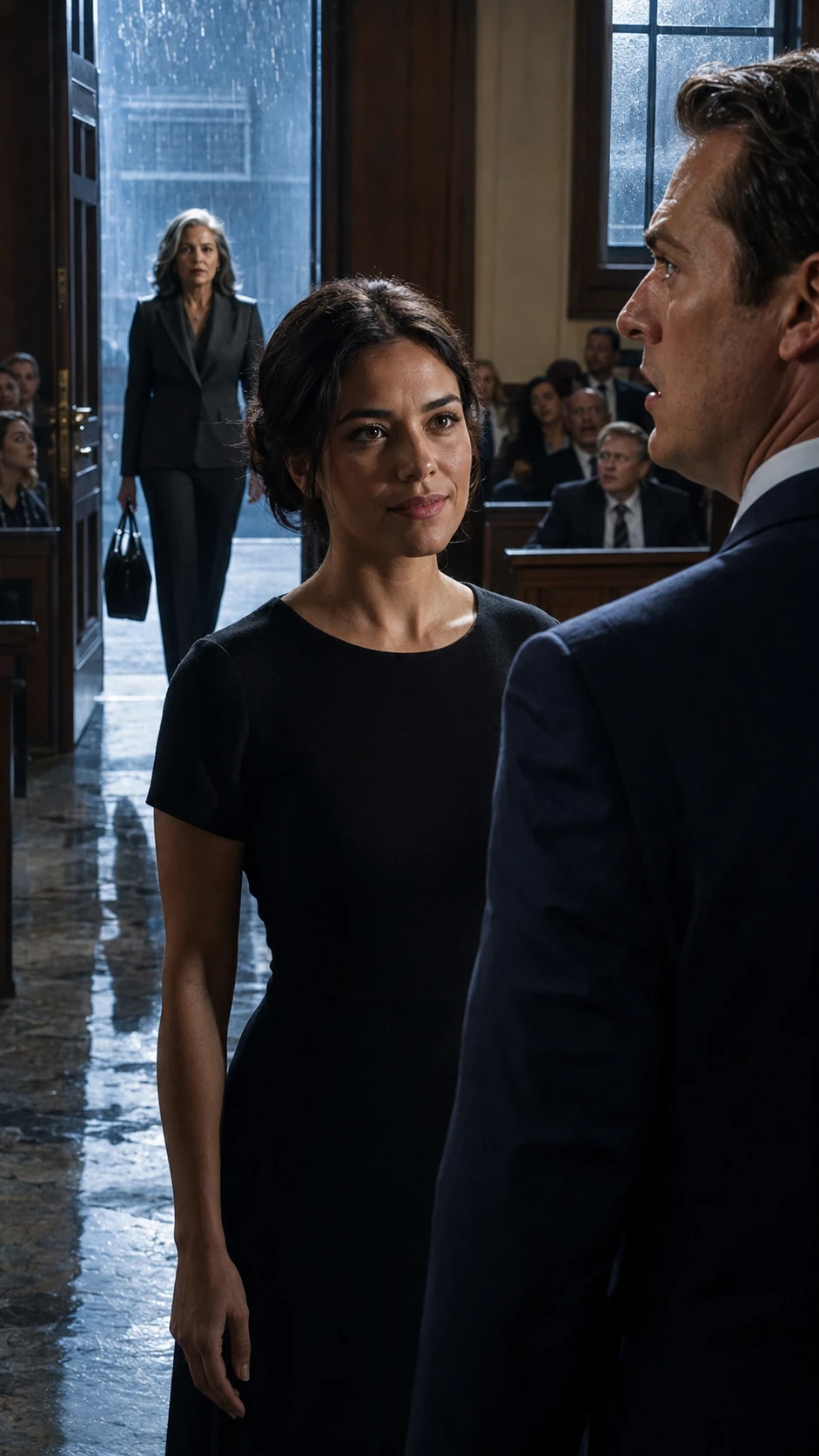
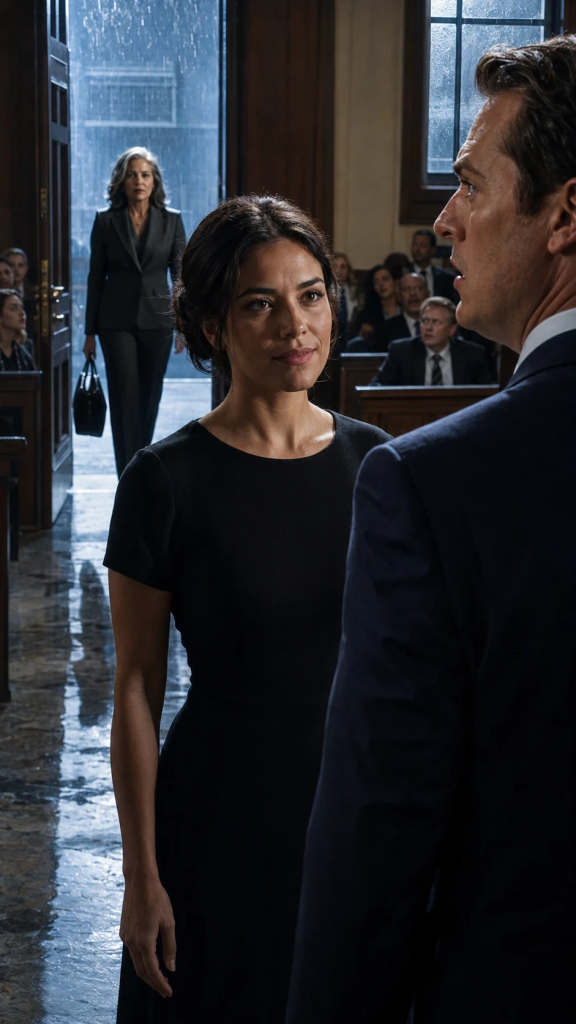
My husband arrived at divorce court with his pregnant mistress on his arm—and smiled as if he had already won everything I owned.
What Julian Mercer did not know was that almost none of it had ever belonged to him.
Rain had fallen over downtown Los Angeles since dawn, turning the courthouse steps slick beneath the polished shoes of attorneys, reporters, and wealthy spouses hiding ruined lives behind designer sunglasses.
Inside the Superior Court building, cold air drifted through long marble corridors.
Fluorescent lights reflected against the stone floors like surgical steel.
I sat alone outside Department 47 in the plainest black dress I owned.
My hands were folded tightly in my lap.
To anyone watching, I looked exactly like the woman Julian had spent seven years convincing everyone I was.
A poor orphan.
A grateful wife.
A woman with no family, no money, and nowhere to go without him.
In reality, I possessed enough hidden wealth to buy half the block surrounding the courthouse.
Then Julian appeared.
He was not alone.
One arm was wrapped possessively around Stacy Hale, a rising social media model whose carefully displayed pregnancy had become her favorite accessory.
She wore cream-colored designer cashmere and exaggerated the curve beneath her dress as if motherhood were a trophy she had stolen from another woman.
Three attorneys followed behind them, each carrying a leather briefcase worth more than many people earned in a month.
The irony almost made me smile.
Julian was paying them with money he had secretly transferred from our joint accounts during the final year of our marriage.
He stopped directly in front of me and slowly looked me over.
Even after seven years, I recognized that expression.
It was the look he wore whenever he believed someone beneath him deserved to be humiliated.
“Valeria,” he said loudly enough for nearby spectators to hear.
“Where exactly is your attorney?”
He paused, then smirked.
“Actually, forget I asked.”
“Maybe you finally realized you can’t afford legal representation after spending years pretending you belong in high society.”
Stacy pressed herself closer to him and smiled sweetly.
“Julian, don’t embarrass her too much,” she said theatrically.
“You told me she came from some miserable foster background outside Bakersfield, right?”
Her hand rested protectively over her stomach.
“Honestly, Valeria, you should sign the papers today.”
“We want to begin renovating the Bel Air property before the baby arrives.”
I did not cry.
That disappointed them.
Julian mistook my silence for weakness because he had never understood the woman he married.
He still believed I was the frightened twenty-four-year-old orphan he met at a charity gala in Malibu.
He still believed he had rescued me from loneliness, debt, and obscurity.
He never realized I had been quietly studying him the entire time.
The courtroom doors opened.
We entered beneath the watchful eyes of reporters lining the back wall.
Julian’s mother, Eleanor Mercer, sat in the front row clutching a crocodile leather handbag against her chest like proof of inherited superiority.
She looked at me with open disgust.
To Eleanor, I had always been contamination.
I was the wife without prestigious bloodlines, East Coast family money, or political connections.
One of Julian’s attorneys rose immediately.
“Your Honor, our client was the sole financial provider throughout the marriage, while Mrs. Mercer maintained no meaningful independent income.”
“We therefore request full possession of the Bel Air residence, all investment portfolios, and immediate termination of long-term support obligations.”
Julian leaned toward me, satisfaction glowing across his face.
“You already lost,” he whispered.
The judge adjusted his glasses and looked at me with careful sympathy.
“Mrs. Mercer, has counsel not appeared on your behalf this morning?”
Stacy let out a soft laugh.
I stood slowly.
Then the heavy courtroom doors opened behind me.
Every head turned.
I looked directly at Julian and answered calmly enough for the entire room to hear.
“Actually, Your Honor, my representation has just arrived.”
Four people entered in a line so smooth and silent that the room itself seemed to hold its breath.
At the front was Miranda Vale, one of the most feared divorce attorneys in California.
Behind her came Nathan Cho, a forensic accountant who had dismantled three billionaire fraud cases in open court.
Beside him walked an older woman with silver hair, a black silk suit, and a face Julian’s mother recognized before anyone else did.
Eleanor went pale.
The fourth person carried a sealed evidence box and did not look at Julian at all.
Miranda stopped beside me and placed a hand lightly on my shoulder.
“Apologies for the timing, Your Honor.”
She opened her folder.
“We were delayed downstairs by the press.”
Julian’s smirk trembled.
His lead attorney frowned.
“Your Honor, this is highly irregular.”
Miranda looked at him as if he had spoken out of turn at a funeral.
“What is irregular, Mr. Hargrove, is your client’s attempt to petition for assets he never owned, using statements he knew to be false, while concealing marital theft, corporate fraud, and a matter involving an unborn child.”
A low murmur traveled through the courtroom.
Stacy’s hand tightened over her stomach.
Julian’s eyes cut toward me.
For the first time that morning, he looked less like a victor and more like a man hearing footsteps in a locked house.
“Valeria,” he said under his breath.
“What have you done?”
I looked forward.
“Exactly what you taught me to do, Julian.”
“I learned to protect myself.”
The judge’s expression sharpened.
“Counsel, approach.”
The attorneys moved forward, but Miranda remained angled slightly toward the room.
She wanted every whisper to carry.
That was why I had chosen her.
For seven years, Julian had controlled the story.
Today, I was taking it back sentence by sentence.
The first lie began with the house.
Julian had paraded the Bel Air residence through magazines as if it were a Mercer family jewel.
He had hosted charity galas beneath its white archways.
He had accepted praise for its gardens, its infinity pool, and its sweeping view of the city glittering like scattered diamonds below.
He had once told a reporter, with his hand resting on my waist, that buying the property had been “the greatest gift a husband could give his wife.”
I remembered standing beside him that night, smiling as cameras flashed, while knowing the deed had been placed in my name three months before our wedding.
Not Valeria Mercer.
Not Valeria anything that Julian knew.
The deed belonged to the Arden Trust.
The Arden Trust belonged to me.
When I was six years old, my parents died in what newspapers called a tragic private-plane accident.
What the newspapers never reported was that my mother, Isadora Arden, had been the sole heir to one of the most private fortunes in the country.
She had hated publicity.
She had hated greedy men even more.
Before she died, she created a maze of trusts, shell companies, trustees, and legal protections designed to keep her only child hidden until adulthood.
After the crash, I disappeared into foster care under a changed surname because my mother’s last surviving adviser believed someone had wanted the Arden estate vulnerable.
So yes, I had grown up outside Bakersfield.
Yes, I had eaten cereal for dinner and learned which foster homes locked the refrigerator.
Yes, I had once worn shoes with cardboard tucked inside the soles because my feet bled less that way.
But poverty had not been my origin.
It had been my camouflage.
At twenty-five, I received the first letter from my mother’s estate.
At twenty-six, I inherited enough money to make men like Julian Mercer look like boys playing with borrowed coins.
At twenty-seven, I met Julian.
At twenty-eight, I married him because I wanted to believe love could be real even for someone raised among locked doors and vanished names.
That had been my greatest mistake.
Miranda returned to our table and projected the first document onto the courtroom screen.
It was the Bel Air deed.
The name Arden Residential Holdings appeared in crisp black lettering.
Julian’s attorney blinked.
“That company is not disclosed in the marital filings.”
“It did not need to be,” Miranda replied.
“It is premarital property owned by a trust established eighteen years before the marriage.”
Julian sat straighter.
“That’s impossible.”
Miranda clicked again.
The screen changed to a chain of title, purchase records, trustee certifications, and my signature written in a name Julian had never seen.
Valeria Arden Stone.
Eleanor made a small choking sound.
The older silver-haired woman behind Miranda rose.
“Your Honor, my name is Helena Voss.”
“I have served as trustee for the Arden family estate for twenty-one years.”
“I am prepared to testify that Mr. Mercer never held ownership, equity, or controlling interest in the Bel Air property.”
Julian turned to his mother.
Eleanor refused to meet his eyes.
That told me something.
She had recognized Helena immediately because old money always recognized older money.
Stacy whispered, “Julian, what is happening?”
He did not answer.
Miranda clicked again.
The investment portfolios appeared next.
The supposedly marital assets.
The accounts Julian claimed were built through his brilliance, discipline, and sacrifice.
Line after line revealed the truth.
Initial funding source.
Arden Capital Reserve.
Transfer date.
Four months before marriage.
Beneficiary.
Valeria Arden Stone.
My name moved across the screen like a blade.
Nathan Cho stood and adjusted his glasses.
“Our review shows that Mr. Mercer contributed less than three percent of the portfolio value during the marriage.”
He glanced at Julian.
“However, he removed or redirected approximately twelve point eight million dollars during the final fourteen months of the marriage.”
Julian exploded.
“That is a lie.”
Nathan did not flinch.
“Your transfers were routed through six entities, two Cayman accounts, and a consulting firm registered to Ms. Stacy Hale’s manager.”
Stacy went rigid.
“Leave me out of this.”
Nathan clicked a remote.
Bank records appeared.
The courtroom went silent.
There it was.
A payment to Stacy’s luxury apartment.
A payment for her car.
A payment for a diamond bracelet she had worn in a photo captioned blessed beyond words.
A payment for the cream cashmere dress she wore in court.
I turned and looked at her stomach.
Then I looked away before the old wound opened.
There are betrayals the heart can name.
There are others the body remembers before the mind is ready.
Mine began two years earlier in a white fertility clinic in Pasadena.
Julian had wanted children once the Mercer brand needed softening.
That was how he put it.
“We need legacy,” he had said.
Not family.
Legacy.
Month after month, I endured injections, scans, hormones, bruises, and the humiliating intimacy of medical hope.
Julian charmed the nurses and called me brave in public.
At home, he complained that my grief made the house heavy.
When the first pregnancy failed, I found him drinking champagne in the library because a deal had closed.
When the second ended at eleven weeks, I bled through silk sheets while Julian texted in the hallway.
Later, he told me my sadness was becoming unattractive.
Still, I kept trying.
Not for him.
For the tiny future I had already loved.
Then came the test result Julian begged me never to mention.
He was infertile.
Completely.
Irreversibly.
His face had crumpled in the doctor’s office, not from grief, but from humiliation.
“No one can know,” he whispered to me in the parking garage.
“Promise me, Val.”
I promised because I loved him.
I promised because I believed marriage meant protecting each other’s weakest places.
We used an anonymous donor.
My eggs.
Donor sperm.
Our clinic created five embryos.
Two failed.
One miscarried.
Two remained frozen.
Julian called them “insurance” when he thought I was asleep.
I called them my last pieces of hope.
Then, after the miscarriage, he told me he could not bear to try again.
He said the embryos would remain frozen until we both healed.
I believed him.
That had been my second greatest mistake.
Back in the courtroom, Julian’s attorney was sweating.
“Your Honor, financial disagreement is common during dissolution proceedings.”
“This theatrically presented material does not change the fact that Mrs. Mercer enjoyed a lifestyle funded by my client’s public success.”
Miranda smiled without warmth.
“Public success is not the same as actual ownership.”
She opened another folder.
“Which brings us to Mercer Development Group.”
Julian’s jaw tightened.
For the first time, I saw real fear.
Mercer Development Group was his crown.
It was the company he bragged about on business panels.
It was the name engraved on towers, luxury condos, and charity plaques.
It was also, as Nathan had discovered, a palace built on loans he never intended to repay.
Miranda placed the financing documents before the judge.
“Mr. Mercer represented to investors that Mercer Development Group was independently capitalized.”
“In reality, its first five projects were underwritten by private loans from Arden Capital through intermediaries.”
“Those loans are now in default.”
The judge looked over his glasses.
“Are you saying Mrs. Mercer’s trust financed Mr. Mercer’s company?”
“Yes, Your Honor.”
Miranda turned toward Julian.
“And Mr. Mercer appears to have known that by no later than March of last year.”
Julian stood so abruptly his chair scraped backward.
“I did not know.”
“You expect people to believe my wife secretly owned everything and somehow I just missed it?”
I finally turned to him.
“Yes.”
The word landed harder than a shout.
“You missed it because you never looked at me long enough to see anything except what you wanted.”
His mouth opened.
No sound came out.
“You saw a foster girl.”
“You saw a useful wife.”
“You saw someone you could dress up for charity events and silence behind closed doors.”
“You never saw me.”
The courtroom was so quiet I could hear rain ticking against the windows.
I should have felt triumphant.
Instead, I felt the terrible ache of watching a life collapse that I had once tried to save.
I remembered Julian in the early days, laughing barefoot in my kitchen, burning pancakes because he was too busy kissing flour from my cheek.
I remembered believing that the world had finally sent me someone who chose me without needing my past.
I remembered the first time he called me home.
That memory hurt more than every insult he had thrown at me.
Because love does not always die when betrayal appears.
Sometimes it stays alive just long enough to watch the truth bury it.
Stacy shifted beside him.
“Julian,” she whispered.
“Say something.”
He turned on me instead.
“You planned this.”
“No,” I said.
“I survived this.”
His face darkened.
“There is no difference.”
That was when Miranda opened the sealed evidence box.
Inside were printed emails, clinic records, notarized forms, security stills, and one small silver flash drive.
Stacy stopped breathing for half a second.
Only half a second.
But I saw it.
Miranda’s voice softened.
“Your Honor, before we continue with property division, we request an emergency protective order concerning two cryopreserved embryos unlawfully transferred from Pacific Crest Fertility Clinic.”
Julian went white.
Not pale.
White.
His mother’s handbag slipped from her lap and struck the floor.
Stacy’s beautiful face emptied.
The judge leaned forward.
“Explain.”
Miranda did not look at Julian now.
She looked at me.
It was the only moment all morning when she asked without words whether I was ready.
I nodded.
The room blurred at the edges, but my voice remained steady.
“Two embryos were created during my marriage after medical testing showed Julian could not father a biological child.”
A gasp moved through the gallery.
Julian slammed his palm on the table.
“Stop.”
The judge’s gavel cracked.
“Mr. Mercer, sit down.”
I continued.
“The embryos were created using my eggs and donor sperm.”
“Julian signed consent forms acknowledging he had no genetic relationship to them.”
“He also signed that no transfer could occur without my written authorization.”
Stacy whispered, “No.”
It was not disbelief.
It was fear.
Miranda displayed the first fertility document.
My signature.
Julian’s signature.
The donor identification code.
The clinic’s seal.
Then the next document appeared.
A transfer authorization dated four months earlier.
It bore my name.
But the signature was not mine.
It curved wrong at the V.
It pressed too hard at the end.
I had spent my life hiding behind signatures.
I knew my own like I knew the sound of my childhood bedroom door closing for the last time.
Miranda clicked again.
A surveillance still from the fertility clinic filled the screen.
Julian stood at the reception desk in a baseball cap.
Beside him was Stacy Hale wearing oversized sunglasses.
The timestamp glowed in the corner.
Three days after Julian had filed for divorce.
The courtroom erupted.
Reporters stood.
Eleanor whispered something that sounded like prayer.
The judge struck the gavel twice.
“Order.”
Miranda waited until silence returned.
“The clinic released one embryo for transfer based on forged authorization and fraudulent identification.”
“That embryo was implanted in Ms. Hale.”
Stacy burst into tears.
Not pretty tears for cameras.
Ugly, terrified tears.
Julian grabbed her wrist.
“Do not say anything.”
I looked at his hand.
Then at hers.
Then at her stomach.
Everything inside me broke and reassembled into something colder.
“Take your hand off her,” I said.
Julian stared at me.
“You do not get to give orders.”
“Yes,” I said.
“I do.”
Miranda placed one final report before the judge.
“Prenatal genetic screening obtained through subpoena confirms that the fetus Ms. Hale is carrying is genetically related to Mrs. Mercer and not genetically related to Mr. Mercer.”
The judge went still.
The reporters stopped typing.
Even the rain seemed to pause.
Stacy’s hand flew over her mouth.
Julian looked as if the world had dropped away beneath him.
I stood there, every scar inside me burning at once.
For months, I had imagined this moment.
I had imagined rage.
I had imagined triumph.
I had imagined slapping Julian so hard the sound would echo through every room where he had ever made me feel small.
But when the truth finally entered the courtroom, I felt only one thing.
A mother’s terror.
Because Stacy Hale was not carrying Julian’s victory.
She was carrying my child.
The judge dismissed the gallery for a recess, but the damage had already escaped into the air.
Reporters poured into the hallway like floodwater.
Julian’s attorneys huddled around him, their polished confidence shattered.
Eleanor sat frozen, her lips moving silently.
Stacy was escorted into a side room by a bailiff after she began shaking too violently to stand.
I remained at the table with Miranda beside me.
My knees wanted to fail.
My lungs wanted to forget their purpose.
But I did not sit.
If I sat, I feared I would remember every night I had whispered goodnight to embryos I had never met.
I feared I would remember the tiny ultrasound photo I kept hidden in a jewelry box beneath rings I never wore anymore.
I feared I would become the woman Julian expected.
Broken.
Useful.
Quiet.
So I stood.
Julian approached me during the recess when his attorneys were distracted.
His face looked older now.
The handsome arrogance had drained away, leaving something raw and monstrous beneath.
“You cannot prove I knew,” he said.
I laughed once.
It sounded like glass snapping.
“You were on camera.”
“I mean the donor.”
His voice dropped lower.
“You cannot prove I remembered those forms.”
I looked at him in disbelief.
That was his concern.
Not the stolen embryo.
Not the forged signature.
Not the woman carrying a child dragged into his war.
His concern was whether people would know he was infertile.
“You are still protecting your pride,” I said.
“My God, Julian.”
“You stole a baby from me, and you are embarrassed about your reputation.”
His eyes flashed.
“That baby would have been raised Mercer.”
“No.”
I stepped closer.
“That baby would have been raised inside a lie.”
His mouth twisted.
“You think you can raise a child alone?”
There it was.
The old knife.
The one he always used when I became inconvenient.
A child needs a real family.
A child needs a name.
A child needs stability.
A child needs more than a woman who grew up unwanted.
Once, those words would have found every bruise in me.
Today, they struck armor.
“I was alone before you,” I said.
“I was stronger then.”
He leaned in.
“You are nothing without me.”
I smiled.
It was not kind.
“Julian, you are standing in a courthouse trying to steal a fortune from a woman you thought owned nothing.”
“That is not confidence.”
“That is comedy.”
His hand twitched.
For a second, I thought he might grab me.
Then a voice cut through the hallway.
“Touch her, and I will make sure the press photographs the cuffs.”
Helena Voss stood behind him.
She looked small compared to Julian, but authority does not always need height.
Julian stepped back.
“You knew?” he demanded.
Helena’s expression did not change.
“I knew enough.”
Eleanor rushed toward us then, her heels striking the floor like gunshots.
“You venomous girl,” she hissed at me.
“You came into my family and destroyed my son.”
I stared at her.
“No, Eleanor.”
“I came into your family and funded it.”
Her face contorted.
“You trapped him.”
“He married me for love.”
“Did he?”
I tilted my head.
“Or did you tell him that a quiet orphan wife would make him look charitable?”
The color drained from her face.
I had guessed correctly.
That was the thing about cruel people.
They believed secrets were safe because decent people did not think as hideously as they did.
But I had spent years learning their language.
Eleanor recovered quickly.
“That child belongs with us.”
The hallway seemed to narrow.
“You knew,” I said.
Her eyes flickered.
It was the smallest confession.
But Helena saw it.
Miranda saw it.
Nathan saw it.
Most importantly, Julian saw it.
His head turned slowly.
“Mother?”
Eleanor lifted her chin.
“Do not look at me like that.”
“I did what was necessary.”
Stacy appeared in the doorway of the side room, pale and trembling.
A bailiff stood behind her.
Her voice shook.
“You told me it was his.”
Eleanor did not even glance at her.
“I told you what you needed to hear.”
Julian whispered, “What did you do?”
Eleanor’s mask finally cracked.
“What you were too weak to do.”
She pointed at me.
“She had the money.”
“She had the bloodline.”
“She had the house, the company, the press sympathy, and those embryos sitting in a freezer like keys to a kingdom.”
Her voice rose.
“I was not going to watch the Mercer name disappear because you could not produce an heir.”
The words hung there, grotesque and naked.
Stacy sobbed.
Julian staggered back as if his own mother had struck him.
For one wild second, I almost pitied him.
Then I remembered the stolen transfers.
The mistress.
The forged forms.
The years of soft insults sharpened into daily weapons.
Pity passed.
The recess ended.
By the time we returned to the courtroom, everyone had changed positions in the invisible architecture of power.
Julian no longer sat like a king.
Stacy sat apart from him with a court officer between them.
Eleanor’s hands trembled around her empty lap.
My hands were still.
The judge’s voice was grave.
“This court is not a criminal court, but the allegations presented here are extraordinary.”
He looked at Julian.
“I am referring the evidence to the district attorney and ordering preservation of all relevant records.”
Julian’s attorney stood.
“Your Honor, my client disputes the characterization of these events.”
The judge cut him off.
“Your client may dispute them through proper channels.”
“For today, we are addressing immediate civil remedies.”
Miranda rose.
“We request exclusive temporary possession of the Bel Air residence for Mrs. Mercer, freezing of contested accounts, recovery tracing for misappropriated funds, and an emergency order preventing Mr. Mercer, Mrs. Eleanor Mercer, or their agents from contacting Pacific Crest Fertility Clinic, Ms. Hale, or making decisions regarding the unborn child.”
The judge looked at Stacy.
“Ms. Hale, do you have counsel?”
Stacy shook her head.
Tears clung to her lashes.
“No, Your Honor.”
“Do you understand the seriousness of what has been alleged?”
“Yes.”
Her voice cracked.
“I thought Julian was the father.”
Julian snapped, “Stacy.”
She flinched but kept speaking.
“His mother arranged the clinic.”
“She said Valeria had abandoned the embryos.”
“She said Julian had rights.”
“She said if I helped them, I would be taken care of forever.”
Eleanor closed her eyes.
Julian stared at the table.
Stacy turned toward me then.
For the first time since I had known her name, she looked young.
Not glamorous.
Not victorious.
Just young and terrified.
“I am sorry,” she whispered.
“I know that is not enough.”
It was not enough.
It would never be enough.
But the child beneath her hand did not deserve my hatred.
So I nodded once.
Not forgiveness.
Not yet.
Only acknowledgment that the truth had taken another victim hostage.
The judge issued temporary orders before noon.
The Bel Air house remained mine.
The investment accounts were frozen.
Julian’s access was revoked.
Eleanor was barred from contacting Stacy.
Pacific Crest was ordered to provide all records to law enforcement.
And the embryo transfer would become part of both the divorce and a criminal investigation.
Julian left the courtroom without his mistress on his arm.
That was the first photograph the papers published.
His empty hand.
His white face.
My black dress behind him.
The headline called it the most explosive divorce hearing in Los Angeles that decade.
They were wrong.
The hearing was only the beginning.
Over the next four months, the Mercer world collapsed with the slow violence of a building coming down floor by floor.
Nathan traced every stolen dollar.
Miranda filed motions that landed like thunderclaps.
Investors sued Mercer Development Group after learning its foundation had been borrowed, hidden, and misrepresented.
Eleanor’s charity boards removed her name from their websites before dinner parties could turn awkward.
Julian gave one televised statement claiming he was the victim of a “weaponized marital dispute.”
By sunrise, the internet had discovered the fertility documents.
After that, no publicist could save him.
I moved back into the Bel Air house alone.
For the first few nights, I slept in the guest room because the master bedroom still smelled faintly of Julian’s cedar cologne.
Then, on the fifth night, I opened every window in the house during a storm.
Rain blew across the floors.
Curtains snapped like sails.
I stood barefoot in the dark and let the weather erase him.
By morning, the house felt mine again.
Not because of the deed.
Because I had survived being haunted by someone still alive.
Stacy’s attorney contacted Miranda two weeks later.
Stacy wanted to cooperate.
She wanted protection from Eleanor.
She wanted money for medical care, but not the Mercer money.
She wanted to know whether I planned to hate her forever.
I read the message three times.
Then I drove to the small apartment where she was staying under a temporary confidentiality order.
She opened the door in leggings and an oversized sweater.
Without makeup, she looked nothing like the woman who had smiled at me outside Department 47.
She looked exhausted.
Pregnant.
Human.
For a moment, neither of us spoke.
Then she stepped back.
“I understand if you only came to scream.”
“I did not come to scream,” I said.
“I used all my screaming in silence.”
She lowered herself onto the couch carefully.
The baby shifted beneath her sweater.
My baby.
The thought still knocked the air from me.
Stacy saw me looking.
“I can leave the room if it is too much.”
“No.”
My voice broke.
“Please do not.”
She nodded.
We sat across from each other in a room filled with cheap furniture and the unbearable presence of what had been stolen.
“I thought he loved me,” she said.
I almost laughed, but the sound would have been cruel.
“So did I.”
She wiped at her cheek.
“Eleanor told me you were cold.”
“She said you did not want children anymore.”
“She said the embryo was Julian’s only chance to be a father.”
“She said you were using it to punish him.”
I closed my eyes.
There were lies so evil they seemed almost creative.
“Did you know it was mine?”
Stacy shook her head violently.
“No.”
Then she hesitated.
“I suspected something after the transfer.”
“Julian would not come to appointments.”
“Eleanor came instead.”
“She kept saying the baby had to be protected from you.”
Her hands trembled.
“Then I heard her on the phone saying the trust would respond once there was a living descendant.”
My eyes opened.
“What trust?”
Stacy swallowed.
“The Arden Trust.”
The room tilted.
That was the hidden piece.
The one even Miranda had not found.
I drove straight to Helena’s office.
By evening, she had pulled the oldest governing documents from the Arden estate archive.
The clause was buried deep inside a document drafted by my grandmother forty years earlier.
If the primary beneficiary died without issue, control shifted to charitable distribution.
But if the beneficiary had a biological child, that child became future contingent beneficiary at birth.
Control would remain with appointed trustees until adulthood, but a legal guardian could petition for certain distributions on the child’s behalf.
Eleanor had not just wanted a Mercer heir.
She had wanted a living key to the Arden fortune.
If Julian could not possess me, he planned to possess my child.
That night, I sat on the nursery floor I had once locked and never entered again.
Dust covered the white crib.
A mobile of tiny moons hung motionless above it.
I had bought it during my second pregnancy and thrown the receipt away because hope felt safer when it could not be returned.
I pressed my hand against the crib rail and finally cried.
Not politely.
Not beautifully.
I cried until my throat hurt.
I cried for the foster girl who had learned not to ask for too much.
I cried for the wife who had mistaken control for devotion.
I cried for the embryos I had whispered to in a clinic freezer.
I cried because one of them was alive somewhere across the city, beneath the heart of a woman who had helped humiliate me and had also been deceived.
Most of all, I cried because I was terrified I would love this child so much that the world would have a new way to destroy me.
The trial never fully happened.
Powerful people prefer private ruin when public ruin becomes too expensive.
Julian accepted a settlement after prosecutors opened inquiries into forgery, fraud, and conspiracy.
Eleanor fought longer.
Eleanor always had.
But Stacy’s testimony broke her.
So did the clinic footage.
So did the recorded call Stacy had made under instruction from her attorney, in which Eleanor said, clear as a church bell, that “Valeria’s womb was useless, but her bloodline still had value.”
When Miranda played that recording during a closed evidentiary hearing, I watched Julian cover his face.
I still do not know whether he was ashamed of his mother or ashamed that she had said the quiet part aloud.
The final divorce decree came on a bright, merciless morning in May.
I kept my house.
I kept my name.
I recovered nearly every stolen dollar.
Julian kept what remained of his dignity, which was nothing the court could garnish.
Stacy signed an agreement before the birth.
It acknowledged the fraud, the embryo’s origin, and my parental rights.
She did not ask to keep the baby.
She asked for one thing.
She wanted to hold the child once.
I said yes.
People later called me generous.
They did not understand.
Generosity had nothing to do with it.
I said yes because the child had known Stacy’s heartbeat for nine months.
No court order could erase that.
The baby came during another rainstorm.
Los Angeles rain is never gentle when your life is changing.
It throws itself against glass like it wants to get inside and witness everything.
I was in the delivery room because Stacy asked me to be.
Miranda waited in the hallway.
Helena sat beside her with a diaper bag worth more than the car I had driven at eighteen.
Stacy screamed, cursed Julian, cursed Eleanor, cursed every influencer who had ever called pregnancy glowing, and then laughed hysterically because the nurse told her she was doing beautifully.
I stood by her shoulder and held a cup of ice chips.
At 2:17 in the morning, a baby girl entered the world furious, red-faced, and alive.
The nurse placed her in Stacy’s arms first.
Stacy looked down and began to sob.
“She has your mouth,” she whispered.
I could not move.
The room blurred.
The doctor said my name gently.
“Valeria.”
Stacy looked at me.
There was grief in her face, but no resistance.
“Come meet your daughter.”
My daughter.
Two words.
A universe.
They placed her in my arms, and every fortress I had built inside myself fell without a sound.
She was impossibly small.
Her fist opened against my chest like she had been searching for me through every lie.
I bent my head over hers and breathed in the warm, milky scent of new life.
“Hello,” I whispered.
“I have been waiting for you longer than you know.”
Behind me, Stacy cried quietly.
I reached out one hand.
After a moment, she took it.
That was how my daughter came into the world.
Not in triumph.
Not in revenge.
But between two women who had both been used by the same cruel family and somehow chose not to pass the cruelty down.
I named her Maren Isadora Stone.
Maren because it meant sea, and she had survived storms before she ever saw daylight.
Isadora for my mother.
Stone for the name that had protected me when Arden was too dangerous to wear.
The news broke three days later.
Not the details.
Those remained sealed to protect Maren.
But enough emerged for the city to understand that Julian Mercer had not been betrayed by a gold-digging wife.
He had been exposed by a woman he had mistaken for prey.
For a while, photographers camped outside my gates.
Commentators debated my marriage as if pain were a sporting event.
Strangers sent letters.
Some called me ruthless.
Some called me brave.
One woman mailed a note with no return address that said only, Thank you for not staying silent.
I kept that note.
I kept it beside Maren’s crib.
Julian requested to see the baby once.
His attorney sent the letter six weeks after she was born.
The wording was careful.
Respectful.
Desperate.
Miranda asked if I wanted to respond.
I said yes.
I wrote three sentences by hand.
Maren is not your child.
Maren is not your redemption.
Maren will never be used to repair what you destroyed.
I did not sign it Valeria Mercer.
I signed it Valeria Arden Stone.
Months passed.
Maren learned to smile.
Stacy entered therapy and disappeared from social media.
Eleanor sold her Palm Springs house to cover legal fees.
Julian moved into a rented apartment in Century City and began giving private consulting advice to men who still believed arrogance was strategy.
I thought the story was over.
Then, on Maren’s first birthday, a package arrived at the Bel Air house.
It had no return address.
Inside was a small wooden music box.
My hands turned cold before I opened it.
The tune was one I remembered from childhood.
My mother had hummed it while brushing my hair.
Beneath the velvet lining was a folded letter, yellowed at the edges but preserved carefully.
Helena was with me when I read it.
Her face changed before mine did.
The handwriting belonged to my mother.
My darling Valeria, the letter began.
If this reaches you after I am gone, then someone has finally become desperate enough to use your child against you.
I stopped breathing.
Helena gripped the back of a chair.
The letter continued.
There is a clause in the trust your grandmother insisted upon, and I fear one day it may be misunderstood or exploited.
I have created a countermeasure known only to Helena and the court of record.
Any person who attempts to gain access to the Arden estate through coercion, fraud, reproductive theft, or manipulation of your descendants forfeits all claims, direct or indirect, and triggers immediate transfer of discretionary control to you alone.
My vision blurred.
At the bottom of the box was a sealed certificate from a probate court dated weeks before my parents died.
Helena whispered, “She knew.”
But that was not the twist.
The twist was in the final paragraph.
If you are reading this, my brave girl, remember that family is not the person who claims your name.
Family is the person who protects your future when they are not there to see it.
I have also left instructions for the trustee to reveal one final truth only when you become a mother.
My hands shook so badly that Helena had to unfold the last page for me.
There, in my mother’s elegant script, were the words that split my life open one final time.
You were not hidden because of my fortune.
You were hidden because the crash was meant for you.
I looked up at Helena.
Her eyes were wet.
“What does that mean?”
She sat down slowly.
“It means your parents were not the target.”
“You were.”
The room seemed to tilt around Maren’s laughter coming from the nursery monitor.
Helena reached into the box and removed a photograph I had never seen.
My mother stood on the terrace of the Bel Air house holding me as a baby.
Beside her stood a young Eleanor Mercer.
On the back, someone had written, Isadora and Eleanor, summer benefit, before the threats.
I stared at the image until the faces blurred.
Eleanor had known my mother.
Eleanor had known the Arden name before I ever entered her house as Julian’s “orphan wife.”
Helena’s voice was almost a whisper.
“Your mother refused Eleanor’s request for investment in the old Mercer company.”
“Shortly after, threats began.”
“We could never prove who arranged the crash.”
My daughter laughed again through the monitor, bright and alive.
The sound moved through the house like dawn.
I understood then.
Julian had thought he discovered a helpless woman and married beneath himself.
Eleanor had watched him bring me home and recognized the child she had failed to erase.
She had spent seven years smiling across dinner tables at the grown woman who should have died in the sky with her parents.
And when she realized she could not steal the Arden fortune through Julian, she tried to steal it through my unborn child.
The final shock was not that Julian had betrayed me.
The final shock was that his mother had been hunting my family before I was old enough to speak.
I walked to the nursery on unsteady legs.
Maren stood in her crib, gripping the rail with both tiny hands.
When she saw me, she squealed as if I were the best thing the world had ever invented.
I lifted her into my arms and held her close.
For the first time, I did not feel like an orphan.
My mother had protected me from beyond death.
I had protected my daughter before birth.
And somewhere, behind prison walls and ruined names, the Mercer family had finally learned the lesson they should have known from the beginning.
You can steal money.
You can forge signatures.
You can buy judges, charm reporters, and dress cruelty in cashmere.
But you should never mistake a silent woman for a defeated one.
Because sometimes the woman sitting alone in a courthouse hallway is not waiting to be saved.
Sometimes she is waiting for the doors to open.
Sometimes she is waiting for the truth to walk in.
And sometimes, when her enemies arrive smiling with everything they think they have stolen, she lets them come close enough to hear the one sentence that destroys them.
“You never owned me.”