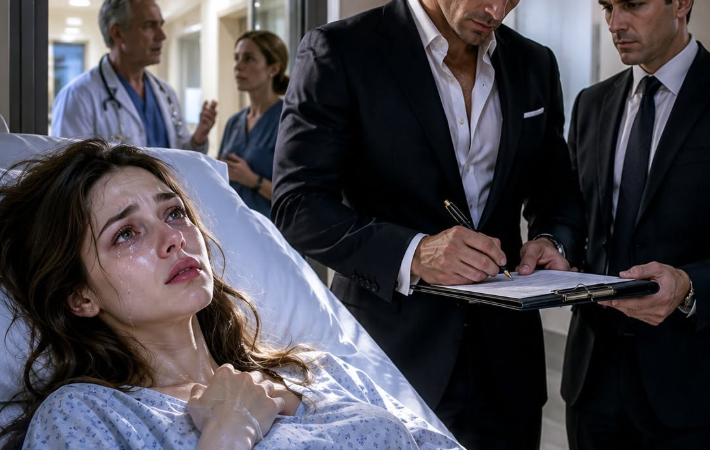
For seven terrifying minutes, I was clinically dead while doctors fought to bring me back after the emergency birth of my tripleTS.
My heart had stopped.
My lungs had failed.
Blood soaked through surgical sheets as alarms screamed inside the operating room.
A nurse performed chest compressions while another doctor charged the defibrillator, refusing to accept that a thirty-four-year-old mother could die only moments after bringing three babies into the world.
“Clear!”
The shock lifted my body from the table.
Nothing.
“Again!”
Outside the ICU, my billionaire husband was not praying for a miracle.
He was signing divorce papers.
Grant Holloway stood beneath the cold fluorescent lights in a custom charcoal suit, calmly turning pages while my blood pressure disappeared from the monitor.
The pen in his hand was worth nearly four thousand dollars.
He used it to end our marriage while doctors were still trying to restart my heart.
His attorney glanced toward the ICU doors as another emergency team rushed past.
“Mr. Holloway,” he said uneasily, “your wife may not survive the next hour.
Perhaps we should postpone this.”
Grant continued signing.
“How fast can we finalize it?”
The attorney stared at him.
“Under normal circumstances, several weeks.
But with the emergency waiver you requested—”
“I asked how fast.”
The lawyer swallowed.
“Possibly today.”
“Then finish it today.”
A doctor emerged from the restricted corridor moments later.
His scrubs were stained, his face pale with exhaustion.
“Mr. Holloway, your wife has been resuscitated, but she remains unstable.
We may need authorization for further procedures.”
Grant closed the folder.
“You’ll need to find someone else.”
The doctor frowned.
“You are her husband.”
“Not anymore.”
Grant checked the expensive watch on his wrist.
“As of two minutes ago.”
The doctor looked from Grant to the lawyer, as though waiting for one of them to admit it was some cruel misunderstanding.
Neither did.
“What about the babies?” the doctor asked.
“Your children are in the neonatal unit.”
Grant’s expression did not change.
“They are the hospital’s responsibility until arrangements are made.”
Then he walked away.
He did not ask whether I would regain consciousness.
He did not stand beside the nursery window.
He did not touch the tiny knitted blankets volunteers had placed over our three newborn children.
As the elevator doors closed, Grant’s phone lit up.
A message from a woman named Vanessa appeared on the screen.
Is she gone?
Grant typed back:
Not yet.
But the marriage is.
He believed he had escaped everything—the wife whose medical crisis threatened his reputation, the premature babies he had never wanted, and the financial obligations that might interfere with the new life he was secretly planning.
He believed I would wake up powerless.
Or better yet, never wake up at all.
But Grant did not know that my apparent death had triggered an investigation.
He did not know that a nurse had overheard every word he said in the hallway.
And he had forgotten about the confidential clause my grandfather placed inside the Holloway family trust years before our wedding—a clause designed specifically to punish any spouse who abandoned an heir during a medical emergency.
The moment Grant’s divorce became official, the clause activated automatically.
His voting shares were frozen.
His access to the family accounts was suspended.
And temporary control of the entire Holloway empire transferred to the one person Grant believed would never open her eyes again.
Me.
Three days later, I woke beneath the steady rhythm of a heart monitor.
My body felt shattered.
My voice was barely a whisper.
But when the hospital attorney placed a sealed envelope in my hands and told me what Grant had done, something inside me became stronger than pain.
Grant had signed those papers believing he was setting himself free.
In reality, he had signed away everything he had ever owned.
PART 2
The first time Grant Holloway called after abandoning me, every nurse in my hospital room stopped what they were doing.
His name flashed across my phone screen while I was still connected to heart monitors, IV lines, and machines that reminded everyone—including me—that only three days earlier I had technically been dead.
The room became strangely quiet.
One nurse looked away.
Another slowly adjusted the blanket covering my legs, pretending not to notice.
They all knew who Grant was.
Not just because he was one of the country’s youngest billionaire CEOs, but because half the hospital had already heard the unbelievable story spreading through the staff.
The husband who signed divorce papers while surgeons were performing CPR on his wife.
The father who walked away before meeting his newborn tripleTS.
The man who smiled at another woman’s text message before leaving the hospital forever.
The phone continued vibrating.
Once.
Twice.
Three times.
Every ring felt heavier than the last.
Part of me wanted to throw it across the room.
Another part wanted to hear whether a human being capable of such cruelty could actually explain himself.
A nurse quietly asked, “Do you want me to decline the call?”
I stared at the screen.
Grant had ignored every update about my condition.
He never asked whether I survived.
He never visited the neonatal intensive care unit.
He never even signed a birthday card for the three children who had entered the world fighting for their lives.
Yet now…
He wouldn’t stop calling.
Something had changed.
Powerful men rarely begged unless they had already lost something they believed could never be taken away.
The phone rang again.
This time, a voicemail notification appeared almost immediately.
Then another.
Then a text message.
Claire… please answer.
A second message arrived only seconds later.
There has been a mistake.
We need to talk before this goes any further.
Mistake?
I almost laughed despite the pain pulling across my stitches.
Grant never believed in mistakes.
He believed in contracTS.
Calculations.
Winning.
Every decision in our marriage had been measured by profit and loss.
When I wanted another vacation together, he scheduled a board meeting.When I announced I was pregnant with triplets, he congratulated me through an email because he was “too busy” to come home.
And when my heart stopped on the operating table…
He treated our marriage like another business agreement waiting to be terminated.
So why was the man who never apologized suddenly desperate enough to beg?
Margaret Ellis, my attorney, walked into the room carrying a thick leather briefcase before I could answer.
She glanced once at the phone screen.
A slow, knowing smile crossed her face.
“So,” she said quietly, setting the briefcase on the table beside my bed, “it finally happened.”
I frowned.
“What happened?”
Margaret looked directly into my eyes.
“He knows.”
“He knows what?”
She opened the briefcase and removed a thick cream-colored folder bearing my late grandfather’s embossed family seal.
“The documents have been executed.”
She paused just long enough for my heartbeat to quicken beneath the monitor.
“And Grant Holloway has just realized that divorcing you while you were clinically dead may become the most expensive decision any billionaire has ever made.”
The phone began ringing again.
This time, neither of us reached for it.
The photographs changed everything.
Margaret spread the security stills across the tray beside my hospital bed one by one.
Every image carried a timestamp accurate to the second.
In one frame, surgeons were rushing into the operating room while Grant calmly signed another page of the divorce agreement.
In the next, a nurse sprinted past pushing the crash cart as my attorney’s courier handed him the final document.
The last photograph froze the exact moment my heart monitor flatlined inside the operating room while Grant stood only thirty feet away, checking his watch with complete indifference.
“There will be no jury in this country that overlooks these,” Margaret said quietly.
Before I could answer, another notification appeared on my phone.
Grant had left twelve voicemails.
Then twenty-three text messages.
Then came a single sentence.
Please… I didn’t know about the trust.
For the first time since our marriage began, he wasn’t apologizing for hurting me.
He was apologizing because he had lost his fortune.
I deleted every message without replying.
The following morning, Holloway Holdings held its first shareholder meeting without Grant in the building.
News helicopters circled overhead while reporters gathered outside the headquarters hoping to catch a glimpse of the billionaire who had fallen in less than twenty-four hours.
Instead, they filmed Grant arguing with security guards outside the front entrance.
“I built this company!” he shouted.
The elderly head of security, a man who had worked there longer than Grant himself, calmly answered, “No, sir.
You managed it.
The Holloway family built it.”
Grant’s access badge failed again.
The revolving doors never opened.
By afternoon, every major financial network was broadcasting the story.
Not the divorce.
Not the frozen asseTS.
The hospital footage.
A whistleblower from the hospital legal department confirmed that the timeline matched every surveillance camera in the maternity wing.
Public sympathy shifted overnight.
Investors who had once admired Grant’s ruthless business style now questioned whether someone capable of abandoning his wife during cardiac arrest should ever lead a public corporation again.
The board didn’t wait for public opinion.
They voted unanimously to begin proceedings removing him from every remaining affiliated company.
Meanwhile, I finally met my babies.
A nurse wheeled me into the neonatal intensive care unit where three tiny incubators stood side by side.
Three little faces.
Three tiny hands.
Three miracles who had fought just as hard as I had.
I reached through the opening of the nearest incubator and touched my daughter’s fingers.
She wrapped her tiny hand around mine.
In that instant, I realized something extraordinary.
Grant had walked away from the greatest fortune he would ever possess.
Not the company.
Not the money.
His children.
Weeks later, after I was discharged, Margaret accompanied me to my grandfather’s estate.
Hidden inside his private study was one final letter addressed only to me.
My hands trembled as I unfolded it.
“Claire,” it began.
“If you are reading this, someone has valued power more than your life.
Wealth can always be rebuilt, but character cannot.
Never fight to reclaim a man who abandons you in your darkest hour.
Fight instead to build a future where your children never mistake money for love.”
Tears blurred the final lines.
For the first time since everything happened, I wasn’t crying because I had been betrayed.
I was crying because my grandfather had protected me long after he was gone.
Six months later, the divorce hearings finally ended.
Grant entered the courtroom wearing a suit that looked expensive but no longer carried the confidence that once filled every room.
He had sold his sports cars.
His penthouse was gone.
Even the private jet had been auctioned to satisfy obligations created after the trust reclaimed its asseTS.
When the judge asked whether either party wished to make a statement, Grant slowly stood.
“I made the biggest mistake of my life,” he admitted.
He turned toward me.
“I thought money could replace everything.”
I looked at the three children sleeping in the stroller beside me.
Then I met his eyes.
“No,” I answered calmly.
“You thought money could erase everyone.”
The courtroom fell silent.
The judge finalized the proceedings within minutes.
Outside, reporters surrounded us.
Someone shouted, “Mrs. Holloway, do you hate him?”
I looked back once.
Grant stood alone at the courthouse steps while dozens of cameras captured the consequences of his own decisions.
“I don’t hate him,” I replied.
“I simply survived him.”
I walked toward the waiting car carrying my children.
Behind me, Grant remained frozen on the courthouse steps, watching the family he had abandoned disappear forever.
Years later, Holloway Holdings became one of the nation’s most respected family foundations, funding hospitals for mothers facing high-risk pregnancies and neonatal care for premature babies.
Every new maternity wing carried a small bronze plaque dedicated to my grandfather’s belief that compassion always outlives wealth.
My triplets grew up knowing the truth.
Not that their father had once been a billionaire.
But that their mother had been declared dead, fought her way back to life, and chose forgiveness without ever surrendering her dignity.
Because in the end, Grant Holloway did lose everything.
Not when he lost his company.
Not when he lost his fortune.
But the moment he walked away from the hospital believing love could be replaced by money.
He spent the rest of his life discovering that some signatures can never be undone.
THE END