The smell of antiseptic filled the hospital corridor.
Behind the ICU doors, a team of doctors worked desperately to save my life.
Just hours earlier, I had delivered twins through an emergency C-section.
Two tiny babies survived.
I almost didn’t.
My heart had stopped.
Machines breathed for me.
Doctors weren’t sure I would ever wake up.
But while medical staff rushed to save the mother of his children, my husband was focused on something else entirely.
Flynn Vance stood in the hallway wearing a tailored designer suit that cost more than most families earned in a month.
No tears.
No panic.
No concern.
Only impatience.
A lawyer handed him a stack of papers.
“Mr. Vance,” the attorney said carefully, glancing toward the ICU, “your wife is in critical condition. Are you sure you want to proceed with this right now?”
Flynn barely looked up.
He signed every page.
One signature after another.
As casually as if he were approving a business expense.
Then he asked the question that left everyone speechless:
“How quickly can this be finalized?”
The lawyer hesitated. The doctors nearby exchanged stunned looks.
A moment later, the ICU doors opened. A physician stepped into the hallway, visibly exhausted after fighting to stabilize me.
“Mr. Vance,” she said, “your wife is alive, but she’s still critical. We need a family member to authorize additional treatment.”
Flynn snapped the folder shut.
“I am no longer her husband.”
The doctor stared at him. He checked his watch.
“As of two minutes ago, exactly. Update the records.”
The hallway fell silent. Even the doctor seemed unable to process what she had just heard.
Then Flynn walked away.
Without asking about me.
Without asking about our babies.
Without looking back once.
On his way to the elevator, his phone vibrated. A message appeared from another woman:
Is it done?
Flynn smiled and typed a single word:
Yes.
As his luxury car disappeared into city traffic, he believed he had just removed the biggest obstacle standing between him and the future he wanted.
A sick wife.
Medical expenses.
Complications.
Responsibilities.
Gone.
At least, that’s what he thought.
Three days later, I finally opened my eyes.
The first thing I learned was that my insurance coverage had vanished.
The second was even worse.
My newborn twins had been placed under review because my legal status had suddenly changed.
Then a hospital administrator quietly pulled me aside and delivered the words that made my blood run cold:
“You are no longer listed as immediate family.”
I stared at her in disbelief.
Everything had been erased.
My marriage.
My protection.
My access.
My rights.
Flynn thought he had deleted me from his life with the stroke of a pen.
What he didn’t know was that the moment he signed those divorce papers, he unknowingly activated something hidden deep inside a trust agreement created years earlier.
A protection clause.
A financial safeguard.
And a countdown that had already begun.
A countdown that would dismantle everything he spent decades building.
By the time Flynn finally called and said, “We need to talk,” the process was already underway.
And for the first time in his life, money couldn’t stop what was coming.
PART 2 I woke to the sound of an alarm I didn’t recognize and a hollowness in my body that felt wrong, as if something vital had been stolen. My throat was sandpaper dry, my head throbbed with a chemical haze. For a terrified moment, I couldn’t remember where I was or why I couldn’t move my legs.
Then the pain rushed back—a sharp, tearing ache through my abdomen that forced a gasp from my cracked lips.
A nurse hurried to my side, her face kind but guarded. “Easy,” she whispered. “You’ve been through a lot.”
“My babies,” I rasped, my voice raw from the breathing tube. “Where are my babies?”
The nurse hesitated. Not for long, but long enough for terror to spike in my chest. “They’re in the NICU,” she said softly. “They’re alive. Fighting. Very small, but stable for now.”
Relief flooded me so violently it made the room spin. Tears slid hot down my temples and soaked into the pillow. “Can I see them?”
The nurse looked away, busying herself with the IV drip. “There are… some things we need to go over first.”
A man I had never seen stepped into the room. He wasn’t a doctor. He held a tablet instead of flowers and wore a hospital badge that identified him as Administration.
“Mrs. Sterling,” he began, then corrected himself without a shred of empathy. “Miss Sterling. Room 202.”
The correction landed harder than the surgery.
“There has been a change to your marital status,” he continued, his voice flat, professional, reciting a script. “Your divorce was finalized early this morning.”
I stared at him, certain the morphine was making me hallucinate. “That’s not possible,” I whispered. “I was unconscious.”
“Yes,” he replied, tapping the screen. “But the paperwork was valid. Pre-signed contingencies.”
My heart began to hammer against my ribs, a frantic bird trapped in a cage. “Flynn wouldn’t…”
“He did.” The man turned the tablet toward me. Flynn’s signature stared back, bold, arrogant, familiar. My own name appeared beneath it—printed, authorized, executed. The date, the time—everything precise. Everything final.
“You are no longer covered under Mr. Vance’s insurance,” he went on, oblivious to the world collapsing around me. “Hospital administration has reassigned your room. Your children’s medical decisions are currently under review pending custody and financial clarification.”
My fingers curled into the thin sheets, clutching them until my knuckles turned white. “Those are my children. Is he—”
PART 3 “Is he trying to take my children?” my voice cracked, raw with rising panic.
“Mr. Vance’s attorneys have temporarily restricted parental authorization pending a formal custody evaluation,” the administrator stated, sliding a printed notice onto my tray table. “Until financial liability is settled, direct visitation for non-insured primary guardians is currently under review.”
Tears burned my eyes, but as I looked down at Flynn’s signature on that screen, the paralyzing shock melted into a cold, terrifying clarity.
Flynn Vance had spent five years believing I was merely a quiet, accommodating wife who gave up her financial consulting career to support his rise as CEO of Vance Global. He had assumed my family’s modest background meant I was entirely dependent on his wealth.
He had completely forgotten about my late grandfather, Arthur Sterling.
Ten years ago, long before I ever met Flynn, my grandfather established the Sterling Irrevocable Governance Trust. It was a massive, dormant family estate designed to protect my future. When I married Flynn, my grandfather—distrustful of corporate climbers—added a non-negotiable, dormant clause to the master deed:
If Flynn Vance ever initiated an ex-parte divorce, attempted financial abandonment during medical distress, or severed my marital equity without mutual written consent, 100% of the proxy voting stock held by Vance Global’s primary institutional lender—which was secretly owned by my grandfather’s trust—would immediately default back to my sole personal authority.
Flynn had signed those divorce papers in the hospital corridor to cut off my medical coverage and secure his corporate assets before our twins were even out of surgery.
Instead, he had pulled the pin on his own financial grenade.
I pushed myself up against the pillows, ignoring the sharp, tearing pain along my surgical incision. I looked directly at the hospital administrator.
“Hand me my phone,” I said, my voice dropping into a razor-thin register of absolute authority.
The administrator blinked, taken aback by my sudden shift in posture. “Miss Sterling, you need to rest—”
“Hand me my phone,” I repeated, locking eyes with him. “Or the board of directors of this hospital will be answering to my legal team by noon.”
Trembling slightly, the man passed my phone from the bedside table.
I dialed my family trust attorney, Phoebe Reed. She picked up on the second ring.
“Mabel?” Phoebe’s voice came through, thick with concern. “I just received the automated court filing. Did Flynn really file an emergency dissolution while you were in surgery?!”
“He did,” I said, my breathing steady and cold. “He cut my insurance, restricted my access to our newborn twins in the NICU, and thinks he walked away cleanly.”
Silence hung over the line, followed by the crisp sound of Phoebe opening a heavy legal ledger.
“Phoebe,” I continued softly, “activate the Sterling Trust default protocol. All of it.”
“All of it?” Phoebe gasped. “Mabel… that means an immediate seizure of Vance Global’s credit lines, an emergency takeover of his board of directors, and the immediate freezing of his personal accounts.”
I looked down at the hospital gown covering my bruised arms.
“He left me to die in an ICU hall while he signed divorce papers to save his money,” I said, staring out the window at the bright morning skyline. “Execute the clause, Phoebe. Let’s see how much his money protects him now.”
EPILOGUE Four days after the emergency takeover was triggered, Flynn Vance stormed through the doors of the hospital’s private VIP pediatric wing, flanked by two frantic corporate attorneys.
His bespoke designer suit was wrinkled, his hair disheveled, and his face drained of every drop of color.
Over the past ninety-six hours, his entire world had disintegrated:
Vance Global’s master credit facility was frozen by the Sterling Trust’s institutional board.
His board of directors voted unanimously to suspend him as CEO following an emergency audit disclosing his attempted abandonment of his family.
His personal bank accounts, luxury vehicles, and private penthouse were locked under a federal asset freeze pending full forensic accounting.
Flynn pushed past security, stopping dead in his tracks at the entrance of the NICU private recovery lounge.
I was sitting in a comfortable armchair, dressed in a warm cashmere sweater, holding our newborn twin boy and girl gently against my chest. Standing beside me were two high-powered corporate attorneys, four private hospital security officers, and the Chief of Medicine.
Flynn’s eyes darted frantically from the babies to me, then to the legal documents resting on the coffee table.
“Mabel…?” Flynn stammered, his voice trembling with pathetic, raw terror. “What… what is happening?! The bank froze my accounts! The board voted me out! They’re saying you own sixty percent of Vance Global’s debt shares!”
I gently rocked my sleeping daughter, looking up at my ex-husband with absolute, unshakeable detachment.
“I do, Flynn,” I said smoothly. “My grandfather bought your company’s underlying debt six years ago. The exact second you signed those divorce papers outside the ICU to avoid my medical bills, you triggered the default clause.”
Flynn fell to his knees on the polished floor, his hands shaking violently as he looked at the woman he had tried to discard like trash.
“Mabel… please!” Flynn sobbed, tears spilling down his cheeks. “I made a mistake! I was panicked! We can fix this—we’re a family!”
“We aren’t a family, Flynn,” I said cleanly, gesturing to the lead attorney beside me. “As of nine AM this morning, my trust officially assumed full operational ownership of Vance Global. You have been formally terminated as CEO, and your primary parental rights have been permanently suspended pending criminal inquiries into medical fraud and abandonment.”
Two security officers stepped forward, placing their hands firmly on Flynn’s shoulders to escort him off the hospital premises.
“You ruined me!” Flynn shrieked as he was pulled back toward the hallway. “You ruined everything!”
I didn’t offer a response. I turned my gaze away from him, looking down at the two tiny, beautiful miracles resting safely in my arms.
Flynn Vance had spent his entire life believing that money bought absolute power, that people were disposable, and that leaving his wife to die in an ICU was a clever business decision.
He had forgotten one fundamental truth: a mother fighting for her children is the most dangerous force on earth, and no amount of wealth can save a man from the consequences of his own cruelty.
I pressed a soft kiss to my son’s and daughter’s foreheads, held them close, and stepped forward into a future where my children and I would never be unprotected again.
The call came at 2:07 in the morning on a Tuesday in November.
I still remember the cold tile of the kitchen floor beneath my bare feet when I answered the phone and heard David’s voice break before he could even finish his first sentence.
“Leo… Sarah’s gone.”
I stood completely still.
Sarah was thirty-one. She was my best friend’s wife and one of those rare people who seemed built to survive anything. But a sudden brain aneurysm gave her no chance to fight.
No warning.
No goodbye.
Nothing.
Their son, Mason, was barely four years old.
“I can’t do this, Leo,” David repeated over the line, his breathing erratic. “I can’t raise a kid on my own.”
I thought he was speaking from raw fear.
From grief.
From the sheer shock of losing his wife just hours earlier.
“I’m coming over right now,” I told him. “Don’t do anything. Just stay with Mason.”
At seven that morning, I arrived at his house holding two coffees, a bag of pastries, and absolutely no idea how to comfort a man who had just lost his partner.
I knocked.
No answer.
The front door was unlocked. I stepped inside.
The television was playing on low volume in the living room. Mason was sitting on the rug in his pajamas, eating dry cereal straight out of a plastic bowl.
“Uncle Leo,” he asked, looking up with big eyes. “Where’s my daddy?”
A tight knot formed in my chest.
I walked through the house. David wasn’t there. His car was gone from the driveway.
On the kitchen counter rested a piece of notebook paper torn from a pad. He had written only five words:
I wasn’t built for this.
I walked back into the living room and looked down at Mason. He was four years old. His mother had died hours ago, and his father had walked out before the boy even woke up.
I was twenty-eight, single, and working as an auto mechanic in a local garage, making barely thirty-five thousand dollars a year. I lived in a cramped one-bedroom apartment, knew how to cook maybe five basic meals, had zero savings, and had never changed a diaper in my life.
But as Mason looked up at me and asked again when his dad was coming back, I made a choice that reshaped the next fourteen years of my life.
I knelt down in front of him. “I don’t know when your daddy is coming back, pal. But I am not going to leave you.”
The first few months were chaotic.
Sarah had no close relatives who could take Mason in, and David’s family refused to assume legal responsibility. Child Protective Services intervened immediately.
A family law attorney named Patricia took my case pro bono.
“Leo, this is an uphill battle,” she warned me gently in her office. “You aren’t a blood relative. You’re single. Your income is modest.”
“Then tell me what I need to do,” I replied.
“Are you completely sure about this?”
I looked through the glass window at Mason, who was fast asleep on a reception chair, clutching a dinosaur backpack.
“Yes.”
The legal process took eleven exhausting months.
I sold my motorcycle to cover processing fees. Mason slept in my bedroom while I took the worn-out sofa that wrecked my back every night.
I learned how to pack school lunches before my six-thirty morning shifts.
I learned how to comb his hair for elementary school picture days.
I learned that whenever he ran a fever, he wanted a small nightlight left on by the door.
I learned the names of his teachers, his classmates, and every kid on the playground who ever made him cry.
When he turned six, he called me Dad for the first time.
It happened without any grand announcement. We were sitting at the small kitchen table eating waffles.
“Dad, can you pass the milk?”
I froze, the carton suspended in midair. Mason didn’t even notice what he’d said; he was focused on his breakfast. I walked into the bathroom right after, turned on the faucet, and cried quietly for five minutes.
David never called.
Not on birthdays.
Not on holidays.
Not when Mason broke his arm playing youth soccer.
Not when he won his first middle school athletic award.
Nothing.
Fourteen years passed.
That scared four-year-old boy grew into a six-foot-two young man—fast on his feet, holding a lethal left foot on the soccer field that had begun attracting serious interest from Division I college recruiters.
His high school team made it to the state championship game. Mason was the varsity captain.
I had attended virtually every single match he had played since he was seven years old. But during the three months leading up to the championship, I noticed a subtle shift in his behavior.
Mason was constantly checking his phone.
When I walked into the living room, he’d flip the screen face-down.
He became unusually quiet.
I assumed he was talking to a girl.
Until the morning before the championship game, when he knocked gently on my bedroom door.
“Dad,” he said, taking a seat on the chair across from my bed. “I need to tell you something. But promise me you’ll let me finish first.”
My stomach tightened. “Go ahead, Mason.”
He rubbed his palms together, looking down. “I invited David to the game tomorrow.”
The room went dead silent.
My brain struggled to process the name. David’s name hadn’t been spoken inside our home in nearly a decade.
“Who?” I asked softly.
“My biological father,” Mason said. “He found me on Instagram three months ago. He messaged me.”
I sat up slowly. “You’ve been talking to him for three months?”
“Yeah.”
“And you didn’t tell me?”
“I tried to,” Mason murmured. “A dozen times.”
“It didn’t look like it.”
Mason lowered his head. “I was afraid.”
“Of what?”
He looked up, his eyes wide and vulnerable. “That you’d think I was choosing him over you.”
That sentence cut deeper than I cared to admit. I stayed silent, staring at the floorboards.
Mason swallowed hard. “He says he’s changed, Dad. He’s married now. He runs a successful commercial real estate firm in Chicago. He’s doing really well.”
“Did he happen to mention how he changed after leaving a four-year-old alone in an empty house?”
“I know what he did.”
“No, Mason, you know the story,” my voice rose slightly before I could check it. “I was there. I walked into that house at seven in the morning and found you sitting on the floor eating dry cereal by yourself. Your mother was dead, and he was already gone.”
“I know, Dad.”
“Then you know what kind of man walks away from his own kid.”
Tears glistened in Mason’s eyes, but he didn’t pull back. “I’m not asking you to forgive him.”
“Then what do you want from me?”
“I want you to trust me.”
I stared at him. Every protective instinct in my body urged me to tell him that David had no right to show up after fourteen years of radio silence just to snap a picture at the biggest game of his high school career.
I wanted to forbid it.
I wanted to shield him.
Then I remembered the core principle I had lived by since the day I brought him home: being his father had never been about controlling his choices. It was about teaching him how to make them.
“Okay,” I said quietly.
Mason blinked, caught off guard. “What?”
“If you invited him, he can come.”
“Are you serious?”
“I won’t make a scene,” I promised.
Mason stood up, walked to the doorway, and turned back to look at me. “I love you, Dad.”
“I love you too, son.”
I didn’t sleep a wink that night. As he rested up for the state final, I lay awake reviewing fourteen years of memories, wondering if I was about to lose the boy I had raised as my own.
PART 2
The high school stadium was packed to capacity.
Parents, students, teachers, and local scouts filled the aluminum bleachers an hour before kickoff. I recognized almost every face in our section—we had shared years of carpools, rain-drenched tournaments, late-night ER visits for sprained ankles, and greasy diner dinners after away games.
Then I saw him.
David.
Custom dark navy suit. Polished leather shoes. A wristwatch that cost more than my pickup truck.
It took me a moment to reconcile the prosperous executive walking up the bleacher steps with the broken, cowardly man who had left a sticky note on a kitchen counter fourteen years ago.
He recognized me instantly. He walked up the aisle and stopped right beside the single empty seat next to mine.
“Leo.”
I kept my eyes fixed on the field. “David.”
“It’s been a long time.”
“Fourteen years.”
He adjusted his tailored jacket and sat down carefully. “Mason left a ticket for me at the box office.”
I didn’t reply.
“He asked me to sit here, next to you,” he added softly.
That made me turn my head. David looked visibly uncomfortable under my gaze.
“I’ve built a good life now, Leo,” he said, keeping his voice low. “I run a firm. I remarried six years ago. My wife helped me get back on my feet.”
“I’m glad to hear it.”
“I know I made mistakes.”
“Abandoning your four-year-old son isn’t a mistake, David. It’s a choice.”
David’s jaw tightened. “I was destroyed after Sarah died. I was out of my mind.”
“So was Mason.”
Before he could respond, a hand clapped down on my shoulder. It was Marcus, my lead mechanic from the shop. For over a decade, Marcus had covered my shifts whenever Mason had a fever, a parent-teacher conference, or a mid-week away game.
“Who’s the suit, Leo?” Marcus whispered, glancing over.
“Mason’s biological father,” I said quietly.
Marcus looked David up and down, offering a cold, dismissive grunt. “Unbelievable. Shows up for the victory lap, does he?”
The referee blew the opening whistle, cutting off any further conversation.
Mason played like he had lightning in his veins. In the thirty-first minute, he controlled a cross on his chest, beat two defenders, and drove a fierce left-footed shot into the top corner of the net.
The stadium erupted. David leaped to his feet, cheering his name at the top of his lungs.
I stayed seated.
Not because I wasn’t thrilled—my heart was pounding with pride—but because watching David celebrate triggered a quiet, dark anger I couldn’t entirely suppress.
He was cheering like a proud father.
But he hadn’t been there when Mason learned to tie his cleats.
He hadn’t paid for those cleats.
He hadn’t spent late nights wrapping ice packs around his swollen ankles.
He hadn’t driven three hours through snowstorms to watch him play twenty minutes in a middle-school scrimmage.
He simply hadn’t been there.
The match ended 4–1. State champions. Mason finished the night with two goals and an assist.
When the final whistle blew, his teammates hoisted him onto their shoulders in the center of the pitch. Tears spilled over my eyes. I noticed David wiping tears from his face, too.
A quiet, uncomfortable thought crossed my mind: Maybe Mason needed this. Maybe I have to learn how to share a place in his life that has belonged exclusively to me for fourteen years.
After the trophy presentation, the head coach stepped up to the PA system microphone on the field.
“Before we wrap up tonight, we have one final honor to present,” the coach announced. “The State Tournament Most Valuable Player award goes to our captain, Mason Sterling.”
The crowd roared. Mason walked to midfield, accepted the glass trophy, and shook the athletic director’s hand.
Then he held up a hand, asking for the microphone.
“I want to say something,” Mason said into the mic, his voice echoing over the stadium speakers.
The crowd quieted down. Mason looked directly up into our section of the bleachers.
“Tonight, my real father is sitting in these stands.”
I felt my stomach drop straight through the floor.
David straightened his posture in the seat beside me, buttoning his jacket, a subtle, proud smile touching his lips.
The noise of the stadium faded into static in my ears.
For fourteen years, I had quietly feared a hundred different things. I worried about making rent, about being an inadequate parent, about Mason getting sick, about the day he might ask why he was being raised by a man who shared none of his DNA.
But I had never felt a fear as sharp and terrifying as the one gripping my chest right then.
Mason continued speaking over the microphone, his voice echoing across the turf.
“We haven’t seen each other in fourteen years. A few months ago, he reached out to me. He told me he wanted a chance to rebuild our relationship.”
David raised a hand slightly toward the crowd, preparing to be acknowledged.
Mason paused. Then his eyes locked straight onto mine.
PART 3
The entire stadium followed his gaze down to the first row of bleachers.
I was standing there in my faded denim jacket, my fingernails still bearing faint traces of motor oil from the shop floor where I’d worked until four o’clock that afternoon.
Mason raised his hand, pointing directly at our row.
“David is the man who gave me life.”
David’s smile widened slightly. But Mason wasn’t finished.
“My dad is the guy who walked into an empty house when I was four years old and decided to stay, even though nobody forced him to,” Mason said, his voice echoing clear and strong across the PA system.
The stadium went completely silent.
“He’s the man who sold his motorcycle to pay legal fees so I wouldn’t end up in a state foster home.”
I raised a hand to my mouth. Mason had discovered that story years later; I had never brought it up to him.
“He’s the man who learned how to cook because I needed breakfast before school. The man who took unpaid leave from his job when I was sick. The man who sat outside my elementary school in his truck during lunch breaks just to make sure I was doing okay. The man who bought my very first pair of soccer cleats and pretended he wasn’t hungry at dinner so I wouldn’t realize money was tight.”
Beside me, Marcus lowered his head, wiping his eyes.
David’s smile vanished completely.
Mason lifted the MVP trophy high into the night air.
“For a long time, I thought a father was just the guy you inherited your eyes or your last name from,” Mason said, taking a deep breath. “Now I know that a father is the man who stays when staying costs him everything.”
Tears streamed down my face, uncontrolled and unashamed.
“David gave me life,” Mason concluded, looking right at me. “But Leo taught me how to live it.”
The bleachers erupted into a deafening wall of applause. A few people started clapping, then dozens, then the entire home side stood up, cheering.
I wanted to melt into the floorboards—not from embarrassment, but because my heart felt too full for my chest to hold.
Mason stepped off the podium on the field and walked straight toward the sideline gates.
David stood up in the bleachers, extending his hand as Mason approached the railing.
Mason walked past him. Not with malice. Not with anger. He simply walked past.
He stopped directly in front of me and reached over the fence, pressing the heavy MVP trophy into my hands.
“This belongs to you, Dad.”
I shook my head, my voice cracking. “No, son. You earned this on the field.”
“I won the game,” Mason said softly, leaning over the railing to push the glass trophy firmly against my chest. “You won everything else.”
I pulled him into a tight, desperate hug over the chain-link fence, ignoring the crowd around us. I felt the four-year-old boy who had once clung to my shirt in an empty living room asking when his dad was coming home. Only now, that boy was an eighteen-year-old man standing on his own two feet.
When I finally pulled back and looked up, David was already walking quietly down the bleacher stairs toward the exit gates. Nobody followed him.
Mason called out over the noise: “David.”
David stopped and turned around.
Mason walked over to the fence gate and stepped out onto the concourse. I couldn’t hear their entire conversation over the noise of the crowd, but I saw David nod slowly several times. Then they shared a brief, polite handshake.
I’ll admit that seeing them touch sent a small pang through my chest. It would be a lie to pretend it didn’t.
On the drive home, the truck was quiet. The heavy championship trophy rested on the back seat between our sports bags.
“Are you going to keep in touch with him?” I asked quietly, keeping my eyes on the highway.
“Yeah,” Mason replied.
I tightened my grip on the steering wheel.
Mason noticed immediately. “I’m not trying to replace you, Dad.”
“I know you’re not.”
“You’re thinking it, though.”
I let out a slow sigh. “Maybe a little.”
Mason looked out the passenger window at the passing streetlights. “I want to get to know him, Dad. I want to understand why he left. But understanding his choices doesn’t mean I excuse them.”
His words settled heavily in the quiet cab.
“And I don’t need to hate him to prove how much I love you,” Mason added softly.
That hit me right where I needed it.
For fourteen years, I had assumed that protecting Mason meant keeping David out of his world entirely. But Mason wasn’t four years old anymore. He possessed a maturity I hadn’t given him enough credit for. He could seek answers without losing his way. He could offer forgiveness without forgetting where he came from.
“You’re right,” I said.
Mason grinned, turning toward me. “Wait, can you repeat that? I need to record you saying I’m right.”
“Don’t push your luck, kid.”
He laughed, and for the first time since David had reentered our lives, I felt like I could finally take a full, deep breath.
Over the next few weeks, Mason met David for lunch twice. He never kept secrets from me about their meetings.
David admitted that after Sarah’s death, he had spiraled into severe depression and alcohol abuse, fleeing to Chicago and spending years feeling too ashamed and cowardly to face what he’d walked away from. None of that erased the damage he had done, but it stripped away the myth. He was no longer a haunting ghost in Mason’s mind—just a flawed, foolish man who had made a catastrophic mistake and realized too late what he had lost.
A month later, Mason signed a partial athletic scholarship to play Division I soccer at a university three hours away.
On the morning he packed up to leave, his suitcases were lined up by the front door. His official enrollment forms sat on the kitchen counter.
I made scrambled eggs and toasted bagels, just as I had done thousands of mornings before.
I looked over at the living room shelf. The state championship MVP trophy sat right beside the framed, official adoption decree from fourteen years ago. Two completely different documents that meant the exact same thing to me.
“I have one question for you,” I said, setting the spatula down.
“Go ahead.”
“Did you rehearse that speech at the stadium?”
Mason paused, then grinned sheepishly. “I worked on it for three weeks.”
“And that’s why you invited David?”
“Partly.”
“You nearly gave me a heart attack on the bleachers.”
“I’m sorry,” he chuckled. “I had to build the suspense.”
“You’re terrible.”
“I learned from the best.”
He picked up his duffel bag, zipped his jacket, and walked toward the front door. Before stepping out into the morning air, he stopped and turned around.
For a split second, I didn’t see an eighteen-year-old college athlete with a beard and a muscular frame. I saw the little boy in oversized pajamas standing in a sunlit living room holding a bowl of dry cereal.
“Dad,” he said softly.
“Yeah?”
“Thanks for choosing me.”
A lump formed in my throat, but I managed a steady smile. “I didn’t just choose you once, Mason.”
He waited in the doorway.
“I chose you every single day.”
Mason dropped his bag, walked back across the room, and pulled me into a fierce embrace. “I love you, Dad.”
“I love you too, son.”
When the door finally clicked shut behind him, I stood alone in the quiet kitchen.
I looked at the framed adoption papers on the shelf, then out the window as his truck pulled out of the driveway into the bright morning sun.
For fourteen years, I believed I was the one who had saved a little boy from being left behind.
Standing in that quiet room, I finally understood the truth: he had given me a life, a purpose, and a home just as much as I had given him one.
Blood might explain where you start in this world, but it’s the people who stand by you through the storm who show you where you truly belong.
I Wasn’t Purchasing Security, I Was Purchasing My Absolute Freedom
For illustrative purposes only
“If you pretend you don’t know anything, you can keep being my wife.”
Ethan said it in the dark, with a chilling calm that froze me far more than any confession ever could.
I had just asked him why, after three years of working away in Chicago, he had come home with the sudden habit of wrapping his arm tightly around my waist while he slept. He had never done that before.
“Who taught you to sleep like that?” I asked softly.
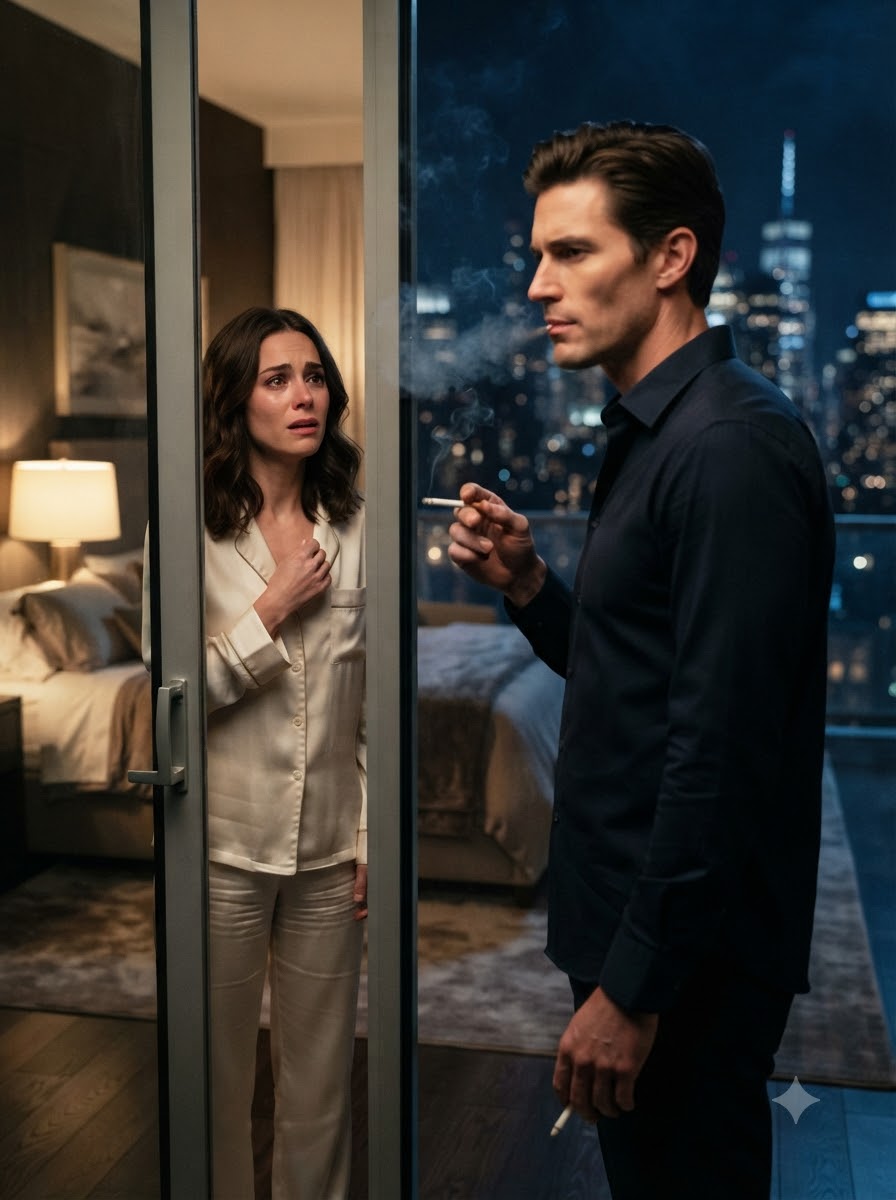
His arm pulled back from my body instantly. He got up, walked out onto the balcony, and lit a cigarette.
“Mabel, there are things I don’t tell you because you don’t need to know them. Chloe isn’t like other women. If you don’t make a scene, she’ll never bother you.”
Just like that. Without a shred of shame. As if I were the intruder in my own marriage.
“Then make a choice,” I told him, stepping onto the balcony. “It’s her or me.”
Ethan set his jaw.
For three long years, I had waited for him to come back while he led a major expansion for Vance Global in Illinois. We had talked about having children when he returned, about finally having the large, formal wedding we never had, about making up for lost time.
But from his very first night home, I knew something was deeply wrong.
Ethan always came home freshly showered. Always. He could wash off another woman’s perfume, but he hadn’t realized I would recognize the sweet, lingering scent of a luxury body wash he had never bought for himself.
And that morning, I had found something far worse.
Chloe Vance, twenty seven years old, an assistant in his international corporate office.
Ethan had quietly funded her brother’s startup, paid for the renovation of her parents’ home in Ohio, and flown across the country specifically for her mother’s sixtieth birthday party.
Meanwhile, in three whole years, he had never once flown back for mine.
When I confronted him with it, his eyes dropped. For a split second, I thought I saw a flash of guilt.
Then he pulled me into an embrace. “Just give me time. I’m going to break things off with her.”
Those words still carried the familiar tone of the man I had fallen in love with. But deep down, I already knew that man no longer existed.
That night, Ethan slept in the guest room.
At two in the morning, I went downstairs for a glass of water and heard his voice coming from the study. He was on a video call.
“Why did you tell her about me?” Chloe asked in a soft, childish whine. “Now she probably hates me.”
Ethan let out a quiet laugh, a sound I hadn’t heard him make with me in years. “As long as I’m here, nobody is going to touch you.”
A brief pause followed.
“Come over early tomorrow,” he added smoothly. “I want to have a breakfast you made.”
I stood frozen in the hallway.
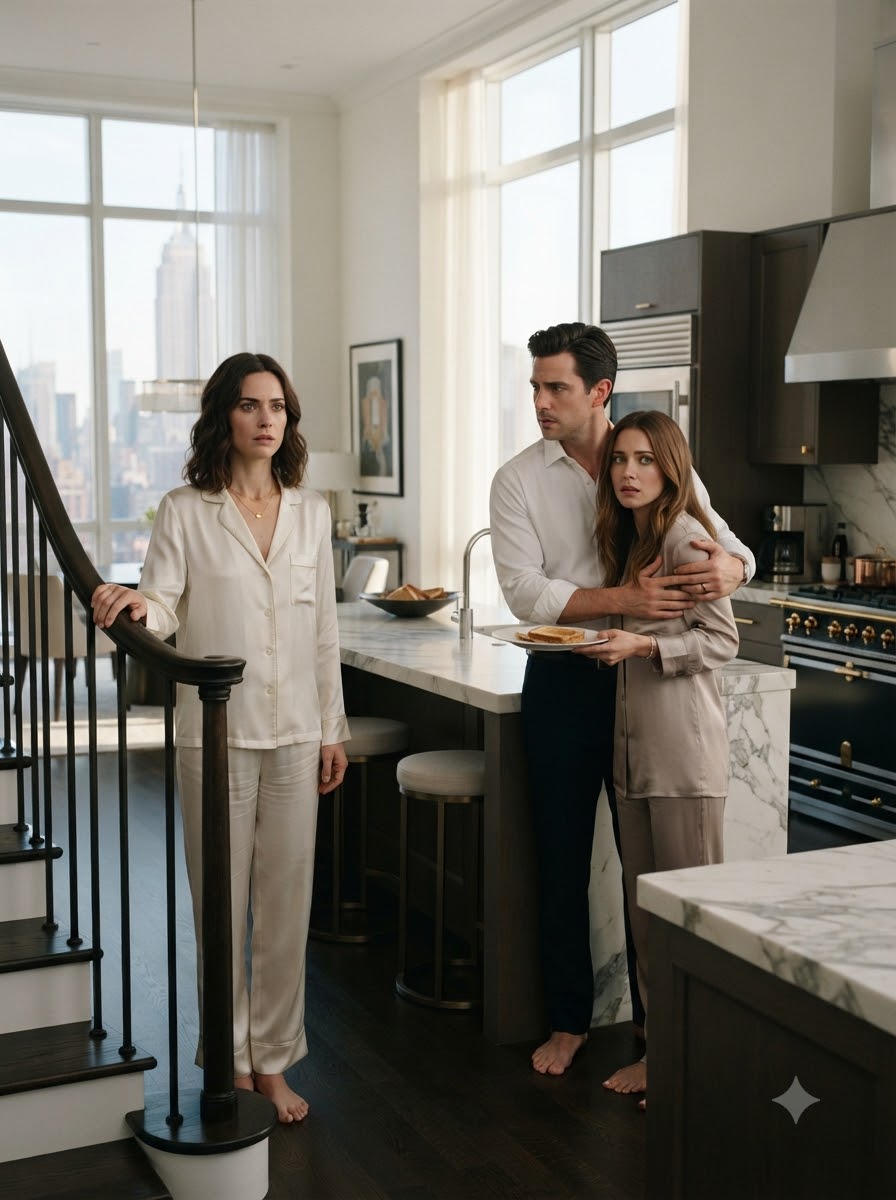
The next morning, I walked downstairs in my pajamas. Chloe was already there in our kitchen. Young, immaculate, smiling, her arms wrapped tightly around the man who was still my husband.
When she saw me, she feigned shock and shrank behind him. “Oh… I’m so sorry. I’m scared she’s going to be angry with me.”
Ethan looked at me instantly, as if I were a volatile threat.
Then he introduced us: “Mabel, this is Chloe.”
I took another step down the stairs.
Chloe walked toward me holding a hot breakfast plate. Before I could even reach her, she dramatically let herself drop to the hardwood floor, spilling the food.
Ethan rushed forward to pull her up. “Mabel! I told you not to hurt her!”
I stared at him in utter disbelief. “I didn’t touch her.”
“Chloe is very delicate,” he snapped. “You can’t act like this!”
I looked him straight in the eyes. “I didn’t push her, Ethan. Look at me and tell me you believe me.”
Ethan hesitated. It lasted only a second.
Then Chloe buried her face against his chest, sobbing, and he stopped looking at me altogether.
In that single second, I understood that my marriage hadn’t just broken.
It had been dead for three years.
And what I did next was something neither of them ever saw coming.
PART 2
Two days later, Ethan completely stopped hiding Chloe.
First, he brought her to corporate strategy meetings. Then to high profile business dinners. Finally, to private parties where all our mutual friends knew perfectly well that I was still his lawful wife.
Chloe went overnight from “the office assistant” to the woman walking arm in arm with him through every room in New York.
The absurd part was that Ethan continued to insist he had no intention of divorcing me.
At a mutual friend’s anniversary party, one of his oldest colleagues pulled him aside. “Ethan, enough is enough. Mabel is your wife. You can’t bring another woman on your arm and expect everyone in our circle to act like this is normal.”
I had arrived at the party alone.
Ethan spotted me from across the ballroom and, perhaps feeling a sudden pang of social embarrassment under the cold glares of our peers, dropped Chloe’s hand. He walked over to me and wrapped his arm possessively around my waist.
“You know no one could ever take your place, Mabel,” he whispered.
Then, right in front of Chloe, he pressed a deliberate kiss to my cheek.
Chloe offered a tight, polite smile, but her eyes burned with pure fury.
That was the moment I decided to stop competing.
I started calculating instead.
Later that evening, I overheard Ethan talking to a few close associates in a private cigar lounge. “Of course I care about Chloe,” he said smoothly, “but Mabel is a different story. I’m just furious that she reconnected with her family recently. The Sterling family looked down on me for years.”
My family had never wanted me to marry him.
My father had warned me that Ethan didn’t love me nearly as much as he loved the access and credibility my family name provided. But back then, I had defended Ethan fiercely. I distanced myself from my parents. I married him quietly at city hall without a lavish wedding because he insisted he needed to establish his own standing within Vance Global first.
And now he was punishing me because, after years of distance, I had reconnected with my mother.
For illustrative purposes only
“Chloe is temporary,” Ethan continued in the lounge. “I already promised Mabel I’d end it.”
Then I caught sight of Chloe standing behind the heavy velvet curtain, hearing every single word. When she turned around, she found me standing directly in front of her.
“Now you know your place,” I whispered coldly.
Her face drained of all color.
The very next morning, my private investigator received exceptionally simple instructions: observe, document, and do not intervene.
I didn’t have to wait long.
Chloe called Ethan thirty nine times in a single evening. He finally answered while he and I were driving home from a charity event.
“I lost my apartment keys!” she sobbed over the speakerphone. “There’s a strange man in the hallway… I’m terrified!”
A muffled scream followed, and the line went dead.
Ethan ordered the driver to turn the car around immediately. I got out at the next red light.
Half an hour later, my investigator sent high resolution photographs of the two of them kissing on the staircase of her apartment building.
I had the photos printed. But I didn’t leak them to the press.
Instead, I had them delivered anonymously directly to Chloe, alongside older archived photos proving their affair had been going on for three full years.
I knew with absolute certainty what she would do.
Chloe was a prominent lifestyle influencer with hundreds of thousands of followers who tracked her luxury travels, wardrobe, and high society lifestyle.
That very night, she posted the photos to her public profile with the caption:
“After three years of hiding in the shadows, we can finally tell our truth.”
The scandal exploded across social media and financial news outlets overnight.
Ethan stormed into our penthouse in an absolute rage. He smashed decorative vases, slammed doors, and threw my phone onto the floor, shattering the glass.
“You leaked those photos!” he screamed, his face contorted. “You’re trying to ruin my career because you’re jealous!”
Ignoring the sharp pain in my ankle where the phone had bounced off my foot, I unlocked my tablet and pulled up Chloe’s live feed.
A video had been posted minutes prior: Ethan was fast asleep in bed right beside her.
Ethan went ghost white. “Mabel… I didn’t know she posted that.”
He looked around at the destruction he had just caused in our living room. “I’m sorry. Forgive me.”
I didn’t say a word.
Because while he was stammering apologies, my attorney had already spent hours finalizing the divorce petition that Ethan was convinced I would never have the courage to sign.
And he had no idea what my non negotiable conditions for that divorce were going to be.
PART 3
When I walked into the executive headquarters of Vance Global accompanied by my senior counsel, the front desk security didn’t even recognize me at first.
I found the irony almost amusing.
Ethan and I had kept our marriage strictly out of the corporate press for years because he always claimed he needed to build his own reputation without being accused of riding the coattails of the Sterling family estate.
Chloe, on the other hand, had become a minor celebrity inside the building. Several junior staffers were clustered around her desk, asking her about wedding dresses.
“We haven’t set an official date yet,” she was saying, feigning sweet modesty.
When she saw me approach, her posture stiffened.
I walked straight past her toward Ethan’s corner office. Chloe tried to follow me, but Ethan’s executive assistant stepped in front of her.
“The meeting is private, Chloe.”
“But I’m his…”
“Mr. Vance explicitly instructed that you are not to enter,” the assistant said firmly, before adding in a hushed, patronizing tone: “The jeweler just delivered the ring he requested. You can wait in the executive boardroom.”
I walked into his office without looking back.
Ethan sat behind his massive mahogany desk. The second he recognized my attorney, his confident smile vanished.
My attorney set the divorce settlement flat onto his desk.
“What is this, Mabel?” Ethan asked, his voice tight.
“It is exactly what it looks like,” I replied smoothly.
Ethan looked at me as if I had dealt him a deep personal betrayal. “Mabel, you and I swore an oath to stay together for life.”
My attorney raised an eyebrow. “According to our records, Mr. Vance, it was your own board of directors that recommended you formalize a quiet divorce to mitigate the severe reputational damage caused by your public extramarital scandal.”
Ethan averted his gaze.
That was when I realized he had already spoken to his grandfather, the chairman. The Vance family wanted to spin the public narrative into a clean, romantic story: Ethan had quietly dissolved an outdated marriage and subsequently pursued a relationship with Chloe. A much more palatable lie for their shareholders.
“I don’t actually want to divorce you, Mabel,” Ethan said, leaning forward the moment my attorney stepped outside to take a call. “We just need to do this for the public eye.”
I remained silent, letting him speak.
Then Ethan laid out his extraordinary, delusional plan.
We would officially divorce. He would publicly marry Chloe. We would wait one year. Then he would divorce Chloe, execute a private NDA, and quietly come back to me.
“Even if I have to stand at an altar with Chloe,” he said, taking my hands in his, “you will always be my real wife.”
A sudden urge to laugh out loud washed over me. Instead, I lowered my eyes, playing the part.
“I agree,” I whispered softly.
Ethan froze, stunned. “Really?”
I nodded gently.
He pulled me into an embrace so tight he lifted me slightly off the floor. “I knew you still loved me.”
“I have one condition,” I added against his shoulder.
“Anything you want.”
“I want the liquid capital legally under your personal name that corresponds to our marital asset distribution. I want the division finalized right now, before any public wedding takes place.”
He frowned slightly.
I let my eyes glaze over with artificial emotion. “I’m just terrified that you’ll end up genuinely falling in love with her, Ethan… and I’ll be left with nothing.”
His expression instantly softened into condescending pity. He reached up, gently caressing my cheek. “You foolish girl. Chloe could never mean to me what you mean.”
He signed the papers on the spot.
He didn’t understand that I wasn’t purchasing security.
I was purchasing my absolute freedom.
Over the next three weeks, my legal and forensic teams audited every account, investment, and property portfolio. I didn’t seek to strip him of anything that wasn’t legally mine under marital law. I didn’t need to. My family possessed substantial wealth long before I met Ethan, and we would continue to possess it long after him.
What mattered was severing our financial ties before the corporate disaster I suspected was brewing at Vance Global finally caught up to him.
On the day our divorce decree was officially entered into the court record, Ethan made one final request.
“Chloe wants to live in the penthouse,” he said smoothly. “She says she fell in love with it the morning she came over for breakfast.”
I looked at him for several long seconds. “Fine by me.”
Relief washed across his face. He had clearly expected a bitter argument.
Instead, that very afternoon, I hired a professional moving crew.
I removed every single piece of furniture I had purchased, my private art collection, my books, the antique silverware inherited from my grandmother, the designer light fixtures, my plants, my personal belongings, and even the espresso machine.
When Ethan walked into the penthouse that evening, he stepped into an echoing, hollow shell.
“What happened here?” he demanded.
Teresa, the housekeeper who had worked for my family since before my marriage, looked at him flatly. “Mrs. Vance took her belongings.”
Ethan surveyed the empty rooms and offered a faint, arrogant smirk. “She’s just throwing a dramatic tantrum.”
Teresa looked at him with an expression I will never forget. She slowly unknotted her apron and set it on the bare counter.
“And I am leaving as well, Mr. Vance.”
“Why?” he asked, genuinely confused.
“Because I work for Mabel Sterling, not for this apartment.”
Ethan looked baffled for a moment, but eventually shrugged it off. “Make sure she stays safe.”
He genuinely believed I was throwing a temper tantrum. He still believed he would come looking for me a year later to reclaim his dutiful wife. He still didn’t understand that some women grieve their love in total silence long before they ever walk out the door.
I moved back to my parents’ estate in Greenwich.
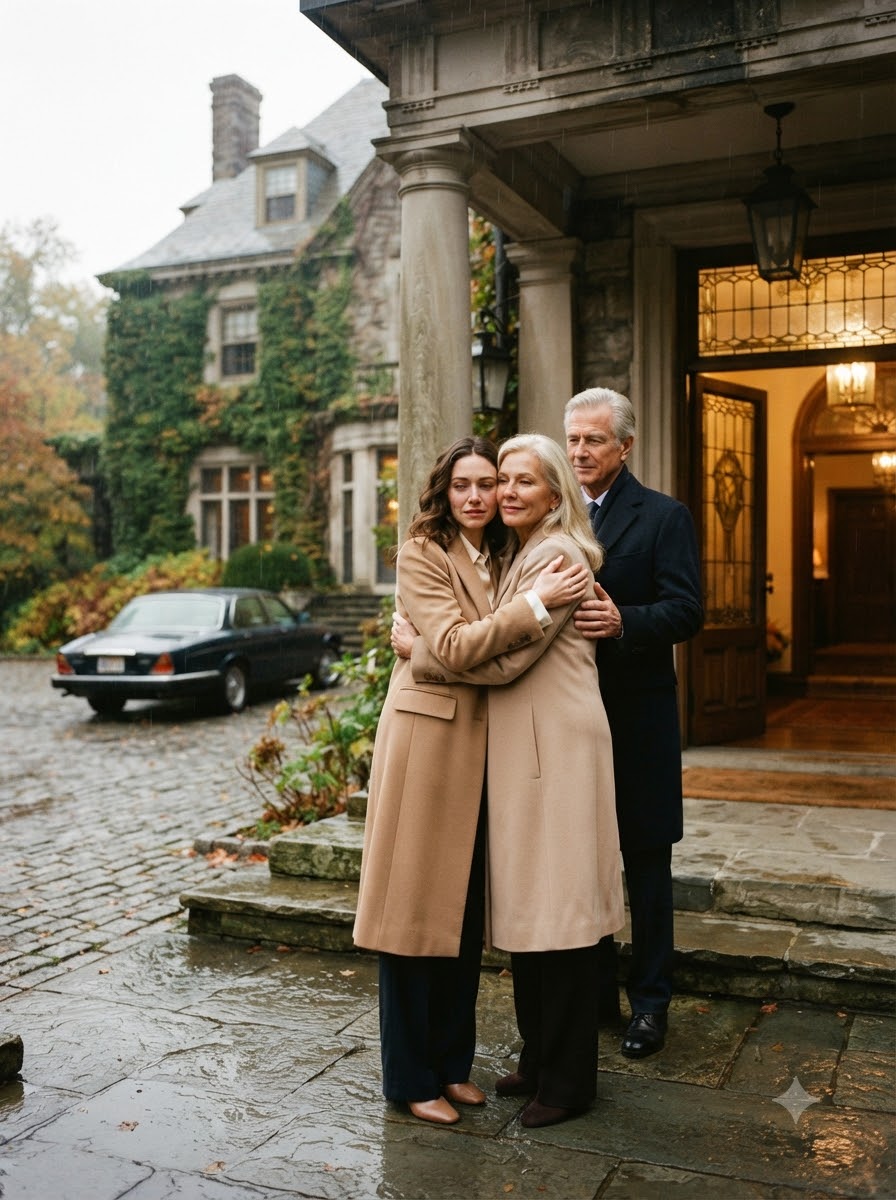
My mother opened the grand front doors herself. She didn’t say “I told you so.” She didn’t ask why it had taken me three years to see the truth. She simply wrapped her arms around me. My father stood right behind her in the foyer.
For illustrative purposes only
For years, Ethan had claimed that my family despised him because of his modest corporate origins. And there was a grain of truth to that. My father had been harsh when Ethan initially asked for my hand in marriage. He had told me outright that he would never approve of his daughter marrying a man who seemed far more interested in leveraging the Sterling name to gain corporate influence at Vance Global than in building a genuine marriage.
Back then, I had viewed my father as elitist. I had argued with my family. I had moved out.
Afterward, I used my personal network to help Ethan secure high level contacts, institutional backing, and investment opportunities that no executive his age could have acquired on his own.
Ethan always maintained that he achieved his rapid rise entirely by himself. I never corrected him.
Now, I finally understood what my father had seen all along. It wasn’t that Ethan came from a secondary branch of the Vance family, it was that he was driven by an unquenchable need to prove he was superior to everyone around him. Superior to his colleagues. Superior to my family. Superior to me.
When he secured the international expansion project three years ago, he viewed it as his ultimate moment of personal validation.
I had offered to move to Chicago with him. He had refused.
Months later, I even flew out unannounced to surprise him at his hotel. I never made it past the airport terminal. One of Ethan’s junior aides met me at arrivals, claiming Ethan was in another state on urgent business, and recommended I take the next flight back to New York.
Years later, I discovered the truth: Chloe was already living in his hotel suite.
Ethan had a different narrative, of course. According to him, everything had started one evening when he fell ill. Chloe had stayed behind to take care of him. He felt vulnerable; she was there. Something happened between them, and he decided he had a “responsibility” toward her.
Responsibility. It was Ethan’s favorite word to dress up choices he desperately wanted to make anyway.
Out of “responsibility,” he funded her brother’s business. Out of “responsibility,” he bought a house for her parents. Out of “responsibility,” he took her to high profile dinners. Out of “responsibility,” he slept with her for three years.
And when he returned to New York, he intended to slowly discard her, until he discovered I had reconciled with my parents.
Then he decided to punish me. His affair became his way of proving that he could discard me, too.
His tragic mistake was believing I would sit around waiting for his return.
In the weeks following our divorce, Ethan began trying to reach me.
First with casual text messages: Have you eaten today?
Then with late night phone calls: I just wanted to hear your voice.
Finally, he showed up at my parents’ estate one rainy evening. My brother stepped out onto the porch to meet him.
“Mabel doesn’t want to see you, Ethan.”
“She is still my wife,” Ethan insisted.
“Not anymore.”
That single answer, my brother told me later, left Ethan standing in the rain completely speechless.
While Ethan was frantically attempting to reclaim a life he had dismantled himself, Chloe was busy orchestrating their grand society wedding.
An imported designer dress. A lavish venue in Manhattan. Exquisite floral arrangements flown in from abroad. An exclusive press feature with a major digital magazine. She even posted a high profile update:
“In the end, true love always wins.”
I was occupied with something far more serious.
During the financial audit for our divorce, my legal team had flagged several suspicious wire transfers linked to the international division Ethan had managed in Chicago. Non existent consulting firms. Shell vendors sharing identical corporate addresses. Invoices for services that were physically impossible to verify. Funds funneled into private holding entities tied to Ethan’s inner circle.
I asked my attorney flatly, “Could this create legal liability for me?”
“Now that your divorce is finalized and your assets are completely separated, no,” he replied. “In fact, we need to document that you had zero knowledge or participation in his corporate accounts.”
So we continued investigating. Not out of vengeance, but out of self preservation.
We uncovered that Ethan had authorized corporate maneuvers far more severe than simple accounting errors. A significant portion of the “spectacular growth” that had turned him into the rising star of Vance Global had been manufactured through illegal accounting shortcuts and shell company routing.
The moment I grasped the scale of the exposure, my legal team delivered the verified documentation directly to the proper regulatory authorities and Vance Global’s internal audit board.
I didn’t publish anything. I didn’t call reporters. I didn’t post cryptic messages online.
I simply protected my name.
On the eve of Ethan and Chloe’s wedding, federal investigators and internal auditors descended upon Vance Global’s corporate headquarters.
The corporate fallout was instantaneous and absolute.
The board of directors suspended Ethan from all executive duties immediately. They froze internal account transfers, ordered emergency forensic audits, and publicly announced that the activities under investigation had been conducted entirely without the knowledge or authorization of the executive board.
The wedding was canceled overnight.
Chloe woke up that morning believing she was about to become the wife of one of New York’s most promising corporate leaders. By that afternoon, she was packing her suitcases and vacating her luxury apartment because the building lease was held by a subsidiary entity linked to the firm.
Her brand sponsorships vanished within forty eight hours; corporate sponsors wanted no association with a high profile financial fraud investigation.
She tried reaching out to Ethan, then to his legal team, and finally to me.
I never answered her calls.
Several months later, after Ethan was formally indicted on multiple counts of corporate wire fraud and tax evasion, he requested a single meeting through his defense counsel.
I agreed to meet him once.
He was no longer wearing the immaculate, bespoke suits he had loved so much. He looked as if he had aged a decade in a matter of months.
When he saw me sit down across from him in the conference room, his eyes filled with tears. “I knew you’d come, Mabel.”
I sat composed in my chair. “I only came because your attorney stated you had something essential to say to me.”
Ethan took a long, shaky breath. “Thank you.”
I hadn’t expected that word. “For what?”
“Because you could have completely destroyed me personally,” he said, letting out a bitter, dry laugh. “You had the photos. The text messages. The proof of everything with Chloe. You could have gone to every media outlet in the country and told them I cheated on my wife for three years.”
He went silent for a moment. “And you didn’t.”
I looked at him calmly.
For years, this man had mistaken my love for weakness, my silence for obedience, my patience for an inability to walk away.
“Ethan, I need to clarify something for you,” I said softly.
He looked up.
“The photographs that ended up in Chloe’s hands? I had them delivered to her myself.”
The color drained instantly from his face. “What?”
“I knew the moment she received them, her ego would force her to post them publicly,” I explained evenly. “I didn’t need to leak anything. I simply held up a mirror and let her do it for me.”
Ethan began shaking his head in disbelief. “Mabel… you…”
“However, I never publicly broadcasted your infidelity,” I continued. “Not because I was protecting you, but because my family name was connected to yours. Because I was your wife. Because turning our private life into a public circus would have tarnished my own dignity.”
I stood up from my chair.
Ethan’s fists clenched on the table. “And the regulatory audit? Was that you too?”
I stopped, looking down at him. “When my attorneys uncovered fraudulent documents that could have dragged my personal trust into a criminal investigation, I did what any rational person would do: I protected myself and handed the evidence over to the auditors.”
“You turned me in?” he choked out.
“I didn’t manufacture a single fraudulent invoice, Ethan. I didn’t set up shell vendors. I didn’t sign your authorization forms.”
He opened his mouth to reply, but no words came.
As I turned toward the door, he called out quietly, “Mabel… I really did love you.”
I paused, looking back at him one last time. “I know.”
And it was the truth. I believe Ethan had loved me, in his own deeply flawed way. The insurmountable problem was that he loved his own ego, his resentment, his corporate status, the shallow admiration of Chloe, and the thrill of proving no one could ever abandon him far more.
And a point had arrived where all of those things weighed infinitely more than his respect for me.
“But loving someone doesn’t grant you the right to break them and then demand they wait around while you decide who you want to keep,” I said softly.
I walked out of the room.
Outside the facility, my mother was waiting in the back of our car. “Are you finished, sweetheart?”
“Yes, Mom. I’m finished.”
We pulled away into the afternoon traffic. My phone buzzed in my bag, a message from an unknown number.
Chloe.
“Don’t think you won just because he’s ruined. You lost Ethan too.”
I read it once, then permanently blocked the number.
Chloe still didn’t understand the fundamental truth I had taken far too long to learn:
Losing a man who lies to you, disrespects you, blames you for his own failures, and expects you to remain available while he builds a life with another woman is never a loss.
Sometimes, it is the exact way you reclaim your life.
For illustrative purposes only
And for the first time in three long years, as the car drove smoothly toward my family’s estate, I wasn’t thinking about Ethan at all.
I was thinking about my future.
Note: This story is a work of fiction inspired by real events. Names, characters, and details have been altered. Any resemblance is coincidental. The author and publisher disclaim accuracy, liability, and responsibility for interpretations or reliance. All images are for illustration purposes only.
The barrel of Officer Harlon Quill’s gun caught the sun and flashed white-hot, pointed dead center at Delaney Voss’s chest.
Heat rippled up off the blacktop in waves you could almost taste. Gravel crunched under her shoes. Behind her, the rental SUV ticked as the engine cooled, and the whole road smelled like dust and hot rubber and the dead weeds baking along the shoulder.
Delaney didn’t scream. She didn’t shake. She didn’t look away.
Quill smiled like a man who already knew how this ended.
Like a woman alone on some forgotten stretch of East Texas highway, out-of-state plates, a coffee cup sweating in the console, was just another easy stop. Another wallet he could squeeze without anybody ever finding out.
He had no idea who he’d just pulled over.
Three days before that, at 7:18 on a Tuesday night, Delaney’s phone rang while she was standing in her kitchen with a dish towel over her shoulder. It was her younger brother, Ronan, calling from a gas station bathroom outside Austin. He was trying to sound calm. He failed before he even got through her name.
“Del,” he said, and his voice cracked right there, one syllable in. “Del, they took it. They took all of it.”
She set the towel down slow, like moving fast might break whatever he was about to tell her.
“Took what, Ro? Slow down. Breathe.”
He’d been driving to college orientation that day. Freshman year, the one he’d worked two years to afford, picking up warehouse shifts on weekends, skipping dinners out with friends, skipping everything, really, just to save enough.
He kept the tuition money in an old bank envelope, soft at the corners from being handled so much, because the registrar’s office had told him more than once that the deadline was final. No extensions. No excuses.
He never made it to campus.
A local cop pulled him over outside a town called Cedar Ridge. No warning, no clear reason, just lights in his mirror and a voice telling a nineteen-year-old kid that a wad of cash sitting in his glovebox looked suspicious.
By 7:46 that same night, the envelope was gone. No police report. No seizure receipt. No case number, nothing. Just a scrawled citation Ronan had managed to snap a photo of on his phone before the officer snatched it back out of his hands.
One name was legible at the bottom of that photo.
Harlon Quill.
Delaney didn’t drive out to Cedar Ridge for revenge. She wants people to understand that part clearly, because it matters. She drove out there for answers. And answers, she’s learned over eleven years in the Bureau, have a funny way of making guilty men behave exactly like themselves, given enough rope.
Officially, she was on administrative leave that week, an unrelated case still working its way through review. Unofficially, she was behind the wheel of a rented Chevy Tahoe on a two-lane road outside a town most people had never heard of, dressed like any tired traveler passing through.
Jeans. A plain gray T-shirt. Sunglasses. Hair pulled back in a low ponytail. Phone mounted on the dash, angled just right, with a small camera tucked low enough on the windshield to catch the driver’s side window clean.
She’d learned a long time ago that corruption doesn’t announce itself with a mustache-twirl. It smiles at you. It calls you sweetheart. It asks one harmless little question while its hand is already easing toward your wallet.
She needed to know if Harlon Quill was one rotten badge working alone, or if the whole department around him had simply learned to look the other way.
So she drove five miles under the limit. Calm. Clean. Nothing to see here.
At 2:13 in the afternoon, she passed a barbecue joint’s sign, half-bleached white by years of sun. A small American flag snapped on a pole outside a feed store a little further down. She clocked the patrol car tucked in behind that sign before it even pulled out, but she kept her face easy, her hands loose on the wheel.
The cruiser slid out onto the road behind her.
At first it hung back, keeping a normal distance. Then, slowly, it crept closer, until the grille filled her whole rearview mirror.
Delaney tapped her brake once. Just enough to mark the gap, to make it obvious she was aware of him.
That was all the excuse he needed.
Red and blue lights exploded behind her, bouncing off her mirrors.
“Here we go,” she murmured to herself, and eased onto the gravel shoulder.
She cut the engine, rolled both front windows down, and set her hands on top of the wheel where anyone approaching could see them clearly. Basic procedure. No sudden moves. Nothing that could be twisted into an excuse.
But men like Quill were never actually looking for safety in a traffic stop. They were looking for obedience.
He got out of his cruiser like he owned the whole stretch of highway. Big through the shoulders, boots heavy on the gravel, one hand resting loose near his holster, the other hand carrying nothing but attitude.
When he reached her window, he didn’t say hello.
“You know how fast you were going, darling?”
“Below the speed limit, officer.”
His laugh came out dry as the weeds along the shoulder. “My radar says different. Reckless driving through a construction zone.”
“There hasn’t been a construction sign for miles.”
The smile slid right off his face.
“You calling me a liar, girl?”
“I’m stating a fact,” Delaney said evenly. “And I’d appreciate you not calling me that.”
That was more than enough for him.
His voice hardened instantly. He leaned in closer to her window, and then he ordered her out of the vehicle.
Delaney knew the law inside and out. She knew he had no probable cause, not a shred of one. But she also knew, from years of watching men exactly like him operate, that guys like Quill didn’t fear the law in the moment they were breaking it.
They counted on everybody else fearing them more than they feared any consequence down the road.
She opened her door slowly.
The heat hit her full in the chest the second she stepped out. Quill didn’t back up to give her room. He crowded her right up against the side of the SUV, forced her palms flat onto the hot hood, and then reached for the oldest, dirtiest line in the whole crooked-cop playbook.
“I smell marijuana.”
A cold thread ran straight down Delaney’s spine.
Not because she believed him for one second.
Because she knew exactly what usually came next.
His hands moved over her with slow, ugly confidence, taking his time in a way that had nothing to do with procedure. Then his eyes landed on the black bag sitting in her passenger seat.
“What’s in there?”
“My identification,” Delaney said, keeping her voice level. “And my badge.”
Quill barked out a laugh, loud and mean. “Your badge? What are you, mall security?”
Delaney turned her head just enough to make sure every word landed clean.
“I’m a special agent with the FBI. And you are making a very serious mistake.”
For one full second, the whole roadside seemed to hold its breath.
The weeds stopped moving in the wind. The cruiser engine hummed low behind them. A pickup truck slowed down in the far lane, the driver rubbernecking, then kept on going. Even Quill just stared at her for a beat, like her sentence had reached his ears in a language he badly didn’t want to understand.
Then he laughed again, shakier this time.
“Sure you are.”
Delaney reached one careful hand toward the open passenger door.
“I’m going to retrieve my credentials.”
“Don’t move!” he roared, and in one blink the Glock was already out of his holster.
The gun stayed leveled at her chest.
Inside the SUV, the hidden camera kept right on recording. The weapon. The distance between them. The anger twisting across his face. The way his finger sat too close to the trigger for anyone with proper training, which told her plenty about how little training he’d actually had, or how little he cared about following it.
But what Harlon Quill still didn’t understand, standing there with a gun pointed at an unarmed woman on the side of a public highway, was that this wasn’t the moment Delaney broke.
It was the moment his whole world started to crack open.
Because while he stood there grinning with a Glock in his hand, Delaney looked past his shoulder, into the reflection of her side mirror.
And she saw the nose of a second vehicle rolling slowly onto the shoulder, right behind his cruiser.
No siren. No hurry. Just steady, deliberate movement.
For the first time since the stop had started, Officer Harlon Quill’s smile twitched.
The second vehicle was an unmarked black Suburban, windows tinted so dark they seemed to swallow the afternoon sun whole. It rolled to a stop twenty feet behind his cruiser, engine idling with a low, heavy purr that somehow sounded more threatening than any siren could have.
Quill didn’t lower his weapon, but his eyes flicked toward his rearview mirror, and his jaw tightened visibly. “Tell your friend in the truck to stay back,” he growled, some of the casual cruelty draining out of his voice. “This is a local traffic stop. I’m the authority here.”
“You were the authority, Harlon,” Delaney said, her voice dropping into something ice-cold and completely without fear. “Past tense.”
The driver’s door of the Suburban swung open. A tall man in a charcoal suit stepped out onto the gravel, and he didn’t look anything like a local deputy. No Stetson, no cowboy boots, nothing local about him at all.
He carried himself with the slow, deliberate weight of a man who’d already read the last chapter of whatever story was unfolding here.
Assistant Special Agent in Charge Marcus Vance walked toward them, and his voice carried easily across the hot, empty highway.
“Officer Quill. Keep that weapon exactly where it is. If that barrel moves an inch off its current angle, my team is going to treat that as an active threat against a federal agent.”
Quill’s face went the color of old milk. All that bravado he’d built up over years of shaking down college kids and out-of-towners started curdling right there on the pavement.
“She reached into the vehicle!” he shouted, his voice cracking under the strain. “She refused a lawful order! I smelled narcotics, I had reasonable suspicion—”
“The only thing rotting out here is your story,” Delaney said quietly.
She didn’t wait for him to lower the gun himself. In one smooth, practiced motion, she reached past his locked elbow, into the passenger seat, and pulled out her leather credential case. She flipped it open with a snap. The gold federal shield caught the sun and threw a hard, blinding glint straight into his eyes.
“Special Agent Delaney Voss,” she said, staring right into his pupils. “Public Corruption Unit. We’ve had your precinct’s asset forfeiture records under review for six months, Harlon. But you got greedy. You took a badge and a thin blue line and turned it into a highway robbery operation. And three days ago, you robbed my little brother.”
The mention of Ronan made whatever confidence Quill had left completely collapse. The gun in his hand started trembling, that steel Glock suddenly seeming to weigh a hundred pounds in his grip.
“I didn’t know,” he muttered, the smirk long gone now, replaced by the hollow, trapped look of an animal that finally understood the cage door had already shut. “I didn’t know who he was.”
“That’s the whole tragedy of men like you,” Delaney said, stepping forward, forcing him into a choice, shoot a federal agent in broad daylight or back down.
“You only respect the law when it’s protecting you. When it’s a nineteen-year-old kid with his whole future stuffed into an envelope, you think you’re God out here.”
Two more agents climbed out of the Suburban, weapons held low and ready. The trap, months in the building, finally closed shut.
Quill’s hands went up slowly. The Glock clattered down onto the hot asphalt of Highway 290, a sound that seemed to echo far longer than it should have.
Within minutes, that lonely stretch of road transformed into a full command post. The local sheriff’s department, tipped off only minutes before the takedown to keep any internal leaks from reaching Quill first, rolled in with lights flashing, not to help him, but to put as much visible distance between
themselves and him as possible.
Delaney stood by the hood of her rental, watching agents move methodically through Quill’s patrol car. She didn’t feel triumphant, not really. The air was too hot, and Ronan’s panicked voice from three nights earlier was still too fresh in her ears.
Vance walked over and handed her a bottle of water already sweating in the heat. “You alright, Delaney?”
“I’m fine,” she said, though her eyes stayed fixed past him, on the open trunk of Quill’s cruiser.
An agent had just popped the latch. Underneath the spare tire and a pile of dirty roadside flares sat a heavy, locked tactical box. When they forced it open, it didn’t hold emergency gear. It held rows of manila envelopes, rubber-banded stacks of cash, and a ledger written out in Quill’s own sloppy
handwriting. It was the accumulated misery of hundreds of drivers who’d been bullied into silence over the years, all of it sitting there in a box in his trunk like trophies.
“We found your brother’s envelope,” Vance said quietly, checking a notification on his phone. “Four thousand two hundred dollars. His name’s written across the front in black marker. Somebody crossed it out and wrote ‘abandoned’ next to it.”
Delaney took a slow breath, feeling something tight in her chest loosen, just barely. “It wasn’t abandoned,” she said. “It was stolen.”
“The U.S. Attorney’s already drawing up the indictment,” Vance told her. “Civil rights violations under color of law. Extortion. Wire fraud. He’s looking at twenty years minimum, and the state’s going to drop him like a bad habit to protect themselves.”
She looked across the blacktop to where Quill was being pushed, hands cuffed behind his back, into the rear of a transport van. He looked smaller now, without the belt, without the badge, his uniform shirt soaked through with sweat and streaked gray with roadside dust. He looked exactly like what he
actually was underneath the costume the whole time. A thief who’d somehow been handed a gun and a badge and told he was allowed to use both.
The flight back to Austin was quiet. But the short drive afterward, out to the small apartment Ronan shared with two roommates near campus, felt longer than the entire investigation combined.
When Delaney knocked on his door, it opened almost instantly, like he’d been sitting right there waiting for hours. Ronan stood in the doorway looking exhausted, dark circles under his eyes from three sleepless nights, the crushing weight of believing his whole future had been erased by a man who didn’t
even bother to learn his name before taking it from him.
Delaney didn’t say anything at first. She just reached into her jacket pocket and pulled out the worn bank envelope, slightly creased now, a federal evidence tag clipped to the top corner. The money inside was untouched.
Ronan stared at it for a long moment. His lips parted, but no sound came out at first. He looked up at his sister, and his eyes filled with tears almost instantly.
“He’s not going to hurt anyone else, Ro,” Delaney said, her voice finally softening after days of holding steady. “It’s over.”
Ronan threw his arms around her, burying his face into her shoulder, his whole body shaking. He didn’t ask how she’d done it. He didn’t ask about the highway, or the gun pointed at her chest, or the federal grand jury already convening down in San Antonio. He just held onto his sister, the only person in his
life who’d believed a scared nineteen-year-old kid over the word of a man wearing a badge.
Later that night, Delaney sat out on her small balcony, looking over the Austin skyline as the heat finally started to break. Her phone buzzed with a link to a local news broadcast.
Breaking: Cedar Ridge Police Officer Arrested By FBI In Multi-Year Highway Extortion Scheme. Authorities Urge Potential Victims To Come Forward.
She watched a grainy mugshot of Harlon Quill flash across her screen. He wasn’t smiling in it. Not anymore.
She turned the screen off and leaned back against the railing, watching the Texas twilight fade slowly into a deep, bruised purple over the city. The system was broken in a thousand different places, she knew that better than most people ever would. She wasn’t naive enough to think she’d fixed all of it, or even most of it.
But today, on one forgotten stretch of highway outside a town most people would never hear of, the law had finally done exactly what it was supposed to do all along.
It had protected the innocent. And it had broken the man who’d spent years convincing himself he was above it.The barrel of Officer Harlon Quill’s gun caught the sun and flashed white-hot, pointed dead center at Delaney Voss’s chest.
Heat rippled up off the blacktop in waves you could almost taste. Gravel crunched under her shoes. Behind her, the rental SUV ticked as the engine cooled, and the whole road smelled like dust and hot rubber and the dead weeds baking along the shoulder.
Delaney didn’t scream. She didn’t shake. She didn’t look away.
Quill smiled like a man who already knew how this ended.
Like a woman alone on some forgotten stretch of East Texas highway, out-of-state plates, a coffee cup sweating in the console, was just another easy stop. Another wallet he could squeeze without anybody ever finding out.
He had no idea who he’d just pulled over.
Three days before that, at 7:18 on a Tuesday night, Delaney’s phone rang while she was standing in her kitchen with a dish towel over her shoulder. It was her younger brother, Ronan, calling from a gas station bathroom outside Austin. He was trying to sound calm. He failed before he even got through her name.
“Del,” he said, and his voice cracked right there, one syllable in. “Del, they took it. They took all of it.”
She set the towel down slow, like moving fast might break whatever he was about to tell her.
“Took what, Ro? Slow down. Breathe.”
He’d been driving to college orientation that day. Freshman year, the one he’d worked two years to afford, picking up warehouse shifts on weekends, skipping dinners out with friends, skipping everything, really, just to save enough. He kept the tuition money in an old bank envelope, soft at the corners from
being handled so much, because the registrar’s office had told him more than once that the deadline was final. No extensions. No excuses.
He never made it to campus.
A local cop pulled him over outside a town called Cedar Ridge. No warning, no clear reason, just lights in his mirror and a voice telling a nineteen-year-old kid that a wad of cash sitting in his glovebox looked suspicious.
By 7:46 that same night, the envelope was gone. No police report. No seizure receipt. No case number, nothing. Just a scrawled citation Ronan had managed to snap a photo of on his phone before the officer snatched it back out of his hands.
One name was legible at the bottom of that photo.
Harlon Quill.
Delaney didn’t drive out to Cedar Ridge for revenge. She wants people to understand that part clearly, because it matters. She drove out there for answers. And answers, she’s learned over eleven years in the Bureau, have a funny way of making guilty men behave exactly like themselves, given enough rope.
Officially, she was on administrative leave that week, an unrelated case still working its way through review. Unofficially, she was behind the wheel of a rented Chevy Tahoe on a two-lane road outside a town most people had never heard of, dressed like any tired traveler passing through. Jeans. A plain
gray T-shirt. Sunglasses. Hair pulled back in a low ponytail. Phone mounted on the dash, angled just right, with a small camera tucked low enough on the windshield to catch the driver’s side window clean.
She’d learned a long time ago that corruption doesn’t announce itself with a mustache-twirl. It smiles at you. It calls you sweetheart. It asks one harmless little question while its hand is already easing toward your wallet.
She needed to know if Harlon Quill was one rotten badge working alone, or if the whole department around him had simply learned to look the other way.
So she drove five miles under the limit. Calm. Clean. Nothing to see here.
At 2:13 in the afternoon, she passed a barbecue joint’s sign, half-bleached white by years of sun. A small American flag snapped on a pole outside a feed store a little further down. She clocked the patrol car tucked in behind that sign before it even pulled out, but she kept her face easy, her hands loose on the wheel.
The cruiser slid out onto the road behind her.
At first it hung back, keeping a normal distance. Then, slowly, it crept closer, until the grille filled her whole rearview mirror.
Delaney tapped her brake once. Just enough to mark the gap, to make it obvious she was aware of him.
That was all the excuse he needed.
Red and blue lights exploded behind her, bouncing off her mirrors.
“Here we go,” she murmured to herself, and eased onto the gravel shoulder.
She cut the engine, rolled both front windows down, and set her hands on top of the wheel where anyone approaching could see them clearly. Basic procedure. No sudden moves. Nothing that could be twisted into an excuse.
But men like Quill were never actually looking for safety in a traffic stop. They were looking for obedience.
He got out of his cruiser like he owned the whole stretch of highway. Big through the shoulders, boots heavy on the gravel, one hand resting loose near his holster, the other hand carrying nothing but attitude.
When he reached her window, he didn’t say hello.
“You know how fast you were going, darling?”
“Below the speed limit, officer.”
His laugh came out dry as the weeds along the shoulder. “My radar says different. Reckless driving through a construction zone.”
“There hasn’t been a construction sign for miles.”
The smile slid right off his face.
“You calling me a liar, girl?”
“I’m stating a fact,” Delaney said evenly. “And I’d appreciate you not calling me that.”
That was more than enough for him.
His voice hardened instantly. He leaned in closer to her window, and then he ordered her out of the vehicle.
Delaney knew the law inside and out. She knew he had no probable cause, not a shred of one. But she also knew, from years of watching men exactly like him operate, that guys like Quill didn’t fear the law in the moment they were breaking it. They counted on everybody else fearing them more than they feared
any consequence down the road.
She opened her door slowly.
The heat hit her full in the chest the second she stepped out. Quill didn’t back up to give her room. He crowded her right up against the side of the SUV, forced her palms flat onto the hot hood, and then reached for the oldest, dirtiest line in the whole crooked-cop playbook.
“I smell marijuana.”
A cold thread ran straight down Delaney’s spine.
Not because she believed him for one second.
Because she knew exactly what usually came next.
His hands moved over her with slow, ugly confidence, taking his time in a way that had nothing to do with procedure. Then his eyes landed on the black bag sitting in her passenger seat.
“What’s in there?”
“My identification,” Delaney said, keeping her voice level. “And my badge.”
Quill barked out a laugh, loud and mean. “Your badge? What are you, mall security?”
Delaney turned her head just enough to make sure every word landed clean.
“I’m a special agent with the FBI. And you are making a very serious mistake.”
For one full second, the whole roadside seemed to hold its breath.
The weeds stopped moving in the wind. The cruiser engine hummed low behind them. A pickup truck slowed down in the far lane, the driver rubbernecking, then kept on going. Even Quill just stared at her for a beat, like her sentence had reached his ears in a language he badly didn’t want to understand.
Then he laughed again, shakier this time.
“Sure you are.”
Delaney reached one careful hand toward the open passenger door.
“I’m going to retrieve my credentials.”
“Don’t move!” he roared, and in one blink the Glock was already out of his holster.
The gun stayed leveled at her chest.
Inside the SUV, the hidden camera kept right on recording. The weapon. The distance between them. The anger twisting across his face. The way his finger sat too close to the trigger for anyone with proper training, which told her plenty about how little training he’d actually had, or how little he cared about following it.
But what Harlon Quill still didn’t understand, standing there with a gun pointed at an unarmed woman on the side of a public highway, was that this wasn’t the moment Delaney broke.
It was the moment his whole world started to crack open.
Because while he stood there grinning with a Glock in his hand, Delaney looked past his shoulder, into the reflection of her side mirror.
And she saw the nose of a second vehicle rolling slowly onto the shoulder, right behind his cruiser.
No siren. No hurry. Just steady, deliberate movement.
For the first time since the stop had started, Officer Harlon Quill’s smile twitched.
The second vehicle was an unmarked black Suburban, windows tinted so dark they seemed to swallow the afternoon sun whole. It rolled to a stop twenty feet behind his cruiser, engine idling with a low, heavy purr that somehow sounded more threatening than any siren could have.
Quill didn’t lower his weapon, but his eyes flicked toward his rearview mirror, and his jaw tightened visibly. “Tell your friend in the truck to stay back,” he growled, some of the casual cruelty draining out of his voice. “This is a local traffic stop. I’m the authority here.”
“You were the authority, Harlon,” Delaney said, her voice dropping into something ice-cold and completely without fear. “Past tense.”
The driver’s door of the Suburban swung open. A tall man in a charcoal suit stepped out onto the gravel, and he didn’t look anything like a local deputy. No Stetson, no cowboy boots, nothing local about him at all. He carried himself with the slow, deliberate weight of a man who’d already read the last chapter of whatever story was unfolding here.
Assistant Special Agent in Charge Marcus Vance walked toward them, and his voice carried easily across the hot, empty highway.
“Officer Quill. Keep that weapon exactly where it is. If that barrel moves an inch off its current angle, my team is going to treat that as an active threat against a federal agent.”
Quill’s face went the color of old milk. All that bravado he’d built up over years of shaking down college kids and out-of-towners started curdling right there on the pavement.
“She reached into the vehicle!” he shouted, his voice cracking under the strain. “She refused a lawful order! I smelled narcotics, I had reasonable suspicion—”
“The only thing rotting out here is your story,” Delaney said quietly.
She didn’t wait for him to lower the gun himself. In one smooth, practiced motion, she reached past his locked elbow, into the passenger seat, and pulled out her leather credential case. She flipped it open with a snap. The gold federal shield caught the sun and threw a hard, blinding glint straight into his eyes.
“Special Agent Delaney Voss,” she said, staring right into his pupils. “Public Corruption Unit. We’ve had your precinct’s asset forfeiture records under review for six months, Harlon. But you got greedy. You took a badge and a thin blue line and turned it into a highway robbery operation. And three days ago, you robbed my little brother.”
The mention of Ronan made whatever confidence Quill had left completely collapse. The gun in his hand started trembling, that steel Glock suddenly seeming to weigh a hundred pounds in his grip.
“I didn’t know,” he muttered, the smirk long gone now, replaced by the hollow, trapped look of an animal that finally understood the cage door had already shut. “I didn’t know who he was.”
“That’s the whole tragedy of men like you,” Delaney said, stepping forward, forcing him into a choice, shoot a federal agent in broad daylight or back down. “You only respect the law when it’s protecting you. When it’s a nineteen-year-old kid with his whole future stuffed into an envelope, you think you’re God out here.”
Two more agents climbed out of the Suburban, weapons held low and ready. The trap, months in the building, finally closed shut.
Quill’s hands went up slowly. The Glock clattered down onto the hot asphalt of Highway 290, a sound that seemed to echo far longer than it should have.
Within minutes, that lonely stretch of road transformed into a full command post. The local sheriff’s department, tipped off only minutes before the takedown to keep any internal leaks from reaching Quill first, rolled in with lights flashing, not to help him, but to put as much visible distance between themselves and him as possible.
Delaney stood by the hood of her rental, watching agents move methodically through Quill’s patrol car. She didn’t feel triumphant, not really. The air was too hot, and Ronan’s panicked voice from three nights earlier was still too fresh in her ears.
Vance walked over and handed her a bottle of water already sweating in the heat. “You alright, Delaney?”
“I’m fine,” she said, though her eyes stayed fixed past him, on the open trunk of Quill’s cruiser.
An agent had just popped the latch. Underneath the spare tire and a pile of dirty roadside flares sat a heavy, locked tactical box. When they forced it open, it didn’t hold emergency gear. It held rows of manila envelopes, rubber-banded stacks of cash, and a ledger written out in Quill’s own sloppy
handwriting. It was the accumulated misery of hundreds of drivers who’d been bullied into silence over the years, all of it sitting there in a box in his trunk like trophies.
“We found your brother’s envelope,” Vance said quietly, checking a notification on his phone. “Four thousand two hundred dollars. His name’s written across the front in black marker. Somebody crossed it out and wrote ‘abandoned’ next to it.”
Delaney took a slow breath, feeling something tight in her chest loosen, just barely. “It wasn’t abandoned,” she said. “It was stolen.”
“The U.S. Attorney’s already drawing up the indictment,” Vance told her. “Civil rights violations under color of law. Extortion. Wire fraud. He’s looking at twenty years minimum, and the state’s going to drop him like a bad habit to protect themselves.”
She looked across the blacktop to where Quill was being pushed, hands cuffed behind his back, into the rear of a transport van. He looked smaller now, without the belt, without the badge, his uniform shirt soaked through with sweat and streaked gray with roadside dust. He looked exactly like what he
actually was underneath the costume the whole time. A thief who’d somehow been handed a gun and a badge and told he was allowed to use both.
The flight back to Austin was quiet. But the short drive afterward, out to the small apartment Ronan shared with two roommates near campus, felt longer than the entire investigation combined.
When Delaney knocked on his door, it opened almost instantly, like he’d been sitting right there waiting for hours. Ronan stood in the doorway looking exhausted, dark circles under his eyes from three sleepless nights, the crushing weight of believing his whole future had been erased by a man who didn’t even bother to learn his name before taking it from him.
Delaney didn’t say anything at first. She just reached into her jacket pocket and pulled out the worn bank envelope, slightly creased now, a federal evidence tag clipped to the top corner. The money inside was untouched.
Ronan stared at it for a long moment. His lips parted, but no sound came out at first. He looked up at his sister, and his eyes filled with tears almost instantly.
“He’s not going to hurt anyone else, Ro,” Delaney said, her voice finally softening after days of holding steady. “It’s over.”
Ronan threw his arms around her, burying his face into her shoulder, his whole body shaking. He didn’t ask how she’d done it. He didn’t ask about the highway, or the gun pointed at her chest, or the federal grand jury already convening down in San Antonio. He just held onto his sister, the only person in his
life who’d believed a scared nineteen-year-old kid over the word of a man wearing a badge.
Later that night, Delaney sat out on her small balcony, looking over the Austin skyline as the heat finally started to break. Her phone buzzed with a link to a local news broadcast.
Breaking: Cedar Ridge Police Officer Arrested By FBI In Multi-Year Highway Extortion Scheme. Authorities Urge Potential Victims To Come Forward.
She watched a grainy mugshot of Harlon Quill flash across her screen. He wasn’t smiling in it. Not anymore.
She turned the screen off and leaned back against the railing, watching the Texas twilight fade slowly into a deep, bruised purple over the city. The system was broken in a thousand different places, she knew that better than most people ever would. She wasn’t naive enough to think she’d fixed all of it, or even most of it.
But today, on one forgotten stretch of highway outside a town most people would never hear of, the law had finally done exactly what it was supposed to do all along.
It had protected the innocent. And it had broken the man who’d spent years convincing himself he was above it.The barrel of Officer Harlon Quill’s gun caught the sun and flashed white-hot, pointed dead center at Delaney Voss’s chest.
Heat rippled up off the blacktop in waves you could almost taste. Gravel crunched under her shoes. Behind her, the rental SUV ticked as the engine cooled, and the whole road smelled like dust and hot rubber and the dead weeds baking along the shoulder.
Delaney didn’t scream. She didn’t shake. She didn’t look away.
Quill smiled like a man who already knew how this ended.
Like a woman alone on some forgotten stretch of East Texas highway, out-of-state plates, a coffee cup sweating in the console, was just another easy stop. Another wallet he could squeeze without anybody ever finding out.
He had no idea who he’d just pulled over.
Three days before that, at 7:18 on a Tuesday night, Delaney’s phone rang while she was standing in her kitchen with a dish towel over her shoulder. It was her younger brother, Ronan, calling from a gas station bathroom outside Austin. He was trying to sound calm. He failed before he even got through her name.
“Del,” he said, and his voice cracked right there, one syllable in. “Del, they took it. They took all of it.”
She set the towel down slow, like moving fast might break whatever he was about to tell her.
“Took what, Ro? Slow down. Breathe.”
He’d been driving to college orientation that day. Freshman year, the one he’d worked two years to afford, picking up warehouse shifts on weekends, skipping dinners out with friends, skipping everything, really, just to save enough. He kept the tuition money in an old bank envelope, soft at the corners from being handled so much, because the registrar’s office had told him more than once that the deadline was final. No extensions. No excuses.
He never made it to campus.
A local cop pulled him over outside a town called Cedar Ridge. No warning, no clear reason, just lights in his mirror and a voice telling a nineteen-year-old kid that a wad of cash sitting in his glovebox looked suspicious.
By 7:46 that same night, the envelope was gone. No police report. No seizure receipt. No case number, nothing. Just a scrawled citation Ronan had managed to snap a photo of on his phone before the officer snatched it back out of his hands.
One name was legible at the bottom of that photo.
Harlon Quill.
Delaney didn’t drive out to Cedar Ridge for revenge. She wants people to understand that part clearly, because it matters. She drove out there for answers. And answers, she’s learned over eleven years in the Bureau, have a funny way of making guilty men behave exactly like themselves, given enough rope.
Officially, she was on administrative leave that week, an unrelated case still working its way through review. Unofficially, she was behind the wheel of a rented Chevy Tahoe on a two-lane road outside a town most people had never heard of, dressed like any tired traveler passing through. Jeans.
A plain gray T-shirt. Sunglasses. Hair pulled back in a low ponytail. Phone mounted on the dash, angled just right, with a small camera tucked low enough on the windshield to catch the driver’s side window clean.
She’d learned a long time ago that corruption doesn’t announce itself with a mustache-twirl. It smiles at you. It calls you sweetheart. It asks one harmless little question while its hand is already easing toward your wallet.
She needed to know if Harlon Quill was one rotten badge working alone, or if the whole department around him had simply learned to look the other way.
So she drove five miles under the limit. Calm. Clean. Nothing to see here.
At 2:13 in the afternoon, she passed a barbecue joint’s sign, half-bleached white by years of sun. A small American flag snapped on a pole outside a feed store a little further down. She clocked the patrol car tucked in behind that sign before it even pulled out, but she kept her face easy, her hands loose on the wheel.
The cruiser slid out onto the road behind her.
At first it hung back, keeping a normal distance. Then, slowly, it crept closer, until the grille filled her whole rearview mirror.
Delaney tapped her brake once. Just enough to mark the gap, to make it obvious she was aware of him.
That was all the excuse he needed.
Red and blue lights exploded behind her, bouncing off her mirrors.
“Here we go,” she murmured to herself, and eased onto the gravel shoulder.
She cut the engine, rolled both front windows down, and set her hands on top of the wheel where anyone approaching could see them clearly. Basic procedure. No sudden moves. Nothing that could be twisted into an excuse.
But men like Quill were never actually looking for safety in a traffic stop. They were looking for obedience.
He got out of his cruiser like he owned the whole stretch of highway. Big through the shoulders, boots heavy on the gravel, one hand resting loose near his holster, the other hand carrying nothing but attitude.
When he reached her window, he didn’t say hello.
“You know how fast you were going, darling?”
“Below the speed limit, officer.”
His laugh came out dry as the weeds along the shoulder. “My radar says different. Reckless driving through a construction zone.”
“There hasn’t been a construction sign for miles.”
The smile slid right off his face.
“You calling me a liar, girl?”
“I’m stating a fact,” Delaney said evenly. “And I’d appreciate you not calling me that.”
That was more than enough for him.
His voice hardened instantly. He leaned in closer to her window, and then he ordered her out of the vehicle.
Delaney knew the law inside and out. She knew he had no probable cause, not a shred of one. But she also knew, from years of watching men exactly like him operate, that guys like Quill didn’t fear the law in the moment they were breaking it.
They counted on everybody else fearing them more than they feared any consequence down the road.
She opened her door slowly.
The heat hit her full in the chest the second she stepped out. Quill didn’t back up to give her room. He crowded her right up against the side of the SUV, forced her palms flat onto the hot hood, and then reached for the oldest, dirtiest line in the whole crooked-cop playbook.
“I smell marijuana.”
A cold thread ran straight down Delaney’s spine.
Not because she believed him for one second.
Because she knew exactly what usually came next.
His hands moved over her with slow, ugly confidence, taking his time in a way that had nothing to do with procedure. Then his eyes landed on the black bag sitting in her passenger seat.
“What’s in there?”
“My identification,” Delaney said, keeping her voice level. “And my badge.”
Quill barked out a laugh, loud and mean. “Your badge? What are you, mall security?”
Delaney turned her head just enough to make sure every word landed clean.
“I’m a special agent with the FBI. And you are making a very serious mistake.”
For one full second, the whole roadside seemed to hold its breath.
The weeds stopped moving in the wind. The cruiser engine hummed low behind them. A pickup truck slowed down in the far lane, the driver rubbernecking, then kept on going. Even Quill just stared at her for a beat, like her sentence had reached his ears in a language he badly didn’t want to understand.
Then he laughed again, shakier this time.
“Sure you are.”
Delaney reached one careful hand toward the open passenger door.
“I’m going to retrieve my credentials.”
“Don’t move!” he roared, and in one blink the Glock was already out of his holster.
The gun stayed leveled at her chest.
Inside the SUV, the hidden camera kept right on recording. The weapon. The distance between them. The anger twisting across his face. The way his finger sat too close to the trigger for anyone with proper training, which told her plenty about how little training he’d actually had, or how little he cared about following it.
But what Harlon Quill still didn’t understand, standing there with a gun pointed at an unarmed woman on the side of a public highway, was that this wasn’t the moment Delaney broke.
It was the moment his whole world started to crack open.
Because while he stood there grinning with a Glock in his hand, Delaney looked past his shoulder, into the reflection of her side mirror.
And she saw the nose of a second vehicle rolling slowly onto the shoulder, right behind his cruiser.
No siren. No hurry. Just steady, deliberate movement.
For the first time since the stop had started, Officer Harlon Quill’s smile twitched.
The second vehicle was an unmarked black Suburban, windows tinted so dark they seemed to swallow the afternoon sun whole. It rolled to a stop twenty feet behind his cruiser, engine idling with a low, heavy purr that somehow sounded more threatening than any siren could have.
Quill didn’t lower his weapon, but his eyes flicked toward his rearview mirror, and his jaw tightened visibly. “Tell your friend in the truck to stay back,” he growled, some of the casual cruelty draining out of his voice. “This is a local traffic stop. I’m the authority here.”
“You were the authority, Harlon,” Delaney said, her voice dropping into something ice-cold and completely without fear. “Past tense.”
The driver’s door of the Suburban swung open. A tall man in a charcoal suit stepped out onto the gravel, and he didn’t look anything like a local deputy. No Stetson, no cowboy boots, nothing local about him at all. He carried himself with the slow, deliberate weight of a man who’d already read the last chapter of whatever story was unfolding here.
Assistant Special Agent in Charge Marcus Vance walked toward them, and his voice carried easily across the hot, empty highway.
“Officer Quill. Keep that weapon exactly where it is. If that barrel moves an inch off its current angle, my team is going to treat that as an active threat against a federal agent.”
Quill’s face went the color of old milk. All that bravado he’d built up over years of shaking down college kids and out-of-towners started curdling right there on the pavement.
“She reached into the vehicle!” he shouted, his voice cracking under the strain. “She refused a lawful order! I smelled narcotics, I had reasonable suspicion—”
“The only thing rotting out here is your story,” Delaney said quietly.
She didn’t wait for him to lower the gun himself. In one smooth, practiced motion, she reached past his locked elbow, into the passenger seat, and pulled out her leather credential case. She flipped it open with a snap. The gold federal shield caught the sun and threw a hard, blinding glint straight into his eyes.
“Special Agent Delaney Voss,” she said, staring right into his pupils. “Public Corruption Unit. We’ve had your precinct’s asset forfeiture records under review for six months, Harlon. But you got greedy. You took a badge and a thin blue line and turned it into a highway robbery operation. And three days ago, you robbed my little brother.”
The mention of Ronan made whatever confidence Quill had left completely collapse. The gun in his hand started trembling, that steel Glock suddenly seeming to weigh a hundred pounds in his grip.
“I didn’t know,” he muttered, the smirk long gone now, replaced by the hollow, trapped look of an animal that finally understood the cage door had already shut. “I didn’t know who he was.”
“That’s the whole tragedy of men like you,” Delaney said, stepping forward, forcing him into a choice, shoot a federal agent in broad daylight or back down. “You only respect the law when it’s protecting you. When it’s a nineteen-year-old kid with his whole future stuffed into an envelope, you think you’re God out here.”
Two more agents climbed out of the Suburban, weapons held low and ready. The trap, months in the building, finally closed shut.
Quill’s hands went up slowly. The Glock clattered down onto the hot asphalt of Highway 290, a sound that seemed to echo far longer than it should have.
Within minutes, that lonely stretch of road transformed into a full command post. The local sheriff’s department, tipped off only minutes before the takedown to keep any internal leaks from reaching Quill first, rolled in with lights flashing, not to help him, but to put as much visible distance between themselves and him as possible.
Delaney stood by the hood of her rental, watching agents move methodically through Quill’s patrol car. She didn’t feel triumphant, not really. The air was too hot, and Ronan’s panicked voice from three nights earlier was still too fresh in her ears.
Vance walked over and handed her a bottle of water already sweating in the heat. “You alright, Delaney?”
“I’m fine,” she said, though her eyes stayed fixed past him, on the open trunk of Quill’s cruiser.
An agent had just popped the latch. Underneath the spare tire and a pile of dirty roadside flares sat a heavy, locked tactical box. When they forced it open, it didn’t hold emergency gear. It held rows of manila envelopes, rubber-banded stacks of cash, and a ledger written out in Quill’s own sloppy
handwriting. It was the accumulated misery of hundreds of drivers who’d been bullied into silence over the years, all of it sitting there in a box in his trunk like trophies.
“We found your brother’s envelope,” Vance said quietly, checking a notification on his phone. “Four thousand two hundred dollars. His name’s written across the front in black marker. Somebody crossed it out and wrote ‘abandoned’ next to it.”
Delaney took a slow breath, feeling something tight in her chest loosen, just barely. “It wasn’t abandoned,” she said. “It was stolen.”
“The U.S. Attorney’s already drawing up the indictment,” Vance told her. “Civil rights violations under color of law. Extortion. Wire fraud. He’s looking at twenty years minimum, and the state’s going to drop him like a bad habit to protect themselves.”
She looked across the blacktop to where Quill was being pushed, hands cuffed behind his back, into the rear of a transport van. He looked smaller now, without the belt, without the badge, his uniform shirt soaked through with sweat and streaked gray with roadside dust. He looked exactly like what he
actually was underneath the costume the whole time. A thief who’d somehow been handed a gun and a badge and told he was allowed to use both.
The flight back to Austin was quiet. But the short drive afterward, out to the small apartment Ronan shared with two roommates near campus, felt longer than the entire investigation combined.
When Delaney knocked on his door, it opened almost instantly, like he’d been sitting right there waiting for hours. Ronan stood in the doorway looking exhausted, dark circles under his eyes from three sleepless nights, the crushing weight of believing his whole future had been erased by a man who didn’t even bother to learn his name before taking it from him.
Delaney didn’t say anything at first. She just reached into her jacket pocket and pulled out the worn bank envelope, slightly creased now, a federal evidence tag clipped to the top corner. The money inside was untouched.
Ronan stared at it for a long moment. His lips parted, but no sound came out at first. He looked up at his sister, and his eyes filled with tears almost instantly.
“He’s not going to hurt anyone else, Ro,” Delaney said, her voice finally softening after days of holding steady. “It’s over.”
Ronan threw his arms around her, burying his face into her shoulder, his whole body shaking. He didn’t ask how she’d done it. He didn’t ask about the highway, or the gun pointed at her chest, or the federal grand jury already convening down in San Antonio. He just held onto his sister, the only person in his
life who’d believed a scared nineteen-year-old kid over the word of a man wearing a badge.
Later that night, Delaney sat out on her small balcony, looking over the Austin skyline as the heat finally started to break. Her phone buzzed with a link to a local news broadcast.
Breaking: Cedar Ridge Police Officer Arrested By FBI In Multi-Year Highway Extortion Scheme. Authorities Urge Potential Victims To Come Forward.
She watched a grainy mugshot of Harlon Quill flash across her screen. He wasn’t smiling in it. Not anymore.
She turned the screen off and leaned back against the railing, watching the Texas twilight fade slowly into a deep, bruised purple over the city. The system was broken in a thousand different places, she knew that better than most people ever would. She wasn’t naive enough to think she’d fixed all of it, or even most of it.
But today, on one forgotten stretch of highway outside a town most people would never hear of, the law had finally done exactly what it was supposed to do all along.
It had protected the innocent. And it had broken the man who’d spent years convincing himself he was above it.The barrel of Officer Harlon Quill’s gun caught the sun and flashed white-hot, pointed dead center at Delaney Voss’s chest.
Heat rippled up off the blacktop in waves you could almost taste. Gravel crunched under her shoes. Behind her, the rental SUV ticked as the engine cooled, and the whole road smelled like dust and hot rubber and the dead weeds baking along the shoulder.
Delaney didn’t scream. She didn’t shake. She didn’t look away.
Quill smiled like a man who already knew how this ended.
Like a woman alone on some forgotten stretch of East Texas highway, out-of-state plates, a coffee cup sweating in the console, was just another easy stop. Another wallet he could squeeze without anybody ever finding out.
He had no idea who he’d just pulled over.
Three days before that, at 7:18 on a Tuesday night, Delaney’s phone rang while she was standing in her kitchen with a dish towel over her shoulder. It was her younger brother, Ronan, calling from a gas station bathroom outside Austin. He was trying to sound calm. He failed before he even got through her name.
“Del,” he said, and his voice cracked right there, one syllable in. “Del, they took it. They took all of it.”
She set the towel down slow, like moving fast might break whatever he was about to tell her.
“Took what, Ro? Slow down. Breathe.”
He’d been driving to college orientation that day. Freshman year, the one he’d worked two years to afford, picking up warehouse shifts on weekends, skipping dinners out with friends, skipping everything, really, just to save enough. He kept the tuition money in an old bank envelope, soft at the corners from being handled so much, because the registrar’s office had told him more than once that the deadline was final. No extensions. No excuses.
He never made it to campus.
A local cop pulled him over outside a town called Cedar Ridge. No warning, no clear reason, just lights in his mirror and a voice telling a nineteen-year-old kid that a wad of cash sitting in his glovebox looked suspicious.
By 7:46 that same night, the envelope was gone. No police report. No seizure receipt. No case number, nothing. Just a scrawled citation Ronan had managed to snap a photo of on his phone before the officer snatched it back out of his hands.
One name was legible at the bottom of that photo.
Harlon Quill.
Delaney didn’t drive out to Cedar Ridge for revenge. She wants people to understand that part clearly, because it matters. She drove out there for answers. And answers, she’s learned over eleven years in the Bureau, have a funny way of making guilty men behave exactly like themselves, given enough rope.
Officially, she was on administrative leave that week, an unrelated case still working its way through review. Unofficially, she was behind the wheel of a rented Chevy Tahoe on a two-lane road outside a town most people had never heard of, dressed like any tired traveler passing through. Jeans. A plain
gray T-shirt. Sunglasses. Hair pulled back in a low ponytail. Phone mounted on the dash, angled just right, with a small camera tucked low enough on the windshield to catch the driver’s side window clean.
She’d learned a long time ago that corruption doesn’t announce itself with a mustache-twirl. It smiles at you. It calls you sweetheart. It asks one harmless little question while its hand is already easing toward your wallet.
She needed to know if Harlon Quill was one rotten badge working alone, or if the whole department around him had simply learned to look the other way.
So she drove five miles under the limit. Calm. Clean. Nothing to see here.
At 2:13 in the afternoon, she passed a barbecue joint’s sign, half-bleached white by years of sun. A small American flag snapped on a pole outside a feed store a little further down. She clocked the patrol car tucked in behind that sign before it even pulled out, but she kept her face easy, her hands loose on the wheel.
The cruiser slid out onto the road behind her.
At first it hung back, keeping a normal distance. Then, slowly, it crept closer, until the grille filled her whole rearview mirror.
Delaney tapped her brake once. Just enough to mark the gap, to make it obvious she was aware of him.
That was all the excuse he needed.
Red and blue lights exploded behind her, bouncing off her mirrors.
“Here we go,” she murmured to herself, and eased onto the gravel shoulder.
She cut the engine, rolled both front windows down, and set her hands on top of the wheel where anyone approaching could see them clearly. Basic procedure. No sudden moves. Nothing that could be twisted into an excuse.
But men like Quill were never actually looking for safety in a traffic stop. They were looking for obedience.
He got out of his cruiser like he owned the whole stretch of highway. Big through the shoulders, boots heavy on the gravel, one hand resting loose near his holster, the other hand carrying nothing but attitude.
When he reached her window, he didn’t say hello.
“You know how fast you were going, darling?”
“Below the speed limit, officer.”
His laugh came out dry as the weeds along the shoulder. “My radar says different. Reckless driving through a construction zone.”
“There hasn’t been a construction sign for miles.”
The smile slid right off his face.
“You calling me a liar, girl?”
“I’m stating a fact,” Delaney said evenly. “And I’d appreciate you not calling me that.”
That was more than enough for him.
His voice hardened instantly. He leaned in closer to her window, and then he ordered her out of the vehicle.
Delaney knew the law inside and out. She knew he had no probable cause, not a shred of one. But she also knew, from years of watching men exactly like him operate, that guys like Quill didn’t fear the law in the moment they were breaking it. They counted on everybody else fearing them more than they feared any consequence down the road.
She opened her door slowly.
The heat hit her full in the chest the second she stepped out. Quill didn’t back up to give her room. He crowded her right up against the side of the SUV, forced her palms flat onto the hot hood, and then reached for the oldest, dirtiest line in the whole crooked-cop playbook.
“I smell marijuana.”
A cold thread ran straight down Delaney’s spine.
Not because she believed him for one second.
Because she knew exactly what usually came next.
His hands moved over her with slow, ugly confidence, taking his time in a way that had nothing to do with procedure. Then his eyes landed on the black bag sitting in her passenger seat.
“What’s in there?”
“My identification,” Delaney said, keeping her voice level. “And my badge.”
Quill barked out a laugh, loud and mean. “Your badge? What are you, mall security?”
Delaney turned her head just enough to make sure every word landed clean.
“I’m a special agent with the FBI. And you are making a very serious mistake.”
For one full second, the whole roadside seemed to hold its breath.
The weeds stopped moving in the wind. The cruiser engine hummed low behind them. A pickup truck slowed down in the far lane, the driver rubbernecking, then kept on going. Even Quill just stared at her for a beat, like her sentence had reached his ears in a language he badly didn’t want to understand.
Then he laughed again, shakier this time.
“Sure you are.”
Delaney reached one careful hand toward the open passenger door.
“I’m going to retrieve my credentials.”
“Don’t move!” he roared, and in one blink the Glock was already out of his holster.
The gun stayed leveled at her chest.
Inside the SUV, the hidden camera kept right on recording. The weapon. The distance between them. The anger twisting across his face. The way his finger sat too close to the trigger for anyone with proper training, which told her plenty about how little training he’d actually had, or how little he cared about following it.
But what Harlon Quill still didn’t understand, standing there with a gun pointed at an unarmed woman on the side of a public highway, was that this wasn’t the moment Delaney broke.
It was the moment his whole world started to crack open.
Because while he stood there grinning with a Glock in his hand, Delaney looked past his shoulder, into the reflection of her side mirror.
And she saw the nose of a second vehicle rolling slowly onto the shoulder, right behind his cruiser.
No siren. No hurry. Just steady, deliberate movement.
For the first time since the stop had started, Officer Harlon Quill’s smile twitched.
The second vehicle was an unmarked black Suburban, windows tinted so dark they seemed to swallow the afternoon sun whole. It rolled to a stop twenty feet behind his cruiser, engine idling with a low, heavy purr that somehow sounded more threatening than any siren could have.
Quill didn’t lower his weapon, but his eyes flicked toward his rearview mirror, and his jaw tightened visibly. “Tell your friend in the truck to stay back,” he growled, some of the casual cruelty draining out of his voice. “This is a local traffic stop. I’m the authority here.”
“You were the authority, Harlon,” Delaney said, her voice dropping into something ice-cold and completely without fear. “Past tense.”
The driver’s door of the Suburban swung open. A tall man in a charcoal suit stepped out onto the gravel, and he didn’t look anything like a local deputy. No Stetson, no cowboy boots, nothing local about him at all. He carried himself with the slow, deliberate weight of a man who’d already read the last chapter of whatever story was unfolding here.
Assistant Special Agent in Charge Marcus Vance walked toward them, and his voice carried easily across the hot, empty highway.
“Officer Quill. Keep that weapon exactly where it is. If that barrel moves an inch off its current angle, my team is going to treat that as an active threat against a federal agent.”
Quill’s face went the color of old milk. All that bravado he’d built up over years of shaking down college kids and out-of-towners started curdling right there on the pavement.
“She reached into the vehicle!” he shouted, his voice cracking under the strain. “She refused a lawful order! I smelled narcotics, I had reasonable suspicion—”
“The only thing rotting out here is your story,” Delaney said quietly.
She didn’t wait for him to lower the gun himself. In one smooth, practiced motion, she reached past his locked elbow, into the passenger seat, and pulled out her leather credential case. She flipped it open with a snap. The gold federal shield caught the sun and threw a hard, blinding glint straight into his eyes.
“Special Agent Delaney Voss,” she said, staring right into his pupils. “Public Corruption Unit. We’ve had your precinct’s asset forfeiture records under review for six months, Harlon. But you got greedy. You took a badge and a thin blue line and turned it into a highway robbery operation. And three days ago, you robbed my little brother.”
The mention of Ronan made whatever confidence Quill had left completely collapse. The gun in his hand started trembling, that steel Glock suddenly seeming to weigh a hundred pounds in his grip.
“I didn’t know,” he muttered, the smirk long gone now, replaced by the hollow, trapped look of an animal that finally understood the cage door had already shut. “I didn’t know who he was.”
“That’s the whole tragedy of men like you,” Delaney said, stepping forward, forcing him into a choice, shoot a federal agent in broad daylight or back down. “You only respect the law when it’s protecting you. When it’s a nineteen-year-old kid with his whole future stuffed into an envelope, you think you’re God out here.”
Two more agents climbed out of the Suburban, weapons held low and ready. The trap, months in the building, finally closed shut.
Quill’s hands went up slowly. The Glock clattered down onto the hot asphalt of Highway 290, a sound that seemed to echo far longer than it should have.
Within minutes, that lonely stretch of road transformed into a full command post. The local sheriff’s department, tipped off only minutes before the takedown to keep any internal leaks from reaching Quill first, rolled in with lights flashing, not to help him, but to put as much visible distance between themselves and him as possible.
Delaney stood by the hood of her rental, watching agents move methodically through Quill’s patrol car. She didn’t feel triumphant, not really. The air was too hot, and Ronan’s panicked voice from three nights earlier was still too fresh in her ears.
Vance walked over and handed her a bottle of water already sweating in the heat. “You alright, Delaney?”
“I’m fine,” she said, though her eyes stayed fixed past him, on the open trunk of Quill’s cruiser.
An agent had just popped the latch. Underneath the spare tire and a pile of dirty roadside flares sat a heavy, locked tactical box. When they forced it open, it didn’t hold emergency gear. It held rows of manila envelopes, rubber-banded stacks of cash, and a ledger written out in Quill’s own sloppy handwriting. It was the accumulated misery of hundreds of drivers who’d been bullied into silence over the years, all of it sitting there in a box in his trunk like trophies.
“We found your brother’s envelope,” Vance said quietly, checking a notification on his phone. “Four thousand two hundred dollars. His name’s written across the front in black marker. Somebody crossed it out and wrote ‘abandoned’ next to it.”
Delaney took a slow breath, feeling something tight in her chest loosen, just barely. “It wasn’t abandoned,” she said. “It was stolen.”
“The U.S. Attorney’s already drawing up the indictment,” Vance told her. “Civil rights violations under color of law. Extortion. Wire fraud. He’s looking at twenty years minimum, and the state’s going to drop him like a bad habit to protect themselves.”
She looked across the blacktop to where Quill was being pushed, hands cuffed behind his back, into the rear of a transport van. He looked smaller now, without the belt, without the badge, his uniform shirt soaked through with sweat and streaked gray with roadside dust. He looked exactly like what he
actually was underneath the costume the whole time. A thief who’d somehow been handed a gun and a badge and told he was allowed to use both.
The flight back to Austin was quiet. But the short drive afterward, out to the small apartment Ronan shared with two roommates near campus, felt longer than the entire investigation combined.
When Delaney knocked on his door, it opened almost instantly, like he’d been sitting right there waiting for hours. Ronan stood in the doorway looking exhausted, dark circles under his eyes from three sleepless nights, the crushing weight of believing his whole future had been erased by a man who didn’t even bother to learn his name before taking it from him.
Delaney didn’t say anything at first. She just reached into her jacket pocket and pulled out the worn bank envelope, slightly creased now, a federal evidence tag clipped to the top corner. The money inside was untouched.
Ronan stared at it for a long moment. His lips parted, but no sound came out at first. He looked up at his sister, and his eyes filled with tears almost instantly.
“He’s not going to hurt anyone else, Ro,” Delaney said, her voice finally softening after days of holding steady. “It’s over.”
Ronan threw his arms around her, burying his face into her shoulder, his whole body shaking. He didn’t ask how she’d done it. He didn’t ask about the highway, or the gun pointed at her chest, or the federal grand jury already convening down in San Antonio. He just held onto his sister, the only person in his
life who’d believed a scared nineteen-year-old kid over the word of a man wearing a badge.
Later that night, Delaney sat out on her small balcony, looking over the Austin skyline as the heat finally started to break. Her phone buzzed with a link to a local news broadcast.
Breaking: Cedar Ridge Police Officer Arrested By FBI In Multi-Year Highway Extortion Scheme. Authorities Urge Potential Victims To Come Forward.
She watched a grainy mugshot of Harlon Quill flash across her screen. He wasn’t smiling in it. Not anymore.
She turned the screen off and leaned back against the railing, watching the Texas twilight fade slowly into a deep, bruised purple over the city. The system was broken in a thousand different places, she knew that better than most people ever would. She wasn’t naive enough to think she’d fixed all of it, or even most of it.
But today, on one forgotten stretch of highway outside a town most people would never hear of, the law had finally done exactly what it was supposed to do all along.
It had protected the innocent. And it had broken the man who’d spent years convincing himself he was above it.The barrel of Officer Harlon Quill’s gun caught the sun and flashed white-hot, pointed dead center at Delaney Voss’s chest.
Heat rippled up off the blacktop in waves you could almost taste. Gravel crunched under her shoes. Behind her, the rental SUV ticked as the engine cooled, and the whole road smelled like dust and hot rubber and the dead weeds baking along the shoulder.
Delaney didn’t scream. She didn’t shake. She didn’t look away.
Quill smiled like a man who already knew how this ended.
Like a woman alone on some forgotten stretch of East Texas highway, out-of-state plates, a coffee cup sweating in the console, was just another easy stop. Another wallet he could squeeze without anybody ever finding out.
He had no idea who he’d just pulled over.
Three days before that, at 7:18 on a Tuesday night, Delaney’s phone rang while she was standing in her kitchen with a dish towel over her shoulder. It was her younger brother, Ronan, calling from a gas station bathroom outside Austin. He was trying to sound calm. He failed before he even got through her name.
“Del,” he said, and his voice cracked right there, one syllable in. “Del, they took it. They took all of it.”
She set the towel down slow, like moving fast might break whatever he was about to tell her.
“Took what, Ro? Slow down. Breathe.”
He’d been driving to college orientation that day. Freshman year, the one he’d worked two years to afford, picking up warehouse shifts on weekends, skipping dinners out with friends, skipping everything, really, just to save enough. He kept the tuition money in an old bank envelope, soft at the corners from
being handled so much, because the registrar’s office had told him more than once that the deadline was final. No extensions. No excuses.
He never made it to campus.
A local cop pulled him over outside a town called Cedar Ridge. No warning, no clear reason, just lights in his mirror and a voice telling a nineteen-year-old kid that a wad of cash sitting in his glovebox looked suspicious.
By 7:46 that same night, the envelope was gone. No police report. No seizure receipt. No case number, nothing. Just a scrawled citation Ronan had managed to snap a photo of on his phone before the officer snatched it back out of his hands.
One name was legible at the bottom of that photo.
Harlon Quill.
Delaney didn’t drive out to Cedar Ridge for revenge. She wants people to understand that part clearly, because it matters. She drove out there for answers. And answers, she’s learned over eleven years in the Bureau, have a funny way of making guilty men behave exactly like themselves, given enough rope.
Officially, she was on administrative leave that week, an unrelated case still working its way through review. Unofficially, she was behind the wheel of a rented Chevy Tahoe on a two-lane road outside a town most people had never heard of, dressed like any tired traveler passing through. Jeans. A plain
gray T-shirt. Sunglasses. Hair pulled back in a low ponytail. Phone mounted on the dash, angled just right, with a small camera tucked low enough on the windshield to catch the driver’s side window clean.
She’d learned a long time ago that corruption doesn’t announce itself with a mustache-twirl. It smiles at you. It calls you sweetheart. It asks one harmless little question while its hand is already easing toward your wallet.
She needed to know if Harlon Quill was one rotten badge working alone, or if the whole department around him had simply learned to look the other way.
So she drove five miles under the limit. Calm. Clean. Nothing to see here.
At 2:13 in the afternoon, she passed a barbecue joint’s sign, half-bleached white by years of sun. A small American flag snapped on a pole outside a feed store a little further down. She clocked the patrol car tucked in behind that sign before it even pulled out, but she kept her face easy, her hands loose on the wheel.
The cruiser slid out onto the road behind her.
At first it hung back, keeping a normal distance. Then, slowly, it crept closer, until the grille filled her whole rearview mirror.
Delaney tapped her brake once. Just enough to mark the gap, to make it obvious she was aware of him.
That was all the excuse he needed.
Red and blue lights exploded behind her, bouncing off her mirrors.
“Here we go,” she murmured to herself, and eased onto the gravel shoulder.
She cut the engine, rolled both front windows down, and set her hands on top of the wheel where anyone approaching could see them clearly. Basic procedure. No sudden moves. Nothing that could be twisted into an excuse.
But men like Quill were never actually looking for safety in a traffic stop. They were looking for obedience.
He got out of his cruiser like he owned the whole stretch of highway. Big through the shoulders, boots heavy on the gravel, one hand resting loose near his holster, the other hand carrying nothing but attitude.
When he reached her window, he didn’t say hello.
“You know how fast you were going, darling?”
“Below the speed limit, officer.”
His laugh came out dry as the weeds along the shoulder. “My radar says different. Reckless driving through a construction zone.”
“There hasn’t been a construction sign for miles.”
The smile slid right off his face.
“You calling me a liar, girl?”
“I’m stating a fact,” Delaney said evenly. “And I’d appreciate you not calling me that.”
That was more than enough for him.
His voice hardened instantly. He leaned in closer to her window, and then he ordered her out of the vehicle.
Delaney knew the law inside and out. She knew he had no probable cause, not a shred of one. But she also knew, from years of watching men exactly like him operate, that guys like Quill didn’t fear the law in the moment they were breaking it. They counted on everybody else fearing them more than they feared any consequence down the road.
She opened her door slowly.
The heat hit her full in the chest the second she stepped out. Quill didn’t back up to give her room. He crowded her right up against the side of the SUV, forced her palms flat onto the hot hood, and then reached for the oldest, dirtiest line in the whole crooked-cop playbook.
“I smell marijuana.”
A cold thread ran straight down Delaney’s spine.
Not because she believed him for one second.
Because she knew exactly what usually came next.
His hands moved over her with slow, ugly confidence, taking his time in a way that had nothing to do with procedure. Then his eyes landed on the black bag sitting in her passenger seat.
“What’s in there?”
“My identification,” Delaney said, keeping her voice level. “And my badge.”
Quill barked out a laugh, loud and mean. “Your badge? What are you, mall security?”
Delaney turned her head just enough to make sure every word landed clean.
“I’m a special agent with the FBI. And you are making a very serious mistake.”
For one full second, the whole roadside seemed to hold its breath.
The weeds stopped moving in the wind. The cruiser engine hummed low behind them. A pickup truck slowed down in the far lane, the driver rubbernecking, then kept on going. Even Quill just stared at her for a beat, like her sentence had reached his ears in a language he badly didn’t want to understand.
Then he laughed again, shakier this time.
“Sure you are.”
Delaney reached one careful hand toward the open passenger door.
“I’m going to retrieve my credentials.”
“Don’t move!” he roared, and in one blink the Glock was already out of his holster.
The gun stayed leveled at her chest.
Inside the SUV, the hidden camera kept right on recording. The weapon. The distance between them. The anger twisting across his face. The way his finger sat too close to the trigger for anyone with proper training, which told her plenty about how little training he’d actually had, or how little he cared about following it.
But what Harlon Quill still didn’t understand, standing there with a gun pointed at an unarmed woman on the side of a public highway, was that this wasn’t the moment Delaney broke.
It was the moment his whole world started to crack open.
Because while he stood there grinning with a Glock in his hand, Delaney looked past his shoulder, into the reflection of her side mirror.
And she saw the nose of a second vehicle rolling slowly onto the shoulder, right behind his cruiser.
No siren. No hurry. Just steady, deliberate movement.
For the first time since the stop had started, Officer Harlon Quill’s smile twitched.
The second vehicle was an unmarked black Suburban, windows tinted so dark they seemed to swallow the afternoon sun whole. It rolled to a stop twenty feet behind his cruiser, engine idling with a low, heavy purr that somehow sounded more threatening than any siren could have.
Quill didn’t lower his weapon, but his eyes flicked toward his rearview mirror, and his jaw tightened visibly. “Tell your friend in the truck to stay back,” he growled, some of the casual cruelty draining out of his voice. “This is a local traffic stop. I’m the authority here.”
“You were the authority, Harlon,” Delaney said, her voice dropping into something ice-cold and completely without fear. “Past tense.”
The driver’s door of the Suburban swung open. A tall man in a charcoal suit stepped out onto the gravel, and he didn’t look anything like a local deputy. No Stetson, no cowboy boots, nothing local about him at all. He carried himself with the slow, deliberate weight of a man who’d already read the last chapter of whatever story was unfolding here.
Assistant Special Agent in Charge Marcus Vance walked toward them, and his voice carried easily across the hot, empty highway.
“Officer Quill. Keep that weapon exactly where it is. If that barrel moves an inch off its current angle, my team is going to treat that as an active threat against a federal agent.”
Quill’s face went the color of old milk. All that bravado he’d built up over years of shaking down college kids and out-of-towners started curdling right there on the pavement.
“She reached into the vehicle!” he shouted, his voice cracking under the strain. “She refused a lawful order! I smelled narcotics, I had reasonable suspicion—”
“The only thing rotting out here is your story,” Delaney said quietly.
She didn’t wait for him to lower the gun himself. In one smooth, practiced motion, she reached past his locked elbow, into the passenger seat, and pulled out her leather credential case. She flipped it open with a snap. The gold federal shield caught the sun and threw a hard, blinding glint straight into his eyes.
“Special Agent Delaney Voss,” she said, staring right into his pupils. “Public Corruption Unit. We’ve had your precinct’s asset forfeiture records under review for six months, Harlon. But you got greedy. You took a badge and a thin blue line and turned it into a highway robbery operation. And three days ago, you robbed my little brother.”
The mention of Ronan made whatever confidence Quill had left completely collapse. The gun in his hand started trembling, that steel Glock suddenly seeming to weigh a hundred pounds in his grip.
“I didn’t know,” he muttered, the smirk long gone now, replaced by the hollow, trapped look of an animal that finally understood the cage door had already shut. “I didn’t know who he was.”
“That’s the whole tragedy of men like you,” Delaney said, stepping forward, forcing him into a choice, shoot a federal agent in broad daylight or back down. “You only respect the law when it’s protecting you. When it’s a nineteen-year-old kid with his whole future stuffed into an envelope, you think you’re God out here.”
Two more agents climbed out of the Suburban, weapons held low and ready. The trap, months in the building, finally closed shut.
Quill’s hands went up slowly. The Glock clattered down onto the hot asphalt of Highway 290, a sound that seemed to echo far longer than it should have.
Within minutes, that lonely stretch of road transformed into a full command post. The local sheriff’s department, tipped off only minutes before the takedown to keep any internal leaks from reaching Quill first, rolled in with lights flashing, not to help him, but to put as much visible distance between themselves and him as possible.
Delaney stood by the hood of her rental, watching agents move methodically through Quill’s patrol car. She didn’t feel triumphant, not really. The air was too hot, and Ronan’s panicked voice from three nights earlier was still too fresh in her ears.
Vance walked over and handed her a bottle of water already sweating in the heat. “You alright, Delaney?”
“I’m fine,” she said, though her eyes stayed fixed past him, on the open trunk of Quill’s cruiser.
An agent had just popped the latch. Underneath the spare tire and a pile of dirty roadside flares sat a heavy, locked tactical box. When they forced it open, it didn’t hold emergency gear. It held rows of manila envelopes, rubber-banded stacks of cash, and a ledger written out in Quill’s own sloppy handwriting. It was the accumulated misery of hundreds of drivers who’d been bullied into silence over the years, all of it sitting there in a box in his trunk like trophies.
“We found your brother’s envelope,” Vance said quietly, checking a notification on his phone. “Four thousand two hundred dollars. His name’s written across the front in black marker. Somebody crossed it out and wrote ‘abandoned’ next to it.”
Delaney took a slow breath, feeling something tight in her chest loosen, just barely. “It wasn’t abandoned,” she said. “It was stolen.”
“The U.S. Attorney’s already drawing up the indictment,” Vance told her. “Civil rights violations under color of law. Extortion. Wire fraud. He’s looking at twenty years minimum, and the state’s going to drop him like a bad habit to protect themselves.”
She looked across the blacktop to where Quill was being pushed, hands cuffed behind his back, into the rear of a transport van. He looked smaller now, without the belt, without the badge, his uniform shirt soaked through with sweat and streaked gray with roadside dust. He looked exactly like what he actually was underneath the costume the whole time. A thief who’d somehow been handed a gun and a badge and told he was allowed to use both.
The flight back to Austin was quiet. But the short drive afterward, out to the small apartment Ronan shared with two roommates near campus, felt longer than the entire investigation combined.
When Delaney knocked on his door, it opened almost instantly, like he’d been sitting right there waiting for hours. Ronan stood in the doorway looking exhausted, dark circles under his eyes from three sleepless nights, the crushing weight of believing his whole future had been erased by a man who didn’t even bother to learn his name before taking it from him.
Delaney didn’t say anything at first. She just reached into her jacket pocket and pulled out the worn bank envelope, slightly creased now, a federal evidence tag clipped to the top corner. The money inside was untouched.
Ronan stared at it for a long moment. His lips parted, but no sound came out at first. He looked up at his sister, and his eyes filled with tears almost instantly.
“He’s not going to hurt anyone else, Ro,” Delaney said, her voice finally softening after days of holding steady. “It’s over.”
Ronan threw his arms around her, burying his face into her shoulder, his whole body shaking. He didn’t ask how she’d done it. He didn’t ask about the highway, or the gun pointed at her chest, or the federal grand jury already convening down in San Antonio. He just held onto his sister, the only person in his
life who’d believed a scared nineteen-year-old kid over the word of a man wearing a badge.
Later that night, Delaney sat out on her small balcony, looking over the Austin skyline as the heat finally started to break. Her phone buzzed with a link to a local news broadcast.
Breaking: Cedar Ridge Police Officer Arrested By FBI In Multi-Year Highway Extortion Scheme. Authorities Urge Potential Victims To Come Forward.
She watched a grainy mugshot of Harlon Quill flash across her screen. He wasn’t smiling in it. Not anymore.
She turned the screen off and leaned back against the railing, watching the Texas twilight fade slowly into a deep, bruised purple over the city. The system was broken in a thousand different places, she knew that better than most people ever would. She wasn’t naive enough to think she’d fixed all of it, or even most of it.
But today, on one forgotten stretch of highway outside a town most people would never hear of, the law had finally done exactly what it was supposed to do all along.
It had protected the innocent. And it had broken the man who’d spent years convincing himself he was above it.The barrel of Officer Harlon Quill’s gun caught the sun and flashed white-hot, pointed dead center at Delaney Voss’s chest.
Heat rippled up off the blacktop in waves you could almost taste. Gravel crunched under her shoes. Behind her, the rental SUV ticked as the engine cooled, and the whole road smelled like dust and hot rubber and the dead weeds baking along the shoulder.
Delaney didn’t scream. She didn’t shake. She didn’t look away.
Quill smiled like a man who already knew how this ended.
Like a woman alone on some forgotten stretch of East Texas highway, out-of-state plates, a coffee cup sweating in the console, was just another easy stop. Another wallet he could squeeze without anybody ever finding out.
He had no idea who he’d just pulled over.
Three days before that, at 7:18 on a Tuesday night, Delaney’s phone rang while she was standing in her kitchen with a dish towel over her shoulder. It was her younger brother, Ronan, calling from a gas station bathroom outside Austin. He was trying to sound calm. He failed before he even got through her name.
“Del,” he said, and his voice cracked right there, one syllable in. “Del, they took it. They took all of it.”
She set the towel down slow, like moving fast might break whatever he was about to tell her.
“Took what, Ro? Slow down. Breathe.”
He’d been driving to college orientation that day. Freshman year, the one he’d worked two years to afford, picking up warehouse shifts on weekends, skipping dinners out with friends, skipping everything, really, just to save enough. He kept the tuition money in an old bank envelope, soft at the corners from being handled so much, because the registrar’s office had told him more than once that the deadline was final. No extensions. No excuses.
He never made it to campus.
A local cop pulled him over outside a town called Cedar Ridge. No warning, no clear reason, just lights in his mirror and a voice telling a nineteen-year-old kid that a wad of cash sitting in his glovebox looked suspicious.
By 7:46 that same night, the envelope was gone. No police report. No seizure receipt. No case number, nothing. Just a scrawled citation Ronan had managed to snap a photo of on his phone before the officer snatched it back out of his hands.
One name was legible at the bottom of that photo.
Harlon Quill.
Delaney didn’t drive out to Cedar Ridge for revenge. She wants people to understand that part clearly, because it matters. She drove out there for answers. And answers, she’s learned over eleven years in the Bureau, have a funny way of making guilty men behave exactly like themselves, given enough rope.
Officially, she was on administrative leave that week, an unrelated case still working its way through review. Unofficially, she was behind the wheel of a rented Chevy Tahoe on a two-lane road outside a town most people had never heard of, dressed like any tired traveler passing through. Jeans. A plain
gray T-shirt. Sunglasses. Hair pulled back in a low ponytail. Phone mounted on the dash, angled just right, with a small camera tucked low enough on the windshield to catch the driver’s side window clean.
She’d learned a long time ago that corruption doesn’t announce itself with a mustache-twirl. It smiles at you. It calls you sweetheart. It asks one harmless little question while its hand is already easing toward your wallet.
She needed to know if Harlon Quill was one rotten badge working alone, or if the whole department around him had simply learned to look the other way.
So she drove five miles under the limit. Calm. Clean. Nothing to see here.
At 2:13 in the afternoon, she passed a barbecue joint’s sign, half-bleached white by years of sun. A small American flag snapped on a pole outside a feed store a little further down. She clocked the patrol car tucked in behind that sign before it even pulled out, but she kept her face easy, her hands loose on the wheel.
The cruiser slid out onto the road behind her.
At first it hung back, keeping a normal distance. Then, slowly, it crept closer, until the grille filled her whole rearview mirror.
Delaney tapped her brake once. Just enough to mark the gap, to make it obvious she was aware of him.
That was all the excuse he needed.
Red and blue lights exploded behind her, bouncing off her mirrors.
“Here we go,” she murmured to herself, and eased onto the gravel shoulder.
She cut the engine, rolled both front windows down, and set her hands on top of the wheel where anyone approaching could see them clearly. Basic procedure. No sudden moves. Nothing that could be twisted into an excuse.
But men like Quill were never actually looking for safety in a traffic stop. They were looking for obedience.
He got out of his cruiser like he owned the whole stretch of highway. Big through the shoulders, boots heavy on the gravel, one hand resting loose near his holster, the other hand carrying nothing but attitude.
When he reached her window, he didn’t say hello.
“You know how fast you were going, darling?”
“Below the speed limit, officer.”
His laugh came out dry as the weeds along the shoulder. “My radar says different. Reckless driving through a construction zone.”
“There hasn’t been a construction sign for miles.”
The smile slid right off his face.
“You calling me a liar, girl?”
“I’m stating a fact,” Delaney said evenly. “And I’d appreciate you not calling me that.”
That was more than enough for him.
His voice hardened instantly. He leaned in closer to her window, and then he ordered her out of the vehicle.
Delaney knew the law inside and out. She knew he had no probable cause, not a shred of one. But she also knew, from years of watching men exactly like him operate, that guys like Quill didn’t fear the law in the moment they were breaking it. They counted on everybody else fearing them more than they feared any consequence down the road.
She opened her door slowly.
The heat hit her full in the chest the second she stepped out. Quill didn’t back up to give her room. He crowded her right up against the side of the SUV, forced her palms flat onto the hot hood, and then reached for the oldest, dirtiest line in the whole crooked-cop playbook.
“I smell marijuana.”
A cold thread ran straight down Delaney’s spine.
Not because she believed him for one second.
Because she knew exactly what usually came next.
His hands moved over her with slow, ugly confidence, taking his time in a way that had nothing to do with procedure. Then his eyes landed on the black bag sitting in her passenger seat.
“What’s in there?”
“My identification,” Delaney said, keeping her voice level. “And my badge.”
Quill barked out a laugh, loud and mean. “Your badge? What are you, mall security?”
Delaney turned her head just enough to make sure every word landed clean.
“I’m a special agent with the FBI. And you are making a very serious mistake.”
For one full second, the whole roadside seemed to hold its breath.
The weeds stopped moving in the wind. The cruiser engine hummed low behind them. A pickup truck slowed down in the far lane, the driver rubbernecking, then kept on going. Even Quill just stared at her for a beat, like her sentence had reached his ears in a language he badly didn’t want to understand.
Then he laughed again, shakier this time.
“Sure you are.”
Delaney reached one careful hand toward the open passenger door.
“I’m going to retrieve my credentials.”
“Don’t move!” he roared, and in one blink the Glock was already out of his holster.
The gun stayed leveled at her chest.
Inside the SUV, the hidden camera kept right on recording. The weapon. The distance between them. The anger twisting across his face. The way his finger sat too close to the trigger for anyone with proper training, which told her plenty about how little training he’d actually had, or how little he cared about following it.
But what Harlon Quill still didn’t understand, standing there with a gun pointed at an unarmed woman on the side of a public highway, was that this wasn’t the moment Delaney broke.
It was the moment his whole world started to crack open.
Because while he stood there grinning with a Glock in his hand, Delaney looked past his shoulder, into the reflection of her side mirror.
And she saw the nose of a second vehicle rolling slowly onto the shoulder, right behind his cruiser.
No siren. No hurry. Just steady, deliberate movement.
For the first time since the stop had started, Officer Harlon Quill’s smile twitched.
The second vehicle was an unmarked black Suburban, windows tinted so dark they seemed to swallow the afternoon sun whole. It rolled to a stop twenty feet behind his cruiser, engine idling with a low, heavy purr that somehow sounded more threatening than any siren could have.
Quill didn’t lower his weapon, but his eyes flicked toward his rearview mirror, and his jaw tightened visibly. “Tell your friend in the truck to stay back,” he growled, some of the casual cruelty draining out of his voice. “This is a local traffic stop. I’m the authority here.”
“You were the authority, Harlon,” Delaney said, her voice dropping into something ice-cold and completely without fear. “Past tense.”
The driver’s door of the Suburban swung open. A tall man in a charcoal suit stepped out onto the gravel, and he didn’t look anything like a local deputy. No Stetson, no cowboy boots, nothing local about him at all. He carried himself with the slow, deliberate weight of a man who’d already read the last chapter of whatever story was unfolding here.
Assistant Special Agent in Charge Marcus Vance walked toward them, and his voice carried easily across the hot, empty highway.
“Officer Quill. Keep that weapon exactly where it is. If that barrel moves an inch off its current angle, my team is going to treat that as an active threat against a federal agent.”
Quill’s face went the color of old milk. All that bravado he’d built up over years of shaking down college kids and out-of-towners started curdling right there on the pavement.
“She reached into the vehicle!” he shouted, his voice cracking under the strain. “She refused a lawful order! I smelled narcotics, I had reasonable suspicion—”
“The only thing rotting out here is your story,” Delaney said quietly.
She didn’t wait for him to lower the gun himself. In one smooth, practiced motion, she reached past his locked elbow, into the passenger seat, and pulled out her leather credential case. She flipped it open with a snap. The gold federal shield caught the sun and threw a hard, blinding glint straight into his eyes.
“Special Agent Delaney Voss,” she said, staring right into his pupils. “Public Corruption Unit. We’ve had your precinct’s asset forfeiture records under review for six months, Harlon. But you got greedy. You took a badge and a thin blue line and turned it into a highway robbery operation. And three days ago, you robbed my little brother.”
The mention of Ronan made whatever confidence Quill had left completely collapse. The gun in his hand started trembling, that steel Glock suddenly seeming to weigh a hundred pounds in his grip.
“I didn’t know,” he muttered, the smirk long gone now, replaced by the hollow, trapped look of an animal that finally understood the cage door had already shut. “I didn’t know who he was.”
“That’s the whole tragedy of men like you,” Delaney said, stepping forward, forcing him into a choice, shoot a federal agent in broad daylight or back down. “You only respect the law when it’s protecting you. When it’s a nineteen-year-old kid with his whole future stuffed into an envelope, you think you’re God out here.”
Two more agents climbed out of the Suburban, weapons held low and ready. The trap, months in the building, finally closed shut.
Quill’s hands went up slowly. The Glock clattered down onto the hot asphalt of Highway 290, a sound that seemed to echo far longer than it should have.
Within minutes, that lonely stretch of road transformed into a full command post. The local sheriff’s department, tipped off only minutes before the takedown to keep any internal leaks from reaching Quill first, rolled in with lights flashing, not to help him, but to put as much visible distance between themselves and him as possible.
Delaney stood by the hood of her rental, watching agents move methodically through Quill’s patrol car. She didn’t feel triumphant, not really. The air was too hot, and Ronan’s panicked voice from three nights earlier was still too fresh in her ears.
Vance walked over and handed her a bottle of water already sweating in the heat. “You alright, Delaney?”
“I’m fine,” she said, though her eyes stayed fixed past him, on the open trunk of Quill’s cruiser.
An agent had just popped the latch. Underneath the spare tire and a pile of dirty roadside flares sat a heavy, locked tactical box. When they forced it open, it didn’t hold emergency gear. It held rows of manila envelopes, rubber-banded stacks of cash, and a ledger written out in Quill’s own sloppy handwriting. It was the accumulated misery of hundreds of drivers who’d been bullied into silence over the years, all of it sitting there in a box in his trunk like trophies.
“We found your brother’s envelope,” Vance said quietly, checking a notification on his phone. “Four thousand two hundred dollars. His name’s written across the front in black marker. Somebody crossed it out and wrote ‘abandoned’ next to it.”
Delaney took a slow breath, feeling something tight in her chest loosen, just barely. “It wasn’t abandoned,” she said. “It was stolen.”
“The U.S. Attorney’s already drawing up the indictment,” Vance told her. “Civil rights violations under color of law. Extortion. Wire fraud. He’s looking at twenty years minimum, and the state’s going to drop him like a bad habit to protect themselves.”
She looked across the blacktop to where Quill was being pushed, hands cuffed behind his back, into the rear of a transport van. He looked smaller now, without the belt, without the badge, his uniform shirt soaked through with sweat and streaked gray with roadside dust. He looked exactly like what he actually was underneath the costume the whole time. A thief who’d somehow been handed a gun and a badge and told he was allowed to use both.
The flight back to Austin was quiet. But the short drive afterward, out to the small apartment Ronan shared with two roommates near campus, felt longer than the entire investigation combined.
When Delaney knocked on his door, it opened almost instantly, like he’d been sitting right there waiting for hours. Ronan stood in the doorway looking exhausted, dark circles under his eyes from three sleepless nights, the crushing weight of believing his whole future had been erased by a man who didn’t even bother to learn his name before taking it from him.
Delaney didn’t say anything at first. She just reached into her jacket pocket and pulled out the worn bank envelope, slightly creased now, a federal evidence tag clipped to the top corner. The money inside was untouched.
Ronan stared at it for a long moment. His lips parted, but no sound came out at first. He looked up at his sister, and his eyes filled with tears almost instantly.
“He’s not going to hurt anyone else, Ro,” Delaney said, her voice finally softening after days of holding steady. “It’s over.”
Ronan threw his arms around her, burying his face into her shoulder, his whole body shaking. He didn’t ask how she’d done it. He didn’t ask about the highway, or the gun pointed at her chest, or the federal grand jury already convening down in San Antonio. He just held onto his sister, the only person in his life who’d believed a scared nineteen-year-old kid over the word of a man wearing a badge.
Later that night, Delaney sat out on her small balcony, looking over the Austin skyline as the heat finally started to break. Her phone buzzed with a link to a local news broadcast.
Breaking: Cedar Ridge Police Officer Arrested By FBI In Multi-Year Highway Extortion Scheme. Authorities Urge Potential Victims To Come Forward.
She watched a grainy mugshot of Harlon Quill flash across her screen. He wasn’t smiling in it. Not anymore.
She turned the screen off and leaned back against the railing, watching the Texas twilight fade slowly into a deep, bruised purple over the city. The system was broken in a thousand different places, she knew that better than most people ever would. She wasn’t naive enough to think she’d fixed all of it, or even most of it.
But today, on one forgotten stretch of highway outside a town most people would never hear of, the law had finally done exactly what it was supposed to do all along.
It had protected the innocent. And it had broken the man who’d spent years convincing himself he was above it.
For Her 55th Birthday, She Demanded 20 Dishes. I Said It Was Impossible. My Husband Lost His Temper and Snapped, “Cook or Get Out!”
She Wanted 20 Dishes for Her 55th Birthday, and I Told Her I Couldn’t Do It. Then My Husband Grabbed My Hair and Said, “Cook or Get Out!” I Stayed Quiet, but Not Because I Was Afraid. For a Year, I Had Been Preparing Something He Never Saw Coming.
“Twenty dishes. Not nineteen. Twenty.”
Linda Mercer tapped the handwritten menu against my chest like a court order. For her fifty-fifth birthday, she had decided twenty-three relatives would celebrate at our house in suburban Columbus, Ohio.
I scanned the list: roast beef, glazed ham, baked salmon, shrimp casserole, three kinds of potatoes, macaroni and cheese, green beans, corn pudding, stuffing, biscuits, two salads, deviled eggs, four desserts, and more.
“Linda, this is impossible,” I said. “Not with one oven. Not by six.”
My husband, Mark, stood behind me.
He grabbed my hair at the base of my neck and pulled hard enough to force my head back.
“Cook or get out.”
Linda smiled.
That was when I stopped pretending I belonged to this family.
For eleven years, I had cooked, cleaned, paid bills, covered Mark’s debts, and apologized for things I never did. Linda called me ungrateful whenever I resisted. Mark called me selfish whenever I asked where his paycheck went.
Neither knew about the metal cash box beneath loose floorboards in the storage room.
Inside was $6,000.
Beside it sat a flash drive holding a year of evidence: photos of bruises, screenshots of Mark’s threats, bank records showing transfers from our joint account to Linda, recordings of Linda telling him to “put me in my place,” and copies of bills I had paid alone.
I had collected everything quietly because I knew someday I might need to leave without warning.
That day had come.
I looked at Mark.
“Fine,” I said.
He released my hair.
Linda handed me the menu. “Good. And don’t embarrass me in front of my sisters.”
I went into the kitchen and started chopping onions.
For the next three hours, I did exactly what they expected. I cooked. Smiled when guests arrived. Accepted compliments. Refilled drinks. I even carried Linda’s cake into the dining room while everyone sang.
Then, at 5:47 p.m., I slipped upstairs.
I changed into jeans, grabbed the backpack I had packed two months earlier, lifted the floorboard, took the cash box and flash drive, and ordered a rideshare from the side street.
Before leaving, I placed an envelope on the bed.
Inside was a copy of the police report I had filed that morning.
At 5:58, while Linda blew out fifty-five candles, I walked through the back door.
At 6:12, Mark called.
His name flashed across my screen.
For the first time in eleven years, I didn’t wonder what punishment would follow.
I blocked him.
I didn’t go to a hotel.
That was the first place Mark would search, and I knew his routine: anger, then apologies, then promises.
Instead, I went to a small furnished apartment on the south side belonging to Teresa Hall, a coworker from my accounting office. Three months earlier, after seeing a bruise on my wrist, Teresa had quietly handed me a spare key and said, “If you ever need a door he can’t open, use mine.”
I had laughed it off.
That night, I used it.
The apartment smelled of dust and lemon cleaner. It had one bed, a folding table, and an old television.
To me, it looked like freedom.
At 6:40 p.m., I turned on my phone long enough to check voicemail.
Mark had left fourteen messages.
The first three were furious.
“You made me look like an idiot.”
“Get back here right now.”
“My mother is crying because of you.”
By the seventh, his tone had changed.
“Claire, come on. I was stressed. You know I didn’t mean it.”
By the twelfth, he was crying.
“We can fix this.”
The final message sounded different.
“If you try to take my house or my money, you’ll regret it.”
I saved them all.
Then I called Detective Aaron Pike, the officer who had taken my report that morning.
I expected indifference.
Instead, he told me not to return home alone and asked if Mark knew where I was.
“No.”
“Keep it that way.”
The next morning, I met attorney Rebecca Sloan, whose name Teresa had given me.
Rebecca was direct and calm. She listened while I explained the marriage, the money, the threats, and the birthday dinner.
Then I placed the flash drive on her desk.
“There’s a year on that.”
She opened the folders.
Photos.
Bank statements.
Texts.
Audio recordings.
A spreadsheet listing dates, amounts, and incidents.
Rebecca leaned back.
“You did something very important,” she said. “You documented patterns.”
She explained that the house was jointly titled despite Mark constantly calling it “his.” She also found transfers totaling more than $18,000 from our joint account to Linda over eighteen months.
“Did you authorize these?”
“No.”
“Did he tell you?”
“No.”
Rebecca printed several pages.
“This is not just about leaving. We need to protect you financially before he empties what’s left.”
That afternoon, we filed for divorce and requested temporary financial restraints. Rebecca also helped me seek a protection order based on the physical assault and documented threats.
Mark was served two days later at work.
At 3:16 p.m., Teresa received a message from an unknown number.
Tell Claire she’s destroying this family.
I immediately recognized Linda’s style.
I sent the screenshot to Rebecca.
That evening, sitting alone at the folding table, I counted the cash again.
$6,000.
It wasn’t enough to rebuild an entire life.
But it was enough to keep me from returning for one more night.
For years, I imagined leaving would feel dramatic, like freedom arriving all at once.
Instead, freedom looked like paperwork, locked doors, silence, and realizing nobody was shouting my name from another room.
Three weeks later, Mark tried to rewrite the story.
His attorney claimed I had abandoned the marital home, withdrawn “significant household funds,” and intentionally ruined Linda’s birthday to humiliate the family. Mark described the hair-pulling as a “brief argument involving mutual physical contact.”
There had been nothing mutual about it.
Rebecca read the filing and pushed it across her desk.
“Don’t react to the adjectives,” she said. “We answer with records.”
That became my new rule.
No shouting.
No long messages.
No midnight explanations.
Records.
We submitted the police report, photographs, threatening voicemails, and messages I had saved during the previous year. We also provided bank statements showing transfers to Linda, along with my pay stubs and payment history for the mortgage, utilities, insurance, groceries, and repairs.
The $6,000 had not come from our joint account. I had saved it gradually from grocery cash-back, small bonuses, birthday money from my sister, and bookkeeping work on weekends.
Rebecca documented every source we could prove.
Mark had always mocked my habit of saving receipts.
Now those receipts had dates.
Dates formed timelines.
Timelines became evidence.
The temporary hearing took place in Franklin County in a courtroom smaller than I expected.
Mark sat across the aisle in a gray suit I had bought him two Christmases earlier.
Linda sat behind him, rigid and glaring.
When I entered, she whispered something to Mark.
He looked at me.
For eleven years, that look alone had been enough to make me calculate what to say, what to apologize for, and how to keep the evening from becoming worse.
This time, a deputy stood near the door, Rebecca sat beside me, and a thick binder rested in front of us.
Outside our house, Mark’s expression had lost its power.
The judge reviewed the protection-order evidence first.
Rebecca didn’t play every recording.
She didn’t need to.
One voicemail included Mark saying, “If you try to take my house or my money, you’ll regret it.” Another older recording, made after he shoved me into a kitchen cabinet, captured Linda saying, “She only understands consequences.”
Mark’s attorney argued the statements were taken out of context.
Rebecca asked what context could make them appropriate.
Silence followed.
The temporary protection order remained. Mark was prohibited from contacting me directly or appearing at my workplace or temporary residence. The court also restricted both of us from making unusual transfers or disposing of significant marital assets while the divorce continued.
Outside the courtroom, Linda tried anyway.
She stepped toward me.
“You’re proud of yourself?”
Rebecca moved between us.
“Mrs. Mercer, do not communicate with my client.”
“I’m her family.”
“No,” I said.
It was all I said.
Linda stared as if the word itself had struck her.
Then I walked away.
The divorce wasn’t easy after that.
Real life was less satisfying than movies.
There was no single dramatic speech that ended everything.
There were months of financial disclosures, appraisals, settlement offers, legal bills, and arguments about ordinary belongings.
Mark wanted the house.
I wanted my share.
He claimed the transfers to Linda repaid an old loan.
When asked for documentation, Linda produced a handwritten page supposedly dated four years earlier.
Rebecca noticed it listed an address Linda had not yet lived at when the paper was allegedly signed.
That alone proved nothing, but it justified deeper review.
Bank statements showed no matching loan entering our accounts.
What they did show was Mark sending Linda money shortly after quarterly bonuses, often on the same days he told me we couldn’t afford repairs or medical deductibles.
I remembered one winter when our furnace failed.
Mark claimed we couldn’t afford replacement, so I put $3,800 on my personal credit card.
Two days earlier, he had transferred $4,000 to Linda.
I sat in Rebecca’s office staring at the dates.
“I remember being cold,” I said.
Rebecca said nothing.
That was one reason I trusted her.
She never forced meaning onto facts.
Six months after I left, the house was appraised and eventually listed for sale under an agreement negotiated through our attorneys.
Mark resisted until he realized he couldn’t secure financing to buy out my share.
When the sign appeared in the yard, Teresa drove me past once.
I expected seeing the house to break something inside me.
Instead, I noticed details I had ignored for years.
The crooked gutter.
The worn patch beside the driveway.
Linda’s birthday balloons, faded and tangled in a maple tree months later.
“I used to think that place was my whole life,” I said.
Teresa kept driving.
“It was an address.”
That sentence stayed with me.
I found a one-bedroom apartment closer to work.
Beige walls.
Cheap cabinets.
A balcony overlooking a parking lot.
I used part of my hidden savings for the deposit and first month’s rent.
The first thing I bought was a secondhand dining table.
Not because I needed it.
Because I wanted somewhere to sit without serving anyone.
That first night, I ate takeout noodles there.
One container.
One fork.
No twenty-dish menu.
Nobody criticizing the salt.
Nobody ordering me back into the kitchen.
My sister, Emily, flew in from Denver the following weekend.
We had barely spoken during the final years of my marriage because Mark disliked her and always found reasons visiting her was “too expensive.”
When she saw me, she hugged me so tightly I almost dropped my keys.
Then she looked around.
“This is yours?”
“Rented.”
“I didn’t ask who owns the building.”
I smiled.
“Yes. It’s mine.”
Emily helped me buy curtains and a mattress.
She never asked why I had stayed so long.
She asked what I needed now.
That difference mattered.
At work, I stopped volunteering for every late assignment simply because I feared going home.
My supervisor, Daniel Cho, knew almost nothing about my marriage. When I explained only that I was going through a difficult divorce and occasionally needed time for court, he nodded and adjusted deadlines.
No interrogation.
No suspicion.
No punishment.
Ordinary kindness felt unfamiliar enough that I sometimes distrusted it.
Mark violated the no-contact order once.
Almost eight months after the birthday, I left a grocery store and found him beside my car.
He looked thinner.
His beard was longer.
For a moment, he seemed more exhausted than frightening.
“Claire.”
I stopped several yards away.
“You need to leave.”
“I just want five minutes.”
“You’re not allowed to contact me.”
He raised both hands.
“I’m not touching you.”
The old me might have heard that as evidence he was reasonable.
The new me heard what he actually meant.
He believed only physical contact crossed the line, not violating the court order.
“I’m calling the police.”
His expression shifted.
“After everything I did for you?”
I pulled out my phone.
“You left me with the mortgage. You turned my mother against everyone. You made people at work think I’m some kind of monster.”
“I’m calling now.”
“You think Rebecca actually cares about you? You think Teresa cares? They’ll get tired of this.”
I dialed.
Mark left before officers arrived, but the store’s exterior cameras recorded the encounter.
The incident was documented.
Rebecca notified his attorney and the court.
He received a warning that another violation could bring harsher consequences.
Afterward, I sat in my car shaking.
I had always imagined courage meant no longer feeling afraid.
It didn’t.
I was terrified.
I called anyway.
The final settlement came eleven months after I walked out during Linda’s birthday.
The house sold. After paying the mortgage and closing costs, the remaining equity was divided under our agreement. Certain unexplained transfers became part of the negotiations, and Mark assumed several debts that mainly benefited him.
I kept my retirement account subject to the negotiated division, my car, my personal property, and enough proceeds to create an emergency fund larger than the original $6,000.
There was no jackpot.
No revenge fortune.
Only something more useful because it was real.
Solvency.
Mark signed without looking at me.
Linda didn’t attend.
When the judge finalized the divorce, I expected a rush of emotion.
Instead, I felt exhausted.
Rebecca closed her folder.
“That’s it.”
“That’s it?”
“That’s it.”
Eleven years reduced to signatures, stamped pages, and a case number.
Outside, beneath a bright Ohio sky, I called Emily.
“It’s done.”
She screamed so loudly I moved the phone away from my ear.
Teresa insisted on dinner.
“What do you want?” she asked.
I opened the menu.
For a moment, I remembered Linda’s handwritten list.
Twenty dishes.
Twenty-three guests.
One woman cooking until she vanished beneath everyone else’s demands.
“I want the burger,” I said.
“That’s all?”
“And fries.”
Teresa laughed.
“Wild.”
A month later, on my forty-third birthday, I invited six people to my apartment: Teresa, Emily, who flew in again, Daniel and his wife, Rebecca, and my neighbor Mrs. Greene, who had started leaving tomatoes outside my door every Sunday.
I made one pot of chili.
Emily brought cornbread.
Teresa brought a grocery-store cake.
Nobody complained.
At one point Rebecca looked around and said, “Do you realize this is the first time I’ve seen you host anything without standing up every thirty seconds?”
I looked down.
My bowl was still warm.
I had eaten while everyone else ate.
It felt ridiculous that something so small could matter so much.
After dessert, everyone left before ten.
I washed six bowls, switched off the kitchen light, and stepped onto the balcony.
My phone buzzed.
For a second, my body reacted before my mind caught up.
Then I looked.
Emily.
Happy birthday. Proud of your boring chili.
I laughed.
The next morning, an envelope arrived from a storage company containing the final inventory of several boxes left at the marital house.
At the bottom of one box, wrapped in an old dish towel, was Linda’s handwritten birthday menu.
I unfolded it on my dining table.
Twenty dishes.
A grease stain still marked one corner.
For several minutes, I considered throwing it away.
Instead, I placed it beside the police report and the original spreadsheet tracking the money.
Not as a shrine.
Not as a threat.
Simply as a record.
The birthday dinner had not been the worst thing that happened during my marriage.
It was only the final demand I obeyed.
I once believed leaving required one perfect act of courage.
Looking back, I realized I had actually left in pieces long before walking through the back door.
Every receipt I kept.
Every screenshot I saved.
Every twenty-dollar bill I hid.
Every date I recorded.
Every private admission that what was happening was not normal.
The physical exit took seconds.
Preparing took a year.
Rebuilding took longer.
On the first anniversary of Linda’s fifty-fifth birthday, I did something deliberately ordinary.
I went to work.
Came home.
Reheated leftover pasta.
Then sat at my secondhand table and paid my electric bill from my own bank account.
Nobody grabbed my hair.
Nobody told me to cook.
Nobody told me to get out.
There was no dramatic music.
No audience.
No final confrontation.
Just a quiet apartment in Columbus and a woman who finally understood that peace can look almost boring from the outside.
They Banned Me, Then Showed Up at My Beach House …
My sister announced in the family chat that I was banned from the reunion and warned everyone not to tell me where it was.
She wrote it the way she wrote everything cruel: clean, practical, and smug.
Nobody sends Skyla the address.
She is not invited.
If anyone tells her where we are, don’t bother coming either.
We are keeping this drama-free for Mom.
Drama-free.
I stared at that line until I started laughing.
Not because it was funny.
Because sometimes the only thing your body can do with that kind of humiliation is turn it into a sound that doesn’t look like pain.
Then I tapped the location pin attached under her message.
And when the map opened, I laughed so hard I had to cover my mouth.
They were going to my beach house.
The house sat in Seabrook Cove, Georgia, in a strip of private oceanfront homes where every driveway curved through dune grass and sea oats before opening to the Atlantic.
Mine was the dusty-blue three-story one with bright white trim, a wraparound deck, and windows so big the whole front of the house turned gold at sunset.
I knew every inch of it because I had rebuilt it.
I bought it through my LLC two years earlier, after a wrecked marriage and a worse year had left me with the kind of money that looked lucky from the outside and felt expensive from the inside.
The place had been neglected when I found it.
Salt damage.
Rot under the deck.
A kitchen that smelled like mildew.
Bad wiring.
Ugly bathrooms.
Everybody told me I was stupid for taking it on.
I spent six months proving them wrong.
I picked the siding color myself.
I chose the white trim because it made the house look clean without feeling cold.
I had hand-scraped oak installed downstairs, and I stood in the tile yard for three hours deciding on the exact marble for the island because I wanted the kitchen to feel like the center of a life I was building on purpose.
I commissioned a giant abstract oil painting from an artist in Savannah for the living room wall.
I bought linen drapes that moved like water when the doors were open.
I had custom locks installed, cameras placed at every exterior entry point, and a smart system tied directly to my phone.
The house was mine in every way that matters.
My family knew I owned property.
They just didn’t pay enough attention to my life to know which property was which.
That had always been the story with them.
My older sister Bridget liked attention more than truth.
My brother Kyle liked comfort more than loyalty.
My father preferred the path of least resistance, which usually meant agreeing with whichever woman in the room was angriest.
And my mother, Linda, liked power in forms she could display: a better table, a nicer neighborhood, a prettier vacation, the right people seeing her where she believed she belonged.
For years, I kept trying to earn a softness from them that never came.
When I was younger, I thought if I became more useful, more patient, less sensitive, less blunt, less myself, they would finally relax around me.
Instead, every version of me became something to criticize.
Too
ambitious when I worked late.
Too private when I stopped explaining myself.
Too proud when I bought my own things.
Too dramatic when I reacted to anything cruel.
Too quiet when I didn’t.
My mother had a favorite line for me.
Skyla always has to make things about Skyla.
It was a perfect sentence because it worked no matter what I did.
If I protested, I was dramatic.
If I cried, I was manipulative.
If I left, I was selfish.
If I stayed, I was exhausting.
By the time Bridget removed me from the family reunion plans, I was too tired to perform hurt in a way they would enjoy.
I had been left out in smaller ways before.
Lunches.
Group photos.
Birthday dinners that somehow got scheduled on nights they knew I was out of town.
But this was the first time they had said it plainly.
You are banned.
Even then, some old part of me might have broken and gone begging if she had not attached that pin.
The moment I saw the location, something cold and clear settled into place.
I did not text back.
I did not warn them.
I changed the front door code remotely to a number I knew my mother would never forget.
198507.
My birthday: July 5, 1985.
Not because she cherished it.
Because for thirty years she had found ways to mention that my birth had ruined her figure, interrupted her career plans, exhausted her, trapped her, aged her.
She had repeated that date so many times in resentment that it lived in her memory more securely than love ever had.
Then I drove to Seabrook Cove and parked across the road in a silver rental sedan with tinted windows.
I could have called the sheriff before they arrived.
I could have met them at the gate.
I could have locked them out and watched them unravel on the porch.
But I knew my family.
If I blocked them before they entered, they would rewrite the entire scene.
They would say I had misunderstood.
That they were surprising me.
That the booking had been mixed up.
That they were just stopping by to look.
There was always a story ready when they needed one.
So I let them commit to the lie.
The Georgia heat that day was obscene.
Ninety degrees, maybe more, with humidity so thick it felt like the air had weight.
The engine in the rental was off.
The air conditioner had given up minutes earlier, and sweat gathered at the base of my neck and between my shoulder blades.
I didn’t care.
The discomfort kept me sharp.
From behind the windshield, I watched the parade arrive.
Three large SUVs rolled into my shell driveway in a little cloud of white dust.
My mother climbed out of the lead car first, draped in a floral caftan and a broad straw hat, already moving like a hostess making an entrance.
She clapped once and started directing people before both rear doors had even opened.
Kyle hauled coolers from the back.
My father reached for folding chairs.
Two cousins came with tote bags and beach umbrellas.
Bridget got out of the second SUV holding her phone high, filming the facade of my house with the ocean glinting behind it.
I knew exactly what she was doing.
She was building content.
A luxury family getaway.
Soft light.
Blue water.
Wealth without labor.
The kind of footage that made followers imagine private money and easy summers.
My family loved the appearance of privilege far more than the cost of it.
They moved up the stone path toward the porch with complete confidence.
Nobody looked around for a property manager.
Nobody checked a listing.
Nobody waited for a call.
My mother went straight to the keypad like she had every right in the world.
She entered the code.
1-9-8-5-0-7.
My birthday.
The lock hummed.
The keypad flashed green.
A cheerful chime rang through the porch.
For half a second they all froze, almost surprised that brazen entitlement had worked.
Then they erupted.
Kyle smacked my father’s hand.
Bridget squealed and rushed inside.
My mother turned back toward the driveway and waved the last of them forward with that imperious little tilt of her chin I had hated since childhood.
Come on, come on, she mouthed, as if she were opening a country club to invited members.
Through the glass, I could see them fan out through my foyer and into the living room.
The giant painting caught the light.
The oak floors shone.
The kitchen glimmered beyond the entry hall.
Bridget spun in the center of the room with her phone lifted, filming the chandelier, the ocean view, the marble island.
My mother touched the back of one of the bar stools and pointed at something by the stairs.
I didn’t need audio to know what she was doing.
Don’t scratch the floors.
Set the bags over there.
Take your shoes off.
Be careful with the paint.
She was managing my home with the authority of a woman who had never paid one tax bill on it.
I let them settle in.
I let them stack drinks in my refrigerator.
I let them open cabinets.
I let them drag ice chests toward the deck.
I let Bridget post from my upstairs balcony.
I let my mother stand at my kitchen island pouring wine into glasses as if she were rewarding people for choosing her side.
After twenty minutes, I made one call.
I had already spoken to the sheriff’s office before driving over.
Seabrook Cove took trespassing complaints seriously because half the houses were empty part of the year and the owners were not interested in strangers deciding private property looked temporarily available.
I explained that I owned the home under my LLC, that unauthorized people were inside, and that I was nearby with identification and deed records.
The deputy who answered had a voice like dry paper and asked three efficient questions.
Was anyone violent? Were they armed? Were they family?
That last one almost made me smile.
Yes, I said.
He exhaled like he understood everything he needed to understand.
Now, when I saw the patrol vehicle turn into the road beside the dunes, I felt my pulse go calm instead of fast.
The SUV stopped at the foot of my driveway.
No lights.
No siren.
Just that slow official glide that made the whole scene change shape.
People came to the windows.
My mother stepped onto the porch first, smile already prepared for whatever minor inconvenience she thought needed
to be charmed.
Bridget followed, then Kyle, then the others gathering behind them with plastic cups and confused faces.
The deputy got out and adjusted his belt before he even looked up at the house.
He took in the crowd, the open front door, the coolers, the bags, the beach towels hanging from shoulders, the barefoot entitlement of the whole thing.
Then he climbed the steps.
My mother met him halfway with a smile that could have passed for gracious if you didn’t know how often she used it as a weapon.
“Can I help you, Officer?” she asked.
“Sheriff’s department,” he said.
“We received a report of unlawful entry on this property.”
Her smile twitched but held.
“Oh, there’s some misunderstanding.
We rented the house.”
“From whom?”
She did not answer right away.
I could see her doing the math, reaching for a story sturdy enough to sound true.
“We handled it through a friend,” she said finally.
The deputy glanced past her into my foyer, then back at the people clustered behind her.
“Which one of you can identify the legal owner of this property?”
Bridget went pale so fast it was visible from the road.
I stepped out of my rental car before anybody else found their voice.
The heat hit me like an oven opening.
Gravel crunched under my sandals as I crossed the road carrying a slim leather file and my phone.
Every head turned toward me.
For one clean second, nobody moved.
It felt less like walking toward my family and more like stepping into a stage light.
My mother’s face changed first.
Not to guilt.
To outrage.
“Skyla?” she said, and even then she managed to sound offended, as if my existence at my own house were a breach of etiquette.
Bridget lowered her phone.
Kyle muttered, “What the hell?” under his breath.
My father looked like a man wishing he could evaporate through the porch boards.
I climbed the steps and stopped beside the deputy.
“This is my property,” I said.
“Owned through Morales Coastal Holdings LLC.
I filed the complaint.”
Then I handed the deputy the folder.
Inside were copies of the recorded deed, the LLC registration, my driver’s license, my insurance card with the property address, and recent tax documentation.
On my phone, I opened the smart-lock app showing the access logs.
The front door had been unlocked at 12:14 p.m.
with a temporary code generated from my administrator account.
I had created it at 9:03 that morning.
The deputy looked over the deed, then the address, then my ID.
He was careful, almost bored, the way competent people often are when somebody else’s drama arrives in a neat stack of paperwork.
My mother recovered enough to lunge for moral ground.
“You did this on purpose?” she demanded.
I turned to her.
“You banned me from the reunion and brought everyone to my house,” I said.
“Yes.
I let you in.”
That line landed harder than shouting would have.
Because it was true.
And because everybody on that porch knew it.
Linda’s eyes sharpened.
“Don’t be dramatic,” she snapped.
“We’re family.”
There it was.
The old family absolution.
We’re family meant she could take, insult, erase, and still expect access.
The deputy looked up from the papers.
“Ma’am,” he said,
“family doesn’t override title ownership.”
I almost liked him for that.
Behind my mother, Bridget’s phone lit up.
A motion notification.
I recognized it immediately because it came from my home security app, mirrored through the connected system.
The interior cameras had turned on the second the property registered unauthorized occupancy under an owner-away setting.
Bridget frowned and tapped the screen by reflex.
Then her face changed.
She had not known the cameras inside belonged to me too.
The clip autoplayed with sound.
It showed my living room from the angle above the bookshelves.
My mother walking in first.
Kyle dropping a cooler by the stairs.
Bridget panning the room with her phone.
My father lingering near the entry.
Their voices came through clearly enough that nobody on the porch missed a word.
“See?” my mother said on the recording, laughing as she looked around.
“I told you she’d never know.
This place is perfect.”
There was a stunned little silence on the porch.
Then Kyle, on the recording, asked, “You sure this is legal?”
And my mother answered, “By the time Skyla finds out, the weekend will be over.”
No one spoke.
Not even Linda.
The deputy held out his hand toward Bridget.
“May I?”
She surrendered the phone without argument.
He replayed the clip.
Calmly.
Completely.
In front of everyone.
My father shut his eyes.
One of my cousins quietly set her plastic cup on the porch rail like it had become too embarrassing to hold.
Bridget whispered, “Mom…” but there was no support left in the word.
Linda drew herself up and made one last attempt at superiority.
“This is absurd,” she said.
“You’re humiliating us over a misunderstanding.”
I looked at her, really looked at her, at the hat and the caftan and the careful vacation face cracking under the sun.
“It stopped being a misunderstanding when you told people not to tell me where my own house was,” I said.
The deputy handed Bridget’s phone back and shifted into an official tone that made even Kyle step backward.
“All unauthorized occupants need to gather their belongings and exit the residence,” he said.
“Now.
If the owner wants trespass warnings issued, I can do that here.”
That was the moment the confidence finally broke.
The family that had marched into my home like a parade suddenly couldn’t look each other in the eye.
My mother turned to my father as if he might rescue her.
He didn’t.
Kyle muttered, “This is insane,” but the anger in his voice sounded thin, embarrassed, and aimed mostly at himself.
Bridget’s cheeks had gone blotchy.
She kept glancing toward her phone, probably calculating what she had posted, who had seen the house, and how fast she could delete anything before the story escaped her control.
I could feel the old version of myself somewhere in the background, the one who would have rushed in to soothe all of them, to make it gentler, to say it was okay, to save them from the natural shape of what they had chosen.
She stayed quiet.
The new version stood still.
They filed inside to gather their things.
I followed the deputy into the foyer while they moved around my house in a very different silence than the one they had arrived with.
Coolers closed.
Cabinet doors shut.
Wheels bumped over the oak flooring.
The same people who had laughed and poured drinks twenty minutes earlier now avoided touching anything longer than necessary.
Bridget came down from upstairs carrying a garment bag and a makeup case.
She would not meet my eyes.
Kyle hauled the coolers back toward the door with his jaw tight.
My father collected the beach chairs and muttered “sorry” once without specifying whether it was to me, to the deputy, or to himself.
My mother lingered longest.
She stood in the kitchen staring at the marble island, at the range, at the light falling over everything she had tried to enjoy without permission.
When she finally turned to me, her voice came out lower.
“You would do this to your own mother?”
I had spent most of my life answering the wrong version of that question.
So this time I answered the right one.
“You did this to yourself,” I said.
She flinched as if I had slapped her.
Maybe because I had never said anything that plain before.
Outside, the deputy asked each adult for identification and issued written trespass warnings at my request.
He explained, in the same flat practical voice, that returning to the property without my consent could lead to arrest.
My mother signed hers with a fury that made the pen scratch the paper.
Bridget signed without a word.
Kyle rolled his eyes and signed anyway.
My father’s hand shook.
I stood near the porch rail and watched the ocean behind them, blue and indifferent.
When the last bag was loaded and the final cooler slammed shut, nobody looked like a family on vacation anymore.
They looked like people leaving a scene they had misread too late.
Before my mother got into the SUV, she turned once more.
There was no apology in her face.
Only disbelief that the rules she used on me had finally reached her.
“Enjoy the house,” she said bitterly.
The line was ridiculous.
Small.
All that performance, reduced to a sentence a child could have said.
“I plan to,” I answered.
She climbed into the passenger seat.
The caravan backed down my driveway one by one, tires cracking over shell and stone, and then they were gone.
The sound that remained was the ocean and the faint hum of the house systems behind me.
The deputy handed back my papers.
“You handled that calmly,” he said.
“Calm took practice,” I said.
He almost smiled at that.
After he left, I locked the front door from my phone and walked through the rooms they had just occupied.
A lemon wedge sat abandoned on the counter beside a half-opened bag of chips.
One bar stool was turned at an angle.
A damp ring from a drink marked the marble near the sink.
Upstairs, one of the guest room curtains had been tugged crooked.
These were tiny things, easy to fix, but each one carried the same message: they had come ready to consume whatever I had built.
I cleaned in silence.
Not because the house needed much work.
Because putting everything back exactly where I wanted it felt like restoring the truth.
When I finished, I took a glass of water out to the deck and sat facing the Atlantic.
The sun had started to soften.
The sea oats moved in the wind.
Down the beach, somebody laughed, far enough away that it sounded harmless.
My phone buzzed once.
A text from my father.
I should have said something sooner.
I looked at it for a long time and set the phone facedown without replying.
Then another buzz.
Bridget.
Please don’t post anything.
That one almost made me laugh again.
As if my dignity existed only in relation to her fear.
I did not answer that either.
What I posted later was not revenge.
It was one photo of the ocean from my deck at sunset and a single caption.
Nothing is more peaceful than being exactly where people hoped you wouldn’t be.
I didn’t tag the location.
I didn’t mention family.
I didn’t need to.
By then, the story already belonged to me.
That was the part nobody in my family had ever understood.
The power was never in yelling louder than them.
It was in knowing what was mine.
My work.
My name.
My house.
My peace.
And once I finally stopped begging to be included in places built on my exclusion, I realized something that tasted better than revenge and lasted longer.
They had never been keeping me out of anything worth having.
The sky turned lavender over the water.
Lights came on along the neighboring decks.
Inside, my house glowed warm and steady behind the glass, every room exactly where I had made it, every lock answering to me.
For the first time in a long time, I did not feel like a ghost circling somebody else’s life.