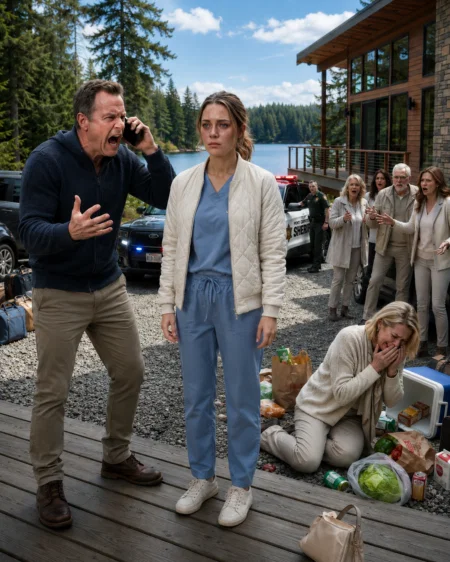
My parents announced they were bringing 20 guests to my lake house and ordered me to fill the fridge. When I said no, Mom laughed and asked if I really thought I could stop them. By Friday morning, Dad was screaming, “What did you do to the house?”
I had just finished a twelve-hour shift at St. Mercy Medical Center, most of it spent on my feet, most of it spent watching people fight for one more breath beneath fluorescent lights. By the time I pulled up outside my apartment in Portland, Oregon, my scrubs smelled like disinfectant and coffee, and my phone had been buzzing for twenty minutes straight.
Family group chat.
Dad had tagged me three times.
Dad: We’re using your lake house this weekend—20 guests.
Mom: Fill the fridge and behave.
My younger brother, Kyle, added a line of laughing emojis.
I stared at the messages until the letters started to blur.
My lake house was not “family property.” It belonged to me. I bought it after six years of double shifts, overtime, and living with roommates who stole food from my shelves. It was a quiet place near Devils Lake where I could sleep, breathe, and not listen to my mother judge every part of my life.
I typed one word.
Me: No.
Mom answered immediately.
Mom: 😂😂😂 You really think you can stop us?
Dad sent a voice message, but I did not open it. I already knew the voice he would use: an order dressed up as family love.
So I did not argue.
I showered, changed, and made one call to my neighbor, Mrs. Harper, who lived across the gravel road from the lake house.
“Margaret,” I said, “if any cars show up this weekend, they do not have permission to enter.”
She paused. “Your parents again?”
“Yes.”
“Good. I’ll keep an eye out.”
Then I opened my laptop and signed into the smart security system. I changed every door code. I disabled the old garage keypad. I shut off the guest Wi-Fi. I turned on the cameras and called the local locksmith, the same man who had helped me after my father “borrowed” the place the previous summer and left beer cans in the hot tub.
By noon, the locks had been replaced.
By three, I had emailed the sheriff’s office non-emergency line with a written statement: no one had permission to enter the property.
Then I slept.
Friday morning, my phone exploded.
Forty missed calls.
Dad’s name filled the screen over and over.
I answered the forty-first call.
“What did you do to the house?” he screamed.
His voice came through windy and furious. In the background, I heard Mom shouting, “Tell her to stop acting crazy!”
I sat up slowly. “Good morning.”
“Don’t you good morning me! The front door code doesn’t work. The garage is locked. There are cameras everywhere. Your mother is standing outside with groceries melting, and everyone is staring at us!”
“Then everyone should leave.”
“This is a family weekend!”
“No,” I said. “It was a break-in attempt with witnesses.”
For once, silence followed.
Then Dad lowered his voice. “Open the door, Claire.”
I looked at the live camera feed.
Twenty people were standing on my porch.
And behind them, a sheriff’s cruiser was pulling into the driveway.
PART 2
Dad saw the cruiser at the exact same moment I did.
On camera, his face shifted from rage to panic so fast it almost looked practiced. He turned away from the Ring camera and barked something at Kyle, who stood there holding a cooler and pretending not to hear him.
Mom moved closer to the door camera, her lipstick too bright beneath the morning sun.
“Claire,” she said, suddenly sweet, “this is enough. You’re embarrassing your father.”
I almost laughed.
For thirty-one years, embarrassment had been their favorite weapon. When I got accepted into nursing school, Mom told relatives I had chosen “a practical little job” because medical school was too difficult. When I bought the lake house, Dad said it was selfish to own a second property when Kyle was still renting. When I refused to lend Kyle ten thousand dollars after his sports bar failed, they called me cold.
But now I had embarrassed them.
A deputy stepped out of the cruiser. Tall, calm, sunglasses on. I recognized him from the email signature: Deputy Aaron Miles.
He looked at the crowd, then at my father. “Morning. Who’s in charge here?”
Dad straightened his shoulders. “I’m her father.”
“That wasn’t my question.”
Mom crossed her arms. “Our daughter is having some kind of episode. She’s tired from work.”
I pressed the speaker button through the security app.
“Deputy Miles, this is Claire Bennett, owner of the property. No one there has permission to enter.”
Every head turned toward the camera.
Dad’s jaw tightened. “Claire, hang up.”
The deputy looked directly at the camera. “Ms. Bennett, can you confirm you requested a trespass notice?”
“Yes. I emailed the documents yesterday. I can forward the deed and my ID again.”
“No need. I have them.” He turned back to my family. “You all need to leave the property.”
Kyle scoffed. “For standing outside?”
“For refusing to leave after the owner denied access.”
Aunt Denise, who had not spoken to me in two years but apparently believed she was entitled to my lake view, lifted both hands. “We drove four hours.”
Deputy Miles nodded. “Then you have a four-hour drive back.”
Dad’s face flushed red. “This is ridiculous. I paid for part of that house.”
The lie was so bold that even Mom glanced at him.
I spoke again. “You didn’t pay a dime.”
Dad pointed at the camera. “I raised you.”
“And I repaid that by not pressing charges last summer when you used my emergency key without permission.”
The porch fell quiet.
A cousin whispered, “Wait, what?”
Mom edged closer to Dad. “Claire, stop.”
“No. You told them I invited everyone, didn’t you?”
No one answered.
That was enough of an answer.
Deputy Miles gave them ten minutes to collect their coolers, folding chairs, bags, and grocery boxes from my porch. Across the road, Mrs. Harper appeared in her pink gardening hat, pretending to water flowers while watching the entire thing.
Dad called me six more times after they drove away.
I answered none of them.
Then Mom texted me privately.
Mom: You humiliated us in front of everyone. I hope you’re proud.
I typed back:
Me: I am.
Three dots appeared.
Disappeared.
Appeared again.
Then the message came that told me the real fight had barely begun.
Mom: Fine. Since you love ownership so much, we’ll discuss what you owe this family.
PART 3
I stared at Mom’s message for a long time.Family
What you owe this family.
It was a sentence I had heard in many forms since I was a child.
You owe your brother patience.
You owe your father respect.
You owe me gratitude.
You owe us help.
You owe us because we raised you.
It never mattered that I had started paying my own phone bill at sixteen, bought my own car at nineteen, covered Kyle’s rent twice in my twenties, paid for Mom’s dental surgery when Dad said money was tight, and let them use my lake house “just one time” the summer before.
One time had turned into three weekends.
Three weekends had turned into them telling relatives it was “our family lake place.”
And now twenty people had arrived because my parents had promised them access to something I owned.
I did not respond to Mom right away.Emotional support services
Instead, I got dressed, made coffee, and drove to Devils Lake.
The house was quiet when I arrived. Peaceful. The cedar siding glowed in the afternoon light, and the water beyond it was deep blue beneath a silver sky. On the porch, I found two crushed plastic cups, a torn grocery bag, and one package of hot dogs someone had dropped in the gravel.
I picked everything up slowly, letting the anger settle into something colder and more useful.
Mrs. Harper crossed the road with a covered dish in her hands.
“You all right, honey?”
“I am now.”
She handed me the dish. “Peach cobbler. You looked like a woman who might need sugar and silence.”
I smiled for the first time that day. “You’re an angel.”
“No. Just old and nosy.”
Inside, I checked every room. Nothing was broken. No windows were forced. No back door damage. The locksmith had done his job. The cameras had done theirs. The sheriff’s notice had done the rest.
My phone buzzed again.
This time, it was my cousin, Megan.
Megan: Hey. I didn’t know you said no. Your mom told everyone you asked us to come because you felt bad the house sat empty.
I sat down at the kitchen island.
Then another message arrived.
Uncle Rob: Your dad said you were “being dramatic” but that the house was basically family-owned. Is that true?
Then Aunt Denise.
Aunt Denise: I’m sorry. We should have checked with you.
Within an hour, the story my parents had created began to crack.
So I did something I had never done before.
I sent one message to the entire family chat.Family
Me: To clarify: I did not invite anyone to my lake house. I told Mom and Dad no. They brought twenty people anyway. The house is legally mine. I paid for it alone. Last summer, they entered without permission using an emergency key and left the property dirty and damaged. I changed the locks because they refused to respect a clear answer.
For once, I did not soften it.
I did not add, “I love you guys, but…”
I did not add, “Sorry for the confusion.”
There had been no confusion. There had been entitlement, performance, and a lifetime of assuming I would fold if enough people were watching.
Kyle answered first.
Kyle: Wow. You’re really making Mom cry over a house.
I replied publicly.
Me: Mom lied to twenty people over a house.Emotional support services
No one responded for several minutes.
Then Dad called.
I let it ring.
He called again.
I declined.
Then he sent a voice message.
I almost deleted it, but curiosity won.
His voice was lower now, rougher.
“You think you’re so smart, Claire? You think because you’ve got a deed and some cameras, you can treat your parents like criminals? Fine. Keep your house. But don’t come asking us for anything when you need family.”
I looked around my quiet kitchen.
The counters I had paid for.
The windows I had chosen.
The lake I had watched through sleepless mornings after hospital shifts that left me hollow.
I pressed record.
“Dad, I have not asked you for anything in years. But you have asked me for money, access, favors, and silence. That stops now. Do not come to this property again. Do not send anyone else here. Do not claim ownership of my home. If you do, I will handle it legally.”
I sent it before my courage could fade.
Mom replied ten seconds later.
Mom: You are cruel.
I typed:
Me: I am clear.
That evening, I ate Mrs. Harper’s peach cobbler on the back deck while the sun sank behind the trees. My phone kept buzzing, but less often now. The family chat had split into private conversations without me. I knew because Megan texted again.Family
Megan: Your mom is saying you’ve changed.
I replied:
Me: I have.
Because I had.
Not all at once. Not dramatically. Not because of a single weekend.
I had changed every time I worked a double shift and still answered Mom’s calls about Kyle’s problems. I had changed every time Dad talked over me at dinner and called it humor. I had changed when they used my house without asking and I cleaned up after them with shaking hands. I had changed when I finally understood peace was not something they would give me. It was something I had to protect.
The next morning, I drove back to Portland for another night shift. Before I left, I placed a printed notice inside the front window.
PRIVATE PROPERTY. NO TRESPASSING. OWNER PERMISSION REQUIRED. CAMERAS IN USE.
It looked harsh.Emotional support services
It also looked honest.
Three days later, a certified letter arrived at my apartment.
For one wild second, I thought Dad had hired an attorney.
But the letter came from the county sheriff’s office. It confirmed that the trespass warning had been documented and that any future unauthorized entry could result in a citation or arrest.
I scanned it. Saved it. Printed two copies.
Then I went to sleep without checking my family messages.
A week passed.
Then two.
The first real test came on a Sunday afternoon.
Kyle showed up at my apartment.
I saw him through the peephole in a hoodie, a baseball cap, and the guilty expression he had worn since childhood whenever he wanted something.
I opened the door but kept the chain locked.
He looked offended by the chain.
“Seriously?”
“Yes.”
He pushed his hands into his pockets. “Mom’s been crying.”
“I’m sure.”
“She says you’re tearing the family apart.”
“No. I stopped lending out pieces of myself.”
He rolled his eyes. “You always talk like a therapy pamphlet now.”
“And you always show up when you need something.”
That landed. His mouth tightened.
“I came to talk.”
“Talk.”
He glanced down the hallway, then lowered his voice. “Dad screwed up, okay? He told everyone you were fine with it. Mom backed him up. I didn’t know.”
“You laughed when she asked if I thought I could stop you.”
He looked away.
“I thought it was just family drama.”Family
“It became sheriff’s-office drama.”
Kyle rubbed the back of his neck. “Yeah. That was messed up.”
I waited.
Apologies in my family usually came with hooks.
Sure enough, Kyle added, “But you didn’t have to make it so public.”
I almost closed the door.
Instead, I said, “They made it public when they brought twenty people to my porch.”
He had no answer.
Behind his irritation, I saw something else: discomfort. Not regret exactly, but the beginning of awareness. Kyle was twenty-eight, old enough to know better, young enough to hide behind our parents when it benefited him.
“I need to ask you something,” he said.
“There it is.”
“No, not money.” He swallowed. “Did Dad ever pay you back for my rent?”
I stared at him. “What?”
“When I was twenty-three. I was behind two months. Dad said he covered it, then later said you helped him a little.”
I laughed once, without humor. “Kyle, I paid all of it. Twenty-four hundred dollars. He told me you knew.”
Kyle’s face changed.
For once, he looked truly ashamed.
“He said he paid.”
“He didn’t.”
The hallway felt smaller.
Kyle removed his cap and twisted it in his hands. “I didn’t know.”
“I believe you.”
That seemed to surprise him more than anything else.
He leaned against the wall. “How much stuff like that happened?”
“A lot.”
He nodded slowly, eyes fixed on the floor.
“I’m not saying I was great to you,” he said. “I wasn’t. I let them make you the responsible one and me the screwup. It was easier.”
That was the first honest thing he had said to me in years.
I kept my hand on the door.
“Being honest now doesn’t erase it.”
“I know.”
“And I’m not opening the lake house to you.”
“I know.”
He looked up. “But maybe we could get coffee sometime.”
I studied him. The chain stayed on the door. The boundary stayed in place.
“Maybe,” I said. “Not today.”
He nodded. “Okay.”
After he left, I sat on the floor beside the door for a few minutes, not crying, not smiling, just breathing.
That was the strange thing about finally standing up for yourself. At first, it did not feel like victory. It felt like leaving a loud room and realizing your ears were still ringing.
Months passed.
Summer shifted into fall. The lake turned steel-gray. I used the house on my own terms. Sometimes I invited friends from work. Sometimes I invited no one. Mrs. Harper and I created a routine: I brought her fresh coffee beans from Portland; she brought me baked goods and neighborhood intelligence.
My parents did not apologize.
Dad sent two angry texts, then stopped.
Mom sent the occasional dramatic message.Emotional support services
Mom: I hope your empty house keeps you warm.
Mom: Family should matter more than property.
Mom: One day you’ll regret pushing us away.
I answered none of them.
Then, in November, Aunt Denise hosted Thanksgiving in Salem. I almost skipped it. Megan convinced me with one sentence.
“Come for me, not for them.”
So I went.
I arrived with a pie and my own car keys in my pocket, parking where no one could block me in.
The room changed when I walked inside.
Mom sat on the couch in a cream sweater, looking fragile in the carefully arranged way I knew too well. Dad stood by the fireplace with a drink in his hand. Kyle was in the kitchen helping Megan.
Mom looked at the pie.Family
“How nice that you could make time for us.”
I handed it to Aunt Denise. “Thanks for hosting.”
Dad snorted. “Still doing the ice queen routine?”
The old Claire would have flushed. The old Claire would have tried to make the room comfortable again.
I set my purse on my shoulder.
“Happy Thanksgiving, Dad.”
“That’s it?”
“That’s it.”
He stepped closer. “You embarrassed me in front of my family.”
“You embarrassed yourself in front of a deputy.”
The room went silent.Sofas & Armchairs
Aunt Denise coughed into her wine.
Dad’s eyes narrowed. “Careful.”
I looked at him, really looked at him. He was not as huge as he had seemed when I was a child. He was a man with thinning hair, a red face, and a lifetime of getting his way by raising his voice first.
“No,” I said. “You be careful. I’m done pretending your anger is authority.”
Mom stood. “Claire Bennett, do not speak to your father that way.”
I turned to her. “And I’m done pretending your tears are evidence.”
Her face went pale.
For a moment, nobody moved.
Then Kyle entered from the kitchen, wiping his hands on a towel.
“Dad,” he said quietly, “drop it.”Emotional support services
Dad turned toward him. “Excuse me?”
Kyle’s voice trembled, but he did not step back. “You lied about the lake house. You lied about paying my rent. You’ve been lying to everybody.”
Dad’s mouth opened.
No words came out.
Mom looked betrayed, not because Kyle was wrong, but because he had said it where others could hear.
Megan stepped beside him.
Aunt Denise sat down slowly.
Something changed in that room. Not everything. Not magically. This was real life, not a movie. Dad did not confess. Mom did not cry into my arms. The family did not heal over turkey and pie.
But the old pattern cracked.
Dinner was tense. Dad barely spoke. Mom dabbed at her eyes twice and received less attention than usual. Kyle sat beside me, not too close, not asking for forgiveness, just present.
When I left after dessert, Mom followed me onto the porch.
The air was cold. Her sweater looked too thin for it, but she crossed her arms and stared at me.
“You really are different,” she said.
“Yes.”
“I don’t know who taught you to be this hard.”
I unlocked my car.
“You did.”
She flinched as if I had slapped her.
I did not stay to comfort her.
On the drive home, rain tapped against the windshield. I thought about the lake house waiting in the dark, locked and quiet. I thought about the woman I had been, exhausted in scrubs, reading those laughing emojis. I thought about how small the word “no” had looked on my phone screen and how much weight it had carried.
By December, the family chat was different.Family
Less loud.
Less certain.
People asked before assuming.
Megan visited the lake house in January. She brought soup, wine, and a board game. Kyle came once in March, after asking two weeks ahead of time. He slept on the pullout couch, washed every dish he used, and left a thank-you note on the counter.
My parents were not invited.
Not because I hated them.
Because access was not love.
Obedience was not respect.
And a house built from my labor was not a family trophy to be claimed by whoever shouted the loudest.
One Sunday morning, almost a year after the attempted weekend takeover, I woke at the lake house before sunrise. The water was still. Mist hovered above it in pale ribbons. I made coffee and stood barefoot on the deck, wrapped in a blanket.Sofas & Armchairs
My phone buzzed.
A message from Dad.
Dad: Your mother wants to know if we can come by sometime.
I looked at the lake.
Then at the door behind me.
Then at the cameras tucked beneath the eaves, silent and watchful.
I typed back:
Me: You can ask me directly when you are ready to acknowledge what happened.
Three dots appeared.
Disappeared.
No reply came.
That was fine.Emotional support services
For the first time in my life, silence did not feel like punishment.
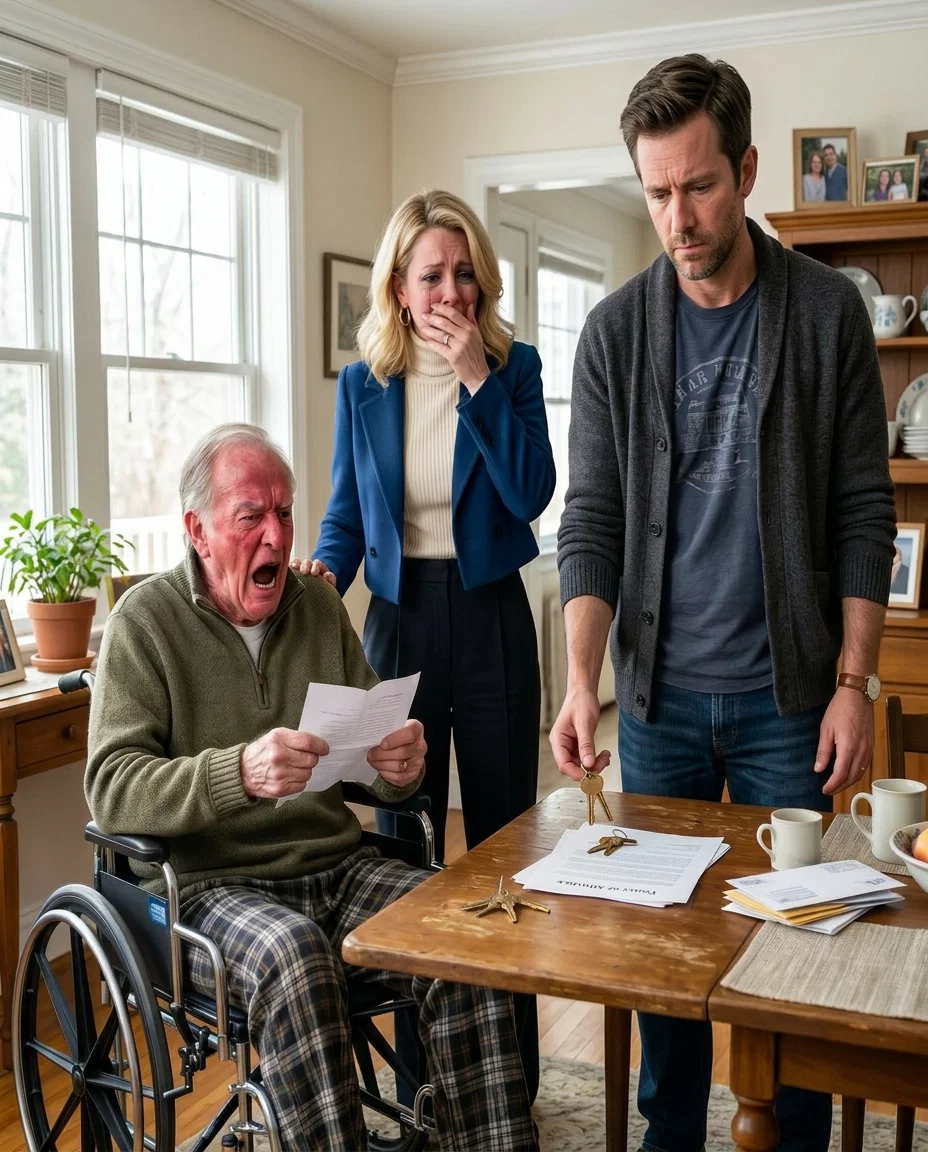
After five years of giving up my own life to look after Dad, he left the full inheritance to my golden-child sister, who had only returned eight weeks earlier. I calmly placed the power-of-attorney papers and house keys in front of them, smiled, and said, “Congrats.” Then Dad read my letter and erupted.
For five years, I surrendered my life to my father’s home.
I was thirty-four when Dad’s stroke changed everything. One minute, Walter Bennett was the loudest man in any room, the retired contractor who could still embarrass younger men with a hammer in his hand. The next, he was half-paralyzed, angry, and frightened in a hospital bed in Cleveland, Ohio, gripping my hand as if I were the only thing stopping him from sinking through the floor.
My sister, Claire, called twice during that first week.
Then she vanished.
I became the person who memorized medication schedules, insurance codes, physical therapy routines, and the careful way to lift a grown man without damaging his pride. I left my marketing job and picked up freelance projects at night. I sold my car to keep the property taxes paid. I gave Dad sponge baths while he criticized my cooking. I slept on the worn leather couch outside his bedroom because he panicked whenever he woke up alone.
Claire was the golden child. She always had been. Beautiful Claire. Charming Claire. The daughter who mailed glossy Christmas cards from Los Angeles and forgot Dad’s birthday three years straight.
Eight weeks before the will was read, she returned.
She showed up in a cream coat, holding tulips and wrapped in a cloud of perfume, calling Dad “Daddy” in a gentle voice I had not heard since we were teenagers. Suddenly, he was laughing again. Suddenly, he wanted his hair combed before breakfast. Suddenly, Claire was taking photos with him on the porch and posting captions about “family healing.”
I realized something was wrong when Dad’s attorney, Mr. Whitcomb, stopped returning my calls.
The meeting took place on a gray Monday morning in Dad’s dining room. Dad sat at the head of the table in his wheelchair. Claire sat beside him, one manicured hand resting on his shoulder. Mr. Whitcomb opened a folder and read the revised will.
The house, the retirement accounts, the lake cabin, and almost everything else went to Claire.
I was given Dad’s watch, his old pickup truck, and “gratitude for years of assistance.”
Claire lowered her eyes, acting surprised.
Dad would not look at me.
I rose slowly. I set the power-of-attorney documents on the table, then the house keys, then the medication binder I had built page by page over five years.
“Congrats,” I said calmly.
Claire blinked. “Evan, don’t be dramatic.”
I smiled at her, then at Dad. “I’m not.”
I handed Mr. Whitcomb a sealed envelope. “Please make sure he reads this today.”
Dad frowned. “What is that?”
“My resignation,” I said.
Then I walked out.
An hour later, my phone rang twelve times. I let every call go to voicemail.
The thirteenth call came from Claire.
“He read your letter,” she hissed. “Dad’s screaming. What did you do?”
In the background, Dad shouted, “You can’t be serious!” His voice cracked with anger. “Evan!”
I looked at the empty passenger seat of my rental car and kept driving west.
Part 2
By the time I crossed into Indiana, Claire had left seven voicemails.
The first was furious. The second was panicked. By the fourth, her voice had thinned into something anxious and brittle.
“Evan, Dad needs his evening pills. The blue one, the white one, and the little half tablet. I can’t find the cutter. Where do you keep the cutter?”
I deleted it.
Not because I wanted Dad harmed. Before I left, I had arranged two weeks of professional home care. I had contacted his primary doctor, emailed his medication list, paid the first deposit from my own savings, and left every document in labeled folders on the kitchen counter. My letter explained all of that clearly.
It also explained that I was finished being unpaid staff while Claire performed daughterhood for applause.
I drove to Columbus and checked into a cheap motel near the freeway. The room smelled of bleach and old carpet, but when I shut the door, no one called my name. No monitor beeped. No television blasted from Dad’s bedroom. No one accused me of buying the wrong soup.
I slept for eleven hours.
The next morning, I turned my phone back on.
There were twenty-nine missed calls.
One was from Mr. Whitcomb.
I called him back first.
“Evan,” he said carefully, “your father wants to discuss the situation.”
“There’s no situation.”
“He feels the letter was… severe.”
I sat on the edge of the bed. “Did he understand it?”
Silence.
Then Mr. Whitcomb sighed. “Yes.”
Good.
The letter was not emotional. I had learned a long time ago that emotion only gave Dad something to attack. So I wrote it like a formal business notice.
As of Monday, I resigned as caregiver, household manager, medical coordinator, financial assistant, driver, emergency contact, and power-of-attorney agent.
I listed every task I handled each day.
I listed every bill I had paid using my own money.
I listed the dates Claire promised to visit and failed to show up.
I attached copies of emails where Dad called me “the only reliable one,” followed by copies of the revised will naming Claire as his primary beneficiary because she “needed a fresh start.”
At the end, I wrote: “Since Claire is now trusted with your legacy, I trust she can also manage the responsibility attached to it.”
By noon, Claire called again.
This time, I answered.
“You need to come home,” she snapped.
“No.”
“You can’t just abandon him.”
“I didn’t. I arranged care.”
“For two weeks!” she shouted. “What happens after that?”
“You inherit the house. Sell it. Hire help. Move in. Choose one.”
She went silent.
That silence told me everything. Claire had expected the money, not the work. She wanted the keys, not the alarms. The lake cabin, not the bathroom rails. The praise, not the pill organizer.
At last, she whispered, “You’re punishing us.”
“No,” I said. “I’m believing you.”
That evening, Dad called.
I almost let it ring. But a part of me wanted to hear his voice without immediately rushing to repair something.
When I answered, he did not greet me.
“You made your point,” he barked.
“No, Dad. I made my exit.”
“You owe me better than this.”
I laughed once, not because it amused me, but because the sentence was so perfectly him.
“I gave you five years,” I said. “Claire gave you eight weeks. You chose what that meant.”
His breathing turned heavy.
“She’s your sister.”
“And I’m your son.”
For once, he had no quick answer.
Then, more quietly, he said, “Come home and we’ll talk.”
“No.”
“Evan.”
“I’m going to build a life that doesn’t revolve around earning basic respect from you.”
He cursed. Then his voice turned angry again, because anger was safer than shame.
I ended the call before he could finish.
Two days later, Claire sent me a photo of Dad sitting at the kitchen table, looking small and furious beside a mountain of unopened medical mail.
Under it, she wrote: “This is cruel.”
I typed back: “That is responsibility.”
Then I blocked her for the night.
For the first time in five years, I went out to dinner alone and ordered something Dad would have hated.
I ate slowly.
I tasted every bite.
PART 3
Three weeks later, the first official letter arrived at my new apartment.
By then, I had rented a small one-bedroom in Columbus with a view of a brick wall and a laundromat sign that buzzed blue after dark. It was not pretty. It was not large. But every mug in the cabinet belonged to me. Every towel stayed exactly where I left it. Every morning began without dread.
The envelope came from Whitcomb & Hale.
I opened it over the kitchen sink.
Mr. Whitcomb’s letter was formal, but I could feel Dad’s temper beneath every sentence.
Walter Bennett wished to request a family meeting. Walter Bennett had concerns about continuity of care. Walter Bennett believed certain misunderstandings had occurred regarding the recent estate planning documents.
I read it twice.
Then I placed it in a drawer.
I did not answer.
That week, I accepted more freelance work. I began walking every evening. At first, my body did not know what to do with freedom. I kept waking at 3:00 a.m., convinced I had missed Dad’s blood pressure check. I kept reaching for a phone that was not ringing. I kept hearing his cane strike the floor.
Caregiving had carved pathways into my nervous system. Leaving the house did not erase them. Real Estate
But little by little, the world grew wider.
A coffee shop owner named Marisol hired me to rebuild her website. An old colleague asked if I wanted to consult for a healthcare nonprofit. I bought a used gray Honda with 140,000 miles and a cracked dashboard. It felt like a luxury car because it did not need to fit a wheelchair inside.
Meanwhile, the Bennett house collapsed into the shape of Claire’s promises.
I did not have to spy. People told me.
Mrs. Alvarez from next door called first.
“Evan, sweetheart,” she said, “your sister asked my grandson to shovel the driveway for free because ‘family is going through a hard time.’ We are not family.”
I apologized, even though I did not owe an apology.
Then Dad’s pharmacy called because I was still listed as the backup contact. I removed my name.
Then the home care agency emailed to say the prepaid two-week period had ended and Claire had refused to renew because it was “too expensive.”
Two days later, Dad fell.
Not badly enough to die. Badly enough to frighten everyone.
He slipped while transferring from his wheelchair to the recliner because Claire had left the brake unlocked. He bruised his hip, scraped his arm, and spent six hours in the emergency room calling nurses by the wrong names. Hospital emergency services
Claire reached me through a new number.
“Dad fell,” she wrote.
I looked at the message for a long time.
Then I replied, “Call his doctor and hire certified help.”
She wrote back instantly. “He wants you.”
I did not answer.
The following morning, Mr. Whitcomb called.
This time, I picked up.
“Your father is revising his will again,” he said.
I closed my laptop. “That’s his choice.”
“He wants to restore your share.”
“Good for him.”
“Evan, he also wants to reinstate you as power-of-attorney.”
“No.”
The word came out so cleanly that I almost did not recognize my own voice.
Mr. Whitcomb paused. “He may not be competent to manage everything himself much longer.”
“Then Claire can petition the court. Or you can advise him to appoint a professional fiduciary.”
“He trusts you.”
“No,” I said. “He relies on me. There’s a difference.”
Another silence followed.
I pictured Mr. Whitcomb in his polished office, surrounded by framed diplomas and expensive pens, realizing that the obedient son no longer existed.
Finally, he said, “Would you consider speaking with him once?”
I looked around my apartment. The buzzing laundromat sign. The secondhand table. The quiet.
“Yes,” I said. “Once.”
We scheduled the call for Friday.
Dad answered on speakerphone. I could hear Claire moving around in the background, dishes clinking too loudly. She wanted me to know she was there. She always performed best with an audience.
“Evan,” Dad said.
“Dad.”
His voice sounded older. Not exactly softer. Just worn down at the edges.
“I’m changing the will back.”
“I heard.”
“I was angry when I changed it.”
“No,” I said. “You were flattered.”
He drew in a sharp breath.
Claire snapped, “That’s unnecessary.”
I ignored her.
Dad said, “Your sister came home. She said she wanted to reconnect. She said you kept her away.”
I leaned back in my chair, suddenly cold.
There it was.
Claire had not simply arrived with tulips. She had arrived with a story.
“What exactly did she say?”
No one answered.
I smiled without humor. “She told you I controlled your calls, didn’t she?”
Dad’s breathing shifted.
“She told you I made decisions without you. That I liked having power. That I wanted the house.” Visual Art & Design
Claire cut in. “That is not what I said.”
“But it’s close.”
Dad said nothing.
Five years of lifting him, feeding him, fighting insurance companies, getting screamed at because his left hand would not obey him—and he had believed her in eight weeks.
Not because she had evidence.
Because believing Claire made him feel wanted.
I said, “Dad, I need you to listen carefully. I did not leave because of the money.”
“Then why?”
“Because the will told the truth.”
He made an irritated sound. “It was just paperwork.”
“No. It was a receipt.” Real Estate
Claire laughed bitterly. “That doesn’t even mean anything.”
“It means Dad paid inheritance to the person who made him feel good, and paid gratitude to the person who kept him alive.”
The line fell silent.
Dad whispered, “I didn’t think you’d leave.”
That sentence hit harder than any insult.
Because it was honest.
He had not believed I would leave.
Not because I was loved.
Because I was useful.
I looked down at my hand. It was steady.
“I know,” I said.
Dad cleared his throat. “Come home. We’ll fix it.”
“I’m not coming home.”
“Not even if I change the will?”
“No.”
Claire made a sharp sound, half laugh and half panic.
Dad’s voice rose. “So that’s it? You abandon your own father?”
“I resigned from a job nobody admitted I was doing.”
“You’re my son!”
“Yes,” I said. “And I should have been more than your emergency plan.”
For a moment, all I heard was the faint hum of my refrigerator.
Then Dad said, quieter, “What do you want from me?”
Five years earlier, I would have had an answer waiting. An apology. A thank-you. A birthday dinner where he did not compare me to Claire. One sentence proving he actually saw me.
But by then, I had stopped arranging my life around impossible wishes.
“I want you to hire professional care,” I said. “I want you to remove me from every emergency contact list. I want you to stop sending people to guilt me. And I want you to understand that changing the will does not buy me back.”
His breath trembled.
Claire said, “You’re being cold.”
I finally spoke directly to her.
“You wanted the crown,” I said. “Wear it.”
She hung up.
Dad called back twice. I did not answer.
After that, the real unraveling started.
Claire lasted one more month.
She attempted to manage Dad’s schedule with phone reminders and sticky notes. She missed appointments. She confused his cardiology visit with his neurologist appointment. She forgot to renew one medication until the pharmacy refused an emergency refill. She complained online about being “thrown into caregiving,” and Mrs. Alvarez screenshotted it before Claire deleted the post.
Then Claire tried to sell the lake cabin.
That was when Dad’s sentimentality finally woke up.
The cabin had belonged to my mother’s parents. Mom died when Claire and I were sixteen and fourteen, and Dad had kept almost nothing of hers except that cabin. He refused to sell it even when medical bills stacked up. He used to say the porch still smelled like her coffee when it rained. Pregnancy & Maternity
Claire found a buyer within two weeks.
Dad discovered it when a realtor arrived to inspect the dock.
The fight was so loud that neighbors called the sheriff.
No arrests. Only humiliation.
By Sunday evening, Claire was gone.
Not permanently, of course. People like Claire rarely disappear when assets are still involved. But she returned to Los Angeles, saying Dad had become “emotionally abusive” and that she needed space to protect her mental health.
Dad moved into assisted living ten days later.
Mr. Whitcomb handled the paperwork. The house was listed for sale to pay for care expenses. The pickup truck, which Dad had left to me in the will, sat in the driveway with a dead battery until a tow company carried it away.
I learned that from an email. Real Estate
I felt sadness, but not the old kind. Not the kind that made me rush back. This sadness had distance inside it. It belonged to the reality of things, not the demands attached to them.
In August, I visited Dad once.
The assisted living facility sat outside Akron, surrounded by flat lawns and young maple trees held straight by stakes. His room was clean, with beige walls, a television, and a framed photo of Claire from her college graduation on the dresser. There was no photo of me.
I noticed.
I did not mention it.
Dad sat in a recliner by the window. He looked smaller than I remembered, his hair thinner, his left hand curled against his lap.
When I walked in, his eyes filled with something like relief.
“You came,” he said.
“I said I would visit once.”
He nodded. Visual Art & Design
For a while, neither of us spoke.
Then he said, “Claire doesn’t call much.”
I sat in the chair across from him. “No.”
“She says it’s hard to hear me like this.”
I looked at the framed photo on the dresser. Claire in a white dress, arms around Dad’s neck, both of them glowing with a happiness I had spent years trying to earn.
“Maybe it is,” I said.
Dad’s jaw tightened. For a second, I saw the old Walter Bennett return, ready to blame, ready to swing.
But he was tired.
“I messed it up,” he said.
I did not save him from the sentence. Anatomy
He swallowed. “I thought you’d always understand.”
“I did understand,” I said. “That was the problem.”
He looked at me then.
“I understood that Claire needed praise, so she got it. I understood you were scared, so I absorbed it. I understood money was tight, so I paid. I understood you hated feeling weak, so I let you feel powerful by taking it out on me. I understood everything until there was nothing left of me.”
His face folded.
“I’m sorry,” he whispered.
It was the apology I had wanted for half my life.
It did not repair half my life.
Still, I let it exist.
“Thank you,” I said. Hospital emergency services
He stared at his curled hand. “Can we start over?”
“No.”
He flinched.
I continued before he could twist the hurt into anger. “We can have something different. Maybe a phone call once a month. Maybe a visit when I choose. But I’m not going back to what we were.”
He nodded slowly, as if every word weighed more than he could lift.
Before I left, he asked, “Did you ever read the final will?”
“No.”
“I left things evenly.”
I stood by the door. “That’s fine.”
“You don’t care?”
“I care less than I used to.”
His eyes closed.
For once, he did not argue.
Outside, the air smelled of cut grass and hot pavement. I sat in my Honda for several minutes before starting the engine. I did not cry. I did not feel victorious. Life rarely gives clean endings. Mostly, it gives you a door and the chance to stop walking back through it.
A year later, Dad died after a second stroke.
Claire came to the funeral wearing black designer sunglasses and cried loudly when people were watching. She told relatives she had “lost her rock.” Mrs. Alvarez stood beside me at the cemetery and squeezed my arm so tightly it hurt.
Mr. Whitcomb contacted us two weeks later.
The estate was smaller than Claire had expected. Assisted living, medical bills, and the sale of the house had consumed most of it. The lake cabin remained, protected by a clause Dad had added after Claire tried to sell it. It was left equally to both of us, but neither share could be sold unless both agreed. Real Estate
Claire was furious.
“This is ridiculous,” she said in the lawyer’s office. “You don’t even care about the cabin.”
I looked at her across the polished table.
“I care enough not to let you erase Mom for cash.”
Her mouth twisted. “You always act like you’re better than me.”
“No,” I said. “I just stopped cleaning up after you.”
She threatened lawyers. She threatened partition. She threatened to reveal family secrets everyone already knew. In the end, legal costs scared her more than principle. She agreed to let me buy out her share over five years.
The first time I returned to the cabin alone, it was raining.
I opened the windows, swept dust from the floor, and found one of Mom’s old mugs in the back of a cabinet. Blue ceramic. Chipped handle. I made coffee in it and sat on the porch while rain darkened the lake. Pregnancy & Maternity
For the first time, the Bennett name felt quiet.
Not healed.
Not perfect.
Quiet.
My phone buzzed once.
A text from Claire.
“Dad would hate how this ended.”
I looked at the lake, at the circles forming where rain touched the surface.
Then I typed back, “Dad hated a lot of things that were true.”
I blocked her number again.
Years later, people would ask whether I regretted leaving that day with the power-of-attorney papers and the keys on the dining table. Visual Art & Design
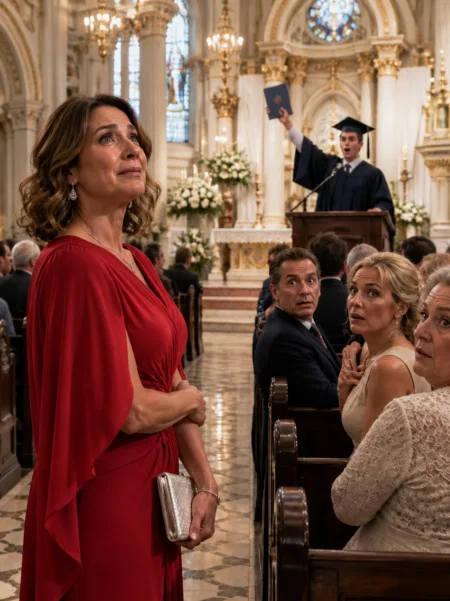
My sister told our parents I had quit medical school—a lie that made them cut me off for five years. They missed my residency graduation and my wedding. Last month, my sister was rushed into the ER. When her attending physician entered, my mom clutched dad’s arm so tightly it left bruises.
The first time my mother laid eyes on me in five years, I was under the harsh lights of the emergency room with her favorite daughter’s blood staining my gloves. She seized my father’s arm so hard that purple marks formed before either of them could even speak my name.
“Dr. Bennett?” the trauma nurse asked.
I kept my gaze fixed on the chart. “Thirty-two-year-old female, abdominal pain, fainting, pressure dropping. Get surgery on standby.”
My sister, Claire, was curled on the stretcher, her face gray and slick with sweat. Even behind the oxygen mask, her eyes widened with recognition.
“Emily?” she whispered.
I had pictured that instant through every lonely holiday, every overnight shift, every photo of family dinners where I had not been welcome. In my imagination, I gave a flawless speech and watched Claire’s smug expression shatter.
Real life allowed no room for speeches.
“Possible ruptured ectopic pregnancy,” I said. “Ultrasound now.”
Five years before, Claire had phoned our parents while I was preparing for my second-year pathology exam. She claimed I had flunked out of medical school, concealed gambling debts, and used my tuition money on a married professor.
None of it was true.
My father called me one time. “Tell me she’s lying.”
“I can prove it,” I said. “Call the dean. Check the tuition account. Please.”
Claire sobbed in the background. Mom accused me of being manipulative. Dad said, “We didn’t raise a liar,” and before midnight, they had cut off my rent, tuition, and health insurance.
I mailed transcripts, enrollment confirmations, and exam scores. Claire intercepted the certified package because she was “helping” with their mail. She blocked my number on their phones, then showed them fake messages where I supposedly demanded money.
They trusted her because Claire had always been the favored one: sweet, delicate, and endlessly excused.
I made it through emergency loans, tutoring, and surviving on four hours of sleep. I graduated without them. I completed residency without them. At my wedding, two seats in the front row stayed empty until an usher quietly took them away.
My husband, Daniel, a civil-rights attorney, never urged me to forgive people who had not tried to uncover the truth. Instead, he helped me keep every returned letter, tuition statement, blocked call record, and suspicious trust notice that came years later.
The trust notice mattered more than anything. My grandfather had set up equal education funds for Claire and me, but mine showed withdrawals I had never approved. Daniel had already brought in a forensic accountant. We were waiting on one final document before filing suit. Claire had confused my silence with surrender. It was preparation.
Now Mom stared at the embroidery on my white coat.
EMILY BENNETT, MD
ATTENDING PHYSICIAN
“You’re a doctor,” she breathed.
At last, I looked at her.
“Yes,” I said. “And Claire is bleeding internally.”…
PART 2
The ultrasound confirmed it. Claire required emergency surgery, and the on-call gynecologic surgeon was still ten minutes out.
Dad moved toward me, color gone from his face. “Emily, save your sister.”
The words hit harder than any apology could have. He had never once asked whether I had needed saving.
“I am treating my patient,” I said. “Nothing more, nothing less.”
Claire’s blood pressure plummeted. I ordered blood, activated the operating room, and kept her stable until the surgeon arrived. When they wheeled her out, Mom reached toward me.
I moved back. “Do not touch me while I’m working.”
Her hand dropped. For the first time, she listened.
Claire lived. Fifteen more minutes could have killed her. I recorded everything, transferred her care, and formally stepped away from the case because of our connection.
Only after that did I walk into the consultation room.
My parents sat side by side, looking smaller than I remembered. Daniel stood near the window with a thin black case.
Mom looked at him. “Who is that?”
“My husband.”
Her mouth parted.
Dad murmured, “You got married?”
“Three years ago. You returned the invitation unopened.”
“We never received it,” Mom said.
Daniel set a postal record on the table. “Someone at your address signed for it.”
Then he opened the case.
Copies covered the table: trust withdrawals with forged signatures, bank transfers into Claire’s event-planning business, tuition records proving I never left school, and metadata from the fake email account she had used to pretend to be me.
Claire had stolen $184,000 from my education trust.
Dad picked up one page with shaking fingers. “This cannot be real.”
“The bank preserved the originals,” Daniel said.
Mom shook her head. “Claire said Emily threatened her. She showed us messages.”
“From an address one letter different from mine,” I said.
Daniel pushed the forensic report forward.
The cruelest detail showed Claire had used my tuition withdrawal as the down payment for the office our parents praised as proof of her success. My father stared at the date. It was my graduation day.
The door swung open.
Claire stood there in a hospital gown, pale and furious, clutching her IV pole while a nurse lingered behind her. She noticed the documents and froze.
“You went through my accounts?” she snapped.
My mother’s expression shifted.
Claire understood what she had just confessed.
Dad raised a forged request. “Did you do this?”
Claire gave a sharp, bitter laugh. “You had already chosen me. I only made sure she stayed gone.”
Daniel gestured toward the recorder already sitting in plain sight on the table. “You should speak carefully.”
But Claire had spent five years believing consequences were for everyone else.
She admitted intercepting my letters, creating fake screenshots, blocking my number, and redirecting the trust money. She called our parents “too stupid to verify anything” and said I deserved exile because I made her feel ordinary.
The nurse stood silent in shock.
When Claire was done, Dad buried his face in his hands.
Mom whispered, “Why?”
Claire stared at me with raw hatred.
“Because she was always going to become someone,” she said. “And I couldn’t let her.”
PART 3
Claire’s confession was only the last brick in a case already built from bank records, metadata, postal scans, and notarized trust documents.
Two weeks after she was discharged, we filed a civil fraud suit and sent the forged withdrawals to the district attorney.
“She nearly died,” Mom said over the phone.
“So did our relationship,” I answered. “You never called an ambulance for that.”
Dad met me in the hospital cafeteria with my unopened wedding invitation and a box of letters.
“We found them in Claire’s desk,” he said. “I should have called the school. I should have driven to see you.”
“Yes.”
“I failed you.”
“Yes.”
He flinched. I did not make the truth softer.
My revenge was never cruelty. It was refusing to protect people from consequences they had chosen with comfort.
Claire’s company fell apart when vendors learned she had used stolen trust funds to obtain credit. The court froze her accounts. She pleaded guilty to forgery, identity theft, and felony theft, receiving eighteen months in county custody, restitution, and five years of probation.
My parents sold their lake house to restore the trust after investigators discovered they had signed documents without reading them. They were not charged, but their friends found out exactly how Claire’s success had been funded.
At the restitution hearing, Claire wore beige jail clothes and no makeup.
“You ruined my life,” she hissed.
I stood beside Daniel, calm enough to hear the hum of the air conditioner.
“No, Claire. I stopped letting you finance your life with mine.”
The judge ordered her to repay every dollar, along with interest and legal costs.
Outside, Mom handed me a childhood photo of Claire and me in matching dresses.
“I want my daughter back,” she said.
“You want relief from guilt.”
“I love you.”Romance
“You loved a version of me that never required you to question Claire.”
They both looked broken.
I told them reconciliation, if it ever came, would require therapy, accountability, and patience without expectations. No unexpected visits. No demands. No using Claire’s punishment as evidence that they had suffered enough.
For once, they accepted my conditions.
Eight months later, I became director of emergency medicine. Daniel and I bought a bright house near the river, with a small room we painted pale green after finding out I was pregnant.
Dad sent one letter every month and never asked why I did not reply. Mom volunteered with a scholarship fund for estranged students and quietly paid off my remaining loans.
Claire served her sentence. Her messages shifted from fury to excuses, then stopped completely.
After my promotion ceremony, I found my residency photograph on our mantel. I stood alone in my white coat, smiling despite the empty seats behind the camera.Paternity testing kits
Daniel touched my hand. “Still hurts?”
“Sometimes.”
Outside the window, the river mirrored the city lights, bright.
I used to think revenge meant making them feel the abandonment they gave me. I was wrong.
Revenge was becoming someone they could no longer erase.
I turned the photograph toward the home we had built, switched off the light, and walked with Daniel into our future.
The ink on my divorce papers had not even dried for twenty-four hours when my ex-husband called, screaming.
He did not sound heartbroken.
He did not sound regretful.
He sounded like a man who had just watched his favorite cash machine catch fire.
“What did you do, Marissa?” Anthony shouted through the phone, his voice slicing through the calm morning air in my kitchen.
I stood beside my white quartz counter, holding a fresh espresso and looking out over the Manhattan skyline. The sky was bright and clear. For the first time in five exhausting years, I felt like I could breathe.
“What are you talking about, Anthony?” I asked, though a slow smile was already forming.
“My mother was humiliated!” he yelled. “Do you know what happened at the Metropolitan Children’s Trust auction? She bid on a vintage Cartier necklace. Fifty thousand dollars. She won. The whole ballroom clapped. Then the foundation director brought the payment terminal to her table…”
He stopped, choking on the words.
I took a calm sip of coffee.
“Go on.”
“The card declined,” he hissed. “In front of everyone. She tried three times. The machine kept flashing red. They had to give the necklace to the runner-up. She walked out while the most powerful people in New York whispered about her.”
For five years, I had paid for Eleanor Whitmore’s luxury life while she treated me like an embarrassing stain on her family name.
Designer shopping on Fifth Avenue.
Spa retreats in Palm Beach.
Charity luncheons where she introduced me as “Anthony’s new wife” like I was a temporary assistant.
To the Whitmores, I had never been family.
I was a credit card with a heartbeat.
“She wasn’t treated like a criminal,” I said. “She was simply reminded of reality.”
“You canceled the card during the gala?”
“If your name isn’t on the account, you don’t get to use the card,” I replied. “The divorce is final. Eleanor is your mother, not mine.”
Anthony snapped, “You can’t just cut her off. It keeps the peace.”
I almost laughed.
Peace.
That was what he always called my silence.
But they never wanted peace.
They wanted obedience.
“The account is closed permanently,” I said. “She will never spend another dollar I earn.”
“Marissa, stop being dramatic.”
“I’m not being dramatic,” I said. “I’m being divorced.”
Then I hung up and blocked him.
I thought that would be the end of the Whitmores.
I was wrong.
At 6:42 the next morning, something slammed against my apartment door.
BOOM.
BOOM.
BOOM.
“OPEN THIS DOOR!” Eleanor shrieked from the hallway. “No spoiled new-money gold digger humiliates me and hides behind a lock!”
I checked the hallway camera.
Eleanor stood there in a camel cashmere coat, furious. Anthony paced beside her.
And a locksmith stood with them, holding a heavy-duty drill.
“Drill the lock,” Anthony told him. “My wife is inside having a mental breakdown after getting divorce papers. She threatened to hurt herself. We need to get in.”
My blood went cold.
They were lying to break into my home.
At that exact moment, my laptop chimed.
My emergency board meeting with Apex Capital had just begun.
I did not panic.
I threw on a silk blouse and blazer over my pajama pants, sat at my desk, and joined the video call.
Eight investors stared back at me.
“Good morning, Marissa,” Marcus, the lead investor, said. “Is there construction happening?”
“No,” I said calmly. “That is my ex-husband and his mother attempting to illegally enter my apartment.”
Then I turned the laptop toward the foyer.
Part 2:
The deadbolt cracked.
The door flew open.
Eleanor stormed in, screaming, “You vicious little—”
Anthony followed. “Marissa, put the computer down. You need help.”
“Anthony,” I said clearly, looking into the webcam, “I am currently on a live, recorded board meeting with Apex Capital. Marcus, can you hear them?”
Marcus’s voice boomed from the speaker.
“Loud and clear. My assistant is calling NYPD. Do you also need private security?”
Anthony froze.
Eleanor’s mouth fell open.
The society queen had just been caught trespassing and screaming on camera in front of the kind of powerful men she spent her life trying to impress.
“This is a private family matter,” Anthony stammered.
“There is no family here,” Marcus said coldly. “There is our CEO, and there are trespassers in her home. Leave immediately.”
They ran.
That afternoon, after changing my locks and finishing a successful board meeting, I sat in my attorney Lydia Chen’s office.
“The restraining order is filed,” Lydia said. “But while auditing the accounts, I found something.”
She slid a folder toward me.
Inside was a deed and loan agreement for my Hamptons house, a property I had bought years before marrying Anthony.
At the bottom of the second page was a signature.
It was supposed to be mine.
It was not.
“Two months ago,” Lydia said, “someone took a second mortgage against the Hamptons property. Three million dollars. Your signature was forged. The money went to an offshore account.”
My stomach dropped.
Anthony had not only used my money.
He had committed a felony.
“Where did the money go?”
Lydia handed me the bank trace.
“To a private debt consolidation firm. Eleanor has a hidden gambling problem. Anthony forged your name to steal your equity and save his mother from public ruin.”
They had stolen my home to protect her reputation.
Lydia asked, “Do you want to go to the police now?”
I looked out at the city.
“No,” I said. “Eleanor is receiving the Philanthropist of the Decade award at the Plaza this Saturday. Let her wear the crown one more day.”
Lydia smiled.
“And then?”
“Then I’ll burn her kingdom down where everyone can see.”
That Saturday, the Grand Ballroom at the Plaza glittered with chandeliers, orchids, and champagne glasses.
I arrived an hour late, perfectly on time.
Eleanor stood onstage, holding her award and pretending to cry.
“Philanthropy is about legacy,” she said into the microphone. “The Whitmore family has always believed in silent sacrifice…”
I walked down the center aisle in an emerald gown.
Heads turned.
Whispers spread.
Anthony saw me first. Terror flashed across his face.
Then the microphone cut out.
Richard Sterling, chairman of the foundation board, stepped onto the stage with printed documents in his hand.
“Eleanor,” he said sharply, “step away from the podium.”
She clutched the trophy.
“Richard, I’m in the middle of my acceptance speech.”
“You are in the middle of a fraud.”
The ballroom froze.
Richard announced that the so-called Whitmore family donations had actually come from my personal tech company accounts. He revealed that Eleanor had used foundation expense accounts for luxury purchases.
Effective immediately, she was stripped of the award, removed from the board, and banned pending a full audit.
Two hundred people stared.
Eleanor’s perfect world cracked open in front of everyone.
“Anthony!” she screamed. “Defend me!”
But Anthony only stared at the floor.
I did not wait for security.
I turned and walked out.
A week later, Eleanor sued me for ten million dollars for defamation and public humiliation.
She wanted a courtroom battle.
She did not know I still had the forged mortgage documents.
Part 3:
At the deposition, Eleanor sat across from me in black Chanel and pearls, flanked by aggressive attorneys. Anthony sat beside her, sweating and refusing to meet my eyes.
Lydia waited until their lawyer finished speaking.
Then she slid a white folder across the table.
“Mr. Whitmore,” she said, “why does your signature, along with a forged version of my client’s signature, appear on a three-million-dollar second mortgage against her Hamptons property?”
Anthony went pale.
Eleanor leaned forward.
“What is this?”
Lydia continued. “The money was wired offshore to cover Eleanor Whitmore’s gambling debt. We have the transfers, the IP addresses, and the notary who admits he was bribed.”
Then Lydia said the words that ended them.
“Tomorrow morning, this file goes to the U.S. Attorney’s Office. Forgery and interstate wire fraud are federal felonies.”
Anthony broke first.
He yanked away from his mother and stood so fast his chair fell backward.
“I didn’t want to do it!” he shouted, pointing at Eleanor. “She made me! She was going to be exposed. She begged me. She said if I didn’t forge the papers, she would destroy herself!”
“Anthony, stop!” Eleanor screamed.
But he was already sacrificing her to save himself.
“It was all her idea,” he sobbed. “I’ll testify. I’ll wear a wire. Please, Marissa, don’t send me to prison.”
Eleanor sank into her chair.
The son she had worshipped had turned on her the moment he saw a cage closing.
I looked at them both.
They had finally destroyed each other.
The settlement was fast and brutal.
Anthony signed over every remaining shared asset, repaid the three million dollars by liquidating his trust fund, and signed a strict non-disclosure agreement.
Eleanor sold her Upper East Side penthouse, paid down her debts, and disappeared into a small condo in Florida, exiled from the society she had valued more than her soul.
A year later, I stood on a rooftop terrace in Brooklyn, looking across the water at Manhattan.
The money I recovered did not sit untouched in my account.
I used it to create The Hale Independence Grant, a scholarship and venture fund for young women studying finance and tech at public universities.
Inside the venue, brilliant students held grant certificates in their hands.
No society photographers.
No fake charity queens.
Just young women with futures that no one would be allowed to steal.
At 43, Laura Bennett ran trembling hands down the front of her navy-blue dress, smoothing out the wrinkles. She had found it on a clearance rack at a discount store in downtown Chicago for forty dollars, spending what little remained after rent and utilities were paid. As a nursing assistant in an overcrowded public hospital on the South Side, Laura was familiar with back-to-back twelve-hour shifts, the sharp scent of antiseptic, and the constant pain that settled deep in her spine. But that morning, something stronger than exhaustion showed on her face.
Hope.
Her eighteen-year-old son, Ethan Bennett, was graduating with highest honors from one of the most respected private academies in the city. Ethan had won a full scholarship through sleepless nights, perfect grades, and relentless determination, while Laura had spent countless evenings hemming uniforms and sewing clothes for neighbors just to afford bus fares and meals.
Only one week earlier, her phone had buzzed with a text message:
“Mom, I saved you two seats in the front row on the left side. I want to see you when they call my name.”
Laura had cried alone in a hospital restroom after reading it, realizing every sacrifice she had made over the past eighteen years had mattered.
But the moment she stepped into the luxurious auditorium that Saturday afternoon, reality struck her like cold water.
She arrived with her sister, Maria Bennett, who carried a huge bouquet of sunflowers wrapped in brown paper. Together, the two women searched for the reserved seats Ethan had promised.
They were already taken.
Sitting comfortably in the front row was Richard Bennett, Laura’s ex-husband, dressed in an expensive tailored suit and a gold watch large enough to catch every light in the room. Beside him sat his twenty-eight-year-old wife, Sabrina Collins, wearing a cream silk dress and designer heels. Four more members of Sabrina’s family occupied the remaining seats.
On the back of one chair, Laura saw a torn piece of paper still taped there.
Her name.
“Excuse me,” Laura said softly to a student volunteer managing the seating chart. “My son reserved these seats for me.”
Before the young man could respond, Sabrina slowly turned around.
Her smile was full of contempt.
“Your place isn’t in the front row, Laura,” she announced loudly enough for nearby parents to hear. “Richard has a family that actually belongs here now. A family that knows how to behave at events like this.”
The conversations around them stopped at once.
Sabrina crossed one leg over the other and added, without lowering her voice:
“If you want to stay, maybe stand in the back. You should already be used to watching life from there.”
Heat rushed into Laura’s cheeks.
Maria clenched her fists and stepped forward, ready to defend her sister, but Laura caught her arm before she could speak. She would not turn her son’s graduation into a public fight.
She looked at Richard, waiting—just once—for him to intervene.
But he simply adjusted his tie and stared at the stage as if she were not there.
Something inside Laura broke quietly.
Without another word, she and Maria walked all the way to the back of the enormous auditorium. By the time they reached the rear wall beneath the glowing red EXIT sign, every seat was full.
They stood there.
No chairs.
No graduation programs.
Completely pushed aside.
Ten minutes later, the ceremony began.
Three hundred graduates marched down the center aisle in navy caps and gowns while proud families applauded. Laura searched anxiously for Ethan’s face among the students.
Then she found him.
Tall, broad-shouldered, serious.
At first, Ethan looked toward the front row. Richard raised a hand confidently, smiling like he had earned the moment himself. Sabrina lifted her phone to record.
But Ethan did not smile back.
His expression hardened immediately.
His eyes moved across the auditorium, row by row, until they finally reached the back wall.
His mother.
Standing beneath the EXIT sign in tired shoes, with trembling hands, and a sunflower bouquet beside her.
Laura forced a smile at him, trying silently to tell him, It’s okay.
But Ethan froze for exactly one second.
And in that second, something dark and furious crossed his face.
No one in the auditorium understood that the graduation ceremony was about to become something nobody there would ever forget.
Ethan kept walking to his assigned seat beside the other honor students, but his jaw stayed tight the entire time.
Laura knew that look.
She had raised him alone since he was six years old—the same year Richard packed three suitcases, claimed he “needed space to rediscover himself,” and left their tiny apartment in Aurora.
That rediscovery had apparently included a younger wife, a gated community, and a social circle where Laura and Ethan were never welcome.
At first, Richard promised he would visit every other weekend.
Then once a month.
Eventually, he only appeared for important events where photographs could be taken and posted online beside the “brilliant son” he had barely helped raise.
There was never proper child support.
Never birthday calls.
Never real effort.
Only excuses.
Still, Laura never turned Ethan against his father. Even on the nights Ethan fell asleep beside the apartment window waiting for a car that never arrived, she would stroke his hair and whisper:
“Your dad loves you in his own way.”
Then she would lock herself in the bathroom and cry silently for an hour.
Because some kinds of love hurt exactly like abandonment.
Suddenly, the principal’s voice filled the auditorium speakers.
“And now, to conclude the first portion of today’s ceremony, we invite our valedictorian, the student with the highest academic record in this graduating class—Ethan Bennett—to deliver a few words.”
Thunderous applause rose from more than a thousand people.
Laura’s knees almost gave way.
Ethan had never told her he would be giving a speech.
In the front row, Richard jumped to his feet and clapped dramatically, glancing proudly at the other wealthy parents as though Ethan’s achievements were his own trophy. Sabrina held up her phone again, ready to record.
Ethan walked onto the stage slowly.
He stood behind the podium, unfolded a carefully prepared speech, and looked down at the pages.
Then something unexpected happened.
He folded the speech once.
Then again.
And with a calm motion that confused even the principal, he slid the pages into the inside pocket of his jacket.
The entire auditorium became silent.
“I wrote a speech for today,” Ethan began, his deep voice carrying across the massive room. “Three pages about ambition, success, discipline, and chasing dreams.”
He paused.
“But fifteen minutes ago, something happened in this auditorium that reminded me success means absolutely nothing if you forget who carried you to the finish line.”
A ripple passed through the crowd.
Laura’s heart pounded so violently it hurt.
In the front row, Richard’s smile slowly vanished.
Sabrina lowered her phone.
“When we’re children,” Ethan continued, “we think heroes are people in movies with powers and capes. But when you grow up in the real world, you realize heroes usually look nothing like that.”
His voice grew stronger.
“Some heroes don’t drive luxury SUVs. Some heroes take the city bus at five in the morning to make it to work on time. Some heroes spend twelve hours cleaning wounds in overcrowded hospitals, skip meals so their child can eat three times a day, and stay awake sewing clothes at two in the morning before a final exam.”
The silence became almost unbearable.
The faint buzz of the overhead lights could be heard.
“My hero,” Ethan said, raising his hand and pointing directly toward the back wall of the auditorium, “is standing under the EXIT sign right now.”
Hundreds of heads turned at once.
Gasps moved through the room.
“And she’s standing back there because someone in the front row decided a hardworking woman with rough hands didn’t deserve the seats I personally reserved for her.”
The auditorium erupted into murmurs.
People looked back at Laura.
Then toward Sabrina.
Then toward Richard.
Sabrina’s face lost all color.
Richard stared down at the floor.
“My mother, Laura Bennett, was never handed privilege,” Ethan continued, his voice shaking for only a second before turning firm again. “She built my entire life with her own hands. She taught me poverty never defines your worth. She taught me exhaustion is not an excuse to quit. And she taught me that a mother can have her heart broken a thousand times and still smile every day so her child never feels afraid.”
At the back of the auditorium, Laura covered her mouth as tears streamed down her face.
Beside her, Maria cried openly.
“That’s why,” Ethan declared, glaring straight at the front row, “before I accept my diploma today, I want to make one thing clear in front of every person here.”
His voice rang through the auditorium like thunder.
“If my mother is standing in the back, then the most honorable seat in this entire building is in the back with her.”
For one breathless moment, no one moved.
Then a literature teacher stood and began clapping.
A father in a gray suit followed.
Within seconds, the entire auditorium rose to its feet.
More than a thousand people applauded so loudly the walls seemed to tremble.
Some parents wiped tears from their eyes.
Others looked at Sabrina with open disgust.
Ethan stepped away from the microphone, leaned toward the principal, and whispered something in her ear.
Then he returned to the podium.
“With all respect, Principal Harris,” he said firmly, “I refuse to accept my diploma until my mother is sitting in the seat I reserved for her.”
The audience erupted again.
“Bravo!”
“Let her sit!”
“That’s her seat!”
Principal Margaret Harris immediately stepped down from the stage and walked straight toward the front row.
“Mrs. Collins,” she said coldly, “those seats were reserved specifically for this student’s mother and aunt. I need you and your guests to vacate them immediately.”
Sabrina’s lips shook with humiliation and rage.
“This is ridiculous,” she snapped. “We’re his real family!”
“There is no misunderstanding,” Ethan interrupted through the microphone.
Richard finally stood, trying to reclaim an authority he had never truly earned.
But Ethan’s voice cut through him instantly.
“You can sit wherever you want, Richard,” he said evenly. “But those seats were never yours to give away.”
Humiliated in front of hundreds of recording phones, Sabrina and her relatives grabbed their expensive purses and stumbled toward the exit beneath the judgmental stare of the entire auditorium.
Richard stayed behind for a moment, waiting for Laura to do what she had always done before.
Lower her head.
Stay silent.
Avoid conflict.
But this time, Laura raised her chin.
Together with Maria, she walked slowly down the center aisle.
Every step felt like freedom.
When she reached the front row, she saw the torn reservation paper still taped to the chair.
Her name was still printed across it.
Laura sat down with her back straight while Maria gently placed the sunflowers across her lap like a victory banner.
On stage, Ethan smiled at his mother for the first time that day.
“Thank you, Mom,” he said softly into the microphone.
The applause nearly shook the building apart.
Minutes later, when Ethan officially received his diploma, he ignored the cameras completely.
Instead, he looked only at Laura.
And silently mouthed four words she would never forget:
When the elevator doors opened, William Sterling didn’t run.
He walked.
That was what made my father so intimidating. He had built a billion-dollar empire not by shouting, but by understanding that real power never needed to hurry.
Garrett froze the moment he saw him.
“You didn’t know your son was dying?” my father asked.
Garrett claimed his phone had died. But the phone in his hand was working perfectly.
I sat outside Ethan’s hospital room, exhausted and broken. My five-year-old son was gone. My hands still trembled from trying to save him.
When my father wrapped his arms around me, I collapsed.
“He kept asking for Garrett,” I sobbed. “He wanted his dad.”
Garrett asked to see Ethan.
“No,” I said.
Then I showed my father the truth.
Eighteen unanswered calls.
A message from a woman named Melissa.
Proof that Garrett had been with another woman while Ethan fought for his life.
My father read the message once.
Then handed the phone back.
“You’re finished,” he said.
Garrett was escorted from the hospital.
But before dawn, my phone buzzed with a message from an unknown number.
Attached was a photo of Melissa asleep in a luxury hotel room.
On the nightstand sat Garrett’s wedding ring.
Beside it was something even worse.
A prescription bottle labeled Ethan Vale.
My stomach dropped.
Then another message appeared:
Ask your husband why your son’s inhaler was empty.
Everything changed.
PART 2
By sunrise, Ethan’s death was no longer just a tragedy.
It was an investigation.
My father ordered security footage, pharmacy records, and hotel surveillance to be reviewed immediately.
The truth came quickly.
Melissa wasn’t the mastermind.
She was connected to Vanessa Hale, a woman whose life had been destroyed years earlier after my father exposed a major financial fraud.
Vanessa had spent years planning revenge.
She used Melissa to lure Garrett away from his family. She drugged him, kept him distracted, and created the perfect opportunity to strike.
Disguised as a hospital volunteer, Vanessa gained access to Ethan’s room.
I remembered her clearly.
She had smiled warmly.
She had brought Ethan a stuffed dinosaur.
And I had thanked her.
Later, Garrett handed investigators a recorder he found among Melissa’s belongings.
The recording revealed everything.
Melissa was crying.
“This has gone too far,” she said. “He’s just a child.”
Vanessa’s voice was calm.
“He’s a Sterling.”
Those four words chilled everyone in the room.
That night, I returned home for the first time without Ethan.
Near midnight, a sound came from the hallway.
The bedroom door opened.
Vanessa Hale stood there smiling.
“What did you do to my son?” I asked.
“Your son was never supposed to die so quickly,” she replied.
Before she could do anything else, police stormed the house and arrested her.
But as officers led her away, she left one final warning.
“Ask your father about the account in Ethan’s name.”
The next day, my father revealed the secret.
A trust fund worth two hundred million dollars.
Created for Ethan.
Created to protect him.
“Protect him from who?” I asked.
My father looked away.
“From Garrett.”
PART 3
The final pieces of the puzzle were even more devastating.
My father confessed that Garrett had hidden massive gambling debts for years. He had investigated him long ago but kept the truth from me because he thought he could protect our family.
He was wrong.
Then investigators discovered Vanessa hadn’t acted alone.
Someone inside the hospital had helped her.
The answer shocked everyone.
Andrew Vale.
Garrett’s older brother.
Ethan’s uncle.
A respected pediatric cardiologist.
Hospital records showed Andrew accessed Ethan’s medical chart less than an hour before his condition suddenly worsened.
He was arrested while trying to flee the city.
During questioning, Andrew admitted Vanessa had paid him to interfere with Ethan’s treatment. He claimed he never intended for Ethan to die.
But as a doctor, he knew the risks.
Vanessa, Andrew, and everyone involved were convicted.
Garrett cooperated fully. He surrendered his assets to a foundation created in Ethan’s name and never asked for forgiveness.
At Ethan’s funeral, he stood alone in the rain.
Far away from the family he had destroyed.
After the service, I found a small blue box beneath Ethan’s bed.
Inside was a drawing.
It showed Ethan and me standing beneath a giant yellow sun.
On the back was a message written in a child’s uneven handwriting:
Mommy, don’t be sad forever. I want you to smile when I’m in heaven. Grandpa says love is bigger than goodbye.
I cried harder than I ever had before.
One year later, my father opened the Ethan Vale Children’s Wing at the hospital.
It provided treatment and support for sick children whose families couldn’t afford help.
Two years later, I adopted a four-year-old girl named Lily.
One evening she climbed into my lap and asked:
“Can you be my mommy too?”
I looked at Ethan’s drawing hanging on the wall.
For the first time, the memory didn’t break me.
It guided me.
I hugged Lily tightly.
“Yes,” I whispered. “Always.”
People believed the story ended the night Garrett missed eighteen calls.
They were wrong.
That night ended one life.
But Ethan left behind something stronger than revenge.
I mailed my husband divorce papers while he was sitting with the woman he chose over me. Hours later, I was rushed to a hospital carrying the twins we’d prayed years to have. By the time he realized what he had lost, a phone call was about to shatter everything he thought he still had.
My name is Emily Whitman, and this is the moment my marriage died.
For months, I watched my husband, Michael, become someone I barely recognized.
It started with little things.
Late nights.
A phone that never left his hand.
Cologne mixed with a perfume that definitely wasn’t mine.
At first, I blamed stress. After all, we had spent years trying to have children. When I showed him the positive pregnancy test, tears streamed down his face.
“We’re finally going to be parents,” he whispered as he pulled me into his arms.
A few months later, we learned it was twins.
A boy and a girl.
“Aiden and Savannah,” he said, laughing in the parking lot outside the clinic. “My dream family.”
I believed him.
I believed the man who built cribs with his own hands and rubbed lotion on my growing belly every night.
But that man slowly disappeared.
One humid Tuesday night in Jackson, Mississippi, I sat alone in bed at 11:47 p.m.
The babies kicked beneath my hand.
Aiden first.
Savannah immediately after.
“It’s okay,” I whispered through tears. “Mommy’s here.”
An hour earlier, Michael had sent a text.
Working late. Don’t wait up.
No heart.
No joke.
No “I love you.”
Just another message from a husband who had already checked out of our marriage.
I called my best friend, Nicole.
“Emily?” she answered immediately. “What’s wrong?”
My voice broke.
“I think he’s cheating.”
The silence on the other end told me everything.
The next day, Nicole arrived with proof.
Hotel receipts.
Photos.
Messages.
Evidence I could never unsee.
That was the day I stopped being Michael Whitman’s wife, even though he didn’t know it yet.
Three weeks later, I signed the divorce papers.
Then I disappeared.
What Michael didn’t know was that the envelope arrived at his downtown office while he sat with Jessica Monroe—the woman he’d risked everything for.
According to what I later learned, the courier dropped the envelope onto his desk.
Just a simple thud.
Nothing dramatic.
Yet it changed all our lives.
Jessica smiled from across the office.
“Important paperwork?” she teased.
Michael opened it casually.
Then froze.
The first page read:
Emily Whitman v. Michael Whitman. Petition for Dissolution of Marriage.
Jessica picked up a page that had slipped onto the floor.
Her smile vanished.
“Michael…”
He snatched it from her hands.
At the bottom was my signature.
And beneath it, a message.
You made your choices. Now I’m making mine. Do not contact me except regarding our children or through my attorney.
He called me immediately.
Voicemail.
Again.
Voicemail.
My location sharing was disabled.
The home security system was offline.
I was gone.
“She’s overreacting,” Jessica reportedly said. “Pregnant women get emotional.”
Michael slowly turned toward her.
For the first time, he seemed to see exactly what his choices had cost him.
“Get out.”
“What?”
“Get out of my office.”
“You said you wanted this.”
His voice shook.
“I said a lot of things. Every one of them brought me here.”
Meanwhile, I was driving through a heavy rainstorm, trying to start over.
Then everything went wrong.
An unexpected emergency sent me to St. Joseph Medical Center.
Doctors rushed around me.
Machines beeped.
Voices blurred together.
And somewhere across town, Michael’s phone rang.
“Mr. Whitman?” a nurse asked.
“Yes.”
“Your wife was admitted an hour ago.”
His voice cracked.
“What happened? How are my babies?”
The pause that followed felt endless.
Then the nurse spoke softly.
“Sir… you need to come immediately.”
The phone slipped from his hand.
As he sprinted toward the elevator, one horrifying thought consumed him.
Because the last words I had ever written to him weren’t I love you.
They weren’t even goodbye.
They were:
You made your choice. Now pray it wasn’t too late.
As Michael raced toward the hospital, terrified of what he might find, one question remained unanswered:
Was he about to lose his wife and children forever?
PART 2
Michael arrived at St. Joseph Medical Center with rainwater soaking through his shirt and his hands shaking so violently he could hardly push the elevator button.
The hospital carried the sharp smell of disinfectant, damp coats, and terror.
At the maternity desk, a nurse lifted her eyes. “Name?”
“Emily Whitman,” he said. “My wife. She’s pregnant with twins. Someone called me.”
The nurse’s face shifted with practiced caution. “Please wait here.”
“I can’t wait here.”
“Mr. Whitman,” she said gently, “the doctors are with her.”
Those words snapped something inside him.
For months, Michael had told himself there would still be time. Time to explain himself. Time to make a better choice. Time to return to the home he had abandoned and find me still there, wounded but waiting.
Now time had turned into a corridor he was forbidden to walk down.
He turned and spotted Nicole by the vending machines, her arms folded, her eyes red.
“You,” he whispered.
Nicole stayed still. “Don’t.”
“Where is she?”
“With doctors who actually showed up.”
Her voice was quiet, but the words cut deeper than yelling.
Michael swallowed hard. “Are the babies okay?”
Nicole glanced toward the double doors. “They’re monitoring them.”
“And Emily?”
“She was asking for you,” Nicole said.
Hope flickered across his face.
Then she added, “So I could tell the nurses not to let you make decisions for her.”
The hope vanished.
At last, a doctor stepped out, gray-haired and composed, wearing the weary kindness of a man who had witnessed both miracles and devastation.
“Mr. Whitman?”
“Yes.”
“I’m Dr. Patel. Your wife experienced a placental complication and severe stress-related contractions. We’ve stabilized her for now, but she needs rest and quiet. The babies’ heartbeats are present.”
Michael covered his mouth with one hand.
“For now,” Dr. Patel added. “This remains serious.”
“Can I see her?”
Dr. Patel paused. “She has asked that only Ms. Carter be allowed in at this time.”
Nicole moved forward. “That’s me.”
Michael stared at her. “Please. Tell her I’m here.”
For one brief second, Nicole’s expression softened, not from forgiveness, but because she recognized fear.
“I’ll tell her,” she said.
Inside the room, I lay under pale blankets, one hand resting on my stomach, listening to two tiny heartbeats tremble through the monitor.
Aiden.
Savannah.
Still alive.
Still holding on.
Nicole came to the side of my bed and held my hand. “He’s outside.”
I shut my eyes.
I had pictured hearing that sentence countless times.
He’s outside.
There was a time when it would have comforted me. That night, it only exhausted me.
“Does he know?”
“That you filed? Yes.”
“No,” I whispered. “Does he know I was leaving town?”
Nicole shook her head. “Not yet.”
I turned my gaze toward the rain-streaked window. Beyond the glass, Jackson blurred into shades of silver and black.
“I almost made it,” I said.
Nicole tightened her fingers around mine. “You don’t have to make any decisions tonight.”
But the truth was, I already had.
Once, I had loved Michael with the kind of faith that made ordinary days shine. I had loved him through negative pregnancy tests, hospital bills, wordless dinners after bad news, and all the months when hope felt like a cruel little spark.
I had never stopped loving the man he once was.
But I could not continue bleeding for the man he had become.
An hour later, Dr. Patel adjusted the monitor and said, “Emily, we’re keeping you overnight. Possibly longer.”
“Will I lose them?” I asked.
His expression softened. “We’re doing everything we can to prevent that.”
Everything.
That was the word Michael had once promised me.
I turned my head. “Can he come in for five minutes?”
Nicole stiffened. “Em—”
“Five minutes,” I said. “I need to hear his voice and know I can survive it.”
When Michael walked in, he stopped just inside the doorway.
He seemed smaller than I remembered.
Not in body. He was still tall, still broad-shouldered, still the man whose wedding ring had once flashed in the sunlight across our kitchen table.
But guilt had carved him hollow.
“Emily,” he said.
My name sounded like an admission.
I said nothing.
His eyes dropped to my stomach. “Are they—”
“They’re alive.”
A sob broke out of him before he could hold it back. He clutched the bed rail.
“Thank God.”
“Don’t thank God for what you nearly stopped caring about.”
He recoiled.
For a moment, rain tapped against the window while the machines filled the space between us.
“I didn’t stop caring,” he said.
Then I looked at him. “You just cared quietly while lying loudly?”
His face collapsed. “I made a terrible mistake.”
“No. A mistake is forgetting milk. You built a second life while I was building two babies inside me.”
He shut his eyes.
“I know.”
“Do you?”
“I ended it.”
“With Jessica?”
“Yes.”
I almost laughed, but the sound came out shattered. “Because I filed for divorce?”
“Because I saw the papers and realized—”
“That consequences exist?”
His silence was answer enough.
I turned my face away. “Michael, I am too tired to comfort you about the pain you caused.”
He moved closer. “Then don’t. Let me comfort you.”
“You lost that right.”
His hand stopped in the air, inches from mine.
Slowly, he lowered it.
“I deserve that.”
“No,” I said, my voice trembling. “You deserve to understand it. There’s a difference.”
His eyes filled with tears. “Tell me what to do.”
“For once, nothing.”
The words seemed to stun him.
“Go home,” I continued. “Feed the dog. Call my attorney, not me. And if you truly care about Aiden and Savannah, stop making this about your regret.”
He whispered, “You kept the names.”
“They were never yours to ruin.”
That wounded him. I saw it. Part of me hated that I noticed.
Because love never disappears cleanly. It leaves threads behind. Some soft. Some sharp.
Michael nodded, wiped his face, and walked toward the door.
Before leaving, he turned back. “Emily?”
I did not look at him.
“I’m sorry.”
I stared at the ceiling until his footsteps faded away.
Only then did I cry.
By morning, the contractions had slowed. The babies stayed stable, and Dr. Patel allowed me ice chips, then broth, then a cautious kind of hope.
Nicole remained beside me, asleep in a chair with her jacket pulled over herself like a blanket.
At noon, my attorney, Rebecca Lane, arrived carrying a leather folder and wearing the eyes of a woman who missed nothing.
“How are you feeling?”
“Like I got hit by my own life.”
“That’s understandable.”
She sat near the bed. “Michael called my office.”
“What did he say?”
“He asked what he was allowed to do.”
That caught me off guard.
Rebecca saw it. “He didn’t argue. He didn’t threaten. He asked how to make sure medical bills were covered and whether he could send necessities without violating your boundary.”
Nicole opened one eye. “That sounds suspiciously decent.”
Rebecca gave a faint smile. “Decency often appears after damage. The question is whether it stays.”
I rested a hand on my belly. Savannah shifted softly beneath my palm.
“What happens now?” I asked.
“Now you heal. Legally, nothing has to move quickly. You filed. He’s been served. We can request temporary arrangements regarding finances, the house, and eventually custody.”
“Custody,” I repeated.
The word felt unreal. Our children had not even been born, yet the world already wanted calendars and arrangements.
Rebecca’s voice softened. “Emily, you don’t have to decide your entire future from a hospital bed.”
Everyone kept telling me that.
But no one understood that my future had already started without waiting for my permission.
That afternoon, Michael sent a bag through Nicole.
Inside were my favorite robe, my phone charger, prenatal vitamins, the worn paperback from my nightstand, and a small stuffed elephant he had bought the day we learned we were having twins.
There was no note.
Somehow, that made it hurt more.
Two days went by.
Michael did not attempt to come into my room again. He called Rebecca once. He texted Nicole only when it was necessary. He paid the hospital deposit before billing had the chance to contact me.
Quietly, properly, from a distance.
That should have brought me comfort.
Instead, it reminded me of the man who had once known how to love me.
On the fourth evening, Dr. Patel said the babies were stable enough for me to go home on strict bed rest.
“Home?” I asked.
Nicole looked at me. “My guest room is ready.”
But Dr. Patel looked worried. “You need a place with minimal stairs, reliable help, and quick access back here.”
“My house has all that,” I said.
Nicole lifted her eyebrows. “Emily.”
“My name is on the deed too.”
Michael was not there when we arrived.
The porch light was glowing. The grass had been mowed. The refrigerator was stocked with groceries. Fresh sheets had been placed on the bed in the downstairs guest room.
He had moved his belongings into the den.
On the kitchen counter lay a single sheet of paper.
Emily, I will stay elsewhere if you prefer. I prepared the downstairs room because Dr. Patel said stairs were dangerous. I won’t come into the house unless you agree. Duke has been fed and walked. I’m sorry. Michael
I read it twice.
Then I folded it and put it inside a drawer.
Nicole watched me with care. “What are you thinking?”
“That apologies look different when someone stops demanding forgiveness.”
She nodded. “That doesn’t mean you owe him anything.”
“I know.”
But knowing and feeling are rarely twins.
That night, the rain came back.
I lay in the guest room, listening to thunder roll across the city. Duke, our old golden retriever, slept beside the bed with his head close to my hand.
At 2:13 a.m., I heard a noise from the front porch.
A soft scrape.
Then another.
My heart leapt.
Nicole had gone home to shower and planned to return in the morning. I grabbed for my phone, ready to call her, when headlights swept across the curtains.
A car door shut.
I went still.
Then Michael’s voice came, low and cautious.
“It’s me. I’m not coming in. Duke’s medicine is in the mailbox. I forgot to leave it.”
Through the window, I saw his shadow on the porch.
He stood in the rain, waiting as if even the house might refuse him.
I should have stayed silent.
Instead, I said, “You’ll get sick.”
He turned toward the window.
“I’m fine.”
“You always say that when you’re not.”
Silence.
Then, softly, “So do you.”
The old familiarity slipped between us like a ghost.
I hated it.
I needed it.
“Leave the medicine,” I said.
“I did.”
But he stayed.
After a moment, he said, “Emily, there’s something I need to tell you. Not tonight. Not like this. But before the hearing.”
My fingers tightened around the curtain.
“What kind of something?”
He looked toward the street, rain gleaming on his face.
“The affair wasn’t the only secret.”
A chill moved through me.
“Michael.”
“I promise it isn’t what you think.”
“That promise doesn’t mean much anymore.”
“I know.”
Thunder cracked above us.
He stepped back from the porch. “Rest. Please.”
Then he walked to his car and drove away, leaving Duke’s medicine in the mailbox and a new fear growing beneath my ribs.
The next morning, Nicole found me awake and pale.
“You look like you wrestled a ghost.”
“Michael came by.”
Her face hardened. “Did he come inside?”
“No. But he said there’s another secret.”
Nicole froze.
“What?” I asked.
She looked away too fast.
My stomach tightened. “Nicole.”
“I don’t know if it’s my place.”
“You brought me proof of the affair. We passed ‘your place’ weeks ago.”
She sat on the edge of the bed. “When I was gathering everything, I found a bank transfer.”
“To Jessica?”
“No. To a clinic in Atlanta.”
I blinked. “What clinic?”
“I don’t know. It wasn’t fertility. At least, I don’t think so. It was listed under a foundation name.”
“A foundation?”
Nicole nodded. “I didn’t tell you because you were already falling apart, and then the hospital happened.”
For a long moment, all I could hear was the ceiling fan humming.
Atlanta.
A foundation.
Another secret.
Later that day, Rebecca came over and listened without interrupting.
“Do you want me to look into it?” she asked.
“Yes.”
“Then I will.”
Nicole folded her arms. “Could Jessica be involved?”
Rebecca’s face remained neutral. “Possibly. Or it could be unrelated.”
Unrelated.
It was a comforting word for people who still believed in coincidence.
That evening, Michael called Rebecca, and she put him on speaker only after I nodded.
His voice filled the room carefully. “Emily?”
“Say it.”
He exhaled. “The money was for my brother.”
I frowned. “You don’t have a brother.”
Silence.
Nicole’s mouth fell open.
Michael continued in a low voice. “I do. Half-brother. His name is Daniel. My father had another family before he married my mother. I found out last year.”
I stared at the phone.
“My mother begged me not to tell anyone,” he said. “Daniel has kidney failure. The clinic in Atlanta was part of his transplant evaluation. I’ve been helping with expenses.”
Rebecca leaned in. “Why hide that from your wife?”
“Because my mother said it would destroy her if people knew. Because I was ashamed of keeping it from Emily. Because once I started lying about one thing, lying became easier.”
His honesty was not beautiful. It was not polished. It sounded worn out.
I closed my eyes. “Was Jessica part of that?”
“No.”
“Then why did you cheat?”
The question sat in the room like a lit match.
Michael took time before answering.
“When Daniel found me,” he said at last, “it shook everything I thought I knew about my family. My father wasn’t who I believed. My mother was furious and fragile. I felt trapped between them. Then the pregnancy happened, and I was terrified I’d become the kind of father mine was.”
My voice sharpened. “So you practiced by betraying your children’s mother?”
“I’m not excusing it.”
“Good.”
“I went to Jessica because she didn’t know the real me. With her, I could pretend I wasn’t failing everyone.”
Nicole muttered, “Congratulations.”
Rebecca glanced at her.
Michael heard it anyway. “She’s right.”
I placed my hand on my stomach, waiting for anger to arrive hot and simple.
Instead, sadness came.
Not forgiveness.
Not even close.
Just sadness over how many lies people build when they are terrified of being seen.
“I need time,” I said.
“I know.”
“No more secrets.”
“There’s one more thing.”
Rebecca’s eyes sharpened. “Michael.”
“It matters,” he said. “Daniel contacted me again yesterday. He’s in Jackson.”
“Why?” I asked.
“He wants to meet you.”
I almost laughed. “Your secret brother wants to meet your pregnant, divorcing wife?”
“He said it’s important.”
“Important how?”
Michael’s voice shifted.
“He said it’s about the twins.”
The room fell silent.
Even Nicole seemed to stop breathing.
Rebecca spoke first. “Michael, choose your next words very carefully.”
“I don’t know what he means,” Michael said. “But he sounded scared.”
That night, sleep became impossible.
The twins shifted restlessly, as though they could feel the storm forming around us. I sat propped against the pillows with Duke at my side and watched shadows crawl across the ceiling.
A secret brother.
A hidden illness.
A warning about my unborn children.
At dawn, Rebecca called.
“I spoke with Daniel Reeves,” she said. “He is willing to meet, but only with you present.”
“No.”
“I told him you’re on bed rest. He offered to come to the house.”
Nicole, who had come back with coffee, shook her head fiercely.
Rebecca continued, “I don’t like surprises, Emily. But I also don’t like unknown threats. We can control the meeting. I’ll be there. Nicole can be there. Michael can stay outside unless you permit otherwise.”
I looked down at my stomach.
Aiden pressed against my palm.
Savannah answered.
“Set it up,” I said.
Daniel arrived at three o’clock wearing a navy sweater, thin from sickness but steady on his feet. He had Michael’s eyes, though somehow gentler, as if life had worn down his sharper edges.
He stood in my living room holding a folder.
“I’m sorry,” he said first.
It was strange how different those words sounded from a stranger.
“For what?” I asked.
“For arriving in the middle of your life like bad weather.”
Nicole lingered near the hallway. Rebecca sat beside me with a legal pad.
Daniel lowered himself into the chair across from us.
“I didn’t know Michael was married when I first contacted him,” he said. “I only knew we shared a father.”
“Why ask to meet me?”
His fingers tightened around the folder.
“Because our father left more than a second family behind.”
Rebecca’s pen stopped.
Daniel looked at me. “He left medical records. Genetic history. Things Michael’s mother may not have known.”
My hand froze on my belly.
“What things?”
Daniel opened the folder and took out a photograph.
It showed a younger version of Michael’s father standing beside a dark-haired woman and a newborn baby.
On the back, written in faded ink, were the words:
Daniel, six weeks. Watch the Whitman bloodline.
I stared at the sentence.
“What does that mean?”
Daniel lowered his voice. “There’s a hereditary condition in our family. Rare. Often missed. It can affect newborns if both parents carry certain markers.”
Rebecca frowned. “Both parents?”
Daniel nodded. “That’s why I asked about Emily’s family name.”
“My family name?”
“Before Whitman.”
“Carter,” I said slowly. “Emily Carter.”
Daniel’s face changed.
Nicole whispered, “What?”
He drew another paper from the folder. An old, creased copy of a birth certificate.
A woman’s name had been circled.
Margaret Carter.
“My grandmother,” Daniel said.
The room seemed to tilt.
Rebecca took the paper. “Are you saying Emily and Michael are related?”
“No,” Daniel said quickly. “Not by blood in any close way. But the Carter connection matters.”
I could barely get the words out. “Why?”
Daniel looked at me with apology already in his eyes.
“Because Margaret Carter had a sister who gave up a baby in 1968. That child grew up to be your mother.”
The air vanished from my lungs.
“My mother was not adopted.”
Daniel’s eyes filled with pity. “Are you sure?”
Nicole seized my hand. “Emily, breathe.”
Rebecca’s voice became firm. “Daniel, do you have proof?”
“I have records. Partial ones. Enough to raise questions.” He slid another page forward. “And there’s more.”
I looked at the paper, but the words blurred.
Daniel said quietly, “If Emily’s mother came from the Carter branch I think she did, then the twins need genetic testing immediately after birth. Maybe before.”
The babies shifted beneath my hand.
My entire life suddenly felt rearranged by invisible hands.
Michael had cheated.
Michael had a brother.
My mother might have carried a secret.
And my children, my miracle babies, stood at the center of something none of us understood.
A knock came from the porch.
Not loud.
Not forceful.
Just three careful taps.
Nicole went to the window.
The color drained from her face.
“Emily,” she whispered, “it’s your mother.”
I stared at her.
My mother lived two hours away and never showed up without warning.
Rebecca stood.
Daniel closed the folder.
Another knock sounded.
Then my mother’s trembling voice came through the door.
“Emily, please open up. I know Daniel is there.”
My heart began pounding.
Nicole turned back to me, stunned.
Outside, my mother said the words that changed everything:
“He doesn’t know the whole truth.”
PART 3 — FINAL PART
For several seconds, nobody moved.
It felt as if the entire house had stopped breathing with me. Rain slid from the roof in thin silver strands, dripping onto the porch railing, the steps, and the flowerpots Michael had failed to carry inside before everything between us broke apart.
My mother was standing beyond the door.
And somehow, she knew Daniel was inside.
Nicole looked at me, silently waiting for permission. Rebecca stood close to the hallway, clutching her legal pad against her chest. Daniel remained frozen in his chair, his face drained of color, as if he had spent years chasing answers only to discover those answers had been chasing him too.
My hand stayed pressed against my belly.
Aiden moved.
Savannah moved after him.
They were still with me. Still reminding me that whatever truth stood outside that door, I was not alone inside my own body.
“Open it,” I whispered.
Nicole unlocked the door.
My mother entered in a damp beige coat, her silver-streaked hair pinned too tightly behind her head. She seemed smaller than I remembered, not because she had changed overnight, but because secrets had a way of making people shrink when they finally stepped into daylight.
Her eyes found mine.
“Emily.”
I did not call her Mom.
Not yet.
She saw Daniel seated in the chair and lifted a hand to her mouth. “You look like her.”
Daniel rose slowly. “Like who?”
Tears filled my mother’s eyes. “Like my sister.”
The words were spoken softly, but they altered the entire room.
Nicole closed the door behind her. Rebecca moved forward.
“Mrs. Carter,” Rebecca said calmly, “before anyone says more, Emily is under medical restrictions. This conversation needs to stay peaceful, clear, and honest.”
My mother nodded at once. “Yes. Of course.”
I stared at her. “You said Daniel doesn’t know the whole truth.”
She looked at me, then down at my stomach, and her face trembled.
“I should have told you years ago.”
“Told me what?”
My mother lowered herself onto the edge of the armchair as though her knees had simply given out. Rain tapped softly against the windows. Duke wandered into the room, felt the tension, and lay down beside my bed.
“My name at birth wasn’t Linda Carter,” she said.
My fingers tightened around the blanket.
“It was Linda Reeves.”
Daniel drew in a sharp breath.
Rebecca’s expression shifted only slightly, though her voice stayed controlled. “Reeves?”
“My mother was Margaret Carter,” Mom continued. “She had a younger sister, Elise. Elise fell in love with a man named Thomas Reeves. They had a daughter.”
“You,” I said.
She nodded. “Me.”
Daniel’s face emptied with shock. “Thomas Reeves was my grandfather.”
My mother turned toward him. “Yes.”
For a moment, the room blurred. I pressed my hand against my belly and tried to follow the thread.
“So Daniel is…?”
“Your cousin,” Mom said softly. “Distant enough not to be the issue Daniel feared, but close enough that the family medical history matters.”
Daniel slowly sat again.
“I thought your mother was the baby given up in 1968,” he said.
Mom shook her head. “No. That was the story they told to protect me. I was not given up by my mother. I was taken in by my aunt Margaret after my parents died in an accident. Margaret raised me as her own daughter, and after she married a Carter, she changed my name. She thought she was giving me a safer life.”
“Why hide it from me?” I asked.
My mother looked at me then, and the guilt in her eyes looked so old it had become part of who she was.
“Because I was ashamed that I didn’t know my own story until I was nearly thirty. Because when your father died, I wanted you to feel rooted in something simple. Carter. Whitman. Home. Family. I didn’t want you growing up with old grief following you.”
A bitter laugh climbed into my throat, but it died before it became sound.
“You thought silence would protect me?”
“I thought love would be enough.”
Nobody said anything.
Then Daniel opened the folder again with unsteady hands. “If that’s true, then the genetic risk may not be what I thought. But there’s still a condition in the Reeves line.”
“What condition?” Rebecca asked.
Daniel removed a medical summary. “Neonatal metabolic disorder. Rare, treatable if caught early, dangerous if missed. My kidney failure is connected to a milder adult form. The doctors in Atlanta said any newborns in the family should be screened as soon as possible.”
My mother shut her eyes. “That’s why I came.”
I turned sharply toward her. “You knew?”
“I knew there was something in the family. I didn’t know the name. After your hospital scare, Nicole called me. She was frightened. She said Daniel had brought medical records. When she mentioned the Reeves name…” Mom swallowed hard. “I knew the past had finally reached you.”
Nicole looked devastated. “Emily, I didn’t tell her everything. I just thought your mom should come because—”
“I know,” I said quietly.
And strangely, I really did.
For weeks, my life had been filled with people hiding things for all the wrong reasons. Nicole had called my mother for the right one.
Across the room, Daniel watched me with an expression mixed with apology and hope.
“I didn’t come here to frighten you,” he said. “I came because I lost years to doctors who didn’t know what to look for. If your babies need help, I wanted them to have answers from the first breath.”
Something inside me softened.
Not toward the chaos.
Toward him.
This thin, anxious man had stepped into my living room carrying a folder that looked heavier than a life. He owed me nothing. He owed my children nothing. Yet he had crossed old family pain, fear, and buried history to put the truth in my hands.
“Thank you,” I whispered.
His shoulders lowered, as if he had been waiting all day to breathe.
Rebecca began sorting the papers. “We’ll contact Dr. Patel immediately. Emily, with your permission, I’ll have these records sent to the hospital and request a genetics consult.”
“Yes,” I said.
My mother leaned closer. “I’m sorry.”
I looked at her damp coat, her shaking hands, the face that had comforted me through childhood fevers, school heartbreaks, and my father’s funeral. She had made a terrible choice by burying the truth, but she had also come when the truth mattered most.
“Sit with me,” I said.
Her face crumpled.
She crossed the room and sat beside my bed. I let her take my hand. For a while, that was all either of us could do.
Skin against skin.
An imperfect bridge.
By evening, Dr. Patel had reviewed the documents and ordered more testing.
“We’ll coordinate with a neonatologist and genetics specialist,” he said over the phone. “This is exactly the kind of information that can change outcomes. You did the right thing by bringing it forward now.”
When the call ended, Rebecca released a breath. “That’s good news.”
Good news.
The phrase felt delicate, but I held on to it carefully.
Michael arrived twenty minutes later, but he stayed on the porch as promised. Nicole went outside to speak with him. Through the window, I watched him listen, his expression shifting from confusion to shock, then to something that looked like grief.
Then his eyes moved toward the room where I lay.
He did not try to come inside.
That restraint moved me more than any begging could have.
A few minutes later, Nicole returned. “He wants to know if you need anything.”
I looked at Daniel’s folder, my mother’s tearful face, Rebecca’s notes, and the life I had believed was too broken to ever repair.
“Yes,” I said. “I need him to call his mother.”
Nicole blinked. “Now?”
“Now.”
Because secrets had brought us to this point.
And I was finished letting them survive behind closed doors.
Michael’s mother, Evelyn Whitman, arrived the following morning wearing pearls, a navy dress, and the brittle composure of a woman who believed appearances were the furniture holding the house upright.
Michael came with her, but he stopped at the edge of the living room.
“Emily said you could sit in,” Rebecca told him. “Not lead.”
He nodded.
Evelyn looked from Daniel to my mother and then to me. “What is this?”
I had expected anger, but instead I felt oddly calm.
“This is everyone telling the truth,” I said.
Evelyn’s mouth tightened. “Some truths only hurt people.”
Daniel stood. “Some truths save babies.”
That silenced her.
For the first time, Evelyn truly looked at him.
Her husband’s grandson. Her family’s living evidence. The part of the Whitman story she had spent decades trying to tuck away.
Michael spoke softly. “Mom, the twins may be at risk for a hereditary condition. Daniel’s records helped the doctors catch it early.”
Evelyn’s lips parted.
“The babies?” she whispered.
“Yes,” Michael said. “Aiden and Savannah.”
At the sound of their names, her composure cracked.
She dropped heavily into a chair.
“I didn’t know,” she said. “I knew Thomas had another family. I knew there had been illness somewhere on that side. But I didn’t know it could affect the babies.”
Michael’s jaw tightened. “You told me to keep Daniel secret.”
“I was humiliated.”
“Humiliation doesn’t outrank health.”
Evelyn looked at him in shock.
Maybe she had never heard her son speak to her that way. Maybe Michael had never heard himself do it either.
He did not shout. That made it stronger.
“I have spent months hiding behind fear,” he said. “I blamed stress, family secrets, pressure, anything I could use to avoid looking at myself. I hurt Emily. I nearly missed the chance to protect my children. I won’t hide for you anymore.”
Evelyn’s eyes slowly filled.
“I loved your father,” she said. “And I hated him too. When Daniel appeared, it felt like losing my marriage all over again.”
Daniel looked down.
Evelyn turned to him. Her voice softened, stripped of pride.
“That was not your fault.”
Daniel’s face changed.
It was not forgiveness yet.
But it was a door opening.
Later, after everyone had left and the house became quiet, Michael stood on the porch under a pale blue sky washed clean by rain. I watched him through the window for a long moment before I spoke.
“He can come in,” I told Nicole.
She studied my face. “You’re sure?”
“No,” I said. “But I’m ready.”
Michael entered slowly, as if the air itself might hurt me.
He stopped several feet from the bed.
“How are you feeling?”
“Tired. Scared. Less alone than yesterday.”
His eyes shone. “I’m glad.”
I studied him. Dark circles shadowed his eyes. He looked like a man who had finally stopped running and realized how far from home he had gone.
“I’m not taking you back today,” I said.
He nodded. “I know.”
“I may never take you back.”
“I know that too.”
“But you’re their father,” I continued, placing both hands over my stomach. “And for their sake, I need to know who you’re becoming.”
Michael looked down at his wedding ring.
“I started therapy this morning,” he said.
I blinked.
“Dr. Patel’s office gave me a referral. I had a video session in my car.” His mouth twisted with embarrassed pain. “Not exactly dignified.”
Despite myself, a small smile moved through me. “Growth rarely is.”
He released a breath that almost turned into a laugh.
“I also called Jessica.”
The smile disappeared.
He noticed. “Not like that. I told her all contact had to stop, personally and professionally. I requested a transfer to another division until I can decide whether to leave the firm.”
“That sounds clean.”
“It wasn’t. She was angry. Hurt. She said I made her believe we had a future.”
“Did you?”
His throat moved.
“Yes.”
The honesty hurt. But another lie would have hurt more.
“I’m sorry,” he said. “Not because I got caught. Not because I’m scared. Because I understand now that I let loneliness turn into selfishness. And then I called it confusion so I wouldn’t have to call it betrayal.”
My eyes burned.
“That’s the first true thing you’ve said about it.”
He accepted that with a small nod.
“I don’t want to pressure you,” he said. “I don’t want to perform remorse until you forgive me. I just want to show up correctly, even if the only thing I ever become again is a good co-parent.”
For a long while, I listened to Duke snoring softly on the floor.
Then I said, “The divorce stays filed.”
Pain passed across his face, but he did not protest.
“Okay.”
“We’ll make temporary arrangements through Rebecca.”
“Okay.”
“And when the babies come, you can be at the hospital if the doctors say it’s safe and if you respect whatever boundaries I set.”
His eyes filled. “Thank you.”
“Don’t thank me yet. This is not forgiveness.”
“I know.”
But something in his voice told me he also understood it was a beginning.
Three weeks moved by in careful inches.
Bed rest made the days slow and strange. My world shrank to doctor visits, test results, pillows, blood pressure cuffs, and the soft rolling of twins beneath my ribs. Nicole arranged meal trains. My mother came every afternoon and read old family letters she had found in a cedar chest. Daniel sent medical records, then flowers, then awkward text jokes that made me laugh when I did not expect to.
Michael stayed in the guesthouse behind his cousin’s property, but he stopped by daily with groceries, paperwork, or whichever strange craving had taken hold of me by lunchtime.
He never came inside without permission.
He never asked for more than I gave.
Sometimes I hated how much that mattered.
One evening, I found a small wooden box on the porch. Inside were two polished name plaques.
AIDEN THOMAS WHITMAN.
SAVANNAH ELISE WHITMAN.
My breath caught.
Thomas, for the grandfather whose hidden life had begun the mystery.
Elise, for the woman my mother had lost before she could remember her.
Under them was a note.
I made these before everything fell apart. I changed the middle names after Daniel and your mother gave us the truth. Not to honor secrets, but to honor the people who survived them. Use them only if they feel right to you. —Michael
I held the plaques for a long time.
That night, I called him.
He answered on the first ring. “Emily?”
“The names,” I said.
A pause. “Too much?”
“No.”
I looked toward the nursery door, which had stayed closed for months because I could not bear to see the cribs he had built.
“They’re beautiful.”
His breathing changed.
“I’m glad.”
“I’m not ready to go into the nursery,” I admitted.
“I can cover everything. Or move things. Whatever helps.”
“No,” I said. “Tomorrow, I want to see it.”
The next morning, Michael came over while Nicole, my mother, and Rebecca stood close by pretending they were not hovering.
He opened the nursery door.
Sunlight spilled across pale green walls. Two cribs stood side by side, still unfinished in small ways. A mobile of wooden stars hung above one. A pile of tiny blankets waited on the rocking chair. On the wall, faint pencil lines showed where Michael had meant to paint a tree.
I touched the doorframe.
“I forgot the tree,” he said quietly.
“You didn’t forget,” I replied. “You stopped.”
He took that in.
Then he picked up a paintbrush from the windowsill. “May I finish it?”
I watched him kneel by the wall, careful and quiet, waiting.
“Yes.”
Over the next week, he painted the tree.
Not all at once. Not dramatically. Just branch after branch, leaf after leaf, until a soft oak grew between the cribs. At my request, he added two little birds in the branches, one blue and one gold.
Aiden and Savannah.
On the lowest branch, barely visible unless someone stood close, he painted four tiny initials.
E.C. M.W. D.R. L.C.
Emily Carter. Michael Whitman. Daniel Reeves. Linda Carter.
The family that had fractured.
The family that had told the truth.
The family that had become something else.
Then came the night everything changed again.
I woke to a sharp tightening across my abdomen.
At first, I thought it was another false alarm. I breathed the way Dr. Patel had taught me. Duke raised his head from the rug. The clock said 1:26 a.m.
Then another contraction came.
Stronger.
Lower.
I reached for my phone and called Nicole.
No answer.
I called my mother.
No answer.
My fingers shook as I pressed Michael’s name.
He answered instantly, his voice thick with sleep. “Emily?”
“It’s time,” I said.
The line went silent for half a second.
Then he was fully awake. “I’m coming.”
He did not panic. Not where I could hear it.
Within ten minutes, his car pulled into the driveway. He came inside carrying the hospital bag, my file folder, two bottles of water, and the terrified calm of a man keeping himself together by sheer force of will.
He helped me to the car without touching me more than necessary.
At the hospital, Dr. Patel examined me and exchanged a look with the nurse.
“They’re coming tonight,” he said.
My heart pounded.
“Too early?”
“Early,” he said. “But not unprepared.”
Those words became the rope I held on to.
Not unprepared.
Because Daniel had come.
Because my mother had told the truth.
Because Michael had finally stopped hiding.
The delivery room became its own world of bright lights, steady voices, and focused hands. Nicole arrived breathless, her hair wet from rain. My mother came minutes later, crying silently into a tissue. Rebecca showed up with the medical papers, because apparently even miracles required documentation.
Michael stood near my head.
“You can hold my hand,” I said.
He looked at me, stunned.
Then he took it.
The pain came in waves, but between them were strange moments of clarity. I saw Nicole whispering encouragement. I saw my mother praying with both hands against her lips. I saw Michael’s face each time a monitor changed, fear flashing across it before he mastered himself.
“You’re doing so well,” he whispered.
“I’m doing everything,” I managed.
A tear slipped down his cheek. “Yes, you are.”
At 3:42 a.m., Aiden Thomas Whitman came into the world with a thin, furious cry that made everyone in the room laugh and cry at the same time.
Michael covered his mouth. “He’s here.”
I turned my head, desperate to see him.
A nurse lifted him just long enough for me to glimpse a tiny face, dark hair, clenched fists, life.
Then they carried him to the neonatal team.
“Why are they taking him?” I asked.
“Testing and support,” Dr. Patel said. “Just as planned.”
Planned.
Not panic.
At 3:49 a.m., Savannah Elise followed, smaller than her brother but louder, her cry fierce enough to fill the room.
Nicole sobbed openly.
My mother whispered, “Oh, Emily.”
Michael bowed his head over my hand and wept.
Not quietly.
Not beautifully.
Like a man who had seen the edge of loss and been given grace instead.
Hours later, I truly met my children.
They lay in the neonatal unit beneath warm light, wrapped in soft blankets, with tubes and monitors around them like proof of both fragility and care. Aiden opened one eye as if judging the world. Savannah’s fingers curled around nothing, then around my fingertip.
The genetic screening revealed markers for the condition Daniel had warned us about.
But because the doctors knew what to test for, treatment began immediately.
Dr. Patel stood beside the incubators, smiling tiredly. “This is why family history matters. They have an excellent chance.”
Excellent chance.
I leaned against the wheelchair and cried until my chest hurt.
Michael stood beside me but did not touch me.
“Thank you,” I said.
He looked confused. “For what?”
“For calling Daniel back. For bringing the secret into the open, even badly.”
He swallowed. “Emily, I wish I had done everything differently.”
“I know.”
We watched our babies sleep.
Then I said something I had not expected to say.
“I don’t want their first story to be about betrayal.”
Michael’s eyes moved to mine.
“What do you want it to be?”
I looked at Aiden. Then Savannah.
“Truth,” I said. “And how it saved them.”
The following weeks were the hardest and most beautiful of my life.
Aiden and Savannah stayed in the hospital for careful monitoring. Every tiny milestone felt enormous. Aiden gained two ounces, and Michael brought cupcakes for the nurses. Savannah drank from a bottle without tiring, and my mother cried into her scarf. Daniel visited with a mask on and two tiny knitted hats he insisted he absolutely had not made himself.
“You made these,” Nicole said.
Daniel adjusted his glasses. “I supervised yarn.”
For the first time in weeks, we laughed without guilt.
Evelyn came too.
She stood outside the neonatal unit window for almost ten minutes before going in. When she finally entered, she carried no pearls, no performance, no polished speech.
Only two small blankets.
“I made these when Michael was a baby,” she said. “I kept them.”
Michael looked at her, surprised.
Evelyn turned toward Daniel. “There is another one. It belonged to your father when he was small. I found it in a box after he died. I think it should be yours.”
Daniel’s eyes shone.
“I don’t know what to say.”
“Say nothing yet,” Evelyn whispered. “Let me earn the right to hear more later.”
It was not a perfect reconciliation.
Those belong in movies and rushed apologies.
This was real. Awkward. Slow. Honest.
And maybe that was why it mattered more.
The divorce process continued.
Rebecca filed temporary custody and financial agreements. Michael signed every document without argument. He paid support, went to therapy, completed parenting classes on his own, and took every midnight feeding shift the hospital allowed.
He never asked when I would forgive him.
One evening, after the twins had finally come home, I found him asleep in the nursery rocking chair with Savannah on his chest and Aiden in the crib beside him. The painted tree stretched above them, its leaves glowing in warm lamplight.
For a moment, I saw two Michaels.
The man who had broken my heart.
And the man trying, with both hands and no excuses, to build something worthy from the wreckage.
He opened his eyes as though he felt me watching.
“Sorry,” he whispered. “She wouldn’t settle.”
“She settled.”
He looked down at Savannah, wonder softening his face.
“She has your stubbornness.”
“She has survival instincts.”
“That too.”
I walked to Aiden’s crib and touched his blanket.
Michael watched me carefully. “Emily?”
“Yes?”
“I’m not asking for anything. But I need to say this once, without expecting an answer.”
I nodded.
He looked at the painted tree.
“I used to think losing you meant losing my family. But I understand now that I lost myself first. You didn’t break this marriage by leaving. You told the truth about what I had already broken.”
My throat tightened.
“I am going to spend my life being a good father,” he continued. “Whether I live in this house or not. Whether you ever trust me as a husband again or not. And I’m going to keep becoming someone who doesn’t need fear to teach him honesty.”
The nursery stayed quiet except for Savannah’s tiny breaths.
“That’s all,” he said.
But it was not all.
Not really.
Because I felt something inside me move—not backward into what we had been, but forward into something still unnamed.
Six months later, the judge finalized the divorce.
I wore a blue dress and small pearl earrings my mother had given me the day I came home from the hospital. Michael wore a gray suit and held the diaper bag while I fixed Savannah’s hat. Aiden slept through the whole proceeding.
The judge reviewed the agreement, looked over her glasses, and said, “You two seem unusually cooperative.”
Michael glanced at me.
I answered, “We learned the hard way that children need peace more than parents need to win.”
The judge smiled faintly. “That is a wise lesson.”
When it was finished, Michael and I stood on the courthouse steps beneath a bright Mississippi sky.
Divorced.
Co-parents.
No longer husband and wife.
Still family in a way no legal document could fully define.
Nicole waited near the car with the twins. My mother stood beside Daniel and Evelyn, who were speaking quietly without visible armor between them.
Michael turned to me.
“I suppose this is where I say goodbye.”
I looked at him.
Then I looked at our children, bundled in sunlight.
“No,” I said. “This is where we say the truth.”
His eyes searched mine.
“And what is the truth?”
I drew a breath.
“The truth is, I loved you. I hated what you did. I survived it. The babies survived because people finally stopped hiding. And I don’t know what happens years from now.”
He nodded slowly, tears bright but still unshed.
“That’s fair.”
“I also know this,” I added. “Whatever we become, it has to be new. Not repaired with denial. Not rushed because we’re sentimental. New.”
A quiet hope crossed his face, careful and humble.
“I can live with new.”
I smiled a little.
“You’ll have to do more than live with it.”
“I know.”
One year passed.
Aiden and Savannah turned one on a sunny Saturday full of balloons, cake frosting, and places where cake frosting should never be. Aiden smashed his cake with serious determination. Savannah tasted hers, frowned, then offered a sticky handful to Duke.
Daniel became healthier after a successful transplant from a donor registry match. He became part of our family not only through blood, but through presence. He came to birthdays, appointments, awkward dinners, and quiet afternoons when I needed someone to remind me that truth could arrive late and still do good.
My mother told me the rest of her story piece by piece. Some parts hurt. Some healed. All of it made her more human to me.
Evelyn began volunteering with a family medical history nonprofit. “Penance?” Nicole asked once.
“No,” Evelyn replied, watching her grandchildren play. “Purpose.”
And Michael?
Michael kept showing up.
Not perfectly. But consistently.
He went to therapy. He apologized without opening wounds again just to relieve himself. He learned the twins’ medications, their lullabies, their favorite spoons, and the difference between Aiden’s hungry cry and Savannah’s furious one.
He rented a small house three streets away.
Then, after many months, he started joining us for Sunday dinners.
After many more, I stopped feeling nervous when he stayed to wash dishes.
And one evening, after the twins were asleep, we sat on the porch while fireflies blinked over the lawn.
“I found something,” he said.
I lifted an eyebrow. “That sentence has not historically brought me comfort.”
He winced, then laughed softly. “Fair.”
He handed me an envelope.
Inside was an old photograph of my father standing beside Michael’s father at a church picnic, both men young, both smiling, both unaware of the children who would one day inherit their unfinished stories.
On the back, my father had written:
For the Whitman boy and my Emily someday—may they grow up in kinder truth than we did.
I stared at the handwriting until tears blurred it.
“My father knew your father?”
Michael nodded. “Evelyn found it in a box. Your dad and mine served on a community board together before we were born. Apparently, they both knew pieces of the Reeves-Carter history. Not everything. Enough to hope the next generation would do better.”
I pressed the photograph against my chest.
All this time, I had believed our story began with love, then betrayal, then wreckage.
But maybe it had started long before us, with two flawed fathers, two complicated families, and a quiet wish written on the back of a photograph.
May they grow up in kinder truth than we did.
Michael looked at me. “I think that’s what you gave them.”
“No,” I said, looking through the window toward the nursery where our children slept beneath the painted tree. “That’s what we’re giving them.”
His eyes softened.
Not with certainty.
With gratitude.
Years later, people would ask whether Michael and I got back together.
The answer would not be simple.
We did not remarry quickly.
We did not pretend the pain had been small.
We rebuilt trust the same way the nursery tree had been painted—slowly, carefully, one leaf at a time.
Some evenings, we were co-parents talking about medicine and preschool forms.
Some evenings, we were friends laughing over burnt toast and Savannah’s dramatic opinions.
And some evenings, when the children were asleep and the porch was quiet, we were two people brave enough to admit that love had not died in a single moment.
It had changed.
It had been wounded.
It had been asked to become honest or become nothing.
Two years after the divorce, Michael asked me to dinner.
Not at a fancy restaurant. Not beneath dramatic lighting. Just at a small table in the diner where we had eaten fries after our first ultrasound.
He arrived without flowers, without a speech, without pressure.
Only a folded paper.
“What is that?” I asked.
“A list,” he said.
I smiled despite myself. “Romantic.”
“It’s a list of promises I can actually keep.”
I opened it.
Not sweeping vows.
Not perfect-husband declarations.
Only simple, steady words.
I will tell the truth even when it costs me. I will never confuse regret with repair. I will protect our peace. I will listen before defending myself. I will choose our family in actions, not speeches. I will understand that forgiveness is a gift, not a debt. I will spend my life earning trust without demanding it.
At the bottom, he had written:
And if all I am ever allowed to be is someone safe beside you, I will be grateful.
I read it twice.
Then I reached across the table and took his hand.
His breath caught.
“I don’t know what forever looks like anymore,” I said.
His fingers closed carefully around mine.
“Neither do I.”
“But I know what today looks like.”
He smiled, his eyes shining.
“What does today look like?”
I looked at the man sitting across from me—not the husband I had lost, not the stranger who had wounded me, but the father of my children and the person who had spent years choosing truth after almost losing everything.
“Today looks like a beginning,” I said.
And this time, neither of us hurried it.
We walked out together into the warm Mississippi evening, side by side, not healed because nothing had ever broken, but healed because we had stopped pretending broken things could not become beautiful in different ways.
At home, Aiden and Savannah slept beneath the painted oak tree, their tiny chests rising and falling in peaceful rhythm. On the shelf above them sat the old photograph, the wooden name plaques, and Daniel’s knitted hats.
Our family was not the one I had imagined when I first saw two pink lines on a pregnancy test.
It was messier.
Wider.
Stronger.
It had space for truth, apology, boundaries, laughter, second chances, and the kind of love that does not erase the past but refuses to let the past speak the final word.
And on the lowest branch of the painted tree, Michael added one last detail.
A small gold key.
When I asked him what it meant, he said, “For all the doors we finally opened.”
I looked at our sleeping children, then at him.
For the first time in a very long time, the future did not feel like something I had to survive.
At my sister’s wedding, she humiliated me for showing up alone, poor, and with my “useless kid,” while our mother laughed and said my face would ruin the pictures. Then my 8-year-old daughter walked up to the DJ booth, took the microphone, and revealed a video the groom needed to see.
The chandelier hanging over the ballroom sparkled like frozen rain, throwing gold light across three hundred guests who had gathered to watch my younger sister, Vanessa Whitmore, marry a wealthy real estate attorney named Graham Ellison. The wedding took place at the Rosewood Estate in Newport, Rhode Island, even though we lived in Massachusetts, because Vanessa had declared, loudly and repeatedly, that “ordinary hotels were for ordinary brides.”
I had nearly stayed home.
My name is Claire Bennett. I was thirty-two, divorced, and raising my eight-year-old daughter, Lily, on a teacher’s salary. I wore the nicest navy dress I owned, the one I had ironed twice that morning. Lily wore a pale yellow cardigan with a ribbon tied into her brown hair. She held my hand tightly as we entered the reception hall, already sensing that we were not truly welcome.
Vanessa spotted us before I reached the family table. Her smile shifted, turning sharp.
“Well,” she said into the small circle of bridesmaids gathered around her, loud enough for half the room to hear, “she came alone — no husband, no money, just a useless kid.”
A few people gasped. Others dropped their eyes, pretending their champagne flutes had suddenly become interesting.
My mother, Patricia, stood beside Vanessa in a silver dress and pearls. She did not correct her. She laughed.
“Let’s not ruin the photos with her face,” Mom said, flicking her gaze over me. “Claire, maybe sit somewhere in the back.”
My throat tightened, but I kept my hand steady around Lily’s. I had survived worse than their words. I had survived my ex-husband leaving, medical bills, rising rent, and nights when dinner meant cereal because payday was still two days away.
But Lily had heard every word.
She looked up at me with wide, quiet eyes. I bent down and whispered, “It’s okay. We’ll stay for dinner, then go.”
Before she could respond, the DJ announced the bride and groom’s grand entrance. Music thundered. Guests applauded. Vanessa swept across the dance floor in a lace gown that cost more than my car. Graham followed behind her, handsome and composed, his smile polished but tense.
The speeches began. Vanessa’s maid of honor praised her kindness. My mother cried false tears about family. Graham raised his glass and said he was “the luckiest man alive.”
Then Lily slipped her hand out of mine.
At first, I thought she was heading to the restroom. Instead, she walked straight between the tables toward the DJ booth.
“Lily,” I hissed, standing up.
She stepped onto the small platform, took the microphone from the confused DJ, and faced the room.
Her voice shook, but it carried.
“I brought a video. Mom didn’t know. The groom should watch it before marrying her.”
The ballroom fell silent.
Vanessa’s face lost all color.
“Turn that mic off!” she snapped.
But Lily had already given the DJ a flash drive.
And on the giant screen behind the sweetheart table, a video started playing.
Part 2
The first image on the screen was shaky, recorded from somewhere low and hidden, probably from Lily’s tablet. It showed my mother’s kitchen three weeks earlier. I recognized the yellow curtains, the white marble island, and the small copper clock shaped like a rooster. Vanessa stood at the counter in yoga pants, her engagement ring catching the light as she held a glass of wine.
Across from her stood a man I had never seen before.
But Graham clearly knew him.
The groom stepped forward, his champagne glass still in his hand. “That’s Nolan,” he said, almost to himself. “My business partner.”
The room shifted. Chairs scraped against the floor. Vanessa’s bridesmaids froze like mannequins.
On the screen, Nolan leaned against the counter and said, “You’re really going through with it?”
Vanessa laughed. Not her wedding laugh. Her real laugh. Cold and bored.
“Of course I am,” she said. “Graham’s family has money, and he’s too loyal to ask questions.”
My stomach dropped.
Graham slowly turned toward Vanessa.
“What is this?” he asked.
Vanessa lifted her chin. “A fake video. Claire probably made it. She’s always been jealous.”
I shook my head, stunned. “I didn’t know anything about this.”
Lily stood by the DJ booth, pale but determined.
On the screen, my mother walked into the kitchen. Patricia Whitmore, who had spent years telling me appearances mattered more than truth, placed a folder on the counter.
“I spoke to the caterer,” Mom said in the video. “Everything is under Graham’s card. After the honeymoon, you can start moving the money through the foundation account.”
Graham’s father, an older man in a black tuxedo, shot to his feet.
“What foundation account?” he demanded.
Vanessa’s eyes darted toward him.
The video continued.
Nolan said, “And Claire?”
At the sound of my name, every head turned toward me.
Vanessa rolled her eyes on the screen. “Claire’s useful when she’s pathetic. People feel sorry for her. Mom can pressure her into signing the old house over after the wedding. She doesn’t even know Dad left half of it to her.”
For one second, I could not breathe.
My father had died six years before. I had been told there was nothing left but debt. I had believed my mother because grief had made me soft and exhausted.
On the screen, my mother said, “Claire signs whatever I put in front of her. She always has.”
My hands began to tremble.
Beside me, Aunt Margaret rose from table seven. She was my father’s older sister, a retired nurse with gray hair and a voice sharp enough to cut glass.
“Patricia,” she said, “tell me that isn’t true.”
My mother’s mouth opened, but no sound came out.
The video angle shifted. Lily must have accidentally moved the tablet. Vanessa’s voice still came through clearly.
“Once Graham transfers the Cape property into both our names, I’ll file quietly. Nolan and I already found a condo in Miami.”
The ballroom erupted.
Graham stared at Vanessa as though the woman beside him had become a stranger. Vanessa grabbed his arm, but he pulled away.
“Baby,” she said quickly, “listen to me. It’s edited.”
Nolan, who had apparently attended as a guest and was sitting near the bar, tried to leave. Two of Graham’s cousins blocked his way.
The DJ stopped the video, but the damage had already spread through the room like smoke.
Vanessa spun toward Lily.
“You little brat,” she hissed.
I moved faster than I knew I could. I crossed the dance floor and stepped between my daughter and my sister.
“Don’t you speak to her,” I said.
For the first time that day, Vanessa had no clever reply.
Graham took his wedding band from his pocket. He had not put it on yet.
Then he turned toward the officiant and said, “There will be no ceremony.”
PART 3
The wedding did not end in shouting. It ended with something colder.
Silence.
The kind of silence that follows after a door slams inside everyone’s chest.
Vanessa stood in the center of the ballroom in her custom lace gown, surrounded by white roses, gold chairs, and three hundred witnesses who had just watched her future collapse on a projector screen.Women’s health products
The photographer lowered his camera.
The violinist in the corner stopped pretending to tune her instrument.
My mother slowly sat down, as though her legs had forgotten how to work.
Graham walked to the DJ booth and took the flash drive from the table. His face was pale, but his voice remained steady when he spoke to Lily.
“Do you have another copy?”
Lily nodded. “I saved it in my email.”
I closed my eyes for a moment.
My daughter, my quiet little girl who still slept with a stuffed rabbit and asked me to check her closet for spiders, had done what I had been too tired and too trained to do. She had protected us.
Graham looked at me next. “Claire, did you know about the house?”
“No,” I said. “I didn’t even know there was a house to sign over.”Doors & Windows
Aunt Margaret came to my side. “Your father owned the Plymouth property with Patricia. He told me once he wanted both daughters to have security, but he never trusted Vanessa with money. I asked your mother about the estate after he died. She told me everything had gone to medical debt.”
My mother’s head snapped up.
“You had no right to interfere, Margaret.”
Aunt Margaret gave a small, humorless laugh. “And you had no right to steal from your own daughter.”
Vanessa recovered first, because Vanessa always recovered first. Tears appeared in her eyes like stage lights switching on. She turned toward Graham’s parents.
“This is all a misunderstanding,” she said. “That recording was private. People joke. People say ugly things when they’re stressed. Graham knows me.”
Graham looked at her for a long moment.
“I thought I did.”
“Graham,” Vanessa whispered.
He shook his head. “You planned to use me, divorce me, move money through a foundation, and leave with Nolan.”
“No,” she said, but the word came out thin.
Nolan, still held near the bar by Graham’s cousins, lifted both hands. “I wasn’t part of any money thing. Vanessa told me she was leaving him after she got her settlement. That’s all.”
Vanessa whipped around. “Shut up.”
That was the moment her mask finally split. Not because she felt remorse. Not because she had hurt anyone. Because Nolan had made her look foolish in public.
Graham’s father pulled out his phone. “I’m calling our attorney.”Communications Equipment
My mother stood. “This is a family matter.”
“No,” Graham’s father said. “This became a legal matter the moment my son’s assets were involved.”
Guests began drifting toward the exits, murmuring behind their hands. Some seemed embarrassed to have witnessed it. Others looked thrilled, the way people do when disaster happens to someone dressed expensively.
Vanessa tried once more to grab Graham’s sleeve. “Don’t do this. Think about how this looks.”
He stepped back.
“That’s all you’ve cared about tonight,” he said. “How it looks.”
Then he walked away from her.
The ceremony space beyond the reception hall, decorated with candles and white hydrangeas, remained untouched. No vows were spoken there. No rings were exchanged. No first kiss happened beneath the flower arch.
Instead, security escorted Nolan out after Graham’s father accused him of conspiring to commit fraud. Vanessa screamed that she would sue everyone. My mother demanded that the video be deleted. Aunt Margaret told her to try saying that in front of a judge.Video production services
Through all of it, Lily stood behind me, clutching my dress.
I knelt in front of her.
“Why did you have that video?” I asked softly.
Her lower lip began to tremble now that the brave part had ended.
“When Grandma made me sit in the kitchen that day, she forgot I was there,” Lily said. “I was playing a game on my tablet. Then Aunt Vanessa said your name. She said they were going to make you sign something. I got scared.”
“Why didn’t you tell me?”
“Because you always cry after Grandma calls,” she whispered. “And I didn’t want you to cry before the wedding. I thought maybe Mr. Graham should know.”
I pulled her tightly into my arms. Her ribbon brushed against my cheek.
“You did a very brave thing,” I said. “But you don’t ever have to carry grown-up secrets alone again.”
She nodded against my shoulder.
Aunt Margaret drove us home that night because my hands were still shaking too badly to hold the steering wheel. In the back seat, Lily fell asleep with her head in my lap. Streetlights slid over her face in soft yellow bands as we left Newport behind.
Margaret did not fill the silence with comfort. She had never been that kind of person. After twenty minutes, she said, “Tomorrow, you call a lawyer.”
“I can’t afford one.”
“You can’t afford not to.”
The next morning, she came to my apartment with a folder, a box of old letters from my father, and the name of an estate attorney named Daniel Price.
Daniel’s office was in downtown Boston, on the sixth floor of a brick building that smelled faintly of coffee and printer ink. He was in his forties, calm, exact, and unimpressed by drama. He watched the video once, then asked to see it again.
Afterward, he took off his glasses.
“Claire, based on what I’m hearing, there may have been concealment of estate assets. We need probate records, property records, and any documents your mother asked you to sign after your father’s death.”
“I signed several things,” I admitted. “I didn’t read all of them.”
“That is common when someone is grieving,” he said, not unkindly. “It does not mean the matter is hopeless.”
Over the next several weeks, the truth unfolded in a sickeningly orderly way.
My father had left half of his interest in the Plymouth house to me. The property had not been sold to cover debts, the way my mother had claimed. Instead, it had been quietly rented for years through a management company. The rent had gone into an account my mother controlled.Residential Rentals
There were forged signatures.
There were missing statements.
There was a transfer document prepared but not yet filed, one that would have moved my remaining claim into a family trust controlled by my mother, with Vanessa as successor trustee.
The document I was supposed to sign after the wedding had already been printed.
My mother had planned to invite me to brunch two days later, cry about family unity, mention Vanessa’s new marriage, and tell me that signing would “simplify everything.” She knew precisely which tone to use. She had used it my whole life.
Soft voice. Wet eyes. Quiet accusation.
You’re hurting the family, Claire.
You’re being selfish, Claire.
Your sister needs this more than you do, Claire.
But this time, she did not get to me first.
Daniel filed the necessary motions. Graham’s family attorney cooperated, partly to protect Graham and partly because the video showed possible financial intent against him. Nolan gave a statement to separate himself from Vanessa. He claimed she had promised him a “clean break and a rich settlement.” It was not noble, but it was useful.Video production services
Vanessa called me twenty-six times in one week.
I did not answer.
Then the text messages came.
You ruined my life.
You turned Graham against me.
That kid of yours is creepy.
Mom is sick because of you.
I saved every message in a folder Daniel told me to label “Contact.”
My mother tried another route.
She left voicemails.
“Claire, sweetheart, I think we all said things we regret.”
Then:
“Claire, you know your sister has always been emotional.”
Then:
“Claire, you will destroy this family if you keep going.”
Finally:
“You were never grateful. Even as a child, you were cold.”
That last one almost worked.
I sat on my kitchen floor with the phone in my hand while Lily did homework at the table. The old familiar guilt pressed against my ribs. For a moment, I was ten years old again, apologizing for things Vanessa had broken because it was easier for everyone if I carried the blame.Communications Equipment
Then Lily looked up from her math worksheet.
“Mom?”
“Yes?”
“Are you sad because Grandma is being mean again?”
I deleted the voicemail.
“No,” I said. “Not anymore.”
The legal process lasted months, but the first hearing was enough to shift everything. My mother appeared in court wearing pearls and a navy suit, dressed like a respectable widow. Vanessa arrived in oversized sunglasses, though no sunlight reached the courtroom.
Their attorney argued misunderstanding. He used phrases like “informal family arrangements” and “emotional context.”
Daniel used documents.
Bank transfers.
Rental income records.
Signature comparisons.
The unfiled trust papers.
And finally, Lily’s video.Video production services
The judge watched without expression. My mother stared at the table. Vanessa stared at the wall.
When it was over, the judge ordered the disputed accounts frozen and barred any transfer of the Plymouth property until the estate questions were resolved. It was not a final victory, Daniel warned me, but it was a wall. For the first time, my mother and sister could not simply walk through my life and take whatever they wanted.
Graham never married Vanessa.
Two months after the destroyed wedding, I received a letter from him. Not an email. A real letter, written carefully by hand.
Claire,
I owe Lily more than I can ever repay. She saved me from a marriage built on lies. I also want to apologize for not noticing how Vanessa and your mother treated you that day before the video. I saw it, and I looked away because I thought it wasn’t my place. I was wrong.
I hope you and Lily are safe.
Graham
Inside the envelope was a small gift card to a bookstore for Lily, with a note that said, For the bravest person in the room.Gifts
Lily used it to buy a hardcover mystery novel and a pack of glitter pens.
As for Vanessa, her life did not collapse in one dramatic instant. It came apart piece by piece.
Graham’s family demanded repayment for certain wedding costs after evidence suggested Vanessa had misrepresented several charges. The foundation account was investigated. Nolan stopped answering her calls. Friends who had praised her “perfect love story” suddenly became unavailable. Her social media went silent for exactly eleven days, then returned with inspirational quotes about betrayal.
My mother moved in with Vanessa after legal fees began draining her accounts. That arrangement lasted six weeks.
Aunt Margaret heard from a cousin that they fought constantly. Vanessa blamed Mom for speaking too clearly in the kitchen. Mom blamed Vanessa for choosing a man with security cameras, attorneys, and relatives who knew how to read financial documents.
Neither of them blamed herself.
The Plymouth property was eventually settled through mediation. I received my rightful share, including part of the recovered rental income. It was not millions. It did not transform me overnight. But it paid off my debts. It created a college fund for Lily. It allowed us to leave our cramped apartment and move into a small blue house in Quincy with a fenced yard and a maple tree.
On moving day, Lily stood in the empty living room holding the same stuffed rabbit she had loved since preschool.
“Is this really ours?” she asked.
I looked at the sunlight spilling across the hardwood floor.
“Yes,” I said. “Really ours.”
She smiled, then raced upstairs to choose her room.
I stood alone for a moment and let myself remember my father. Not the hospital bed. Not the funeral. Not my mother’s cold instructions about paperwork.
I remembered him teaching me to ride a bike in the school parking lot, jogging beside me with one hand hovering near the seat.
“You’re steadier than you think, Claire,” he had said.
For years, I had not believed that.
Now I did.
A year after Vanessa’s wedding that never happened, a cream envelope arrived at my new house. No return address.
Inside was a photograph from the reception. I had never seen it before.
It showed Lily standing at the DJ booth, small and pale in her yellow cardigan, holding the microphone with both hands. Behind her, the screen glowed. Guests had turned in their chairs. Vanessa was half-risen from her seat, mouth open. Graham stood frozen beside the sweetheart table.
But what caught my attention was me.
I was in the corner of the frame, already moving toward my daughter.
My face was not ruined.
It was fierce.
For a long time, I kept the photograph in a drawer. Then one Saturday afternoon, while Lily and I were hanging pictures in the hallway, she found it.
“Can we frame this?” she asked.
I hesitated. “It was a hard day.”
“It was the day everything changed,” she said.
So we framed it.
Not because it was pretty. It was not.
Not because it showed revenge. It did not.
It showed the exact second a little girl told the truth in a room full of adults who had chosen silence.
And it showed the moment I finally stepped forward.
Charlotte Whitmore struck the marble floor before a single smile in the ballroom had faded.
One moment, she was beneath the crystal chandeliers of the Grand Sterling Hotel, one hand pressed to her eight-month pregnant stomach, watching her husband hold another woman as though she were the only person in Chicago who existed. The next, the golden glow overhead sharpened into white blades, the string quartet thinned into a faraway shriek, and her legs buckled in front of two hundred guests, six photographers, half of Ethan Whitmore’s board, and the mistress still wearing the diamond bracelet Charlotte had once questioned.
The bracelet Ethan had claimed was meant for a donor.
The mistress was Vanessa Cole.
Charlotte had known that before anyone spoke the name. She had watched it appear on Ethan’s phone at 1:17 a.m. She had seen the locked message thread, the receipts he failed to erase, the soft smile he carried when he lied and said New York was “just business.” But discovering betrayal in darkness was not the same as seeing it unfold beneath chandeliers before everyone who had once raised a glass to her marriage.
Ethan had not simply said hello to Vanessa.
He had bent toward her.
His palm had rested at the curve of her lower back with practiced familiarity. Vanessa’s cheek had grazed his shoulder. Her eyes had shut. So had his.
Only briefly.
But briefly was enough to break a woman who had spent months convincing herself that silence meant peace.
Charlotte remained motionless in her navy maternity dress while the ballroom looked on by pretending not to look. Rich people were masters of that. Their gazes slipped past suffering the way costly shoes stepped around rainwater.
Then Ethan opened his eyes and noticed her.
He did not seem ashamed.
He seemed annoyed.
That was the hit that finally stole the air from her lungs.
The baby kicked sharply under Charlotte’s hand, as if her daughter had sensed the disgrace too. Charlotte tried to say his name, but the sound shattered somewhere between her chest and her lips.
“Ethan…”
He began moving toward her slowly, as though her agony were an inconvenient public relations problem.
Vanessa stayed behind him, fingers brushing the bracelet at her wrist.
The room lurched.
Someone drew in a breath.
Charlotte heard a woman murmur, “Oh my God, she’s going down.”
Then the floor came racing up.
When Charlotte opened her eyes again, she was in a hospital room smelling of antiseptic, rain, and terror.
Her first thought was not Ethan.
It was her baby.
“My daughter,” she rasped, struggling to rise. “Is she okay?”
A nurse rushed beside her. “Mrs. Whitmore, please don’t move too quickly. The baby’s heartbeat is stable. Your blood pressure spiked dangerously, and you had a severe stress response. The doctor wants to monitor you overnight.”
“Stable,” Charlotte echoed. “That means something happened.”
Before the nurse could respond, the door swung open.
Ethan entered with two coffees in his hands, wearing the smooth, composed expression he reserved for boardrooms, magazine profiles, and funerals for people he barely cared about.
“Charlotte,” he said gently. “Thank God.”
He stepped closer, but Charlotte turned her face away before his hand reached her cheek.
His fingers stopped midair.
The nurse withdrew politely.
“No,” Charlotte said.
Both of them turned to her.
Charlotte’s voice shook, but it held. “Please stay.”
The nurse straightened. “Of course.”
Ethan’s jaw flexed. “Charlotte, don’t be dramatic.”
The word hurt more than the fall.
Dramatic.
She had fainted at his charity gala while pregnant after seeing him hold his mistress, and he called her dramatic.
Something deep inside Charlotte became utterly quiet.
“I want you to leave,” she said.
Ethan blinked. “Excuse me?”
“I want you out of this room.”
His gaze darted toward the nurse. “You’re upset. We can talk when you’re thinking clearly.”
“I’m thinking clearly for the first time in months.”
“Charlotte.”
She turned to the nurse. “Can hospital security remove him if he refuses?”
The nurse’s face shifted at once. Professional. Guarded. “Mr. Whitmore, the patient has the right to decide who stays.”
Ethan looked at Charlotte as though she had spoken in another language.
“You don’t mean this.”
Charlotte placed both hands across her stomach. “I have never meant anything more.”
For one instant, his mask fell.
Beneath the charming millionaire husband was a man enraged that his wife had humiliated him by letting the truth bleed into public view.
Then Ethan smiled at the nurse.
“Of course,” he said smoothly. “Whatever my wife needs.”
Before he left, he bent near Charlotte, dropping his voice until only she could hear it.
“Be careful,” he whispered. “Emotional women make expensive mistakes.”
Charlotte met his eyes directly.
“Then start saving money.”
His smile disappeared.
When the door shut behind him, Charlotte breathed in as if the air was finally hers.
The nurse stepped closer. “Is there someone you want me to call?”
Charlotte shut her eyes.
There was one person Ethan had spent three years persuading her not to trust. One person he described as too forceful, too suspicious, too dangerous around private family affairs.
Her older brother.
“Call Daniel Hayes,” Charlotte said. “His number is in my phone under Danny.”
The nurse took her phone.
“And my attorney,” Charlotte added.
The nurse stopped. “Your attorney?”
Charlotte looked toward the rain sliding down the window, Chicago’s lights trembling behind the glass.
“Yes,” she said. “Tell her it’s an emergency.”
By sunrise, Ethan Whitmore was no longer the one controlling the narrative.
PART 2
Daniel Hayes reached Northwestern Memorial Hospital at 5:42 a.m., drenched from the rain, dressed in jeans and a dark jacket, with the look of a man who had run red lights and owed no one an apology.
He was forty-two, a former prosecutor turned private attorney, with gray beginning at his temples and a temper he kept buried until someone he loved was wounded. When Charlotte saw him in the doorway, she finally broke down.
Not loudly.
Not dramatically.
One cracked breath slipped out, then another, until Daniel crossed the room and carefully folded his arms around her shoulders.
“I’m here,” he said.
“I should have called you sooner.”
“I know.”
She let out a damp laugh because Daniel had never been good at comforting lies.
He drew back and studied her face, then her belly. “You and the baby?”
“Stable.”
“Good.” His eyes hardened. “Now tell me everything.”
So Charlotte told him.
She told him about the calls behind Ethan’s closed study doors, the sudden passwords, the business trips that always dragged into weekends, the way Ethan corrected her in public and called it teasing. She told him about Vanessa, the bracelet, the embrace, and the irritation on Ethan’s face when he saw her hurt.
Daniel listened without cutting in.
When she finished, he pulled out his phone.
“What are you doing?” she asked.
“Checking how bad it is.”
“How bad what is?”
He turned the screen toward her.
A shaky video from the gala was already moving across the internet.
Ethan holding Vanessa.
Charlotte standing by herself.
Charlotte collapsing.
The caption read:
PREGNANT WIFE FAINTS AFTER SEEING MILLIONAIRE HUSBAND COMFORT MYSTERY WOMAN AT CHARITY GALA.
Comfort.
Charlotte nearly laughed.
Daniel scrolled with a grim face. “His PR team is already pushing a story. They’re saying Vanessa is a grieving donor and you were exhausted.”
“Her mother is alive.”
“I figured.”
The comments were crueler.
Some felt sorry for her.
Some made fun of her.
Some called her unstable.
Some claimed pregnancy made women irrational.
Some defended Ethan because rich men in tuxedos always seemed innocent to people who wanted wealth to equal virtue.
Charlotte gave the phone back. “I don’t want revenge.”
Daniel watched her. “Then what do you want?”
She looked down at her stomach.
“I want my daughter to never think this is what love looks like.”
Daniel nodded once. “Then we don’t do revenge. We do truth.”
At 7:15, Maya Reynolds arrived.
Maya was Charlotte’s divorce attorney, though Charlotte had never allowed herself to say the word divorce out loud before that morning. Maya was in her fifties, clear-eyed, steady, and elegant in a way that made panic seem unnecessary. She came in carrying a leather folder, hugged Charlotte lightly, nodded to Daniel, and got straight to business.
“I reviewed your prenuptial agreement again,” Maya said. “There is something Ethan never wanted you to understand.”
Charlotte’s pulse jumped. “He always said the prenup protected everything.”
“It protects him if the marriage ends quietly.”
Daniel leaned in. “And if it doesn’t?”
Maya opened the folder. “Your father insisted on a conduct clause.”
Charlotte went completely still.
Her father, Thomas Hayes, had died four years before. He had grown Hayes Medical Supply from a garage warehouse into a national business. Ethan always called Charlotte’s inheritance “family comfort,” as if it were ornamental. As if she were ornamental.
Maya pushed a page toward her.
“Public infidelity, emotional abuse, financial coercion, or behavior that endangers you or your child during pregnancy can shift several asset protections.”
Charlotte stared at the legal wording. “In plain English?”
“In plain English, Ethan may not be as untouchable as he thinks. Company shares moved into marital structures during the merger become vulnerable. The lake house is not automatically his. Your daughter’s trust activates under your control, not his. And if we prove he caused distress that endangered your pregnancy, the court will not be kind.”
Charlotte sat without moving.
For years, Ethan had made her feel like a visitor inside her own life.
But her father had left her a key.
Maya’s expression gentled. “There’s more.”
She pulled a cream envelope from the folder. Charlotte recognized her father’s handwriting instantly.
For my Charlie, when she is about to become a mother.
Her fingers trembled as she opened it.
My dearest Charlotte,
If you are reading this, then you are close to meeting your child. I wish I could be there to see the mother you will become.
Before I died, I moved part of my holdings into a protective trust for you and any children you may have. I did this because love can make good people too trusting, and money can make charming people dangerous.
Never let any man convince you kindness is weakness. Never let him make you smaller so he can feel tall.
If your marriage is happy, put this letter away and laugh at your overprotective old man.
But if it is not, call Maya.
You are not trapped.
You were never trapped.
Love,
Dad
Charlotte held the letter against her chest.
For months, she had felt as though she were falling.
Now she understood that someone had built a net beneath her long before she knew she would need one.
Across town, Ethan Whitmore was not concerned.
Not yet.
He stood inside the marble bathroom of the Whitmore Tower Hotel penthouse suite, fastening a fresh white shirt while Vanessa Cole sat on the tub’s edge in his robe.
“The video is everywhere,” she said.
“It will pass.”
“She threw you out of her hospital room.”
“She’s hormonal.”
Vanessa’s lips tightened. “She looked angry.”
“She looked pregnant.”
“Don’t dismiss this.”
Ethan turned slowly. “Are you advising me?”
“I’m reminding you that your wife saw us.”
“She saw a hug.”
“She saw the truth.”
He smiled, cold and beautiful. “Truth is whatever survives the statement.”
Vanessa rose. “You said you were leaving her after the baby came.”
“I said we would discuss it.”
“No. You said once the trust documents were handled, you could file.”
Ethan’s face sharpened. “Lower your voice.”
“There’s no one here.”
“There is always someone.”
Vanessa folded her arms. “Maybe I should talk to Charlotte.”
Ethan moved toward her at a measured pace.
“That would be a mistake.”
“For you?”
“For everyone.”
For the first time since becoming his secret, Vanessa looked frightened.
Ethan liked that.
Fear was useful.
PART 3
By late morning, Charlotte’s hospital room had turned into a command post.
Daniel sat by the window with his laptop open. Maya murmured to a family court clerk over the phone. Another lawyer from her firm went through the conduct clause line by line. Charlotte’s obstetrician moved in and out, warning her that stress was risky and rest mattered.
Rest.
The word nearly made Charlotte laugh.
She had been resting inside a prison for months.
At 11:03 a.m., Ethan attempted to come in again.
Daniel was on his feet before the door had fully swung open.
The two men stared each other down without speaking.
Ethan looked past Daniel. “I need to speak to my wife.”
Charlotte sat upright in the hospital bed, colorless but composed. “Anything you need to say can be said in front of my attorney.”
Ethan’s gaze shifted to Maya.
“Maya Reynolds,” he said. “I didn’t realize we were escalating.”
Maya gave him a courteous smile. “Men often call it escalation when women stop whispering.”
Daniel coughed to cover a laugh.
Ethan paid him no attention. “Charlotte, Vanessa is a donor. You misunderstood what you saw.”
Charlotte reached for Daniel’s tablet. She touched the screen twice and turned it toward Ethan.
A photograph filled the display.
Vanessa leaving Ethan’s private elevator three weeks before at 6:12 a.m., hair undone, heels in her hand.
Charlotte swiped.
A Manhattan hotel receipt. Two guests. Champagne. Room service. A silk scarf from the lobby boutique.
Swipe.
A text from Vanessa to Ethan at 1:18 a.m.
I hate sleeping without you after you promise me forever.
The quiet in the room grew sharp.
Ethan looked at Daniel. “You’ve been spying on me?”
Daniel shut his laptop. “No. You’ve been sloppy.”
In reality, Daniel had brought in a private investigator six weeks earlier, after Charlotte had called him crying from a grocery store parking lot and pleaded with him not to confront Ethan. Daniel had sworn he would not act.
He had never sworn he would not prepare.
Ethan turned back to Charlotte. “You are making a mistake.”
“No,” she said. “I made one three years ago. Now I’m correcting it.”
“You are carrying my child.”
“Our child.”
“My name. My blood. My family.”
The baby shifted under Charlotte’s palm. At last, she saw him plainly.
He did not want a daughter.
He wanted an heir.
He did not want a wife.
He wanted a smiling witness.
“She will have my name too,” Charlotte said. “And she will know exactly who protected her.”
Ethan gave a quiet laugh. “You think your brother and a lawyer scare me?”
Maya slid a document over the tray.
“No,” she said. “But this might.”
Ethan lifted it.
For the first time, genuine fear moved into his eyes.
“What is this?”
“A notice preserving Charlotte’s rights under the conduct clause,” Maya said, “and a request for emergency financial disclosure.”
“That clause is unenforceable.”
“Then you will enjoy proving that in court.”
“You have no idea what you’re doing,” he snapped at Charlotte.
She gave him a faint smile.
That enraged him more than tears ever could have.
“I know exactly what I’m doing,” she said. “I’m waking up.”
The words traveled faster than Ethan’s PR team could bury them.
Not because Charlotte agreed to an interview.
Not because Daniel released documents.
Because Vanessa made a reckless move.
At 1:37 p.m., enraged that Ethan had stopped picking up her calls, Vanessa uploaded a photo to her private Instagram story. She had intended it for close friends, but one of those friends sent it to a gossip page within minutes.
The picture showed Vanessa’s wrist resting on Ethan’s chest in a hotel bed.
The diamond bracelet could not be missed.
The caption read:
Some men only love you in rooms they paid for.
By 2:10 p.m., the internet had Ethan Whitmore in its grip.
By 3:00, the Whitmore Investments board demanded an emergency meeting.
By 4:30, three major Whitmore Foundation donors released statements separating themselves from “conduct inconsistent with our values.”
By 5:15, Vanessa had deleted her account.
By 6:00, Ethan had called Charlotte nineteen times.
She did not answer once.
That evening, while rain changed into wet snow over Chicago, Charlotte stood by the hospital window with one hand around the IV pole and the other resting on her belly. Daniel hovered behind her like a nervous parent.
“You should be in bed,” he said.
“I’ve been in bed for months.”
“You were unconscious last night.”
“I remember.”
“And pregnant.”
“I noticed.”
He sighed. “You are still annoying.”
She smiled for the first time that day.
Maya entered with her phone in hand. “The board meeting is tomorrow morning. Ethan is trying to frame this as a private marital matter.”
“Of course he is,” Daniel muttered.
Maya looked at Charlotte. “There’s something else.”
Charlotte turned toward her. “What?”
“Vanessa contacted my office.”
Daniel straightened. “Why?”
“She says she has information.”
Charlotte’s stomach tightened. “About Ethan?”
Maya nodded. “She says he planned to pressure you into signing amended trust documents before the baby was born.”
Charlotte went cold. “What documents?”
“Documents giving him management authority over your daughter’s inheritance.”
Daniel swore under his breath.
Maya continued with care. “Vanessa claims Ethan told her that once the baby arrived and the trust activated, he needed control before filing for divorce. Otherwise, the money would remain under your authority.”
For a moment, Charlotte could not speak.
She had pictured betrayal as lipstick, hotel beds, and perfume left on a shirt.
She had not pictured paperwork.
That was Ethan’s real intimacy.
Contracts. Signatures. Fine print. Control dressed up as protection.
“He was going to leave me after I gave birth,” Charlotte whispered.
Maya stayed silent.
“He was going to take my child’s money.”
Daniel’s voice was low. “He was going to try.”
The baby rolled beneath Charlotte’s ribs.
Alive.
Waiting.
When Charlotte opened her eyes, they were dry.
“Set up a meeting with Vanessa,” she said.
Daniel objected at once. “No.”
“Yes.”
“She helped him hurt you.”
“And now she can help me stop him.”
Maya studied Charlotte. “You don’t owe her anything.”
“I know.”
“Then why meet her?”
Charlotte looked back toward the city.
“Because Ethan counts on women hating each other more than they hate what he did.”
PART 4
Vanessa Cole came to Maya Reynolds’s office the next morning in sunglasses, a beige coat, and the frightened look of someone who had confused closeness to power with power itself.
Charlotte had been released from the hospital at 9:00 a.m. under strict instructions to avoid stress. She had almost laughed when the doctor said it.
Avoid stress.
That was what people told pregnant women while placing entire systems in men’s hands to manufacture it.
Now she sat in a conference room facing the Chicago River. Maya was beside her. Daniel stood against the wall with his arms folded.
Vanessa sat across from Charlotte and removed her sunglasses.
Her eyes were puffy.
“Thank you for seeing me,” Vanessa said.
Charlotte’s tone remained even. “I didn’t do it for you.”
Vanessa flinched.
Good, Charlotte thought. Let truth have its moment.
Maya opened a notebook. “Ms. Cole, you said you have information relevant to Mr. Whitmore’s conduct toward his wife and unborn child.”
Vanessa nodded. “Yes.”
“Before you speak, understand this meeting does not guarantee protection from consequences.”
“I know.”
“Then begin.”
Vanessa looked at Charlotte. “He told me your marriage was over.”
Charlotte said nothing.
“He said you both knew it. That you were staying together for appearances until after the baby came.”
“Did he say I was unstable?”
Vanessa lowered her gaze. “Yes.”
“And cold?”
“Yes.”
“And that I trapped him with the pregnancy?”
Vanessa’s voice fractured. “Yes.”
Charlotte nodded slowly. “He used the same script with me. Different role.”
“I believed him.”
“You wanted to.”
The words were not vicious.
That made them harder to avoid.
Vanessa wiped her cheek. “I did.”
Maya leaned in. “The documents.”
Vanessa opened her purse and removed a flash drive.
“I recorded him,” she said.
Daniel’s eyebrows lifted.
Vanessa set the drive on the table. “After the gala, I got scared. Ethan threatened me. Not directly, but enough. I started saving everything.”
Maya picked it up. “What’s on it?”
“Voice memos. Texts. A video from his study. He asked his lawyer to prepare amendment papers. He said Charlotte would sign because she was exhausted and scared. He said once she had the baby, she’d be too overwhelmed to fight.”
Charlotte’s expression went blank.
Vanessa looked at her. “I’m sorry.”
Sorry was far too small for what Vanessa had done.
But it was still something.
“Why help me now?” Charlotte asked.
Vanessa laughed bitterly. “Because yesterday I realized I wasn’t the woman he loved. I was the knife he planned to throw away after using.”
Daniel muttered, “Poetic.”
Charlotte shot him a look.
Vanessa went on. “He told me if I stayed quiet, he’d take care of me. Then his assistant called and said the apartment lease would end next month. The bracelet was charged to the foundation account. He said if I caused trouble, he’d accuse me of stealing from donors.”
Maya’s face sharpened. “Foundation money?”
Vanessa nodded. “Gifts. Trips. Hotels. A lot of things.”
Daniel smiled, and there was nothing warm in it.
“That,” he said, “is no longer a marital issue.”
At 10:00 a.m., Ethan entered the Whitmore Investments boardroom certain he still had allies.
He had shaped his public image from inherited real estate wealth, ruthless investments, and enough charitable work for magazines to call him visionary because predator sounded impolite. The board members sat around the glass table, avoiding his gaze.
Cowards, he thought.
His father, Richard Whitmore, sat at the head of the table. Seventy-one, silver-haired, colder than the marble beneath them.
Ethan sat down. “Let’s not waste time. My personal life is being distorted online. We need a unified statement.”
No one answered.
“Well?” Ethan said.
Richard folded his hands. “The issue is no longer your personal life.”
The door opened.
Charlotte walked in.
For one suspended second, everyone in the room stared.
She wore a plain navy maternity dress and flat shoes. Her face was pale, but her back was straight. Daniel came in behind her. Maya followed with a folder.
Ethan rose so fast his chair slid backward.
“You shouldn’t be here.”
Charlotte looked at him. “I agree. I should be home preparing a nursery. But here we are.”
Richard’s gaze moved to her stomach. “Charlotte.”
“Richard.”
Once, she had called him Dad because Ethan encouraged it and Richard permitted it.
That time had ended.
Ethan turned toward the board. “This is inappropriate. My wife is under medical stress and clearly being influenced by—”
“Sit down,” Richard said.
Ethan stared at his father.
Richard did not say it again.
Ethan sat.
Maya stepped forward. “We have provided board counsel with preliminary evidence suggesting misuse of charitable funds, coercive intent regarding family trust assets, and conduct exposing this company to legal and reputational risk.”
Ethan laughed. “Absurd.”
Daniel laid a printed photo on the table.
Vanessa wearing the bracelet.
Maya placed a receipt beside it.
Foundation account.
Another receipt.
Hotel suite.
Another.
Private jet allocation marked donor relations.
One board member whispered, “Jesus.”
Ethan’s face went hard. “I can explain.”
Charlotte looked at him. “Please do.”
He turned toward her, eyes full of warning.
But warnings only worked on women who were still afraid.
“Explain why foundation funds paid for Vanessa’s bracelet,” Charlotte said.
Silence.
“Explain why you prepared documents giving yourself control over our daughter’s trust.”
His jaw locked.
“Explain why you told your mistress I would sign anything after childbirth because I’d be too exhausted to read.”
Richard’s eyes snapped to Ethan.
That was when Charlotte understood.
Richard had known his son was selfish.
He had not known Ethan was foolish.
Maya slid transcripts across the table.
Ethan reached for them, but Richard picked one up first.
His face shifted as he read.
Not dramatically.
Richard Whitmore did not perform emotion.
But his mouth pressed flat into something close to disgust.
“These recordings may not be admissible,” Ethan said.
Maya replied, “Texts and financial records are admissible enough.”
Daniel added, “And the IRS has less patience than family court.”
A murmur passed through the room.
Ethan looked at Charlotte with open hatred.
There it was.
The true face beneath the suit.
“You think you’ve won?” he asked.
Charlotte felt the baby move inside her.
“No,” she said. “I think I’ve started.”
Richard stood.
“Ethan Whitmore,” he said, voice formal and heavy, “pending investigation, you are suspended from executive authority effective immediately.”
“You can’t do that.”
“The board can. And will.”
“I built this company.”
Richard’s eyes were icy. “You endangered it.”
“I’m your son.”
“You are a liability.”
The words struck Ethan harder than anything Charlotte could have said.
For a heartbeat, he looked almost young.
Then rage covered it.
He pointed at Charlotte. “She’s doing this to punish me.”
Charlotte shook her head.
“No, Ethan. Punishment is what you did every time I asked for honesty. This is consequence.”
PART 5
The following three weeks passed like a storm built from documents.
Ethan denied the affair, then reduced it to an emotional mistake. He denied using foundation money improperly, then blamed bookkeeping problems. He denied intending to push Charlotte into signing trust papers, then insisted they were ordinary estate revisions meant to safeguard the baby.
Every denial collided with another proof.
Texts.
Receipts.
Emails.
Witnesses.
Vanessa gave a sworn declaration.
Then another woman came forward.
Then two more.
One had been an executive assistant in Denver who signed an NDA after Ethan threatened her career. Another was a marketing consultant who had been blacklisted after rejecting him. The third was a foundation accountant who questioned expenses and was fired three days later.
Daniel connected them to Maya.
Maya connected them to federal investigators.
The story shifted.
It was no longer simply about a pregnant wife fainting at a gala.
It was about a millionaire who thought women were doors he could close and lock behind him.
Charlotte watched most of it from home.
Her doctor ordered bed rest after another blood pressure scare, and this time Charlotte listened. Not because she feared Ethan. Because her daughter needed her body to feel safe again.
Reporters waited outside the gates for days. Some yelled questions whenever Daniel drove through.
“Mrs. Whitmore, did you know about the other women?”
“Are you filing for divorce?”
“Is Ethan the father?”
That final question nearly made Daniel get out of the car.
Charlotte stopped him.
“They want a show,” she said. “Don’t give them one.”
But silence had almost ruined her once.
So, one Thursday evening, she sat at the kitchen table and wrote a statement while snow drifted past the windows and Daniel fought with crib instructions in the next room, clearly losing.
At 6:00 p.m., Maya released it.
My name is Charlotte Hayes Whitmore.
Three weeks ago, I collapsed at a public event while eight months pregnant. Many people have speculated about that night, my marriage, and my child.
I will not discuss private medical details, and I ask for respect as I prepare to give birth.
But I will say this:
Pregnancy does not make a woman weak. Pain does not make a woman unstable. Betrayal does not become private simply because powerful people prefer silence.
I am safe. My daughter is safe. And I am taking every necessary legal step to protect our future.
To any woman who has been told she is too emotional to know the truth: you are not imagining the fire just because someone else keeps hiding the matches.
Charlotte Hayes Whitmore
By the next morning, the statement had been shared millions of times.
Women wrote to her from everywhere.
Texas.
Ohio.
California.
Tiny towns, large cities, and suburbs with perfect lawns concealing miserable kitchens.
They told her about husbands, bosses, fathers, pastors, CEOs, professors, and men whose reputations had been polished bright enough to blind everyone around them.
Charlotte read as many of the messages as she could.
Some made her cry.
Some filled her with rage.
All of them made her feel less alone.
Ethan read the statement from his hotel suite and hurled a glass into the wall.
It shattered beautifully.
For once, no one rushed in to clean it up.
The divorce filing became public two days later.
Charlotte asked for primary custody, full control over her daughter’s trust, possession of the marital home until after delivery, and a complete forensic accounting of foundation and corporate spending.
Ethan countersued.
He accused her of parental alienation before the child had even been born. He claimed Charlotte was mentally unstable. He claimed Daniel had manipulated her. He claimed Maya had taken advantage of a vulnerable pregnant woman for publicity.
Then he made the worst mistake of all.
He requested an emergency hearing to force Charlotte to undergo a psychological evaluation before giving birth.
Judge Patricia Bell read the motion without speaking.
Charlotte sat beside Maya in court, one hand resting over her belly. Ethan sat across the aisle with three lawyers and no wedding ring.
Judge Bell peered over her glasses.
“Mr. Whitmore,” she said, “are you asking this court to order a thirty-seven-week pregnant woman, whose medical records indicate stress-related complications following your documented public misconduct, to submit to an immediate psychological evaluation because she filed for divorce?”
Ethan’s lead attorney rose. “Your Honor, we believe Mrs. Whitmore is being influenced by outside parties and may not be acting in the best interest of the child.”
Judge Bell looked at Charlotte.
Charlotte held her gaze.
The judge turned back to the attorney. “The child currently resides inside Mrs. Whitmore’s body. I trust she has some understanding of that child’s best interest.”
A sound passed through the courtroom.
Not quite laughter.
Not quite shock.
The attorney tried once more. “Your Honor—”
“Motion denied,” Judge Bell said.
Ethan leaned toward his attorney, whispering with anger.
Judge Bell went on. “Temporary protective provisions remain in place. Mr. Whitmore is to communicate through counsel. He is not to enter the marital residence without prior agreement. Financial restraints remain active pending accounting.”
She looked directly at Ethan.
“And Mr. Whitmore?”
He raised his head.
“I advise you to consider whether humiliating your pregnant wife in court is improving your position.”
Charlotte did not smile.
Daniel did.
Outside the courthouse, reporters shouted.
This time, Charlotte stopped.
Maya looked at her. “You don’t have to.”
“I know.”
Charlotte stepped toward the microphones.
The noise rose.
“Mrs. Whitmore!”
“Charlotte!”
“Do you have anything to say to your husband?”
She faced the cameras, not looking for Ethan, not looking for sympathy.
“I have something to say to my daughter,” she said.
The crowd fell quiet.
“One day, when you are old enough to understand, I want you to know your mother chose peace over appearance, truth over comfort, and you over everything.”
Then she turned and walked away.
Three days later, her water broke.
It happened at 4:18 in the morning, in the middle of a thunderstorm.
Charlotte woke to a sharp pain and the certain feeling that life had stopped waiting for legal schedules.
Daniel was asleep on the downstairs couch.
She called his name once.
He appeared thirty seconds later gripping a baseball bat.
Charlotte stared at him. “Why do you have a bat?”
“I heard you yell.”
“I didn’t yell.”
“You sounded urgent.”
“I’m in labor.”
Daniel dropped the bat.
Then he panicked.
It was the first genuinely funny thing that had happened in weeks.
At the hospital, everything became bright lights, gentle directions, pain, and time folding over itself.
Ethan was notified through counsel when Charlotte was admitted.
He arrived two hours later with his lawyer.
The nurse blocked him at the maternity ward doors.
“I’m the father,” Ethan said.
“The patient has restricted visitors,” the nurse replied.
“My wife is in labor.”
“The patient has restricted visitors.”
His attorney stepped forward. “We may need court intervention.”
The nurse, who had dealt with men like Ethan before and babies who came whether judges approved or not, smiled politely.
“You do that.”
Ethan did not watch Charlotte labor.
He did not hold her hand.
Daniel did.
When terror came between contractions and Charlotte whispered, “I can’t,” Daniel held her hand and said, “Yes, you can.”
Charlotte said, “I hate you.”
Daniel said, “That’s fair.”
At 2:36 p.m., Charlotte’s daughter came into the world screaming.
The sound split something open inside Charlotte’s chest.
The nurse laid the baby against her skin, tiny, furious, flawless, with dark-blonde hair and little fists clenched as if she had arrived ready to argue.
Charlotte sobbed.
“Hi,” she whispered. “Hi, baby.”
Daniel stood beside her, crying without shame.
“What’s her name?” the nurse asked.
Charlotte kissed her daughter’s forehead.
“Lily Thomas Hayes.”
Daniel made a sound as though someone had struck him. “Dad’s name?”
Charlotte nodded. “She deserves the name of someone who protected us.”
The nurse smiled. “No Whitmore?”
Charlotte looked at her daughter.
“No,” she said softly. “No Whitmore.”
PART 6
When Ethan learned the news, he exploded.
Through his attorney, he demanded that Lily’s birth certificate carry his surname. He claimed Charlotte had no right to leave him out. He threatened emergency motions, custody battles, public statements, and every other weapon money had once taught him to mistake for love.
Charlotte was too occupied learning how to feed her daughter to care.
On the first hospital night, after everyone had gone and the room settled into quiet, Charlotte held Lily under dim lights while rain whispered across the window.
Lily slept against her chest, warm and impossibly tiny.
Charlotte thought about the gala.
The chandelier.
The floor.
The darkness closing over her.
She had believed that was the moment her life broke apart.
Now she understood it was the moment her old life ended because the new one was finally forcing its way through.
The next morning, Ethan came by himself.
No attorney.
No cameras.
No father.
No polished entourage.
Only Ethan, standing outside the hospital room with flowers.
Daniel stepped into the hallway before he could come in.
“No,” Daniel said.
Ethan looked worn out. For once, the suit did not rescue him. His hair was messy. His eyes were red. He looked less like a millionaire and more like a man realizing money could not nurse a baby, repair a reputation, or force a woman to love him.
“I want to see my daughter,” Ethan said.
“You mean Lily,” Daniel replied.
Something flickered across Ethan’s face at the name.
“Please.”
The word sounded strange coming from him.
Daniel glanced back into the room.
Charlotte had heard everything.
For a long moment, she said nothing.
Then she gave one nod.
Daniel opened the door wider but stayed close.
Ethan entered slowly.
Charlotte sat in bed with Lily cradled in her arms.
Ethan stopped when he saw them.
For the first time in weeks, his face softened in a way that almost looked real.
“She’s small,” he whispered.
“She’s a newborn.”
“She’s beautiful.”
“Yes.”
He moved one step nearer. “Can I hold her?”
Charlotte looked at him for a long while.
“No.”
The word visibly hit him.
“Charlotte—”
“You can see her from there.”
“She’s my child.”
“She is a child,” Charlotte said. “Not a possession.”
His mouth tightened. “I made mistakes.”
Charlotte almost laughed.
Mistakes.
Men like Ethan adored that word. It blurred everything. Affairs became mistakes. Schemes became mistakes. Cruelty became mistakes. A mistake was forgetting milk. What Ethan had done had required planning.
“No,” she said. “You made choices.”
He looked down. “I was scared.”
“Of what?”
“Losing everything.”
Charlotte gently adjusted Lily in her arms. “So you decided to lose us first?”
He had no reply.
Outside the room, Daniel watched like a guard dog.
Ethan placed the flowers on the chair. “I know you hate me.”
“I don’t hate you.”
That caught him off guard.
Charlotte looked at Lily. “I don’t have room for hate right now. She takes up all the space.”
His eyes filled, but Charlotte did not trust tears from a man who had used tenderness like a stage performance.
“What happens now?” Ethan asked.
“Court happens. Accountability happens. You get help if you choose to. You become a father through consistency, not demands.”
“And us?”
Charlotte looked at him then.
Really looked.
At the man she had married. The man she had loved. The man she had mistaken for a home because his walls had been tall and impressive.
“There is no us,” she said.
Ethan nodded slowly, as if some part of him had already known before asking.
He looked at Lily once more.
Then he left.
The flowers stayed on the chair until Daniel threw them away.
The months afterward were not easy.
Freedom rarely arrived spotless.
Charlotte had to heal while raising a newborn. She attended legal meetings on three hours of sleep. She read headlines about her own life written by strangers who had no idea what Lily’s hair smelled like after a bath or how Charlotte cried the first time she folded away the maternity dress from the gala.
Some days she felt strong.
Some days she felt empty.
Some days she missed Ethan, and that was the part she hated admitting.
Not the real Ethan.
The imagined one.
The man from their early dates who brought coffee to her office, listened when she talked about her father, and danced barefoot with her in the kitchen of a Wisconsin lake house.
Grief, she discovered, was not only for the dead.
Sometimes you mourned someone who had never truly existed.
Ethan’s world kept shrinking.
The foundation investigation became federal. Whitmore Investments removed him permanently as CEO. Six months later, Richard Whitmore stepped down as board chair, his legacy marked by his son’s scandal.
Vanessa cooperated with investigators and left Chicago.
Charlotte heard she had moved to Portland and started working for a nonprofit under her mother’s surname. Vanessa sent one handwritten letter.
Charlotte did not respond.
But she read it.
The divorce was finalized eleven months after Lily’s birth.
In court, Ethan appeared thinner and quieter. His arrogance had faded, though not disappeared. Men like Ethan did not change overnight. Sometimes they simply learned new ways to live with consequences.
The custody agreement gave Charlotte primary custody. Ethan received supervised visitation at first, with a path toward more time if he followed therapy, parenting classes, and financial obligations. Lily’s trust stayed under Charlotte’s control. The marital home became Charlotte’s in the settlement.
Ethan fought over the surname until the judge asked whether his concern was Lily’s welfare or his pride.
After that, he stopped fighting.
On the day everything legally ended, Charlotte stepped out of the courthouse into bright spring sun.
Daniel was beside her. Maya was too.
A reporter called, “Charlotte, are you happy with the outcome?”
Charlotte paused.
Happiness felt too simple.
She thought of the gala floor, the hospital room, her father’s letter, Vanessa’s flash drive, Ethan’s face when the board turned against him, Lily’s first laugh, the lonely nights, the mornings she survived.
“I’m at peace,” she said.
That was better than happy.
That had been earned.
One year after the gala, Charlotte hosted a charity event of her own.
Not inside a glittering ballroom.
Not beneath chandeliers.
She held it in a renovated community center on Chicago’s South Side, funded by the Hayes Trust and organized with Maya’s help. The foundation offered legal assistance, emergency housing support, financial planning, and counseling referrals for pregnant women and mothers leaving coercive relationships.
Charlotte named it The Lily House.
On opening day, she stood at the podium in a cream suit, her hair pinned back, Lily asleep in Daniel’s arms in the front row. The room was filled with women, advocates, attorneys, nurses, social workers, and a few reporters.
Charlotte looked down at her prepared speech.
Suddenly, it felt too polished.
So she folded it.
“I used to think collapse meant failure,” she said.
The room became quiet.
“I collapsed in front of people who thought they were watching the end of my dignity. Some pitied me. Some judged me. Some laughed. Some made money from the video.”
She drew a breath.
“But that collapse was not my ending. It was my body telling the truth when my mouth had been trained not to. It was the moment I stopped surviving quietly and started living honestly.”
Daniel gently bounced Lily as she stirred.
Charlotte smiled at her daughter.
“I was not brave every day. I was scared. I was embarrassed. I missed the person who hurt me. I blamed myself. I wondered if leaving would damage my child more than staying.”
Several women nodded.
“But children do not need perfect families. They need safe ones. They need adults willing to tell the truth. They need mothers who know peace is not selfish.”
Her voice strengthened.
“This place is for women who have been told to calm down when they should have been protected. For women called dramatic because they reacted to cruelty. For women who are pregnant, exhausted, afraid, and still powerful even if they do not feel powerful yet.”
She looked across the room.
“You are not trapped. You were never trapped. And when you are ready to wake up, we will be here.”
The applause started softly, then swelled until the walls seemed to carry it.
Charlotte stepped away from the podium and took Lily from Daniel.
Her daughter opened her eyes, blue-gray like storm clouds after rain.
“Hi, baby,” Charlotte whispered.
Daniel leaned close. “Dad would be proud.”
Charlotte looked at the sign on the wall.
THE LILY HOUSE Truth. Safety. Beginning Again.
For the first time in a long while, thinking of her father did not ache.
It steadied her.
Across the city, Ethan watched a clip of Charlotte’s speech on his phone.
He sat alone in a modest apartment he had rented after selling nearly everything not trapped in penalties and settlements. The penthouse was gone. Private jet access was gone. The magazine profiles had been buried beneath search results about disgrace.
He now had visitation with Lily twice a week, supervised by a family therapist. He was learning things he should have known without a court order: how to change a diaper, how to warm a bottle, how to sit on the floor without checking his phone.
Lily did not know him as powerful.
She knew him as the man who stacked blocks and sometimes looked sad.
Maybe that was better.
In the video, Charlotte looked calm. Strong. Beautiful in a way Ethan had never truly valued because he had measured women by how well they reflected him.
When the applause began, he switched off the phone.
For a long time, he sat in silence.
This silence was different from the one he had forced on Charlotte.
This one belonged to him.
A year earlier, he had embraced Vanessa in front of his pregnant wife because he believed humiliation was something money could outlast.
He had been wrong.
Money could purchase rooms, lawyers, statements, watches, flowers, and silence.
It could not purchase back the moment a woman woke up and remembered who she was.
That evening, Charlotte drove home with Lily sleeping in the back seat and Daniel following behind in his truck because he still behaved as if Chicago were full of dragons assigned specifically to bother his sister.
The house looked different now.
Not because the limestone had changed.
Because Charlotte had.
The wedding portrait was gone.
In its place hung a framed copy of her father’s letter.
Beneath it sat a photo of Lily laughing with mashed sweet potato on her nose.
Charlotte carried her daughter upstairs to the nursery, now painted soft yellow, with bookshelves Daniel had finally learned to install properly after three failed attempts and one emergency call to a handyman.
She lowered Lily into the crib.
The baby sighed and curled beneath her yellow blanket.
Charlotte stood there for a long time, watching her sleep.
Once, she had believed the worst thing that could happen was losing the life everyone envied.
Now she knew the worst thing would have been keeping it.
Downstairs, her phone buzzed.
A message from Maya.
Proud of you today.
Then one from Daniel.
Don’t forget to eat. This is not advice. It is a legal demand.
Charlotte smiled.
She went into the kitchen, warmed soup on the stove, and stood by the window as evening settled over the lawn.
No shouting.
No footsteps she feared.
No phone lighting up with lies.
Only the gentle sound of a home becoming truthful.
For years, she had waited for Ethan to choose her.
In the end, the miracle was not that he didn’t.
The miracle was that she finally chose herself.
And upstairs, asleep beneath a yellow blanket, her daughter would grow up never having to wonder what that looked like.
The judge had barely ended my marriage when my phone buzzed in my lap.
**Motion detected at front gate.**
I was still sitting outside the family court in Stamford, Connecticut, holding the signed divorce papers in a cream folder. My hands rested on my knees, strangely still, while across the hall my ex-husband, Preston Vale, walked out first, fixing the cuffs of his expensive gray suit as if he had just finished an annoying business meeting instead of five years of lies, quiet cruelty, and the slow erasing of my voice inside my own home.
Near the elevator stood his mother, Cynthia Vale, wearing dark sunglasses, pearls, and that satisfied smile she always wore when she believed the world had finally bent in her direction.
“Well,” she said loudly, “at least now you can have your life back.”
Preston said nothing. He only clenched his jaw and kept walking.
Then I looked at my phone.
The security footage showed two moving trucks outside my property in Riverside. Cynthia was there. So were Preston’s sister Audrey, his brother Nolan, and several movers in navy uniforms. They were all gathered in front of the iron gate of the house I had bought three years before I met Preston—the house I kept after losing my parents, the house Preston had never paid for, never repaired, and never owned.
Yet for years, he had used it as the backdrop for the life he wanted people to believe was his.
Another alert appeared.
**Manual access attempt at front gate.**
On the screen, Nolan kept punching numbers into the keypad as though arrogance could unlock what ownership could not. Audrey was recording with her phone, probably preparing some dramatic post about family betrayal. Cynthia stood beside the trucks, pointing toward my house like she was assigning bedrooms at a hotel.
Then a text came from a number I had deleted months ago but still knew by heart.
**Open the gate, Claire. Don’t make this harder than necessary. Mom only needs the guest suite while things settle.**
It was Preston.
I almost laughed.
“While things settle.”
As if my life were a waiting room.
As if the divorce had only been the first step in letting his family move into my home.
I typed back one sentence.
**I’ll meet you at the gate.**
Then I called my attorney, Caroline Mercer.
“They’re there,” I said.
A brief silence followed.
“With trucks?”
“Two.”
Caroline let out a slow breath.
“Good. That means they came with witnesses, intent, and a stunning amount of confidence. I’m on my way.”
By the time I arrived in Riverside, the scene had turned into the kind of neighborhood drama people pretend not to watch while watching every second. Two police cars were parked at the curb. Neighbors stood half-hidden behind hedges. Audrey was still filming. Nolan paced angrily. Cynthia was speaking to an officer with the stiff dignity of someone deeply offended by the word no.
The iron gate remained closed.
Behind it, my house looked calm and elegant as always—pale stone walls, tall windows, climbing ivy, and afternoon light sliding across the slate roof. From the street, it was still the beautiful home where Preston had hosted clients, where Cynthia had thrown charity lunches, where Audrey had posed beside my kitchen island while cropping my family photos out of the frame.
But they had no idea what was waiting inside.
I stepped out of my car.
Cynthia turned to me like I was a late employee.
“Finally,” she snapped. “Open the gate, Claire. You’ve caused enough drama today.”
I walked to the bars and stopped on the other side.
“Good afternoon, Cynthia.”
“Don’t use that calm voice with me. Preston lived here for five years. This is his home too.”
“No,” I said.
Audrey lifted her phone higher.
“Everyone see this?” she said to her camera. “My former sister-in-law thinks she can throw out an entire family after stealing everything from my brother.”
I looked at her.
“Audrey, if you’re going to record, make sure you keep the whole video.”
Her smile tightened.
Nolan moved closer, red-faced and broad-shouldered.
“Open the gate, Claire. We have furniture to bring in. Mom’s taking the main bedroom for now. I’ll use the study until my condo closes, and Audrey says the big closet has the best lighting for her content.”
He spoke as if he were choosing rooms from a floor plan.
A cold, clean calm settled over me.
For years, the Vales had treated my house like it belonged to their family name. Cynthia rearranged flowers before dinners as if my taste needed correction. Audrey filmed lifestyle clips beside my pool without ever saying the house was mine. Nolan drank my wine and called my late father’s library “the family office.”
And Preston let them.
Back then, I had mistaken silence for peace.
Not anymore.
The officer approached me.
“Ma’am, are you the owner of this residence?”
“I am. Claire Whitaker Bennett.”
I handed him the folder Caroline had prepared weeks earlier.
Cynthia leaned forward.
“Check carefully, Officer. She lies beautifully. My son paid for this house. She probably arranged some paperwork trick.”
The officer glanced at her.
“Ma’am, please step back.”
Cynthia froze.
He reviewed the deed, purchase records, tax receipts, maintenance accounts, and prenuptial agreement Preston had signed before our wedding.
The truth was simple.
I had bought the house before Preston.
I had paid for it with money from my family’s restoration company and my parents’ estate.
Preston had never paid the mortgage, insurance, taxes, repairs, landscaping, or even the boiler replacement he complained about every winter.
But he had posed in front of it like it was his.
The officer closed the folder and turned to Cynthia.
“Mrs. Vale, this property belongs solely to Ms. Bennett. Your son has no ownership rights to this residence.”
The neighbors heard every word.
Audrey lowered her phone.
Nolan muttered, “That can’t be right.”
“It can,” I said. “And it is.”
Cynthia tried again.
“He lived here. That gives him rights.”
“Not ownership rights,” the officer replied. “Not after a divorce, and not without the owner’s permission.”
Audrey crossed her arms.
“Then let us get Preston’s things.”
Nolan jumped in.
“His suits, watches, golf clubs, screens, wine, speakers. The big TV in the den was basically his.”
Basically his.
That was how the Vales described anything they wanted but had not bought.
I turned to the officer.
“To avoid confusion, I’ll allow them inside under police supervision to collect only Preston’s personal belongings.”
The officer nodded.
“That’s reasonable.”
Cynthia smiled.
She thought she had won.
Then she leaned toward Audrey and whispered, just loud enough for everyone near her to hear:
“Once we’re inside, we’re not leaving.”
The officer heard it.
So did I.
I opened the gate from my phone.
The iron panels swung inward with a slow mechanical hum. Cynthia rushed forward before they had fully opened. Audrey followed, phone in hand. Nolan shouted at the movers, “Be ready. We’re unloading today.”
I said nothing.
We walked through the garden, past the ivy, the fountain, and the stone steps leading to the double front doors.
Nolan reached the entrance first and pushed it open.
“We’re in,” he called.
Then his voice disappeared.
Cynthia crossed the threshold and stopped so suddenly Audrey bumped into her.
“What in the world…”
Then they saw it.
Nothing.
The foyer was empty.
No console table. No antique mirror. No rug. No chandelier. No family photos. No fresh flowers in the silver bowl Cynthia always claimed made the house “civilized.”
Only polished floors, pale walls, and the echo of their breathing.
Nolan ran into the living room.
“Where is everything?”
The great room was bare. No sofas. No shelves. No artwork. No lamps. No huge television Preston loved to stand beside during business calls.
It was not minimalist.
It was empty.
Cynthia turned slowly toward me.
“Claire, what did you do?”
PART 2
Audrey rushed into the kitchen and started opening cabinets.
“There’s nothing here,” she said. “There isn’t even a refrigerator.”
Nolan thundered upstairs, his footsteps echoing through the empty house.
“The bedrooms are empty,” he shouted. “The closets too.”
Cynthia’s face turned pale beneath her perfect makeup.
“You stole the furniture.”
“No,” I said calmly. “I sold my furniture. Every item in this house was purchased by me, invoiced to me, insured by me, or inherited by me. Preston’s personal belongings are in the garage, boxed and labeled. His clothes are in four containers. His golf clubs are beside the door. His expired protein powder is there too, unfortunately.”
Someone outside laughed.
Cynthia’s hands curled into fists.
“You spiteful little—”
“Careful,” the officer warned.
Audrey came back from the kitchen, genuinely unsettled now.
“There’s no stove. No dishwasher. No appliances. How is anyone supposed to live here?”
I tilted my head.
“That sounds like a question for someone who planned to live here without permission.”
That was when Cynthia’s expression truly changed.
She had imagined herself in my main bedroom. She had imagined lunches by the pool, Audrey filming in my closet, Nolan using the study, and Preston returning whenever he pleased. To them, my divorce had not been the end of a marriage.
It had been moving day.
But the house gave them nothing.
Only space.
Only heat.
Only the sound of their own entitlement echoing back at them.
Then Audrey started fanning herself.
“Why is it so hot in here?”
Nolan pressed the thermostat.
“It’s not working.”
Audrey turned on the kitchen faucet. The pipes coughed dryly, and nothing came out.
“Is there no water?”
Cynthia stared at me.
“What did you do to the utilities?”
“I canceled them,” I said. “I don’t live here anymore. Electric, water, cable, internet—all of it. The property is under renovation.”
Nolan looked horrified.
“There’s no internet?”
Audrey’s face fell.
“No Wi-Fi?”
I almost smiled.
“No Wi-Fi.”
And there, inside a mansion with no furniture, no appliances, no water, no air conditioning, no internet, and no legal right to stay, the Vale family’s beautiful plan began to collapse.
The movers became the next problem Cynthia had not expected.
They had been waiting outside for hours, and working men with trucks do not appreciate being dragged into a family fantasy without payment. Their foreman, a large white-haired man named Hank Porter, approached Cynthia with a clipboard.
“Are we unloading, or are we heading back?”
Cynthia waved him away.
“Not today. We’ll reschedule.”
Hank looked at her flatly.
“Ma’am, the contract includes two trucks, crew time, waiting time, return mileage, and canceled unloading. Total is forty-eight hundred dollars.”
Cynthia gave a dry laugh.
“For doing nothing?”
“For showing up because you told us to,” Hank replied.
Nolan stepped toward him.
“You don’t want to push us.”
Hank looked at him once, and Nolan’s confidence faded.
The officer explained that the bill was a civil matter, but the contract seemed valid. Cynthia finally pulled out her designer purse and counted the money with trembling hands.
Each bill seemed to hurt her.
That interested me.
Cynthia looked like money—gold bracelets, expensive shoes, oversized sunglasses, polished handbags. But much of it was theater. Preston had been moving money to his family for months before the divorce, and Caroline had already started tracing those transfers.
When the movers drove away with Cynthia’s furniture still inside the trucks, Nolan discovered his SUV had been immobilized.
He had parked half of it on my lawn. My private security company had placed a yellow lock on one wheel and left a notice under the windshield wiper.
“This is my brother’s house!” Nolan shouted.
The officer sighed.
“No, sir. It is not.”
I explained that the release fee was twelve hundred dollars, plus lawn damage and an extra charge if the vehicle stayed overnight.
Nolan kicked the tire lock, then immediately grabbed his foot and hopped backward.
Audrey stood by the curb, near tears because her phone battery was nearly dead. Cynthia sat on the sidewalk with the broken dignity of a queen who had lost her kingdom.
At 7:42 that evening, Preston’s black Mercedes turned onto the street.
He stepped out with his tie loosened and fury arranged across his face. Cynthia rushed toward him, speaking so fast even he seemed unable to follow. He looked at the empty curb where the moving trucks had been, Nolan’s locked SUV, Audrey holding her powerless phone, his mother sitting in front of neighbors she had hoped to impress, and finally at me behind my gate.
Then he opened his trunk and pulled out a baseball bat.
Curtains shifted along the street.
Audrey whispered, “Preston, don’t.”
He ignored her and struck the gate hard enough to make the iron ring.
“Claire, open this gate before I take it down.”
I lifted my phone, started recording, and began a livestream.
“Good evening,” I said calmly to the camera. “This is Preston Vale, my former husband, outside my private property with a baseball bat after his family attempted to move into my house without permission.”
Preston froze.
That was Preston’s weakness.
He cared less about right and wrong than about how right and wrong looked online.
“Turn that off,” he said.
“Would you like to repeat that?”
Cynthia snapped, “Stop filming my son.”
I glanced at Audrey’s dead phone.
“Audrey spent the afternoon recording me and claiming I stole from your family. I assumed public performance was a family tradition.”
Before Preston could lift the bat again, a calm voice came from behind him.
“I would advise against that.”
Caroline Mercer had arrived in a dark sedan, wearing a navy suit and the peaceful expression of a woman ready to ruin several lives with paperwork. Two private security consultants stood beside her.
Caroline opened a folder.
“Claire asked me to come because she suspected Mr. Vale might appear.”
Preston tried to smile.
“Caroline, this is a family matter.”
“No,” she said. “It is a property matter, a financial matter, and possibly a harassment matter. Family is what people call it when they want consequences to sound rude.”
Then she began reading.
Over the past fourteen months, Preston had transferred large amounts from marital accounts into accounts tied to Cynthia, Nolan, and Audrey. There were invoices from Nolan’s inactive consulting company. Credit card payments for Audrey made through accounts connected to Preston’s firm. A deposit on a vacation property Cynthia had tried to buy through a shell company.
There were also photographs from a Miami hotel showing Preston with a woman from a client conference. On her wrist was a diamond bracelet he had once told me was a client gift.
Cynthia looked more upset about the bracelet than the betrayal.
Caroline closed the folder.
“Here is the offer. Mr. Vale returns two hundred fifty thousand dollars within forty-eight hours as an initial settlement toward hidden assets. Every member of this family signs a no-contact agreement. Mr. Vale covers today’s security costs, property damages, and legal fees. In exchange, Ms. Bennett will consider resolving this privately.”
Preston swallowed.
“You’re bluffing.”
Caroline smiled slightly.
“I charge too much to bluff.”
Another patrol car turned the corner. Someone had called about the bat.
Preston let it fall to the pavement.
The sound was hollow.
I thought that night might be the end of it.
I was wrong.
At 12:18 in the morning, Audrey climbed over the back fence wearing black leggings, a cap, a backpack, and carrying bolt cutters.
PART 3
I did not sleep that night.
People think revenge tastes like champagne, but most of the time it tastes like cold coffee, tight nerves, and the strange metallic fear that follows you even when you know you are right.
Caroline had told me to stay at a hotel.
I refused.
Not because I was brave.
Because I was tired of leaving places that belonged to me.
I sat in the security room, watching six cameras glow in the dark. When the rear sensor flashed, I saw Audrey drop awkwardly into the garden, land in the ivy, and crouch like she was starring in a movie no one wanted to watch.
I turned on the exterior lights.
The backyard flooded bright as noon.
Audrey screamed, dropped the bolt cutters, and stumbled into a shrub.
Security arrived in four minutes. Police arrived in seven.
Inside Audrey’s backpack were gloves, a screwdriver, and a printed screenshot of the old garage keypad, taken from a video she had posted years earlier while pretending my home was hers.
When the officer asked why she had the tools, Audrey said, “I was just looking for Preston’s documents.”
I said, “Those documents were already sent electronically to his attorney.”
The officer looked at the bolt cutters.
“Then what were these for?”
Audrey stared at me, mascara running down her cheeks.
“Because she ruins everything.”
For one brief second, I almost felt sorry for her.
Almost.
Audrey had spent years filming in my kitchen, by my pool, and in front of my closet, always careful never to say the house was not hers. That night, her fantasy finally became official enough to appear in a police report.
By morning, Cynthia had called thirty-eight times.
I did not answer.
At 8:05, Caroline and I met Preston at the police station. He looked as though the night had aged him in public. Cynthia was there too, smaller somehow without her sunglasses, begging me not to press the issue with Audrey because her daughter was “sensitive” and “under pressure.”
She reached for my hand.
“Claire, please. We’re family.”
I stepped back.
“No. We were paperwork.”
Preston said he would sign whatever was necessary if I agreed not to make Audrey’s situation worse. Caroline opened her folder again.
The final agreement was stricter than the one offered at the gate.
Full no-contact terms for the entire family. Payment for property damage, security, and legal fees. Initial repayment for hidden assets. Cooperation with the financial review. Written acknowledgment that the Riverside house belonged only to me.
Nolan objected until Caroline mentioned Audrey’s backyard entry and the tools in her backpack.
After that, the room became very quiet.
Within two hours, they signed.
Preston found the money by liquidating investments he had failed to disclose, selling an apartment held under one of his firm’s entities, and admitting just enough to his partners that the rumors arrived before he did.
By Monday, Vale Sterling had placed him on leave.
The man who once told me I was nothing without his name lost his office before I even chose new curtains.
That fall, the Riverside house was renovated.
Not for parties.
Not for clients.
Not for Cynthia’s approval.
For me.
The living room became warm instead of impressive. The kitchen became bright and practical, with deep drawers, copper pans, and a round breakfast table where no one felt small. The dining room where Cynthia had spent years correcting me became a library with soft chairs, oak shelves, and gentle lamps.
The main bedroom was painted ivory, with linen curtains and warm light.
For the first time since my marriage began, I slept there without feeling watched.
Months later, I founded the Bennett House Legal Fund in honor of my parents. It offered emergency legal support to women leaving marriages where money had been used like a leash.
The first woman we helped was a nurse whose husband had hidden her passport. The second was a teacher whose in-laws tried to push her out of a house she had bought before marriage. The third was a grandmother whose adult children had quietly drained her savings and called it “helping.”
Every time I signed an assistance approval, I remembered Cynthia standing at my gate, insisting my house belonged to her son.
No.
My home was mine.
My name was mine.
My life was mine.
Two years later, the Riverside house appeared in a regional magazine as the headquarters of the Bennett House Legal Fund. The writer described it as “warm, serene, and quietly powerful.” I laughed when I read that.
If those walls could talk, they would tell stories about Preston’s bat, Nolan’s locked SUV, Audrey falling into the ivy, and Cynthia discovering there was no Wi-Fi in the mansion she tried to claim.
But they would also tell better stories.
They would tell of women arriving with shaking hands and leaving with folders, plans, phone numbers, and enough courage to take one more step. They would tell of coffee brewed late into the evening, attorneys volunteering after work, neighbors dropping off blankets, and the quiet relief that comes when someone finally says, “Let’s look at the documents before we believe what he told you.”
One afternoon, a letter arrived from Cynthia. She had moved to a smaller town in Vermont. Her handwriting was stiff but familiar.
She wrote that she understood now the house had never been hers to enter, arrange, or claim.
She did not exactly apologize.
Cynthia was not built for that kind of surrender.
But she admitted the truth, and perhaps that was the closest she could come.
Caroline asked if I wanted to reply.
I said no.
Some admissions arrive too late to deserve a door.
On the anniversary of my divorce, I hosted dinner in the library that used to be the dining room. My friends came, along with Caroline, several women the fund had helped, and Hank Porter—the moving foreman who had made Cynthia pay for the trucks that never unloaded.
We ate roast chicken, warm bread, and lemon cake. We laughed harder than the occasion required, which is sometimes the best proof that healing has entered the room quietly.
At the end of the night, Caroline raised her glass.
“To Claire,” she said, “who turned an attempted takeover into a movement.”
After everyone left, I walked alone into the garden. The black iron gate stood at the end of the drive, shining beneath the trees, firm and quiet as it had been on the day the Vales arrived with trucks and confidence.
Once, that gate had kept the wrong people out.
Now, it helped the right people find their way in.
My phone vibrated with an alert from the fund. A woman had sent a message through the emergency form.
**My husband says everything belongs to him. I don’t know what’s true anymore.**
I looked back at the glowing windows of my house, the library lights warm behind the glass, the garden finally peaceful around me.
Then I typed back.
**That’s often the first thing they say. Now let’s look at what the truth says.**
And that was when I understood my story had not ended in the courthouse, or at the gate, or even in the empty mansion that made Cynthia Vale lose her smile.
It ended the day I stopped asking why they had tried to take my life apart—and began using that life to help other women put theirs back together.