Full part: After I gave birth, I brought my baby to meet the grandpa who raised me — but the moment he saw her face, he burst into tears and said, “This is impossible. You have no idea what you’ve done.”
After I gave birth, I brought my baby to meet the grandpa who raised me — but the moment he saw her face, he burst into tears and said, “This is impossible. You have no idea what you’ve done.”
My grandpa was the only father I ever had after my parents died in a car crash.
So when I got pregnant at 27 and the man I loved disappeared the same night I told him, Grandpa was the one who held me together.
He had never met Caleb. I had kept putting off introducing them, telling myself there would be plenty of time once things between us became more serious.
But after Caleb vanished without so much as a goodbye, part of me was almost relieved they had never met.
“You bring that baby into this world, sweetheart. We’ll figure out the rest,” Grandpa said, squeezing my hand.
He built the crib himself, drove me to appointments, and cried when we learned I was having a girl.
Then my delivery went wrong. Two days in the hospital turned into nearly two weeks as little Nora fought for her life.
But from the moment I first held her, one thing was impossible to miss.
She looked painfully like Caleb.
Same dark curls.
Same tiny cleft in her chin.
And the same unusual eyes. One bright blue. The other was so dark brown it looked almost black.
When they finally let me leave with Nora against my chest, I drove straight to Grandpa’s.
Grandpa was on the porch when I pulled in. The moment he saw me, he jumped up so fast his coffee spilled.
“There are my girls!” he cried.
I placed Nora in his arms.
His smile disappeared.
He stared at one eye, then the other. The color drained from his cheeks.
“Grandpa?”
His hands started shaking.
“Who is her father?”
I froze.
“What?”
“The man you were seeing. What was his name?”
“Caleb. Why?”
Grandpa looked at me with something I had never seen on his face before.
“Oh God. You don’t even understand what you’ve done. Why didn’t you tell me who he was?” Grandpa said, stunned.
He pulled Nora closer, staring at her eyes as if he were seeing a ghost.
The worst thoughts started racing through my mind.
“Grandpa, what are you talking about? I don’t understand.”
Grandpa shut his eyes. When he opened them, tears were running down his face.
“I was never supposed to tell you this. Your mother made me promise.”
My whole body went cold.
“But after the mistake you’ve made… I don’t have a choice anymore.”
Full part: For almost three hours, a stranger on the bus kept brushing his hand against my thigh while I sat beside my son, traveling to visit my critically ill father-in-law. I was furious and ready to confront him—until just before our stop, he slipped a gray handkerchief into my palm and whispered,
For almost three hours, a stranger on the bus kept brushing his hand against my thigh while I sat beside my son, traveling to visit my critically ill father-in-law. I was furious and ready to confront him—until just before our stop, he slipped a gray handkerchief into my palm and whispered,
“Pretend you feel dizzy… and whatever happens, don’t sign anything.”
PART 1
I didn’t react.
But once I reached my father-in-law’s house, I found a hidden will—and suddenly understood why someone had been so desperate to warn me.
At first, I thought the man on the bus was simply behaving strangely.
For nearly three hours, the tip of his shoe repeatedly brushed against my ankle. I kept telling myself it might be accidental, but eventually I was ready to turn around and demand that he stop.
Then the bus pulled into a roadside station.
The man stood, walked past my seat, and discreetly pressed a folded gray handkerchief into my hand.
Without looking at me, he whispered,
“Pretend you’re dizzy. And don’t sign anything.”
I went completely still.
My nine-year-old son, Leo, was asleep against my shoulder.
Carefully, I opened the handkerchief.
Inside was a tiny handwritten note.
Don’t trust anyone inside Arthur Sterling’s house.
My stomach tightened.
Arthur Sterling was my father-in-law.
The previous evening, my mother-in-law, Martha, had called me in tears. She said Arthur was gravely ill and desperately wanted to see his grandson one final time.
My husband had already passed away, so I didn’t hesitate.
I packed our things, took Leo, and boarded the earliest bus to Pine Ridge.
But the moment we arrived, something felt wrong.
My late husband’s younger brother was waiting beside a black SUV, smiling like the caring uncle he always pretended to be.
Yet when Leo and I entered the Sterling home, Arthur wasn’t lying helplessly in bed.
He was sitting upright in the living room.
Fully conscious.
And more than a dozen relatives were gathered around him.
One uncle looked directly at Leo and said,
“There he is. The Sterling family heir.”
The way everyone stared at my son made me uneasy.
During dinner, the conversation became even stranger.
They kept mentioning “protecting the family name.”
They talked about my late husband’s assets.
Then several relatives casually suggested that a young widow like me shouldn’t be trusted to make major financial decisions alone.
I stayed quiet.
I kept thinking about the stranger’s warning.
Don’t sign anything.
Late that night, I passed the prayer room and heard voices inside.
My brother-in-law was speaking.
“She has to sign tomorrow. Without her signature, we can’t touch the shares.”
I stopped breathing.
Arthur answered, his voice weak but firm.
“Leave the boy out of this.”
Then Martha began crying.
“We’ve hidden the truth for more than twenty years…”
My heart started pounding.
What truth?
And why did they need my signature so badly?
Suddenly, the strange man on the bus didn’t seem strange at all.
He had been trying to protect me.
And whatever was waiting for me the next morning involved my son, my late husband’s fortune…
And a secret this family had kept buried for decades. Full story in 1st comment
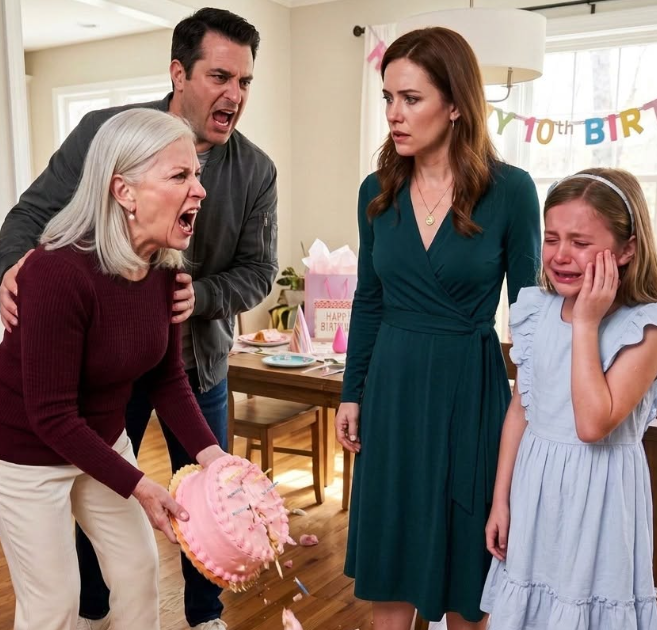
Full part: My MIL crossed the line with my daughter and threw her birthday cake on the floor. “No son, no celebration,” she said. Then my husband looked at me and agreed: “She’s right.” I didn’t scream, cry, or argue. I simply looked at them both and said, “Okay.” They had no idea what that one word would cost them.
My MIL crossed the line with my daughter and threw her birthday cake on the floor. “No son, no celebration,” she said. Then my husband looked at me and agreed: “She’s right.” I didn’t scream, cry, or argue. I simply looked at them both and said, “Okay.” They had no idea what that one word would cost them.
My mother-in-law crossed a line with my daughter on her tenth birthday.
The room went so quiet that every conversation stopped.
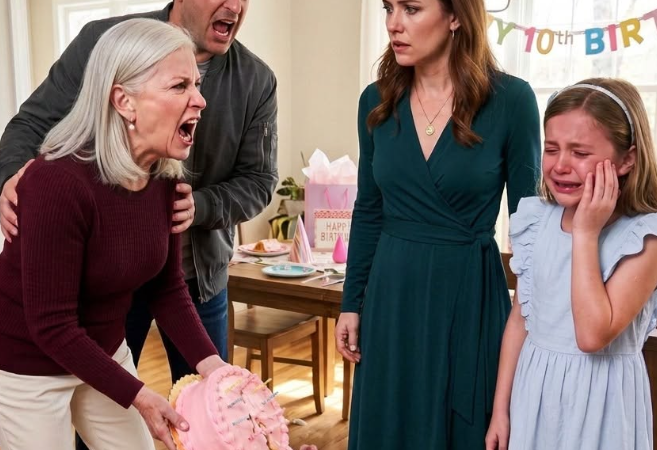
Emma froze beside the table, one hand still reaching toward the pink-frosted cake I had spent half the morning decorating. Her grandmother, Diane Mercer, stood beside her, visibly furious.
“Don’t touch it,” Diane snapped.
Emma’s eyes filled immediately. “Grandma, it’s my cake.”
Diane’s mouth twisted.
Then she grabbed the cake stand with both hands and threw it onto the hardwood floor.
Glass shattered.
Pink frosting splattered across the cabinets.
Ten little candles rolled under the chairs.
“No son, no celebration,” she said.
For three seconds, I honestly thought I had misunderstood her.
My husband, Mark, was standing near the kitchen doorway. His father, Richard, stared at the floor. Mark’s sister Claire looked uncomfortable but said nothing.
Emma stood there fighting back tears.
I turned toward my husband.
“Mark?”
I expected outrage.
Instead, he shrugged.
“She’s right.”
The room became strangely quiet.
Diane had spent twelve years reminding me that the Mercer family needed a grandson. After Emma was born, she asked when we were going to “try properly.” When our second daughter, Lily, arrived four years later, Diane barely visited the hospital.
Mark always defended her.
“She’s old-fashioned.”
“She doesn’t mean anything by it.”
“That’s just Mom.”
But this was different.
Emma wasn’t a baby who couldn’t understand.
She was ten.
And she understood every word.
Mark crossed his arms. “Mom bought most of the gifts anyway. Emma needs to learn she can’t always be the center of attention.”
“It’s her birthday,” I said.
Diane laughed.
“And someday she’ll marry and take another man’s name. What exactly are we celebrating? Another Mercer name disappearing?”
Emma looked at me.
That look changed everything.
She wasn’t asking me why Grandma hated her.
She was asking whether I would let it happen.
I didn’t scream.
I didn’t retaliate.
I didn’t beg Mark to defend his daughter.
I simply bent down, picked up one of the fallen candles, placed it on the counter, and looked directly at my mother-in-law.
“Okay.”
Diane smiled because she thought she had won.
Mark actually looked relieved.
“Good,” he said. “Maybe now we can stop making everything dramatic.”
I nodded.
“Absolutely.”
Then I took Emma’s hand, called Lily from the living room, grabbed my purse, and walked toward the front door.
Mark frowned.
“Where are you going?”
“Out.”
“For how long?”
I looked at him once.
I already knew the answer.
He didn’t.
Diane didn’t know that my attorney had emailed divorce paperwork three days earlier.
She didn’t know the house wasn’t Mark’s.
She didn’t know who owned his company’s building.
And she certainly didn’t know what the word “okay” was about to cost her.
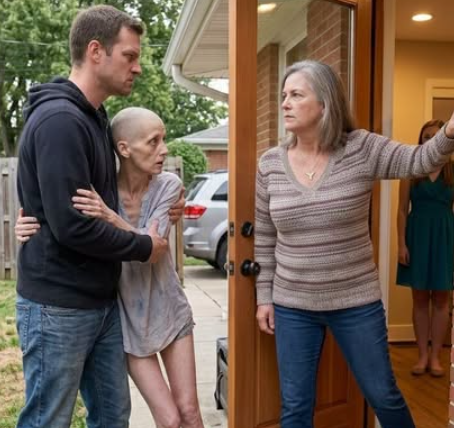
Full part: I returned without warning after four years in Canada and found my wife with a shaved head, skin and bones, eating scraps in the backyard. My mother said she had brought this punishment upon herself. I didn’t yell. I announced that I had just received a million-dollar settlement… and let my family’s greed trigger the trap.
I returned without warning after four years in Canada and found my wife with a shaved head, skin and bones, eating scraps in the backyard. My mother said she had brought this punishment upon herself. I didn’t yell. I announced that I had just received a million-dollar settlement… and let my family’s greed trigger the trap.
“That bald woman shouldn’t let herself be seen when we have company!”
I heard my sister Brianna yelling before I even walked through the door.
In the backyard, Lucy was on her knees gathering pieces of a broken plate with her bare hands. Her head was shaved. Her cheekbones looked hollow. A bucket of dirty water sat beside her feet.
“Pick up the pieces properly, Lucy,” my mother, Theresa, called from the living room. “If someone cuts themselves, I’m taking it out of your food.”
I stopped behind the fence with my suitcase still in my hand.
No one knew I was home.
A shutdown at the metalworking shop in Calgary had given us several unexpected weeks off. My coworkers went to visit family. I bought a ticket that same night because I wanted to surprise my wife.
For four years, I’d worked twelve-hour shifts, eaten reheated meals in a shop that smelled like burnt metal, and spent winters that cracked my lips. Every month, I sent between two and three thousand dollars to Theresa’s bank account.
The money was supposed to finish the house, build our future, and take care of Lucy while I was gone. Altogether, I’d sent almost a hundred thousand dollars, plus a bonus every December.
I never questioned it.
I trusted my mother. I trusted Brianna. Most of all, I believed my wife was safe.
During our video calls, Lucy always said, “I’m fine, my love. Don’t worry.”
Then, a few months ago, she stopped turning on her camera. Bad internet, she said. An old phone. She was tired.
Now I knew why.
Lucy tried to stand, but her legs buckled. Brianna came outside in a new dress holding a wine glass.
“Hurry up. We still need the dinner plates.”
“I feel dizzy,” Lucy whispered. “I haven’t eaten since yesterday.”
Brianna laughed. “With everything you stole, you should be able to buy yourself a feast.”
Every part of me wanted to charge through that door.
But years around failing machines had taught me something: when something starts breaking down, listen before you touch it. The noise tells you where the failure began.
So I listened.
Lucy begged to call me. Theresa came into the backyard wearing the gold hummingbird necklace I’d given Lucy for our fifth anniversary.
“He has the right to know I’m sick,” Lucy said.
“You’re not going to worry him,” Theresa answered. “He’s working to get us ahead, not carry the burden of your drama.”
Lucy said the doctor wanted her to continue treatment.
Theresa dismissed the doctors, then said the sentence that made my stomach turn.
“My son sends the money to my account. That means I decide how it gets used.”
Lucy pointed out the new SUV, Brianna’s nail salon, and the remodeled house. Then she said she had been sleeping in the storage shed.
“I just want to finish my treatment,” she whispered.
Theresa crossed her arms. “You should have thought about that before getting sick.”
I pushed the door open.
My suitcase hit the floor.
Brianna dropped her glass. Theresa grabbed her chest. Lucy stared at me as if I were a ghost.
“Nathan…”
I crossed the yard and knelt beside my wife. She felt terrifyingly light in my arms and smelled faintly of bleach, medicine, and damp clothes.
“I’m back, honey.”
She kept repeating my name.
Theresa immediately insisted things weren’t what they looked like. She accused Lucy of becoming unbearable after getting sick, demanding money, breaking things, even stealing jewelry.
I looked directly at the hummingbird pendant around my mother’s neck.
“Like that one?”
Theresa covered it with her hand.
Lucy told me she’d tried to sell the necklace to pay for a doctor’s visit, and Theresa had taken it.
Then I asked the question nobody wanted to answer.
“What illness does she have?”
Lucy touched her chest.
“Cancer.”
Eleven months.
For eleven months, I’d been sending money while my wife was sick.
Theresa argued that treatment was expensive and there were no guarantees. But everywhere I looked, my money was visible: new floors, a massive TV, leather furniture, granite countertops, the SUV outside, Brianna’s top-of-the-line phone.
Lucy had broken sandals and a six-year-old blouse.
“How much of my money did you use for her treatment?”
Theresa finally admitted they had paid for a few visits.
Lucy corrected her.
Two.
Two visits in eleven months.
I helped Lucy stand and said we were going to the hospital.
Theresa blocked the door.
She accused me of disappearing for four years and coming back to treat my own family like criminals. I rolled up my sleeve and showed her the burn scars and cuts from years in the shop.
“I worked entire nights. I slept in a room with four other guys. I spent two Christmases completely alone so you wouldn’t lack a single thing here.”
“And we didn’t,” Theresa said.
I looked at Lucy.
“She did.”
Brianna blamed me for leaving. Theresa said Lucy had brought everything on herself.
Lucy held tightly to my shirt, waiting for me to explode.
I didn’t.
Instead, I reached into my pocket and pulled out my phone.
────────────────────── Type CASH and I’ll continue. (I know you’re curious about the next part, so please be patient and read on in the comments below.)
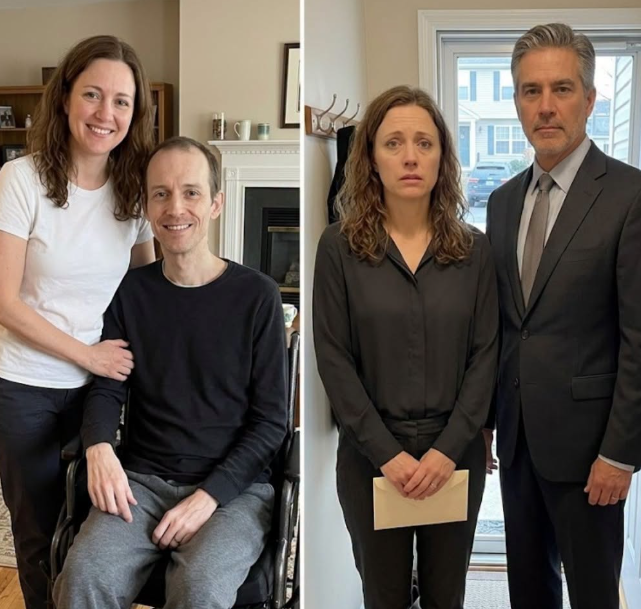
Full part: I married a dying man because it was his final wish—after his funeral, his lawyer came to my door and said, “Carl made me wait until today to tell you who he really was.”
I married a dying man because it was his final wish—after his funeral, his lawyer came to my door and said, “Carl made me wait until today to tell you who he really was.”
Three times a week, I volunteered with a local hospice support program.
That was how I met Carl.
He was around forty, had stage-four cancer, and lived completely alone. I brought him meals, helped around the house, and sometimes we just sat at his kitchen table playing board games over tea.
Then one afternoon, Carl looked at me and said, “Marry me.”
I thought he was joking.
He wasn’t.
“I know how this sounds,” he said. “But I’d like to die knowing I’m not alone. It’s the one thing I want before I go.”
We hadn’t known each other long.
Still, there was something between us I couldn’t explain.
The next day, a priest came to Carl’s house.
I wore a plain white T-shirt because it was the only white thing in my closet.
No flowers.
No music.
No guests.
Just Carl smiling at me in his living room as we became husband and wife.
Ten days later, he died.
I grieved harder than I expected.
After the funeral, I returned home completely exhausted.
Then someone knocked.
A man in a dark coat introduced himself as Carl’s lawyer.
“Carl gave me very specific instructions,” he said. “I was not allowed to tell you the truth until after he was buried.”
My stomach tightened.
“What truth?”
He handed me an envelope.
“Read the NOTE.”
My hands were shaking when I opened it.
The first line said:
**Our meeting was not an accident. I have known you your entire life, and I have quietly watched over you.**
I stopped breathing.
“What does that mean?”
The lawyer didn’t answer.
I forced myself to read the second line.
My knees buckled.
The NOTE slipped from my hand.
And as the lawyer crouched beside me, he said, “There’s one more thing Carl left behind—but you need to understand that sentence first…”
We were riding the bus home from my mother’s house when, as we reached our stop, my 8-year-old daughter pressed herself against the seat and whispered, “Mom, please don’t make me get off. He’s at home.” I didn’t argue. I asked the driver to keep going and pulled out my phone. Minutes later, I received a photo of my deed next to a contract I had never signed…
We were riding the bus home from my mother’s house when, as we reached our stop, my 8-year-old daughter pressed herself against the seat and whispered, “Mom, please don’t make me get off. He’s at home.” I didn’t argue. I asked the driver to keep going and pulled out my phone. Minutes later, I received a photo of my deed next to a contract I had never signed…
PART 1
“Mom, please don’t make me get off! Gregory is at home, and I’m scared of him.”
The words from Abigail, who was only 8 years old, left Alison frozen in the middle of the bus just as the doors opened on an avenue in downtown Milwaukee. Several passengers behind them complained because they were blocking the exit.
Alison felt her face burning with embarrassment. Her first instinct was to take her daughter by the hand and get off. Gregory was waiting for them at home, her partner of eight months, with whom she was supposedly building a new life after a painful divorce.
But Abigail wasn’t throwing a tantrum. She was pale, clutching her backpack, staring toward the street as if someone might appear at any moment.
“Please keep going,” Alison told the driver.
The doors closed amid the passengers’ complaints.
Once the bus started moving, Abigail finally let out the breath she had been holding.
“Last night I woke up because I wanted some water,” she whispered. “Gregory was in my room, standing next to the closet. He was talking on the phone.”
Alison swallowed hard.
“What did you hear?”
“He said, ‘They can take the girl later. First I need her mother’s signature.’ Then he said the apartment was clear because I’m registered as living with my grandmother.”
Alison felt a chill run through her stomach.
Abigail knew nothing about deeds, powers of attorney, or property sales. To her, “being registered with Grandma” simply meant that her school and clinic were close to Mrs. Catherine’s house.
Suddenly, conversations that had once seemed harmless took on a completely different meaning. Gregory had asked several times who owned the downtown apartment, whether Christopher, Abigail’s father, had any rights to it, and why the girl was registered at her grandmother’s address.
Her phone vibrated.
Gregory.
“Where are you?” he asked without even saying hello.
“Abigail wanted to buy some water. We’re getting off at the next stop.”
There was a brief silence.
“Don’t lie to me, Alison. I saw the bus go by. You should have gotten off.”
Alison looked out the window.
“You were waiting at the stop?”
“I went out to meet you. Come back.”
His friendly tone was gone.
“Don’t let a child tell the adults what to do.”
Alison hung up.
Instead of going back, she took Abigail to a shopping center filled with security cameras and called her mother. Mrs. Catherine didn’t waste any time.
“Don’t go back. I’m coming to get you. And call Christopher.”
Alison hesitated. Gregory had spent months telling her that her ex-husband was just waiting for her to make a mistake so he could take Abigail away from her.
Even so, she called him.
Christopher arrived less than an hour later. He didn’t ask questions or make accusations. He hugged his daughter and asked to see the messages.
Then Alison remembered something even worse. Her passport, the deed, and Abigail’s birth certificate were all at home.
Gregory sent her a voice message.
“I have your documents. I put them somewhere safe so they wouldn’t get lost. Don’t make a drama out of this.”
A minute later, a photograph arrived.
On the kitchen table were Alison’s passport, copies of the deed, Abigail’s birth certificate, and a contract marked with several small yellow tabs.
At the top, she could read: “Purchase Agreement.”
The final message said:
“Come back in 10 minutes. Sign it and stop listening to the girl. Otherwise, I’ll decide how to save this family.”
Alison looked at Abigail and realized that her daughter hadn’t been having a nightmare.
Gregory was trying to sell her home.
And the truly terrifying part was that he already seemed to have a buyer.
She could never have imagined what she was about to discover…
Part 2 is already in the first comment
Type “HOME” and press LIKE if you want to continue reading till the end of this story
“Your son has fourteen days left to live, Mr. Santillán.”
That was what Dr. Robles said while my son, Mateo, slept with a stuffed lion pressed tightly against his chest. Outside the private hospital room, two security guards stood watch in the hallway of the hospital in Guadalajara. Downstairs, my chauffeur waited beside the armored SUV. Across the city, my last name opened doors that stayed locked for everyone else. Business leaders rose to greet me. Government officials answered my calls even in the middle of dinner. People who hated me still smiled whenever I walked into a room.
But inside that hospital room, standing beside my three-year-old son, I wasn’t Alejandro Santillán, the man who owned half of Jalisco’s industrial corridor.
I was only a father who had just been told his little boy was dying.
“Bring me another specialist,” I ordered.
Dr. Robles lowered his eyes.
“We’ve already consulted three from Mexico City, one from Monterrey, and two from Houston. His heart is simply too weak. If we attempt another surgery, he may not survive the anesthesia.”
“Then don’t put him under.”
“It doesn’t work that way, sir. There are some things money simply can’t force you to obey.”
I clenched my fists. In another life, anyone who spoke to me that way would have quickly learned to choose their words more carefully.
But at that exact moment, Mateo opened his eyes and whispered,
“Daddy?”
Every ounce of my anger disappeared.
I brought him home later that afternoon. Our mansion in Puerta de Hierro looked more like a fortress than a house: security cameras on every corner, armed guards at every entrance, towering gates, bullet-resistant glass, and professionally trained dogs. I had built it to protect my family after my wife, Sofía, was murdered two years earlier. I was told it had been an att@ck carried out by business enemies. I was told her SUV had been ambushed as she left a charity gala. I was told she d!ed before I could reach the hospital.
I believed them.
And because I believed them, I made sure everyone supposedly responsible paid the price.
Yet no camera, no weapon, and no family name could stop death from taking a seat beside Mateo’s bed.
Within four days, three nurses had resigned.
“He cries every time we try to give him his medicine,” the last one told me.
“I know he’s dy!ng,” I replied coldly. “What did you expect? That he’d thank you?”
Then Elena Morales arrived.
She carried an old suitcase, wore a simple black dress, and had a quiet composure that felt completely out of place in my home. My head of security inspected her identification, her shoes, her bags, even the lining of her suitcase. She never complained.
I was waiting for her in the hallway.
“If anything happens to my son, there won’t be a place in Mexico where you can hide.”
Elena met my gaze without flinching.
“Then stop frigh.ten.ing everyone who’s still willing to help him.”
The guards fell silent.
No one spoke to me like that.
Before I could respond, a faint laugh drifted from Mateo’s room. I hurried to the doorway. My son was looking at Elena, smiling for the first time in weeks.
The following day, she showed up carrying a small red velvet cake covered with white frosting and topped with three slightly crooked candles.
“Cake,” Mateo whispered.
Elena smiled.
“Your mom’s favorite recipe.”
The air caught in my throat.
That recipe had been handwritten by Sofía and locked inside my safe ever since the night she was mur.dered. No one—absolutely no one—had access to it.
Mateo took one bite.
Then another.
His eyes filled with tears.
“It tastes like Mommy.”
I stepped toward Elena.
“Where did you get that?”
She didn’t answer. She simply set a sealed envelope beside my son’s plate.
I recognized Sofía’s handwriting before I even touched it.
For Mateo. Open only after Alejandro has lost all hope.
I grabbed Elena by the arm.
“Tell me right now who gave you this.”
She leaned in slightly without the slightest hint of fear.
“Sofía knew who was going to k!ll her.”
I looked at the envelope, then at my son eating cake with trembling hands, then back at the woman who had just walked into my home as nothing more than a new employee—and placed a bombshell on the table.
I couldn’t believe what was about to unfold inside my own home.
PART 2
I let go of Elena only because Mateo was watching.
“Finish your cake, buddy,” I told him, though my voice barely sounded like my own.
Mateo looked up.
“Will Mommy come back if I finish it?”
That question cut deeper than any bullet ever could.
“Mommy is always with you.”
Elena handed me the envelope.
It felt as heavy as if it contained an entire grave.
I opened it in Sofía’s study, a room no one had touched since the day she died. Her perfume bottles still sat on the vanity. A blue rebozo hung over the back of a chair. The notebook where she wrote down her recipes remained closed beside the window.
The letter read:
Alejandro, if you’re reading this, Mateo is in dan.ger, and Elena has finally found the courage to come to you. Don’t punish her. She already saved our son once.
I looked up.
“Once?”
Elena swallowed hard.
“Keep reading.”
The doctors will tell you that Mateo was born with a weak heart. That’s a lie. His heart was d@maged. Someone began po!soning him before he turned one year old. Tiny doses. Just enough to destr0y it little by little. Just enough to make it look like the will of God.
The floor seemed to shift beneath me.
Mateo had been born healthy. Small, yes, but healthy. I remembered Sofía crying as they laid him on her chest. I remembered his eyes opening the first time he heard my voice.
“No,” I whispered.
“Sofía found the first bottle,” Elena said. “It was a supplement Dr. Robles prescribed when Mateo was eight months old. I was working in the laundry department back then. I noticed it smelled different after someone replaced it.”
“You worked here?”
“Yes. But you didn’t know all your employees. You only knew the names your head of security chose to tell you.”
I wanted to be angry.
I couldn’t.
Because she was right.
Elena continued.
“My brother, Marco, worked in the garage. One night he saw someone carrying a medical case into the hallway outside Mateo’s room. He told me about it the next morning. That afternoon, he disappeared. Later they claimed he’d stolen money and run away.”
I remembered the report.
I remembered signing it without reading it twice.
“And that was a lie?”
Elena’s eyes burned with anger.
“They planted the money. Marco never stole a thing.”
Sofía’s letter mentioned a hidden drawer in her desk. Elena pulled out a tiny key that hung from a chain around her neck. Beneath a strip of decorative molding, the concealed drawer clicked open.
Inside were photographs, medical records, bank statements, and a small black voice recorder.
I pressed Play.
Sofía’s voice filled the room.
“Alejandro, you always believed the dan.ger would come through the front door. That’s why you built walls, installed cameras, and surrounded yourself with armed guards. But the dan.ger never climbed over the fence. You invited it inside.”
I forgot how to breathe.
“Someone is using three fake medical foundations to purchase experimental compounds and falsify diagnoses. Mateo wasn’t the first child. He may not be the last. Don’t trust the private clinic. Don’t trust Dr. Robles. And above all, don’t trust the person who told you my de:ath was an act of revenge.”
The recording ended with a sentence that turned my bl00d to ice.
“Your brother Rodrigo didn’t drown in Lake Chapala.”
Rodrigo.
My older brother.
The one who had supposedly died at seventeen during a storm on the lake.
Mateo, who had fallen asleep on Sofía’s bed, suddenly woke up and pointed at a photograph on the desk. It showed a tall man in a dark overcoat, partially hidden outside a medical clinic. A scar ran across his right eyebrow.
“He comes at night,” my son whispered.
I turned toward him.
“What did you say?”
“The man in the picture. He comes when everyone’s asleep.”
I gently rolled up his sleeve.
There was a tiny red mark on his arm.
Fresh.
At that exact moment, the window exploded.
Elena dropped to the floor a split second before a bullet slammed into the wall where her head had been. The guards rushed in shouting. The alarms blared throughout the house. Outside, sharp bursts of gunfire echoed across the grounds—controlled, coordinated, unmistakably professional.
I scooped Mateo into my arms and ran into the hallway.
The lights went out.
Red emergency lights flooded the house.
At the far end of the hallway, a door slowly opened.
A man stepped out of the shadows.
Tall.
Gray-haired.
His face was scarred by old burns.
I knew that jawline.
I knew that scar.
“Rodrigo,” I said.
My dead brother smiled without a trace of warmth.
“You’re still surrounding yourself with guns, little brother.”
I aimed at his chest.
“Stay away from my son.”
“If you kill me,” he said, raising a small transparent vial, “Mateo won’t make it until sunrise.”
“You’re the one who injected him.”
“Yes.”
My finger tightened on the trigger.
“But not to kill him. To keep him alive until I could get him out of here.”
A sweet scent, like bitter almonds, began drifting through the air-conditioning vents. One by one, my men started coughing. Blood trickled from Elena’s nose. Dr. Robles coll@psed to his knees.
Gas.
Rodrigo tossed a single respirator mask toward me.
“Put it on the boy.”
I sealed the mask over Mateo’s face as my vision began to blur.
Rodrigo took Mateo from my arms.
“No,” I tried to say.
He leaned down and slipped something into my hand.
Sofía’s wedding ring.
“She was still alive when they told you she was de:ad.”
Crawling across the floor, Elena lifted the letter with a trembling hand.
“Rodrigo! There’s another instruction.”
My brother stopped.
“What is it?”
Elena looked at me just before darkness swallowed me whole.
“Sofía said Alejandro must never find out that Mateo wasn’t his only child.”
PART 3
I woke up on the marble floor with Sofía’s wedding ring digging into my palm.
Mateo was gone.
The house smelled of scorched glass, gunpowder, and betrayal. Some of the guards were still unconscious. Others were vomiting from the effects of the gas. Elena was slumped against the wall, pale but alive.
I grabbed her by the shoulders.
“What did you mean? What other child?”
Her eyes closed for a moment.
“A little girl. Isabella.”
“Sofía never had a daughter.”
“Yes, she did.”
“Before she married you.”
I felt as though the ground had split open beneath my feet.
“Where is she?”
“At Santa Clara Children’s Home, just outside Puebla. She’s living under another name. Sofía hid her there because the people hunting her had been searching for Isabella long before she ever met you.”
“Why were they after her?”
For the first time, Elena broke down in tears.
“Because Sofía uncovered what your family was doing to sick children.”
An hour later, I received a call from my uncle Gabriel, the man who had raised me after my father’s supposed death.
“Rodrigo is alive,” I told him.
There was silence.
Not surprise.
Silence.
“You knew.”
“Come to the old church in Analco,” he replied. “Alone. If you want to see Mateo breathing again.”
I went with a pistol at my waist and a heart that felt like solid stone.
Gabriel stood in front of the altar without a single bodyguard.
Beside him was an eight-year-old girl with dark hair and Sofía’s eyes.
She looked at me as if she had seen my face in her dreams.
“Are you Mateo’s daddy?” she asked.
I couldn’t speak.
Gabriel rested a hand on her shoulder.
“Alejandro… this is Isabella.”
The little girl took one step toward me.
“Mom said you’d come when the monsters finally found us.”
In that moment, I realized something that shattered me inside.
Sofía hadn’t hidden Isabella because she didn’t trust me.
She had hidden her because she believed loving me was the same as painting a target on the little girl’s forehead.
Gabriel told me the truth one piece at a time, like a man digging old bones out of the earth.
My father, Ignacio Santillán, had never died the way everyone believed. For years, he had lived under a different face, a different name, and in different countries. Behind medical foundations and private clinics, he had built a network that tested experimental compounds on children with no one to protect them—children from orphanages, public hospitals, and forgotten communities where no one asked too many questions. They called it Project Lazarus.
Rodrigo discovered it when he was seventeen.
Ignacio tried to kill him at Lake Chapala.
Gabriel helped him disappear and allowed me to believe my brother had drowned.
“And Sofía?” I asked.
Gabriel lowered his eyes.
“She uncovered the network after Isabella was born. Years later, after the two of you married, Ignacio recognized her. He ordered the attack on her SUV. Rodrigo tried to get her out alive, but Ignacio’s people reached her first.”
“Is she alive?”
Gabriel took far too long to answer.
“Rodrigo believes she is.”
That same night, we headed for an abandoned clinic near Tapalpa, hidden beneath a restored convent that had been renovated with money from my own charitable foundation.
I had signed those donations without realizing I was financing hell itself.
We entered through a service tunnel.
I didn’t bring an army.
I brought Gabriel, Elena, and three men who still hadn’t sold their souls.
Isabella was placed under the protection of the Attorney General’s Office, but before she left, she took my hand.
“If you find my mommy, tell her I never forgot her song.”
I promised I would.
Beneath the convent, we found spotless white rooms, rows of small beds, and sleeping children with medical sensors attached to their chests. Some bore scars. Others breathed with the help of machines.
On a glass door, I saw the name Sofía had written in her notes:
LAZARUS
The alarms sounded before we reached the central operating room.
A voice echoed through the loudspeakers.
“Welcome home, Alejandro.”
Ignacio.
My father.
The man who taught me that fear was the same thing as respect.
Behind a wall of bullet-resistant glass lay Mateo on a hospital gurney. Rodrigo stood beside him holding a blue vial. Tied to a chair with her wrists bound was Sofía.
Alive.
Thinner.
Her hair cut short.
Dark circles beneath her eyes.
But alive.
Her eyes filled with tears the moment she saw me.
“Alejandro,” she mouthed silently.
I slammed both hands against the glass.
“Sofía!”
Ignacio’s voice echoed through the room again—cold, polished, and rotten to the core.
“Your son needs two compounds. Rodrigo has one. I have the other.”
From the other side of the glass, Sofía screamed,
“Don’t listen to him! He always forces you to choose!”
Ignacio stepped out of the shadows holding a small vial.
“Mateo or Sofía. One lives today. The other d!es in less than an hour.”
That was his true gift.
Not killing people.
Turning love itself into a trap.
Just then, Elena, who had been checking a medical terminal, looked up.
“He’s lying. There are more doses in Refrigerator Three.”
Ignacio turned his head ever so slightly.
That split second was all we needed.
I fired at the security control panel.
Gabriel smashed the manual lock.
Rodrigo tackled one of the guards.
The reinforced glass released with a sharp click.
I ran straight to Sofía.
I cut through the restraints binding her wrists.
She coll@psed into my arms, and for one brief moment, every horror in the world disappeared with the sound of her breathing.
“Forgive me,” she sobbed. “I tried to come back.”
“You already have.”
Rodrigo injected the first compound into Mateo.
The heart monitor let out a piercing alarm.
Then the line went flat.
“What did you do?” I shouted.
“His heart has to stop before it can restart,” Rodrigo said, his voice breaking. “If the second compound reaches him in time, it’ll beat again.”
Elena came rushing back carrying a case filled with blue vials.
Ignacio had lied.
There wasn’t just one dose.
There were dozens.
He wanted to watch me choose because making people choose was what made him feel like a god.
Sofía took one for herself.
Rodrigo administered another through Mateo’s IV.
Ten seconds passed.
Twenty.
Thirty.
Nothing.
Sofía coll@psed against me.
“My little boy…”
I stepped to Mateo’s bedside, took his tiny hand in mine, and rested my forehead against his fingers.
“Buddy, Daddy’s here. If you’re tired, I’ll carry you. If you’re scared, I’ll hold you. But don’t leave by yourself. Not again. Not after everything we’ve been through.”
A beep sounded.
Then another.
Then another.
Mateo’s heart started beating again—weak, uneven, stubborn…
Alive.
Rodrigo buried his face in his hands.
Sofía cried without making a sound.
I kissed my son’s forehead, and for the first time since the day I was told his mother had died, I felt like I could breathe again.
But Ignacio wasn’t finished.
He tried to escape through a side door with a hard drive clutched in his hand.
Gabriel stepped into his path.
“No more, brother.”
Ignacio smiled.
“You were always the sentimental one.”
He fired.
Gabriel went down.
Rodrigo lunged at Ignacio, and the two of them crashed to the floor.
I grabbed the hard drive.
It contained medical files, videos, payment records, and the names of doctors, judges, business leaders, and government officials.
The entire skeleton of Project Lazarus.
Ignacio looked up at me from the floor, bleeding.
“If you destroy this, you destroy your family name.”
I looked at Sofía.
At Mateo.
At Rodrigo.
At Elena.
Then I thought about Isabella, waiting to find out whether her mother was still alive.
“My family name was already rotten.”
I connected the hard drive to Sofía’s secure network.
She had already prepared an automatic release to the Attorney General’s Office, investigative journalists, and international medical organizations.
It needed only one final password.
Isabella.
Isabella wasn’t there, but Sofía had saved a recording of her singing the lullaby she had told me about. When I played it, the system recognized the voice pattern. A prompt appeared on the screen:
TRANSFER OR EXPOSE.
Ignacio shouted,
“Transfer!”
Sofía took my hand.
“Expose.”
I pressed the key.
Within minutes, the network began to collapse.
Bank accounts were frozen.
Clinics were seized.
Doctors were arrested.
Children were rescued.
The men who had once smiled at me across lavish dinner tables suddenly began calling in desperation.
Ignacio reached for a pistol.
Rodrigo fired first.
He didn’t kill him.
He shattered his hand.
“You’re going to live,” Rodrigo said. “And you’re going to watch the whole world learn your real name.”
Gabriel d!ed before the paramedics arrived.
He managed to reach up and touch Rodrigo’s face.
“Your mother would be proud of you.”
Then he looked at me.
“And you… you’ve finally stopped being Ignacio’s son.”
Three months later, Mateo received a lawful treatment at a public hospital under the care of doctors who owed nothing to my family.
It was Rodrigo who donated the cells Mateo needed.
Then the final truth came to light.
Mateo didn’t carry my blood.
The records proved that Ignacio had used Rodrigo’s genetic material during a fr@udulent fertility procedure performed on Sofía without her fully understanding what she was being asked to sign.
Mateo was my brother’s biological son.
Sofía told me through tears, expecting me to fall apart.
And I did.
But not because of that.
I broke when I thought about every time Mateo had called me Daddy while other men argued over his blood as if it were something they owned.
Rodrigo walked over to me in silence.
“I’ll never try to take him from you,” he said. “You’re his father.”
I looked at Mateo asleep with his stuffed lion tucked safely in his arms.
“I know.”
A year later, we were living in a small house near Lake Chapala.
No towering gates.
No armed guards posted on every corner.
No fortune buried beneath the floorboards.
Sofía wears her wedding ring again.
Isabella sings while setting the table.
Every birthday, Elena bakes the same red velvet cake.
Rodrigo comes over every Sunday carrying books, and Mateo calls him Uncle so naturally that it still brings tears to Rodrigo’s eyes.
In the backyard, we planted the Japanese maple Sofía had lovingly cared for while she was pregnant. We rescued it from the ru!ns of the mansion and brought it with us, as though we were saving a promise from the rubble.
On Mateo’s fourth birthday, he blew out his candles, and Sofía asked him what he had wished for.
He smiled.
“That nobody ever disappears again.”
No one spoke for a long moment.
Then Isabella reached over and took his hand.
I looked at my wife, my daughter, my son, and the brother who had returned from the dead to save him.
For years, I believed power meant having guards, wealth, fear, and people willing to obey.
I was wrong.
Real power was staying when the truth destr0yed everything you thought you were.
And that night, as Mateo ran beneath the tree that had once witnessed his heart fall silent, I finally understood the one thing that had survived every lie:
A father isn’t the man whose bl00d creates a child.
A father is the one who stays when de:ath, betrayal, and the entire world try to take that child away from him.
“My dad told me he’d only be away for thirty minutes…” a frigh.ten.ed seven-year-old whispered to a 911 dispatcher after spending four days by herself.
The entire neighborhood quickly labeled her father a heartless man who had a.ban.don.ed his own little girl.
Then rescue crews found something beside a flooded roadside that completely changed what everyone thought they knew…
The small voice on the emergency call trembled so badly that Eric almost failed to catch the next sentence.
“But now it’s been four whole days.”
Eric sat up straighter in his chair and adjusted his headset.
He had spoken with scared children before, yet something about this little girl’s voice felt different.
She was not sobbing uncontrollably or desperately screaming for help.
She sounded exhausted—as though nearly all of her fear had already been spent.
“What’s your name?” Eric asked.
“Ashley.”
“And how old are you, Ashley?”
“Seven.”
Eric kept his tone calm while another dispatcher worked on tracing the call.
“Ashley, are you there by yourself right now?”
After a long pause, she quietly answered, “Yes.”
She explained that her father, Andrew, had gone out to pick up medicine and groceries for her.
He had promised he would only be gone for thirty minutes.
Ashley remembered watching his old pickup truck reverse down the driveway as raindrops tapped softly against the front window.
She had stood beside the curtain with Buddy, her stuffed puppy, tucked beneath one arm.
At first, she waited near the entrance because she wanted to surprise Andrew when he came back.
Then the sky turned darker.
The rainfall became heavier.
Thirty minutes turned into an hour, and that hour slowly became an entire night.
Ashley drifted off on the couch while the porch light remained glowing.
When she opened her eyes again, the light was still shining, and Andrew’s truck was still nowhere in sight.
She waited through another full day because her father had always returned before.
By the third day, hunger had begun making her stomach ache.
She found an opened container of soup inside the refrigerator, but it smelled spoiled, so she placed it back.
She drank water straight from the kitchen faucet and poured some into a plastic cup for Buddy because she did not want him to feel thirsty either.
On the fourth morning, she finally remembered what Andrew had taught her about emergencies.
She dragged a chair beneath the wall telephone, climbed onto it, and dialed 911.
Eric immediately dispatched assistance.
Officer Natalie arrived as rain poured across the small front porch.
Several neighbors stood behind a chain-link fence or watched quietly through their windows.
A mailbox leaned toward the soaked street, while one curtain shifted slightly as Ashley checked every passing vehicle.
Even after four long days, a part of her still believed the next headlights would belong to her father.
Natalie stepped onto the porch and knocked softly.
“Ashley? This is Officer Natalie. I’m here to help you.”
The door opened only a narrow crack.
One frightened eye appeared through the opening.
“You’re not going to yell at me?” Ashley asked.
Natalie crouched until her face was level with the little girl’s.
“No. No one is going to yell at you.”
Ashley slowly opened the door a little wider.
She was barefoot and dressed in one of Andrew’s oversized shirts.
Buddy was pressed tightly against her chest, leaving one of the stuffed puppy’s ears bent flat.
Her lips were dry, her hair was messy, and dark shadows rested beneath her eyes.
When the call came over the radio, Natalie had expected to find signs of neglect.
Instead, she found a child who had survived by holding onto trust long after her food and energy had started running out.
Inside the house, the refrigerator was almost empty.
On the kitchen table, Natalie discovered two handwritten notes lying beneath an uncapped pen.
One was a shopping list: rice, chicken, electrolyte drinks, soup, and Ashley’s medicine.
The second was a reminder about an urgent appointment scheduled for Monday morning.
Several bills had been neatly stacked beside the notes, and Andrew’s work shoes still sat near the back door.
Nothing appeared packed.
No drawers had been cleared.
No clothing was missing from the closet.
Those details did not resemble a father planning to v@nish.
They looked like a father who fully intended to return home.
Outside, several neighbors had already decided otherwise.
One woman quietly remarked that Andrew had likely become overwhelmed by raising a child on his own.
Another neighbor raised a phone and began filming the porch, convinced the story would be all over town before sunrise.
Someone called Andrew a monster.
Another person insisted that no caring father would ever leave a seven-year-old alone, even for thirty minutes.
Natalie heard every comment, but her focus never left Ashley.
“I’m going to pick you up now,” she said.
Ashley gave a faint nod.
“Please don’t leave Buddy behind.”
“I won’t.”
Natalie gently lifted the little girl.
Ashley weighed far less than she should have.
The child rested her head against Natalie’s shoulder while still staring down the street over the officer’s arm.
“Is that Daddy?” she asked as an SUV came around the corner.
“No, sweetheart.”
Only moments later, Ashley’s body became limp.
Buddy slipped from her hands and fell toward the rain-covered porch.
Natalie caught the stuffed puppy with one hand while wrapping her other arm more securely around the child.
“Unconscious minor,” she reported into her radio. “Possible severe dehydration. Send medical support immediately.”
The neighbors fell silent.
The phone that had been recording slowly dropped to its owner’s side.
Natalie held Ashley close and looked toward the people who had already decided Andrew’s guilt.
“This does not look like a.ban.don.ment.”
Ashley was transported to a hospital, where doctors and nurses immediately began giving her fluids and carefully monitoring her condition.
She was exhausted, frigh.ten.ed, and seriously dehydrated, but she gradually responded to treatment.
Even as she drifted in and out of sleep, she kept repeating the same question.
“When is my daddy coming?”
No one could answer.
Andrew’s phone went straight to voicemail.
His pickup was missing from the house, his workplace, and every familiar location the neighbors knew he visited.
There was no note explaining why he was gone.
No relative had received a call.
No one had been asked to care for Ashley, and there had been no bank withdrawal suggesting he intended to disappear.
Those unanswered questions still allowed room for suspicion.
A frightened little girl had been left alone, regardless of Andrew’s intentions.
Natalie understood that.
She also knew intentions mattered when deciding where investigators should search next.
After Ashley was stable enough to sleep, Natalie returned to the rental house.
The porch light still glowed beneath the gray afternoon sky.
Inside, Natalie examined the grocery list once more.
The handwriting started neat and steady but became rushed near the bottom, where Andrew had written Ashley’s medication and underlined it twice.
Next to the list sat a pharmacy reminder showing a pickup window that had opened on the very day he disappeared.
Natalie requested checks at every place Andrew would reasonably have visited.
A pharmacy employee recognized him.
Andrew had arrived soaked from the storm, apologized for rushing, and collected Ashley’s medication.
The purchase had been completed twenty-eight minutes after he left the house.
He had also asked whether the medicine needed refrigeration because he still planned to stop for groceries before returning to his daughter.
That single detail changed the direction of the investigation.
Andrew had not driven away without intending to return.
He had been doing exactly what he had promised Ashley he would do.
A grocery receipt from that same afternoon listed rice, chicken, soup, electrolyte drinks, crackers, and a small box of Ashley’s favorite cereal.
The purchase had been made less than an hour after the pharmacy visit.
The claim that Andrew had intentionally abandoned his daughter no longer matched the evidence.
Now the question was no longer why he had left.
It was what had prevented him from making it home.
Dispatchers reviewed reports from the storm.
Several roads had flooded rapidly that afternoon, including a low section Andrew frequently used between the shopping district and his neighborhood.
The road had later been closed after muddy water flowed across both lanes.
Drivers were redirected, but Andrew had traveled through before the barricades were installed.
Search crews returned to that route.
The heavy rain had erased nearly every tire track, while thick brush covered the lower side of the roadway.
From above, nothing stood out except broken tree limbs and water rushing through a drainage ditch.
One rescuer noticed a strip of flattened brush that was far too wide to have been caused by the wind alone.
It had left the roadway near a washed-out shoulder, slid down the embankment, and came to rest at an angle behind the dense brush.
The passenger side was pinned against the ground.
The driver’s door hung open.
Inside, rescue workers found the groceries.
A torn paper bag had burst across the floor, scattering rice and crushed crackers beneath the dashboard.
The chicken had spoiled, but the cereal box remained lodged behind the seat.
Ashley’s medication was still sealed inside the pharmacy bag.
Andrew was nowhere inside the truck.
For a moment, the discovery made the situation even more troubling.
If he had survived the cr@sh, he might have tried to reach the roadway and then been swept away as the drainage ditch filled with water.
Rescue teams spread out along the flooded roadside, calling Andrew’s name while searching every patch of higher ground.
One rescuer noticed unusual marks in the mud several yards from the vehicle.
They were not ordinary footprints.
They looked like the trail of someone dragging one leg while pulling himself across the soaked grass.
The marks led toward a concrete drainage opening where fallen branches had formed a narrow shelter above the rushing water.
A rescuer dropped to one knee and shined a flashlight beneath the tangled debris.
A hand moved.
Andrew was alive.
He was soaked, severely dehydrated, and far too weak to climb out by himself.
One leg had been injured during the cr@sh, and swelling around his ankle had made standing nearly impossible.
He had crawled away from the truck as water began filling the cab, then dragged himself toward higher ground before the ditch became impossible to cross.
The fallen branches that concealed him from the road had also created a small protected pocket where he could keep his face above the rising water.
Rainwater had collected inside the curved plastic lid of a damaged storage bin that had washed nearby.
It had provided barely enough water to keep him alive.
As rescuers cut through the branches, Andrew tried to speak.
His voice was little more than a whisper of air.
“My daughter.”
One rescuer leaned closer.
“What about your daughter?”
“She’s home alone.”
Andrew never asked what day it was.
He never asked about his truck, the groceries, or his own injuries.
He kept repeating Ashley’s name and the address of the rental house until someone assured him she had been found.
Only then did he close his eyes and allow the rescue team to place him onto a stretcher.
News of Andrew’s discovery spread through the neighborhood even faster than the original accusations.
The woman who had recorded Natalie carrying Ashley from the house watched the rescue footage on her phone and covered her mouth with one hand.
The man who had called Andrew a monster quietly crossed the street and switched off the porch light that had remained glowing for four days.
No apology could erase what Ashley had experienced, and the cr@sh did not remove the risks of leaving a young child alone, even for a short time.
But it changed the central truth.
Andrew had not a.ban.don.ed her.
He had been trapped less than a few miles away, injured and des.per.ate.ly trying to return to the daughter who had been waiting for him.
At the hospital, Natalie sat beside Ashley’s bed while Buddy rested near her pillow.
Ashley had been dressed in clean pajamas, but she still wore Andrew’s oversized shirt over them because she refused to let anyone take it away.
Natalie gently told her that rescuers had found her father.
Ashley stared at her without blinking.
“Is he mad because I called?”
“No,” Natalie replied. “He’s alive because people kept searching, and you’re safe because you made that call.”
“Did he forget me?”
Natalie moved Buddy a little closer to Ashley’s arm.
“No. He was doing everything he could to come home.”
Only then did Ashley begin to cry—not the loud, frigh.ten.ed sobs people expected from a scared little girl, but quiet tears that slipped into her hair as the weight she had carried finally lifted from her face.
Andrew regained fuller awareness later that evening.
When a nurse explained that four days had passed, he slowly turned his face toward the wall.
He remembered the truck sliding.
He remembered the windshield filling with branches and muddy water.
He remembered forcing the driver’s door open because he believed the cab would soon flood.
After that, his memories came only in scattered fragments: crawling through mud, hearing vehicles pass overhead, shouting until his voice gave out completely, and waking each time raindrops struck his face.
He had believed Ashley would ask a neighbor for help if he failed to return.
Then he realized he had never taught her which neighbor she could safely trust.
He had taught her to dial 911, but the wall phone had been mounted too high above the floor.
He had left food inside the refrigerator without realizing that most of it had already gone bad.
He had promised thirty minutes because those words sounded reassuring, not because he had any control over what might happen once he left the house.
The accident had not been his fault.
The absence of a backup plan was something he could no longer overlook.
When Andrew was finally allowed to visit Ashley, he entered her hospital room using crutches.
His clothes had been replaced with a hospital gown and a simple robe, and one ankle was wrapped and supported by a brace.
Ashley looked at him from the bed without moving.
For one painful moment, Andrew expected her to reach toward him.
She didn’t.
“Daddy?”
“I’m here.”
“You said thirty minutes.”
Andrew tightened his grip on the crutches.
“I know.”
“You were gone for four days.”
He did not tell her the cr@sh should explain everything.
He did not ask her to understand.
Instead, he lowered himself into the chair beside her bed and placed both hands where she could clearly see them.
“I was trying to come back,” he said. “But you were alone, and you were frightened. I’m sorry.”
Ashley looked down at Buddy.
“I gave him water.”
“You took good care of him.”
“He was scared too.”
Andrew nodded, unable to speak right away.
After a quiet moment, Ashley pushed Buddy across the blanket toward him.
Andrew held the stuffed puppy while Ashley reached for his hand.
The review of everything that had happened continued after both of them were discharged from the hospital.
The people responsible for evaluating Ashley’s safety did not overlook those four days simply because Andrew had been found injured.
They asked difficult questions about why she had been left alone, what food had been available, who could help during an emergency, and how another crisis would be handled in the future.
Andrew answered every question without becoming defensive.
He admitted that he had convinced himself a short errand was harmless because money was limited and he did not want to take a sick child out into heavy rain.
He had mistaken being cautious for being prepared.
They were not the same thing.
Before Ashley returned home, a practical safety plan was put in place.
Two trusted adults received house keys along with written emergency instructions.
A working phone was placed where Ashley could reach it without climbing onto a chair.
Fresh food and sealed snacks were stored on a lower shelf.
Andrew wrote important phone numbers in large letters and taped them beside the telephone.
He also stopped making promises based on exact minutes.
Ashley’s important appointment was rescheduled, and Andrew personally took her once his ankle had healed enough for him to drive.
He carried the folded grocery list from the kitchen table inside his wallet.
That list had once served as evidence that he had intended to come home.
Now it reminded him that intending to return was never enough unless his daughter knew exactly what to do when life disrupted the plan.
The neighborhood changed more slowly.
Some people apologized face-to-face.
Others avoided Andrew because they were embarrassed by how quickly they had judged him.
The woman who had recorded the porch arrived carrying grocery bags and asked whether Andrew wanted her to delete the video.
“Yes,” he said. “And please don’t share Ashley’s name again.”
The woman nodded.
“I’m sorry.”
Andrew looked through the screen door toward Ashley, who was sitting on the floor with Buddy and a box of crayons.
“If you really want to help, learn the emergency numbers on the refrigerator,” he said. “She needs neighbors who know what to do. She doesn’t need more people talking about her.”
The woman wrote the numbers down.
Andrew never fully became comfortable leaving Ashley, and Ashley did not immediately become comfortable watching him walk out the front door.
For months, the sound of truck keys made her pause whatever she was doing.
Andrew answered that fear by explaining every step of the plan.
He told her exactly where he was going.
He showed her who would stay with her.
He let her watch him send the check-in message.
He came back when he said he would, but he never expected praise for simply keeping his word.
Trust slowly returned through ordinary routines: breakfast waiting before school, medicine measured at the same time every evening, wet shoes drying beside the back door, and Andrew sitting beside Ashley until she fell asleep whenever a storm passed through the neighborhood.
He also stopped treating the porch light as a promise.
On rainy evenings, Ashley decided when it stayed on and when it was switched off.
Several months after the rescue, Andrew discovered the old grocery list lying on the kitchen counter.
Ashley had copied it carefully using a purple crayon.
Rice.
Chicken.
Electrolyte drinks.
Soup.
Medicine.
At the bottom, she had written one more item.
Buddy snacks.
Andrew picked up his keys, and Ashley glanced toward the front door.
He did not promise that he would be back in thirty minutes.
Instead, he held out her coat.
Ashley slipped her arms into the sleeves, tucked Buddy beneath one arm, and carried the purple grocery list out to the truck.
Before Andrew started the engine, she carefully buckled the stuffed puppy into the seat beside her.
Then she handed the list to her father and kept her other hand wrapped around his all the way to the store.
When my husband fused the kennel door shut in our basement and left me there alone while he calmly told the dinner guests upstairs that I was “visiting family,” I realized that before the night ended, I would either lose my life delivering my baby inside that cage or bring his world crashing down.
Above my head, cutlery clinked against dinner plates, glasses settled softly onto the table, and laughter followed something Marcus had just said.
Every sound drifted through the basement ceiling with such clarity that I could almost imagine the guests leaning toward one another beneath the warm glow of the dining room lights.
They were only a short distance away, yet the gap between us felt as impossible as if I had been buried beneath the foundation. I lay curled behind steel bars on the basement floor, one arm wrapped around my swollen stomach while another wave of pain spread across my lower back.
The metal underneath me was cold enough to make my body shiver, while the stale air carried the damp scent of concrete, rust, and the dinner Marcus had carried upstairs moments earlier.
Roasted meat.
Butter.
Fresh bread.
He had deliberately prepared a meal whose aroma would drift into every corner of the basement.
Marcus had spent the past three weeks transforming hunger into another prison.
Every other day, he rolled a rotten apple through the bars and remained there until I finished eating it.
Sometimes the fruit had turned mushy and brown along one side, and other times it was so badly bruised that my fingertips sank through the skin the instant I picked it up.
He never handed me a plate.
He never turned his eyes away.
“The baby has to keep moving,” he would say while crouching outside the cage, his forearms resting casually across his knees.
Then he smiled as though he had delivered a clever joke.
“It keeps me entertained.”
By the second week, my cheeks had become hollow, and the bones in my shoulders dug painfully into the bars each time I tried to sleep.
One eye remained swollen from a strike I had learned never to touch, while my wrists were scraped raw from bracing against the steel every time Marcus stormed downstairs.
The baby still kicked, but the movements had changed.
They were no longer the quick, joyful bursts that once made me laugh and guide Marcus’s hand to my stomach months before.
Now each movement felt slower and heavier, as though my child was carefully saving every bit of strength inside a body that had almost nothing left to offer.
I counted every kick because numbers were among the few things Marcus could never steal from me.
At times, he carried a tablet downstairs and pressed it against the bars.
He forced me to watch recordings of himself with other women while standing close enough to examine every reaction on my face.
He wanted tears.
He wanted desperate pleading.
He wanted proof that, after taking everything else from me, he could still reach whatever remained inside.
“You’re less than a dog now, bitch,” he said once after I turned my face away from the screen.
He tapped one finger lightly against the steel.
“Dogs at least get fed.”
The cruelest part was not the words. It was how completely ordinary his voice sounded.
That same easy, pleasant voice floated through the ceiling now while he entertained the people gathered upstairs.
“She’s visiting family,” he told the guests after someone apparently noticed that my chair remained empty.
His reply came without hesitation.
Without tension.
Without the slightest sign that his wife lay imprisoned directly beneath his feet, bleeding and struggling to remain awake.
Someone upstairs said they hoped I was doing well.
Marcus thanked them.
His mother helped him maintain the deception.
She wore the only key on a delicate gold chain around her neck, hidden just beneath the collar of her blouse like a treasured keepsake.
Every morning, I heard the basement door swing open, followed by the slow, deliberate rhythm of her footsteps descending the stairs.
She never rushed.
She enjoyed making me wait while the key rested against her chest.
She always paused outside the cage and allowed me to see it before unlocking the original latch, even after Marcus had started welding extra strips of metal across the door.
She wanted me to understand that freedom remained close enough to see, yet belonged entirely to her.
Sometimes she carried a cup of water.
Holding it just beyond my reach, she asked whether I was finally ready to apologize for ruining her son’s life.
If I hesitated too long before answering, she poured part of the water across the floor.
If I begged, she smiled.
If I refused, she walked away with the cup still full in her hand.
She hum!liated me whenever Marcus was absent, as though her cru:elty became even more satisfying without an audience.
She blamed me for the pregnancy, for Marcus’s anger, for the money he wasted, and even for the rumors she believed had spread simply because I had disappeared.
According to her, I had trapped her son with a child.
According to Marcus, I had hum!liated him by questioning the other women, the unexplained expenses, and the nights he returned home carrying the scent of another woman’s perfume.
Between the two of them, every decision Marcus made somehow became something they insisted I had forced him to do.
Marcus wanted me convinced that no one had any idea where I had disappeared. He reminded me of that every time I begged for help.
He had taken my everyday phone, my purse, my clothes, and anything else he believed could connect me with the outside world.
Using my account, he sent messages telling everyone that I needed time alone and would reach out when I was ready.
He knew my sister would never stop asking questions, so each new message became colder than the last.
Stop checking on me.
I’m fine.
Leave me alone.
He believed he had erased every trail leading to the basement.
He was mistaken.
Long before the cage became the center of my existence, Marcus had purchased a new phone and laughed at me for refusing to throw away the old one.
He called it worthless junk.
I had completely forgotten about it until the first night he locked me downstairs, when I felt something shift beneath one of the loose metal floor panels inside the cage.
One corner of the panel had loosened over the years, probably from rust and constant pressure.
Whenever Marcus was upstairs, I slipped my fingernails beneath the edge and lifted it just enough to reveal the darkness underneath.
The old phone was still there, sealed inside a plastic bag beside a few random belongings Marcus had tossed into the cage before deciding it would become my prison.
He had forgotten I even owned it because dismissing things came naturally whenever he believed they had no value.
The phone could not rescue me the way I had first imagined.
Its battery was fading, the basement walls blocked most of the signal, and reception appeared only in brief, unpredictable flashes.
Some nights I held it against the bars until my shoulder cramped, watching a single weak signal bar appear and disappear before I could complete a call.
Other nights the display showed nothing except the low-battery warning.
But the recording function still worked.
That changed everything.
Night after night, I captured the sound of Marcus’s footsteps descending the stairs.
I recorded the scrape of the tray across the concrete floor and the sharp clang of metal whenever he struck the cage.
I recorded his threats, his insults, and the laughter that followed whenever he bragged about how easily everyone had accepted his story.
I recorded his mother unlocking the basement door while discussing how much longer she believed I could stay alive.
One day, she told him I looked weaker than I had the previous morning.
Marcus asked whether the baby was still moving.
When she answered yes, he said there was no reason to change anything yet. They spoke about my body as though it were a machine they intended to keep operating until it no longer served a purpose.
I saved every recording.
I gave each file a simple name because my hands trembled too much to type anything longer.
Night.
Door.
Food.
Mother.
Threat.
I lowered the screen brightness and powered the phone off between recordings to preserve the little battery life that remained.
Then I wrapped it in plastic once more and hid it beneath the loose floor panel.
The phone became more than a source of evidence.
It became proof to myself that the truth still existed somewhere beyond Marcus’s version of reality.
He could tell the dinner guests that I was visiting family.
He could tell his mother I deserved everything happening to me.
He could tell me that nobody would ever believe my story.
But those recordings preserved his real voice.
They captured the pauses missing from his polished public lies.
They preserved the sound of his boot striking the cage and his mother’s key turning inside the lock.
That evening, while dinner continued upstairs, the battery was nearly exhausted.
A tiny red warning icon glowed in the corner of the screen as I pulled the phone from beneath the loose floor panel.
The pains of labor had begun spreading through my back in slow, punishing waves.
At first, I convinced myself they came from fear or starvation, but the pattern had become impossible to ignore.
The pain tightened, reached its peak, then faded.
Moments later, it returned.
Each contraction felt stronger than the one before. I pressed one hand beneath my stomach and felt the baby move.
“I know,” I whispered, though my throat was so dry the words barely escaped my lips.
“I’m trying.”
Upstairs, Marcus lifted his glass.
I heard the change in his voice as he offered a toast, speaking louder because he wanted everyone at the table to hear.
He thanked them all for coming.
He joked that I would probably be upset once I realized I had missed such a wonderful dinner.
The guests responded with polite laughter.
Downstairs, I clutched the old phone tightly against my chest.
A few days earlier, during one brief moment when a signal appeared, I had managed to send a broken message to my sister.
It included a location pin, three words, and a short audio recording.
The three words were all I had time to type before the signal vanished again.
Marcus locked the basement.
The recording captured his voice along with the sound of the cage bars rattling.
I stared at the screen for nearly an hour after pressing send.
No reply ever arrived.
No phone call came through.
The message remained stuck with no indication that it had ever reached her.
I convinced myself it had failed.
That thought nearly shattered me more completely than anything Marcus had done.
My sister had always been the one who noticed the smallest changes in my voice during phone calls.
She noticed when I answered too quickly, when I avoided certain questions, and when I insisted everything was fine using the careful tone people choose when nothing is actually fine.
Before Marcus took away my phone, she had asked whether I wanted her to come pick me up.
I told her no because Marcus was standing in the doorway.
I hoped she would hear the meaning hidden beneath my answer.
Now, trapped inside the cage, I wondered whether I had expected too much from three words and a damaged recording sent through a fading signal.
The basement door opened.
Marcus descended the stairs at an unhurried pace.
He made no effort to conceal his mood.
By the time he reached the bottom, he smelled of roasted meat, wine, and expensive cologne.
The scent was so overwhelming that my stomach twisted with hunger before the next contraction even arrived.
He had removed his jacket, and the sleeves of his shirt were neatly rolled to his forearms, as though he had only stepped away from dinner to check on something in the laundry room.
He crouched outside the cage.
His eyes traveled across my face, my swollen eye, my stomach, and the blood staining the metal floor.
Then he smiled.
It was not a wide grin.
Only a small, controlled curve of his lips that somehow made his eyes seem even colder.
“The guests believed every single thing I told them,” he said. I kept the phone hidden beneath my hand and refused to lower my eyes.
For weeks, Marcus had treated eye contact as though it were another privilege he alone controlled.
If I looked down, he called me weak.
If I looked directly at him, he accused me of defying him.
That night, I refused to give him any reaction he could use.
His smile became tighter.
He slammed his boot into the cage with enough force to shake every steel bar.
The crash echoed through the basement and seemed to travel into the room above, yet the dinner conversation continued without interruption.
Pain gripped my stomach harder than before, and I curled around it with both arms, trying to shield my baby with my own body.
The old phone dug pa!nfully between my chest and my hand.
I feared he would discover it.
I feared even more that I might accidentally drop it.
“You’re never leaving this basement,” Marcus said.
Another contraction seized me before I could respond.
My breath caught, and a quiet sound escaped my throat.
Marcus rose to his feet and stepped closer to the bars.
His fingers wrapped around the freshly welded section of the cage door.
“If you make one more sound,” he said, “I’ll cut the child out myself.”
For a single moment, the house seemed split into two completely different worlds.
Above us were warm meals, filled wineglasses, and guests who believed they were spending the evening with a charming husband whose pregnant wife simply happened to be away.
Below them, Marcus stood outside a welded cage threatening the child he had once claimed he wanted more than anything.
I looked down at the phone in my hand.
The tiny red battery symbol flashed once.
I thought about every recording stored inside it. I thought about my sister receiving nothing. I thought about my baby struggling to move beneath my ribs.
Marcus reached toward the bars.
Then the basement door burst inward.
The impact slammed against the wall, and voices flooded the stairwell before Marcus could fully turn around.
The first “dinner guest” through the doorway advanced quickly but carefully, holding a firearm low with its barrel pointed safely toward the floor.
A body camera blinked on his chest, already recording everything. Behind him came the scrape of chairs upstairs, startled voices, and someone shouting for everyone to remain exactly where they were.
Marcus stepped back from the cage.
For the first time since he had trapped me inside that cage, uncertainty crossed Marcus’s face.
The man standing on the stairs paid no attention to Marcus’s clothing, the dinner gathering upstairs, or the expensive bottle of wine resting beside the basement door.
His eyes went straight to the welded cage.
Then they settled on me.
He took in the bru!ses covering my face, the torn skin around my wrists, the bl00d spread across the metal floor, and the way I clutched my stomach as another contraction rolled through me.
Something shifted in his expression, yet his hands never wavered.
He spoke quietly into the radio clipped near his shoulder, giving brief instructions without once looking away from the cage.
Marcus slowly raised both hands and forced out an uneasy laugh.
“This isn’t what it looks like,” he said.
The excuse sounded weak inside the basement.
The body camera continued flashing as it recorded.
The man stepped forward at another pace.
He studied the welded door, then glanced toward the thin gold chain hanging against Marcus’s mother’s blouse near the top of the staircase.
I nearly let it go unanswered, but then Mom’s name appeared on the display, and I picked it up before the second ring finished.
Her voice sounded so faint that I sat upright and held the phone tightly against my ear.
“Clara, I’m at the police station.”
My grip tightened around the blanket. “Why are you at the police station?”
For several moments, all I could hear was uneven breathing and voices shifting somewhere behind her.
Then she quietly said, “Brooke struck me with a baseball bat.”
Brooke was my sister-in-law, while Arthur, my older brother, had been standing near enough to stop everything.
Instead, Mom explained that he watched Brooke swing, helped her create a story for the officers, and remained beside her while police placed our mother in handcuffs.
“They claimed I att@cked her,” Mom said. “Arthur told them I was unstable.”
I asked where she had been injured.
“My shoulder, my ribs, and my wrist,” she replied. “My eye is swelling too.”
Years working in military legal service and federal oversight had taught me that pan!c ru!ns timelines, while discipline protects them.
“Do not sign anything,” I said. “Do not answer the same questions again. I’m coming.”
Freezing rain swept across my windshield as I drove toward Westbridge Police Department, turning the deserted streets into stretches of black glass.
By the time I arrived at the station, I had already assembled the first version of the timeline in my mind: the argument, the bat, the injuries, the false allegation, and the arrest that had somehow occurred without anyone documenting the condition of the woman wearing handcuffs.
The officer behind the front desk looked annoyed when I walked in with rain dripping from my coat.
Then he recognized me.
His posture shifted so fast that it revealed he knew exactly who I was, even though he did not understand why I had arrived.
“Ma’am,” he said, lowering his voice, “I didn’t know she was your mother.”
That single sentence mattered more than any greeting he could have offered.
It meant the treatment my mother received depended upon who her daughter happened to be.
Helena sat on a molded plastic chair across the room with metal cuffs secured around her wrists.
One eye was swollen, her cardigan was ripped at the shoulder, and she kept her left wrist close against her ribs as though every slight movement caused pa!n.
Brooke sat several chairs away with her face pressed against Arthur’s shoulder.
She cried loudly enough for everyone inside the room to hear, but when I studied her from across the distance, I noticed no swelling, ripped clothing, or visible !njuries.
“She att@cked me,” Brooke said the instant she noticed me. “Everyone knows Helena has problems.”
Arthur kept staring at the floor.
He would not meet Mom’s eyes, and he would not meet mine.
I walked across the room, knelt beside Helena, and asked whether anyone had photographed her !njuries.
She shook her head.
I asked whether anyone had requested medical assistance.
She shook her head once more.
“Was the baseball bat collected?”
Before she could respond, one of the responding officers stepped forward.
“There was no we:apon,” he said.
Brooke stopped crying for less than a second.
It was only a tiny reaction, but I noticed her fingers tighten around Arthur’s sleeve before she buried her face against him once again.
Captain Thomas Landry stepped out of his office while adjusting his duty belt as though the injured woman in handcuffs was merely an inconvenience disrupting his night.
“This is a family matter,” he said. “Don’t make it bigger than it is.”
I looked directly into his eyes. “You have no idea what you’ve already made.”
Landry recognized my face because I had attended a preliminary meeting in town under a limited disclosure arrangement, but he did not realize I was leading the confidential federal review scheduled to begin in six days.
My team had been assigned to examine evidence handling, interview procedures, use-of-force reporting, and allegations that officers were deciding which witnesses deserved credibility before gathering the facts.
The department knew a review was approaching.
They did not know how extensive it was, and they did not know I was standing inside their lobby looking at my mother’s swollen eye.
I removed my phone and photographed her injuries, the ripped cardigan, the handcuffs, her guarded wrist, the surrounding chairs, the front desk, and every individual who was present.
Landry stepped nearer. “You can’t interfere with an active investigation.”
“I’m preserving what your officers ignored.”
I opened my secure communication channel and sent two brief sentences to the review team.
Preserve every recording.
Lock down everything.
The officer who had insisted there was no baseball bat glanced toward Landry, while Brooke’s grip tightened around Arthur’s sleeve.
For the first time that evening, everyone inside the station realized they no longer controlled the official record.
Landry reached toward the front-desk computer and instructed the officer to complete the report immediately.
I stepped between them without laying a hand on either man.
“No one edits, finishes, exports, deletes, or replaces anything connected to this incident until the preservation request has been acknowledged.”
“You don’t have authority over my station,” Landry said.
“Not over your station,” I answered. “Over the federal review you were ordered to cooperate with, and over records that may now fall within its scope.”
My phone vibrated.
The message on the screen confirmed the preservation process had started and that an independent review lead was being assigned because my family connection created an obvious conflict of interest.
That mattered to me.
I wanted the truth uncovered, but I also wanted to prevent anyone from later claiming I had personally influenced the process to protect my mother.
I showed Landry only the line confirming preservation.
His jaw tightened.
Then he made his first mistake in front of me.
He turned toward the responding officer and said, “I told you to leave the we:apon language out until we had the statements straight.”
The atmosphere inside the room changed.
The officer at the desk froze with both hands hovering above the keyboard, and Brooke slowly raised her head.
Landry appeared to realize what he had admitted, but the station’s ceiling cameras were still recording, the front-desk microphone remained active, and my phone had already documented where everyone had been standing.
I requested medical assistance again.
Landry argued that Mom had already declined treatment, but Helena immediately stated that no one had ever offered it.
The desk officer looked away.
I instructed him to record her request in the incident log and call for a medical evaluation.
He hesitated until I asked whether he wanted the next preserved recording to show him ignoring an injured detainee after she requested treatment in front of witnesses.
The call was placed.
While we waited, another officer approached Helena carrying a statement form and a pen.
Mom looked at me, remembering what I had told her during our phone call, and kept both hands resting in her lap.
“I’m not signing anything until I’ve received medical care and spoken to someone who isn’t part of this department,” she said.
Her voice remained weak, but it was no longer uncertain.
Brooke suddenly stood and accused Mom of putting on a performance for me.
As she moved, her coat opened, revealing a narrow streak of dust across the front of her jeans and several pale wood fibers caught near one pocket.
The detail meant nothing on its own, so I photographed it without making any comment.
Arthur noticed and reached out as though he wanted to brush the fibers away, but stopped the moment he saw my phone.
Medical personnel arrived and immediately questioned why Helena remained handcuffed despite her visible !njuries and the absence of any documented aggression inside the station.
The responding officer claimed she had resisted arrest.
Mom looked directly at him. “I asked you not to pull my left arm because Brooke had already !njured it.”
He said nothing.
The handcuffs were removed so she could be examined, and dark pressure marks were already visible around both wrists.
As the medical team prepared to transport her, the independent review lead called me and instructed Landry to preserve the original incident report, every revision, dispatch audio, body-camera files, station surveillance video, intake records, and vehicle-location data connected to the responding officers.
Landry argued that the request was excessive.
The review lead informed him it was no longer optional.
At the hospital, imaging revealed a fractured wrist, two cracked ribs, and deep bruising across Helena’s shoulder and back.
The doctor documented that the injury pattern was consistent with being struck by a hard object and was inconsistent with the minor pushing struggle described in the officers’ report.
Mom listened quietly while the doctor explained the treatment plan.
Only after he left did she ask the question she had been avoiding.
“Why would Arthur do this to me?”
I had no answer that could make the truth hurt any less.
The preserved records began arriving before sunrise.
Because I had been recused from making investigative decisions, I reviewed them only with the independent lead present and did not direct any interviews, but I was permitted to identify discrepancies relevant to the department-wide review.
The first body-camera recording began outside Helena’s house.
Mom was sitting on the front porch steps when the officers arrived, one hand pressed against her ribs and pale swelling already visible around her eye.
Brooke stood in the driveway shouting that Helena had attacked her.
Arthur remained beside Brooke, repeating nearly the same statements word for word.
One officer asked where the baseball bat was.
Brooke replied, “Arthur put it in the garage.”
The officer looked toward the house and then at his partner.
Neither officer searched the garage.
Neither took photographs of the driveway, the front steps, or Mom’s injuries.
Instead, one officer muted his body camera for forty-three seconds.
When the audio resumed, he walked straight toward Helena and instructed her to stand and place her hands behind her back.
She asked why Brooke was not being questioned about the bat.
The officer answered, “The captain wants this handled without turning it into something bigger.”
Those words closely matched Landry’s warning at the station.
The dispatch recording revealed the next break in the timeline.
Arthur had placed the emergency call, but his original description was not the version included in the final report.
During the opening moments, before Brooke started talking over him, Arthur told the dispatcher, “My wife hit my mother with a bat, and now they’re fighting.”
Less than a minute later, after Brooke took the phone, the story changed.
She claimed Helena had attacked first and that Brooke grabbed the bat only because she was frightened.
The final police report completely omitted Arthur’s original statement.
The report’s audit history showed that the word bat appeared six times in the initial draft.
Following a phone call between the responding officer and Landry, all six references were removed and replaced with the phrase household object, even though no object was listed among the collected evidence.
The station intake video exposed another contradiction.
When Helena was brought inside, she told three different officers that Brooke had struck her and that the bat remained at the house.
One officer replied, “We already know what happened.”
Another instructed her to stop changing her story, even though every preserved recording showed her account had remained consistent.
Brooke’s version had changed four different times.
By midmorning, the independent team returned to Helena’s house with proper authority and documented the garage before anything could be removed.
The bat was discovered behind a stack of storage bins, wiped clean across most of its surface but still carrying fibers matching Helena’s torn cardigan along an untreated section near the handle.
The investigators did not announce any conclusions in front of me, and I did not ask for any.
They secured the bat in an evidence bag, photographed the garage, and documented the recovery through a continuous chain-of-evidence log.
Arthur was interviewed separately from Brooke for the first time.
Without Brooke sitting beside him, his version lasted less than twenty minutes.
He admitted Brooke had swung the bat during an argument and struck Helena more than once.
He explained that he had frozen when it happened, then pan!cked after Brooke told him one arrest could destr0y their marriage, their finances, and the life they had built together.
She convinced him Helena would be released by morning if they described her as unstable.
Arthur persuaded himself the injuries were not serious and that he could quietly repair the damage after the police left.
Instead, he helped place his injured mother in handcuffs.
He also admitted Landry called him after the officers arrived and instructed him to keep his statement simple.
Landry had not cared which member of the family was telling the truth.
He cared that a we:apon as:sault, a mishandled domestic call, and another evidence dispute would not appear in department records only days before the federal review.
The cover-up had not started because he knew Helena was my mother.
It had started because he believed she was someone whose !njuries could be ignored without consequences.
That was the part I could never forget.
By that afternoon, the accusation against Helena was withdrawn, and the official record was corrected to show she had been released because the evidence did not support her arrest.
The as:sault allegation against Brooke, Arthur’s false statement, and the officers’ conduct were referred for independent review and any charging decisions supported by the completed evidence.
Landry and the officers directly involved were removed from operational duties while investigators examined the record manipulation and the failure to provide medical care.
No one promised immediate convictions, dismissals, or dramatic courtroom victories.
Real accountability moved far more slowly than public outrage, but for the first time, it was moving through a record Landry could no longer rewrite.
Brooke asked to speak with Helena before leaving the station.
Mom refused.
Arthur came to the hospital alone and stood quietly in the doorway holding the coat he had worn the previous night.
He looked smaller without Brooke beside him, but helplessness was no longer an excuse anyone in the room was willing to accept.
“I was scared,” he said.
Mom’s bandaged wrist rested on a pillow.
“So was I,” she replied. “The difference is that you were standing when you decided what to do.”
Arthur started crying and said he would tell investigators everything.
Mom told him that telling the truth was now an obligation, not a gift he could offer in exchange for forgiveness.
She did not tell him she hated him, and she did not promise everything would be all right.
She asked him to leave and explained that any future contact would depend on what he chose to do after apologies stopped being useful.
He nodded once before walking away.
The broader review of the Westbridge Police Department began earlier than originally planned.
The mishandling of Helena’s arrest became one part of that review, not because she was my mother, but because the preserved records revealed the exact pattern the investigation had been created to examine: premature conclusions, altered reports, uncollected evidence, repeated pressure, and treatment that changed depending on whether officers believed a detainee mattered.
I remained recused from decisions involving my family, but I completed the remainder of my assignment under separate supervision.
Every time I entered the station, I remembered the desk officer saying he had not known Helena was my mother.
He had intended those words as an explanation.
The review treated them as evidence of the deeper problem.
Helena spent several weeks recovering at my house while her ribs and wrist slowly healed.
At first, every sound late at night made her reach for her phone, and she refused to sit with her back facing the front door.
I never told her she was safe as though a single sentence could repair everything that had happened.
I drove her to appointments, placed her medication beside a glass of water, helped wash her hair whenever lifting her arm became painful, and stayed nearby whenever investigators needed her to review the timeline once more.
Arthur sent letters instead of appearing at the front door.
Mom kept every one of them unopened inside a kitchen drawer until she felt ready to decide whether reading them would help her or simply ease his guilt.
Months later, after the evidence process released her clothing, the torn cardigan was returned inside a clear storage bag.
For a while, Helena left it sealed because it had become more than a piece of clothing; it represented the moment officers looked directly at it without truly seeing her.
One quiet morning, she removed it from the bag, threaded a needle with matching yarn, and repaired the torn shoulder using the slow movements of her healing wrist.
The seam remained visible when she finished.
She made no effort to hide it.
That afternoon, she wore the cardigan to physical therapy, buttoned it herself, and slipped her phone into the pocket before we walked out to the car.
At 2:27, the phone rang again.
This time it was Arthur, calling at the time Mom had chosen, within the boundaries she had established.
She looked at the screen, took one steady breath, and answered only when she was ready.