A second later, his hand struck my face so hard that my maroon graduation cap flew off my head and skidded across the main quad of Hudson Valley University.
The sound of the slap cut through the courtyard like a crack of thunder. Conversations stopped. Cameras lowered. Families who had been laughing and cheering moments earlier froze in place, as if the entire ceremony had suddenly lost power.
My cap landed beside the leather case that held my diploma. I stood completely still, my cheek burning, my hand trembling at my side, while hundreds of students, professors, parents, photographers, and university staff stared at us.
My father, Arthur Vance, was red with rage.
“You’re a disgrace,” he hissed, stepping closer. “You stood on that stage like you actually earned something.”
Before I could answer, my mother, Victoria, rushed forward with a look of pure hatred on her face.
“You’re a failure wearing a graduation gown!” she snapped loudly. “Stop embarrassing this family in front of everyone!”
A wave of horrified whispers moved through the crowd. One professor lowered his camera, stunned. A campus security officer began walking toward us, but I slowly raised one hand to stop him.
“No,” I said quietly, keeping my eyes on my father. “Let him finish.”
My best friend, Paige, appeared beside me in her own graduation gown, pale with shock.
“Audrey, are you okay?” she whispered. “What is going on?”
I didn’t answer.
Not because I hadn’t heard her.
Because I had spent four years preparing for this moment.
I hadn’t expected my father to strike me in front of everyone. I hadn’t expected the sting in my cheek or the silence of the crowd pressing down on me. But I had expected the truth to corner my parents eventually.
For years, Arthur and Victoria had fed our relatives a carefully built lie.
They told everyone I had dropped out of college. They said I was lazy, reckless, and too undisciplined to finish school. They acted like heartbroken parents who had tried everything to save their ungrateful daughter.
But the truth was completely different.
I had earned a partial academic scholarship. I worked double shifts at a diner in the mornings, tutored students in the afternoons, and studied until long after midnight. Some weeks, I slept only three hours a night. Some weeks, I lived on coffee and cheap bread so I could keep paying tuition.
There were nights I cried silently in library bathrooms because I was too exhausted to keep pretending I was fine.
And yet, that morning, when the dean announced my name with Summa Cum Laude honors, the courtyard exploded with applause.
That was the moment my younger brother, Julian, stopped smiling.
He stood behind my parents in a tailored suit, wearing an expensive watch and polished leather shoes. Julian had always been treated like the golden child, even though he had dropped out twice and ruined a business I warned him would fail.
For Julian, there was always money.
Courses. Vacations. Phones. Gas cards. Investments.
For me, my parents always claimed there was nothing left.
When my father watched me walk across that stage to accept my honors diploma, his face twisted. He did not look proud. He looked furious, as if every clap from the audience was an insult aimed directly at him.
That was why he stormed toward me.
That was why he hit me.
I bent down, picked up my cap, and brushed dust from my diploma case. My cheek throbbed, but my voice stayed calm.
“You’re right, Dad,” I said clearly. “Everyone here should hear the truth.”
My mother’s expression changed instantly.
“Audrey,” she warned. “Do not make a scene.”
But I was already walking toward the main podium.
The university president, Dr. Sterling, stood near the microphone, unsure whether to stop me or call security.
I reached into the hidden lining of my graduation gown and pulled out a thick manila envelope sealed with wax. I had carried it against my chest all day, waiting for the right moment.
“Dr. Sterling,” I said into the microphone, my voice spreading across the entire quad, “before I leave this university, I need to submit a formal report against the people who stole my tuition money, forged federal documents in my name, and tried to erase me from my own family.”
From below, my father roared, “Shut your mouth, Audrey!”
But it was too late.
The microphone was on.
And everyone could hear me.
PART 2
The courtyard fell into a heavy, stunned silence.
Dr. Sterling looked at the thick folder in my hand, then down at my parents. Their faces had changed completely. The anger was gone. In its place was panic.
“Ms. Crestwood,” Dr. Sterling said carefully, still speaking into the microphone, “are you filing a formal administrative and legal statement?”
“Yes,” I said. “And I have proof.”
My mother gave a sharp, artificial laugh, the kind she used whenever she wanted to make someone else look unstable before they could defend themselves.
“Please don’t encourage this nonsense,” she announced to the crowd. “Audrey has always been dramatic. She invents crises because she wants attention.”
I turned and looked directly at her.
“Did I also invent the three student loans opened under my Social Security number?” I asked. “The ones with forged electronic signatures?”
Her laugh died immediately.
Whispers spread across the courtyard. The photographers, who had been covering a simple graduation ceremony, suddenly raised their cameras again. They were no longer capturing smiling graduates.
They were watching a respected family fall apart in public.
I took a breath and continued.
“Four years ago, I came here on a partial merit scholarship. The rest of the tuition was my responsibility. I worked from my first semester and never asked my parents to pay for me. But during my junior year, I found three high-interest education loans in my name. I had never applied for them. The money had been transferred into an account controlled by my parents.”
Arthur moved toward the stage.
“This is a private family matter!” he shouted. “Turn off the microphone!”
Two campus security officers stepped in front of him.
“Sir,” one said firmly, “step back.”
Julian lowered his eyes to his expensive shoes. The proud, untouchable expression he usually wore had disappeared.
I opened the folder and handed the documents to Dr. Sterling. Inside were bank records, routing numbers, signature comparisons, IP tracking reports, and a legal summary prepared by a consumer protection attorney who had quietly helped me build the case for six months.
“When I confronted my parents,” I said, “my father told me I owed them for raising me. My mother said no court would believe me because she had already spent months telling people I was unstable. I was nineteen. I was broke, frightened, and completely alone. So I stayed quiet. I finished my degree. And I saved every document.”
Paige stepped beside me and took my hand.
“Finish it,” she whispered.
I swallowed hard.
“They did not just steal my identity,” I said. “They told our relatives I had dropped out because of substance abuse. They said I refused to work. They used my credit to support Julian’s failed startup while I was sleeping on a bench at the transit station after closing the diner at three in the morning.”
A gasp came from the front row.
An older woman pushed through the crowd. It was my Aunt Beatrice, my mother’s older sister. Her face was pale with shock as she stared at Victoria.
“Victoria,” she said, her voice shaking, “you told the estate trustees Audrey couldn’t attend family events because she had been institutionalized.”
My chest tightened.
That was new information.
They had not only stolen from me. They had used lies to block me from the family trust.
My mother’s eyes filled with tears, but they were not tears of guilt. They were tears of fear. She knew her control was slipping.
“Audrey,” she pleaded softly, “please think about Julian’s future.”
I looked down at my brother.
He said nothing.
No apology.
No denial.
No shame.
His silence told me everything.
Arthur grabbed my mother’s arm. “We’re leaving.”
Dr. Sterling’s voice cut across the quad.
“No, Mr. Vance. You are not leaving. Municipal police have already been called, and the exits are being secured.”
For one second, I thought nothing could hurt worse than what had already happened.
Then Julian raised his head and looked at me.
“She knew the money was for my startup,” he said flatly. “She always knew.”
PART 3
The ground seemed to shift beneath me.
It was not my father’s shouting that broke the last piece of my childhood. It was not the slap or the lies my mother had spread for years.
It was hearing Julian talk about my stolen identity as if it had simply been a business arrangement.
As if my name, my credit, my future, and my survival had always belonged to him.
“What did you just say, Julian?” I asked into the microphone.
He straightened, as if he still believed he could talk his way out of it.
“I said you understood the situation,” he replied. “Everyone knew the company needed funding. It was supposed to generate a major return. I only needed a temporary injection of capital.”
“A temporary injection?” I repeated, laughing once in disbelief. “I worked sixteen-hour days. I sold Dad’s old vintage watch to cover my sophomore tuition balance. I lived in my car for three weeks because I couldn’t afford a security deposit. And you call my life your capital injection?”
Arthur lunged toward the stairs again.
“That is enough!”
But nobody listened to him anymore.
Not the security officers. Not the president. Not the families who had come to celebrate their children and were now witnessing the truth spill out in broad daylight.
Aunt Beatrice stepped closer to my mother.
“You swore Audrey was a disgrace to this family,” she said.
Victoria lowered her head.
“I did what I had to do to protect my son’s future.”
That sentence hurt more than the slap.
Because in that moment, I finally understood.
My mother had not made a mistake.
She had chosen.
She had chosen Julian’s comfort over my survival.
Police cars arrived before the ceremony officially ended. There was no joyful music, no cheerful tossing of caps. Graduates collected their diplomas quietly while families moved away from us as if they were avoiding broken glass.
Arthur, Victoria, and Julian were escorted into the administrative building for questioning. Julian tried to argue that his name was not on the loan forms, but the officers did not give him room to perform his usual charm.
I stayed outside on a concrete bench beneath the shade, my gown still zipped, an ice pack pressed against my swollen cheek.
Paige sat beside me and wrapped an arm around my shoulders.
“You finished it, Audrey,” she said softly.
I looked down at my diploma case.
“I didn’t want my graduation to be like this.”
“I know,” Paige whispered. “But they made those choices.”
She was right.
No one dreams of exposing their family on graduation day. No one imagines walking off a stage and giving statements to investigators. Freedom does not always feel like victory at first. Sometimes it feels like grief, because you are finally burying the last hope that the people who gave you life might someday love you properly.
Within a week, the financial fraud investigation moved toward a grand jury case.
The evidence became impossible to deny.
There were forged signatures copied from my old school forms. Intercepted tuition refund checks. Wire transfers. Loan applications. Digital records. Server logs.
Arthur claimed I had verbally approved the loans. Victoria filed a statement saying she had managed the money because I was emotionally unstable. Julian insisted he had no idea where the funds for his company had come from.
But the digital records told the truth.
Investigators recovered messages from their private accounts.
In one message, Victoria had written to Arthur:
“As long as Audrey doesn’t request a certified credit report, she won’t see the distribution line.”
In another, Julian had asked:
“When does Audrey’s next tuition refund clear? My office lease is overdue.”
Reading those messages was the moment I stopped crying.
Not because it no longer hurt.
Because I finally stopped questioning myself.
For years, I had wondered if I was being too sensitive. I had wondered if maybe there was some reason my parents treated me with such coldness. I had wondered if being a good daughter meant staying quiet, smiling at family dinners, and allowing myself to be sacrificed for the image of a perfect household.
But good families do not destroy one child to protect another.
Six months later, Arthur and Victoria accepted a plea agreement. They avoided a long prison sentence, but they were ordered to pay major civil judgments and full restitution. The fraudulent loans were removed from my record after judicial review. Julian was held legally responsible for receiving stolen funds, and his company collapsed under court order before the end of the year.
The family split exactly as expected.
Some relatives said I had done the right thing.
Others whispered that I should have handled it privately. They claimed family loyalty mattered more than the law.
Aunt Beatrice was the only one who came to my new apartment. She arrived with kitchen supplies, a wool blanket, and swollen eyes.
“Forgive me, Audrey,” she said, her voice breaking. “Forgive me for believing them instead of looking for you.”
I did not rush to comfort her.
It was the first apology from my family that did not come with a hidden demand attached.
With my final academic stipend, a junior analyst job at a consulting firm, and Paige’s steady support, I rented a small apartment near the park. It had a folding desk, two chairs, an old espresso machine, and a wide window overlooking a blooming jacaranda tree.
To me, it felt like a palace.
Two months later, my framed degree arrived by courier.
I opened it carefully and hung it above my desk.
Not because I needed strangers to admire it.
Not because it proved I was smart.
I hung it there because it proved I had survived long enough to tell the truth.
Behind the frame, hidden from view, I taped a photo Paige had taken in the administration lounge after the confrontation. In it, my cheek was red, my eyes were full of tears, and my diploma was pressed tightly to my chest.
I looked broken.
But I also looked free.
One night, my father sent me a restricted message.
“One day, Audrey, you will regret destroying this family.”
I read it three times.
Then I looked at my degree, my desk, my window, and the quiet life I had started building with my own hands.
I typed back one final reply.
“I didn’t destroy this family, Arthur. I only stopped hiding what you did.”
Then I blocked him forever.
My parents had planned for my graduation to become the day I was publicly humiliated. They wanted everyone to remember me as the unstable dropout, the failure in a graduation gown, the daughter who had no right to stand on that stage.
But reality changed the ending.
That day became the day everyone finally saw who they were.
And it became the day I learned a truth no one in that family had ever taught me: honoring your name does not mean staying silent for the people who hurt you. Sometimes, it means standing up first and saying exactly what the truth is.
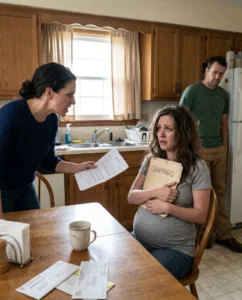
At eight months pregnant, I sat motionless as my sister-in-law struck the kitchen table and threatened to make sure my children never got a cent unless I gave her the money. My husband stood silently behind her while I held the savings folder against my stomach and told her it belonged to our children. Then she smiled and revealed the document that changed everything.
I was eight months pregnant when my sister-in-law slammed her hand onto my kitchen table.
“Hand over the money, Natalie,” Rebecca hissed. “Or I will make sure those kids never see a dime.”
The room fell so silent that the refrigerator’s hum sounded loud.
I stood near the sink, the savings account folder pressed to my belly. My twins kicked hard once, as if they could sense the fear moving through me.
My husband, Evan, stood behind his sister with his arms folded.
Silent.
And that silence wounded me more than Rebecca’s yelling.
The money did not belong to her. It did not truly belong to me either. It was the education fund my late father had opened before his death. Every birthday check, every insurance payment, every dollar I had put aside from my nursing shifts had gone into it.
It was for my children.
Rebecca’s boutique had collapsed. Again. She owed suppliers, credit cards, and a private lender she refused to name. Two weeks earlier, she had called the twins “family blessings.” Now she was using them as pressure.
“I already told you,” I whispered. “This money is for our children.”
Rebecca smiled.
Not a normal smile. The kind people wear when they believe the fight is already over.
“Then you should have read what your husband signed.”
My grip tightened on the folder.
Evan turned his eyes away.
Rebecca pulled a folded document from her purse. She set it on the table and pushed it toward me with two red fingernails.
At the top, I read Emergency Family Financial Petition.
Under it was my name.
Natalie Brooks.
Then Evan’s.
Then a paragraph that made the kitchen seem to tilt.
My husband had signed a sworn statement saying I was emotionally unstable, careless with money, and unfit to manage funds for our unborn children.
The petition asked that control of the twins’ savings be given to Evan as legal custodian.
And Rebecca Brooks as financial administrator.
My blood turned cold.
“You signed this?” I asked Evan.
He finally met my eyes.
His face had gone pale, but his voice stayed empty.
“It is temporary.”
Rebecca leaned in.
“Sign the withdrawal form, Natalie. Make this easy. Or by Monday, a judge sees that paper.”
I stared at the document.
Then at my husband.
Then I opened the folder in my hands.
They thought it contained bank forms.
It did not.
It held copies of the recording transcripts my attorney had filed that morning.
Part 2
Rebecca looked at the first page and laughed.
“What is that supposed to be?”
I wanted to speak, but my throat felt locked.
For three months, I had been pretending not to see what was happening.
Evan whispering in the garage after midnight.
Rebecca asking far too much about my father’s estate.
My bank password suddenly failing.
A checkbook disappearing.
The strange way Evan kept saying pregnancy had made me forgetful.
At first, I blamed stress. I was eight months pregnant with twins, still working part-time at St. Mary’s Hospital, still mourning my father, and still trying to believe my marriage had not gone cold while I was busy preparing a nursery.
Then I found the first draft.
It was sitting in Evan’s office printer tray, partly hidden under a cable bill.
Natalie has shown signs of emotional instability.
Natalie makes impulsive financial decisions.
Natalie has refused family support regarding the children’s future.
I stood there reading my husband’s words while the babies shifted inside me.
That night, I called my father’s attorney, Marlene Porter.
Marlene had known me since I was twelve. She had helped my father create the education trust before he died. When I told her what I had found, she did not comfort me with gentle lies.
She said, “Natalie, this is not a family disagreement. This is preparation.”
So we prepared too.
I stopped confronting Evan. I stopped asking why Rebecca came over every afternoon. I stopped defending myself when they called me hormonal, dramatic, or forgetful.
Instead, I documented everything.
Marlene sent the bank a formal notice requiring in-person verification for withdrawals over five thousand dollars. My doctor wrote a letter confirming I was pregnant, not mentally incompetent. My supervisor at the hospital wrote that I was still working safely and responsibly.
Then I recorded what happened inside my own home.
Not cruelly or secretly for revenge. Carefully. Legally. Marlene told me my state allowed recordings of conversations I was part of. So when Rebecca came into the kitchen that morning with threats ready, my phone was already recording from the fruit bowl.
Rebecca did not know.
Evan did not know.
They thought my silence was fear.
Now Rebecca grabbed the transcript from my hand.
Her smile disappeared as she read her own words.
Hand over the money.
Those kids never see a dime.
Make this easy.
Evan moved closer.
“Natalie,” he said quietly, “give me that.”
For the first time that morning, fear entered his voice.
I pulled the folder back to my belly.
“No.”
Rebecca’s expression hardened.
“You think a recording changes anything?”
Before I could answer, the doorbell rang.
All three of us froze.
Through the kitchen window, I saw Marlene standing on the porch.
Beside her stood a uniformed police officer.
Behind them, my mother was crying into both hands.
Part 3
Evan answered the door because he still thought he controlled the room.
That was another mistake.
Marlene Porter entered first in a gray suit, wearing the expression she saved for people who underestimated paperwork. Officer James Keller followed her, then my mother, Diane, who crossed the kitchen and wrapped both arms around me without a word.
Rebecca recovered fast.
“This is a private family matter,” she said.
Officer Keller looked at the paper on the table.
“Threatening a pregnant woman over money is not usually private.”
Rebecca closed her mouth.
Marlene set her briefcase on the table and took out another folder.
“Before anyone says another word, you should know the bank has already rejected the attempted withdrawal request made yesterday.”
I turned toward Evan.
His gaze dropped.
Yesterday.
He had not even waited for me to surrender.
Marlene continued.
“The education fund is protected under the Brooks Children Trust. Natalie is the primary trustee until the children are eighteen. Evan cannot remove her without a court hearing, medical evidence, and independent review. Rebecca has no legal claim at all.”
Rebecca snapped, “She is unstable.”
My mother lifted her face.
“My daughter worked twelve-hour shifts until seven months pregnant while your brother lost three jobs in two years.”
Evan flinched.
I had never heard my mother speak that way.
Marlene pushed another paper across the table.
“This is a letter from Natalie’s physician confirming full mental competency. This is a statement from her employer. And this is the transcript of Rebecca’s threats from this morning.”
Officer Keller asked whether I felt safe in the house.
I looked at Evan.
For five years, I had loved him. I had pictured him holding our babies, teaching them to ride bikes, making pancakes on Saturday mornings. I had wanted that version of him so desperately that I ignored the man standing in my kitchen while his sister threatened his unborn children.
“No,” I said.
The word was soft.
But it changed everything.
Evan’s face fell.
“Natalie, come on. I was trying to help my sister.”
“You helped her try to steal from our children.”
Rebecca said nothing then.
That silence was all the confession I needed.
Officer Keller escorted Evan and Rebecca outside while Marlene helped me pack a hospital bag, my documents, and the tiny yellow blankets from the nursery. My mother drove me to her house, where the guest room was already ready because Marlene had called her the night before.
Two weeks later, my sons were born.
Henry and Lucas arrived early but healthy, crying like they already had opinions about the world. I wept when the nurse placed them on my chest, not because I was afraid anymore, but because they were here, real and safe.
After the court reviewed the recordings and the attempted bank withdrawal, Evan was allowed supervised visits. Rebecca was barred from contacting me or the children.
The divorce lasted almost a year.
It was painful, expensive, and humiliating in ways I had not expected. Evan claimed his sister had pressured him. Rebecca claimed she had only wanted a loan. But the documents told the truth. The recordings told the truth. The bank records told the truth.
And for once, I did not have to beg anyone to believe me.
On the twins’ first birthday, I opened that same savings folder again.
This time, nobody was yelling.
My mother was icing cupcakes in the kitchen. Marlene held Lucas like a proud aunt. Henry slept with one fist wrapped around my finger.
Inside the folder was a new trust statement.
Every dollar was still there.
Still protected.
Still theirs.
I kissed both my sons on their soft dark hair and whispered, “No one gets to build their future by stealing yours.”
For the first time since that morning in the kitchen, my body finally relaxed.
My mother always said my brother was the future of our family, while I was expected to disappear quietly. So when Dad died, they tried to sell our home to pay Liam’s $340,000 gambling debt and pushed me out in front of everyone. But they didn’t know Dad had hidden one final secret for me—and when the lawyer revealed it, my brother’s smile vanished.
Part 1: The Funeral Betrayal
The morning of my father’s funeral should have been about honoring his memory.
Instead, it became the day my family tried to erase my future.
As I sat in the third row of Kensington Memorial Chapel, surrounded by flowers and carefully rehearsed grief, I felt strangely detached. My mother, Penelope Finch, looked perfectly composed in black, while my older brother, Liam, seemed far more interested in what would happen after the service than in saying goodbye to our father.
When family members were invited to speak, Liam stepped confidently to the podium. His tribute sounded heartfelt, filled with stories about fishing trips and fatherly advice. The guests listened quietly, believing every word.
Then his speech changed.
He explained that our father’s passing had left the family with difficult financial obligations and announced that the house on Willow Creek Drive would be sold immediately.
He called it a necessary sacrifice.
I knew exactly what he meant.
For months, my mother had hidden the truth behind gentle language. Liam had accumulated nearly $340,000 in gambling debt, and they intended to pay it by selling the only home my father had spent his life building.
Before I could respond, my mother stood.
Without even looking toward my father’s casket, she turned to me.
“Your father would understand,” she said calmly. “Liam needs help. You have your own career and can live anywhere. You’ll have to move out.”
She announced my eviction as though it were a minor inconvenience.
Around forty guests sat in stunned silence.
Some looked sympathetic.
Others simply looked away.
No one spoke.
The scene felt painfully familiar.
Growing up, Liam had always been treated as the future of the Finch family, while I was expected to sacrifice quietly.
When I earned admission to excellent universities, my mother questioned whether investing in my education made sense.
“You’re a daughter,” she once told me. “Eventually you’ll leave. Liam needs the opportunities more.”
My father remained silent.
So I stopped expecting help.
I paid my own way through college, built a successful career in forensic accounting, and eventually became financially independent.
For nearly two years I barely spoke to my family.
Then my father died.
When I returned to Willow Creek Drive after his stroke, I found expensive luggage, golf clubs, and luxury purchases filling the house while Liam, who barely worked anymore, continued spending recklessly.
Even my old bedroom had become storage for his newest purchases.
Instead of arguing, I handled the funeral arrangements while Liam entertained guests and performed grief whenever people were watching.
One evening I overheard him whispering on the phone.
“Just give me until the end of the week. The house is as good as sold.”
The moment he saw me, he ended the call.
That was when I realized there was far more happening than anyone admitted.
Just as Liam finished announcing the sale during the funeral, an unexpected sound echoed through the chapel.
A chair scraped loudly across the floor.
Family attorney Irving Scott slowly stood.
Looking directly at my mother and brother, he calmly said,
“I’m afraid you’ve misunderstood Mr. Finch’s final instructions.”
The room fell silent.
Liam’s confident smile disappeared.
For the first time that day, I sensed everything was about to change.
Part 2: My Father’s Secret
After the funeral, I began sorting through my father’s office.
Hidden inside a locked drawer was an old folder labeled Personal Correspondence.
One document immediately caught my attention.
It referenced a company called Pine Valley Holdings LLC—and somehow my own signature appeared on the paperwork.
At first I couldn’t remember signing anything.
Then I recalled my father asking me to sign several family documents shortly after graduating from college.
I had trusted him completely.
When I casually mentioned Pine Valley Holdings to my mother the next morning, she dismissed it instantly.
“That company disappeared years ago.”
Her answer came too quickly.My instincts told me she was hiding something.
A few days later Liam gathered the family around the dining room table.
He slid a document toward me.
“It’s only a disclaimer,” he said. “Signing it will make selling the house easier.”
I read the first page.
“If I don’t own anything,” I asked, “why do I need to sign away my rights?”
Neither Liam nor my mother had an answer that made sense.
Instead of signing, I drove downtown to visit the attorney whose name appeared in the company’s records.
The moment I introduced myself, he smiled knowingly.
“I’ve been expecting you.”
I asked one simple question.
“What is Pine Valley Holdings?”
His answer changed everything.
“The house isn’t part of your father’s estate.”
I stared at him.
“What do you mean?”
“In 2011 your father legally transferred ownership of the property into Pine Valley Holdings.”
My pulse quickened.
“Who owns the company?”
He looked directly at me.
“You do.”
For several seconds I couldn’t speak.
The attorney explained that my father had quietly transferred ownership because he feared Liam’s gambling addiction would eventually destroy everything he had worked for.
He loved his son.
He simply no longer trusted him.
Then the attorney handed me a sealed envelope.
My father’s handwriting covered the front.
Inside was the letter I had wanted my entire life.
He admitted he knew my mother had never treated us equally.
He apologized for staying silent whenever I needed him.
Most importantly, he explained why he had created Pine Valley Holdings.
“You are the only one I trust to protect this family,” he wrote.
For years I believed my father had done nothing.
Instead, he had spent more than a decade quietly protecting me.
Part 3: The Reading of the Will
The official reading of the will took place the following Friday.
Liam arrived wearing another expensive suit and acting as though the house already belonged to him.
When discussion finally turned to Willow Creek Drive, everyone leaned forward.
Attorney Irving Scott calmly removed his glasses.
“The property is not part of Theodore Finch’s estate.”
Liam frowned.
“What?”
“The home has belonged to Pine Valley Holdings since 2011.”
He smiled again.
“Fine. Then who owns the company?”
The lawyer turned toward me.
“Fiona Finch.”
The room froze.
Liam shot to his feet.
“No. That’s impossible.”
Irving quietly placed the corporate records on the table.
Everything had been legally transferred years earlier.My mother looked stunned.
“He never told me.”
“He specifically instructed me not to discuss it,” the attorney replied.
For the first time in my life, my mother looked frightened rather than confident.
“We need that house,” she whispered.
“Why?”
Silence answered.
Finally I asked,
“How much does Liam owe?”
No one spoke.
“Three hundred forty thousand?”
My mother broke down.
She admitted she had spent years covering Liam’s gambling losses until the family home became their final option.
The relatives who had admired Liam moments earlier now looked at him with disappointment.
I stood.
“I’m not taking anything from anyone,” I said. “I’m simply respecting Dad’s decision.”
Then I looked at Liam.
“He knew this day would come. That’s why he protected the house.”
Part 4: A Different Kind of Inheritance
Although I legally owned the property, I wasn’t interested in revenge.
I offered my mother a lifetime lease.
She could remain in the house for one dollar per month.
But Liam would no longer live there.
“He needs treatment,” I said. “Not another rescue.”
My mother protested, but I refused to change my mind.
Outside, my grandmother caught up with me.
“I knew about the company,” she admitted.
“My father told you?”
She nodded.
“He hoped your mother would eventually do the right thing.”
“She never did.”
“No,” Grandma said softly. “But you did.”
Later Liam approached me alone.
For the first time, the arrogance was gone.
“I kept believing one big win would fix everything.”
“It never does.”
I encouraged him to enter treatment.
To my surprise, he agreed.
A few weeks later he checked himself into a rehabilitation program.
That winter I moved back into Willow Creek Drive.
I cleared years of Liam’s belongings from my old bedroom and slowly turned the house into a home again.
My mother quietly honored the lease.
Our relationship remained distant, but the bitterness slowly faded.
Every Sunday my grandmother visited for dinner and shared stories about my father.
I often reread his final letter.
For years I believed his silence meant he didn’t care.
Eventually I understood the truth.
He wasn’t a man who knew how to fight with words.
Instead, he spent fifteen years protecting me through careful planning, legal documents, and decisions no one else knew existed.
His greatest gift wasn’t simply the house.
It was the proof that, even in silence, he had been fighting for me all along.
My sister made sure my car would never reach the courthouse the morning I was taking my daughter to finally escape my family. Then my mother stood on the porch, smiled, and said, “You’re not going anywhere.” But they had no idea I had already prepared for that exact moment.
Something was terribly wrong with the car.
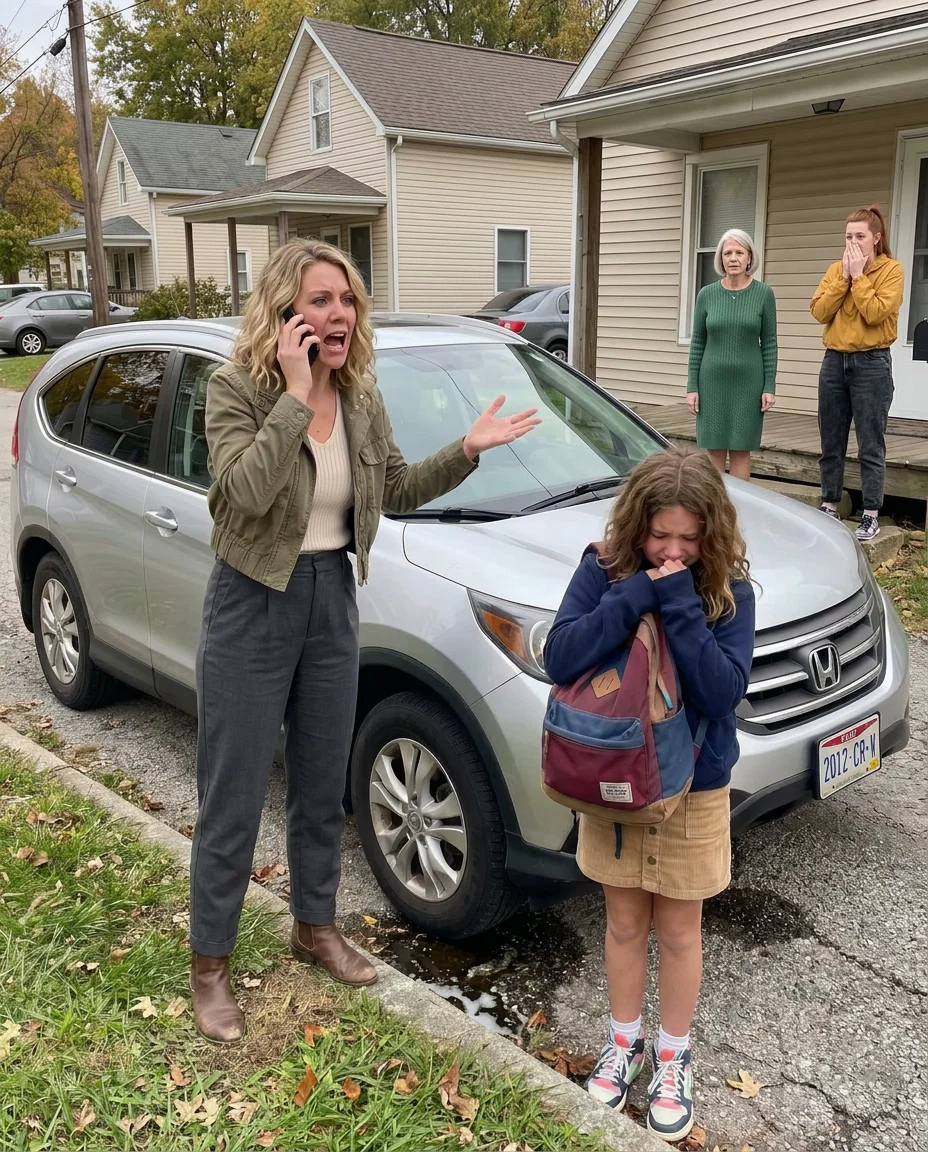
For one frozen second, Claire Donovan thought her foot had slipped. Then the old Honda gathered speed down the rain-slick driveway, its tires hissing over the wet pavement. Beside her, twelve-year-old Ava gripped her backpack in the passenger seat.
“Mom?” Ava whispered.
Claire pressed the brake again.
Nothing happened.
At the end of the driveway, Pine Hollow Road bent sharply beside a drainage ditch. Beyond it, morning traffic moved beneath the gray Ohio sky. Claire gripped the wheel tighter as her heart slammed against her ribs.
“Hold on,” she said.
She yanked the emergency brake.
The car shrieked. The rear wheels slid sideways. Ava cried out as the Honda fishtailed, struck the mailbox, and stopped at the edge of the grass, seconds before the ditch.
For a few moments, only the ticking engine made a sound.
Then Claire looked back at the house.
Her mother, Margaret Vale, stood on the porch in a blue housecoat, coffee mug in hand. Beside her, Claire’s younger sister, Paige, leaned against the railing with a cigarette between her fingers.
Neither one looked shocked.
Claire turned off the engine with shaking hands. Ava sat frozen, tears pooling in her eyes.
“Stay here,” Claire said.
She stepped into the rain and circled the car. Near the rear wheel, a thin stream of fluid slowly dripped onto the driveway.
Someone had tampered with the vehicle before they left.
Claire slowly lifted her gaze.
Paige breathed out a cloud of smoke.
Margaret smiled.
“You should have stayed where you belonged,” she called calmly.
Something inside Claire went perfectly still.
For three years, she had recorded everything: threats, missing paychecks, broken phones, false reports, custody battles, and every moment that proved she had to leave. Today was meant to be the final hearing, where a judge would decide whether she and Ava could finally begin again somewhere else.
Claire did not argue.
She did not panic.
Instead, she picked up her phone.
Paige’s smug smile faded.
“What are you doing?” Paige demanded.
Claire tapped the screen. The security footage had been recording since 6:11 that morning, including exactly what happened before they left the house.
She sent the footage straight to her attorney, Detective Owens, and the court clerk.
Then she dialed 911.
“My name is Claire Donovan,” she said evenly. “I need to report a suspicious incident involving my vehicle while my daughter and I were preparing to leave.”
Margaret’s coffee mug slipped from her hand and shattered on the porch.
PART 2
The first patrol car arrived seven minutes later.
By then, Claire had taken Ava across the street to Mrs. Bellamy’s porch. Mrs. Bellamy was seventy-eight, sharp-eyed, and had spent years pretending not to see the Vale family’s problems. That morning, she brought Ava a blanket, settled her into a wicker chair, and stood beside Claire like a witness finally choosing a side.
Margaret tried to take control of the scene.
She began crying before the officer even reached the porch. She clutched her chest and claimed Claire had always been unstable. She said Claire was turning a simple car issue into another family drama. Paige supported her, arms crossed and jaw tight, insisting she had only been “checking for a leak” because Claire’s car was old.
Officer Ramirez listened without a change in expression.
Then Detective Owen arrived in an unmarked sedan.
Claire had known him for six weeks. He was the first person in law enforcement who had not treated Margaret like a confused grandmother or Claire like an overly emotional daughter. He had asked for evidence. Claire had given him a flash drive filled with dates, photos, voicemails, and bank records.
Now he watched the security video on Claire’s phone.
Paige stopped talking halfway through.
On the screen, Paige appeared in the pale dawn light, kneeling beside the Honda in a red hoodie and working beneath the vehicle while Margaret stood nearby, watching the driveway.
Then the audio silenced the porch.
“She isn’t getting to that hearing today,” Paige said in the recording.
Margaret laughed softly. “Not if everything goes according to plan.”
Ava heard it. Claire watched her daughter’s face fold inward, not with surprise, but with confirmation. Children understood more than adults liked to admit.
Detective Owen looked at Margaret. “Do you want to explain that?”
Margaret’s face hardened. The tears disappeared so completely it was as if someone had shut off a faucet.
“She was never supposed to leave this family,” she said, staring at Claire. “And neither was the child.”
Officer Ramirez told Margaret she needed to come with him while the investigation continued. Paige began shouting the second she realized she was going too, calling Claire a traitor, a liar, and a thief.
Margaret said nothing as she was led toward the patrol car.
She only looked at Ava.
Ava stepped behind Claire.
That tiny movement accomplished what years of arguments never had. It proved the truth without a single word.
At 9:42 a.m., Claire and Ava arrived at court in Detective Owen’s sedan.
Claire wore muddy flats and a blouse damp from the rain. Ava’s hair was still frizzy from the storm. They looked nothing like the composed mother and daughter Claire had pictured the night before. But when Judge Ellen Marwick entered the courtroom, Claire did not feel ashamed.
She felt free.
Her attorney, Dana Whitaker, stood and asked for an immediate emergency order. She submitted the recording, the police report, and Detective Owen’s statement.
Margaret’s attorney was not there. Paige had no attorney yet. Neither woman could reach anyone fast enough to change what had already been documented.
Judge Marwick watched the footage once.
Then she looked over her glasses at Claire.
“Ms. Donovan,” she said, “I am granting the emergency protective order. I am also granting temporary relocation permission pending the full hearing.”
Ava gripped Claire’s hand beneath the table.
Claire squeezed back.
For the first time in years, the door was not locked from the outside.
PART 3
The first thing Claire bought after court was not a plane ticket, a hotel room, or a new phone.
It was breakfast.
Ava had not eaten. Neither had Claire. They sat in the back booth of a diner two towns away, the kind with laminated menus and weary waitresses who called everyone honey. Rainwater dripped from Claire’s coat onto the cracked vinyl seat. Ava stared at her pancakes as if she needed permission to begin.
“You can eat,” Claire said.
Ava lifted her fork, then put it down again.
“Are Grandma and Aunt Paige going to get out?”
Claire had promised herself she would stop softening the truth. Gentle lies had kept them trapped. Gentle lies had taught Ava that danger was only another family mood.
“Not today,” Claire said. “And not before we’re gone.”
Ava nodded, though her eyes stayed guarded.
Dana Whitaker arrived twenty minutes later with a folder, a charger, and the kind of calm Claire wished she could borrow. She slipped into the booth beside Claire and explained the next steps without drama.
The protective order covered both Claire and Ava. Margaret and Paige could not contact them directly or through anyone else. They could not approach the house, the school, Claire’s workplace, or Mrs. Bellamy’s property. Because the brake line had been cut while Ava was in the car, the prosecutor was considering felony charges, including attempted assault and child endangerment.
Claire listened with one hand wrapped around a coffee mug she had not touched.
“What about my father?” she asked.
Dana’s expression shifted slightly.
Robert Vale had been quiet for most of Claire’s life. Not gentle. Not kind. Just quiet. He let Margaret rule the house, let Paige lie, let Claire absorb blame because blame always needed somewhere to land. He never threw the match, but he always stood there watching the fire.
“He has not been arrested,” Dana said. “But the order can still prohibit him from contacting you if he acts on their behalf.”
Claire already knew he would.
Her phone buzzed on the table.
Unknown number.
Dana held out her hand. “May I?”
Claire handed it over.
The voicemail played on speaker.
Robert’s voice filled the booth, low and flat. “Claire, this has gone far enough. Your mother is sick over this. Paige made a mistake. Families handle things privately. You bring Ava back to the house, and we’ll talk like adults.”
Ava went pale.
Dana saved the voicemail and forwarded it to herself.
“Good,” she said.
Claire stared at her.
Dana shrugged. “He just proved he’s part of the pattern.”
By noon, Detective Owen had arranged for officers to meet Claire at the house so she could gather essentials. Claire expected fear when she walked back through the front door. Instead, she felt strangely detached, as if entering a museum exhibit of someone else’s misery.
The living room smelled of Margaret’s lavender cleaner. Family portraits lined the wall, each staged to tell a lie. Margaret in pearls, smiling with one hand on Claire’s shoulder. Paige laughing beside her. Robert standing in the background, stiff and unreadable. Ava as a little girl in a white dress, looking uncertain even then.
Claire took only what mattered.
Birth certificates. Social Security cards. Ava’s medical records. Her laptop. Two suitcases of clothes. The envelope of cash she had hidden behind the loose baseboard in the laundry room. Ava’s sketchbooks. The silver necklace Claire’s grandmother had given her before Margaret pawned everything else valuable.
In Ava’s room, her daughter stood before the bookshelf.
“Can I take all of them?” she asked.
Claire looked at the row of paperbacks, the stuffed fox on the pillow, the tiny glass horse on the windowsill.
“Yes,” Claire said. “All of them.”
Ava packed with sudden energy, as though leaving had finally become something real enough to hold.
One officer remained near the bedroom door. Another watched the driveway. Across the street, Mrs. Bellamy stood on her porch with folded arms, no longer pretending.
When the suitcases were loaded into Dana’s SUV, Claire looked back at the house.
She had imagined this moment for years. In every version, she cried. She whispered goodbye. She needed one last look.
But the house gave her nothing.
No grief. No tenderness. No memory strong enough to compete with Ava crying inside a car with no brakes.
Claire turned away.
They spent the night in a hotel outside Columbus under names Dana arranged through a victim relocation contact. Ava chose the bed by the wall. Claire took the bed closest to the door. Neither slept much, but sleep was not the same as safety. Safety was the deadbolt. Safety was the court order folded in Claire’s purse. Safety was Ava breathing without flinching every time the ice machine dropped cubes in the hallway.
The next morning, the prosecutor called.
Margaret had changed her story three times. First, she claimed the video was fake. Then she claimed Paige had acted alone. Then she said Claire had provoked them by “abandoning the family unit.” Paige blamed Margaret. Robert tried to post bail for both of them, then became furious when the conditions banned contact with Claire and Ava.
By afternoon, Robert had violated the order twice.
First, he called from a neighbor’s phone.
Then he sent Claire an email with the subject line: You are killing your mother.
Claire forwarded both to Dana without reading beyond the first sentence.
That became her first true skill of freedom: not finishing every message designed to wound her.
Three days later, Claire and Ava left Ohio.
They drove west in a rental car with new plates, following a route Dana had helped plan. The relocation permission was temporary, but it was enough. Claire had an old college friend in Oregon, Jenna Morales, who owned a small duplex outside Eugene and had offered the back unit for as long as they needed. Claire resisted accepting help until Jenna said, “You are not borrowing peace. You are allowed to have it.”
The road stretched wide beneath a clear sky.
Ava slept through Indiana. In Illinois, she ate gas station pretzels and asked whether Oregon had whales. In Iowa, she opened her sketchbook and drew the diner booth, the police car, and Mrs. Bellamy’s porch. By Nebraska, she was drawing mountains she had not yet seen.
Claire watched her daughter come back in pieces.
Not all at once. Trauma did not leave like a guest taking its coat. It hid in corners, spoke through nightmares, and tightened Ava’s shoulders whenever Claire’s phone rang. But Ava began asking ordinary questions. Could she paint her new room green? Could she join art club? Would she have to use the last name Vale at school?
“No,” Claire said. “You can use Donovan.”
Ava looked out the window.
“Good.”
Two months later, Judge Marwick held the full hearing by video conference. Claire sat in Dana’s office in Eugene, wearing a navy blazer Jenna had lent her. Ava waited in the next room with headphones, drawing. Claire did not want her daughter hearing adults debate whether a severed brake line counted as a misunderstanding.
Margaret appeared from the county jail in a beige uniform. Paige appeared from another room in the same building, eyes swollen and hair unwashed. Robert sat beside a defense attorney, looking smaller than Claire remembered.
Their argument collapsed under the evidence.
The driveway camera footage was clear. The brake inspection confirmed deliberate damage. The voicemails showed motive. Mrs. Bellamy gave a statement saying she had seen Paige near the car before dawn. Detective Owen testified about prior reports and the pattern of control. Ava’s school counselor submitted notes documenting fear, isolation, and repeated absences caused by “family emergencies” Margaret had invented.
Margaret attempted one final performance.
She cried to the judge about motherhood. She said Claire had always been difficult, dramatic, and ungrateful. She said families sometimes said things they did not mean.
Judge Marwick allowed her to finish.
Then she said, “Mrs. Vale, the court is not evaluating whether your daughter disappointed you. The court is evaluating whether you endangered her and her child. The evidence is overwhelming.”
Claire closed her eyes.
The permanent protective order was granted for five years, with the option to renew. Claire was allowed to remain in Oregon with Ava. Robert was included in the no-contact restrictions. Margaret and Paige stayed under criminal prosecution, and the court barred any third-party contact.
When the hearing ended, Claire sat completely still.
Dana touched her arm. “It’s done.”
But done was not the word Claire felt.
The word was beginning.
That evening, Claire and Ava walked through their new neighborhood. Oregon smelled like wet cedar and distant rain. Their duplex was small, with uneven floors and a kitchen window that stuck halfway open. Ava had painted her room pale green. Claire had found work managing accounts for a dental supply company. It was not glamorous, but every paycheck went into a bank account no one else could touch.
At the corner, Ava stopped beside the community board outside a bookstore.
A flyer advertised a watercolor class for kids.
“Can I sign up?” she asked.
Claire looked at the cost, already calculating groceries, gas, and rent.
Then she looked at Ava’s face.
Hope made her look younger.
“Yes,” Claire said. “We’ll make it work.”
Ava smiled.
Not politely. Not carefully. Not the smile she used around Margaret.
A real one.
Six months later, the criminal case ended with plea agreements. Margaret accepted a deal after Paige’s attorney suggested Paige would testify against her. Paige took a separate deal after realizing Margaret planned to blame her completely. Their loyalty lasted only as long as their shared control.
Margaret received prison time. Paige received a shorter sentence with probation after release. Robert sold the Ohio house to cover legal fees and moved in with a cousin in Kentucky. He sent one final letter through an old family friend, but the friend gave it to Dana instead of Claire. The judge added another violation to the record.
Claire never read the letter.
On Ava’s thirteenth birthday, Jenna hosted a backyard dinner with paper lanterns and a grocery-store cake covered in crooked purple flowers. Ava invited three girls from school and her art teacher, Ms. Lin, who brought watercolor brushes tied with blue ribbon.
Claire watched Ava laugh with frosting on her chin.
For years, Claire had believed escape would feel like revenge. She had imagined Margaret realizing she had lost control. She had imagined Paige frightened, Robert exposed, and the whole family forced to admit what they had done.
Some of that happened.
But the best part was quieter.
It was Ava leaving her bedroom door open. It was buying oranges without anyone checking the receipt. It was sleeping through rain without dreaming of tires sliding toward a ditch. It was a phone ringing without Claire’s stomach turning. It was a kitchen where no one shouted from the hallway.
After the guests left, Ava sat beside Claire on the back steps.
“Do you think Grandma misses us?” she asked.
Claire considered lying.
Then she chose the truth carefully.
“I think she misses having control.”
Ava nodded. “That’s not the same.”
“No,” Claire said. “It isn’t.”
Ava rested her head against Claire’s shoulder.
The yard was dark except for the lanterns swaying gently overhead. Somewhere beyond the fence, a dog barked. A car passed on the street, its brakes giving a normal, harmless squeak at the stop sign.
Claire listened as the sound faded.
Once, that noise would have dragged her back to the driveway, the rain, Margaret’s smile, and Paige’s cigarette smoke. Now it was only a car stopping the way it was supposed to.
Ava stood and stretched.
“I’m going to paint before bed.”
“Okay.”
At the door, Ava paused.
“Mom?”
Claire looked up.
“I’m glad we didn’t die that day.”
The words struck clean and deep.
Claire swallowed. “Me too.”
Ava went inside.
Claire stayed on the steps a little longer, beneath the paper lanterns, inside a life whose gentleness still felt unfamiliar. She thought about the morning of the hearing, the brake pedal sinking beneath her foot, the ditch waiting at the end of the driveway. She thought about Margaret’s voice promising she would never leave alive.
Margaret had been wrong.
Claire had left alive.
More than that, she had survived long enough to become unreachable.
Inside, Ava’s brush tapped lightly against a water jar. The sound drifted through the open kitchen window, small and steady.
Claire rose, locked the back gate, and went inside.
I took my son to the naval base to surprise my husband on the day of his promotion. But before we could get inside, the guard stepped in front of us and whispered, “His girlfriend is inside. No visitors.” Then she walked out wearing a smug smile and said, “The Commander doesn’t have time for domestic interruptions. Take the kid and go home.” I didn’t cry. I simply took my son’s hand, walked away, and made one phone call. By 2 PM, in front of 200 guests, the empire my husband built on lies was about to burn to the ground.
Part 1: The Gate
The first thing I heard when I stepped out of the rideshare was my son excitedly pointing toward the naval base.
The second was the guard saying, “His girlfriend is inside the unit. No visitors.”
I dropped my keys into my handbag.
At 8:17 on a gray Thursday morning in San Diego, Evelyn Whitaker stood outside the west gate of Naval Support Unit Coronado with one hand on her eight-year-old son’s shoulder and the other holding a paper bag of warm cinnamon rolls.
Dylan had begged to surprise his father.
“Dad said commanders like coffee,” he had said seriously in the car, holding the thermos on his knees.
Evelyn had smiled then.
She was not smiling now.
The gate guard looked uneasy the moment he saw her dependent military ID. His name tag read Harris. He was young, maybe twenty-four, with the stiff expression of someone who had already been instructed exactly what to say.
“Ma’am,” he said quietly, “Commander Whitaker is unavailable.”
Evelyn looked past him toward the administration building. Brandon’s black Tahoe sat in his reserved parking spot.
“Unavailable?” she asked. “He told our son he would have lunch with him today.”
Harris swallowed.
Dylan tugged her sleeve.
“Mom?”
The guard looked at the boy, then back at Evelyn. His composure cracked.
“Ma’am, I’m sorry. His girlfriend is inside the unit. No visitors.”
For three seconds, the world went silent.
Evelyn moved quickly. She covered Dylan’s ears with both hands before the words could settle inside him.
But her son had already seen the guard’s face.
He had already seen his mother go pale.
Inside the administration building, a woman in a cream coat stepped near a second-floor window, laughing into her phone.
Evelyn recognized her instantly.
Chloe Vale.
The civilian contractor whose “strategic consulting firm” had received emergency funding through a nonprofit account controlled by Evelyn’s family.
Then Commander Brandon Whitaker appeared behind Chloe and placed a hand at her waist.
Evelyn’s breath left her body.
Not from pain.
Not yet.
From calculation.
She led Dylan back to the parking lot, buckled him into the SUV, and closed the door before she allowed herself to speak.
Then she called her second brother, Lucas Langford.
He answered on the first ring.
“Evie?”
Her voice was quiet.
“Cut off all support immediately. No mercy.”
Lucas did not ask what had happened.
In the Langford family, that sentence had only one meaning.
“Brandon?” he asked.
“And every account connected to Chloe Vale.”
A pause.
“Done.”
By noon, Brandon’s discretionary housing grant was frozen.
By two, Chloe’s consulting invoices had been flagged for audit.
By four, the private foundation that had quietly funded half of Brandon’s career advancement withdrew every endorsement tied to his name.
At five thirty, Brandon called Evelyn seventeen times.
She did not answer.
At six, an unmarked government sedan pulled up beside the unit.
At six fifteen, Commander Brandon Whitaker walked out of the building without his cover, without his confidence, and without Chloe beside him.
Evelyn watched from across the street.
Dylan slept in the back seat.
Her phone buzzed with a message from Lucas.
He thought you were powerless. He was wrong.
Part 2: The Langford Name
Evelyn did not drive home right away.
She parked by the marina, where the water moved dark and restless beneath the evening wind, and let Dylan sleep under his dinosaur blanket in the back seat.
For eleven years, she had been Commander Brandon Whitaker’s wife.
To the officers’ spouses, she was gracious, composed, and useful. She hosted dinners. Remembered birthdays. Wrote thank-you notes to donors and sympathy notes to widows. She smiled beside Brandon at ceremonies while he accepted applause for programs that would never have existed without Langford money.
The Langfords were not flashy old money.
They were disciplined old money.
Her grandfather had built ports, warehouses, and shipping contracts after World War II. Her father expanded the family into defense logistics. Her eldest brother, Nathaniel, ran the public company. Lucas, the second brother, handled private risk, legal exposure, and political relationships.
Evelyn had chosen marriage over the boardroom.
Brandon had loved that choice while it benefited him.
Now that benefit was over.
At 7:04 p.m., Lucas called again.
“You need to know what we found.”
Evelyn stared at the lights on the water.
“Tell me.”
“Chloe Vale’s firm received three accelerated payments from the Foundation for Veterans’ Housing. All three were approved under Brandon’s recommendation.”
Evelyn closed her eyes.
“That foundation was mine.”
“Yes,” Lucas said. “And one payment was routed through a subcontractor in Nevada. That subcontractor is linked to a company Brandon registered under his aide’s address.”
The cold inside Evelyn sharpened.
“So this is not only an affair.”
“No,” Lucas said. “It is fraud, procurement abuse, and likely misuse of influence. I already sent the preliminary file to outside counsel. Nathaniel wants him destroyed publicly. I told him to wait.”
“Good.”
Lucas paused.
“Evie, I have to ask. Did you know any of this?”
“No.”
“I believe you.”
That nearly broke her.
Not Brandon’s betrayal.
Not Chloe laughing behind the glass.
Not the guard’s pity.
Her brother’s simple trust almost did it.
Evelyn looked back at Dylan. He was awake now, silent, watching her with wide eyes.
“Mom,” he whispered, “does Dad have another family?”
Evelyn climbed into the back seat, pulled him into her arms, and held him until his small body stopped trembling.
“No,” she said. “He made a terrible mess. But you are not the mess. You are my son. You are loved. That part does not change.”
Dylan buried his face in her coat.
“Did I do something?”
“No. Never.”
At 8:22 p.m., Brandon finally sent a text.
Come home. We need to talk before your family ruins everything.
Evelyn read it once, then forwarded it to Lucas.
His reply came quickly.
That is useful. Keep everything. Do not warn him.
When Evelyn arrived home, Brandon was waiting in the driveway of their Coronado house. He was still wearing his uniform trousers and a white undershirt, his hair damp as if he had showered in a rush. His face carried the ugly panic of a man who had mistaken charm for immunity.
He stepped toward the SUV.
“Evelyn, listen to me.”
She locked the doors from inside.
Dylan flinched at the sound.
Brandon noticed.
For one moment, shame crossed his face.
Then anger replaced it.
“You called Lucas?” he demanded. “Do you understand what you’ve done?”
Evelyn lowered the window three inches.
“Yes,” she said. “I finally understood what I should have done years ago.”
Brandon leaned close to the opening.
“Chloe means nothing.”
Evelyn looked at him without blinking.
“That is the first honest thing you have said tonight.”
Then she raised the window, backed out of the driveway, and drove away with their son while Brandon shouted her name behind them.
By midnight, she and Dylan were inside a secure Langford-owned apartment downtown.
By morning, Brandon’s command would no longer protect him.
It would become the room where every lie came due.
Part 3: The Investigation
At 8:00 the next morning, ocean fog still hung thick over Naval Support Unit Coronado.
Inside the main administration building, the air felt suffocatingly tense. Brandon sat at his spotless mahogany desk, his cover placed neatly to his left, though his uniform shirt was slightly wrinkled from a sleepless night.
He was typing an encrypted email to a logistics contact, trying to find out why his discretionary funds had been frozen, when his office door swung open without a knock.
It was not his aide.
Rear Admiral Vance stepped inside, flanked by two stone-faced NCIS investigators. Behind them stood Lucas Langford in a sharp dark suit, carrying a leather briefcase.
Brandon stood out of military habit, puffing his chest, though his jaw tightened.
“Admiral. I wasn’t expecting an unannounced inspection.”
“This is not an inspection, Commander,” Admiral Vance said, his voice heavy and final. “Hand over your base credentials, your government-issued devices, and your sidearm. You are relieved of command immediately pending a formal Article 32 hearing.”
Brandon’s confidence cracked.
“Sir? On what grounds? If this is about a domestic dispute with my wife’s family—”
“It is about procurement fraud, Commander,” one NCIS investigator interrupted, placing a sealed federal warrant on the desk. “We spent the night reviewing the financial trail of the Foundation for Veterans’ Housing. Your signature authorized three accelerated payments to a shell contractor in Nevada. That contractor funneled forty percent of those defense logistics funds into a private offshore account registered under your name.”
Brandon slowly turned toward Lucas, hatred burning across his face.
“You did this. You’re trying to destroy my career because Evelyn is throwing a tantrum.”
Lucas did not flinch.
He walked to the desk, opened his briefcase, and laid out a series of printed bank forensics.
“Evelyn did not destroy your career, Brandon. Your greed did. You assumed that because she hosted dinners instead of sitting in boardrooms, she didn’t understand how money moved. But the Langford family does not just build ports. We secure them.”
He tapped one page.
“Every dollar you gave Chloe Vale came from a trust fund Evelyn’s grandfather created. You were stealing from my sister under the disguise of serving your country.”
From the office down the hall, a frantic commotion broke out.
Two female base security officers escorted Chloe Vale into the corridor. Her cream coat was wrinkled, her hands empty as they carried her electronics in static-free evidence bags.
“Brandon!” Chloe cried, her voice echoing through the open door, stripped of the smug laughter she had worn the morning before. “They froze my firm’s server. They’re revoking my defense clearance. Do something!”
Brandon could not even look at her.
He stared down at his desk as the realization settled over him.
The uniform he had used as a shield for over a decade was no longer protecting him.
Part 4: The Fall
By two that afternoon, news of the commander’s sudden removal had spread through the tight Coronado military community.
The black Tahoe was towed out of its reserved parking space. Brandon was escorted off the installation in the back of an unmarked government vehicle.
Six months later, the legal and financial force of the Langford family had dismantled every lie Brandon Whitaker had built.
The procurement investigation was merciless. Facing federal charges for grand larceny, fraud, and wire fraud, Chloe Vale quickly turned state’s evidence. She handed over months of encrypted messages proving Brandon had arranged the shell company network to fund their expensive life behind Evelyn’s back.
Because Brandon had used his active military command to support the fraud, the court-martial moved quickly and decisively.
He was stripped of rank.
Dishonorably discharged from the United States Navy.
Sentenced to eighty-four months in a federal military correctional facility.
His pension was completely forfeited to repay restitution owed to the veterans’ foundation.
On a clear Saturday afternoon, Evelyn stood near the edge of the Coronado marina. The water sparkled blue beneath the Pacific sun, a bright contrast to the dark waves from months before.
She had sold the Coronado house and used the proceeds to fully fund Dylan’s education trust. She wore a simple tailored sundress, her hair moving lightly in the ocean breeze, and she looked lighter than she had in years.
A silver sedan pulled up to the curb.
Brandon stepped out.
He was no longer in uniform. He wore a faded T-shirt and jeans, his posture hollow, his face carrying the permanent exhaustion of a man waiting for his prison check-in date.
He walked toward Evelyn slowly and stopped a few feet away, unable to meet her eyes.
“The lawyers said you agreed to let me see Dylan one last time before I report,” Brandon said, his voice thin and rough.
“Dylan is with Uncle Lucas at the park,” Evelyn replied steadily. “He knows you are going away for a long time to fix the mistakes you made. I will not teach our son to hate you, Brandon. But I will teach him never to confuse power with permission to hurt people.”
Brandon wiped a hand across his face, shame filling his eyes too late.
“Evelyn… I lost everything. My command, my pension, my name. If your family hadn’t interfered, we could have handled this privately.”
“You lost everything because you mistook my silence for blindness,” Evelyn said calmly. “You thought that because I hosted dinners and wrote thank-you notes, I was powerless. But I was only choosing to be a wife.”
She held his gaze.
“The moment you turned your command into a playground for your mistress and a vault for your fraud, the marriage was over. And the Langford family always protects its own.”
She turned away from him and looked toward the open ocean, where a massive naval ship was slowly heading out to sea.
She felt no joy in his ruin.
Only the clean, freeing peace of a woman who had reclaimed her life.
“Goodbye, Brandon,” she said quietly.
Then she walked to her vehicle, where Dylan was waiting in the passenger seat, his eyes bright as he held up a model airplane his uncle had bought him.
“Where are we going now, Mom?” Dylan asked as she started the engine.
Evelyn smiled and squeezed his hand.
“We’re going to our new home, sweetie. A place where the foundation is completely honest.”
Brandon Whitaker had spent eleven years believing his uniform made him untouchable. He assumed a quiet, gracious wife would always absorb his betrayal in silence to protect his career.
But as he stood alone on the marina walkway, watching his family drive out of sight, he finally understood the true weight of the Langford name.
Strength was not found in command authority or the arrogance of an affair.
It lived in the quiet, unyielding integrity of the people who held the ground beneath your feet when you believed you were flying high.
I was balanced on a ladder, pulling soggy leaves from the gutters, when my phone vibrated in my pocket. The morning air carried that strange early-autumn feeling—still warm enough to remember summer, but already smelling like change.
“Morning, Dad.”
The moment I heard Clara’s voice, I frowned.
“You sound worn out.”
She gave a quiet laugh.
“It’s been a long week.”
Behind her, I heard a muffled airport announcement, followed by the rolling thunder of suitcase wheels. I pictured her walking through the terminal with the careful, measured pace she had developed over the last six months. Since her separation from Evan, nothing about her had been casual anymore. Every movement seemed planned. Every choice controlled.
“I’m at the airport,” she said. “They just started boarding an earlier flight, so it’s loud here.”
I climbed down the ladder slowly. At seventy-two, I did not take chances with my footing anymore.
“You always show up too early.”
“I know,” she said. “It helps with the anxiety.”
There was a brief pause.
“I wanted to say thank you for checking on the house while I’m gone.”
“That’s what fathers are for.”
“And for finding someone to mow the lawn.”
“He should be there around one.”
“Perfect.”
Another silence followed. This one felt heavier.
“If you go by today,” she said carefully, “don’t worry if the inside looks bare. I packed most things away before leaving.”
I paused.
“You planning to move while you’re gone?”
She laughed, but it was not a happy laugh.
“No. I just wanted everything neat.”
It sounded odd, but then again, so much had seemed odd since the divorce and the ugly custody battle. Clara had become almost painfully cautious. She locked doors twice. Closed curtains before dark. Filed every receipt. Saved every message. She never said she was scared.
But I knew my daughter.
“You’ll call when you land?”
“I promise.”
“I love you.”
“I love you too, Dad.”
The call ended.
At that moment, I had no idea that it would be the last normal conversation we would have that day.
Around noon, I drove to Clara’s house to water her flowers before going back home to finish my own yard work. Everything looked exactly as it should. The white shutters were closed against the afternoon heat. The porch was clean. No packages sat by the door. Nothing seemed broken, disturbed, or out of place.
I checked the mailbox, watered the hanging baskets, and locked the gate the way Clara always asked me to.
As I drove away, a dark pickup truck turned out of the neighborhood. Its windows were too tinted for me to see the driver. I barely noticed it.
Later, I would wish I had.
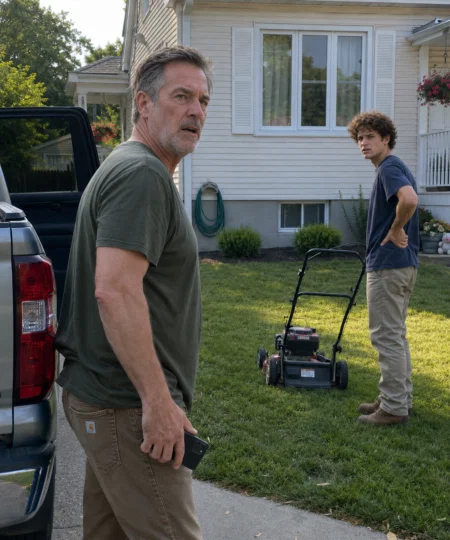
At 1:15 p.m., Jesse, the young man I had hired to mow the lawn, sent me a photo of the front yard. The grass looked clean and even.
Looks good so far, he wrote. Starting the backyard now.
I sent back a thumbs-up and returned to cleaning out my garage. I was sorting old tools and moving boxes, doing the kind of work that keeps your hands busy while your mind wanders.
About forty-five minutes later, my phone rang.
Jesse’s voice was different this time—lower, careful, uncertain.
“Mr. Whitmore?”
“Everything okay?”
“I’m not sure.”
I set down the rake in my hand.
“What happened?”
“I keep hearing someone crying.”
My chest tightened.
“Where?”
“Inside your daughter’s house.”
For a second, I did not answer.
“That can’t be right.”
“I thought it was coming from another yard,” he said quickly, like he was embarrassed. “But whenever I turn off the mower, it sounds like it’s coming from inside.”
Then I heard the mower stop in the background.
Part 2
Silence.
And then, faintly, a child cried.
Not loudly. Not desperately. Just a small, tired sob that disappeared almost as soon as it came.
Jesse whispered, “That’s what I’ve been hearing.”
The house was supposed to be empty.
“I was there this morning,” I said.
“I haven’t gone in,” Jesse answered. “I just thought… if someone needed help…”
“You did the right thing.”
I was already reaching for my keys.
“Stay outside. I’m coming.”
I called Clara first. It went straight to voicemail. That made sense if she was on the plane, but it still made my stomach twist.
“Call me as soon as you hear this,” I said.
Then I called Evan.
No answer.
The divorce had been finalized almost a year earlier, but the fight over their two-year-old son, Liam, had dragged on and on. Hearings. Lawyers. Evaluations. Accusations. Clara and Evan barely spoke directly anymore. Everything went through attorneys or written messages, carefully worded so nothing could be twisted later.
As I pulled out of my driveway, I remembered something from three weeks earlier.
Clara had come over for dinner and barely touched her food. Halfway through the meal, she asked me a strange question.
“Dad, if someone kept driving past your house without stopping, would you think that was weird?”
I had put my fork down.
“Is someone doing that?”
She forced a smile.
“It’s probably nothing.”
I had not believed her.
And now, driving toward her house, I hated myself for not pressing harder.
It took me fifteen minutes to get there. Jesse was waiting beside his mower, looking relieved the moment he saw me.
“I’m glad you’re here.”
“You stayed outside?”
“Yes, sir.”
He pointed toward the backyard.
“It comes and goes.”
As if on command, another faint cry drifted through the afternoon air. My arms prickled.
“I hear it,” I said.
Jesse exhaled.
“I thought I was imagining it.”
“You weren’t.”
We walked around the side of the house. Nothing looked forced. No broken windows. No damaged locks. No muddy footprints in the flowerbeds. The backyard looked almost exactly the way it had when I left.
Almost.
Near the back steps, a grocery bag had fallen over. A box of crackers lay in the grass beside a receipt. I picked it up and read the timestamp.
The back door was closed, but it had not latched all the way.
That was not like Clara.
Since the custody fight had turned ugly, she had become almost obsessive about safety. New locks. Checked windows. Alarm questions. Closed doors. Locked gates. All the habits of a woman who no longer felt secure in her own home.
I reached beneath the ceramic frog near the flowerpot. The spare key was still there.
Jesse shifted beside me.
“Maybe we should call the police first.”
He was probably right.
But then the crying came again. Softer this time. Weaker.
The unmistakable sound of a little boy trying not to cry.
Every instinct I had as a father and grandfather overruled everything else.
“If a child is in there,” I said, “I’m not waiting outside.”
The kitchen smelled faintly of soup. A saucepan sat on the stove, the contents cooled and thick. A child’s cup rested beside the sink, washed and drying. The room was tidy, but not empty.
Someone had been there.
Someone had been living there that day.
Jesse stayed near the doorway.
“I’ll wait here.”
I nodded and moved deeper into the house.
The cry came again.
Then a woman whispered gently, “It’s okay, sweetheart.”
My heart hammered.
At the end of the hallway, the basement door stood slightly open.
Clara hated open doors. She always had. Cabinets, closets, bedrooms—everything closed, everything orderly. She said it made the house feel calm.
This door being open felt wrong.
I pushed it wider.
Cool air rose from below.
The whispering stopped.
So did the crying.
“Hello?” I called.
No answer.
Only the faint creak of someone shifting in the basement.
Jesse lowered his voice behind me.
“Mr. Whitmore… maybe we should wait.”
But if Liam was down there, I could not wait.
I started down the stairs.
Halfway down, I saw a small blanket folded on the landing. Yellow ducks covered the fabric. My late wife had sewn that blanket before Clara was even born. I still remembered her sitting by the window, stitching each tiny duck with careful hands and a smile she could not hide.
That blanket belonged in the cedar chest upstairs.
Seeing it there made no sense.
At the bottom of the stairs, the basement opened in front of me.
And for a moment, I could not breathe.
The unfinished basement had been turned into a hidden little apartment.
A mattress sat in one corner. Children’s books were stacked on a low shelf. Plastic bins held neatly folded toddler clothes. There were diapers, bottled water, canned food, medicine, toys, and a folding table covered with legal papers.
Nothing looked careless.
Nothing looked rushed.
Someone had planned this.
Then I heard a tiny cough.
I turned.
A little boy sat on the mattress, clutching a worn stuffed rabbit. His cheeks were flushed, and his eyes were wet with feverish tears.
“Mommy…”
A woman stepped from the shadows, lifted him into her arms, and kissed his hair.
Then she looked at me.
“Dad.”
Clara looked exhausted. Her hair was tied back loosely. Dark circles sat beneath her eyes. She wore the same sweater she had worn during our phone call from the airport.
She did not look shocked to see me.
She looked relieved.
Behind me, Jesse quietly stepped away.
“I’ll give you some privacy,” he said.
Neither Clara nor I answered.
I stared at my daughter.
“You never left,” I whispered.
She held Liam tighter.
“No,” she said. “I couldn’t.”
For a long moment, the only sound was the quiet hum of a small fan and Liam’s uneven breathing against her shoulder.
“I’m sorry, Dad,” Clara said softly. “I didn’t want you to find out like this.”
I looked around again. Water. Medicine. Blankets. Food. Documents. Every detail had been arranged with care.
This was not a hiding place made in panic.
It was a refuge.
Part 3:
“Why?” I asked.
She took a slow breath.
“I really did go to the airport.”
“I believe you.”
“I checked in. I sat at the gate.”
“So why did you come back?”
She looked down at Liam.
“Because I couldn’t leave him.”
“You were only going away for a few days.”
“I know.”
Her eyes filled with tears.
“But every announcement made me feel farther away from him. When they called my boarding group, I stood up… and I couldn’t walk through the gate.”
“So you came home.”
She nodded.
“I called you from the airport before I left. I knew if I sounded uncertain, you’d start asking questions.”
That explained the noises in the background. The rolling suitcases. The announcement. She had not lied about being at the airport.
She had lied about boarding the plane.
“I almost called you when I got back,” she admitted. “Three times.”
“Why didn’t you?”
“Because I know you.”
She gave me a tired smile.
“The second you knew I was here, you would have driven over.”
She was right.
“And I was afraid you’d confront Evan,” she added.
“I probably would have.”
“And then his lawyer would say my family was interfering before Monday’s emergency hearing.”
I looked at the stack of files on the table.
“What happens Monday?”
“My attorney filed an emergency request to suspend Evan’s visitation.”
“Based on what?”
She handed me a thick folder.
Inside were police reports, legal letters, photos, printed messages, and a statement Clara had written in calm, precise language. One photo showed marks on Liam’s upper arm. Another report described Evan returning him hours late after a scheduled visit.
I looked up.
“He threatened you.”
Clara nodded.
“The last time he dropped Liam off, he smiled and said, ‘One day I won’t bring him back, and you’ll never see him again.’”
Cold anger moved through me.
“You reported it?”
“Immediately.”
“What did they say?”
“No witnesses. My word against his.”
Then I remembered the truck.
“The dark pickup.”
Her face changed.
“You saw it?”
“I saw one leaving the neighborhood today.”
“It wasn’t the first time,” she said. “He’s been driving past the house.”
She pointed toward the small basement window.
“I covered the window at night so no one could see light down here.”
Now I understood.
“The upstairs looked empty.”
“That was the point,” she said. “If Evan drove by, I wanted him to think I’d actually gone to Phoenix.”
“Why stay here at all?”
“My lawyer told me not to leave my legal residence unless there was an immediate emergency. If I took Liam somewhere else, Evan’s attorney could claim I was violating the temporary custody arrangement.”
“So you stayed where the court expected you to be.”
She nodded.
“I just had to make it through the weekend.”
Outside, Jesse’s mower started again. The sound was so ordinary that it almost felt cruel.
Then Liam stirred and opened his eyes. He looked at me and reached out one small hand.
“Grandpa.”
I smiled.
“Hey, buddy.”
He lifted his stuffed rabbit.
“Rabbit sleepy.”
I gave a soft laugh.
“I think Grandpa is pretty sleepy too.”
For the first time that day, Clara laughed for real.
I stepped closer and took her hand.
“You should have trusted me.”
“I know.”
“I would never have judged you.”
“I wasn’t afraid of that,” she said. “I was afraid you loved us enough to do something that would hurt the case.”
I could not argue with that.
If she had told me about Evan’s threat, I might have driven straight to his house. I might have said things that would later be repeated in court. Clara knew me better than anyone.
“You don’t have to hide anymore,” I told her.
She looked uncertain.
“What do you mean?”
“I mean you and Liam are not spending another night in this basement.”
“What if Evan drives by?”
“Then he’ll see what you wanted him to see.”
I smiled gently.
“An empty house.”
“But where will we go?”
“My house.”
“What if he follows?”
“He won’t.”
“How do you know?”
“Because we’re not leaving alone.”
I pulled out my phone.
“My friend Daniel retired after thirty years with the sheriff’s department. He still knows people.”
Within twenty minutes, Daniel arrived with another retired deputy who volunteered with neighborhood watch. After I explained everything, both men agreed to park nearby and quietly watch Clara’s street through the night.
Not to confront anyone.
Only to observe and record.
“If Evan comes by,” Daniel said, “he’ll be on three cameras before he even realizes it.”
Clara’s shoulders finally loosened.
“Thank you.”
Daniel nodded kindly.
“You’ve got enough on your mind.”
We packed only what Liam needed for the weekend—medicine, clothes, books, diapers, and the stuffed rabbit. Before leaving, Clara removed the duck-patterned blanket from the basement window and folded it against her chest.
“Mom made this,” she whispered.
“I know.”
“I kept thinking… if she were still here…”
I placed a hand on her shoulder.
“She would tell you what I’m telling you.”
Clara looked at me.
“You are not alone.”
Monday came with gray skies and steady rain. Clara’s attorney met us outside the courthouse. The emergency hearing lasted most of the afternoon.
The judge reviewed the photos, police reports, messages, neighbor statements, and security footage showing Evan’s truck lingering outside Clara’s house on multiple evenings.
When it was over, the judge issued a temporary emergency order.
Evan’s visitation was suspended until a full custody hearing could be held. Any future contact about Liam would happen under court supervision.
It was not the end.
There would be more hearings. More evidence. More difficult days.
But for the first time in months, Clara did not have to spend every evening wondering whether someone would take her little boy away.
When we stepped outside the courthouse, rain fell softly around us. Liam reached for Clara, and she lifted him into her arms.
This time, she did not hold him like she was terrified of losing him.
She held him like she was finally allowed to breathe.
Months later, I returned to Clara’s house to help clean out the basement. The mattress was gone. The folding table had been packed away. The bins had been moved upstairs into Liam’s room.
Sunlight poured through the uncovered basement window.
Clara carried the duck-patterned blanket upstairs and placed it carefully back inside the cedar chest.
“It belongs here,” she said.
“It always did.”
Outside, I heard the familiar sound of a lawn mower. Jesse was trimming the front yard again, just another ordinary task on a bright autumn afternoon.
He waved when he saw me.
“Everything going okay?”
I smiled.
“Much better.”
Sometimes I still think about the phone call that brought me there. One simple question from a young man who trusted what he heard.
“Is anyone supposed to be inside the house?”
That day, I thought I was driving toward a mystery.
Instead, I found a frightened mother, a sick little boy, and a family carrying more fear than anyone should ever have to carry.
The real mystery was not who was hiding in Clara’s house.
It was how long my daughter had believed she had to face all of it alone.
At three o’clock in the morning, a frantic knock came at my door. It was my daughter, still wearing the wedding dress I had lovingly zipped up just hours before. Now, the gown was torn, stained with blood, and clinging to her badly bruised body. Before she collapsed into my arms, she managed to whisper, ‘Mom… my mother-in-law did this because I wouldn’t sign over my condo.’ In that exact second, I knew someone was about to pay a terrible price.
Part 1: The Bride Who Came Home Broken
When I opened my apartment door in Dallas, I almost didn’t recognize my daughter.
Sofia stood in front of me with a split lip, a swollen cheek, and dark marks around both arms. The woman who had smiled through her wedding photos only hours earlier was gone.
In her place was someone terrified.
“Mom,” she whispered, gripping my wrist with shaking fingers. “Please don’t call the hospital. They said if I tell anyone, they’ll kill me.”
My heart stopped.
“Who threatened you?”
She closed her eyes, struggling to breathe.
“Carmen… Javier’s mother.”
Even hearing that name made my stomach tighten.
From the beginning, Carmen Robles had never acted like a mother welcoming a new daughter. She cared about status, money, and appearances.
Three months before the wedding, she visited my home wearing designer clothes and expensive jewelry. Instead of asking about Sofia’s dreams, she asked about what Sofia owned.
“I heard Sofia has a luxury condo in Uptown Dallas,” she said casually.
“She does,” I replied. “And it will always belong to her.”
That condo had been a gift from Sofia’s father, Colonel Alexander Brooks, after our divorce. He wanted his daughter to always have something that was hers alone.
Carmen only smiled.
As the wedding approached, her requests became demands.
Money.
Jewelry.
Financial guarantees.
Every conversation felt less like family planning a marriage and more like a negotiation.
I refused everything except helping with the wedding costs because Sofia truly believed Javier loved her.
Before the ceremony, I made one thing clear.
“The condo is not negotiable.”
Everyone smiled.
Now I understood those smiles were fake.
Sofia sat curled up on my couch, still wearing her torn wedding dress, shaking as she told me what happened.
“After the reception, Javier took me to the honeymoon suite,” she whispered. “Then he said he had something to handle and left.”
She took a shaky breath.
“About twenty minutes later, his mother came in with six other women.”
My blood ran cold.
“They locked the door.”
I covered my mouth.
Sofia’s voice broke.
“Carmen demanded that I sign the condo over to Javier’s family.”
“She said it belonged with them.”
Sofia refused.
And that was when everything changed.
“She grabbed me and attacked me,” Sofia whispered. “She kept saying a stubborn daughter-in-law needed to learn respect.”
My hands tightened into fists.
“And Javier?”
Fresh tears rolled down Sofia’s face.
“He was outside the door.”
She looked at me with disbelief and pain.
“I heard him tell his mother, ‘Just don’t damage her face too much. People will notice tomorrow.’”
Something inside me broke.
Not from fear.
From anger.
I reached for my phone.
Sofia grabbed my arm.
“Mom… Dad hasn’t spoken to us in years.”
I looked at my daughter.
“He is still your father.”
Then I called the one number I had avoided for a decade.
The phone rang twice.
“Clara?”
It was Alexander.
I forced myself to stay calm.
“Our daughter was attacked on her wedding night.”
Silence.
Then his voice changed completely.
“Send me your address. I’m coming.”
Thirty minutes later, the doorbell rang.
Alexander stood outside wearing jeans and an old military jacket.
He didn’t say a word until he saw Sofia.
His daughter was sitting on the couch, bruised, frightened, and still wearing the dress from the happiest day of her life.
He walked over slowly, knelt beside her, and took her hand.
“Baby girl…”
His voice cracked.
As his eyes moved over the injuries covering her arms, I saw the transformation happen.
The retired soldier.
The father.
The man who had spent years staying away.
All of it disappeared.
What remained was a father who had just learned someone had declared war on his family.
Part 2: The Evidence Begins
Alexander did not raise his voice.
Somehow, that was more frightening than anger.
He sat beside Sofia, carefully studying every injury with the focus of the military officer he used to be.
“Did Javier hurt you directly?” he asked.
Sofia shook her head.
“No. He stayed outside the door.”
Alexander’s expression hardened.
“Sometimes the person who watches the cage being built is just as guilty as the person holding the key.”
Then he stood and made a call.
“I need a doctor, a forensic photographer, and my attorney here within twenty minutes.”
Sofia looked at him nervously.
“Dad, please. Carmen said—”
Alexander cut her off calmly.
“Carmen doesn’t make threats anymore.”
He looked at the injuries on his daughter’s face.
“She creates evidence.”
Eighteen minutes later, three people arrived at my apartment.
Dr. Mitchell carefully documented Sofia’s injuries. A legal investigator photographed every bruise, every tear in her wedding dress, and the evidence left behind from the attack.
Then Alexander asked Sofia to tell the story again.
This time, everything was recorded.
No rumors.
No misunderstandings.
Only facts.
At 4:17 a.m., his attorney placed a folder on my kitchen table.
The moment I saw the address, my stomach dropped.
Sofia’s condo.
“There was a property transfer request submitted yesterday,” the attorney explained.
“Yesterday?” I asked. “Before the wedding?”
He nodded.
“Someone prepared documents claiming Sofia agreed to transfer ownership of the condo into a family trust controlled by Carmen Robles.”
Sofia went pale.
“But I never signed anything.”
Alexander looked at me.
“That is why they needed her signature tonight.”
Before anyone could say more, Sofia’s phone began vibrating across the table.
Javier.
She ignored it.
A message appeared.
COME BACK BEFORE MY MOTHER GETS ANGRY AGAIN.
Alexander read it once.
Then another message arrived.
SIGN THE PAPERS AND WE CAN STILL BE A FAMILY.
A cold smile appeared on his face.
Not kindness.
Not forgiveness.
Strategy.
“Good,” he whispered. “Keep sending messages.”
By sunrise, Sofia finally fell asleep against my shoulder.
I assumed Alexander was preparing to contact the police.
Instead, he opened his laptop.
A photograph appeared on the screen.
It showed Carmen standing at the wedding reception with six women beside her.
The same six women Sofia had described.
Alexander enlarged the image.
Then he suddenly stopped.
His finger moved toward one woman standing behind Carmen.
“Elena,” he whispered.
His voice changed.
“Do you recognize her?”
I leaned closer.
And my blood turned cold.
Because the woman smiling in that wedding photograph was someone who had supposedly died twelve years earlier.
And Alexander knew exactly who she was.
Part 3: The Boy Who Knew His Name
The knock came again.
Three slow taps against my apartment door.
It wasn’t aggressive.
It wasn’t desperate.
But somehow, it felt more frightening than someone trying to break inside.
Sofia grabbed my hand tightly. Her fingers trembled against mine. Alexander stood in front of her like a shield, his face controlled, but the fear beneath it was impossible to miss.
Reed moved toward the door first.
“Who is it?”
A young voice answered from the hallway.
“My name is Mateo. I was told to ask for Colonel Brooks.”
Alexander froze.
For a moment, the entire room went silent.
Grace immediately stepped forward.
“Don’t open the door until we know who sent him.”
But Alexander was already moving.
“Reed, check the hallway.”
Reed looked through the peephole, then carefully opened the door while keeping one hand near his waistband.
A boy stood outside.
He looked around eleven or twelve years old. Thin frame. Dark hair falling across one eye. A backpack hanging from his shoulder. An oversized jacket covering his small body.
But it was his face that stopped everyone.
Not because I recognized him.
Because Alexander did.
The boy had Alexander’s eyes.
The same gray-blue stare.
The same serious expression of someone who studied a room before trusting it.
Sofia looked from the boy to her father.
“Dad… who is he?”
The boy stepped inside slowly, trying to be brave despite the fear in his face.
He held a folded envelope tied with a red thread.
“My mother told me that if anything happened to her, I had to bring this to Colonel Brooks.”
Alexander stared at the envelope.
His voice broke.
“Who is your mother?”
The boy hesitated.
“Isabel Marquez.”
The name hit the room like a shockwave.
Sofia went still.
I felt my knees weaken.
Alexander finally accepted the envelope, but his hands shook.
“Where is Isabel?”
The boy swallowed.
“She disappeared last night.”
“Where?”
“At the Robles house.”
Sofia sat straighter despite her injuries.
“The Robles house?”
The boy nodded.
“She worked there sometimes. She didn’t want to. Carmen made her.”
Grace stepped closer.
“Made her do what?”
The boy looked at Alexander.
“My mother said Colonel Brooks would understand.”
Alexander opened the envelope.
Inside was a photograph, a small key, and a handwritten letter.
His eyes moved across the first lines.
Then he closed them.
“What does it say?” I asked.
For several seconds, he said nothing.
Then his voice came out broken.
“Isabel says Carmen Robles has controlled her for twelve years.”
Sofia stared at him.
“Controlled her how?”
Alexander began reading.
“Alexander, if this reaches you, then Carmen has finally moved against your daughter. I’m sorry. I tried to stop her. I tried to keep Sofia away from that family, but Carmen discovered who she was before the engagement.”
He paused.
“Javier was never in love with her. He was instructed to marry her.”
The room fell silent.
Sofia’s expression went blank.
The marriage she thought was real had been nothing more than a plan.
Alexander continued.
“Carmen wanted Sofia’s condo first. But the condo was never the true goal. The real goal was forcing you to reveal yourself.”
My voice was quiet.
“Why?”
Alexander looked at Mateo.
The boy stood frozen, terrified of what came next.
Then Alexander read the next line.
“Because Mateo is your son.”
Nobody moved.
The entire room seemed to stop.
Sofia looked at Mateo.
Then at her father.
Alexander shook his head slowly.
“No…”
His voice was barely audible.
“Isabel was under my protection. I never…”
Mateo flinched.
Alexander noticed immediately.
His expression changed.
He lowered himself until he was eye level with the boy.
“I’m not saying you don’t matter,” he said softly. “I’m saying I was told your mother died before you were born.”
Mateo’s eyes filled with tears.
“She told me you saved her life once.”
Alexander closed his eyes.
“I tried.”
The letter slipped slightly from his hand.
Grace took it and continued reading.
Her expression changed.
“Colonel, this is much bigger than assault and property fraud.”
Reed stepped closer.
“What else?”
Grace looked at Sofia.
Then at me.
“Carmen Robles has been hiding Isabel because Isabel witnessed financial crimes involving the Robles family and several officials. She was supposed to testify twelve years ago.”
A pause.
“Instead, she disappeared.”
Alexander looked stunned.
“I was told she died in a car accident.”
Grace shook her head.
“According to this letter, the accident was staged. Isabel survived, but Carmen’s people found her before authorities could protect her.”
Mateo spoke quietly.
“They said if she ran, they would take me away.”
Sofia slowly stood despite the pain.
Her voice trembled.
“That woman attacked me on my wedding night because she wanted revenge against my father?”
Alexander turned toward her.
“Sofia—”
“No.”
Her voice became stronger.
“I lost my husband tonight. I found out my marriage was a trap. And now there is a child standing here because Carmen Robles has spent years destroying people’s lives.”
Then she looked at Mateo.
And something changed.
Despite everything she had just endured, Sofia reached out her hand.
Mateo hesitated.
Then he took it.
“We’re both part of this now,” she whispered.
That was when I understood.
My daughter was not broken.
She was becoming stronger.
The small key from Isabel’s envelope rested on the table.
Reed picked it up.
“There’s a number engraved on it.”
Grace leaned closer.
“Storage unit.”
Alexander looked toward the rising sun outside the window.
“Then that’s where we go next.”
“I’m coming,” Sofia said.
“No,” Alexander replied immediately.
She looked at him with exhausted, furious eyes.
“You don’t get to hide the truth from me anymore.”
The words hit him harder than anything else that night.
For years, Alexander had protected people by keeping secrets.
Now every secret he buried had returned in the form of a frightened child standing in front of him.
He looked at me.
I wanted to tell Sofia to stay behind. I wanted to protect her from more pain.
But hiding her again would only give Carmen another victory.
So I said:
“We all go.”
Alexander looked at Sofia.
Then at Mateo.
Finally, he nodded.
“Then we move together.”
And for the first time in years, our broken family stood on the same side of the fight.
Part 4: The Storage Unit of Secrets
The storage facility sat on the outskirts of Dallas, hidden between a tire shop and an abandoned furniture warehouse. It was the kind of place people drove past every day without noticing.
Reed led the way. Grace followed behind us. Alexander sat quietly in the passenger seat, gripping Isabel’s letter in one hand and staring ahead.
In the back seat, Sofia sat beside Mateo.
Her wedding dress was gone, replaced by a loose sweater and sweatpants. But the injuries on her face remained. Every time Mateo looked at them, guilt filled his expression.
Finally, he whispered:
“I’m sorry.”
Sofia turned toward him.
“For what?”
“My mom said they chose you because of your father.”
Sofia’s expression softened.
“You didn’t choose any of this.”
“Neither did you.”
That simple exchange said more than anyone else could.
The storage unit was number 317.
Alexander inserted Isabel’s key into the lock.
The click echoed through the quiet hallway.
Inside were several boxes, a small metal safe, and a sealed plastic container.
Reed checked the room first.
“Clear.”
Grace photographed everything before anyone touched a thing.
Then Alexander opened the first box.
Inside were files.
Hundreds of pages.
Financial records.
Property documents.
Bank transfers.
Shell companies.
Photos of Carmen Robles standing beside judges, businessmen, officials, and powerful people who looked comfortable hiding behind expensive smiles.
Grace opened one folder and froze.
“This could destroy the entire Robles organization.”
Alexander opened another box.
This one contained medical records.
Birth documents.
And a small blue baby blanket.
Mateo stepped closer.
“That’s mine.”
Alexander touched the blanket carefully.
For a moment, he looked like a man carrying twelve years of regret all at once.
Inside the metal safe, Reed found a flash drive, an old phone, and one sealed envelope.
Sofia’s name was written across the front.
She stared at it.“Why would Isabel write to me?”
Grace handed it to her.
Sofia opened the letter with shaking hands.
Her voice was quiet as she read.
“Sofia, I don’t know if you will ever forgive me. I tried to stop Javier from marrying you. I warned him that you were innocent. He laughed and said that innocence made you easier to control.”
Sofia stopped reading.
Alexander’s hands tightened into fists.
She continued.
“Carmen wanted your property, but that was only part of the plan. She wanted your father. She knew that if you were harmed, Alexander would come. And if he came, she could force him to exchange the evidence he had hidden years ago.”
Sofia looked up.
“Dad?”
Alexander said nothing.
Grace turned toward him.
“What evidence?”
He lowered his eyes.
“Before Isabel disappeared, she gave me a file. She told me to hide it until Mateo was safe.”
I stared at him.
“You had evidence this whole time?”
“I didn’t know what was inside. I was ordered not to open it unless she failed to contact me.”
“And she failed.”
His silence answered.
Anger rose before I could stop it.
“You let everyone believe she was dead. You let Sofia think you abandoned us. You let years pass while you protected a secret.”
Alexander looked away.
“I thought I was keeping danger away from you.”
“No,” I said. “You were keeping the truth away from us.”
Sofia stepped between us.
“Mom. Not now.”
She was right.
But some wounds wait years for a chance to speak.
Part 5: The Plan Behind the Wedding
Grace connected the flash drive to an offline laptop Reed had brought.
The screen filled with files.
Videos.
Audio recordings.
Documents.
One folder immediately caught our attention.
ROBLES_WEDDING_PROTOCOL
Grace opened it.
The room went silent.
It was not a plan for a wedding.
It was a strategy.
Sofia’s name.
Javier’s instructions.
Carmen’s timeline.
The honeymoon suite.
The property transfer documents.
And the story they planned to tell afterward.
“Bride became unstable after drinking.”
Sofia covered her mouth.
“They planned to make me look insane.”
Reed looked at the screen.
“They planned much more than that.”
He pointed to a section near the bottom.
If bride refuses transfer, apply family correction. Avoid visible facial damage. Secure signature before morning.
The words felt colder than any threat.
Sofia whispered:
“Family correction.”
Mateo looked down.
“My mom heard that phrase before.”
Alexander turned toward him.
“When?”
Mateo swallowed.
“When women tried to leave.”
The storage unit suddenly felt too small.
Too much pain was hidden inside those files.
Then Grace opened another video.
The footage was grainy, recorded through a damaged doorway.
A younger Carmen stood in a dining room surrounded by several people.
“If Alexander Brooks ever comes back,” Carmen said, “use the daughter. Men like him always come when blood is involved.”
The video ended.
Nobody moved.
Then Sofia stepped forward.
She pressed replay.
She watched Carmen say the words again.
Use the daughter.
When the screen went dark, Sofia turned toward Alexander.
“Now we stop running.”
For the first time, Alexander looked at his daughter differently.
Not as someone he needed to hide from the truth.
But as someone strong enough to fight beside him.
Grace closed the laptop.
“We take everything to federal authorities.”
Reed nodded.
“But carefully. If Carmen has influence locally, we choose the right people first.”
Then Sofia’s phone buzzed.
Everyone froze.
A message from Javier.
Mom says you have until noon.
Another message appeared.
After that, we tell everyone you attacked her first.
Sofia read the screen.
Then slowly smiled.
Not because she was happy.
Not because she wanted revenge.
Because fear no longer controlled her.
She typed one sentence.
Tell your mother I’m bringing the wedding gift.
Alexander looked at her.
“What wedding gift?”
Sofia picked up Isabel’s flash drive.
“The truth.”
Part 5: The Bride Who Came Back Standing
By 11:30 that morning, the Robles mansion was full of people pretending everything was normal.
Carmen had arranged a post-wedding brunch.
White flowers decorated the tables.
Gold chairs filled the garden.
Champagne glasses sparkled beneath soft music from a violinist near the staircase.
It looked beautiful.
But it was nothing more than a stage built to hide the truth.
We watched from an SUV parked across the street.
Sofia sat in the back seat, her injuries partially covered but still visible.
She refused heavy makeup.
“I want them to see what they did,” she said.
Alexander had prepared everything carefully.
The evidence had already been secured. Federal contacts were notified through trusted channels. Dr. Mitchell’s medical report was complete. Hotel surveillance footage had been preserved.
But Sofia made one thing clear.
She would walk inside herself.
Not alone.
Never alone.
She stepped out of the vehicle wearing a simple ivory dress, flat shoes, and Alexander’s old military jacket resting over her shoulders—the same jacket he had wrapped around her when he first saw her injured.
Mateo stayed with me, holding my hand.
“Is she scared?” he asked.
“Yes,” I told him. “But being brave doesn’t mean you aren’t afraid.”
Sofia climbed the mansion steps with Alexander beside her and Grace on the other side.
We followed behind.
Before we even knocked, the front doors opened.
A maid froze when she saw Sofia’s face.
Then the entire room went silent.
Guests turned.
Whispers spread.
Javier stood near the fireplace in an expensive suit, looking exhausted and nervous.
Carmen sat at the center of the room like a queen waiting for everyone to obey.
When she saw Alexander, her confidence slipped for a moment.
Only a moment.
Then she smiled.
“Sofia,” she said warmly. “There you are. We were so worried.”
Sofia looked around at the guests.
“At three this morning, I arrived at my mother’s apartment wearing my wedding dress, covered in injuries, and begging for help.”
The room erupted with shocked whispers.
Carmen laughed softly.
“Oh, sweetheart. She had an emotional breakdown.”
Javier stepped forward.
“Sofia, don’t do this here.”
She looked directly at him.
“You stood outside the door.”
His face changed.
“I didn’t know what was happening.”
Sofia pulled out her phone.
“You sent me messages telling me to come back and sign the papers.”
Grace connected her tablet to the mansion’s screen.
The messages appeared for everyone to see.
Sign the papers.
Mom will forgive you.
We’ll say you fell.
The room exploded with conversation.
Javier stepped forward.
“That’s private!”
Alexander moved between them.
“Take one more step toward my daughter.”
Javier stopped.
Carmen slowly clapped once.
A cold, mocking sound.
“You really think this proves anything? She left because she was unstable. She attacked me. She created this drama herself.”
Sofia removed Alexander’s jacket.
The bruises around her arms became visible.
The room changed.
A woman nearby covered her mouth.
Another guest looked away in shame.
Carmen’s confidence weakened.
Then she saw Mateo.
For the first time, real fear appeared on her face.
“You…”
Mateo instinctively stepped behind me.
Everyone noticed.
A guest frowned.
“Who is that boy?”
Carmen forced a smile.
“No one.”
Mateo lifted his head.
“My mother is Isabel Marquez.”
The name meant nothing to some people.
But for others in the room, it meant everything.
Two older guests immediately stood.
Someone dropped a glass.
Carmen’s expression hardened.
“You should not have brought him here.”
Alexander’s voice was calm.
“You should not have hurt my daughter.”
Before Carmen could answer, the mansion doors opened.
Not dramatically.
Not loudly.
Just with the certainty of consequences arriving.
Federal agents walked inside.
Carmen turned toward them, then back at Alexander.
“You think you can destroy me with old secrets?”
Grace stepped forward.
“No.”
She held up the evidence.
“With current facts.”
Reed played the hotel footage.
The screen showed Carmen entering the honeymoon suite.
The six women following behind her.
Javier waiting outside.
Then Sofia leaving later, injured and barely able to walk.
The room became completely silent.
No one defended Carmen after that.
Javier looked at Sofia desperately.
“Sofia, please. I was scared of my mother too.”
She stared at him.
“And because you were afraid of her, you sacrificed me?”
He opened his mouth.
Nothing came out.
Carmen tried moving toward a side hallway, but agents blocked her path.
Then a voice came from the staircase.
“Carmen.”
Everyone turned.
A woman stood there.
Dark hair.
Sharp features.
A small scar near her eyebrow.
Isabel Marquez.
Alive.
Pale.
Thin.
But standing.
Mateo froze.
Then he cried out.
“Mom!”
He ran toward her.
Isabel rushed down the stairs and wrapped her arms around him, crying as she held the child she had spent years trying to protect.
Alexander stood completely still.
Sofia covered her mouth.
I felt tears fall before I even realized I was crying.
Carmen stared at Isabel.
“You ungrateful woman.”
Isabel lifted her head.
“No.”
Her voice was quiet but steady.
“I’m finally free.”
Then she turned toward Sofia.
“I’m sorry.”
Sofia looked at her carefully.
“For what?”
“For not stopping it sooner.”
Sofia glanced at her own injuries.
Then at Mateo holding onto his mother.
“You survived her too,” Sofia whispered.
Isabel nodded.
And in that broken room filled with flowers, wealth, and lies, two women who had been used against each other finally stood together as witnesses.
Carmen screamed as agents took her away.
Javier begged.
The guests watched in silence.
And Sofia never looked away.
Not once.
Part 6: The Truth a Father Buried
By sunset, the arrests were everywhere in the news.
But headlines never tell the full story.
They reported that Carmen Robles had been taken into custody for assault, coercion, property fraud, witness intimidation, and involvement in a larger financial investigation.
They reported that Javier Robles was cooperating.
They reported that other members of the family were being questioned.
They reported that Sofia had survived an attack on her wedding night.
But they did not show what happens after the danger ends.
They did not show how families break quietly when the truth finally arrives.
Back at my apartment, Sofia sat wrapped in a blanket while Isabel gave her statement to Grace in the kitchen. Mateo slept on the rug beside the couch, one hand still holding onto his backpack strap like he was afraid someone might take it away.
Alexander stood near the window, staring silently at the city.
I walked toward him.
“You need to tell me everything now.”
He nodded.
“I know.”
For a moment, he didn’t turn around.
“Twelve years ago, Isabel was placed under protection after discovering evidence connecting Carmen’s organization to corruption, fraudulent property deals, and powerful officials. I was assigned to help move her somewhere safe.”
My chest tightened.
“She was pregnant?”
“Yes.”
“With Mateo?”
He paused.
“Yes.”
I stared at him.
“You knew?”
“I knew she was pregnant. But I didn’t know the child was mine.”
I frowned.
“Because he wasn’t.”
The room went silent.
“Mateo isn’t your biological son?”
Alexander shook his head.
“Carmen wanted everyone to believe he was mine because she needed leverage over me. Isabel knew there was a chance the letter would be intercepted, so she allowed Carmen to believe the lie until Mateo reached safety.”
I looked toward the sleeping child.
“Then who is his father?”
Alexander’s expression changed.
“Daniel Vale.”
The name immediately connected.
Grace’s law firm.
“Isabel’s husband?”
He nodded.
“Daniel helped gather the first evidence against Carmen. He was killed before Isabel disappeared.”
My anger became confusion.
“Then why did you carry this alone for twelve years?”
Alexander looked down.
“After Isabel vanished, I believed someone inside the protection system had betrayed her. I didn’t know who I could trust. So I hid the evidence she gave me and waited.”
“And us?” I asked quietly. “Did you not trust us?”
His face tightened.
“I trusted you too much.”
“That doesn’t make sense.”
“If Carmen discovered what I knew, she would have used you and Sofia against me. I thought distance would keep you safe.”
A bitter laugh escaped me.
“You protected us by leaving us alone?”
His eyes filled.
“I know.”
Those words did not erase the damage.
But they were honest.
Then Sofia spoke from the couch.
“I don’t want secrets anymore.”
We turned toward her.
She looked exhausted, injured, and older than she had been the day before.
“Not from Dad. Not from Mom. Not from anyone who says they love me.”
Alexander walked over and knelt beside her.
“No more secrets.”
She studied him.
“Promise?”
He swallowed.
“I promise.”
Then she looked at me.
“You too.”
I closed my eyes.
Because there was still something I had hidden.
A photograph.
A mistake.
A moment when anger had made me destroy something I did not understand.
I sat beside my daughter.
“Twelve years ago, I received a photograph of Isabel alive after everyone believed she was dead.”
Alexander froze.
“I burned it.”
Sofia stared at me.I forced myself to continue.
“I thought your father had lied to me. I thought he loved her. I was hurt and angry, and I didn’t understand what that photograph meant.”
For the first time that night, Alexander looked truly wounded.
“That photograph could have changed everything.”
“I know.”
My voice broke.
“And I will regret that forever.”
Sofia’s eyes filled with tears.
“Everyone was trying to protect me,” she whispered. “And somehow everyone still hurt me.”
No one could argue with that.
Because it was true.
Then Isabel entered the room.
She looked exhausted after hours of questioning, but calm.
“Your mother wasn’t the reason I stayed hidden.”
I looked up.
She held another envelope.
“I sent that photograph because I was desperate. But Carmen intercepted most of my attempts to reach anyone. Even if you had kept it, she would have moved me again.”
She looked directly at me.
“You made a mistake.”
A pause.
“Carmen built a prison.”
The words broke something inside me.
I covered my face and cried quietly.
Sofia reached for my hand.
Alexander reached for hers.
For the first time in years, the three of us were connected by something deeper than pretending everything was fine.
We were connected by the damage.
And by the choice to stop passing it forward.
But peace did not last.
Grace’s phone rang.
She answered.
Her expression changed.
“What happened?” Alexander asked.
Grace looked at Sofia.
“Javier disappeared during federal transport.”
Sofia’s hand went cold in mine.
Alexander stood immediately.
Reed grabbed his jacket.
Then Sofia’s phone lit up.
A video message.
Unknown number.
Before anyone could stop her, she pressed play.
Javier appeared on the screen.
He was sitting inside a dark vehicle, breathing heavily. His face was bruised, and fear had replaced his usual confidence.
“Sofia,” he whispered. “My mother lied to me too.”
He looked around nervously.
“But I know where she hid the final account book. If I give it to you, they’ll kill me.”
He paused.
Then he said the words that changed everything.
“Your mother-in-law was never the top of the family.”
The screen went black.
Part 7: The Man Behind the Empire
For nearly an hour, nobody knew what to say.
Javier was gone.
Carmen was already in custody.
But his final message revealed something far worse.
The woman we thought was in control had only been a piece of a much larger machine.
Grace replayed the video several times while Reed studied the background.
“Parking garage,” he said. “Concrete pillars. Yellow markings. Somewhere downtown.”
Alexander focused on Javier’s expression.
“He’s terrified.”
Sofia’s voice was calm.
“He should be.”
It wasn’t anger.
It was emptiness.
And somehow, that worried me more.
Grace paused the recording.
“If Carmen wasn’t the top, then someone else was controlling everything.”
A quiet voice interrupted.
“I know who.”
Everyone turned toward Isabel.
Her hands were shaking.
“Carmen answered to someone named Tomas Robles.”
Alexander frowned.
“Her husband died years ago.”
Isabel shook her head.
“Not her husband. Her brother.”
Reed immediately searched the records.
“There is no Tomas Robles connected to the family.”
“Because they erased him,” Isabel explained. “Carmen was the public face. Tomas controlled the money, the threats, the connections, and the people who made problems disappear.”
At that moment, Mateo woke up.
“Mom?”
Isabel sat beside him and gently brushed his hair back.
“It’s okay.”
But everyone knew it wasn’t.
At midnight, Javier sent an address.
An abandoned printing shop south of downtown.
Grace wanted federal agents to handle everything.
Alexander agreed.
But Sofia refused to stay behind.
“If he has the account book, I need to hear the truth from him.”
“No,” Alexander said.
“You promised no more secrets.”
“This isn’t about secrets. It’s about keeping you safe.”
Sofia stood.
Her bruises were still visible beneath the kitchen lights.
“Everyone says that right before they decide things for me.”
Alexander had no answer.
So we went.
Not recklessly.
Not alone.
Federal agents moved first. Reed coordinated from a nearby vehicle. Grace stayed connected through a secure line. Isabel remained behind with Mateo under protection.
Sofia waited outside the building with me.
Alexander stood near the entrance, tense and ready.
Inside, the abandoned print shop smelled of rust, old paper, and rain.
They found Javier hiding behind broken equipment.
He was shaking.
In his hands was a leather ledger.
When he saw Sofia, his face collapsed.
“Sofia.”
She did not move closer.
She stayed several feet away.
“Tell me the truth.”
Without the expensive suit, without Carmen protecting him, Javier looked different.
Not powerful.
Just afraid.
“My mother planned everything,” he admitted. “The engagement. The wedding. The property papers. She told me marrying you was the only way I could finally control something.”
Sofia’s eyes filled.
“Did you ever love me?”
Javier looked down.
“I wanted to.”
That answer hurt more than a lie.
Sofia slowly nodded.
“Thank you for finally telling one truth.”
He extended the ledger.
“This has everything. Accounts. Names. Payments. Tomas’s entire network.”
Alexander stepped forward.
Then a gunshot exploded through the building.
Javier fell backward.
Sofia screamed.
Agents shouted.
I pulled my daughter down as another bullet shattered the window above us.
For several seconds, everything became noise.
Commands.
Glass breaking.
Footsteps.
Fear.
Then silence.
A man was dragged from the alley behind the building.
Older.
Silver hair.
Expensive coat.
Calm expression.
Tomas Robles.
Even in handcuffs, he looked confident.
He looked at Sofia and smiled.
“You caused a lot of trouble for a girl who could have simply signed the papers.”
Alexander moved forward, but Reed stopped him.
Sofia stood slowly.
Her face was pale.
Her voice was steady.
“You destroyed people because you valued ownership more than human lives.”
Tomas smiled.
“Property is power. Once you understand ownership, you understand the world.”
Sofia looked at the ledger.
Then at the agents surrounding him.
“No,” she said. “Once you lose control, you understand justice.”
For the first time, Tomas stopped smiling.
Javier survived the attack and was taken to the hospital under guard. His testimony became the final piece needed to bring down the Robles organization.
By sunrise, Tomas was arrested.
Carmen’s accounts were frozen.
The women involved in Sofia’s assault were taken into custody.
And the condo remained protected.
But the final surprise came two days later.
Javier requested one last meeting with Sofia before surgery.
Alexander refused.
I expected Sofia to refuse too.
Instead, she went.
Not because she forgave him.
Because she wanted closure.
Javier lay in the hospital bed, pale and frightened.
“I’m sorry,” he whispered.
Sofia stood at the end of the bed.
“I believe you.”
Hope appeared in his eyes.
Then she continued.
“But I will not carry your apology for you.”
She placed her wedding ring on the table beside him.
“You gave me a marriage built like a prison.”
She looked at the ring one last time.
“I’m leaving with the key.”
Then Sofia turned and walked away.
And this time, when she left Javier Robles behind…
Nobody followed.
Part 8: The Bride Who Chose Freedom
Six months later, Sofia stood by the windows of her Dallas condo, watching rain slide down the glass.
The apartment was still hers.
No transfer.
No stolen property.
No one had taken it from her.
But Sofia was no longer the same woman who once filled that place with wedding plans and dreams of a perfect future.
Her wedding dress had been preserved as evidence and stored away. The visible injuries had healed.
The invisible ones took longer.
Some nights, she woke up remembering a locked hotel room.
Some mornings, white flowers made her uncomfortable.
But slowly, Sofia found her way back to herself.
Not the person she had been before.
Someone stronger.
She began working with Grace to create a foundation helping women trapped in controlling relationships and financial abuse.
She named it The Open Door Fund.
When I asked why, she smiled.
“Because I reached your door at three in the morning. Some women never get that chance.”
Those words became the foundation’s mission.
Part 9: Rebuilding What Was Broken
Alexander returned to Dallas.
But he did not try to force his way back into our lives.
He did not move into my home.
He did not pretend the lost years never happened.
Instead, he rented a place nearby and rebuilt his relationship with Sofia slowly.
Sunday coffee.
Doctor visits.
Court appointments.
Small conversations where he simply asked:
“How are you really?”
At first, Sofia answered with one word.
“Fine.”
Then later:
“I’m tired.”
Until one evening, she called him first.
“Dad, can you come over? I don’t want to be alone tonight.”
He arrived with soup, books, and no expectations.
That was how trust returned.
Not suddenly.
Not magically.
Piece by piece.
Isabel and Mateo entered protection again, but this time it was their choice.
Before leaving, Mateo asked Sofia:
“Can I call you sometimes?”
She knelt beside him.
“Only if you promise to tell me when you’re scared.”
He nodded.
“Only if you do too.”
They made the promise seriously.
Like a vow.
Like something worth protecting.
Part 10: Justice Arrives
Javier testified.
His cooperation reduced his sentence, but it did not erase what he had done.
Carmen fought every charge until the evidence became impossible to deny.
The hotel footage.
Sofia’s medical records.
Isabel’s testimony.
Javier’s messages.
Tomas’s financial records.
Everything she had spent years hiding finally came back.
Tomas Robles never smiled in court.
Not once.
When Sofia testified, I sat behind her with Alexander and Grace beside her.
Carmen watched her with hatred.
Sofia never looked away.
“My marriage lasted less than one night,” she told the court. “But that night taught me the difference between a family and a prison.”
Her voice shook only once.
“When I refused to give up my home, they tried to teach me fear. Instead, they taught me the value of my own name.”
The courtroom fell silent.
The judge sentenced Carmen first.
Then Tomas.
Then the women who helped trap Sofia.
When the final sentence was announced, Sofia closed her eyes.
She did not smile.
Because justice is not the same as happiness.
It is simply the moment the truth is finally acknowledged.
Outside the courthouse, reporters surrounded her.
Most questions were ignored.
Until one reporter asked:
“Do you regret the wedding?”
Sofia stopped.
Alexander reached toward her, but she gently raised her hand.
Then she faced the cameras.
“I regret trusting people who confused love with ownership,” she said. “But I will never regret surviving.”
The video spread everywhere.
Women sent messages saying they had finally left.
Mothers shared their own stories.
Some fathers wrote to Alexander.
And some people only sent two words:
“I left.”
Part 11: The Key She Kept
One year after the wedding, Sofia invited us to dinner at her condo.
There were no white flowers.
No champagne.
No performance.
Just warm lights, homemade food, and people who actually cared about each other.
Mateo joined through a video call from his safe location. Isabel laughed quietly in the background. Grace told her usual dry jokes. Reed claimed he did not want dessert, then ate three slices of cake.
Alexander stood on the balcony looking over the city.
I joined him.
For a while, neither of us spoke.
Then he finally said:
“I’m sorry I left you alone with the silence.”
I looked at him.
“I’m sorry I destroyed the photograph.”
He nodded.
Some apologies cannot erase history.
But they can open a door that has been locked for years.
Inside, Sofia laughed at something Mateo said on the screen.
The sound filled the condo.
Alive.
Whole.
Free.
Alexander looked through the glass.
“She saved herself.”
I smiled.
“She came to my door.”
He nodded.
“And then she opened one for everyone else.”
Later that night, Sofia handed me a small velvet box.
Inside was her wedding ring.
But it had been melted down and reshaped.
Into a tiny gold key.
“I don’t want to wear something that trapped me,” she said. “But I wanted to remember what freed me.”
I held the little key carefully.
“It’s beautiful.”
She looked at me and then at Alexander.
“I’m keeping it by the door.”
“Why?”
She smiled.
“So I never forget that leaving is sometimes the bravest way to come home.”
Outside, rain began falling softly against the windows.
But this time, nobody arrived terrified in the middle of the night.
Nobody begged for help.
Nobody threatened from the shadows.
There was only Sofia, standing in the home that had always belonged to her, holding a symbol created from the remains of a broken marriage.
And I finally understood.
Carmen Robles wanted to change Sofia’s life forever.
She did.
Just not the way she imagined.
My daughter did not become someone’s possession.
She became a survivor.
She became a voice for others.
She became proof that a locked door can become the beginning of freedom.
As Sofia placed the golden key beside her front door, she whispered:
“No woman in this family will ever belong to anyone again.”
When CID agents raided my home at 1:47 A.M. for leaking classified secrets, my mother-in-law smiled and my sister-in-law livestreamed it to a million people. I didn’t fight it. I knew what would happen next. At headquarters, the agent took one look at my secret personnel file and completely froze. He made one urgent call, and fifteen minutes later, a two-star general walked in, stared directly at me, and said: “Ma’am… You’re…”
Part 1: The Midnight Arrest
At 1:47 a.m., someone started pounding on my front door so hard the hallway mirror shook against the wall.
It was not a neighbor checking on a noise complaint. It was not a worried stranger looking for help. It was the kind of knock that told me the people outside already believed they had the right to take control of my home.
I woke before my husband did.
For a moment, all I heard was the ceiling fan above us and the quiet hum of the refrigerator downstairs. Then bright flashlights cut through the bedroom curtains, sweeping across the walls and the photographs from my twenty-two years in the Army.
Kuwait.
Germany.
Fort Bragg.
The Pentagon.
Every place I had served suddenly felt less like memories and more like evidence.
Daniel sat up, confused.
“What’s happening?”
Before I could answer, a voice echoed from below.
“CID! Open the door!”
My stomach tightened instantly.
I knew that voice.
I had spent my entire career around military investigations. I knew when authority was being used carefully.
And I knew when someone arrived with a warrant.
Daniel grabbed my wrist.
“Evelyn?”
I pulled away and stood.
The pounding came again, harder this time. The front door frame shook.
“CID! Open the door now!”
I walked to the top of the stairs wearing an old Army shirt and sweatpants. Red and blue lights flashed through the living room windows, painting everything in harsh bursts of color.
They moved across our wedding photo.
Across my retirement display case.
Across the small bowl near the door where I kept spare keys.
Then came the sound.
The battering ram.
One strike.
Two.
On the third, the lock broke.
The front door crashed open.
Seven Criminal Investigation Division agents entered wearing tactical gear. Their weapons were lowered but ready. Their expressions were controlled, serious, and exactly what you saw when people expected something terrible.
The lead agent held up a thick folder marked with a federal seal.
“Colonel Maren Vale?”
My voice came out colder than I felt.
“Yes.”
His eyes moved from the document back to me. For a brief moment, he almost looked sympathetic.
“Ma’am, we have a federal warrant.”
Another agent stepped forward.
“You are under arrest for unauthorized disclosure of classified intelligence.”
Behind me, Daniel whispered in disbelief.
“What?”
I ignored him.
I looked at the agents.
At the warrant.
At my broken front door opening into the freezing Virginia night.
And in that moment, I understood the truth.
This was not a mistake.
Part 2: The Betrayal Outside My Door
This was not an accident.
Accidents came from mistakes—wrong names, wrong addresses, incomplete reports. This had been planned. It had documents, timing, coordination, and enough evidence to send federal investigators to my home before dawn.
Someone was not trying to embarrass me. Someone was trying to destroy me. I slowly extended my hands.
“I won’t fight.” The handcuffs closed around my wrists. The sound was strangely quiet. Just a small metallic click.
After twenty-two years in the Army—after classified missions, dangerous deployments, and decisions where a single sentence could change lives—I never imagined the moment everything changed would sound so ordinary.
Daniel stood frozen near the stairs, still wearing his pajamas.
“Is this real?”
No one answered. The agents escorted me outside. The cold air hit my face first, followed by the smell of wet pavement and the harsh glow of headlights. Then I saw them.
Standing at the end of my driveway was my mother-in-law, Vivian Cross. She wore a long beige coat over her nightclothes, her silver hair perfectly arranged as if she had been waiting for a special event. She was not crying. She was not confused.
She was smiling. Beside her stood my sister-in-law, Sable Cross, holding her phone toward me. She was not calling for help. She was broadcasting everything live.
“There she is!” Sable shouted into the camera. “I told everyone she wasn’t the hero she pretended to be!”
I stopped for half a second. The agent beside me quietly said, “Ma’am.” I forced myself to keep walking.
Neighbors stood outside in robes and jackets, watching from their porches. A dog barked behind a fence. Some people looked horrified. Others already held up their phones, hungry for a story.
Sable turned the camera toward me. “Look at Colonel Perfect now.”
The comments flooded across her screen.
“Traitor.”
“Lock her up.”
“Fake hero.”
“Military corruption.”
“Justice.”
I didn’t need to read every message. The crowd had already chosen its version of the truth. Vivian lifted her chin.
“Some people finally get what they deserve.”
Her words did not hurt. Daniel’s silence did. He stood behind his mother, staring anywhere except at me. He did not ask if there had been a mistake. He did not demand evidence.
He did not say my name. After twenty-three years of marriage, my husband watched me get taken away and said nothing.
As the agents placed me inside the vehicle, Sable laughed.
“We’re already over a million viewers!”
The door closed.
Through the tinted window, I watched Vivian place an arm around Daniel’s shoulders while Sable smiled into her camera like she had just won the greatest victory of her life.
That image stayed with me during the entire drive to CID headquarters.
Not the handcuffs. Not the accusations. Not the cameras.
The silence of the man who was supposed to stand beside me.
Part 3: The File That Changed Everything
That image followed me all the way to CID headquarters.
Strangely, I wasn’t afraid.
Not yet.
I knew investigations. I knew evidence mattered. Records mattered. Timelines mattered. And eventually, the truth mattered—if the right people were willing to uncover it.
CID headquarters looked exactly as I remembered from years of professional visits.
Gray walls.
Harsh fluorescent lights.
Metal tables bolted to the floor.
The familiar smell of coffee, printer ink, and old carpet.
But something felt different.
No one treated me like a criminal.
That was the first thing I noticed.
They photographed me, recorded my belongings, and collected everything from my Pentagon badge to my phone, wedding ring, and shoelaces. One young investigator stared at my identification card longer than necessary before quietly handing it to another agent.
I noticed.
After years in intelligence, I had learned that silence often revealed more than words.
They placed me in an interview room with a steel table and a clock that seemed painfully loud.
Nearly forty minutes passed.
Then an investigator entered carrying a folder.My personnel file.
He sat across from me and opened it.
His eyes moved across the first page.
Then the second.
Then he stopped.
Completely.
The man who had entered looking confident suddenly looked frozen.
Another investigator near the wall noticed.
“You okay?”
He didn’t answer.
He slowly closed the file, stared at me for several seconds, then stood and walked out without asking a single question.
A few moments later, voices echoed outside the room.
A phone rang.
Someone spoke quickly.
A chair scraped across the floor.
The investigators inside exchanged confused looks.
Five minutes passed.
Then ten.
Still no questions.
No accusations.
No interrogation.
The entire atmosphere had changed, as if everyone had suddenly realized they were standing on the wrong side of something much bigger than an arrest.
Then footsteps approached.
Several sets.
Calm.
Controlled.
Important.
Someone outside the door said, “Attention.”
The door opened.
A lieutenant colonel entered first, scanned the room, then stepped aside.
Behind him walked Major General Alden Rourke.
Two stars on his uniform.
Silver hair.
A reputation as one of the most respected intelligence commanders in the Army.
He was not supposed to know who I was.
Especially not at three in the morning.
Every person in the room immediately stood.
But General Rourke ignored them.
He walked directly toward me and stopped a few feet away.
His expression was not anger.
It was not suspicion.
It was something else.
Uncertainty.
For several seconds, neither of us spoke.
The room was so quiet I could hear the fluorescent lights buzzing overhead.
Then he slowly exhaled and lowered his voice.
“Ma’am, you’re…”
He stopped.
A two-star general had lost his words.
In twenty-two years wearing the uniform, I had never seen that happen.
And sitting there with my hands restrained to a steel table, I realized something far more dangerous than being arrested.
Whatever General Rourke had discovered inside my file…
Vivian, Sable, and Daniel had no idea what was about to happen.
Part 4: The Life After the Storm
Three weeks after my name was officially cleared, I stood in my backyard with a cup of coffee and listened to birds instead of news cameras.
For the first time in months, life felt quiet.
The reporters were gone. The neighbors stopped pretending to check their mail whenever I stepped outside. The internet had already moved on to another scandal, another person to judge.
But attention disappearing does not mean wounds disappear.
Some things heal slowly.
Some scars remain where no one can see them.
The Army offered me extended leave while everything settled. I refused.
After twenty-two years in uniform, routine had always kept me grounded. I did not need work to prove myself. I needed it because service had never been about recognition.
It had always been about purpose.
When I returned to the Pentagon, I expected uncomfortable silence.
Instead, I found something I never expected.
Respect.
Not pity.
Not curiosity.
Just genuine respect.
Outside the elevator, a young captain stopped me. His uniform was perfectly pressed, and his nervous expression reminded me of the young officers I had once trained.
“Ma’am?”
“Yes?”
“I wanted to thank you.”
I almost smiled.
“For what?”
“For reminding us that integrity still matters.”
I didn’t know how to answer.
So I told him the truth.
“I hope you never have to prove yours the way I had to.”
He nodded quietly and stepped into the elevator.
Those words stayed with me.
Part 5: Teaching the Next Generation
A few weeks later, Army leadership offered me a new assignment.
Not another deployment.
Not another classified operation.
They asked me to mentor newly promoted intelligence officers.
At first, I almost laughed.
Me?
After everything?
Then General Alden Rourke called me personally.
“I believe you are exactly who they need.”
“I became famous because I was falsely accused.”
“No,” he replied. “You became known because you stayed honorable when it would have been easier to become bitter.”
That difference mattered.
So I accepted.
Every Friday afternoon, I met with young officers in a classroom filled with dry erase markers, coffee cups, and questions about leadership, pressure, family, classified decisions, and the burden of choices that most people would never understand.
Eventually, someone always asked about the investigation.
During one session, a young lieutenant raised her hand.
“Ma’am?”
“Yes?”
“Were you angry?”
I smiled slightly.“Very.”
“How did you stop yourself from becoming consumed by it?”
I looked around the room before answering.
“Anger can help you survive a difficult moment,” I said. “But it cannot build a good life.”
The room became quiet as they wrote it down.
I continued.
“If you allow bitterness to become your identity, the people who hurt you still control your future.”
No one responded.
They didn’t need to.
Sometimes silence means people are truly listening.
Part 6: The End of Old Bonds
The legal case ended quietly months later.
Vivian Cross admitted responsibility for providing false information during a federal investigation. Sable Cross was found guilty of fabricating evidence and exploiting my arrest for personal gain.
The court ordered penalties, restrictions, and restitution.
The online followers who once defended them disappeared almost instantly.
Their punishment did not satisfy me.
Not because they avoided justice.
But because no sentence could restore what had been destroyed.
Trust.
Marriage.
Family.
The life I thought I had.
Courtrooms can punish lies.
They cannot return the person you were before those lies changed everything.
Daniel asked to meet me before our divorce became final.
We chose a quiet park near the river, the same place where we had once walked when we were newly married. Twenty-three years earlier, we had sat there believing our future was endless.
Now we sat there saying goodbye.
Daniel looked older.
Not from age.
From regret.
“I signed the papers,” he said. “They’ll be final next week.”
“I know.”
“I don’t blame you.”
“You shouldn’t.”
We watched the river move beneath the bridge.
After a long silence, he spoke again.
“My mother calls every week.”
I said nothing.
“I don’t answer.”
Still, I stayed quiet.
He covered his face with his hands.
“I keep wondering how I became the man who watched his wife get arrested.”
I looked toward the water.
“You didn’t become that person overnight.”
His eyes lowered.
“No.”
“It happened through small choices.”
He nodded.
“Staying silent.”
“Yes.”
“Choosing comfort over truth.”
“Yes.”
“And eventually forgetting the difference.”
Tears filled his eyes.
“I’m sorry.”
“I know.”
That was enough.
Forgiveness does not always mean rebuilding what was broken.
Sometimes it means refusing to carry the hatred anymore.
Before we left, Daniel surprised me.
“I started volunteering.”
“Where?”
“A veterans’ housing program.”
I looked at him.
“They need contractors.”
He gave a small, sad smile.
“They also needed someone to remind me what service actually means.”
For the first time in a long while, we both smiled.
Not because everything was repaired.
Because healing had finally started.
Separately.
Part 7: What Integrity Leaves Behind
Months later, I received a handwritten letter with no return address.
It came from one of the young officers I had mentored.
She wrote:
“Ma’am, I almost stopped investigating because everyone believed the suspect was guilty. Then I remembered your story. We kept searching, and the evidence proved the soldier was innocent. Thank you for teaching me that facts deserve more patience than rumors.”
I folded the letter carefully and placed it inside the wooden box where I kept my medals.
Not because it was an award.
Because it reminded me why honor matters.
Medals recognize moments.
Character defines a lifetime.
When people ask what the hardest part was, they expect me to mention the arrest.
The handcuffs.
The broken door.
The cameras.
The strangers who called me a traitor before knowing the truth.
Those moments hurt.
But they were not the hardest.
The hardest part was refusing to let someone else’s cruelty decide who I became.
Anyone can believe a rumor.
Anyone can follow a crowd.
Anyone can press a button and share a story they do not understand.
But waiting for the truth requires courage.
Your reputation may be attacked.
Your character may be questioned.
People may judge you before they know the facts.
But integrity is built quietly, one decision at a time.
The first thing I heard at my children’s funeral was my husband laughing. It was a quiet, reckless laugh from the back of the little chapel, where Silas stood next to his mistress while our twins rested inside two white coffins no longer than my arms.
Everyone in the chapel turned toward the rear of the room. Silas showed no shame at all. He straightened his black tie, leaned close enough that I could smell cheap bourbon on his breath, and hissed: — God took them because He knew what kind of mother I was.
My knees almost gave way beneath the cruelty of his words. I clutched the cold edge of Rose’s coffin and whispered: — Please be quiet today… Just for today.
His heavy hand slammed across my face with terrifying force.
The impact sent me twisting sideways toward the floor. My temple struck the polished wood with a hollow crack that made the mourners gasp. Silas grabbed my hair, lowered his mouth to my ear, and murmured: — If you speak again, you will join them in the ground.
His lover, Margot, watched everything with a faint, icy smile.
Then the chapel doors burst open with a violent bang. Two detectives stepped inside, followed by three uniformed officers. Behind them came my attorney, Samantha Page, holding a heavy sealed evidence box. Silas let go of my hair so fast I nearly collapsed against the casket.
Detective Miller lifted his metal badge for everyone to see and announced: — Silas Fletcher and Margot Hunt, you are under arrest for conspiracy, insurance fraud, and two counts of first-degree murder.
The room exploded into frantic shouting. Silas stared at me, his eyes wide with panic: — What have you done?!
I touched the warm blood running from my temple and looked straight at him: — I have simply listened to the truth.
Three weeks earlier, the police had ruled the crash a heartbreaking accident. Silas said the twins’ babysitter had lost control on a road slick with rain. He wept for the news cameras, blamed the storm, and signed two enormous life insurance claims before the coffins had even been chosen.
Everyone believed grief had hollowed me out. Silas believed it most of all. He moved Margot into our guesthouse, drained our joint account, and told every relative that my mind was falling apart. He even requested legal control over my inheritance, telling the court: — My wife is far too mentally unfit to manage her own finances.
He had forgotten entirely what I had done before becoming a mother. For twelve years, I had worked as a forensic accountant for the state attorney general. I knew how criminals concealed stolen money, how fraudsters created false timelines, and how arrogance always made people careless.
So while Silas acted out his grief, I silently reviewed every financial record. The twins’ policies had been raised from fifty thousand dollars to two million dollars each, exactly twelve days before the crash. The beneficiary change carried my digital signature. I had never signed those documents.
I told no one what I had found. I copied every document, contacted Samantha, and made one quiet call to Detective Miller.
At the funeral, when the cold handcuffs locked around Silas’s wrists, every bit of color drained from his face. Margot’s smug smile disappeared along with his confidence in front of the entire chapel. But I knew the arrests were only the beginning. If I wanted to bury him for good, I needed the truth he still thought was hidden.
Silas’s attorneys attacked the case before nightfall. They claimed the insurance updates were routine, the forged signature was a clerical mistake, and the arrest was a terrible misunderstanding. Margot told police: — I barely even know that man.
By the next morning, both of them had posted bail and stood outside the courthouse while reporters shouted questions. Silas stared into the cameras and said: — My wife is sick with grief. She needs medical treatment, not attention.
He thought public shame would make me disappear.
Instead, I returned to our house with a court order, a professional locksmith, and an elite digital forensics team. Silas had erased his messages, wiped his laptop, and destroyed an old phone. But he had forgotten about the smart home server I installed after the twins were born. It stored thirty days of voice command records and every device connection inside the house.
One connection appeared every night at two in the morning: a prepaid phone connected to our garage Wi-Fi. Detective Miller traced the signal to Margot. Most of the recovered messages were incomplete, but one sentence survived deletion:
“Make sure the rear tire goes first because she will think it just blew out.”
Detective Miller looked at me and asked: — Who does “she” refer to in this message? — They meant the babysitter — I replied. — They expected her to die in the crash as well.
The babysitter had lived through the crash with a fractured spine and no memory of the final minutes. Silas had visited her twice in the hospital, pretending to be a concerned employer. On the second visit, her heart monitor had spiked after he whispered something the nurses could not hear.
I went to the hospital with Miller. Her name was Elena, a hardworking nursing student who had cared for Rose and Jack since they were babies. When she saw me, she broke down sobbing: — I’m so sorry… I should have remembered more.
I held her hand and comforted her: — You survived, and that is enough for now. Anything you can give us might save other innocent people from him.
She shut her eyes, breathed deeply, and remembered: — A black pickup truck followed us. It hit the back of the van twice. Then a man pulled beside me and pointed down… like something was wrong with the tire.
Miller laid several photographs on the table: — Do you recognize any of these men, Elena?
Elena touched one photograph: — It’s him. This man.
It was Silas’s cousin, Travis, a mechanic buried under heavy gambling debts. That was the lead Silas never thought we would uncover. Travis had installed four new tires two days before the deadly crash. Lab testing later proved the rear valve had been weakened by a precise cut. Bank records revealed a forty-thousand-dollar payment from Margot’s shell company into Travis’s mortgage account.
Miller gave Travis a choice: — You can either cooperate with us, or face two counts of first-degree murder. Choose wisely.
Travis broke in eleven minutes. Silas and Margot had arranged every detail. They forged my approval for the insurance policies, paid Travis to damage the tire, and forced the van toward the steep ravine. After collecting the payout, Silas planned to have me declared incompetent, take my entire inheritance, and flee the country with Margot.
But Travis had secretly recorded their final meeting. He had also saved photos of Silas examining the damaged valve and Margot counting cash across his workbench.
On the audio, Silas’s voice rang out with a laugh: — Once the children are gone, Claire will be too broken to fight. — What if she isn’t broken? — Margot’s voice asked on the tape. — Then we will finish the job — Silas replied coldly.
Detective Miller stopped the recording there. My grief hardened into something cold and solid. — They targeted the wrong woman — Samantha said, her eyes flashing. — No, they actually targeted the right mother — I replied. — That is the reason they will lose everything they have.
The trial opened four months later. Silas entered the courtroom smiling as if charm could erase two tiny coffins. Margot wore a spotless white dress. Their attorneys called Travis dishonest, Elena unreliable, and me a bitter grieving widow.
Then Samantha called me to the stand. Silas watched from the defense table with the same smirk he had worn at the funeral.
— Mrs. Fletcher, has your grief impaired your judgment in any way? — Samantha asked. — It has actually sharpened it — I replied firmly.
She presented the insurance applications to the jury. I explained the forged authentication trail, the shell company, the illegal transfers, and the exact timestamps tying Silas’s computer to the policy changes. Every document had been verified by experts. At last, his smile vanished.
Then came the records, the laboratory report, the photographs, and Elena’s testimony. She entered the courtroom, looked directly at Silas, and stated under oath: — This man stood beside my hospital bed and told me: “Accidents happen twice.”
Finally, Detective Miller played Travis’s recording. Silas’s voice filled the silent courtroom: — Once the children are gone, Claire will be too broken to fight. — What if she isn’t broken? — Margot’s voice followed. — Then we will finish the job.
Nobody moved when the recording ended. Then panic erupted at the defense table. Silas shot to his feet and yelled at his mistress: — It was her idea! She planned it all! — You were the one who chose the road! — Margot whipped her head toward him and screamed.
Their lawyers tried to stop them, but fear stripped away every bit of control. They shouted over one another, revealing the payout schedule, the forged signature, and the planned second accident meant for me.
— Order! Order in the court! — the judge slammed his gavel. — Bailiffs, physically restrain the defendants!
I looked at Silas as deputies forced him back into his chair. At the funeral, he had whispered that I would be buried with my children. Now I leaned close enough for him to hear every word: — You were right about one thing, Silas. Someone is being buried today… but it is the life you thought you stole from me.
The jury needed only three hours. Silas and Margot were found guilty on every count. Each received two consecutive life sentences without parole, plus twenty-five years for conspiracy and attempted murder. Travis was sentenced to twenty-eight years. Their accounts were frozen, the insurance claims were canceled, and their remaining assets went to Elena’s medical trust and a foundation created in Rose and Jack’s names.
Silas appealed twice.
He lost both times.
One year later, I stood beside a quiet lake where my children had once loved feeding ducks. The foundation had opened a free legal and financial clinic for families dealing with domestic abuse and insurance fraud. Elena became its first scholarship recipient. We planted two beautiful cherry trees beside a stone bench.
Samantha handed me the latest prison letter from Silas, still unopened. — Do you want to open it? — she asked.
I held the envelope above a lantern and touched it to the flame: — No.
The paper curled into gray ash. When the wind carried it away, I sat between the young trees and listened to their leaves rustle together in the breeze. For the first time since the crash, the silence no longer felt empty. It felt safe. It felt peaceful.
I pressed my palms against the warm stone engraved with Rose and Jack’s names and whispered: — I could not save you, but I made sure the killers could never hurt anyone ever again.
Sunlight broke through the heavy clouds overhead. I stood without fear, without Silas’s name, and without the woman he had tried to destroy.
For 12 years, I looked at the woman’s face inked onto my husband’s shoulder and wondered why he would never tell me who she was. Then one afternoon, I ran into her by chance inside a bakery, and the fear in her eyes made me realize I had been asking the wrong question the entire time.
From the very first day I met Ryan, I noticed the tattoo. It was not a name, not a rose, not one of those abstract symbols people claimed carried some deep meaning.
It was a woman’s face, a detailed portrait. She appeared young, perhaps in her early twenties, with dark hair, thoughtful eyes, and a sadness in her expression that never seemed to disappear.
At first, I said nothing. We had only started dating, and I wanted to be the kind of girlfriend who did not feel threatened by things that existed before she came along.
Whenever Ryan wore a tank top, there she was. Whenever we went to the beach, there she was. Whenever he turned over in bed, there she was.
Watching.
Eventually, curiosity won.
“Who is she?”
Ryan barely looked at the tattoo. “Nobody.”
Not enough to start an argument, but enough to stay in my mind.
Several years later, after we became engaged, I brought it up again. This time he laughed.
“There isn’t some big story.”
“So who is she?”
“My buddy was learning realistic tattoos. He downloaded a random photo online and needed somebody to practice on.”
“It’s the truth.”
Even then, I knew he was lying. I simply had no idea why.
After we married, the tattoo bothered me more and more. It was not because I suspected Ryan of cheating. It was because people do not permanently place a stranger’s face on their body.
Not like that. Not with that level of detail.
Eventually, I asked him to cover it. I was not asking him to remove it. I just wanted something else. A compass. A mountain range. A dragon. Anything.
At first he agreed. Then the months slipped by. The tattoo artist moved. Money became tight. Work got busy. There was always another excuse.
Eventually, I stopped asking. Not because I no longer cared, but because I was exhausted. Exhausted from losing the same fight. Exhausted from feeling like I was competing with a woman whose name I did not even know.
So I taught myself to ignore her.
Or at least I believed I had.
Until last week.
I was waiting in line at a bakery when the woman standing in front of me turned slightly. My stomach dropped. I knew that face. Not from school, not from work, not from anywhere in my actual life.
For a moment, I honestly thought my mind was playing tricks on me. Then she turned a little farther. The same eyes. The same lips. Even the tiny beauty mark near her jaw. Older now, but undeniably her.
My hands began to shake. I must have stared at her for nearly a minute. Finally, before I lost my courage, I stepped forward.
“Excuse me.”
She turned around.
“This is going to sound strange, but do you know someone named Ryan?”
Every bit of color disappeared from her face. She took a small step backward. I read her expression. Her face had turned red, not from confusion or surprise.
Fear.
My heartbeat pounded. “Are you okay?” I asked.
For several long seconds, she said nothing. Then she looked past me toward the bakery entrance, as though checking to see if someone was watching.
When she finally answered, her voice was barely audible.
I nodded. Somehow her expression grew even worse. The fear remained, but now another emotion appeared.
Sadness.
“Is he okay?”
The question caught me completely off guard. I had expected denial. Maybe embarrassment. I had never expected concern.
“He’s fine.”
The woman briefly closed her eyes. Relief crossed her face. Then she looked at me again.
I swallowed because suddenly this conversation felt far more complicated than I had imagined.
“Because my husband has your face tattooed on his shoulder.”
For several seconds she simply stared at me. Then she slowly lowered herself into the nearest chair.
“Ryan did what?”
My heart skipped a beat.
She slowly shook her head.
“No.”
Neither of us spoke for several moments. Then she looked down at her coffee.
“If Ryan still hates me,” she said quietly, “I understand.”
The sentence fit none of the scenarios I had imagined. Hates her? If she had been an ex, maybe. If she had broken his heart, perhaps. But then why tattoo her face onto his shoulder?
“How do you know him?” I asked.
A sad smile crossed her face. “I knew him a long time ago.”
That was not an answer. Before I could ask more, she stood.
“I should go.”
“Wait.”
“Who are you?”
For a moment I thought she might finally explain. Instead, she shook her head.
“That’s a conversation you need to have with your husband.”
Then she turned and walked away.
The entire drive home, my thoughts spiraled. Ex-girlfriend. Childhood friend. The daughter of family friends.
Because none of those explanations fit all the pieces. Not the tattoo. Not the lies. And certainly not the fear I had seen in her eyes.
By the time I reached our driveway, I was worked up. Ryan was sitting on the porch. The moment he saw me, he smiled.
I did not smile back.
His expression changed immediately. “What happened?”
I walked directly toward him.
“I met her.”
For a second, Ryan simply stared at me. Then all the color drained from his face. It was not guilt. It was not panic over being discovered.
It was fear.
The exact same fear I had seen in the bakery.
“Who?” he asked.
“You know who.”
Ryan looked as though I had struck him. For several seconds he remained silent.
Then, “You talked to her?”
I folded my arms.
“Interesting choice of words.”
He ignored the comment.
“Did she seem okay?”
The question hit me like a slap. Not “What did she say?” Not “How did you find her?” Not “What happened?”
“Did she seem okay?”
Ryan rubbed both hands over his face. He looked exhausted, defeated, almost resigned.
“Her name is Sloane.”
At least now she had a name.
“Who is she?”
Again.
This time Ryan looked away. For a long while I thought he would not answer. Then he quietly said:
The words stopped me cold. Not loved. Not lost.
Hurt.
A strange feeling settled inside my chest. The story I had spent twelve years creating suddenly began to collapse.
“What does that mean?”
Ryan remained silent. Then he stood.
“Come inside.”
We sat at the kitchen table, the same table where we had celebrated birthdays, paid bills, and planned vacations. Yet suddenly it felt as though I was sitting across from a stranger.
“When I was 16, my dad was one of the most respected people in town.”
I frowned. His father had died years before I met Ryan, and everything I had ever heard about him had been positive. Teacher. Coach. Volunteer. One of those men everyone admired.
Ryan laughed bitterly.
“That’s the version everyone remembers.”
A knot formed in my stomach.
“Sloane accused him of something.” He stopped, swallowed, and tried again. “She said he’d crossed a line he never should have crossed.”
“What happened?”
Ryan looked directly at me.
“The town destroyed her.”
The words landed heavily.
“Nobody believed her.” His voice became quiet. “Not me. Not my mom. Not anyone.”
I felt sick.
“We called her a liar.” His eyes drifted toward the window. “We called her worse things, too.”
For the first time since I had known him, Ryan looked genuinely ashamed of the person he once had been.
“I was a kid,” he said. “But that’s not an excuse.”
Silence settled between us.
Then I asked the question I already knew the answer to.
“Was she telling the truth?”
Ryan closed his eyes.
“Yes.”
The word barely escaped his lips, yet somehow it carried twelve years of weight.
“Proof came out years later. Not right away. Not when it mattered.” He laughed without humor. “That’s how these things work sometimes.”
The room felt painfully quiet.
“What happened to her?”
Ryan looked down.
“She left town.”
I thought back to the fear in the bakery. The sadness. The exhaustion. The way she looked over her shoulder before answering a simple question.
“What does any of this have to do with the tattoo?”
Ryan stared at me, almost surprised, as if he had forgotten that was the original question. Then he gave a small, broken smile.
“The tattoo came later.”
I froze.
“What?”
“It wasn’t before.”
For twelve years I had assumed the tattoo represented a relationship that existed before me. A former love. An obsession. Something he could never release.
Ryan shook his head.
“I got it after I learned the truth.”
Nothing I had imagined came close to that answer.
“Why?”
His eyes wandered toward the living room, toward the hallway, anywhere except me. Finally, he spoke.
The words hit me harder than I expected.
Ryan swallowed.
“I wanted to remember.”
“Remember what?”
His answer came immediately.
“Her.”
I frowned. Ryan looked down at the tattoo.
“I chose her face because I never wanted to forget who paid the price for being right.”
“Or what happens when people choose the easy story instead of the true one.”
Silence.
Then he said, “I didn’t get the tattoo because I loved her.” His voice cracked. “I got it because I couldn’t forgive myself.”
“I should’ve told you years ago.”
I looked at him.
“So why didn’t you?”
“Because every time you asked, I imagined having to explain what I’d done.”
His eyes dropped to the table.
“And every time, I chose the coward’s way out.”
For a long while, neither of us spoke. I kept looking at Ryan, trying to reconcile the man sitting across from me with the story he had just shared.
Twelve years of marriage, and somehow I had never come close to the truth.
Finally, I asked the question that had bothered me ever since the bakery.
Ryan’s expression immediately darkened. He already knew the answer.
“She thought I still blamed her.”
“Did you?”
A painful smile appeared.
“Back then? Absolutely.”
He leaned back in his chair.
“I was sixteen. My dad was my hero. He coached my baseball team. Helped me with homework. Came to every game.”
“When Sloane came forward, it felt impossible.” The next words seemed physically painful. “So I made her the villain.”
Silence.
“I wasn’t the only one.” His laugh carried no humor. “The whole town did.”
I thought of Sloane standing in the bakery, frightened and cautious, glancing over her shoulder before answering a simple question. Suddenly it all made sense.
“Did you ever apologize?”
The answer surprised me. Not because I thought he lacked the desire, but because I assumed guilt would have pushed him to do it years ago.
“I tried once.” He rubbed his forehead. “I drove to her house. Sat in my truck for almost an hour.”
“What happened?”
“I left.”
The answer hurt me, not because it excused him, but because it did not.
“I told myself she’d be better off without hearing from me.” He shook his head. “Truth is, I was a coward.”
Ryan looked up.
“Where are you going?”
I picked up my keys.
“To finish a conversation.”
“Elsie.”
“I’ll be back.”
“Elsie.”
The bakery manager recognized me. I left my phone number and a brief note asking Sloane to call if she wanted to talk. Honestly, I expected nothing.
An hour later, my phone rang.
Before I knew it, I was sitting across from Sloane in a small park two blocks away. She looked nervous. I understood why.
“Ryan told you.”
It was not a question.
I nodded.
For several seconds, Sloane stared at her coffee. Then she laughed softly. There was no joy in the sound.
The sentence surprised me.
“After everything?”
She looked up.
“Especially after everything.”
I did not understand. Sloane seemed to realize that.
“You know the strange part?” She smiled sadly. “The people who hurt you the most are rarely the people you worry about.”
The words lingered between us.
Then she sighed.
“I spent years hoping Ryan would figure it out.”
My throat tightened.
I thought about the tattoo and the guilt Ryan carried every day.
“He did figure it out.”
Sloane looked away.
“A little late.”
I could not argue.
For a while we sat quietly.
Then I asked, “If he apologized now, would it matter?”
Sloane looked at me. Not angry. Not bitter.
Just tired.
It was the most honest answer she could have given.
Three days later, Ryan knocked on Sloane’s door. I stayed in the car. This was not my conversation.
It never had been.
From where I sat, I watched the door open. Then stop. Neither of them moved for a long moment. Twenty years of history stood between them.
Eventually Sloane stepped aside.
Ryan went inside.
The conversation lasted nearly two hours. When he returned, his eyes were red. I did not ask immediately. We drove for almost ten minutes before he finally spoke.
I nodded.
“And?”
Ryan stared through the window. Then he laughed softly, a sound filled with relief rather than humor.
“She forgave me.”
The words lingered in the car. For some reason, they made me emotional.
Perhaps because forgiveness is rarer than people realize.
Perhaps because I had spent twelve years believing the tattoo represented love, when all along it represented regret.
Ryan smiled.
A real smile.
“The first thing?”
I nodded.
His smile widened slightly.
“She asked to see the tattoo.”
I blinked.
“And?”
“She said I should’ve found a less permanent way to learn a lesson.”
I actually laughed.
The sound surprised both of us.
Then Ryan shook his head.
“The last thing she said was worse.”
“What?”
For several seconds he stared through the windshield.
Then he quietly said,
“Ryan, I forgave you years ago. You’re the one who’s still carrying it.”
Neither of us spoke for the rest of the drive.
A month later, Ryan finally scheduled an appointment with a tattoo artist. For years I had wanted him to cover the portrait. For years he had found reasons not to.
This time, he made the appointment himself.
The night before, we sat together on the couch. I found myself looking at the tattoo again. The same face. The same sad eyes. The same woman who had haunted our marriage.
Only now, I understood.
Ryan looked down at it.
For a long moment he remained silent.
Then he surprised me.
“No.”
I frowned.
“What do you mean?”
His thumb brushed the edge of the tattoo.
“I don’t think I need to anymore.”
I waited.
“For years, I kept it because I thought I deserved the reminder.”
His eyes remained on the portrait.
The words caught me off guard. A year earlier, they would have started another fight.
Now they did not.
Because the tattoo was no longer a secret. It was not another woman. It was not a lost romance. It was not a lie.
It was a reminder.
A painful and ugly one.
But an honest one.
For the first time since I had known him, Ryan was no longer hiding from it. And for the first time since I had known him, I was no longer competing with it.
The next morning, he canceled the appointment.
A week later, Sloane mailed us a photograph.
Not of herself.
It showed a youth resource center she had helped create for teenagers dealing with crises at home.
The building was simple.
But it was full.
Teenagers sat at tables doing homework. Volunteers spoke with families. A handmade sign near the entrance read:
“You belong here.”
Attached to the photograph was a short note.
No anger.
No bitterness.
Just seven words.
“Thank you for finally telling the truth.”
Ryan framed it.
The photograph now hangs in our hallway.
The tattoo is still there as well.
Because once I finally learned the truth about the woman on my husband’s shoulder, I stopped seeing another woman.