On my first morning at a new job, I saw my husband’s photo sitting on another woman’s desk.
The office was buzzing with the usual Monday sounds: keyboards tapping, phones vibrating, coffee machines hissing, and people pretending they were more awake than they really were. TechSphere occupied two polished floors in a Madison Avenue building, all glass walls, clean lines, and expensive simplicity.
My employee badge was still warm from the printer when I stopped beside my new coworker’s desk.
That was when I saw the photo.
It sat in a silver frame beside a tiny plant and a pink planner. A man in a navy polo shirt smiled toward the camera, his face turned slightly.
I knew that smile.
I had slept beside it for seven years.
Keeping my expression calm, I pointed at the picture.
“Who’s that?”
My coworker, Maya Jenkins, brightened immediately.
“That’s the man I’m going to marry,” she said.
The room kept moving around me. Someone laughed near the elevators. The espresso machine hissed. Sunlight poured through the windows.
But my world had gone still.
The man in the photo was Michael Davis.
My husband.
The night before, he had stood in our kitchen with his arms around me, telling me he was proud of me and that my new company was lucky to have me. I had believed him. I had felt grateful for his support.
Apparently, he had been giving that same version of himself to someone else for years.
Maya lifted her hand to show me her ring.
“He proposed last month,” she said. “We’ve been together three years.”
Part 2
Three years.
The number quietly rearranged everything I thought I knew.
The business trips.
The delayed flights.
The client dinners.
The weekends away.
All of it suddenly changed shape.
Then I realized something worse.
The photo on her desk was one I had taken during our trip to Maui. I remembered that day perfectly. The sunlight, the water, the way Michael had laughed right before I pressed the camera button.
He had taken a photo from our marriage and given it to her as proof of theirs.
“That’s wonderful,” I said.
Somehow my voice sounded normal.
Maya had no idea. She looked happy, open, and completely unaware.
In less than a minute, I understood one thing clearly: she was not my enemy.
She had believed the same man I had.
I went to my desk, opened my laptop, and stared at the login screen until I remembered my password.
For the rest of the day, I performed being normal.
Maya brought me coffee and told me about wedding venues. She said Michael wanted a hotel with skyline views because a woman should always remember the room where her life changes.
I wrote notes for a campaign meeting and nodded like my life had not just split in half.
At lunch, she talked about the expensive restaurant Michael had taken her to the week before.
That night, I found the receipt in his suit pocket.
Dinner for two.
Five hundred and fifty dollars.
He had told me he was taking investors out.
I photographed the receipt and created a folder on my phone.
Then I opened my laptop and made a spreadsheet.
Date.
His excuse.
What really happened.
Amount.
Evidence.
Notes.
By the time Michael came home, I had ten entries.
He kissed my forehead and asked how my first day had gone.
I told him about the office, the meetings, the view.
I did not mention Maya.
Not because I was afraid.
Because I was not ready to give him a chance to lie his way out of it.
The next morning, his phone lit up on the kitchen counter.
Maya: *Can’t wait for tonight.*
He picked it up quickly and told me he had back-to-back pitches.
“Good luck,” I said.
At work, Maya arrived glowing.
She told me about their favorite hotel bar and another dinner Michael had planned.
I asked questions carefully.
I collected details.
Then, after lunch, I called Sarah Levin, my best friend and one of the sharpest divorce attorneys in New York.
“Can you meet tonight?” I asked.
There was a pause.
“Your voice is very quiet,” she said.
“I know.”
“I’ll be there at seven.”
That evening, I saw Michael pick Maya up outside our office.
She wrapped her arms around his neck.
He kissed her hair.
Then he opened the passenger door for her.
I stood behind the lobby glass and watched my husband help another woman into his car.
That was the moment I stopped doubting myself.
Sarah met me at our usual coffee shop near Washington Square. I told her everything from the photo to the car.
When I finished, she placed both hands on the table.
“You haven’t said anything to him?”
“No.”
“Good. Don’t.”
She told me to gather evidence of a pattern, not just a single mistake. Financial records. Travel history. Credit card statements. Proof of the engagement. Any documents I could legally access as his wife.
For the next few weeks, I moved quietly.
Michael traveled.
Maya talked.
Statements matched her stories.
Hotels.
Restaurants.
Jewelry.
All paid from accounts connected to my name.
Part 3
At home, Michael was gentle and attentive. He asked about my job, refilled my wine glass, and remembered tiny details from my day.
I began to understand that he was not careless.
He was skilled.
He knew how to make two women feel chosen at the same time.
Three weeks after I first saw his photo on Maya’s desk, Sarah filed the divorce papers.
Michael was served at work.
Four minutes later, he called me.
I let it ring.
Then he texted:
*We need to talk.*
I replied:
*My attorney will be in touch.*
The next morning, Maya came into the office without her ring.
She was pale and quiet.
I did not know what Michael had told her. Maybe the truth. Maybe another lie.
I did not ask.
That afternoon, I brought her coffee and placed it beside her keyboard.
She looked up.
Neither of us mentioned his name.
“Thank you,” she said.
“Of course,” I replied.
The divorce took eight months.
Financial discovery revealed Michael had used joint funds for dinners, hotels, trips, and jewelry connected to Maya. It also uncovered income he had hidden in a separate business account.
Sarah handled every denial with calm precision.
In the end, I kept the apartment, my investment accounts, and a settlement that reflected both the marriage and the financial misconduct.
Maya ended the engagement once the truth became undeniable.
On the day the final papers were signed, Sarah took me to dinner at the same West Village restaurant where Michael and I had gone after our City Hall wedding.
“You are the most controlled person I have ever seen in a crisis,” she said.
I wasn’t sure if that was a compliment.
Later, I returned to the apartment that was finally mine.
I stood in the hallway and looked at our wedding photo.
Then I took it down.
Not angrily.
Simply because I no longer wanted to walk past proof of a life that had never been what I believed it was.
I made coffee and stood by the window, watching the city move below.
For the first time in months, I could see the outline of what came next.
Not clearly.
But enough.
I had a job I was good at.
A home that no longer required pretending.
A best friend who had helped me protect myself.
And I had learned something important about my own strength.
It was quiet.
It did not shout.
It did not need an audience.
Months later, Maya stopped by my desk.
“How are you?” she asked, and I knew she meant it.
“I’m doing well,” I said.
And for the first time, I truly meant it.
We never became close friends, but we became something honest: two women who had been handed the same lie and found the truth in different ways.
The office continued around us.
Phones rang.
Coffee brewed.
People typed.
Morning moved forward.
That is what no one tells you when your life breaks open.
When my ex-husband invited me to his wedding, I knew exactly what he wanted.
He wanted me to arrive alone, look uncomfortable, and silently prove that leaving me had been the right choice.
The invitation was printed on thick cream paper, elegant and expensive, just like Adam always liked. At the bottom, he had written one line by hand:
“Hope you can come alone. It would mean a lot to me.”
I laughed when I read it.
Adam had cheated on me, divorced me, and spent months acting like I was the problem because I had not accepted his betrayal gracefully enough. He used to call me too emotional, too difficult, too ordinary.
So no, I did not believe he wanted me there out of kindness.
He wanted a final victory.
And I decided he was not getting one.
Instead of going alone, I hired a date.
Adrian arrived three days before the wedding—handsome, charming, perfectly dressed, and calm in a way that made me feel less nervous. He was a theater actor who sometimes worked as an event companion.
When I told him what Adam had done, he simply asked, “Do you want him jealous, embarrassed, or shaken?”
“All three,” I said.
On the wedding day, I wore a stunning dress and walked into the vineyard reception with Adrian on my arm.
The room turned to look.
Adam saw me first. His smile widened for half a second—until he noticed Adrian beside me.
Then his face went pale.
At the same time, the bride turned around.
She froze too.
Adrian leaned close and whispered, still smiling, “I swear I didn’t know this… but the bride is my ex-fiancée.”
For a moment, I forgot how to breathe.
The bride’s name was Elise. She had once been engaged to Adrian before leaving him for a married man.
That married man was Adam.
Suddenly, the perfect wedding began to unravel in front of everyone.
Adam had invited me to humiliate me, but instead, he had brought both of his lies into the same room.
Elise demanded to know why his ex-wife was there. Adam stumbled through excuses. Adrian stood beside me, calm and unbothered, while guests quietly gathered around to watch.
I looked at Adam and smiled.
“You invited me,” I said. “And this is my boyfriend. Apparently, you already know him.”
By the time Adrian and I walked out, the celebration had turned into a public argument.
Adam’s perfect day cracked under the weight of his own ego.
Later, Adrian told me everything. Elise had cheated on him with a married man and bragged that he would leave his wife for her. He never knew the man’s name until that night.
We both realized the same thing at once.
We had shown up as revenge dates against the same affair.
Back at my apartment, we opened champagne, laughed until our sides hurt, and talked for hours. For the first time in a long time, I felt seen by someone who understood exactly what betrayal does to a person.
We did not rush anything after that.
We texted. Then had dinner. Then went to a small theater downtown.
And slowly, something real grew between us.
Eight months later, I still do not know where this story ends.
But I know this:
Adam invited me to his wedding because he wanted to see me lonely.
Instead, I walked in with the man whose life he had also helped ruin—and together, we watched his perfect celebration fall apart.
Then I went home with the first decent man I had met in years.
Two months ago, my wife, Maggie, drove to Knoxville to help our son Kevin and his wife settle into their new house.
She planned to stay for two weeks.
After four days, she stopped answering my calls.
By the fifth day, I couldn’t ignore the fear anymore. I got in my truck and drove three hours to West Knoxville.
Kevin’s neighborhood was quiet and wealthy, the kind of place with wide lawns, old trees, and houses set far back from the street. His home looked nicer than I expected, especially for a man who had spent months telling me money was tight.
I parked outside and tried to convince myself Maggie was fine.
Maybe her phone was dead.
Maybe she was exhausted.
Maybe she had misplaced it.
But in forty-one years of marriage, Maggie had never gone silent like that.
Before I even reached the front walk, an elderly man from across the street hurried toward me.
“You related to the woman in that house?” he asked.
“She’s my wife,” I said. “Frank Callaway.”
“I’m Earl Hutchins. You need to call an ambulance before you go inside.”
I had spent thirty-one years as a homicide detective. I knew real fear when I saw it.
Earl was terrified.
He told me he had seen Maggie through the kitchen window three days earlier. She was sitting at the table, barely able to hold her head up. Then she slipped from the chair and fell to the floor.
He called out to Kevin, but Kevin told him Maggie had simply had too much wine.
Earl kept watching.
For an hour, nobody helped her.
So he called 911.
But Kevin met the paramedics at the door and told them she had reacted badly to new medication and was already being handled.
They left.
Earl had not seen Maggie since.
I called emergency services immediately, then went to the door.
Kevin answered.
“Dad. I didn’t know you were coming.”
“Where’s your mother?”
“Upstairs resting. She hasn’t been feeling—”
I pushed past him.
I found Maggie in the guest bedroom.
She was pale, weak, and terrifyingly thin beneath the blankets. When she opened her eyes and saw me, the relief on her face nearly broke me.
“Frank,” she whispered.
“I’m here,” I said. “Help is coming.”
She tried to sit up but couldn’t.
“Something’s wrong with me. I can’t think straight.”
Kevin appeared in the doorway and tried to explain.
I turned on him.
“Don’t say another word.”
The paramedics arrived minutes later.
At the hospital, the doctor told me Maggie had a dangerous amount of benzodiazepines in her system.
But Maggie had no prescription for them.
The levels suggested she had been given high doses over several days. Combined with poor nutrition, her body was starting to shut down.
“If she had gone another day,” the doctor said, “this conversation would be very different.”
Maggie was admitted to the ICU.
That night, she woke enough to tell me about the tea.
Every evening, Brittany had made her chamomile tea before bed.
Part 2
After the second night, Maggie became weak and confused. She tried to tell Kevin something was wrong. He only patted her hand and told her to sleep.
Her phone had fallen out of reach.
She couldn’t call me.
The next morning, Sergeant Patricia Ware from the Knox County Sheriff’s Office came to take my statement.
I told her everything: Kevin’s odd questions about our pension, Earl’s account, Maggie’s symptoms, and the nightly tea.
Kevin and Brittany came to the hospital that afternoon.
They acted concerned.
Too concerned.
When I mentioned the sedatives, Brittany quickly suggested Maggie might have accidentally taken something from their medicine cabinet.
Then I mentioned the tea.
For one second, something flickered in her eyes.
That night, I called an old FBI friend, Ray Dalton, now a private investigator specializing in financial records.
Two days later, he called back.
Kevin was drowning in debt.
Personal loans.
Private lenders.
Maxed-out credit cards.
Over $120,000 in consumer debt.
Then Ray told me something worse.
Six weeks before Maggie went to Knoxville, Brittany had called a life insurance company asking about claim timelines and beneficiary rules for a policy in Maggie’s name.
Maggie had a $400,000 policy.
Suddenly, everything was clear.
They had not been waiting to inherit.
They had been planning to collect.
The lab results confirmed it.
Maggie’s mug contained crushed alprazolam. Brittany had ordered it online weeks before Maggie arrived, using a PO box in her own name.
Her search history was even worse.
How much Xanax causes unconsciousness.
Sedative overdose symptoms.
How long alprazolam stays in the body.
Can sleeping medication cause death if untreated.
Charges were filed.
Attempted murder.
Conspiracy.
Elder abuse.
Criminal poisoning.
Kevin and Brittany were arrested the next morning.
Then came the lies.
Their attorney went on television and claimed Maggie had been secretly self-medicating, that Kevin and Brittany had only been trying to help her.
But evidence does not care about performance.
Our civil attorney froze their assets.
Eventually, their stories cracked.
Kevin accepted a deal and testified against Brittany.
He admitted Brittany began planning months earlier after learning about Maggie’s life insurance policy. He admitted he watched her put the sedative in the tea. He admitted they kept Earl away, turned away help, and hoped nobody could prove what had happened.
Brittany was convicted.
The judge sentenced her to twenty-four years, with a minimum of twenty before parole.
Kevin received eight years through his cooperation deal.
Maggie slowly recovered, though some weakness and memory issues remained.
Before we left Knoxville, we visited Earl. Maggie baked him a pound cake. He had been the only person on that street willing to trust what he saw and act on it.
Part 3
He saved her life.
Later, we changed our wills.
Nothing would go to Kevin.
Instead, our estate would support a nursing program, the Nashville food bank where Maggie had volunteered for years, and a scholarship in Earl Hutchins’s name.
Last month, Kevin sent me a letter from prison.
Four pages.
An apology.
Excuses.
He blamed Brittany, the debt, and the version of himself he claimed no longer existed.
He asked if there was a path back.
I read it twice.
Then I shredded it.
Some doors are not meant to be reopened.
That evening, Maggie was in our kitchen, stirring soup the way she had every winter since we married.
I sat at the table and watched her move through the warmth of our home.
When my brother passed away, I put my own dreams aside to raise his twin sons, who were only five years old at the time. For thirteen years, I cared for them, protected them, and loved them as if they were my own. But on the night of their eighteenth birthday, after everyone had gone home, they placed a legal notice in front of me that shattered everything I thought I knew.
Morning sunlight stretched across my kitchen counter as I carefully placed eighteen candles on the chocolate cake I had baked before dawn.
Thirteen years.
That was how long it had been since my brother, Caleb, died.
Somehow, I had taken his two frightened little boys and carried them all the way to adulthood.
I glanced at Caleb’s framed photo in the hallway and smiled sadly.
I had no idea that by the end of that same day, I would be crying for a completely different reason.
The doorbell rang, and Aunt Marta came in with a casserole dish in her arms.
She kissed my cheek and said, “You look tired and beautiful at the same time.”
I laughed softly. “That has basically been my personality for the last thirteen years.”
Soon, the house filled with relatives, warm voices, and the smell of food.
Mason wore a navy blazer. Noah kept tugging at his collar like it was choking him.
“Stop fussing with it,” I said, smoothing his shirt.
“Aunt, I’m eighteen now,” Noah said, stepping back. “You don’t have to do that anymore.”
His tone felt strange, but I ignored it.
I told myself new adults always sounded awkward when trying to act grown.
During dinner, Mason raised his glass.
“We just want to thank everyone for coming,” he said. “Especially the woman who raised us.”
Everyone softened.
My eyes filled with tears.
I thought it was gratitude.
I thought they were about to give me a hug, a speech, maybe a small gift.
But after the last guest left, everything changed.
Noah looked at me and said, “Aunt, we need to talk.”
Mason reached into his jacket and pulled out a thick envelope.
He slid it across the table.
“We need you to read this.”
My hands shook as I opened it.
At the top of the document were three words:
NOTICE TO VACATE.
I stared at the page, unable to breathe.
“I don’t understand.”
“You have thirty days,” Mason said. “Dad left the house to us. We’re eighteen now, so it legally belongs to us.”
I looked from one face to the other.
“I know the house is in your names. I’m the one who paid the taxes every year so it would still be here for you.”
“And we appreciate that,” Noah said coldly. “But things are different now.”
They told me they had already spoken to a lawyer.
They had a buyer.
They wanted to sell the house.
Their father’s house.
The home where I had raised them.
“Where am I supposed to go?” I asked quietly.
Mason shrugged. “You’ll figure it out. People rent apartments all the time.”
I felt something inside me crack.
Part 2
“I gave up everything for you,” I whispered. “My career. My relationships. Thirteen years of my life.”
Noah looked at me without blinking.
“We never asked you to.”
The words hit harder than any slap.
They had been five years old when I took them in.
They couldn’t have asked me anything.
But somehow, after all those years, they looked at me like I was just someone standing in the way of their money.
The next morning, strangers were already walking through my home.
Real estate agents measured rooms, took photos, and talked about renovations like I was invisible.
When I told one woman she had just walked into my bedroom, she glanced at her clipboard and said, “The owners said the whole house was available for viewing.”
The owners.
Not my nephews.
Not the boys I had raised.
The owners.
I called every lawyer I could afford. They all told me the same thing.
My name was not on the deed.
I had guardianship, not ownership.
Legally, I had no claim.
One older lawyer looked at me with pity and said, “They began this process the day they turned eighteen. That means they planned it.”
That hurt more than the eviction notice.
While I was baking their birthday cake, they had been preparing to throw me out.
When I asked them when they had decided I was no longer family, Mason casually admitted they had discussed it for years.
Noah said they wanted freedom.
Travel.
A nicer car.
A fresh start.
Then he added, “Honestly, you lived rent-free in our house for thirteen years. If anything, you owe us.”
That night, for the first time, the house no longer felt like home.
By the third week, I began packing.
I folded my clothes into old cardboard boxes.
I wrapped family photos in newspaper.
Some nights I cried on the bedroom floor until I had nothing left.
Other nights I stared at the ceiling, wondering where I had failed Caleb.
On the twenty-eighth day, Mason appeared at my door.
“The buyers want to close sooner,” he said. “You need to be out by Friday.”
Friday was two days away.
There was only one place I had not packed yet.
The attic.
Caleb’s old things were still up there, and I had been avoiding them because I knew the memories would hurt.
I climbed the narrow stairs and began moving boxes.
Then an old metal lockbox slipped from my hands and crashed open on the floor.
Inside was an envelope with my name written in Caleb’s handwriting.
My heart stopped.
Inside were legal documents.
A trust summary.
And then something else.
A guardian benefit fund.
Caleb had created a separate account for whoever raised his children if something ever happened to him.
For thirteen years, I had never known it existed.
There was enough money for me to buy a home of my own and live comfortably for years.
Beneath the documents was a note from Caleb.
He wrote that he hoped his sons would grow up understanding that love should be repaid with gratitude.
Before I could fully process it, Mason and Noah came rushing up the attic stairs.
They said the inspector had found a foundation crack.
Repairs would cost forty thousand dollars.
And they expected me to pay.
“Why would I do that?” I asked.
“Because you owe us,” Mason said.
For the first time in weeks, I felt calm.
I looked at the two young men standing in front of me.
Part 3
They wore the faces of the boys I had raised, but I no longer recognized their hearts.
“I owe you nothing,” I said.
Then I handed them the house keys.
Their father had protected me after all.
Caleb had remembered what his sons had forgotten.
I walked down the stairs, out the front door, and to my packed car.
I did not look back.
Later, Aunt Marta arrived with cousins and a rented truck to help move the rest of my things.
By then, the family had heard everything.
No one blamed Mason and Noah for wanting their inheritance.
They blamed them for discarding the woman who had sacrificed thirteen years to preserve it for them.
As the last boxes were carried out, one cousin noticed the inspection report on the counter.
He looked at the twins and said, “Funny how some houses start falling apart the moment people stop appreciating what holds them up.”
Neither of them said a word.
For thirteen years, I had held that house together.
Now they would finally learn what life looked like without me.
The chair reserved for my father at my wedding had a white ribbon tied around it.
I remember standing at the end of the aisle, bouquet in hand, staring at that empty seat for a few seconds longer than I should have. Then I walked forward, said my vows, smiled for the photographs, and pretended everything was fine.
Only Daniel knew that something inside me had quietly broken.
That was eight years ago.
Two hours before the ceremony, my father had sent a text.
**Can’t make it. Important meeting.**
No apology.
No explanation.
Just another businesslike message disguised as family communication.
That was Richard Collins.
Consistent in all the ways that hurt.
My name is Hannah Collins.
Today, I’m the founder and CEO of Lumen Retreats, a hospitality company whose recent financing round valued it at nearly six hundred million dollars.
I don’t mention that number to impress anyone.
I mention it because it was the exact reason my father suddenly remembered he had a daughter.
After three years of silence, he finally sent me a message.
And that tells you everything about the man who raised me.
My father owned a chain of aging motels and business hotels across the Pacific Northwest.
He talked about them like monuments he had built with his own hands.
To him, hospitality was never about people.
It was about occupancy rates.
Profit margins.
Expansion plans.
Status.
My mother, Evelyn, spent years orbiting around his priorities.
Whenever he missed one of my important moments, she would gently explain it away.
“He loves you in his own way,” she always said.
I spent most of my childhood trying to figure out what that way looked like.
I never found the answer.
Part 2
My older brother Ethan never had that problem.
Five years older than me, he seemed born for my father’s approval.
Football games.
Leadership awards.
Easy confidence.
My father attended every one of his games.
He cheered from the sidelines.
He celebrated every achievement.
Meanwhile, at my piano recitals, if he appeared at all, he spent most of the performance staring at his phone.
By twelve, I already understood the mathematics of our family.
Some children were investments.
Others were afterthoughts.
I simply happened to be the second category.
After school, I often spent afternoons at one of my father’s motels.
Officially, I was “learning the business.”
In reality, I was a quiet kid who needed somewhere to go until dinner.
I sat behind the front desk wearing an oversized Collins Hospitality polo shirt and watched families arrive.
One afternoon, a father checked in with his wife and daughter.
The little girl tugged on his hand and asked if they could swim before bedtime.
“If we finish homework first,” he said, bending down to kiss her forehead.
“Deal?”
She laughed and agreed.
As they walked toward the elevator, I remember thinking something that felt far too old for a twelve-year-old.
**That man is staying in my father’s motel, and he’s a better father than mine has ever been.**
Later that evening, I finally asked my father why he never came to my recitals.
He barely looked up from his laptop.
“Because I’m building a future for this family,” he said.
“You should be grateful.”
Grateful.
That word followed me for years.
So did the others.
Be reasonable.
Be understanding.
Don’t make things difficult.
I learned all of them.
Then I left.
Going to Cornell was the first major decision I ever made against my father’s wishes.
He wanted me working in his business.
I wanted to learn how to create something different.
Something better.
When I told him I was leaving, he stopped speaking to me for three days.
I went anyway.
Cornell changed everything.
For the first time, I was surrounded by people who cared about ideas.
People who talked about design, experience, and what it meant to make others feel welcome.
And that was where I met Daniel.
He worked mornings in a campus coffee shop while finishing graduate studies in architecture.
One conversation became two.
Two became hundreds.
Eventually, he became home.
Unlike my father, Daniel showed up.
For presentations.
For milestones.
For ordinary days.
When my father skipped my college graduation because of another “important meeting,” Daniel stood and applauded loud enough for both of them.
Years later, Daniel proposed on a rainy Seattle evening.
I said yes before he finished asking.
When we planned our wedding, my mother kept promising my father would attend.
“He knows how important it is.”
“He wouldn’t miss this.”
But I knew better.
Two hours before the ceremony, the text arrived.
**Can’t make it. Important meeting.**
And once again, he chose something else.
I walked down the aisle alone.
People assumed it was intentional.
Modern.
Independent.
The truth was much simpler.
The seat reserved for my father was empty.
Daniel squeezed my hands at the altar.
“You don’t have to pretend you’re okay,” he whispered.
But by then, pretending had become a habit.
After the wedding, something changed.
Not dramatically.
Quietly.
I stopped waiting.
I stopped chasing approval.
I stopped building my life around the possibility that one day my father might notice me.
Instead, I focused on building something of my own.
The first property was a rundown lodge outside Portland.
The carpets smelled old.
The roof leaked.
The walls needed work.
Most people saw a disaster.
I saw potential.
For months, I lived on construction sites.
Part 3
I cleaned rooms.
Managed contractors.
Answered guest calls.
Balanced budgets.
Cried exactly once in a boiler room.
Then got back to work.
Daniel spent every weekend helping.
Together, we slowly transformed the property.
One location became three.
Three became six.
Then more.
The company grew carefully, one decision at a time.
And through all of it, my father said nothing.
Not when the first lodge became profitable.
Not when travel magazines featured us.
Not when investors started calling.
Not when Lumen Retreats became one of the fastest-growing hospitality brands on the West Coast.
Silence.
Until the valuation announcement.
Nearly six hundred million dollars.
Suddenly my phone buzzed.
A message from Richard Collins.
**Family dinner. 7 p.m. Important discussion.**
No congratulations.
No pride.
No acknowledgment.
Just a summons.
Daniel looked at the message and laughed softly.
“He never called at ten million.”
“Or fifty.”
“Or two hundred.”
I nodded.
“He needs something.”
And he did.
Because while Lumen Retreats was thriving, Collins Hospitality was collapsing.
Loan defaults.
Contractor liens.
Missed payments.
Properties on the edge of foreclosure.
That afternoon, my CFO handed me a folder.
Inside was every financial problem my father had spent years ignoring.
Then she told me something unexpected.
The lenders wanted out.
The debt could be purchased.
Every loan.
Every obligation.
Every property.
I stared at the paperwork.
Then I made a decision.
“Buy it.”
By sunrise, the transaction was complete.
That evening, I arrived at the family dinner.
My father immediately got to the point.
The business needed help.
Family should support family.
He expected me to understand.
Instead, I placed a folder on the table.
“I already own it,” I said.
The room went silent.
My mother looked shocked.
Ethan grabbed the documents.
My father stared at me.
Then he asked the only question he could think of.
“How dare you interfere in my business?”
I looked at him for a long moment.
“You called me here because you needed saving.”
“You were going to lose everything.”
“At least now it’s honest.”
He accused me of taking what belonged to him.
But the truth was simple.
He had already lost it.
I merely arrived before strangers claimed it first.
Then I finally said what I should have said years earlier.
“You missed my wedding.”
The room froze.
He called it unfortunate timing.
I shook my head.
“Traffic is unfortunate timing.”
“Missing your daughter’s wedding is a choice.”
And suddenly everything became clear.
He hadn’t called because he loved me.
He hadn’t invited me because he was proud.
He called because, for the first time in his life, I had become useful.
And for the first time in mine, I didn’t need anything from him.
Not approval.
Not validation.
Not even an apology.
Because somewhere between the empty chair at my wedding and the success of my company, I had finally learned the truth.
Love that only appears when you become valuable isn’t love.
Family that only shows up when it needs something isn’t family.
And the most important thing I ever built wasn’t a hospitality company.
It was a life that no longer depended on being chosen by someone who never intended to choose me.
That realization wasn’t worth six hundred million dollars.
I was still wearing my combat boots when my father made it painfully clear that my leg was not worth five thousand dollars to him.
The military clinic smelled like harsh bleach and old linoleum. It felt cold, sterile, and final — like the perfect place for a career to end.
The doctor had just said the word disability.
Not as a possibility.
As a warning.
If I did not get reconstructive surgery outside the base within the week, the damage to my knee could become permanent.
I sat on the narrow exam bed with my phone pressed against my ear. One boot was half unlaced. My knee was swollen so badly that the fabric of my fatigues stretched tight against my skin.
The injury had happened during a routine tactical movement.
No gunfire.
No heroic moment.
Just one wrong step under heavy gear, followed by a sickening pop and a flash of pain so bright I nearly passed out.
The medic had dropped beside me and ordered, “Do not move.”
Now the military doctors were telling me the earliest approval for the surgery would be six weeks away.
Six weeks meant a limp.
A discharge.
The end of everything I had built.
But a civilian surgeon could operate that Thursday.
The cost was five thousand dollars upfront.
My father, Richard, answered on the fourth ring.
Before he spoke, I heard champagne in the background. Glasses clinking. People laughing. My mother’s voice calling for more Bollinger.
“Hey, kiddo,” Dad said cheerfully. “You’re on speaker. We’re in the middle of a toast.”
“Dad,” I said, forcing my voice to stay steady. “I got hurt today. It’s serious.”
I explained everything.
The torn ligaments.
The risk of permanent damage.
The military delay.
The civilian surgery.
I told him I would pay him back with interest. I only needed help right now.
For one second, the noise behind him faded.
Then he sighed.
“Sweetheart,” he said in that calm, businesslike voice he used when rejecting people, “we just closed on the new yacht today. The Nautical Heritage. The timing is terrible.”
I closed my eyes.
“Dad. It’s my leg. If I don’t do this by Thursday, I may never walk normally again.”
“Well,” he said, taking a sip of his drink, “you’re young. You’ll adjust. There are plenty of desk jobs.”
Then my sister Chloe cut in.
Chloe, the golden child. The one whose failed boutiques and wellness businesses my parents always funded.
“Oh my god, Sarah,” she groaned. “Can’t you just take some painkillers? You’re ruining the mood. You’re the tough one. You always figure things out.”
Then she laughed.
I stared down at my bruised, swollen knee.
Permanent.
That word echoed in my head.
“I understand,” I whispered.
And I did.
I hung up without crying, without arguing, and sat alone in the humming silence of the clinic.
Two days later, I was trapped in my tiny apartment, moving on heavy crutches and trying to calculate my way out of disaster.
Credit cards.
Loans.
Selling my car.
Nothing was enough.
Then someone knocked on my door.
When I opened it, my older brother Marcus stood there in his grease-stained jacket. His eyes were tired, and his hands looked rough from years of mechanic work.
He looked at my braced leg.
“They didn’t help you,” he said.
It was not a question.
I shook my head.
Marcus stepped inside, reached into his jacket, and pulled out a thick bundle of cash.
“Eight hundred and forty dollars,” he said quietly.
My chest tightened.
“Marcus… where did this come from?”
He looked away.
“I sold Grandpa’s old Snap-on tool set. And I emptied the garage fund.”
“No,” I said immediately. “You need that money. You need those tools. That’s your dream.”
His eyes snapped back to mine.
“I need my sister walking. I can buy tools again someday. I can’t buy you another leg.”
On top of the cash was a lottery ticket.
“I bought it with the change from the pawn shop,” he said with a tired smile. “Maybe fate owes us one miracle.”
After he left, I sat there holding the cash and the ticket, feeling something hard and cold ignite inside me.
I would get the surgery.
But this was no longer only about saving my leg.
It was about balancing the debt.
PART 2
The loan office smelled like cheap coffee and desperation.
The man across from me wore a cheap suit and a smile that looked practiced. He explained the terms calmly, as if he were not asking me to trade my future for the right to walk.
The interest rate was brutal.
The repayment plan was a trap.
But I signed.
The next morning, I had the surgery.
When I woke up, my leg was wrapped in bandages and locked inside a heavy brace. The pain was sharp and deep, but it felt clean — like something broken had finally been put back in place.
The surgeon stood at the foot of my bed and said, “We got it just in time. If you commit to therapy, you can regain full mobility. No limp.”
Relief hit me so hard I almost cried.
Then reality followed.
I was financially ruined.
Three weeks later, the first loan payment drained almost my entire military paycheck. I had forty-seven dollars left. I ate rice and beans. I rationed medication. My apartment felt like a cage.
One night, while searching for a medical bill, I found Marcus’s lottery ticket in a drawer.
I had forgotten about it.
I smoothed it out on the kitchen counter and opened the lottery app.
The first number matched.
Then the second.
Then the third.
Fourth.
Fifth.
Powerball.
Every number.
For a moment, I thought the pain medicine was making me see things.
But the numbers were real.
It was not the massive national jackpot, but it was a secondary prize.
Two point four million dollars.
I sat in the dark for hours, listening to the refrigerator hum.
The universe had not only given me a miracle.
It had handed me power.
I did not call my parents.
I did not even call Marcus yet.
The next morning, I put on my uniform, strapped on my brace, grabbed my crutches, and went to the most ruthless corporate law firm downtown.
The attorney, Mr. Vance, had calm eyes and a shark’s patience.
I placed the winning ticket on his desk.
“I have two goals,” I said. “First, I want this claimed anonymously through a blind trust. My assets must be protected.”
He nodded.
“And the second?”
“I want a full forensic investigation into my parents’ finances. I want to know exactly how strong their empire really is.”
Three days later, his report arrived.
The truth was pathetic.
My parents were not rich.
They were pretending.
Their big colonial house was buried under debt. They had refinanced it multiple times to support Chloe’s failing businesses. They were behind on the mortgage. The yacht had been bought with a dangerous loan. Chloe’s wellness studio was bleeding money.
They refused me five thousand dollars to save my leg while burning tens of thousands to look wealthy.
I called Mr. Vance.
“Can we buy their distressed debt?”
“Yes,” he said. “Through your LLC, we can purchase the mortgage and commercial credit lines for far less than their face value.”
“Good,” I said, looking at the scar on my knee. “I don’t want to rescue them. I want to own the roof over their heads.”
Within days, Apex Holdings LLC was created.
Through intermediaries, we bought the debt on the house, the yacht, and Chloe’s business.
Then came the trap.
A private representative approached my father with a solution: a sale-and-leaseback agreement. My parents could keep living in the house, keep using the yacht, and receive a small cash injection.
In exchange, Apex Holdings would own everything.
They would simply lease it back.
For people obsessed with appearances, it was irresistible.
They could avoid public foreclosure.
They could keep pretending.
On page forty-two of the contract, Mr. Vance included the clause I requested.
Any late payment over twelve hours, any misuse of the credit line, any breach of terms — immediate termination.
No grace period.
No appeal.
No mercy.
I watched the digital document from Vance’s office.
My father signed.
Then my mother signed.
They had handed their lives to the daughter they had abandoned.
And they had no idea.
Over the next months, I rebuilt myself.
Physical therapy was brutal. My therapist, Davis, was a veteran who pushed me past every excuse.
“You have to teach your body not to protect the injury,” he told me. “You have to make the muscle remember who you are.”
So I did.
Every painful step reminded me of champagne glasses on the phone.
Every lunge reminded me of Marcus selling his dream for me.
I pushed harder.
Meanwhile, my parents acted as if nothing had changed.
They told their country club friends they had “strategically restructured” their assets.
Chloe posted photos from the yacht.
They looked proud.
They thought they had won.
They did not know they were tenants living on my time.
Then Thanksgiving approached.
In my family, Thanksgiving was not about gratitude. It was a performance of money, status, and superiority.
That year, my parents planned a huge gala to celebrate their “financial comeback.”
My father even called me.
“We’re having a gathering,” he said. “A gala, really. You should hobble on over.”
Hobble on over.
“I’ll see if I can make it,” I replied.
Two days before the party, Chloe used the restricted business credit line to pay a huge catering bill.
That was a direct violation.
Then my father missed the lease payment deadline.
At 12:01 a.m., the system flagged both breaches.
The trap closed.
Mr. Vance called me the next morning.
“We can send the eviction and asset seizure notices immediately.”
I looked out at the gray sky.
“No,” I said. “Print them on heavy legal stock. Put them in a leather folio.”
“Where should they be delivered?”
“They won’t be delivered,” I said. “I’ll serve them myself. Tomorrow night. At the gala.”
PART 3
On Thanksgiving evening, I drove to my childhood home in a black sedan.
The estate glowed with expensive lights. Valets rushed between luxury cars. Jazz music floated through the open doors.
I sat for a moment and placed my hand on my reconstructed knee.
No brace.
No crutches.
No limp.
Only strength.
Then I picked up the leather folio and stepped out of the car.
I wore a midnight-blue silk gown and four-inch heels.
I walked up the stone path like a soldier entering a battlefield she already owned.
Inside, the house smelled of flowers, roasted food, perfume, and money.
My mother stood near the fireplace, covered in diamonds.
Chloe posed near the bar.
And my father stood on a small platform, tapping a spoon against his glass.
“Friends, family, esteemed guests,” he announced. “This year has proven our resilience. Our family legacy is stronger and more prosperous than ever.”
Applause filled the room.
Then I spoke.
“That is a fascinating view of value, Richard.”
My voice was not loud, but it cut through the room.
Everyone turned.
I walked down the center of the ballroom, my heels striking the marble floor.
Click.
Click.
Click.
My family stared.
They had expected a broken daughter.
They saw a woman standing perfectly straight.
“Sarah?” my mother gasped. “How are you walking like that?”
I ignored her and looked at my father.
“I recovered, Dad. No thanks to you.”
Then I placed the leather folio on the table.
“I came to discuss your strategic growth.”
My father’s face darkened.
“You are embarrassing yourself.”
“No,” I said. “I am the intermediary.”
I opened the folder.
“Five months ago, you signed a sale-and-leaseback agreement with Apex Holdings. You sold this house. You sold the yacht. You leveraged Chloe’s business.”
The room began to whisper.
My mother stepped forward, panicked.
“This is private family business.”
“It stopped being private when you missed your lease payment yesterday,” I said. “And when Chloe illegally charged fifty thousand dollars of catering to a restricted commercial credit line.”
Chloe dropped her champagne glass.
It shattered on the marble.
“How do you know that?” she whispered.
I smiled.
“Because I am Apex Holdings.”
The room went silent.
“I bought your debt when the banks were ready to foreclose. I own this house. I own the yacht. I own the business.”
My father stared at me, finally understanding.
Then his mask shattered.
“You ungrateful little—”
He lunged at me, raising his hand to strike.
Gasps erupted.
But I was a soldier.
I caught his wrist in midair.
I did not flinch.
I twisted, shoved his arm back, and sent him stumbling into the table.
White roses scattered across the floor.
He looked up at me in terror.
“You don’t get to touch me anymore,” I said quietly. “You don’t get to decide my worth. You thought my leg wasn’t worth five thousand dollars. So I bought your entire life for pennies.”
I dropped the eviction notice onto his chest.
“You have until 8:00 a.m. Monday to leave my property.”
Then I walked out.
No one stopped me.
The next morning, I drove to Marcus’s repair shop.
It was early. The air was cold. The shop smelled like oil, metal, and honest work.
Marcus rolled out from under a truck and froze when he saw me standing without crutches.
A smile spread across his tired face.
“Look at you,” he whispered.
He hugged me so tightly I nearly broke.
“It worked,” I said. “The surgery worked.”
“I knew it would,” he said. “You’re the strongest person I know.”
I handed him coffee.
“Come with me. I want to show you something.”
We walked two blocks to a newly renovated automotive building with glass bay doors, fresh brick, and an empty sign waiting above the entrance.
Marcus stared.
“Some chain bought the old warehouse,” he said. “Places like this will put guys like me out of business.”
“It’s not a chain,” I said.
I pulled a heavy set of keys from my pocket and handed them to him.
“Read the tag.”
His thumb moved over the engraved metal.
“Sterling & Grandson Automotive,” he whispered.
He looked at me, stunned.
“That lottery ticket you bought with the change from Grandpa’s tools,” I said, tears finally slipping down my face. “It won. Two point four million.”
“You won?” he breathed.
“We won,” I corrected. “I bought you this garage. Fully equipped. The deed is in your name. You will never have to sell your dream for anyone again.”
Marcus dropped to his knees on the sidewalk, crying into his hands.
I knelt beside him.
“You showed up when I was bleeding,” I said. “You were the only one.”
He looked at me.
“What about Mom and Dad?”
I thought of the mansion, the eviction notice, the empire collapsing under its own lies.
“They know,” I said softly. “But they don’t live in our world anymore.”
By Monday morning, there were no loopholes left.
My parents were evicted.
The yacht was seized.
Chloe’s business collapsed.
Their social circle learned the truth.
They called me, first angry, then desperate, then begging.
I did not answer.
I sold the house to a family who wanted to fill it with warmth.
I sold the yacht.
I invested more into Marcus’s garage, which became the best independent auto shop in the county within six months.
I finished my military contract and left honorably, walking off base without a limp.
Now I work from the office above Marcus’s busy garage, helping run the business.
The smell of oil and metal rises through the floorboards.
It smells like loyalty.
It smells like home.
That year taught me one truth I will never forget.
Family is not blood.
Family is who stands beside you when you are broken.
Family is who sells his tools so you can walk again.
I did not ruin my parents.
I simply held up a mirror.
And let them collapse beneath their own reflection.
My husband d:ied four days before I delivered twins. Then my family barged into my hospital room, my father slapped me, took my newborn son, and placed him in my brother’s arms. They believed they had broken a grieving widow—until I pressed the hidden button beneath my bed.
My husband, Ethan Walker, was killed four days before I gave birth to our twins.
A drunk driver drifted across the center line outside Boise, Idaho, and stole him from me in under three seconds. When the police officer came to my door, I was thirty-seven weeks pregnant, swollen, exhausted, and folding the two tiny yellow blankets Ethan had personally picked out.
Four days after that, I lay in a hospital bed with stitches across my abdomen, an IV in my arm, and two newborn babies sleeping beside me.
My daughter, Lily, had Ethan’s dark hair.
My son, Noah, had his mouth.
I was still murmuring their names when the door flew open.
My father, Richard Bell, came in first like a storm. Behind him were my mother, Denise, my older brother, Mark, and Mark’s wife, Carla. None of them had come to see me during my pregnancy. None of them had called after Ethan died, except to ask whether the life insurance had “come through yet.”
“You ungrateful little witch,” my father hissed.
I tried to reach for the call button, but my body was too weak.
Before I could say anything, he slapped me so hard that my head struck the pillow rail. Pain exploded across my cheek. My incision burned as I gasped for air.
“You think you can keep everything?” he growled. “Ethan’s money, the house, the babies? You owe this family.”
My mother locked the door.
Carla pulled the privacy curtain shut.
Mark stepped toward the bassinet.
“No,” I choked. “Don’t touch them.”
But he smiled like the fight was already over.
My father grabbed Noah from the bassinet. My son woke with a thin, frightened cry.
“Give him to Mark,” Denise said coldly. “A boy belongs with a real family. She can barely take care of herself.”
My father pushed my newborn son into my brother’s arms.
Mark looked down at Noah and said, “He’ll be safer with us. And once you sign over the estate paperwork, maybe we’ll let you see him.”
They thought I had no one.
They thought grief had turned me powerless.
They thought no one knew what they were planning.
But Ethan had known.
Two weeks before his death, after my father threatened to “take what was owed,” Ethan hired a private security service for my delivery. A silent panic button had been placed beneath my hospital bed, connected directly to hospital security, local police, and Ethan’s attorney.
With my trembling left hand hidden under the blanket, I pressed it.
Once.
Then again.
A soft vibration told me the signal had gone through.
Ninety seconds later, heavy boots pounded down the hallway.
My family began screaming before the door even opened.
PART 2
The first person to enter was not a nurse.
It was Officer James Porter from the Boise Police Department, followed by two uniformed officers, three hospital security guards, and a tall woman in a navy suit who walked like she controlled the entire floor.
That woman was Rachel Monroe, Ethan’s attorney.
My father still had his hand lifted toward me when Officer Porter shouted, “Step away from the patient and put the infant down.”
Mark held Noah tighter.
“He’s my nephew,” Mark snapped. “This is a family matter.”
Rachel stepped forward, composed and cold as ice. “No, Mr. Bell. This is an attempted kidnapping, assault, unlawful restraint, and extortion witnessed by hospital surveillance and recorded audio.”
My mother’s face went pale.
Carla whispered, “Recorded?”
Rachel lifted her gaze toward the corner of the ceiling. “Ethan paid for additional consent-based monitoring in his wife’s recovery room due to documented threats. The hospital approved it. The court order is already filed.”
My father looked at me then. For the first time in my life, fear crossed his face.
Officer Porter repeated, “Put the baby down.”
Mark waited one second too long.
A security guard moved quickly. Another officer caught Mark’s wrist and supported Noah’s head with careful hands. My son was taken from him and placed gently back into my arms.
The instant Noah touched my chest, I broke.
I held him against my hospital gown and sobbed so hard my stitches felt as though they were splitting. Lily woke beside me and started crying too, as if she had waited until her brother was back before letting the room hear her fear.
A nurse rushed in and checked my incision. “She’s bleeding,” the nurse said sharply. “Everyone not medical, move back.”
My father began yelling, “She’s mentally unstable! Her husband just died! She’s making all of this up!”
Rachel opened a leather folder. “Richard Bell, three days ago you left a voicemail saying, ‘Once Ethan is gone, the house comes back to the family.’ Yesterday, your son Mark texted Mrs. Walker demanding she sign temporary guardianship of the male child. This morning, Denise Bell told hospital staff she was the legal grandmother with authorization to remove the infant. She had no such authorization.”
Denise spun toward Carla. “You said that would work.”
Carla opened her mouth, but nothing came out.
The officers separated them. My father struggled until his shoulder struck the wall. Mark cursed at Rachel. My mother cried, but not from remorse. She cried because their plan had failed.
Then Rachel came to my bedside.
Her voice gentled. “Grace, Ethan prepared for this. He named me emergency legal contact, and he filed a protective affidavit before the accident. Your parents cannot access the twins, your property, your insurance, or your medical decisions.”
I looked down at Noah. Then at Lily.
My cheek pulsed. My body trembled. My husband was gone.
But my babies were in my arms.
For the first time in four days, I whispered, “They’re safe.”
Rachel touched the side rail of my bed. “Yes. And now we make sure they stay that way.”
PART 3
By sunrise, my family had been removed from the hospital, but the damage they had caused remained in the room.
My cheek had swollen purple. My incision had opened slightly from the struggle and the panic. The nurses transferred me to a secured private room on a different floor under a false name in the hospital system. Only three people were permitted inside: Rachel Monroe, Officer Porter, and my best friend, Mia Carter.
Mia arrived at 6:18 a.m., wearing pajama pants, mismatched shoes, and a coat thrown over a sweatshirt. She had driven through the night from Salt Lake City after Rachel called her.
When she saw my face, she stopped in the doorway.
“Grace,” she whispered.
I tried to smile. “I had the babies.”
Her eyes filled immediately. She came to the bed and looked first at Lily, then at Noah, both tucked beside me in a double bassinet beneath a soft hospital blanket.
“They’re beautiful,” she said.
“They’re Ethan,” I answered.
Mia covered her mouth and cried quietly. Not loudly. Not theatrically. Just enough to show me she was grieving him too.
For two days, I remained in that secured room while Rachel dealt with everything beyond the door. She filed an emergency protective order. Officer Porter took my statement. A hospital social worker documented my injuries. The room recording was preserved as evidence. Security footage showed my father entering without permission, my mother locking the door, and Mark trying to leave with Noah.
My father was charged with assault, attempted kidnapping, coercion, and intimidation of a vulnerable adult. Mark was charged with attempted kidnapping and extortion. Denise faced charges for conspiracy and making false statements to hospital staff. Carla, whose text messages proved she had helped plan the hospital visit, later accepted a plea agreement in exchange for testimony.
At first, I thought the legal battle would be the hardest part.
I was wrong.
The hardest part was going home without Ethan.
Rachel drove us because I was not allowed to drive after the C-section. Mia followed in her own car with diapers, formula, baby wipes, and every soft blanket she could find at Target.
The house looked exactly the way Ethan had left it.
His boots were still beside the garage door.
His coffee mug was still sitting in the sink.
The nursery smelled of fresh paint and cedar because he had built the twins’ cribs himself. Above Lily’s crib, he had painted tiny white stars. Above Noah’s, he had painted little pine trees because he said our son should grow up knowing mountains belonged in his dreams.
I stood in the nursery doorway with a baby in each arm, and grief hit me so violently I nearly fell to my knees.
Mia carefully took Lily. Rachel took Noah.
I sat on the floor between the cribs and pressed Ethan’s old flannel shirt against my face.
For ten minutes, I said nothing.
No one told me to stay strong.
No one told me time would heal me.
No one told me Ethan was in a better place.
They only stayed.
That was the first lesson I learned after losing him: real family does not always need words. Sometimes real family simply refuses to leave the room.
Three weeks later, Rachel asked me to come to her office.
I brought the twins because I still did not trust anyone else with them. Mia came too, carrying the diaper bag like a soldier carrying ammunition.
Rachel’s office looked out over downtown Boise. Snow had begun falling beyond the windows. She placed a sealed envelope on the table.
“Ethan wrote this for you,” she said.
My fingers went numb.
“When?” I asked.
“Eleven days before the accident.”
I stared at the envelope. My name was written across the front in Ethan’s handwriting.
Grace.
Not Gracie, the teasing way he used to say it.
Just Grace.
As if he knew I would need to stand straight when I read it.
With shaking hands, I opened the envelope.
Inside was a letter.
My Grace,
If you are reading this, then something happened to me, or your family tried something so serious that Rachel believed you needed this now.
I hate writing that sentence.
I hate imagining you alone.
But you are not alone. I have made sure of that.
The house is fully yours. The deed was transferred into your name last month. Your father cannot touch it. The business account is closed. Any money he thinks he is owed does not exist.
The life insurance names you as sole beneficiary. Not your parents. Not mine. Not anyone else.
The twins’ trust is already established.
Rachel has instructions to protect you from anyone who treats our children like property.
I know you still want your family to love you.
I know that because I watched you answer calls from people who only called when they needed money. I watched you forgive insults. I watched you shrink yourself to keep peace with people who never gave you peace back.
Please do not give them our children in exchange for love they will never give properly.
You are their mother.
You are enough.
You were always enough.
Love,
Ethan
By the time I reached the end, tears were falling onto the page.
Mia held Lily and cried openly.
Rachel turned toward the window, giving me the privacy she understood I did not really have.
I read the letter again that night after the twins fell asleep.
Then I read it every night for two months.
Not because it healed anything.
Grief does not work that way.
But it reminded me that Ethan had seen the truth while I was still trying to explain it away.
My family did not stop right away.
From jail, my father sent letters saying I had “destroyed the family.” My mother left voicemails from unknown numbers, sobbing that “a daughter should not do this to her parents.” Mark’s friends posted online that I was keeping children away from their blood relatives.
Rachel told me not to respond.
So I did not.
Instead, I gathered evidence.
Every voicemail was saved. Every message was screenshotted. Every fake social media account was documented. Rachel filed all of it with the court.
Three months later, the judge extended the protective order for five years.
My father glared at me from across the courtroom.
I wore a black dress, flat shoes, and Ethan’s wedding ring on a chain around my neck. Mia sat behind me with the twins in their carriers.
My father’s lawyer tried to claim grief had made me vindictive.
Rachel stood and played the hospital audio.
My father’s voice filled the courtroom.
“You think you can keep everything? Ethan’s money, the house, the babies? You owe this family.”
Then Mark’s voice followed.
“Once you sign over the estate paperwork, maybe we’ll let you see him.”
The courtroom fell silent.
The judge did not look persuaded. He looked disgusted.
“Mrs. Walker,” he said to me, “the court finds credible evidence that your family members posed a direct threat to you and your children. The protective order is granted in full.”
My mother began to sob.
I felt nothing.
At first, that frightened me.
Later, Mia told me it was not cruelty. It was exhaustion finally leaving my body.
The criminal trial took longer.
Carla testified that my father had planned the hospital confrontation before I gave birth. He believed that if they could take Noah, they could pressure me into signing paperwork. Mark wanted control over Ethan’s insurance payout because he had gambling debts. Denise had convinced herself that Lily could remain with me, but Noah, “the boy,” should be raised by Mark because he carried the family name, even though Noah’s last name was Walker.
That detail made the prosecutor pause.
Even she looked stunned.
My father rejected a plea deal. He wanted a trial because he believed he could charm a jury.
He could not.
The jury saw the footage. They heard the recordings. They saw pictures of my swollen cheek and medical notes about my reopened incision. They saw Mark’s text messages. They saw the forged guardianship form Carla had printed but never managed to get me to sign.
My father was convicted.
Mark was convicted.
Denise accepted a plea before the verdict and received probation, mandatory counseling, and a permanent no-contact order involving me and the twins.
When the judge sentenced my father, he looked back at me and said, “You’ll regret this when you need family.”
I stood with Noah sleeping against my chest and Lily holding my finger.
“I already found mine,” I said.
He had no reply.
Life after that did not suddenly become easy.
There were nights when both babies cried and I cried along with them. There were mornings when I reached across the bed for Ethan and found only cold sheets. There were bills, pediatrician appointments, court dates, insurance forms, and moments when grief attacked me in the grocery store because I saw Ethan’s favorite cereal on a shelf.
But there was life too.
Noah laughed first.
Lily crawled first.
Mia moved into the guest room for six months and claimed it was only because her apartment lease had ended, though we both knew she stayed because she was afraid I might disappear into sorrow if I was alone too long.
Rachel became more than my attorney. She became the person I called when something official frightened me. When the twins turned one, she came to their birthday party with two stuffed bears and a card that said, Ethan would be proud.
On their first birthday, I baked two small cakes.
Noah smashed his with both fists.
Lily tasted the frosting carefully, then rubbed it into her hair.
I placed Ethan’s photo on the mantel. In the picture, he was laughing beside the unfinished cribs, paint on his jeans, one hand resting proudly on the wood.
For one moment, I could almost hear him.
Not like a ghost.
Not like a miracle.
Just memory.
Warm, painful, real.
I lifted my glass of sparkling cider and said, “To their father.”
Mia raised hers. Rachel raised hers.
Noah babbled.
Lily clapped.
And I understood something I had not understood in that hospital room.
My family had believed widowhood made me weak.
They thought birth, grief, blood loss, and fear would make me easy to control.
But love had prepared me.
Ethan’s love had left safeguards behind.
Mia’s love had filled the empty spaces.
Rachel’s loyalty had turned planning into power.
And my love for my children had made one truth very simple: I would never again hand my life over to people who only knew how to take.
Five years later, the twins began kindergarten.
Noah wore a dinosaur backpack. Lily wore purple rain boots even though the sky was clear.
Outside the school, Noah looked up at me and asked, “Did Dad want us to go here?”
I crouched in front of them.
“He wanted you to be safe,” I said. “He wanted you to be curious. And he wanted you to know you were loved before you were even born.”
Lily touched the ring on my necklace. “Do you miss him every day?”
“Yes,” I said. “Every day.”
Noah frowned. “Does it hurt every day?”
I thought about lying, but Ethan and I had promised each other that we would raise honest children.
“Some days it hurts a lot,” I said. “Some days it hurts softly. But loving someone is never wasted.”
Lily wrapped her arms around my neck.
Noah hugged my side.
For one second, I was back in that hospital bed, bleeding and terrified, watching my brother hold my son as though he were a prize.
Then the memory passed.
Because Noah was here.
Lily was here.
They had not been stolen.
They were not bargaining chips.
They were children, laughing beneath a bright Idaho morning, waiting to walk into school.
Mia waved from the parking lot, holding two coffees. Rachel had already sent a good-luck text with six heart emojis, which was very unlike her and therefore perfect.
I kissed both twins on the forehead.
“Go on,” I said.
They ran toward the school doors hand in hand.
I watched until they disappeared inside.
Then I touched Ethan’s ring and breathed.
The life I had now was not the life I had planned.
It was scarred, rebuilt, guarded, and hard-won.
But it was mine.
And no one was ever going to take it from me again.
There were many things Ray Calloway could do with his hands.
After twenty-two years as a plumber, he could diagnose a failing water heater by sound alone, repair pipes in cramped crawl spaces without a flashlight, and feel pressure changes in a system before any gauge confirmed them.
But on a quiet Monday night in March, sitting alone in his kitchen, he faced a challenge he had never prepared for.
He needed to learn how to sew.
Spread carefully across the table was something he had protected for over a decade—his late wife Ellen’s wedding gown.
The ivory satin had yellowed slightly with age, but the delicate blue flowers embroidered along the neckline remained beautiful. Ellen had chosen those flowers herself and had proudly called the gown the most beautiful thing she had ever owned.
Ray had never disagreed.
Ellen died of pancreatic cancer when their daughter Maya was only five years old.
Now Maya was seventeen.
Prom was six weeks away.
Over the past few months, Ray had noticed the signs. Maya never talked about prom dresses the way her classmates did. She avoided conversations about shopping and quickly changed the subject whenever dresses came up.
Then one day, he accidentally saw messages on her phone.
She had left it unlocked on the kitchen counter.
Photos of expensive dresses filled a group chat. Girls compared prices, boutiques, and accessories.
Then he saw Maya’s name.
Someone joked that she would probably wear something from Goodwill.
Another posted a photo of Maya in a borrowed dress from the previous year.
The comments that followed were cruel.
Ray stood at the sink with the water running, trying to calm the anger building inside him.
His daughter had spent years quietly hiding financial struggles from everyone around her.
And now strangers were mocking her for it.
That night, Ray opened his laptop and searched for sewing tutorials.
He watched videos until midnight.
Then he watched them again.
By the weekend, Ellen’s wedding gown was out of storage.
For the first time in years, Ray unzipped the garment bag and looked at the dress.
He thought about his wife.
Then he thought about his daughter.
And he made a decision.
If Maya couldn’t afford the dress she deserved—
He would make one himself.
PART 2
Ray bought a secondhand sewing machine for forty dollars.
He practiced every day.
First on cheap cotton fabric.
Then on more difficult materials.
The early results were terrible.
Seams wandered.
Necklines sat crooked.
Entire sections had to be ripped apart and rebuilt.
But Ray refused to quit.
He spent evenings after work sewing at the kitchen table.
He worked after Maya went to bed.
Sometimes until two in the morning.
Maya’s friend Amara, who had taken sewing classes for years, eventually came over to help.
She patiently showed him techniques he couldn’t learn from videos.
She never laughed when he made mistakes.
She never treated him like a clueless father trying too hard.
Instead, she treated him like an apprentice learning a craft.
Slowly, the dress began to take shape.
Ray preserved the ivory satin from Ellen’s gown.
He redesigned the bodice for a teenage girl.
Most importantly, he recreated the blue floral embroidery by hand.
The first attempts looked awful.
The seventh looked acceptable.
The tenth was beautiful.
Three days before prom, he finally finished.
The dress looked completely new while somehow still carrying Ellen’s spirit inside it.
Ray carefully placed the dress on Maya’s bed.
The next morning, he heard her stop at the top of the stairs.
Then he heard her voice.
“Dad?”
“Yeah?”
She walked downstairs holding the dress with both hands.
Her eyes were already filled with tears.
“This was Mom’s dress.”
“It was,” Ray said softly. “Now it’s yours.”
Fifteen minutes later, Maya came downstairs wearing it.
Ray felt something tighten in his chest.
She looked so much like Ellen that it almost hurt.
“You look like your mother,” he whispered.
Maya smiled through tears.
“That’s what I was hoping for.”
Ray placed his hands on her shoulders.
“She should be here tonight,” he said. “Since she can’t be, I wanted a part of her to go with you.”
Maya buried her face against his shoulder and cried.
The night of prom arrived.
Ray took dozens of photos.
More than Maya would normally allow.
But both of them understood these pictures would matter forever.
When she stepped out of the car at the venue, the blue flowers along the hem caught the light.
Ray watched her walk inside.
Then he sat in the parking lot for several minutes before finally driving home.
He had no idea what was about to happen.
PART 3
Prom was going perfectly.
Maya spent the evening with Amara and friends.
People complimented the dress.
For the first time in weeks, she felt confident.
Then her English teacher approached.
Mrs. Delacroix was known for being demanding.
Some students respected her.
Others feared her.
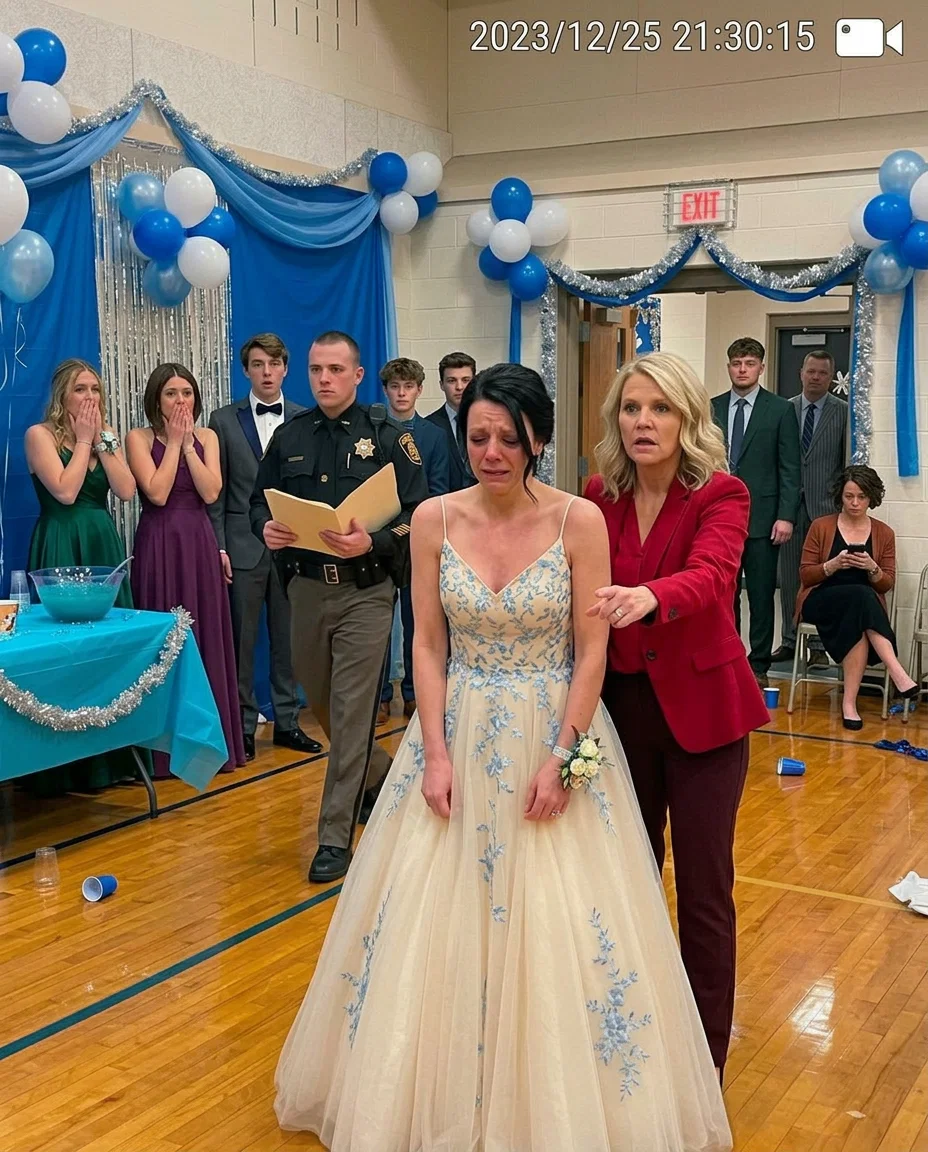
She stopped in front of Maya and examined the dress from top to bottom.
Then she spoke loudly enough for nearby students to hear.
“Where did you find those rags?”
Maya blinked.
“I’m sorry?”
Mrs. Delacroix pointed at the dress.
“You can’t seriously think you belong in prom court dressed like that.”
Silence spread through the room.
Students nearby froze.
Nobody knew what to say.
Maya stood perfectly still.
The way her mother used to when she was trying not to cry.
Mrs. Delacroix seemed ready to continue.
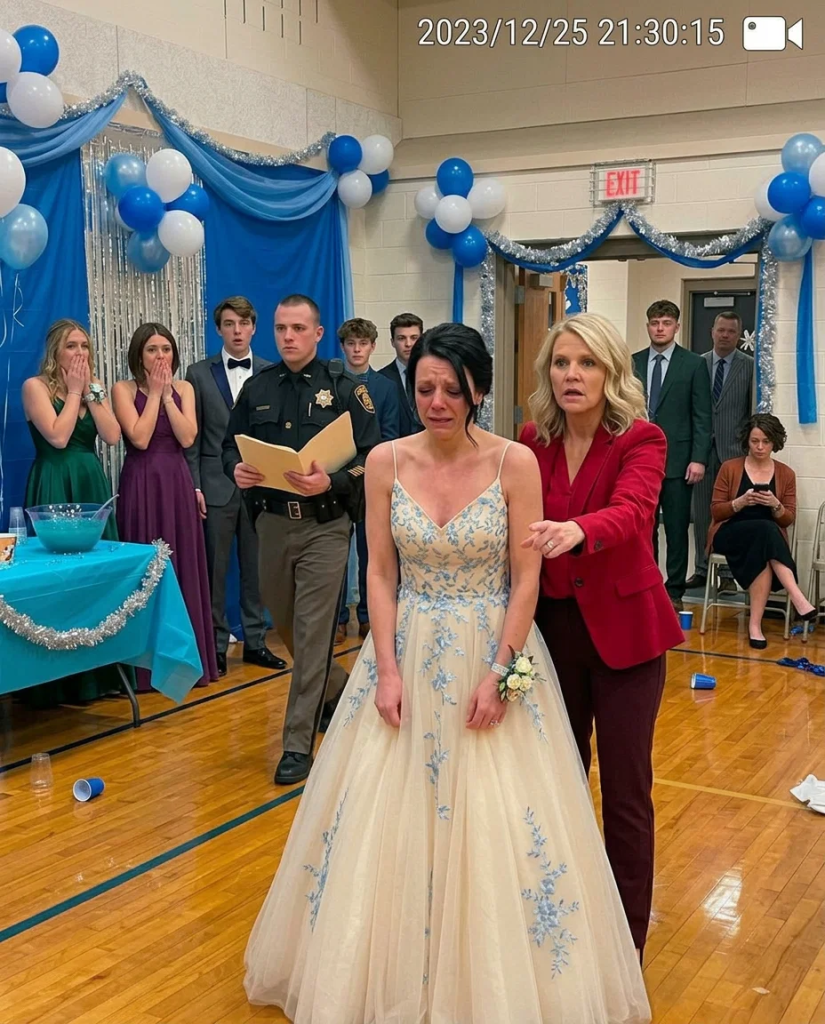
Then the gymnasium doors opened.
A uniformed county officer walked inside carrying a folder.
He moved directly toward the teacher.
The room watched.
The officer showed her paperwork.
Her face immediately lost color.
Within minutes, she was escorted out of the gym.
The doors closed behind her.
Then the room erupted.
Students began cheering.
No one understood exactly what had happened.
The truth came out later.
Mrs. Delacroix had been under investigation for months.
Parents had filed formal complaints.
Students had documented years of humiliating comments.
Many had saved screenshots, journal entries, and written records.
The district finally had enough evidence to act.
The officer had arrived that night to serve official disciplinary paperwork.
Prom simply happened to be the only place they knew she would be.
The next morning, Amara posted photos of Maya’s dress online.
She explained that the gown had been handmade by Maya’s father from her late mother’s wedding dress.
The post spread everywhere.
Thousands of people shared it.
Thousands more shared stories of their own struggles with poverty, bullying, and grief.
One comment stood out above all the others:
*”Poor kids remember every insult forever because survival already hurts enough.”*
Ray read that sentence during a plumbing job and understood every word.
A week later, Maya and Ray sat together at the kitchen table.
They talked about the dress.
About the attention.
About Ellen.
“She would’ve liked it,” Maya said quietly.
“Yeah,” Ray replied.
“Would she have been embarrassed by all the attention?”
Ray laughed.
Thinking about Ellen, he shook his head.
“No. She would’ve been absolutely unbearable about it.”
Maya laughed too.
A real laugh.
The kind that heals something.
The dress was eventually folded carefully into a box and placed on Maya’s shelf.
Not hidden away.
Not forgotten.
Because some things deserve to stay close.
The next morning, Ray woke up before sunrise and went back to work fixing pipes and water lines.
The same steady work he had done for decades.
The same reliable hands.
Only now, those hands had done something even more important.
They had given his daughter a piece of her mother back.
The first thing that caught my attention was not the replacement lock.
It was my mother’s Bible, sitting in a brown paper grocery sack on the porch, its cracked black cover warped from being jammed inside too quickly, too roughly, as though it was not the final piece I had left of the woman she had been before sorrow and fear taught her to choose ease instead of honesty.
Then my nursing shoes came into view.
Then my three neatly folded scrub sets.
Then my phone charger, tangled around a bottle of cheap shampoo.
And then I noticed my sister in the doorway of the only house I had ever called home, her polished hand resting against the brand-new brass deadbolt as if the house, the driveway, the porch, and every breath I had ever drawn inside those walls now belonged to her.
“Lena,” I said, because my drained body could not manage anything else.
I had just come off a twelve-hour shift at Mercy General. My hair was crushed into a loose, messy bun, my eyes stung from fluorescent lights and constant patient alarms, and a dried coffee stain marked the sleeve of my scrub top. At 6:14 that morning, I had held an eighty-year-old woman’s hand while her son broke down in the hallway. At 8:02, I had wiped blood from the floor after a man coded in Room 317. At 9:30, I had missed breakfast so I could phone the pharmacy and confirm that my mother’s anxiety prescription had been refilled.
And at 9:47, my sister had replaced the locks.
Behind Lena, my brother-in-law Derek stepped into the hallway, looking pleased with himself in a gray polo shirt, gripping a power drill as though it were a prize.
“This is better for everyone,” Lena said softly.
She spoke in the tone she saved for church potlucks and public displays of compassion. The sort of voice that convinced people she was kind. The same voice she had used at our father’s funeral, when she wept into a tissue while I managed the death certificates, the insurance paperwork, and the funeral home invoice.
“For everyone?” I repeated.
My mother was behind them near the staircase, one hand pressed to her cardigan. Her eyes were swollen and red, but she did not walk toward me. She did not cover the ten feet separating us. She did not say, Stop. She did not say, This is your home too.
She only stared at the paper bag on the porch.
Derek moved closer. “You’re twenty-eight, Audrey. You’ve got a career. It’s time you stood on your own.”
I nearly laughed.
For four years, half of every paycheck I earned had gone into that house. Mortgage installments. Food. Prescriptions. Utility bills. Cardiology visits for Dad before he passed away. Nights spent sitting with Mom when her hands trembled so badly she could not hold a glass of water. I had slept on a pull-out couch in the den because, somehow, Derek’s golf clubs had needed my closet more than I needed an actual bedroom.
And now he was telling me I needed to stand on my own.
Lena folded her arms. “You’ve always been independent. You’ll be fine.”
There it was.
The family verdict.
The line they had relied on my whole life to justify abandoning me with every difficult burden.
You’re capable.
You’re strong.
You’ll be fine.
My phone buzzed in my pocket, but I did not glance at it. I already knew what the alert said. Three days before, a healthcare technology startup I had quietly co-founded during night shifts and stolen lunch breaks had been purchased by a major company in Chicago.
My portion had arrived that morning.
Thirty-eight million dollars.
Thirty-eight million, two hundred thousand, to be precise, before the final tax transfers. The money was sitting in an account my family had no idea existed. My attorney, Paul Whitaker, had emailed me while I was eating a granola bar in a gas station parking lot after yet another shift.
Congratulations, Audrey. It is official.
I had stared at the figure until my phone screen went dark.
I had not told my mother.
I had not told Lena.
I had not told Derek.
And as I stood there with the paper bag of my life by my feet, watching my sister protect the door as though I were some stranger attempting to force my way inside, I realized with such cold clarity that it almost felt calm: my silence had protected me.
I lifted the bag.
My mother made a small noise that almost sounded like my name, but not enough of it to count.
Lena’s expression shifted for a second. Maybe she had expected tears. Maybe she had hoped for a fight. Maybe she had wanted me to beg, so she could feel merciful while refusing me anyway.
I gave her none of it.
I walked toward my car.
Derek called after me, “Audrey, don’t make this dramatic.”
I opened the driver’s door and set the paper bag on the passenger seat.
Then I turned and looked once more at the house where I had carried all of them for years.
“I won’t,” I said.
And I meant every word.
I would not be the one to make it dramatic.
They would.
PART 2
I drove for twenty-three minutes before it occurred to me that I had nowhere to go.
My hands were clamped around the steering wheel as if I were restraining a patient mid-seizure. The city drifted past in fragments: a pharmacy sign, a church parking lot, an elementary school crossing, a gas station, a billboard showing personal injury lawyers grinning as if tragedy could be turned into profit as long as you wore the correct suit.
At a stoplight, my phone buzzed again.
Not Lena.
Not Mom.
Paul.
“Are you safe?” he asked when I picked up.
That was the first thing out of his mouth. Not congratulations. Not a legal plan. Not details about the bank transfer. Just: Are you safe?
I turned into the parking lot of a diner with a cracked blue sign and shut off the engine.
“I’m in my car,” I said.
“What happened?”
I looked at the brown paper bag in the seat beside me. Apparently, my entire life now came with handles.
“My sister changed the locks.”
Silence followed.
Paul was not the theatrical type. He wore navy suits, spoke in full sentences, and had the composed voice of a man who had watched wealthy people behave terribly so often that little could shock him anymore.
Even so, when he answered, something in his tone had shifted.
“Do they know about the acquisition?”
“No.”
“Good,” he said. “Do not tell them.”
I shut my eyes.
“Paul, they kicked me out.”
“I understand.”
“No, you don’t. I paid the mortgage. I paid their bills. I took care of my father until the day he died. I moved out of my room because Derek needed space for golf clubs. I slept in a den for six months. And now I’m sitting in a parking lot with my mother’s Bible in a grocery bag.”
“I understand enough,” he said quietly. “And that is why you are not going back there today.”
I let out one sharp, bitter laugh. “Where am I supposed to go?”
“A hotel tonight. Tomorrow we discuss housing. Quietly.”
Quietly.
That word had become his favorite once the sale process began.
We had built the startup quietly. Three nurses, all worn down, all furious about how many patients slipped through the gaps between departments. A medication adjustment that was not entered properly. A discharge note hidden beneath six different tabs. A lab result nobody flagged because the system treated urgency like an optional suggestion.
I had begun keeping a notebook in my locker, listing every way the hospital’s data systems failed actual people. Priya, another nurse, noticed it. Then Marcus did too. We started meeting after work. Coffee shops. Library rooms. Priya’s apartment, with her baby asleep in the next room. We built a prototype no one believed could function until it did.
My family never asked about it.
They asked whether I had paid the electric bill.
They asked whether I could get Mom’s prescription.
They asked whether I could change shifts so I could drive Dad to the cardiologist.
They never asked what I was creating during the hours they assumed I was simply making myself useful.
So I kept it for myself.
The first night after Lena replaced the locks, I checked into an extended-stay hotel near the interstate. Room 114. Gray carpet. A thin blanket. An air conditioner that rattled like coins were trapped inside it. I put the paper bag on the small table and removed everything one piece at a time.
Three scrub sets.
One charger.
One Bible.
One pair of shoes.
A few toiletries.
No framed photographs. No childhood mementos. No jewelry. No winter coat. No dignity, apparently, because I sat on that bed and cried so hard my chest physically ached.
Not because of the house.
Not even because of the lock.
Because when I looked backward, I understood that my eviction had not truly happened that morning.
It had taken place slowly, year after year.
It happened when I was fifteen and my father’s construction company began to collapse, and I babysat neighborhood children on weekends to buy groceries while Lena went shopping at the mall.
It happened when I earned my way into nursing school through loans and scholarships, and my mother said, “You’re so capable, Audrey. You’ll figure it out,” while Lena quit community college after one semester and received comfort, patience, and money for “finding herself.”
It happened when I passed my nursing boards, and my family celebrated Lena’s promotion to shift supervisor at a clothing boutique that very same night with balloons and cake, while nobody even mentioned that I had become a registered nurse.
It happened when Dad’s heart worsened and everyone turned to me, not because anyone asked, but because asking would have meant admitting I had a choice.
And it happened when he died.
I had held his hand in the hospital. I had called the funeral home. I had tracked down the insurance documents. I had returned the oxygen machine. Lena selected the flowers and cried beautifully from the front row.
After the service, Derek began discussing the house.
Not grief.
The house.
How it was too large for Mom. How it would make sense for him and Lena to move in permanently. How families should consolidate during difficult periods. How the den could someday be turned into a nursery.
No one asked where I would sleep.
They simply shifted things around until there was no place left for me.
At 2:11 in the morning, sitting in Room 114, I opened my banking app and stared at the number again.
It still did not feel real.
Thirty-eight million dollars did not look like freedom at first.
It looked like a test.
Would I turn into them?
Would I use money as a weapon?
Would I run back and plead for them to love me correctly now that I could afford to be considered valuable?
I placed the phone facedown on the bed.
Then I picked up my mother’s Bible.
A photograph slid out from between the pages. Me at nine years old, missing a front tooth, standing beside Lena in matching Easter dresses. Lena had her arm wrapped around me. I was gazing up at her like she had hung the moon herself.
I smoothed the photo against my palm.
Then I whispered into the empty room, “I’m done being the useful one.”
The air conditioner clattered.
Outside, someone laughed in the parking lot.
And for the first time in my entire life, no one needed me.
It terrified me.
It was also where everything started.
PART 3
During the next two months, I became a ghost with money.
That was Paul’s description after he created the first LLC.
“You need privacy before you need revenge,” he said.
“I don’t want revenge.”
“No,” he replied. “You want protection. People often confuse the two when money enters the room.”
I purchased a downtown condominium through a company name that meant nothing to anyone except me. It was on the twelfth floor of a quiet building with security, underground parking, and windows overlooking the river. On the first night I slept there, I left every closet door open simply because I could.
There were no golf clubs.
No boxes full of Derek’s outdated electronics.
No stacks of Lena’s holiday decorations pushed into corners.
No one telling me the space was temporary, that I needed to adjust, that I should be grateful to have a roof over my head.
My bed was mine.
My kitchen was mine.
The quiet was mine.
I continued working at Mercy General because routine kept me anchored inside my own life. My patients did not care that I had suddenly become rich. They cared that their IV pump would stop shrieking. They cared that someone would explain what the doctor had rushed through too quickly. They cared that I remembered their names.
At work, I remained Audrey in navy scrubs.
At home, I was someone I had not yet fully met.
Paul managed the taxes, estate planning, investment structure, and the kinds of documents I had once believed existed only for people in movies. Priya and Marcus signed their own final paperwork and vanished into their new lives with joy and disbelief. The acquisition appeared in a healthcare technology newsletter, but the founders were not highlighted by name. The company wanted to absorb our platform into its own system without turning us into small-scale celebrities.
That suited me perfectly.
For a while, I believed I had gotten away.
Then Derek discovered the article.
He had always liked to imagine himself as a business-minded man, though his biggest financial accomplishment had been convincing my mother that paying him “consulting fees” from her savings to oversee household repairs was normal. He spent hours on investor forums, threw around words like leverage and scale at family dinners, and once lost three thousand dollars buying crypto after watching a video called Millionaire Mindset Before Breakfast.
Unfortunately, he remembered that I had once mentioned a side project.
Not directly to him. To my father.
Dad had still been alive then, sitting at the kitchen table with his pill organizer open in front of him. I had been trying to explain why the hospital software forced nurses to complete the same documentation three separate times. He had listened, truly listened, in the way he still could before pain and medication exhausted him.
Derek had been in the next room.
Apparently, that had been enough.
The first call came at 7:42 on a Tuesday morning while I was helping a patient sit up after surgery.
Lena.
Then Mom.
Then Lena again.
Then Derek.
By lunch, there were seventeen missed calls.
By dinner, thirty-nine.
By midnight, sixty-two.
By the following morning, ninety-one.
I stared at the number on my screen while drinking coffee in the kitchen of my condo. Ninety-one missed calls from people who had watched me walk away with my life in a paper bag and decided silence was acceptable until money made me worth hearing.
Lena left the first voicemail.
“Hey, Audie,” she said.
Audie.
She had not called me that since we were kids, before jealousy learned how to wear lipstick and introduce itself as concern.
“I’ve been thinking about you so much. I know things were tense with the house, and I just want you to know it was never personal. Derek and I were under a lot of stress, and Mom was fragile, and we were all grieving. Family is everything, and I miss my sister. Let me take you to dinner. Just us. I love you.”
I saved it.
My mother’s voicemail came next.
“Sweetheart, I heard you did something wonderful with a company. I don’t understand all the technology things, but I’m proud of you. I just want to hear your voice. Are you eating? Are you sleeping? Call your mother.”
She did not bring up the lock.
She did not bring up the couch.
She did not bring up the fact that she had watched me pick up a grocery bag from the porch.
I saved that one as well.
Derek did not begin with a phone call.
He sent an email.
Subject line: Family Opportunity.
Attached was a four-page PDF with a logo he had clearly made using a free design app. Whitmore Family Holdings, LLC. Under the name was the tagline: Building Generational Wealth Together.
I opened it at my kitchen island while wearing pajamas that cost more than his laptop, and I read the entire document twice because I could not believe that much audacity had been organized into numbered pages.
He suggested that I make an initial capital contribution of four million dollars into a “diversified family investment vehicle” under his management. He would collect a management fee. Lena would act as “community relations director.” My mother would be “honorary matriarch.” There were pie charts. There was a paragraph about trust. There was a single sentence stating that “past domestic misunderstandings should not hinder future prosperity.”
Past domestic misunderstandings.
That was his term for making me homeless.
I forwarded it to Paul.
He called six minutes later.
For the first time since I had known him, he sounded as if he was fighting not to laugh.
“Do nothing,” he said.
“That’s your legal advice?”
“That is my human advice. My legal advice is: save everything, answer nothing, and let them reveal themselves.”
So I did exactly that.
Three days later, Lena appeared at Mercy General wearing a cream coat and holding a gift bag. The front desk phoned my unit to tell me my sister was asking for me.
I was thirty feet away, standing behind the partition near the nurses’ station.
“Tell her I’m unavailable,” I said.
I watched through the glass.
At first, Lena smiled as though she expected doors to open automatically for her. Then confusion settled over her face. Then embarrassment. Then something colder. She squeezed the gift bag so tightly that the tissue paper crumpled.
She waited eleven minutes.
I counted.
When she finally left, she tossed the gift bag into the lobby trash.
Later, I asked security to preserve the footage.
Not because I needed it.
Because I was learning how valuable evidence could be.
Derek sent two more emails. Lena sent texts filled with childhood photos. My mother mailed a handwritten letter on floral stationery, the kind she used for sympathy notes and church donations.
The first page was about my father.
The second page was about forgiveness.
The third page was about money.
Specifically, it was about a home equity line of credit Derek had persuaded her to take out against the house six months earlier. They had fallen behind. Default notices had arrived. Foreclosure was possible.
She asked whether I might be “in a position to help.”
I sat at my dining table with the letter spread open in front of me.
Then I called Paul.
“I know what I want,” I said.
This time, my voice did not tremble.
PART 4
Paul’s office sat on the twenty-first floor of a downtown building where every polished surface looked costly enough that you felt the need to apologize before laying a hand on it.
The first time I returned there after deciding on my next move, I carried a folder with me. Inside were duplicates of the mortgage payments I had made toward the family home, grocery receipts, records of the medical bills I had paid for Dad, the transcript of Lena’s voicemail, Derek’s PDF, and the letter from my mother.
Paul went through all of it without saying a word.
When he was done, he laced his fingers together on top of the desk.
“Tell me your goal.”
“I don’t want my mother homeless,” I said.
“That is one.”
“I don’t want Derek anywhere near her finances.”
“That is two.”
“I don’t want Lena to benefit from what she did to me.”
“That is three.”
“And I don’t want to become cruel just because I can afford it.”
Paul studied me for a long moment.
“That one,” he said, “will be the hardest.”
It took fourteen days.
Through one of my LLCs, we discreetly bought the defaulted home equity note from the lender. Paul walked me through every detail until I fully understood what was happening. I was not purchasing the house itself. I was purchasing the debt attached to the house, which meant I became the person with the legal right to enforce it or restructure it.
A legal strategy.
A quiet one.
A brutal one, if it was used without compassion.
I had compassion.
I also had limits.
The lender was glad to sell it. Distressed debt meant uncertainty. Cash was simple. The documents moved through channels my family never knew existed. By the time Derek sensed something had changed, if he sensed it at all, it had already been completed.
I now controlled the debt tied to the house.
The same house where Lena had replaced the locks.
For three days after the transaction was finalized, I did nothing.
I went to work. I gave patients their medication. I helped a teenage boy breathe through a panic attack before surgery. I rode the elevator up to the maternity floor and delivered a chart to a nurse who looked as exhausted as I had once felt every single day of my life.
Then, on a Thursday evening, I stood in the closet of my condo, running my fingers over the sleeve of my navy blazer.
The old Audrey would have picked something plain, something nobody could accuse her of wearing to show off.
The new Audrey picked the blazer.
Not because it cost money.
Because it fit me.
I called Lena.
She answered before the first ring had finished.
“Audie,” she breathed, warm and cautious. “Oh my gosh. I’m so glad you called.”
“I know about the default,” I said.
Silence.
“I know about Derek’s proposal. I have your voicemail, Mom’s letter, and the emails. I want all three of you at a meeting Saturday morning. Paul Whitaker’s office. I’ll text the address.”
“A meeting?” Her voice became thinner. “Can’t we just have lunch like sisters?”
“No.”
Another pause.
Then Derek’s muffled voice came through in the background: “Ask her how much.”
I smiled.
Lena must have put her hand over the phone, but she had not done it well enough.
I heard every word.
When she returned, her tone had tightened.
“Of course,” she said. “We’ll be there.”
They arrived on Saturday dressed like they were attending the funeral of someone whose belongings they expected to receive afterward.
My mother had on pearl earrings and a pale blue cardigan. Lena wore a black dress with heels. Derek wore a suit that strained across his shoulders, his hair combed with too much care, and a leather folder tucked beneath one arm.
I was already sitting beside Paul in the conference room.
Behind us, the windows framed the city shining under winter sunlight.
Lena entered first and smiled far too brightly.
“There she is,” she said.
She moved like she intended to hug me.
I did not rise from my chair.
Her smile wavered.
My mother hugged me anyway, bending awkwardly over the conference chair. She smelled of rose lotion and old guilt. I let her hold me for two seconds before gently easing myself back.
Derek shook Paul’s hand and introduced himself as though Paul had any interest in knowing him.
We all sat down.
Paul set three folders on the table.
No one reached for them.
I was the first to speak.
“I’m not here to argue about what happened.”
Lena’s eyes immediately filled with tears, a skill she had perfected years earlier.
“Audrey, we never wanted to hurt you.”
I looked directly at her.
“You changed the locks while I was at work.”
Her mouth opened, then shut again.
Derek leaned in. “There was context.”
“There always is,” I said.
Paul’s expression stayed unreadable.
I went on. “The home equity debt against Mom’s house is no longer held by the original lender. It is held by one of my companies.”
Derek went completely still.
Lena blinked at me.
My mother looked between me and Paul as if we had started speaking a foreign language.
“What does that mean?” she asked.
“It means,” Paul said calmly, “Audrey has the legal authority to restructure the debt, enforce the debt, or transfer it.”
Derek’s expression shifted before anyone else’s did. He understood first. The confidence seemed to drain out of him so fast I could almost see it leaving.
“You bought the note?” he asked.
“I did,” I said.
“That’s aggressive.”
“So was changing the locks.”
Lena flinched.
I opened my folder.
“I have three choices. I can foreclose. I can forgive the debt. Or I can restructure it. I am choosing to restructure.”
My mother began to cry quietly.
“Mom will stay in the house for the rest of her life if she wants to,” I said. “She will not pay rent. Utilities, groceries, medical expenses, basic maintenance, and a modest monthly allowance will be covered through a trust.”
My mother lifted a hand over her mouth.
Lena’s tears stopped at once.
Derek’s eyes narrowed.
I saw the exact moment they understood that generosity was being offered, but not in any form they could touch or control.
“The house will be transferred into a trust,” I continued. “Mom will be the sole lifetime beneficiary. Lena and Derek will not be on the title. They will not manage the trust. They will not borrow against the property. They will not access the account. They may visit Mom as family, if Mom wants them there. They will not treat her home as a financial asset.”
Derek leaned back in his chair.
“This is ridiculous,” he said. “I’ve been managing the household finances for years.”
“Yes,” I said. “That’s why we’re here.”
Color rose in his face.
Lena turned toward me. “Audrey, how can you sit there and talk to us like we’re criminals?”
I thought about the driveway.
The grocery bag.
The brass deadbolt.
The way my mother had stood behind her and said nothing at all.
“I’m talking to you like adults,” I said. “That may feel unfamiliar.”
Paul pushed the folders across the table.
“These documents release Audrey from any personal financial obligation to Lena or Derek,” he said. “They also acknowledge that Audrey’s support for Mrs. Whitmore is final, structured, and not an admission of shared family entitlement.”
Derek snatched up his folder first.
Lena whispered, “Entitlement?”
“Yes,” I said.
She looked injured. Genuinely injured. Not because she felt sorry for hurting me, but because I had finally given a name to the shape of what she expected.
“You have thirty-eight million dollars,” Derek snapped.
The room went silent.
My mother looked sharply at him.
So did Lena.
He understood too late that he had spoken the part they were all supposed to keep quiet.
I folded my hands together.
“And you had one locked door,” I said. “Funny how numbers reveal people.”
PART 5
They did not put their signatures down right away.
People like Lena and Derek do not give in at the first barrier. They circle it. They search for weak spots. They pretend resistance is morality.
Derek read through the papers as if sheer force of attention could make a loophole appear.
Lena began crying again, more quietly this time, directing the tears toward our mother.
For once, Mom did not reach out to comfort her.
She was reading too.
Slowly.
Painfully.
Every few seconds, her gaze rose to me before dropping back down to the page.
When she reached the section that restricted borrowing against the trust property, her hand started to shake.
“Derek,” she whispered.
He said nothing.
“Did you take the credit line for the kitchen renovation?”
Lena’s head snapped toward him.
Derek’s jaw clenched.
“The house needed improvements,” he said.
“There was no kitchen renovation,” my mother said.
The temperature in the room seemed to drop.
I had already known, from Paul’s review, that only part of the borrowed money had actually gone toward household expenses. The rest had disappeared into accounts and payments Derek could not explain. I had chosen not to open with that. Some truths had to arrive in familiar voices.
Lena stared at her husband.
“What did you do?”
Derek laughed, but it came out crooked.
“Don’t let her manipulate you. This is exactly what she wants. Divide us, control Mom, play the hero.”
“I paid the mortgage for four years,” I said quietly. “I took Dad to the hospital. I slept in the den. I left with a paper bag. I don’t need to play anything.”
He pointed a finger at me.
“There it is. The martyr speech.”
Paul’s voice sliced through the conference room.
“Mr. Hale, I would advise you not to continue in that tone.”
Derek looked at him. “Or what?”
Paul did not so much as blink.
“Or I will suggest we pause this meeting and proceed through formal enforcement channels.”
That silenced him.
Lena had gone pale. For the first time, she was not putting on a show. She was mentally retracing her own life, seeing the late bills, the sudden explanations, the moments Derek claimed he had taken care of it, the times he told her not to trouble her pretty head.
She had enjoyed being shielded from responsibility.
Now she was beginning to understand what that protection had cost.
“Sign,” my mother said.
All of us looked at her.
Her voice was small, but there was steel underneath it.
“Mom,” Lena said.
“No.” My mother wiped her cheek. “You let your husband borrow against my house. You let him push your sister out. And I let it happen because it was easier to believe Audrey would survive than admit the rest of us were failing her.”
The words struck me harder than I expected.
I lowered my eyes to the table.
My mother turned toward me.
“I am sorry,” she said.
Not theatrically.
Not loudly.
Not with excuses wrapped around it.
Just four words.
I had pictured hearing them so many times that the real version almost felt too small to hold. But small did not mean meaningless.
Lena began crying again, but this time no one looked at her.
Derek signed first.
His signature was harsh and ugly, carving across the paper like a warning.
Lena signed second. Her hand shook. She avoided my eyes.
My mother signed last.
When she lifted the pen from the page, she closed her eyes.
Paul collected the documents.
“I’ll file the necessary paperwork Monday,” he said.
Derek got up so fast his chair struck the carpeted wall.
“This isn’t over.”
I looked up at him.
“Yes,” I said. “It is.”
He left the room.
Lena followed after a moment, but she stopped at the doorway.
For one second, I saw the sister from the Easter photo: lovely, adored, certain that the world would always move aside to make space for her.
Then I saw the woman who had stood behind a locked door and told me it was better for everyone.
“You changed,” she said.
I almost smiled.
“No,” I said. “I stopped disappearing.”
After they were gone, my mother remained.
She sat opposite me in the empty conference room, gripping her purse with both hands.
“I thought,” she began, then stopped. “I thought you were stronger than Lena.”
“I was.”
“That made it easy to lean on you.”
“I know.”
She swallowed. “That is not an excuse.”
“No,” I said. “It isn’t.”
For a long while, neither of us said anything.
Far below the windows, traffic moved in tiny, orderly lines.
At last, she asked, “Do you hate me?”
I gave her the truth.
“Some days, I did.”
She shut her eyes.
“But not today,” I said.
Her eyes opened again.
“Today I’m tired.”
She nodded as though she deserved that answer.
Maybe she did.
Over the following weeks, the house was transferred into the trust. The credit line was settled. Derek’s access was cut off. A professional trustee managed the practical details. My mother stayed in the house, but the house itself changed without moving anywhere.
Derek’s golf clubs vanished from the garage.
Lena’s storage boxes were taken out of the den.
The room where I had once slept on the fold-out couch became a reading room.
My mother asked whether I wanted any of my old belongings.
I said no.
The condo had taught me something: not everything you leave behind has to be reclaimed.
Sometimes freedom looks like an empty closet.
Derek did what men like Derek tend to do when they lose power. He rebranded himself in public.
He launched a podcast called Real Wealth, Real Men.
In the first episode, he spoke about betrayal, family businesses, and “female financial manipulation.” It had seventeen plays, and six of them were probably his own.
Lena texted me twice.
The first message said she needed closure.
The second said she hoped I was happy.
I answered neither one.
My mother called every Sunday at four.
At first, our calls were awkward. She talked about the weather, the neighbor’s dog, the church bulletin. Then one afternoon, she said, “Your father knew you were special.”
I almost ended the call.
Not because I was angry.
Because grief can strike more violently when it arrives carrying love.
“He told me once,” she continued, “that you had the kind of mind that built bridges out of broken boards.”
I lowered myself onto the floor of my kitchen.
“He never told me that.”
“I know,” she said. “He should have.”
That became the shape our relationship took.
Not fixed.
Not erased.
But honest enough to start again.
PART 6
Eight months after the locks were changed, I resigned from Mercy General.
My final shift ended at dawn. The sky beyond the hospital had turned pale pink, and the city looked soft in the way cities only do before they fully wake. Priya met me in the parking lot with coffee and started crying before I did.
“You know you can still change your mind,” she said.
“I know.”
“You love bedside nursing.”
“I do.”
“But?”
I glanced back at the hospital entrance.
“But I can help more people from the other side now.”
That was true, but it was not the entire truth.
The full truth was that I was tired of being needed only after everything had already become an emergency. I wanted to create something that kept the crisis from swallowing people whole in the first place.
The second company began in a rented office above a bakery. I could have leased a full floor downtown, but I liked the smell of bread in the hall. We built software for smaller clinics that could not pay for the expensive systems used by major hospitals. We focused on missed follow-ups, medication conflicts, confusion after discharge, the quiet administrative failures that turned poor patients into emergency-room cases.
I hired nurses before anyone else.
Not consultants.
Not men in expensive shoes who said phrases like market capture before they understood what a night shift did to a person.
Nurses.
People who knew.
I also anonymously funded two scholarships at my nursing school, one for students who were supporting family members and one for students returning after financial hardship. The dean wanted to put my name on a donor wall. I declined.
I had spent enough of my life invisible for the wrong reasons.
Now I wanted privacy for the right ones.
By thirty-one, I had a company, a condo, a lawyer who had become a friend, and a mother who was learning to apologize in fragments.
I did not have Lena.
People expect that part of the story to become tender. They expect sisters to reunite over coffee, to cry together, to confess envy, to remember childhood, to become whole again because endings feel cleaner when everyone receives forgiveness.
That is not how it happened.
Lena stayed Lena.
She sent a birthday card with a long paragraph about missing “what we used to be,” but what we used to be was an arrangement where she received gentleness and I received responsibility. I did not miss that arrangement.
Months afterward, she called from a number I did not recognize.
I answered because I was waiting for a contractor to call.
For one moment, neither of us spoke.
Then she said, “Derek left.”
I looked out the window of my office at the street below.
“I’m sorry.”
“He took money,” she said. “More than I knew.”
“I’m sorry,” I repeated.
“I didn’t know everything.”
“I believe that.”
Her breath caught, as though she had expected blame and did not know what to do with restraint.
“Can I see you?” she asked.
I closed my eyes.
In another life, maybe I would have said yes right away. Maybe the little girl in the Easter dress would have run toward her big sister with forgiveness already packed in her hands.
But I was no longer that girl.
“Not right now,” I said.
“Audrey—”
“I hope you get help. I mean that. But I can’t be your emergency exit.”
Silence.
Then, almost whispering, she said, “You really are different.”
This time, I smiled.
“I really am.”
I ended the call and cried for ten minutes.
Then I wiped my face and returned to work.
Boundaries are not walls made from hatred. Sometimes they are doors you finally have the right to lock from the inside.
The next spring, my mother invited me to dinner at the house.
I almost refused.
But there was something different in her voice. Not neediness. Not manipulation. Just hope.
So I went.
The brass deadbolt Lena had put in was still there.
For a moment, I stood on the porch and remembered the paper bag. The scrubs. The Bible. Derek’s voice telling me not to make anything dramatic.
My mother opened the door before I could knock.
She looked older, smaller, but steadier than before.
“I’m glad you came,” she said.
Inside, the house smelled of roast chicken and lemon polish. The den was no longer a storage space or a temporary bedroom. There was a small bookshelf, a lamp, and a framed photograph on the side table.
The Easter photo.
Me and Lena in matching dresses.
I stared at it.
“I can put it away,” Mom said quickly.
“No,” I said.
Because the girl in that picture deserved to exist somewhere. Not as evidence that everything had to be forgiven, but as proof that I had once loved without armor.
Dinner was quiet. We talked about Dad. We talked about my work. My mother asked real questions and waited for real answers.
After dessert, she handed me something wrapped in tissue paper.
My father’s watch.
“I should have given it to you years ago,” she said. “He wanted you to have it.”
The watch was scratched, simple, and far too large for my wrist.
I held it as if it had been made from light.
On the drive home, I did not cry.
I felt something better than relief.
I felt ownership.
Not of the house.
Not of the money.
Of myself.
Years before, my family had called me capable because it served them. They labeled me independent so they would not have to show up for me. They praised my strength while placing more weight on my back.
But capability had never belonged to them to define.
It belonged to me.
It was in every night shift. Every unpaid bill I survived. Every quiet humiliation I swallowed until I finally stopped swallowing. Every idea I created in stolen hours. Every boundary I held while people called it cruelty because they could no longer call it access.
The paper bag was gone.
The fold-out couch was gone.
The girl standing in the driveway was gone too, at least the version of her who still believed love had to be earned by being useful.
In her place was a woman with her father’s watch in her purse, her mother’s apology still flawed but real, her sister’s number blocked, and a life no one could enter without permission.
Sometimes people will lock you out of the only home you have ever known and call it an opportunity.
Sometimes they will return when your bank account finally makes you visible.
Sometimes they will call ninety-one times and confuse persistence with love.
Let them call.
Let them knock.
Let them stand outside the door they taught you how to close.
And when they ask what changed, tell them the truth.
The conference room at Sterling and Associates smelled of polished wood, old leather, and wealth that had been protected for generations.
I sat quietly at the long oak table, wearing the same black suit I had bought years ago for a wedding. Across from me, my stepmother Elena looked as if she had come to a cocktail party instead of a will reading. Her son Brad leaned back with sunglasses on, already talking about buying a red sports car. Her daughter Tiffany flipped through a Maldives brochure, discussing penthouses in New York.
My father had been buried only four days earlier.
Elena turned to me with a sweet, poisonous smile. “I hope you didn’t miss work for this, Zachary. Hourly wages must be important to you.”
I said nothing. I had promised my father I would wait.
During our last secret meeting, when I slipped into his room through the garden gate, he had held my hand and whispered, “Let them think they’ve won. Let them show who they really are.”
So I waited.
Jonathan Harrison, my father’s longtime lawyer, finally entered. Elena wasted no time.
“Let’s make this quick,” she said. “Read the important part and give us the account access.”
Harrison lifted the document. “This is the last will and testament of Robert Sterling, dated six years ago.”
Elena smiled at me. “See? It leaves everything to me. Zachary gets nothing.”
Brad laughed. “Tough luck, bro.”
For one painful second, even though I knew there was more, the words still hit me hard.
Then Harrison began to laugh.
Elena’s smile disappeared. “How dare you? My husband is dead.”
Harrison wiped his eyes. “Forgive me, Mrs. Sterling. But you truly believed that old will was the whole story.”
Her face tightened.
Then he placed another folder on the desk.
“Yes, Robert did sign a will six years ago,” Harrison said. “But the estate was never controlled by that will. It was controlled by a trust.”
Elena went still.
Harrison explained that a will only distributes assets a person owns at death. But my father had placed nearly everything—houses, cars, accounts, investments—inside the Sterling Family Trust years ago.
Then came the blow.
“Fifteen months ago,” Harrison said, “Robert restated the trust, resigned as trustee, and appointed Zachary as the sole trustee.”
Elena stared at me as if I had become a stranger.
“He’s a construction worker,” she snapped. “He doesn’t understand money.”
“He has controlled the entire estate for more than a year,” Harrison replied. “And the sole beneficiary is also Zachary.”
The room went silent.
My father had not left me money after death.
He had given me everything before he died.
PART 2: The Trap Closes
Elena shook her head. “Impossible. I watched Robert every day. I monitored his mail, his visitors, everything.”
“You monitored the front door,” Harrison said. “Not the garden entrance. Not the private notary.”
Her face drained of color.
She immediately tried another attack. “He was sick. He wasn’t mentally competent.”
Harrison was ready. He produced a cognitive evaluation from a respected neurologist, completed the same day the trust was signed. My father had scored twenty-nine out of thirty. There was also a video recording of him explaining every decision clearly.
Then I stood.
“Dad gave you one final year,” I said. “He wanted to know if you would care for him because you loved him, or because you wanted his money.”
I looked at Brad. “You charged a forty-thousand-dollar watch while he was in the ICU.”
Then at Tiffany. “You missed his birthday for a music festival.”
Then at Elena. “And you treated my dying father like a problem that wasn’t disappearing fast enough.”
Elena screamed that she had rights as his wife.
Harrison opened another ledger. In the fifteen months after the trust had transferred to me, Elena, Brad, and Tiffany had spent over two million dollars from accounts that legally belonged to the trust.
Then I opened the black folder my father had prepared.
Inside were three piles.
The first showed Brad’s gambling debts in Las Vegas. The second showed Elena’s affairs during her marriage to my father. The third was far darker: an old investigation into the death of Elena’s first husband, along with pharmacy records and new evidence suggesting she had overmedicated him.
My father had also tested his own blood after feeling unusually confused. The lab found sedatives he had never been prescribed.
Elena stopped breathing for a moment.
“We haven’t taken this to the district attorney,” I said. “That is not mercy. It is a choice. My father wanted peace. He wanted you gone.”
Harrison then placed three one-dollar bills on the desk.
“The will leaves Elena one dollar. Brad one dollar. Tiffany one dollar. This proves you were not forgotten. You were remembered exactly.”
I placed three envelopes beside them.
“Eviction notices,” I said. “You have twenty-four hours. Security is already at the house. You may take your clothes, toiletries, and anything you can prove you bought with your own money. Everything else stays.”
Tiffany burst into tears. “Where are we supposed to go?”
“I don’t know,” I said. “But not there.”
Elena stood, trying to look powerful one last time.
“Robert would be ashamed of you.”
I looked directly at her.
“Robert planned every part of this. I’m only carrying it out.”
She left without taking her dollar.
PART 3: What My Father Really Left Me
That evening, I parked across from the house and watched them leave.
Brad carried boxes of expensive shoes. Tiffany dragged bags across the lawn. Elena shouted orders until she noticed my car. For the first time, I saw fear on her face.
By night, they were gone.
Inside, the house still looked like Elena’s cold museum—white furniture, marble, empty beauty. But the air already felt lighter.
On the kitchen counter, Elena had left a note.
Hope you rot in this big empty house.
I threw it away.
The next morning, I went to see Maria, our former housekeeper. Elena had fired her years earlier, accusing her of stealing. Maria had been part of my family since childhood. When she opened the door, we both cried.
I brought her home with double her old salary and a real pension.
Within two days, the house changed. It smelled like garlic, oregano, and warmth again. Thomas, the gardener, tore out Elena’s gravel meditation space and replanted my mother’s yellow roses.
A week later, Harrison sent news. The insurance company had reopened the case involving Elena’s first husband. Her assets were frozen. Her wealthy friends vanished. Brad was later seen working valet at the same country club he once visited with my father’s money.
But by then, I had stopped caring about them.
In my father’s final letter, he told me to check the false bottom in the third drawer of his desk. Inside, I found my mother’s engagement ring and a leather notebook.
The notebook was not about revenge.
It was a secret record of kindness.
My father had quietly paid tuition for Maria’s granddaughter. He had helped Thomas’s son start a business. He had supported former employees, neighbors, and people Elena had pushed aside.
At the back, he had written:
Use the Sterling Education Initiative. Keep it going. Elena wanted to be a queen. I preferred to be a neighbor. Don’t let the money make you hard. Use it to make life softer for people who have it hard.
I pressed the notebook to my forehead.
“I promise, Dad.”
That night, Sarah came over. Maria cooked dinner. The house filled with laughter for the first time in years.
Later, in the garden, beneath the yellow roses, I gave Sarah my mother’s ring.
“My father saved this for someone who understood loyalty,” I said.
She said yes.
A year later, Sarah and I visited my father’s grave. She was six months pregnant with our son. We had already chosen his name.
Robert.
I placed Thomas’s yellow roses beside the stone and whispered, “Hey, Dad. I brought the family.”
The trust, the money, the house—those were not his real gifts.