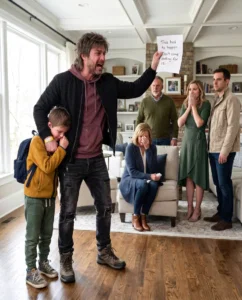
Harrison had spent hours on a bus imagining the moment he would finally see his first love again after fifty years of regret. But during a roadside stop, an unfamiliar woman called and begged him to say he had not arrived yet, turning the journey into something far more urgent than a reunion.
Margaret was my first love.
The only woman I ever truly believed I was supposed to grow old beside.
But fifty years earlier, I let her leave.
I never stopped loving her. That would have been easier to survive.
I let her go because I was young, proud, and foolish in the particular way men sometimes are.
Margaret had the chance to leave our small town and build a better future than anything I believed I could give her.
So I convinced myself I was doing something noble.
I told myself love meant stepping aside and allowing her to go.
What I really did was break both our hearts and call it sacrifice.
I never married.
I nearly married a woman from church who loved the same books I did, and later a widow in my forties who smelled of lavender and laughed with her entire body.
But whenever life began asking something permanent of me, I pulled away.
Neither woman was unkind or unworthy.
They simply were not Margaret.
And when you spend enough years comparing everything to one thing you lost, you begin living beside your life instead of inside it.
I had no children.
No close family remained except a few distant cousins who received Christmas cards from me more out of habit than affection.
I drank coffee at six and watched the news at seven.
I walked when my knees permitted it.
My evenings passed in an armchair with a book or the radio.
My life had become small enough to hold in two hands.
Then, six months earlier, I found Margaret’s name online.
I had been searching for an old high-school classmate, which is the kind of thing a man does when he has too much time and too many memories.
My mind was crowded with people I once assumed would remain young forever, and I only wanted to see what had become of them.
I searched one name, then another.
While scrolling, Margaret appeared under People You May Know.
I stared at the screen until my tea turned cold.
Her profile showed a phone number and several photographs.
There was enough proof to show she was real, somewhere beneath the same sky, still breathing after all those years.
I had no intention of calling.
At least that was what I told myself for three days.
Then, on a Tuesday evening, with my hands trembling as though I were nineteen again, I dialed.
She answered on the fourth ring.
Time is strange.
It had worn both of us down, but it had not erased us.
Her voice was lower than I remembered, perhaps softer, but unmistakably hers.
Something inside my chest nearly broke.
“Margaret? It’s Harrison,” I said.
A pause followed.
Then, quietly: “Harrison?”
Neither of us planned for the conversation to continue.
We simply kept discovering one more thing to say.
Another name from our past.
Another memory.
Another apology that had spent too many years ripening.
She told me she had married once, had one daughter, and lost her husband to cancer nearly fifteen years earlier.
I told her I had never married.
A gentle silence formed when she understood what that meant.
Then we spoke again.
And again.
Before long, we were talking every evening as though fifty missing years had been an unfortunate scheduling conflict rather than an entire lifetime.
We discussed books, weather, old songs, aching joints, and the quiet humiliations of growing older.
We spoke about our parents, the people we had buried, and the younger versions of ourselves we still carried like folded letters.
One night she said, very softly, “I wish we’d had one more chance.”
Neither of us slept afterward.
A week later, Margaret mailed me her address.
Her handwriting had changed, though not completely.
The capital M still leaned the same way.
I stared at the envelope for almost an hour before opening it, as though waiting might make the hope inside easier to endure.
Then I sold my old truck, packed one suitcase, and bought a one-way bus ticket.
At seventy-six, it felt equally absurd and courageous.
This was not simply a trip.
The ride lasted almost twelve hours.
I spent every mile imagining the instant I would see her again.
Would she recognize me immediately?
Would she still tilt her head when she laughed?
Would fifty years vanish in a second, or would we stand before each other like courteous strangers wearing the faces of people we once loved?
Halfway through the journey, the driver slowed and pulled into a roadside station.
“We’ll be here for about 15 minutes,” he announced.
I stayed in my seat, holding the envelope with Margaret’s address.
I had already taken it out three times that morning, afraid the ink might disappear whenever I stopped looking at it.
Then my phone rang.
The number was unfamiliar.
I almost ignored it.
Something told me not to.
So I answered.
An unknown woman asked, “Are you, Harrison?”
“Yes.”
She drew a trembling breath.
“Please tell me you haven’t arrived yet.”
I stood so quickly that the envelope slipped from my hand.
I picked it up while my heart raced.
“What happened?”
There was a pause.
Then she said, “I’m Margaret’s daughter. My name is Ellen. My mother had a heart attack this morning.”
“Is she…”
I could not finish the question.
“She’s alive,” Ellen said quickly. “She’s in the hospital. They stabilized her, but they’re worried. She kept asking whether you’d already arrived. I found your number in her address book.”
I dropped into the nearest seat.
“What hospital?”
She told me.
In one of those moments that seems too perfectly arranged to be coincidence, the hospital was not far from the bus route.
After confirming that with the driver, I called Ellen again.
“I’ll be there in an hour,” I said, my voice shaking. “I’m one stop away.”
“Then come,” she said, and her voice cracked. “Please come now.”
The next section of road passed in a blur.
I remember only that I prayed with real desperation for the first time in years.
At the next stop, I left the bus and found a taxi.
When I reached the hospital, my hands shook so badly that I had to sign the visitor form slowly enough for my name to resemble my own.
Ellen met me in the lobby.
The instant I saw her, I knew she belonged to Margaret.
She had her mother’s eyes exactly.
The same wide, thoughtful shape.
The same way of looking directly at someone while somehow pushing through her own fear to do what needed to be done.
“Yes, this is me.”
She nodded.
Then, to my surprise, she stepped forward and hugged me.
“She’ll be glad you’re here,” she whispered.
Margaret was awake when I entered the room.
She looked small and pale.
For one terrible second, I saw only the illness.
The sharp lines of her face.
The blanket pulled too high.
The wires.
The unnatural stillness.
Then she turned her head, recognized me, and managed a smile.
It was her.
Older, yes.
Fragile in a way that frightened me immediately.
But still Margaret.
Still the girl who had laughed in the rain at nineteen and kissed me behind a grocery store.
The sight nearly undid me.
I moved to her bedside and took her hand with great care, as though fifty years could bruise between us.
“I came as fast as I could.”
“I know.”
I sat there for a long time without speaking.
I simply looked at her and let the impossible truth of her presence settle inside me.
Her eyes filled.
Then mine did too.
Suddenly, we were both old and crying like people in mourning.
“I thought I might miss you,” I finally said.
“You almost did,” she replied, smiling faintly.
Later that afternoon, the doctor asked to speak with Ellen and me in the hallway.
His words were gentle.
So gentle that I understood before he finished that they would not rescue us.
They could keep Margaret comfortable.
They could give her a little time.
But not much.
Perhaps days.
A week, if we were fortunate.
I stared at the floor tiles as he spoke because looking at his face would have made the truth real too quickly.
After he left, Ellen wiped her eyes.
“She’s been weaker than she admitted on the phone.”
The knowledge hurt in a new way.
Ellen nodded.
“She knew enough to take her medications, but we didn’t know it had gotten so bad.”
I thought about all our evening conversations.
The tenderness.
The urgency I had mistaken for simple honesty between two people near the end of life.
Margaret must have known that time was narrowing and still waited for me to come by my own choice.
I loved her more for that.
And hated the world a little.
I rented a room in a motel near the hospital and spent every day beside her.
We tried to speak through fifty missing years with the hunger of people finally allowed to talk after a lifetime of interruption.
She told me about Ellen’s birth, her marriage, the years after her husband died, and the way she learned to live with loneliness without becoming bitter.
I told her about the jobs I had worked, the towns where I had lived, the women I had never married, and the quiet outline of my existence.
I told her that no matter what my hands had been busy doing, some part of me had always remained with her.
Once she said, “I would have been poor with you, Harrison. I don’t think I would have minded.”
“I was too foolish and proud to realize that. I know now,” I replied.
Ellen came and went, bringing coffee, making calls, and handling the terrible practical machinery that begins moving the moment death enters a room.
Between those tasks, she and I talked.
At first, carefully.
After all, what tone is appropriate with the man your mother loved before you were born?
Then gradually, less carefully.
Margaret had never spoken about me with bitterness or scandal.
Only occasionally, inside old stories, when she remembered being young.
“She always called you the one who got away,” Ellen said one evening while Margaret slept.
I looked at my hands.
“I’m sorry for that.”
Ellen shook her head.
“I don’t think she meant it with regret by the end. More like… a room in her heart that never got closed.”
I had no words.
So I took Ellen’s hand and squeezed it once.
On Margaret’s final morning, sunlight entered through the hospital blinds, soft and yellow, almost merciful.
Ellen had gone downstairs to speak with a nurse about paperwork.
For several precious minutes, Margaret and I were alone.
She stirred and opened her eyes.
“Harrison?”
“I’m here.”
She looked at me as though she still needed to confirm that I had truly come all that way.
Then she gave me the same small smile she had offered when I first entered the room.
I bent over our joined hands and pressed my forehead against them because I could not bear the weight of what she was giving me.
“So did I.”
She died that afternoon while I held her hand.
Ellen stood on one side of the bed.
I stood on the other.
Together, we felt the enormous silence of a life closing.
Afterward, I sat alone in the hospital chapel for nearly an hour because I could not yet enter a world where Margaret had become past tense again.
I stayed for everything.
I helped Ellen choose the flowers.
We selected simple white peonies and pale blue delphinium because Margaret had loved growing them in her garden.
Ellen said the colors reminded her of her mother’s best Sunday dress.
At the burial, Ellen slipped her arm through mine as naturally as though it had always belonged there.
That nearly broke me as completely as the grave.
After the funeral, I returned home.
I was too old to pretend grief could be escaped by changing geography.
The world remained untouched by the fact that mine had split apart and reformed around a different shape.
But Ellen called two days later.
Then again on Sunday to check on me.
And after that, somehow, we continued.
I still longed for Margaret.
For weeks, I reached toward the telephone at dusk before remembering there would be no evening call.
But Ellen and I kept growing closer until we became a natural part of each other’s lives.
She sent me copies of photographs I had never seen.
Margaret in her thirties, holding baby Ellen on a porch swing.
Margaret at fifty, wearing a sunhat and laughing at something outside the frame.
Margaret the previous spring, standing among tomato plants with one hand on her hip, looking like a woman who had earned every line on her face.
Margaret at seventeen, barefoot in a creek.
Margaret furious over a damaged library book.
Ellen laughed and cried in equal measure while telling me the stories behind them.
Sometimes she visits me now.
Sometimes I take the bus to see her.
We talk about Margaret often, but not only about her.
We discuss recipes, weather, and Ellen’s life.
Once, she brought her son, Margaret’s grandson, to meet me.
Hearing a child run through a yard that had been silent for years nearly took away my ability to speak.
I am old enough to understand that life rarely returns what it takes.
But sometimes it leaves something at your door that you never imagined receiving.
I did not get forever with Margaret.
I did not get the marriage, the children, or the ordinary decades we might have shared if I had been braver at twenty-six.
But I saw her again.
I heard her forgive me without ever needing to use the word.
I held her hand at the end.
And because I loved her late instead of never loving her at all, I found a daughter I had never expected to have.
I still miss Margaret every day.
But gratitude has made space beside the grief.
At seventy-six, I boarded a bus to see my first love after fifty years.
The years did not stop me from reaching her.
And through the strange mercy of that journey, I found a life I never would have known to ask for.
Now the question at the center of this story remains:
If you were Harrison, would becoming part of Ellen’s life afterward feel like comfort, or like a constant reminder of the family you never had with Margaret?
needed $5,500 to save my daughter’s life, but my husband said, “We just closed on a beach house. Figure it out yourself.” Then my mother-in-law took the phone and told me to stop calling her son. That night, my father-in-law quietly slipped me an envelope… and three days later, my husband was pounding on my front door.
I needed $5,500 to save my daughter’s life.
Not next week.
Not after another specialist.
Not after the insurance company finally stopped passing me from one department to another.
By Friday morning.
My six-year-old daughter, Lily, lay in a hospital bed in Norfolk, Virginia. A valve in her heart was failing, and her surgeon, Dr. Elaine Mercer, explained that the pediatric assistance fund had approved part of the emergency operation, but not the specialized implant. The manufacturer would not ship it until payment was received.
Without it, Lily would be stabilized, delayed, and “monitored.”
Monitored.
As though she were a weather forecast.
I stepped into the hospital stairwell, my phone trembling in my hand, and called my husband, Grant Whitmore.
He answered on the fifth ring.
Music and laughter echoed behind him.
“Cassie?” he said impatiently. “I’m in the middle of something.”
“I need you to listen. It’s Lily. The hospital needs $5,500 for the implant. Today.”
He paused.
Not from fear.
Not from shock.
Only because it inconvenienced him.
“We just closed on a beach house,” he said. “Figure it out yourself.”
For a moment, I thought I had misunderstood.
“Grant, this is your daughter.”
“And you’re her mother. Handle it.”
Then another voice cut into the call.
His mother, Patricia.
“Stop calling my son,” she said. “Go ask the army.”
Then she disconnected.
I stood there with one hand against the cold concrete wall, forcing myself not to scream because Lily’s room was only two floors above.
My brother, Adam, had been killed in Afghanistan nine years earlier.
The army had already taken enough from my family.
Patricia knew that.
She smiled when she said it.
By evening, I had called everyone I could think of.
Friends.
Former coworkers.
A church I had not attended in two years.
A charity that placed me on a waiting list.
My bank rejected my loan request within twelve minutes.
At 7:40 that evening, while Lily slept beneath a thin hospital blanket, my father-in-law, Richard Whitmore, appeared outside her room.
He looked older than I remembered.
His tie hung loose.
His face carried the weight of shame.
He did not ask permission to enter.
He simply walked over, slipped a thick envelope into my hand, and whispered,
“Don’t tell them I came.”
Inside was a cashier’s check for $5,500.
I stared at him.
Richard swallowed.
“Save my granddaughter.”
Three days later, my husband was pounding on my front door, shouting my name loudly enough for the neighbors to step outside.
This time, I did not answer.
PART 2
Grant Whitmore had never liked locked doors.
Not because he valued honesty.
Because he believed every door in his life should open the moment he reached for it.
My rented duplex in Chesapeake had peeling white paint, a weak porch light, and a brass deadbolt I had installed myself after Grant moved out “temporarily” eight months earlier.
Temporary had become weekends at Patricia’s house.
Then business trips that were not business trips.
Then a separate bank account.
Then silence.
Now, at 9:17 p.m., Grant stood on my porch hammering the door with the side of his fist.
“Cassie! Open the damn door!”
Behind me, Lily slept on the couch with her stuffed rabbit tucked beneath her chin.
Fresh bandages remained hidden beneath her pajamas.
The surgery had gone well.
Dr. Mercer had spoken the words I had prayed to hear.
“She’s stable.”
Stable.
That single word had become sacred.
I stepped to the window and lifted the curtain slightly.
Grant stood outside wearing a navy polo, his hair perfectly styled and his face flushed with anger.
Patricia sat in the driveway inside a white Mercedes, headlights shining, arms folded like royalty waiting for punishment to be carried out.
Richard was nowhere to be seen.
“Go home, Grant,” I called through the door.
“You took money from my father.”
“He gave money to Lily.”
“That was family money.”
A quiet laugh escaped me.
Even I was surprised.
“Lily is family.”
“You had no right going behind my back.”
I unlocked the deadbolt but left the security chain fastened.
The door opened only a few inches.
Grant leaned closer.
“You embarrassed me.”
“No,” I replied. “You did that when you bought a beach house while your daughter needed heart surgery.”
His expression twisted.
“That house is an investment.”
“So was saving Lily.”
Suddenly, he shoved the door.
The chain caught with a loud metallic snap.
Lily stirred on the couch.
A wave of cold swept through me.
“Lower your voice,” I said. “She just got home from the hospital.”
Patricia climbed out of the Mercedes, her heels clicking across the walkway.
“You manipulative little beggar,” she said. “You always wanted to turn Richard against us.”
I looked directly at her.
“Your granddaughter almost died.”
Her expression never changed.
“Children get sick. Adults don’t bankrupt families over panic.”
At that moment, my neighbor, Mrs. Alvarez, opened her front door across the yard.
“Cassie,” she called. “Do you need me to call the police?”
Grant instantly changed expressions.
“No need,” he said loudly, smiling for the audience. “Just a family misunderstanding.”
I looked at him through the narrow opening.
Then I answered clearly.
“Call them.”
His smile disappeared.
Patricia hissed,
“You wouldn’t dare.”
But I had already done harder things that week.
I had begged strangers.
Signed surgical consent forms with shaking hands.
Kissed my daughter before anesthesia, wondering whether I would ever hear her laugh again.
Calling the police was easy.
By the time Officer Daniels arrived, Grant had stepped away from the porch and was smoothing his shirt.
Patricia was already speaking into her phone, likely preparing a different version of the story.
Officer Daniels asked what had happened.
I explained everything.
Grant interrupted twice.
Patricia interrupted four times.
Then Lily appeared behind me.
She looked tiny and pale, rubbing one sleepy eye.
“Mommy?” she whispered. “Is Daddy mad because Grandpa helped me?”
The porch became completely silent.
Officer Daniels looked at Grant.
Grant lowered his eyes.
For the first time during our marriage, no one rescued him from the truth.
PART 3
Grant was not arrested that night.
There was no need.
Officer Daniels collected statements from me, Mrs. Alvarez, and Grant, who described himself as “a concerned father attempting to resolve a private financial dispute.”
Patricia stood beside him, nodding confidently as though every lie had already been certified.
But the officer had heard Lily.
He had also noticed the dent beside the chain lock where Grant had slammed the door.
Before leaving, Officer Daniels warned Grant not to return that evening.
He advised me to seek an emergency protective order the next morning and documented everything.
Quietly, he added,
“Ma’am, keep every message. Every voicemail. Every bill. Don’t argue by phone anymore. Text only.”
I followed his advice exactly.
That night marked the moment I stopped reacting and started collecting evidence.
Grant texted before dawn.
You’re making this ugly.
Then another.
My father is confused. You took advantage of him.
Then another.
You think a judge will side with an unemployed mother?
I photographed Lily’s hospital bracelet, the implant receipt, the cashier’s check, her discharge paperwork, and every message Grant had sent after our call from the hospital stairwell.
I found an old voicemail from Patricia calling me “dramatic” because Lily’s cardiology appointments were expensive.
I found Grant’s email announcing he was “temporarily pausing household support” because I “needed to learn financial discipline.”
Financial discipline.
While I had been paying for Lily’s medication with a credit card.
By ten that morning, I stood at the courthouse carrying Lily’s medical file beneath one arm and wearing a borrowed blazer.
Mrs. Alvarez stayed with Lily.
She packed soup, crackers, and a handwritten note inside Lily’s lunchbox.
“Your mother is brave.”
I cried in my car before walking inside.
Not because I was weak.
Because I had mistaken endurance for marriage.
Grant had not always been cruel.
That was what made the story difficult to explain.
In the beginning he had been attentive, charming, almost dazzling.
He remembered birthdays.
Sent flowers to my office.
Held doors open.
When we learned Lily had a congenital heart defect, he cried harder than I did.
Then something changed.
Or perhaps it revealed who he had always been.
Love became measured by convenience.
Hospital visits became “too depressing.”
Medical bills became “your department.”
My fear became “hysteria.”
His mother filled every crack in our marriage with poison.
Patricia Whitmore believed her son had married beneath him.
I was the daughter of a retired school secretary and a soldier who returned home beneath a flag.
Grant came from a wealthy real estate family with country club memberships and silver-framed portraits.
Patricia never forgave me for refusing to be impressed.
At the courthouse, I requested an emergency protective order.
My voice shook at first.
Then it steadied.
I described the hospital.
The money.
The confrontation.
The threats.
The judge granted the temporary order that same day.
Grant could no longer come to my home.
He could contact me only about Lily through a monitored parenting application.
He could not remove Lily from my care.
When he received the order, he exploded.
Not at me.
He had become too careful.
Instead, he confronted Richard.
I learned about it two days later when Richard met me outside Lily’s follow-up appointment.
He looked as though he had not slept in days.
“Grant knows I gave you the check,” he said.
“I’m sorry.”
“Don’t be.”
He looked toward the hospital entrance.
“I should have done more years ago.”
He removed his glasses and wiped them with a handkerchief.
His hands shook.
“Patricia told me the surgery was optional.”
I felt all the air leave my lungs.
“Optional?”
“She said Lily was stable. That you were exaggerating because you wanted revenge over the separation.”
He looked physically sick.
“Then I called the hospital myself. They couldn’t tell me details, but the nurse’s voice told me enough. So I drove there.”
I remembered him standing outside Lily’s room holding that envelope.
“I asked Grant afterward why he refused,” Richard continued. “He said he had already committed the money to the beach house and that giving in would teach you to use Lily as leverage.”
The bitterness filled my mouth.
“Leverage?”
Richard nodded.
For the first time, I clearly saw the fracture inside him.
He had spent decades surrendering to Patricia because silence was easier than conflict.
Lily’s hospital bed had forced him to choose.
“I’m changing my will,” he said.
I looked up sharply.
“Richard, I never asked for that.”
“I know.”
His voice became firm.
“That’s exactly why I’m telling you.”
“Lily will have a medical trust. Grant and Patricia will never control it.”
That decision ignited everything.
Within a week, Patricia called from an unfamiliar number.
Her voicemail sounded sweet enough to poison tea.
“Cassie, darling, all of this has gone too far. Grant is devastated. Richard is under stress. You need to think carefully before destroying this family.”
I saved it.
Grant, restricted to the parenting app, changed his strategy.
I want to see Lily. I’m still her father.
I replied.
You may request supervised visitation through the court.
His answer came quickly.
You’ll regret humiliating me.
I saved that too.
Ten days later came the protective-order hearing.
Grant arrived wearing a charcoal suit beside Patricia and their attorney, Martin Sloane.
I arrived with Nadine Brooks from legal aid, a woman with kind eyes and the courtroom confidence of someone who handled men like Grant every day.
Grant’s attorney called everything “marital stress” and “financial misunderstanding.”
He insisted Grant had never intended harm.
He claimed I had weaponized Lily’s illness.
Nadine let him finish.
Then she played Patricia’s voicemail.
Stop calling my son. Go ask the army.
The courtroom fell silent.
Next came the hospital invoice.
The discharge papers.
The cashier’s check.
Grant’s text messages.
You think a judge will side with an unemployed mother?
You’ll regret humiliating me.
Finally, Nadine called Richard.
Patricia whispered,
“No.”
Richard stood.
He slowly approached the witness stand, raised his hand, and took the oath.
Grant stared at him as though betrayal had suddenly grown bifocals.
Richard testified that Lily’s operation had been urgent.
That Grant knew.
That Patricia minimized Lily’s condition and discouraged him from helping.
That Grant cared more about closing on the beach house than meeting the hospital deadline.
Grant’s lawyer tried to challenge him.
“Mr. Whitmore, are you saying your own son does not love his child?”
Richard looked directly at Grant.
“No,” he answered quietly. “I’m saying love that disappears when it becomes expensive is not something a child can depend on.”
I closed my eyes.
Those words carried more weight than anger ever could.
The judge extended the protective order.
I received temporary sole physical custody.
Grant was limited to supervised visits pending a full custody review.
He was ordered to begin paying Lily’s medical expenses immediately.
Every future communication would remain documented.
Outside the courthouse, Patricia cornered Richard.
“You humiliated your son.”
Richard looked tired.
Not frightened.
“No, Patricia. I told the truth.”
“You chose her over your own blood.”
He glanced toward Lily’s medical bracelet hanging from my keys.
“I chose my granddaughter.”
That afternoon, Grant sent no messages.
The silence felt unfamiliar.
Not peaceful.
Just unfamiliar.
The following month became practical rather than dramatic.
Cardiology appointments.
Medication schedules.
Therapy sessions.
I accepted remote billing work for a dental office while Lily napped.
Mrs. Alvarez drove us when my car failed inspection.
Richard visited every Sunday carrying groceries and library books.
He never entered without asking.
That mattered.
Lily recovered slowly.
Then suddenly.
One morning she walked from the couch to the kitchen without stopping.
A week later she requested pancakes.
Two weeks later she danced carefully across the living room in socks while cartoons played.
I watched quietly from the hallway.
Her scar hid beneath a yellow shirt.
Her smile did not.
Grant attended his first supervised visit inside a family-services room filled with plastic toys.
Lily sat coloring at a small table.
He brought an enormous stuffed dolphin and a pink tablet loaded with games.
She thanked him politely.
When he leaned in too quickly for a hug, she leaned away.
The supervisor wrote something down.
“Lily, it’s Daddy.”
“I know.”
“You don’t have to be shy.”
She looked up with the blunt honesty only children possess.
“Were you mad Grandpa paid for my heart?”
Grant froze.
“I was mad at Mommy,” he answered carefully.
“Why?”
“Adult reasons.”
Lily returned to coloring.
“Mommy cried in the hospital stairs.”
The supervisor wrote another note.
Grant ended the visit after only forty minutes.
That became the pattern.
He enjoyed the image of fatherhood.
Photographs.
Holidays.
Praise.
He did not enjoy supervised rooms, medication schedules, or a daughter who remembered.
Patricia never requested visitation.
She sent expensive gifts through Grant.
Designer dresses.
A pearl bracelet far too large.
A card reading,
“Grandmother loves you.”
Lily placed the card inside a drawer and forgot about it.
The beach house became the symbol no one could escape.
Grant had stretched his finances expecting Richard to help renovate it.
Richard refused.
Patricia would not sell investments to cover the difference.
The house sat empty through storm season.
Beautiful.
Useless.
Meanwhile Grant complained through his attorney about paying Lily’s medical bills.
Four months later came the final custody hearing.
The visitation reports showed Grant attended only six of twelve visits.
He ended three early.
He completed the required parenting course only the week before court.
I attended every medical appointment.
Richard’s trust for Lily had already been established, protecting future medical costs and education through an independent trustee.
Not me.
Not Grant.
Not Patricia.
Protected.
The judge granted me primary physical custody and sole authority over Lily’s medical decisions.
Grant received only limited supervised visitation, subject to future review.
When the ruling ended, Grant looked stunned.
As though consequences had finally become real.
Patricia stood immediately.
“This is outrageous.”
The judge looked over his glasses.
“Mrs. Whitmore, sit down.”
She did.
I did not celebrate.
I simply held Lily’s little sweater in my lap and breathed for the first time in months.
Outside, Grant approached me.
“This isn’t over.”
I really looked at him.
The expensive watch.
The perfect haircut.
The eyes that once made me feel chosen.
Later trapped.
“It is for me,” I said.
Then I walked away.
Six months later, Lily started first grade carrying a purple backpack with a medical alert card tucked into the front pocket.
She insisted on entering the classroom alone.
I watched from the doorway as she chose a seat beside the window.
Richard stood beside me pretending not to cry.
“She looks strong.”
“She is.”
He nodded.
“So are you.”
I remembered the woman sitting on the hospital stairwell floor with no money and a phone in her hand.
If I could have spoken to her, I would not have promised everything would be easy.
I would only have placed a hand on her shoulder and whispered,
“The door will close. Let it. Some doors are meant to stay shut.”
That evening Lily and I shared spaghetti at our tiny kitchen table.
Tomato sauce dotted her chin.
Her homework folder lay open beside her plate.
“Mommy,” she asked, “when my heart gets all better, can we go to the beach?”
For a moment the word beach touched an old bruise.
Then I looked at my daughter.
Alive.
Smiling.
The bruise lost its power.
“Yes,” I said. “We can go to the beach.”
“Can Grandpa come?”
“Absolutely.”
She twirled noodles around her fork.
“Not Daddy?”
I chose my answer carefully.
“Daddy has to learn how to be safe and kind first.”
Lily considered it seriously.
“Okay. Grandpa can build a sandcastle.”
“A very big one.”
Later, after she fell asleep, I sat on the porch drinking tea.
Mrs. Alvarez waved from across the street.
A dog barked somewhere nearby.
The evening was ordinary.
Once, I believed ordinary was boring.
Now it felt like mercy.
My phone buzzed.
A message through the parenting app.
I’m selling the beach house.
I stared at it for a long moment.
Then another message arrived.
I made mistakes.
Not an apology.
Just a man discovering consequences.
I typed one sentence.
Lily’s next supervised visit is Saturday at 10:00.
Then I placed the phone face down.
Inside, Lily slept with her stuffed rabbit tucked beneath one arm, her repaired heart beating steadily in the quiet darkness.
Grant once told me to figure it out myself.
So I did.
I discovered who stayed when everything was falling apart.
I learned that blood alone never creates loyalty.
I learned that help sometimes comes from the quietest person in the family, the one finally brave enough to act.
And I learned that the man pounding on my front door was never coming to save his family.
He came because he had finally realized the lock had changed.
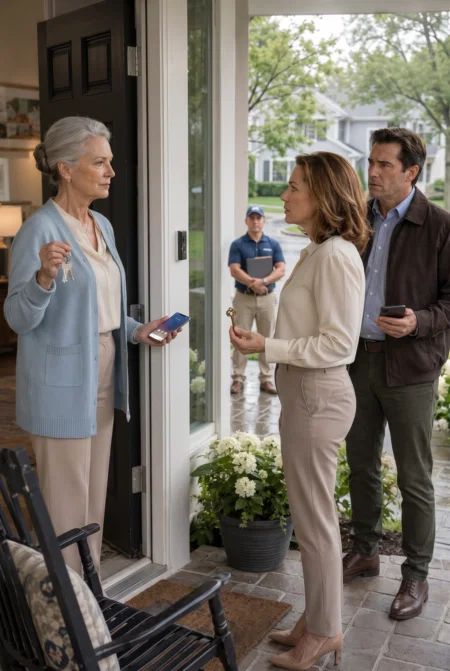
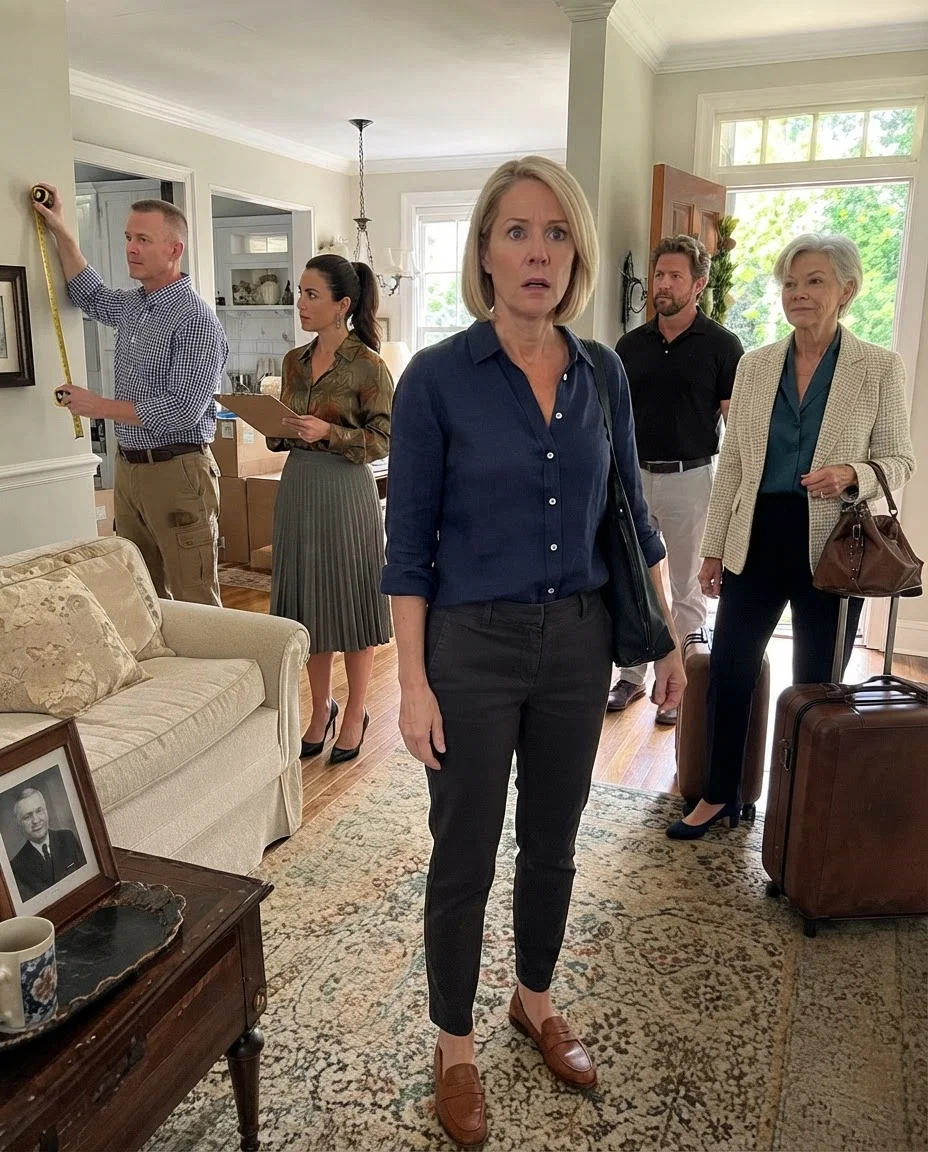
The day I came home to find my daughter-in-law on my front porch with a contractor and a tape measure, preparing to redesign my kitchen without a single word to me, I realized the spare key I had trusted her with was no longer a courtesy—it had become permission she had granted herself.
I had just finished tending the small garden behind my house and was walking back with muddy gloves and a basket of fresh basil when I spotted Clara on the porch. Her white SUV was parked in the driveway, engine silent. Beside her stood a man in a work shirt carrying a clipboard, a tape measure hanging from his belt, wearing the calm expression of someone who assumed this was an ordinary appointment.
Clara slipped a hand into her purse.
I knew exactly what she was reaching for before the old brass key appeared in her fingers.
For a moment I stayed where I was, partly hidden behind the hydrangeas lining the walkway. The late-morning sunshine warmed the brick path. A robin hopped across the lawn. Somewhere farther down the street, a garage door hummed open. It was an entirely ordinary Thursday in Alder Creek Villas, the quiet community outside Columbus where I had lived for almost twelve years.
And my daughter-in-law was about to unlock my front door for a stranger.
Not because I had asked her to.
Not because I needed assistance.
Because at some point, Clara had decided that family no longer needed to knock.
“Clara,” I called.
She stopped with the key halfway to the lock.
The contractor looked around first. Clara turned more slowly, as though she hoped she had imagined my voice.
“Oh,” she said, forcing a brighter smile. “Mom. You’re home.”
I had never cared for the way she called me Mom. It wasn’t that I disliked closeness. I had wanted that. For years after she married David, I tried to nurture it carefully. Birthday cards with handwritten messages. Homemade chicken soup after the twins arrived. Babysitting whenever they asked. Quiet support without expectations. But whenever Clara said Mom, it never sounded loving. It sounded like she believed the title gave her authority.
“I live here,” I replied.
The contractor adjusted his clipboard from one hand to the other.
Clara’s smile faltered before settling back into place. She was thirty-eight, slim, polished, with honey-brown hair cut just above her shoulders and the sort of wardrobe that made grocery shopping look coordinated. That morning she wore cream slacks, a pale blue blouse, and sunglasses resting on top of her head like someone arriving to oversee renovations.
“I thought you were with your walking group,” she said. “This was supposed to be a surprise.”
“I noticed.”
The contractor cleared his throat. “Ma’am, I’m with Nolan Home Design. I was told we’d be taking measurements for kitchen cabinets today.”
“You were told incorrectly,” I answered.
Clara let out a light laugh, the kind meant to make everyone else believe another person was making a fuss. “It’s only a consultation. We’re not doing any work today.”
I climbed the porch steps and quietly positioned myself between them and my front door. I didn’t hurry. I didn’t raise my voice. I didn’t reach for the key. I simply stood where permission should have existed.
“My kitchen is not open for consultation.”
Clara’s smile tightened. “We already discussed this, remember? You said the cabinet doors were sticking.”
“I said one drawer needed oil.”
“And I told you the whole kitchen could be brighter and safer. David agrees.”
“My son does not own this house.”
The contractor lowered his eyes to the clipboard.
A flush crept into Clara’s cheeks. “That’s not what I meant.”
“It is exactly what you planned.”
Silence settled over the porch. The light beside my front door still glowed because I liked leaving it on, even during the day. My late husband, Robert, had installed it himself after I slipped on the icy step one February evening. I could still picture him in his old Cleveland Browns sweatshirt, screwdriver clenched between his teeth, insisting no wife of his was going to break an ankle because a builder had saved money on lighting.
Robert had been gone for three years.
But the house still carried him.
It remembered the oak table he restored in the sunroom. It remembered the dent in the hallway from the day he insisted on carrying a heavy bookcase alone. It remembered the scent of his aftershave that somehow lingered in the linen closet long after he was gone. Every drawer, every lamp, every chipped blue mug sat exactly where I had chosen to place it.
Clara saw a renovation.
I saw my life.
“I’m trying to help you,” she said, her voice tightening.
“I never asked for this help.”
“You never ask for anything.”
“That doesn’t give you the right to decide for me.”
The contractor quietly stepped backward. “Maybe we should come back another day.”
“There won’t be another appointment,” I said, turning toward him. “I’m sorry you were brought here under false assumptions.”
His expression softened. “No problem, ma’am.”
Clara looked at him with obvious irritation. “Just give us one minute.”
“No,” I said. “He may leave now. So may you.”
Her eyes locked onto mine.
Something shifted in that moment. I had seen Clara irritated, impatient, even theatrically sympathetic before. This was different. For the first time, she realized I wasn’t politely objecting.
I was saying no.
“David is going to be very upset,” she warned.
“Then David can call me.”
She stared at me, the spare key still resting in her hand.
“Please give that back.”
“What?”
“The spare key.”
Her fingers tightened around it. “It’s for emergencies.”
“Exactly.”
“It’s safer if we keep it.”
“It’s safer when I know exactly who can enter my home.”
She opened her mouth, then thought better of it. Instead of returning the key, she slipped it back into her purse and turned toward the driveway.
“Come on,” she called to the contractor, although he was already halfway down the walk.
I watched them leave without another word.
As her SUV backed out, Clara never looked in my direction. The contractor lifted one apologetic hand from his truck before driving away. Soon the neighborhood was quiet again. The hydrangeas swayed gently. A sprinkler clicked to life two houses away. My basil remained in its basket, its leaves beginning to droop beneath the sun.
I unlocked my own front door and walked inside.
The house smelled of lemon polish, old books, and the tea I had left cooling on the kitchen counter. Everything remained exactly where I had left it that morning. Yet for the first time in my adult life, I stood in my own entryway feeling like a visitor who had arrived moments before someone else intended to rearrange the furniture.
My name is Ardis Whitaker. I am sixty-five years old, a widow, retired after thirty-seven years as a school librarian, and fully capable of deciding whether my kitchen cabinets need replacing.
That should never have been a controversial statement.
But after Robert died, people slowly began speaking to me differently. Not everyone. My neighbors still called me Ardis. My friends from book club still wanted my thoughts on novels, recipes, and local ballot measures. Mr. Henderson, the property manager at Alder Creek Villas, still treated me like a resident with her own judgment, signature, and decisions.
David, however, changed.
Not overnight. He was my only child, and I loved him with the complicated devotion mothers often carry even when their grown children disappoint them. He had always been gentle, but he had never handled conflict well. As a boy, he sided with whichever playground friend spoke last. As a teenager, he escaped difficult conversations by staying late at basketball practice. As a husband, he seemed convinced that keeping peace meant letting Clara define every problem while expecting everyone else to accept her solution.
Clara didn’t become different after Robert died.
She simply grew bolder.
At first, it looked like kindness. She brought casseroles in disposable dishes. She emailed links to grief support groups. She volunteered to help write thank-you notes after the memorial service and stayed for three hours, though somehow my dining-room drawers were reorganized while I stepped away to the bathroom. When she and David asked for a spare key “just in case,” I handed it over.
At the time, just in case meant a fall, an illness, a storm, a genuine emergency.
It did not mean coming home to find my mail moved from the kitchen counter to the sideboard because Clara believed paper stacks caused “visual stress.”
It did not mean returning from Kroger to discover my thermostat set to seventy-two when Robert and I had agreed years earlier that sixty-eight was perfect sweater weather.
It did not mean finding the slippers I always kept beneath my bed neatly placed in the hallway because Clara believed “older people need fewer trip hazards,” a sentence she delivered with the confident certainty of someone who had read one article and turned it into an identity.
The first several times, I blamed myself.
That was the hardest part.
I stood in my own kitchen holding the mail, wondering if I had absentmindedly moved it. I looked at the thermostat and assumed I must have bumped it. I found my slippers in the hallway and felt an uneasy chill, then convinced myself I was imagining things because the alternative seemed too unsettling.
Who wants to believe the people who insist they love you are quietly erasing the boundaries of your own home?
The answer came from the porch camera.
My neighbor, Bev Lawson, had persuaded me to install the camera after several packages were delivered to the wrong homes around the community. Bev was seventy-two, sharp as wintergreen, and held strong opinions about everything from the proper shade of mulch to the moral collapse caused by self-checkout machines. Her nephew mounted the small device above my porch light, and for months I used it only to check when Amazon delivered my vitamins or when the twins raced up the steps on Sunday afternoons.
Then one evening, after discovering that someone had alphabetized my spice rack despite clearly not knowing cumin from coriander, I opened the camera app.
There she was.
Not David.
Clara.
Clara arriving Tuesday at 2:14 p.m., unlocking my door with the spare key while carrying a tote bag. Clara returning Thursday at 10:07 a.m., leaving with an armful of folded towels she had apparently decided should be washed at her house. Clara entering again the following Monday for six minutes and walking out with a stack of my unopened mail, no doubt intending to “sort” it.
The recordings were not dramatic.
That made them more disturbing.
She moved with the relaxed certainty of someone entering a house that had become part of her own routine. She never hesitated, never glanced toward the camera, never appeared guilty.
I sat in my favorite armchair with the phone in my hand, replaying the short clips as the late-afternoon sunlight stretched across the living-room carpet. Robert’s photograph rested on the mantel. He stood beside Lake Erie in a windbreaker, smiling as though the wind had whispered something funny.
“What would you do?” I asked the photograph.
I already knew the answer.
Robert had been gentle, but never unclear. He would have brewed coffee, seated David at the kitchen table, and said, “Son, you do not enter another adult’s home without permission. Not even mine. Especially not mine.”
I wished I could borrow his voice for five minutes.
Instead, I found my own.
The following morning, I returned from my walk and discovered the front door unlocked.
Fear was not my first reaction. It was irritation, so cold and precise that it almost calmed me.
I pushed the door open without making a sound.
Clara was standing in my kitchen, placing groceries inside my pantry.
She had brought canvas bags from an organic market twenty minutes away, the kind of store where carrots still wore dirt and cost enough to make me wonder whether they had been raised to classical music. She hummed while unpacking almond flour, expensive crackers, herbal tea, and three jars labeled adaptogenic broth.
She did not hear me enter.
“Clara,” I said.
She turned with the polished smile of someone who had expected gratitude to arrive before I did.
“Oh, hi, Mom. I was just dropping off a few things. You looked tired last Sunday, and I know shopping can be a lot.”
I remained in the doorway, still wearing my walking shoes. “I shop for exactly what I need.”
“I know, but you always buy the same things.”
“Because I like them.”
She gave a small laugh. “You are so set in your ways.”
There it was again. A statement disguised as affection but meaning difficult.
I approached the pantry and examined what she had already rearranged. My canned tomatoes had been moved to a higher shelf. My oatmeal was hidden behind quinoa puffs. The peanut butter Robert had loved, which I continued buying because some habits become memorials, had been placed on the counter as though marked for removal.
“I don’t need my pantry reorganized.”
“I’m just trying to make it healthier for you.”
“Please take these groceries with you when you leave.”
Clara blinked.
For a moment, the smile vanished entirely. What appeared beneath it was not pain.
It was offense.
“That’s a little rude,” she said.
“It is direct.”
“I drove all the way here.”
“You live ten minutes away.”
She set a jar on the counter with more force than necessary, then quickly regained control. “David and I were talking. We think this house is becoming too much for you. There are lovely smaller units closer to us. One-level, updated, no yard work.”
“This house is one level,” I said. “And the yard work is handled by the community.”
“You know what I mean.”
“Yes,” I said. “I do.”
She was the first to look away, which told me she understood exactly what she was suggesting.
The house was not too much for me.
My independence was too much for her.
I removed every grocery item she had placed in the pantry and returned it to the canvas bags. I took my time. Crackers. Tea. Broth. Flour. Each item landed with a soft thump, like another piece of a boundary being assembled.
“Please take these with you.”
Clara stared at the bags as if they had personally offended her. “You’re making this very uncomfortable.”
“I am correcting an uncomfortable situation.”
Her phone vibrated on the counter. She glanced at it, then picked up the bags.
“Fine,” she said. “I’ll go.”
I accompanied her to the front door.
I did not offer her tea. I did not remind her to drive safely. I did not dilute the moment with nervous conversation, as I would have done the year before. I simply opened the door and waited.
When she stepped outside, she turned back toward me.
“David is worried about you.”
“David can call me.”
I closed the door between us.
David came over that evening.
Before I even saw his expression, I knew Clara had sent him. He stood on the porch in his work shirt and navy jacket, shoulders slightly hunched, hands buried in his pockets. My son had inherited Robert’s dark eyes, but not his steadiness. Robert could remain inside discomfort like a man standing beneath an umbrella in the rain. David circled it until he found someone else willing to carry it for him.
I allowed him inside because he had rung the bell.
That mattered.
He took a seat at the kitchen table while I prepared tea. His gaze traveled around the room, quietly inspecting the pantry, thermostat, mail basket, and everything Clara had failed to change.
“Mom,” he began, “Clara was just trying to help.”
“I understand that is how she describes it.”
He frowned. “That is how it is.”
“No, David. Checking on me is a phone call. Entering my home without invitation is not checking on me.”
He shifted in his seat. “We have a key.”
“For emergencies.”
“What if you fell?”
“Then I would use the phone I keep in my pocket on walks and the one beside my bed at night.”
“What if you didn’t have your phone?”
“Then the emergency plan posted inside the pantry door gives the community office, Bev, and you instructions. You know this because I gave you a copy.”
He rubbed his forehead.
I studied him, and for a second I saw the seven-year-old boy who had sat at this same table with a scraped knee, claiming he did not need a bandage while crying over his peanut butter sandwich. Motherhood is cruel in that way. It preserves every version of your child inside you, even as the adult version disappoints you in the present.
“Mom, Clara feels unappreciated.”
“I feel intruded upon.”
“She’s busy. She has the kids, the house, work, and she still tries to make time for you.”
“I did not ask her to make time inside my house while I am not here.”
He turned his eyes toward the window.
I allowed the silence to remain.
That was something I had learned later in life. Silence is not an empty space that must be filled for another person’s comfort. Sometimes it is the only seat available for honesty.
Eventually, David said, “She thinks you’re shutting us out.”
“I am shutting out uninvited access.”
“You make it sound so formal.”
“It is formal,” I replied. “The front door is a formal line.”
He released a weary laugh. “It’s just a house.”
The sentence fell between us with heavy finality.
I lowered my teacup.
“No,” I said quietly. “It is not just a house.”
David looked at me, and perhaps he remembered that this was where his father built shelves in the garage, carved pumpkins with his grandchildren, shouted too loudly during Ohio State games, and died one rainy morning in our bedroom while I held his hand and listened to the approaching ambulance siren.
Perhaps he remembered.
Perhaps he did not.
“This is my home,” I said. “Your father’s last home. My private space. My routines. My memories. My decisions. You do not have to understand every feeling I attach to it, but you do have to respect that it is mine.”
He swallowed.
For one brief, gentle moment, I believed we might finally understand each other.
Then he said, “Clara is going to be upset.”
There it was.
The quiet tragedy of my son’s marriage: Clara’s displeasure was treated like dangerous weather everyone needed to prepare for, while mine was handled like clutter that ought to be moved out of sight.
I stood from the table.
“Then Clara can manage her feelings in her own home.”
David left twenty minutes later, courteous but unhappy. At the door, he turned toward me and said, “I wish you’d try to be easier about this.”
I nearly replied.
Instead, I gave him a look Robert would have appreciated.
“Good night, David.”
Once his car disappeared, I returned to the kitchen table and brought out my bills.
For several months, Clara and David had covered two minor household expenses: the water bill and a portion of the electric bill. The arrangement had begun after Robert’s death. David insisted that paying them made him feel useful. I had accepted because grief had exhausted me, and refusing help felt cruel while people were delivering casseroles and speaking in careful voices.
But assistance tied to conditions is not assistance.
It is leverage.
I logged into the utility accounts on my laptop. My reading glasses slid down my nose while the clock ticked above the sink. I removed David and Clara’s connected bank account from the water payment, changed the electric account, and arranged automatic payments from my own checking account. Then I downloaded the confirmations and placed them in a folder titled Household — Paid by Ardis.
I had more than enough money. Robert and I had prepared well. My pension was reliable. The house had no mortgage. My savings were organized, my insurance policies current, and my taxes completed every February because I preferred finishing unpleasant work before the robins returned.
I did not require their money.
I had only forgotten that for a while.
Clara called the following day.
I allowed the phone to ring twice before answering.
“Ardis,” she said.
Not Mom.
That was interesting.
“Clara.”
“Did you change the utility accounts?”
“Yes.”
“Why would you do that?”
“Because I prefer to handle my own bills.”
“We were helping you.”
“I know. I am declining that help now.”
Silence followed before her tone hardened. “You are being very difficult.”
“I am being clear.”
“David and I were trying to save you money. You’re retired. You should be careful.”
“I am careful.”
“You’re acting like we’re trying to control you.”
I glanced at the confirmation email still displayed on my laptop.
“Aren’t you?”
She drew in a sharp breath.
“I will not argue about this,” I said. “The bills are in my name, paid from my account. The matter is closed.”
“You can’t just—”
“I can. Goodbye, Clara.”
I disconnected the call.
Then I remained there, staring at the phone and expecting guilt to overwhelm me.
It appeared, but only faintly. Familiar guilt. Conditioned guilt. The sort that arrives because it has always been invited, not because it belongs.
I brewed tea and waited until it left.
During the following week, the house felt changed. Not entirely peaceful, because the conflict had not vanished. Clara was too invested in being correct, and David remained too afraid of disappointing her. Still, the rooms felt less occupied. My mail remained where I placed it. The temperature stayed at sixty-eight. My slippers rested beneath the bed like respectable slippers should.
I worked in the garden. I read. On Wednesday, I hosted book club, and Bev brought lemon bars that were far too tart, although no one mentioned it because Bev accepted criticism poorly when she was the recipient. We discussed a mystery novel and said almost nothing about my family, which was its own form of kindness.
Then came the morning with the contractor.
After Clara drove away, I understood that hoping she had learned anything was not a strategy.
Hope was suitable for stained-glass windows and spring flowers.
It was worthless as a lock.
The next morning, I contacted a locksmith.
His name was Theo. He arrived in a red van with a dented bumper and a small radio playing old Motown at a considerate volume. He was in his thirties, with kind eyes, a wedding ring, and a pencil tucked behind one ear. He replaced the deadbolt on the front entrance, changed the back-door lock, and reset the keypad code for the garage.
The drill vibrated through the silent house.
I stood in the hallway holding Robert’s old mug with both hands. I was not drinking from it. I only needed to hold it. The noise should have unsettled me, yet every rotation of the drill felt like another breath entering my chest.
When Theo completed the work, he handed me two fresh keys attached to a small silver ring.
“Only these two?” he asked.
“Yes.”
“Want extras made?”
“Not today.”
He nodded as if he understood everything I had not explained. “Good hardware. You’ll feel the difference.”
I did.
The new key entered the lock with a solid, crisp click. It was an ordinary sound, yet powerful enough to sting my eyes.
For three years after Robert’s death, I had carried the constant awareness that someone could open my door at any moment. I had never named the feeling, because naming it would have forced me to acknowledge how much it disturbed me. Standing in the foyer with the new keys resting in my palm, I finally understood that privacy was not a rejection of love.
It was the framework preventing love from turning into ownership.
Clara learned about the locks less than an hour later.
My phone rang while I dusted the hallway table.
It was David.
“Mom,” he said when I answered, tense and breathless. “What happened to the locks?”
“I changed them.”
“Clara said her key doesn’t work.”
“That is correct.”
“Why would you do that?”
I stared toward the front door.
“Because Clara tried to bring a contractor into my kitchen without permission after repeatedly entering my home without invitation.”
“She was trying to do something nice.”
“If it was nice, she would have asked whether I wanted it.”
“She’s humiliated.”
“That is unfortunate.”
“Mom.”
“David.”
He exhaled heavily. “You don’t lock family out.”
“I lock my door. Family may knock.”
Silence followed.
Then he said, “You’re making this sound like we’re strangers.”
“No. I am reminding you that you are guests when you enter a home you do not own.”
He started arguing again. Emergencies. Concern. Age. Safety. The usual list, polished by Clara and repeated by my son. I listened for thirty seconds because he was still my child, and I wanted to know whether an independent thought might finally appear.
It did not.
At last, I said, “If there is a real emergency, call me. If I invite you over, come. Otherwise, do not show up expecting access. I will not discuss this further today.”
I ended the conversation before he could transform my decision into another negotiation.
The silence that followed felt enormous.
There were no calls for two days. No text messages linking helpful articles. No emails about smaller homes. No pictures from Clara showing cabinet samples with notes like “just dreaming!” The quiet I had wanted arrived so completely that, for a moment, it resembled abandonment.
That is another truth people rarely mention about boundaries. Even necessary ones can leave a cold space where harmful company once stood.
I filled the emptiness with intention.
I called Miriam and met her for lunch at a diner where the waitress still addressed everyone as sweetheart. I followed the long walking trail around the retention pond. I sorted my sewing basket, not because Clara would approve, but because I wanted the green thread somewhere visible. I purchased a brushed stainless-steel kettle and did not consult anyone about whether it cost too much.
On Sunday, the twins called using David’s phone.
“Grandma, did you change your door?” Lily asked. She was eight, endlessly curious, and missing one front tooth.
“I changed the locks, yes.”
“Mom said because you want privacy.”
“That is true.”
Ben leaned into the screen beside her. “Can we still come over for pancakes?”
I smiled. “When you are invited, absolutely.”
Lily considered this carefully. “That’s how school works too. You can’t just go into the principal’s office.”
“Exactly.”
Somewhere beyond the screen, David coughed.
I did not weaken the lesson.
Children usually understand boundaries better than adults who profit from crossing them.
By the next week, I knew Clara expected me to call and apologize. I also understood that she would attempt something again. Perhaps not because she wished to visit, but because people who use access as a form of power seldom release it willingly.
So I quietly prepared.
I arranged a meeting with Mr. Henderson at the community office.
His office was located beside the clubhouse, a tidy brick building with seasonal wreaths hanging on the door and a bulletin board advertising water aerobics, bridge night, and a missing gray cat who was probably not missing at all, merely visiting homes with better food. Mr. Henderson was a calm man in his late fifties, with a neatly trimmed beard, wire-framed glasses, and the posture of someone who had mediated disputes involving parking places, decorative mailboxes, patio fencing, and pickleball noise.
He listened without interruption while I explained everything.
The spare key. The unauthorized entries. The relocated mail. The utility payments. The contractor. The replacement locks.
“I am not looking to create drama,” I told him. “I simply want to make sure the office, maintenance staff, and community patrol know that no one is to be given access to my home without my direct permission.”
Mr. Henderson nodded and opened my resident record on the computer.
“That is completely reasonable.”
“I don’t want anyone embarrassed.”
“Mrs. Whitaker,” he said gently, “people who respect your home will not be embarrassed by being asked to wait outside.”
His words settled around me like a warm quilt.
He added a note to the file stating that no relatives or visitors were to receive entry assistance without my personal authorization. He also gave me the afternoon patrol number and explained that someone could include my street in routine rounds if I expected trouble.
“I hope that won’t be necessary,” I said.
“I hope so too,” he answered. “But it is better to have a plan and not need it.”
Robert used to say the same thing about tire pressure and flashlights.
I left his office feeling lighter.
Not because the situation had disappeared, but because someone outside my family had treated my privacy as entirely reasonable. There is a special relief in hearing a stranger affirm what loved ones have repeatedly encouraged you to question.
The final confrontation happened on a Thursday.
The sky had cleared after morning rain, leaving the streets of Alder Creek clean and reflective. I had just carried a small parcel inside when someone knocked.
Three sharp taps.
It was not David’s knock or the twins’ impatient pounding.
It was Clara’s.
Controlled, clipped, and already irritated.
I glanced at the porch-camera screen.
Clara stood outside wearing a camel-colored coat, arms crossed and lips compressed. David was beside her, appearing tired and uneasy. He held the old brass key in one hand.
I did not hurry toward the entrance.
When I finally opened the main door, I left the storm door locked between us.
Clara immediately focused on the latch.
“Really?” she said.
“Good afternoon.”
“We need to talk.”
“You may call and set a time.”
David leaned toward the door. “Mom, please. Can we come in?”
“Not today.”
Clara reached for the storm-door handle as though my refusal had merely been noise instead of language. The door remained closed. She turned toward David.
“Use your key.”
He raised it helplessly. “It doesn’t work, Clara.”
“I know it doesn’t work. Try it anyway.”
I watched my son.
He did not move toward the lock.
That became the afternoon’s first small victory.
Clara faced me again, heat rising across her cheeks. “This is ridiculous. We are your family.”
“Yes.”
“Then stop treating us like strangers.”
“I am treating you like adults responsible for your choices.”
Her voice grew louder. “We are trying to check on you. Do you know how strange this looks? A woman your age suddenly changing locks, cutting off help, refusing family?”
The familiar phrase stung.
A woman your age.
Not shouted, but deliberately placed. Another expression disguised as concern while planting doubt underneath.
Before I answered, Mr. Henderson’s golf cart stopped beside the curb.
He climbed out wearing khaki trousers and a navy jacket embroidered with the Alder Creek emblem. A clipboard rested in one hand, although I suspected it served mostly to lend the moment additional authority.
“Good afternoon,” he said. “Is there a problem here?”
Clara turned in surprise.
Then her expression transformed almost instantly.
It was extraordinary to witness.
Her anger dissolved into worry. Her shoulders softened. Her voice developed the slight tremor she used with teachers, doctors, and anyone whose support she wanted to capture.
“We’re just trying to check on my husband’s mother,” she explained. “She’s been acting very unlike herself. We’re worried she may be confused.”
The sentence drifted through the air like smoke.
David’s face lost its color.
He stared first at Clara, then at me.
For the first time, I watched him truly understand how far she was prepared to go to keep the situation shaped in her favor.
I unlocked the storm door.
I did not open it fully. Only far enough to step onto the porch.
“I am not confused,” I said.
My voice remained calm, steady, and unmistakable. I did not speak loudly enough for the neighborhood to hear, but everyone standing there understood that gentleness was no longer being offered.
“I am the owner and resident of this home. I have told David and Clara they are not invited inside today. I have changed my locks because they repeatedly entered without permission. I have already informed the community office that no one is authorized to access my home on my behalf.”
Mr. Henderson turned toward Clara.
“The resident’s instructions are clear,” he said. “You will need to leave the property now and arrange any future visits directly with her.”
Clara’s expression shifted.
There was no dramatic gasp or public outburst worthy of neighborhood gossip. Only the sudden loss of certainty. Her gaze moved from Mr. Henderson to David and then back to me as she realized the audience now included a witness who was not obligated to accept her version of events.
“You set this up,” she accused.
“I set boundaries.”
“This is humiliating.”
“No,” I said. “This is public because you came to my porch after being told not to.”
David stared down at the old key in his palm.
It appeared smaller now. A useless piece of brass carrying far more entitlement than metal.
“Mom,” he said quietly.
I met his eyes.
There was regret in his expression, though he had not yet found enough words. That was acceptable. The words might arrive later.
Or they might not.
My door no longer depended on them.
“David,” I said, “you may call me when you are ready to speak to me as your mother, not as a problem to manage.”
His eyes glistened, though he quickly blinked the emotion away.
Clara stepped backward. “Come on,” she said, but the command had left her voice.
They walked toward their car. David stopped once and glanced over his shoulder.
Clara never did.
Mr. Henderson remained until their vehicle disappeared down the street.
Then he turned toward me. “Are you all right, Mrs. Whitaker?”
I looked at my front entrance, the porch chair, the pot of geraniums Bev had brought me, and the brass house numbers Robert used to polish every spring whether they needed attention or not.
“Yes,” I said. “I am.”
And it was true.
A full week passed before David called.
By then, the house had returned to its own rhythm. I had cooked soup, completed a novel, planted parsley, and slept more soundly than I had in months. The new lock had already become familiar beneath my hand. That was the best part. Once repeated often enough, a boundary stops feeling like combat and begins to feel like part of the structure.
When David’s name appeared on my screen, I let the phone ring twice. Not to punish him, but because I no longer rushed toward every opportunity to repair things for other people.
“Hello, David.”
“Hi, Mom.”
His voice was subdued. There was no performance in it, no speech he had rehearsed beforehand.
“Clara’s upset,” he said.
“I imagine she is.”
“She says she was embarrassed.”
“That is hers to work through.”
He paused.
“I should have stopped her from saying you were confused.”
“Yes,” I said. “You should have.”
He drew in a breath. “I’m sorry.”
The apology was not dramatic. It did not erase everything that had happened. But it was honest, and honesty was enough to begin with.
“I miss coming over,” he said.
“I miss my son.”
The words remained between us.
After a moment, he asked, “Can we talk about how to fix this?”
“We can talk about how to move forward,” I said. “Fixing makes it sound like we are returning to the old arrangement. We are not.”
“What are the terms?”
The question was so formal that I nearly smiled. For half a second, he sounded like Robert at the kitchen table, trying to handle something seriously.
“You visit when invited. You call before coming over. You do not bring Clara unless I invite her. You do not discuss downsizing, remodeling, bills, safety plans, or my abilities unless I raise the topic. You do not use concern as a way to take control.”
He stayed silent long enough that I wondered whether the call had disconnected.
Then he said, “I can do that.”
“I hope so.”
“I want the kids to see you.”
“I want to see them.”
“Maybe Sunday? Pancakes?”
I glanced toward the kitchen, where my good griddle remained in the lower cabinet exactly where I wanted it.
“Sunday is fine,” I said. “Eleven o’clock. You ring the bell.”
A small laugh came through the phone, weary and sad, but genuine.
“We’ll ring the bell.”
Sunday arrived bright and sunny.
David pulled into the driveway at 10:58 with Lily and Ben. Each child carried a grocery-store bouquet wrapped in crackling plastic. Clara was not with them. I confirmed that through the porch camera before opening the door, and I felt no shame over the relief that followed.
The twins pressed the doorbell three times.
When I opened the door, Lily wrapped both arms around my waist.
“Grandma, Dad said we have to ask before coming in.”
I held her tightly. “That is very polite.”
Ben lifted the flowers toward me. “These are for your table because Dad said we should bring something when we’re guests.”
David stood behind them looking uncertain.
I met his gaze over the children’s heads.
“Come in,” I said.
The morning was not perfect. Perfection would have seemed suspicious. David apologized once more while the twins debated how many chocolate chips belonged in each pancake. He admitted that he had allowed Clara’s anxiety to become the rule everyone else followed because challenging her felt harder. I told him that easy decisions often become costly when someone else is forced to pay for them. He nodded without defending himself.
That was new.
When the pancakes were finished, we gathered around the kitchen table. Lily wanted to know why I kept the thermostat so cold. Ben asked whether Grandpa had truly built the shelves in the garage. David studied the kitchen cabinets Clara had planned to replace and eventually said, “Dad loved this room.”
“He did.”
“I forgot it wasn’t just old to you.”
I lowered my fork.
“It is not wrong to update things,” I said. “It is wrong to decide someone else’s memories are clutter.”
David nodded.
I knew more conversations would follow. Clara would not change instantly. My son would still need to choose, repeatedly, whether honesty was worth the discomfort it caused. I would need to resist the familiar urge to smooth everything over simply to make holidays easier.
But the house no longer felt vulnerable to intrusion.
It was open only when I chose.
Over the following months, Clara remained distant. At first, I assumed pride was keeping her away. Perhaps it was. Then, early in the spring, an envelope arrived in the mail. It had not been delivered by hand or pushed through my door. It came properly stamped, with my full name written neatly across the front.
Inside was a brief note in Clara’s handwriting.
Ardis,
I have been telling myself I was helping when I was really taking over. I am sorry for entering your home without asking and for speaking about you in a way that was unfair. I understand if you need time.
Clara
I read the note twice while standing at the kitchen counter.
Then I placed it inside the drawer where I stored important documents. Not because the apology repaired everything, but because it represented another kind of evidence. It was not a utility statement, property record, or legal paper. It was proof that someone had examined her own behavior long enough to put the truth into writing.
I did not invite Clara over right away.
Time can also be a boundary.
When I eventually did, it was for coffee on the porch in May. The geraniums had opened into bright red blooms. Bev waved from across the street with all the subtlety of someone observing history through binoculars she claimed not to possess. Clara arrived carrying no shopping bags, articles, cabinet samples, or plans. She brought only a box of bakery cookies and a visibly nervous expression.
She rang the doorbell.
I opened the door.
“Come in, Clara.”
Her gaze met mine, carrying both gratitude and shame.
“Thank you,” she said.
We stayed on the porch because I preferred neutral territory and because the weather was far too pleasant to waste indoors. For some time, we talked about the twins, their schoolwork, a neighbor’s new puppy, and David’s failed attempt to repair a dripping faucet that required three separate visits to Home Depot. It was ordinary conversation, and ordinary conversation can sometimes form the safest bridge back from something painful.
Eventually, Clara lowered her eyes to her coffee.
“I was scared,” she said.
I waited for her to continue.
“When Robert died, I saw how alone you were. Or how alone I thought you were. I started imagining all the things that could go wrong. Then I turned that fear into plans and called it help.”
“That may explain it,” I said gently. “It does not excuse it.”
“I know.”
The Clara I had known before would have rushed to defend herself.
This time, she did not.
“I also liked feeling needed,” she admitted. “David worries quietly. I organize. It made me feel useful. Then I forgot to ask whether useful was wanted.”
I looked toward the street, where sunlight flashed across the metal mailboxes.
“Being needed is not the same as being trusted,” I said.
She nodded with care.
“No,” she said. “It isn’t.”
That was the first real conversation we had ever shared as two adult women rather than one woman attempting to manage the other.
The key to my front door remained mine.
That never changed.
I did establish a new emergency arrangement. Clara did not receive another spare key. Instead, the community office kept a sealed lockbox code that could be used only if I called for assistance or failed to respond during a confirmed emergency. David understood the policy. Clara understood it. Mr. Henderson understood it. Every person involved knew precisely where authorization started and where it ended.
That clarity calmed the entire family.
The result surprised me, though perhaps it should not have. Uncertainty had allowed everyone’s worst habits to thrive. Once the rules were unmistakable, there was less space for manipulation or performance.
Summer came green and warm. The twins visited for pancakes twice each month. Clara sometimes joined them, but only after being asked and always after ringing the bell. She never touched my mail again. One Saturday, David repaired the kitchen drawer that had been sticking. Clara had not arranged it. I had asked him to bring his toolbox whenever he had time. He added oil to the track while Ben aimed the flashlight and Lily read the instructions upside down.
For the first time in years, the drawer opened without resistance.
“There,” David said with a grin. “No full renovation required.”
I laughed.
Robert would have enjoyed that.
After they went home, I stood by myself in the kitchen and opened the drawer three times simply to feel how smoothly it moved. The house was silent, but no longer with the tense quiet I had known when I feared hearing an unexpected key turn in the lock. This silence was deliberate. Earned. Complete.
I brewed tea and carried the cup into the living room.
Sunlight poured through the front window and touched the armchair where I had first watched those porch-camera recordings and understood how far the intrusion had gone. Robert’s picture remained on the mantel. The room appeared almost exactly as it had before everything began. The same carpet. The same lamp. The same bookshelves. The same clock ticking softly near the hallway.
But I had changed.
For years, I believed that keeping family near required making myself easy to enter. Easy to advise. Easy to rearrange. Easy to worry over, speak for, and supervise. Widowhood intensified that belief because people often assume an empty chair means the entire house is waiting for someone else to take charge.
It was not.
My life continued to belong to me.
My home continued to belong to me.
My front door was never a measure of love. It was a boundary. A simple, beautiful boundary with a new brass lock and a bell available to anyone who respected me enough to use it.
People often imagine that standing firm requires shouting.
It does not.
I never screamed at anyone on the porch. I never delivered a dramatic plea asking my son to choose me. I did not humiliate Clara before the neighbors or attempt to turn relatives against her. I paid my own expenses. I replaced the locks. I spoke with the property manager. When the truth required support, I allowed a witness to stand beside it.
That was sufficient.
One September evening, I sat on the porch as the sun disappeared behind the rooftops. Bev passed with her small terrier and paused beside the edge of my lawn.
“Quiet night,” she said.
“Yes.”
“Good quiet?”
I looked toward the front door, the pots of geraniums, and the porch chair Robert had painted blue because he believed every home needed one cheerful object facing the street.
“Very good quiet.”
Bev smiled. “Took you long enough.”
I laughed without restraint because she was correct.
After she continued down the sidewalk, I remained outside until the porch light switched on automatically. Its glow spread gently across the steps. The new key rested in my cardigan pocket, warmed by my hand.
Family can knock.
Love can visit.
Help can be offered.
But permission is not a formality, and a spare key is not ownership.
At sixty-five, after loss, pressure, and the discovery of how easily concern can turn into control, I finally understood something I wished I had learned much sooner.
A locked door does not make a home lonely.
Sometimes it is exactly what allows peace to enter and remain.
On our tenth anniversary, I asked my partner one simple question I believed a decade together had earned me the right to ask. By the end of that night, I still had no idea the most humiliating part would not be his answer. It would be the story he had been telling everyone behind my back.
By the time David and I reached our tenth anniversary, nearly everyone already treated us like husband and wife.
We owned the house with blue shutters, shared a checking account, used the same streaming passwords, and had a dog who began as mine before gradually becoming ours. Friends introduced David as my husband. He never corrected them, and neither did I. After ten years together, it seemed easier to let people assume we had crossed a line he continued refusing to name.
I had mentioned marriage before, always carefully. Never as an ultimatum. Never with wedding brochures, lists of baby names, or speeches about forever. I raised it only in quiet moments over the years when the life we had built seemed settled enough to make the question reasonable.
David always managed to avoid answering. He joked about how expensive weddings were, said we were more committed than half the married couples we knew, or kissed my forehead and asked why labels mattered so much to me.
So when he reserved a table at a beautiful restaurant for our anniversary, I allowed myself to hope.
The restaurant was warm and softly lit. David seemed relaxed, which I took as a positive sign. He ordered a bottle of wine we normally would have considered too expensive, and when it arrived, he lifted his glass and said, “Ten years deserves something decent.”
I smiled. “That almost sounds romantic.”
“Don’t get used to it,” he said, grinning.
At first, dinner felt easy. He told me about a coworker whose fiancee wanted a destination wedding in Italy. I laughed. We shared dessert. At one point, he reached across the table and brushed his thumb over my wrist.
Everything felt normal and safe.
That was why I chose that moment.
I placed my fork down.
He looked up. “No?”
I shook my head. “I want something small. Just family. Maybe a backyard, maybe a courthouse. I don’t care. I just think after ten years, I’d like to make it official.”
His expression changed so quickly that it stunned me.
He lowered his fork, leaned back, and gave a short, cold laugh.
The room suddenly seemed sharper. Someone at a nearby table laughed too loudly. A server passed carrying a tray of drinks.
I said, “You don’t have to say it like that.”
He shrugged. “Better than dragging this out again.”
Again.
The word hit hard. As though I were exhausting. As though I had been nagging him instead of asking a fair question after ten years of building a shared life.
“So that’s it?” I asked.
“Marriage is a useless piece of paper,” he said. “It changes absolutely nothing. If you need a legal contract to feel secure, that’s your problem, not mine.”
The contempt in his tone wounded me more than the answer itself.
I thought I might cry. Instead, I looked at him—really looked—and finally made a decision.
I nodded.
“Okay.”
Dinner ended soon afterward. On the drive home, he talked about parking.
When we stepped inside, I removed my shoes beside the door. He loosened his tie and said, “Don’t spend all night working yourself up over this.”
I looked at him.
“I’m not.”
“Good,” he said, and walked straight to bed.
I remained standing in the dark for a moment.
Then I went into the kitchen, opened my laptop, and pulled up our joint accounts, mortgage records, utility bills, and everything else I would need if the relationship was truly ending. Somewhere between the savings account and the homeowners insurance documents, I remembered Christmas at his parents’ house.
Elaine had taken me aside while everyone else argued over a board game in the living room. She touched my arm gently and said, “I hope that when you’re ready, you’ll give David the chance to make things official. He loves you very much.”
At the time, I smiled and assumed she was being old-fashioned. Sitting alone at the kitchen table, I realized she had not been guessing.
She had been repeating something she had been told.
I called her.
She answered after four rings, her voice heavy with sleep.
“Sarah? Is everything okay?”
“I need to ask you something,” I said. “And I need you to answer honestly.”
Silence followed.
Then she said, “All right.”
I told her what David had said during dinner, repeating his exact words. When I finished, she remained silent for so long that I wondered whether the call had disconnected.
Then she spoke very quietly.
“He told us you were the one who didn’t want to get married.”
I shut my eyes.
“He said marriage made you anxious. He said he didn’t want to pressure you. He said he was waiting until you were ready.”
A memory returned instantly, sharp and humiliating. Two Thanksgivings earlier, David’s sister had squeezed my hand and said, “You’re lucky he’s so patient.” I had laughed because I had no idea what she meant.
My fingers tightened around the phone.
Elaine released a shaky breath.
“Oh, David.”
Then she revealed something worse.
Three years earlier, David had asked her for his grandmother’s ring. He claimed he intended to propose during our trip to Maine that autumn. Elaine had the ring cleaned and appraised before handing it to him. She still had the receipt and a photograph she had sent her sister because she had been so excited.
The proposal never happened.
Whenever Elaine asked why, David told her I had panicked and begged him to wait. He claimed he was honoring my wishes. He repeated that explanation until everyone accepted it as truth.
I pressed my free hand against the table to steady myself.
Elaine said, “I’m coming over.”
“I don’t care.”
She arrived before the sun came up.
“I want it back from him,” she said.
When David wandered into the kitchen wearing sweatpants and looking half asleep, he froze in the doorway.
Elaine looked up at him.
He stared first at her, then at me, and finally at the documents spread across the table.
“What is this?”
Elaine raised the receipt. “It’s proof that I gave you your grandmother’s ring.”
His expression hardened. “This is private.”
“No,” Elaine said. “It stopped being private when you used her as your excuse.”
He turned toward me. “You called my mother in the middle of the night?”
I asked, “Where is the ring, David?”
He gave a strained laugh. “This is ridiculous.”
“Bring it here,” Elaine said.
His jaw tightened as he looked at her. “I was going to give it back.”
Elaine did not blink. “You had three years.”
When he returned, the ring sat inside a cheap black jewelry box. It was not the velvet heirloom box Elaine remembered, only something plain and forgettable, as though he wanted the entire matter to become invisible.
Elaine opened it.
The ring was still there, untouched.
He had not misplaced it.
He had not sold it.
He had hidden it in a drawer and allowed me to carry the blame while he enjoyed praise for being patient.
That was when everything became perfectly clear.
Around our friends, David acted as if we were practically married already and too sophisticated to care about legal documents.
Around his family, he portrayed himself as a devoted man waiting for a nervous woman to become ready.
In both stories, he looked admirable.
In both stories, he got exactly what he wanted.
In neither story did I know the truth.
David watched me carefully, finally realizing the entire room had turned against him.
“Sarah, come on.”
I stood, and the dog rose with me.
“I’m staying with my sister for now,” I said.
His expression changed immediately. “You’re leaving?”
“Over this?”
Elaine closed the ring box. “She is leaving because you lied for years.”
I bent down and attached the dog’s leash.
David stared at me. “You’re taking him too?”
“He was mine before we moved in together,” I said. “You know that.”
I picked up the overnight bag I had packed badly in the darkness, filled with mismatched socks and no phone charger, and headed toward the door.
“Sarah,” he said, following me. “Don’t do this like it’s final.”
I turned around.
Then I left.
I stayed at my sister’s house for six days. I barely slept. Once, I cried in her laundry room because one of David’s socks had somehow ended up inside my bag, and it felt unbearable that something so ordinary still belonged in my life.
Mostly, I felt exhausted.
Not victorious.
Not relieved.
Only tired.
David called every day.
I never answered.
On the sixth evening, he left a voicemail saying he finally understood.
The next afternoon, he arrived on my sister’s porch holding the ring.
My sister texted me from the window: He is outside making bad decisions.
I stepped onto the porch and closed the door behind me.
“We are talking.”
His eyes were red. “I messed this up.”
“Yes.”
“I was defensive. And stupid. And I kept putting off a real answer because I liked things the way they were.”
Then he lowered himself onto one knee.
I simply stared at him.
At the restaurant, he had mistaken my quiet “okay” for surrender. In reality, it had been the moment I heard his answer clearly enough to accept it.
He opened the ring box with trembling hands.
I said, “This isn’t a proposal. It’s damage control.”
He flinched.
“It’s not like that.”
“It is exactly like that.”
He remained kneeling for another moment until the position itself became embarrassing. Then he stood.
“What can I do?”
I considered the question.
“You can tell the truth to every person you lied to. Not to win me back. Because it’s the truth.”
His first call was to his sister. Elaine later told me he admitted plainly that I had never rejected marriage. He had rejected me and allowed the family to believe otherwise.
During the following months, he corrected the story with relatives and friends. He admitted I had brought up marriage more than once. He acknowledged that he let people blame me because it was easier than admitting the decision belonged to him.
I still did not return.
I rented a small apartment with bright kitchen windows and a nearby park for the dog. We divided our finances fairly. I purchased new dishes, changed every password, and discovered how peaceful a room could feel when no one inside it was hiding the truth.
A few months later, Elaine asked me to meet her for lunch.
When she arrived, she placed the ring box on the table.
I stared at it. “Elaine.”
“David returned it to me for good,” she said. “And I spoke to my sister and the rest of the family before I called you. They agree with me.”
She pushed the box in my direction.
“It was supposed to become part of a marriage. Instead, it became part of a lie. I’m done letting it belong to that story.”
“Yes, you can.”
“It should stay in your family.”
Her face softened. “Sarah, you were my family for ten years. And if David ever marries someone else, he can choose a ring with his own honesty.”
I studied the box for a long time before finally picking it up.
One month later, I brought the ring to a jeweler and had the stones placed into a small pendant.
Nothing bridal.
Only something simple that I had chosen for myself.
When the jeweler laid the finished pendant in my palm, it appeared almost unrecognizable.
For years, the ring had represented a promise David never made and a lie I never knew I carried.
The night before my mother was supposed to meet my future mother-in-law, she placed her nicest dress across the bed and carefully smoothed every crease.
“Do you think Clarissa will like me?” she asked.
I smiled and told her the truth.
“You’re impossible not to love.”
She smiled back, but I could see how nervous she was.
Clarissa had insisted that their first meeting take place at one of the most expensive restaurants downtown. My mother had offered to host dinner at her house, where the atmosphere would be warmer and more comfortable, but Clarissa refused.
“She said the restaurant would be neutral ground,” I explained.
My mother quietly accepted the decision. She was the kind of person who avoided conflict, even when staying silent hurt her.
Unfortunately, I was the same way.
On the morning of the dinner, I woke up with a pounding headache and a high fever. When my mother touched my forehead, she immediately told me I was staying home.
“I have to go,” I argued. “Clarissa will be offended if we cancel.”
“You can barely stand.”
Eventually, I convinced my mother to attend without me. She hesitated at the front door, clutching her purse tightly.
“I’m going to look so out of place,” she whispered. “Clarissa and her family live in a completely different world.”
“You belong anywhere you walk into,” I assured her.
She kissed my forehead and left.
As soon as the door closed, uneasiness settled over me.
I already knew how Clarissa behaved around food. For more than a year, she and her sisters, Beatrice and Evelyn, had attended nearly every dinner my fiancé and I hosted. They never brought anything, ate enormous portions, and often left carrying containers of leftovers.
Whenever I complained, my fiancé defended them.
“That’s just how my family is,” he would say. “Mom means well.”
So I stayed quiet.
That evening, Clarissa arrived at the restaurant with both sisters beside her.
The waiter had barely passed out the menus when Clarissa began ordering lobster, premium steak, expensive appetizers, wine, and signature cocktails.
My mother looked at the prices and quietly ordered a salad.
“A salad?” Beatrice laughed. “This is supposed to be a celebration.”
“I’m on a budget,” my mother admitted.
The three women ignored her discomfort and continued ordering. For nearly two hours, they ate while my mother sipped water and tried to make polite conversation.
When the table was finally cleared, Clarissa called for the check.
“Bring it to her,” she instructed, pointing at my mother.
My mother stared at her.
“To me?”
Clarissa smiled.
“It’s tradition. The bride’s mother pays when the families meet for the first time.”
My mother had never heard of such a tradition. She explained that she could not afford the entire meal, especially when she had ordered only a salad.
Clarissa’s expression turned cold.
“If you didn’t understand the tradition, that’s your problem.”
The bill was more than $1,700.
My mother’s face burned with embarrassment.
“I don’t have that kind of money,” she whispered.
“Not my concern,” Clarissa replied.
Then she and her sisters stood, put on their coats, and walked out of the restaurant laughing.
They left my mother alone with the bill.
PART 2: THE INVOICE
My phone rang shortly afterward.
My mother was crying.
“They left,” she said. “They ordered everything and left me with the bill. The manager is standing here, and I don’t know what to do.”
Something inside me changed.
“Don’t sign anything,” I told her. “I’m coming.”
Despite my fever, I drove downtown.
When I entered the restaurant, my mother was sitting alone at the table with her hands folded in her lap. She looked like a child who had been punished for something she had not done.
The manager approached with the receipt.
“I’ll pay it,” I said, handing him my card.
As I signed, the waiter quietly came over.
“I’m sorry about what happened to your mother,” he said. “She apologized every time those women ordered something else. She even apologized for choosing the salad because she didn’t want them to think she was rude.”
My anger deepened.
On the drive home, I thought about every meal Clarissa and her sisters had enjoyed at our house.
Thanksgiving dinners.
Christmas celebrations.
Birthday parties.
Summer barbecues.
Sunday meals.
They always arrived empty-handed, ate more than anyone else, and left with leftovers.
By the time I reached home, I had a plan.
The next morning, I asked my fiancé whether Clarissa was still hosting her garden club luncheon.
“Yes,” he replied cautiously. “Why?”
“No reason.”
That afternoon, I ordered several cheap meals from a greasy diner. Then I placed the containers inside an elegant white catering box tied with a gold ribbon.
Underneath the food, I added a folder.
The front of it read:
FREeloader Invoice.
Inside, I listed every meal Clarissa and her sisters had enjoyed at our home during the previous three years.
Thanksgiving dinner: turkey, pie, wine, side dishes, and containers of leftovers.
Estimated value: $186.
Christmas dinner: prime rib, seafood casserole, homemade desserts, and more wine.
Estimated value: $243.
Fourth of July barbecue: burgers, hot dogs, salads, drinks, and half a strawberry trifle.
Estimated value: $141.
Page after page detailed every holiday, party, and family gathering.
The final total read:
Estimated Hospitality Received Over Three Years: $2,486.
Behind the invoice, I attached a copy of the restaurant receipt. I circled the $1,700 total and highlighted my mother’s single salad.
I also included family photographs.
In one, Clarissa was smiling with a third serving of lasagna.
In another, Beatrice was packing leftovers before dessert had even been served.
Evelyn appeared in a Thanksgiving picture leaving our house with two boxes of pie.
Under each photograph, I added a simple caption.
“Third helping.”
“Brought nothing.”
“Took leftovers home.”
From the outside, the package looked like expensive catering. Clarissa would proudly open it in front of all her friends.
That was exactly what I wanted.
PART 3: THE CONSEQUENCES
About an hour after the delivery, my fiancé texted me.
Did you send food to Mom?
Something like that, I replied.
A few minutes later, another message appeared.
She thought it was gourmet catering. She opened it in front of everyone.
I smiled.
And?
He began sending updates.
One of Clarissa’s friends had found the invoice.
The folder was being passed around the table.
The guests were looking through the photographs.
Someone asked whether my mother had truly been forced to pay $1,700 while Clarissa ate lobster and steak.
According to my fiancé, no one was eating anymore.
Soon, my phone lit up with Clarissa’s name.
Her voice exploded through the speaker.
“How dare you humiliate me in front of my friends?”
“They were family photographs,” I replied calmly.
“You made me look like a freeloader!”
“I didn’t make you look like anything. I only showed people what you did.”
She went silent for a moment.
“Do you know how embarrassing that was?”
“Yes,” I answered. “Now you understand how my mother felt.”
Clarissa threatened that I would regret exposing her.
“Actually, you’re the one who needs to fix this,” I said. “Send my mother $1,700 tonight.”
“You cannot be serious.”
“I am completely serious.”
She resisted, argued, and accused me of destroying the family. I refused to back down.
For years, I had tolerated her behavior because I wanted peace. But peace built on humiliation was not peace at all.
Finally, Clarissa became quiet.
“Fine,” she muttered.
Two minutes later, my mother sent me a screenshot.
Transfer received: $1,700.
Clarissa had included a message claiming the entire situation had been a misunderstanding.
But it had not been a misunderstanding.
It had been intentional.
I lifted the phone again.
“Clarissa, you were always welcome in our home,” I told her. “You simply never appreciated anything we gave you.”
“You’ve ruined everything,” she snapped.
“No,” I answered. “I protected my mother.”
Then I ended the call.
My mother phoned moments later.
“You didn’t have to do all that,” she said softly.
“Yes, I did.”
I reminded her that she had spent her entire life being generous, forgiving, and quiet. Clarissa had mistaken her kindness for weakness.
“Nobody is ever going to treat you that way again,” I promised.
My mother began to cry, but this time, they were tears of relief.
For years, I had believed keeping the peace meant swallowing every insult and pretending nothing was wrong.
That night, I finally understood the truth.
Sometimes keeping the peace only protects the person causing the pain.
And sometimes the most loving thing you can do is stop being silent.
My six-year-old daughter spun happily in her brand-new Christmas dress and asked, “Daddy’s going to love this, right?” Moments later, my husband called and said without emotion, “Don’t come. There’s no room for you two.” I looked at my little girl struggling not to cry, and something inside me broke forever. If they wanted to erase us from their perfect Christmas, they had no idea what I was about to uncover… or destroy.
My six-year-old daughter, Lily, stood in front of the hallway mirror wearing the lavender Christmas dress she had picked out weeks earlier.
“Do you think Daddy will like it?” she asked, twirling carefully so the skirt floated around her knees.
“He’ll love it,” I answered, even though I had already started doubting that.
My husband, Nathan Reed, had gone ahead to his parents’ annual Christmas gathering, saying he needed to help get the house ready. Lily and I were supposed to arrive at seven. At six-thirty, while I was fastening her silver shoes, my phone rang.
Nathan didn’t bother with a greeting.
“Don’t come,” he said.
I thought I had heard him wrong. “What?”
“There’s no room for you two tonight.”
Lily’s smile faded as she watched my face.
“Nathan, your parents invited us.”
“Plans changed.”
Then I heard a woman laughing behind him.
I recognized the voice instantly.
It belonged to Brooke Lawson, Nathan’s assistant—the same woman whose late-night messages he always claimed were about work.
“Is she there?” I asked.
Nathan lowered his voice. “Don’t start drama on Christmas.”
“You invited your mistress to a family party and excluded your wife and daughter?”
“You’re imagining things.”
Brooke spoke loudly enough for me to hear.
“Nathan, they’re waiting for the family photo.”
Family.
That single word hurt more than anything else.
Lily tugged gently at my sleeve.
“Mommy, why doesn’t Daddy want us?”
I looked at my daughter, trying not to cry in the dress she had been so excited to wear, and suddenly everything inside me became calm.
“All right,” I told Nathan. “Enjoy your party.”
I ended the call before he could reply.
For months, Nathan had been moving money from our restaurant business into an account labeled “expansion expenses.” Since I managed payroll and taxes, I knew there was no expansion. I had also learned that his parents’ mansion—the same house hosting tonight’s party—legally belonged to our company after we rescued it from foreclosure three years earlier.
Nathan believed I knew nothing because the paperwork had been stored in his office.
He had forgotten I was the one who prepared those documents.
I called our attorney, Sarah Mitchell.
“I’m ready,” I said. “File the emergency financial injunction and the separation papers tonight.”
Then I opened the mansion’s security app.
On the live camera feed, Nathan stood beneath the Christmas tree with Brooke beside him while his parents smiled proudly.
Behind them, two investigators were already walking toward the front door.
Part 2
Sarah had warned me not to let emotion guide my decisions.
“Protect yourself and Lily,” she said. “Do not threaten anyone. Do not post anything online. Let the documents speak.”
So that was exactly what I did.
The investigators arriving at the party were not police officers. They were forensic accountants hired by our company’s minority investors after I reported suspicious withdrawals. Nathan had quietly transferred more than three hundred thousand dollars into a consulting company registered under Brooke’s name.
He believed nobody would find it.
He was wrong.
At 7:15, Nathan called me eleven times.
I answered the twelfth.
“What did you do?” he shouted.
“I reported company funds that disappeared.”
“You embarrassed me in front of everyone.”
“You excluded your own daughter from Christmas so you could introduce Brooke as part of the family.”
“That isn’t what happened.”
“Then explain the family photograph.”
Silence.
Behind him, I heard his father demanding answers while his mother cried. Nathan walked somewhere quieter.
“Brooke said the account was legal,” he whispered.
“You signed every transfer.”
“She told me it was temporary.”
For a moment, I almost felt sorry for him.
Then Lily walked into the kitchen carrying two mugs of hot chocolate.
“Is Daddy coming home?” she asked.
Nathan heard her.
“Lily,” he said quickly. “Daddy loves you.”
She looked toward the phone.
“Then why wasn’t there room for me?”
Nathan had no answer.
I ended the call.
Sarah arrived an hour later carrying the separation petition and copies of the financial records. Under the temporary injunction, Nathan was barred from accessing company accounts, selling shared property, or removing records from either restaurant.
His parents called next.
My mother-in-law, Diane, began angrily.
“How could you destroy Christmas like this?”
“I didn’t transfer company money to my husband’s mistress.”
“You should have handled it privately.”
“I tried privately for six months.”
Diane lowered her voice.
“You don’t understand what is at stake. If the company owns this house, we could lose everything.”
“That house was saved with money from the business I helped build.”
She fell silent.
Then she said something that changed everything.
“Nathan promised us Brooke’s company would purchase the mansion back.”
I sat up straight.
“Purchase it with what money?”
Diane hesitated too long.
I reopened the transfer records and searched Brooke’s company again. Three recent payments matched exactly what Nathan’s parents still owed our business.
Nathan had not simply stolen money to impress Brooke.
He intended to use our own company funds to sell the mansion to Brooke far below market value, removing one of our most valuable assets before filing for divorce.
Sarah studied the records.
“This could be deliberate fraud.”
Then my phone rang again.
This time it was Brooke.
When I answered, she sounded strangely confident.
“You need to stop the investigation,” she said. “Because Nathan isn’t the only person whose signature appears on those documents.”
Then she emailed me a contract bearing my name.
Part 3
The signature looked exactly like mine.
But I knew immediately it had been forged.
The contract claimed I had approved selling the mansion to Brooke’s company at a discounted price. If investigators believed it was genuine, I could appear to be part of the fraud.
Brooke laughed softly.
“You handle the financial paperwork, Claire. Who do you think they’ll blame?”
“You forged my signature.”
“Prove it.”
Then she hung up.
For the first time that night, I felt afraid.
Sarah examined the contract and noticed the digital signature had been created from my office computer two weeks earlier. That detail worried us because I had been working that day.
Then I remembered.
At lunchtime, Nathan had brought me coffee and insisted I take Lily to her dentist appointment while he “finished inventory reports” in my office.
Our security system recorded computer logins and hallway activity.
The footage showed Nathan entering my office moments after I left.
Thirty minutes later, Brooke came in through the employee entrance.
Neither of them realized the hallway camera captured their reflection in the glass office door.
The video clearly showed Brooke sitting at my desk while Nathan stood beside her.
The forensic investigators received the recording that same evening.
By New Year’s Eve, the truth had been fully documented.
Nathan admitted Brooke convinced him the company was undervalued and that together they could seize its most valuable assets before our marriage ended.
He insisted he never meant to hurt Lily.
That excuse meant nothing to me.
A man willing to risk his daughter’s home, future, and financial security is already hurting her, whether he admits it or not.
Brooke was charged with fraud and forgery after investigators discovered she had carried out similar schemes at two previous employers. Nathan cooperated with prosecutors, repaid part of the stolen money by selling personal assets, and avoided the most serious criminal charges. Even so, he lost both his executive position and ownership control.
His parents were allowed to remain in the mansion under a revised repayment agreement, but they never treated me like an unwanted outsider again. The image they had worked so hard to protect collapsed because they chose Nathan’s lies over the truth.
Our divorce became final ten months later.
Nathan initially received only supervised parenting time. Eventually, he became more reliable with Lily, but I never confused improvement with earning another chance with me.
The following Christmas, Lily wore the same lavender dress to a small holiday party at my restaurant. It was a little short on her now, but she refused to replace it.
“This is the dress from the night we became our own family,” she said.
I hugged her tightly.
That night, I realized I had not destroyed what they were protecting.
I had simply exposed it.
Deception.
Greed.
And a carefully crafted image built by excluding the people who deserved love the most.
Would you have quietly stayed home that Christmas, or would you have exposed the financial betrayal immediately? Share your honest opinion, because sometimes protecting your child means refusing to protect the adults who broke the family first.
I knew my mother-in-law had never respected boundaries. What I never expected was that my husband had been helping her search our bedroom. So when Kathryn screamed my name from upstairs, I knew she had finally discovered the truth I had deliberately left in my underwear drawer.
When I married Austin, I already understood that his mother had no concept of personal space. Kathryn never entered a room like a visitor. She walked in like a supervisor inspecting a property. She opened cupboards while talking, rearranged piles I had intentionally left alone, and once reorganized my entire pantry by expiration date while I stood nearby holding two bags of groceries.
Austin only laughed.
“That’s just Mom.”
That became his excuse for everything.
Kathryn had a spare key before I had even finished unpacking. Austin gave it to her because, according to him, family should be able to help during emergencies. Somehow, I became unreasonable for mentioning that most emergencies did not involve his mother letting herself in on a Wednesday afternoon to examine our coat closet.
At first, her behavior was irritating rather than frightening. She refolded towels, moved my mail, and smoothed wrinkles from the untouched guest-room bedspread. She behaved as though every object in my home required her approval.
I convinced myself ignoring her was easier.
Then I noticed my underwear drawer.
The first time, I simply stood there looking at it. Several items had been folded differently. One bra was upside down. A pair of black underwear I clearly remembered pushing to the back was sitting on top.
I closed the drawer and told myself I was mistaken.
The second time happened after Kathryn came for lunch and wandered upstairs without giving a reason. That evening, I found one of my sleep bras inside my sock drawer.
I stood there holding it, embarrassed by how deeply it upset me.
Nothing had disappeared. Nothing had been damaged. Yet someone had handled something private and expected me to tolerate it because the evidence seemed insignificant.
After that, I began watching carefully.
Kathryn had always been intrusive, but over the following weeks, her behavior became much worse. She invented reasons to go upstairs during every visit. If I stepped away from the kitchen, she wandered. If Austin became distracted, she vanished down the hall. Later, the bathroom drawer would be slightly crooked. My jewelry box lid would sit unevenly. The closet door would be open even though I knew I had closed it.
And every time, my underwear drawer had been disturbed.
Then Kathryn said something she should not have known.
We were having dinner when she glanced at me over her tea.
“You do spend a lot on underthings.”
My fork froze halfway to my mouth. Even Austin frowned.
She gave a small shrug. “Nothing. I just think some women waste money on things nobody sees.”
I had never spoken to Kathryn about my underwear. There was only one way she could know what I owned.
That night, I confronted Austin.
He sat on the couch scrolling through his phone, barely listening before I had finished explaining.
He sighed. “No, she isn’t.”
“Yes, she is.”
“Why would she care?”
“My underwear drawer keeps getting rearranged after she visits.”
That finally made him look up, but not with concern. He seemed irritated, as though I had brought him a problem too trivial to deserve attention.
“She’s my mother. If she wants to check that you’re taking proper care of our home, she has every right to.”
I stared at him.
He pressed his fingers to his forehead. “Why are you making this weird?”
Something inside me changed at that moment. Kathryn had crossed a boundary, but Austin had decided the boundary should not exist at all.
The following Saturday, I set a test.
I photographed every drawer in our bedroom. I slipped an old receipt beneath the lining of my underwear drawer and placed a strand of hair along the inner edge so it would fall if the drawer opened.
Kathryn arrived that afternoon carrying lemon bars.
Twenty minutes later, she announced she needed the bathroom and headed upstairs.
I stood in the kitchen doorway and listened.
One drawer opened.
Then another.
When she returned downstairs, she smiled and asked whether I wanted the recipe.
That evening, the strand of hair was gone.
The receipt had shifted.
I said nothing to her. Instead, I began keeping records.
I noted dates, arrival times, what had moved, and anything Kathryn later said that proved she had searched my belongings. Once, she told Austin my nightstand drawer was messy.
Another time, she asked why I owned “so many special bras.” Austin heard every remark and defended her each time.
Around that period, the family tablet became part of our everyday routine. Austin kept it on the kitchen counter for recipes, shopping lists, and video calls with his sister.
Kathryn used it to send articles about storage containers and stain removers. It stayed charged, accessible, and permanently logged into the family group chat.
One Thursday evening, I picked it up to search for a marinade Austin’s sister had shared.
Instead, the group conversation opened, and I saw my name.
Kathryn: House looked cluttered today. She’s slipping.
Kathryn: Bathroom drawer full of pills and vitamins.
Kathryn: Expensive lingerie. A lot of it.
Then came Austin’s response.
Austin: I can’t keep searching without making her suspicious. Check the desk next time.
I dropped into a chair so quickly that its legs scraped against the floor.
There were months of conversations.
Austin thanked his mother for watching me.
Kathryn reported on unopened letters, wardrobe shelves, drawers, and whether I appeared to be hiding anything.
Then their conversation turned to money.
Austin: She’s acting weird about money.
Austin: If she hid papers, she’d use places I wouldn’t think to look.
Kathryn: I’ll check the dresser again
Austin: Especially the back drawers.
I continued scrolling until I uncovered the real reason.
Six months before, Austin had borrowed money from Kathryn. The amount was far larger than he had admitted to me. He sent her a photograph of the loan agreement and blamed the problem on my spending.
He claimed I might be secretly hiding money. He needed his mother to see me as the financial danger, and her constant reports helped maintain that lie.
I forwarded every screenshot to myself.
Then I reviewed our bank accounts. The transfer dates aligned perfectly with the messages. Austin had shifted money in small enough amounts to conceal the debt unless I examined everything closely.
So I examined everything.
For the first time since getting married, I prepared myself for the possibility that our marriage had already ended. I opened a separate account he could not access. I copied every financial record connected to my name. I packed an emergency bag and stored it in my car.
The following morning, Austin asked why our tax folder had been moved.
I told him I needed an insurance number.
He studied me a second longer than necessary.
That night, the family tablet disappeared from the kitchen counter.
He had hidden it.
But the screenshots were already mine.
Afterward, I removed every important financial document from our bedroom. Two days later, Kathryn visited and still went upstairs. During dinner, she was strangely quiet. For the first time, the woman who always knew too much had discovered nothing.
That was when I assembled the binder.
Across the front, I wrote: Kathryn’s Inspection Record.
Inside, I placed photographs of the altered drawers, screenshots of Austin’s directions, and financial records proving what he had concealed. Nothing theatrical. Nothing overstated. Only enough evidence to show precisely what they had been doing behind my back.
Then I hid the binder at the rear of my underwear drawer beneath several old camisoles.
The following Sunday, I baked cinnamon rolls.
Kathryn arrived in a cheerful mood, kissed Austin’s cheek, and criticized my hydrangeas before she was fully inside. We ate together. Austin discussed work. Kathryn asked whether I had finally learned the correct way to store linen napkins.
Then she rose from the table.
I smiled. “Of course.”
She walked upstairs.
I continued spreading butter over my roll.
Austin glanced at me. “What?”
Three minutes later, Kathryn screamed my name.
Austin leaped from his chair. We hurried upstairs together.
Kathryn stood in our bedroom gripping the binder with both hands. Her face was bright red with anger.
“How dare you,” she said.
I remained in the doorway.
Austin took the binder from her and began turning through the pages. I watched his face move from irritation to disbelief and finally to the contained panic people show when they realize denial will no longer work.
“This is crazy,” he said.
I shook my head. “No. Crazy is using your mother to search my bedroom because you were afraid I’d find out about your debt.”
Kathryn turned sharply toward him. “You told me she was hiding money.”
“You said you were worried,” I said. “You told her to check the desk, the dresser, the back drawers. That’s just Mom, right? That was your answer until I proved she was doing exactly what you asked.”
Austin’s expression tightened. “You had no right to go through my messages.”
I laughed.
“You mean the messages on the family tablet you leave open on the kitchen counter? The same way you thought your mother had every right to go through my drawers?”
He had no response.
Kathryn glanced between us, suddenly unsure of herself.
“He lied to you,” I said. “But he didn’t force you to open my drawers.”
Her lips pressed together. She understood that was true.
I extended my hand.
She blinked. “Austin gave me that key.”
“And I am telling you that you no longer have permission to use it.”
Austin stepped closer. “This isn’t necessary.”
I looked directly at him. “You don’t get to decide what is necessary anymore.”
Kathryn hesitated before reaching into her handbag and dropping the spare key into my palm.
Losing access seemed to wound her more than being exposed. It was not getting caught that upset her most. It was being shut out.
Austin looked between his mother and me. “What do you want?”
It was the first sincere question either of them had asked.
“I want you both out of my bedroom,” I said. “Then I want you gone for the day while I call my lawyer.”
He stared at me in disbelief. “You’re serious.”
“Yes.”
Kathryn spoke first.
But Austin was furious with her now as well, because cowards always search for someone else to blame once their deception collapses.
“You kept reporting every little thing,” he snapped.
She recoiled. “You asked me to.”
That was the truth. Neither one felt remorse. They were only trapped.
Austin left later that afternoon. By nightfall, his father, sister, and aunt had received the screenshots. He tried describing his actions as concern. No one accepted that explanation after reading his instructions.
At the first family gathering following our separation, Austin insisted the entire situation had been misunderstood.
His sister lifted her phone.
“Then explain this,” she said.
She read his message aloud.
The room became silent.
After that, no one defended him.
Three months later, I relocated to a smaller home on the other side of town. My attorney uncovered additional debts Austin had hidden, and our separation became permanent.
Last week, he delivered a box containing several books and scarves I had forgotten. He stood outside my front door, holding the box carefully in both hands.
Wearing a timid expression, like a dog that had been sent outside, he asked, “May I come in?”
I looked at him.
“No.”
He nodded and passed me the box without stepping off the porch.
After he left, I carried it into my bedroom and opened my dresser.
Every drawer remained exactly as I had arranged it.
Nothing touched.
Nothing shifted.
I placed the box down, closed the drawer, and locked the front door.
I was trembling beneath two sweaters, my temperature at 40°C, when Ethan struck me because dinner was not waiting on the table.
The impact blurred my vision, and I grabbed the kitchen counter to keep from falling. Ethan did not ask whether I was all right. He only stared at the empty plates as though I had committed some terrible offense.
“The doctor told me to stay in bed,” I whispered.
He glanced at the thermometer beside my medicine, then swept it onto the floor.
“I work all day, Claire. The least you can do is cook.”
His mother, Patricia, sat at the table in a silk robe, tapping her polished fingernails against an empty plate.
“I warned you she was lazy,” she said. “What good is a wife who cannot even prepare dinner?”
Every joint in my body ached. I could barely stand, yet neither of them offered me water, medicine, or help.
Instead, Ethan opened his briefcase and threw a folder onto the counter.
“Sign it.”
Inside were divorce papers.
He had already written the settlement terms. I was expected to leave with only my clothes, give up my claim to our savings, and surrender any interest in the house.
Patricia smiled with satisfaction.
“Ethan finally found the courage to get rid of you.”
I slowly read every page.
Before marrying Ethan, I had worked for eight years as a commercial property attorney. I had left my firm only because his father became seriously ill and needed full-time care.
Ethan had mistaken my sacrifice for weakness.
What he did not know was that three weeks earlier, a hotel confirmation intended for his mistress had appeared on our shared tablet.
What Patricia did not know was that I had already saved copies of every suspicious bank transfer, every cruel message, and every recording from the house’s security cameras.
Most importantly, neither of them knew who actually owned the property.
I picked up Ethan’s pen.
His smile widened.
“That’s right. Don’t make this difficult.”
I crossed out the unlawful financial waiver, initialed the correction, and signed only the acknowledgment confirming that I had received the papers.
Ethan barely looked at what I had changed.
Patricia laughed as I pulled on my coat.
“Where will you go?” she asked. “Your parents are gone, you abandoned your career, and you have nothing.”
My fingers trembled as I zipped my coat.
“If you walk out that door,” she continued, “you’ll end up begging on the streets.”
I looked directly into her eyes.
“I won’t be the one without a home,” I said. “You will—because this house belongs to me, and your eviction starts now.”
For the first time that evening, Patricia stopped smiling.
PART 2: THE TRUTH ABOUT THE HOUSE
Ethan stared at me for a moment before bursting into laughter.
“You own this house?”
“Yes.”
“My father bought it.”
“Your father chose it,” I corrected. “My family trust purchased it.”
Patricia jumped to her feet.
“You’re lying.”
I opened the official property record on my phone and held it out.
The owner was Bellweather Residential Holdings, a company established by my late mother. I was its only beneficiary and managing member.
Years earlier, Ethan’s father had lost most of his money in a failed investment. He was too proud to accept charity, so I quietly purchased the house and allowed him to live there under a symbolic rental agreement.
After he died, I let Ethan and Patricia remain because I believed they were my family.
Patricia grabbed the phone, read the document, and turned pale.
Ethan snatched it from her.
“We’re married,” he said. “Half of everything belongs to me.”
“Not property purchased through a premarital trust and kept legally separate.”
His expression hardened.
“You planned this.”
“No. My mother did. She understood that some people mistake kindness for helplessness.”
Patricia stepped toward me, but I moved back.
“Come any closer,” I warned, “and tonight’s security footage goes directly to the police.”
Her eyes immediately shifted toward the camera above the pantry door.
She had insisted on installing the cameras years earlier because she suspected the housekeeper of stealing.
Now the same system had recorded Ethan mistreating his sick wife.
Ethan suddenly lowered his voice.
“You have a high fever. You’re confused. Go upstairs and sleep. We can discuss this tomorrow.”
“My doctor is already outside.”
Headlights swept across the kitchen windows.
A moment later, Dr. Moreno entered with Lena Brooks, my former colleague and divorce attorney.
Ethan’s confidence disappeared.
Lena took the papers from his hand and examined my corrections.
“Thank you for personally serving my client,” she said.
“Your client?” Ethan demanded.
“Claire hired me two weeks ago.”
Patricia stared at me.
“Two weeks?”
“That was when I discovered Ethan transferred eighty thousand dollars from our joint account into an apartment rented for Vanessa Cole.”
Ethan froze.
Vanessa was not only his mistress. She also worked at his company.
“Her messages suggest you promised her a promotion in exchange for helping conceal company expenses,” I continued.
“That is private!” Ethan shouted.
“It stopped being private when you used marital funds and submitted false reimbursement reports.”
Dr. Moreno checked my temperature while Lena handed Ethan a temporary financial restraining order and a thirty-day notice ending his right to live in the house.
Patricia received one as well.
“You cannot evict us,” she whispered.
“I gave both of you a home for years,” I said. “You answered with disrespect.”
Ethan tore the notice in half.
Lena calmly removed another copy from her folder.
“Destroying the paper does not cancel the notice.”
Then Ethan grabbed my wrist.
“You are not taking my life away from me,” he hissed.
I did not struggle. I simply looked toward the doorway.
Two police officers stepped into the kitchen.
“Release her and move away,” one of them ordered.
Ethan immediately let go.
PART 3: THE LIFE HE LOST
Ethan began shouting as the officers separated us.
“This is my house! She is my wife!”
“I was your wife,” I said. “That never made me your property.”
One officer reviewed the kitchen footage while the other documented the marks on my face and wrist.
Patricia began crying, but not because she was concerned about me.
“Claire, please,” she said. “Families argue. Ethan was hungry, and you were emotional because of the fever.”
Lena stared at her.
“Your explanation is that he hurt her because dinner was not prepared?”
Patricia fell silent.
Ethan was taken away that evening. Because witnesses had seen him grab me after being warned to stop, he could no longer claim the situation was a misunderstanding.
The next morning, while recovering in the hospital, I sent the chairwoman of Ethan’s company a carefully organized file.
It included bank transfers, altered expense reports, hotel receipts, and messages between Ethan and Vanessa. Every document had been legally accessed through accounts we shared.
By noon, Ethan was suspended.
Within days, an internal investigation uncovered fake vendor invoices, unauthorized reimbursements, and payments routed through a consulting company connected to Vanessa.
Ethan had thought his affair was his greatest secret.
It was only the beginning.
Patricia called relatives and claimed I had stolen her late husband’s home. Unfortunately for her, the original lease included his signature and a letter thanking me for saving the family from financial ruin.
When she posted accusations online, Lena sent a formal legal warning with copies of the deed and agreement.
The post disappeared within an hour.
Thirty days later, officers arrived to enforce the eviction.
Patricia stood in the driveway surrounded by expensive suitcases, shouting that she had nowhere to go.
“You once said I would be begging for shelter,” I reminded her. “Perhaps you should call the relatives you told I was useless.”
Ethan arrived in a borrowed car while awaiting trial. Without his tailored suits and executive title, he looked much smaller.
“Claire,” he said, “we can still fix this.”
“You punished me because dinner was missing from a table inside a house you never owned.”
“I was angry.”
“No,” I replied. “You were comfortable treating me that way. That was worse.”
He begged me to withdraw my statement and tell his company that the financial records were a marital misunderstanding.
I handed him a business card.
For one hopeful moment, his expression changed.
Then he read it.
It belonged to an organization that helped people find temporary housing.
“You may need this,” I said.
The divorce was finalized five months later.
Ethan received no share of my home or trust. He was ordered to repay the missing marital funds, lost his position, and accepted legal responsibility for his financial misconduct and his treatment of me.
Vanessa cooperated with investigators to reduce her own consequences, then publicly denied ever caring about him.
Patricia moved into a small apartment owned by a cousin she had mocked for years.
One year later, I stood inside my renovated kitchen as sunlight filled the room.
I had returned to legal practice and transformed the house into a supportive home for women rebuilding their lives after abusive marriages.
The old dining table was gone.
In its place stood a long oak table surrounded by warm coffee, conversation, and women who no longer apologized for surviving.
Ethan had demanded dinner.
Instead, he gave me the reason I needed to reclaim my freedom.
My daughter called me worthless inside the home I had opened to her. So I sold the house, closed the accounts, protected every dollar she had already spent in her imagination, and quietly took my life back.
I did not shout. I did not plead. I did not allow her to see me cry.
I simply waited for the morning she would return from taking my grandchildren to school and discover strangers standing in the kitchen she had already begun calling hers, measuring walls she had never paid for.
My name is Margaret Ellington. I was seventy years old when I finally learned that kindness without boundaries can become permission for cruelty.
For six months, I lived like an unwanted guest beneath my own roof.
That was what my daughter, Lillian, had reduced me to.
Not her mother. Not a widow still learning how to live without her husband. Not the woman who had raised her, protected her, forgiven her, and opened the door the moment her life collapsed.
To Lillian, I was simply an aging inconvenience who remained useful only because I still owned things she expected to inherit.
She arrived at my Savannah home one gray afternoon in March with two suitcases and two frightened children.
Her eyes were swollen from crying.
“Mom, I have nowhere else to go,” she whispered. “Robert left me. He’s with a younger woman in Dallas.”
I did not interrogate her or ask whose fault it was. I did not lecture her about the choices that had brought her to my porch.
I simply opened the door.
I did it for Lillian, but also for Sophie, who was nine, and Ben, who was six. They stood beside their mother with the quiet, stunned expressions of children whose entire world had just shifted beneath them.
My house had been silent for years.
My husband, Ernest, had passed away four years earlier. After his death, the rooms seemed larger and emptier than before. There were five bedrooms, a garden overflowing with bougainvillea, and roses Ernest had planted and cared for over three decades.
His favorite coffee mug still sat in the cupboard exactly where he had left it. I could never bring myself to move it.
When the children arrived, the house began to feel alive again.
Cartoons filled the mornings. Their laughter traveled through rooms that had heard little besides television and my footsteps for years. Small feet raced up and down the staircase, and sometimes I stood at the bottom simply listening.
For a brief, precious time, I believed life had returned something to me.
At first, Lillian appeared grateful.
“You saved me,” she said one night, crying against my shoulder.
I held her as I had when she was little, and I believed her.
Trusting your own child is dangerously easy. Some part of you always remembers the exact weight of them sleeping against your chest.
The first insult came after two weeks.
“Mom, couldn’t you do something with your hair? It looks messy.”
A few days later, she criticized my blouse.
“That makes you look ancient. You own better clothes.”
Then one evening, I sat down beside her to watch television.
“Please don’t sit there,” she said. “The couch smells strange afterward.”
At first, I excused her behavior.
She was humiliated by the divorce. At forty-two, she was living with her mother, raising two children without income of her own. Shame often turns outward when people cannot bear to carry it themselves.
So I adjusted.
I showered twice a day. I bought new clothes in colors she approved of. I stopped eating soup around her because she disliked the sound. I learned to walk more softly through the hallway because the uneven rhythm of my steps irritated her while she worked.
Inside the home Ernest and I had built, I slowly trained myself to disappear.
Then one afternoon, I was trimming roses in the side garden when I heard Lillian speaking on the patio.
The bougainvillea hid me completely.
“I can’t stand living with her, Emma,” she said into the phone. “She disgusts me. The way she eats, the cough, the way she shuffles around. Everything. But I have to tolerate her until I’m back on my feet. It won’t last forever.”
The pruning shears slipped from my hand and landed silently in the grass.
The word *disgusts* hurt, but the calmness in her voice hurt more.
She was not angry. She was not overwhelmed or speaking through tears. She sounded bored, as though she were describing mold growing on a wall—something unpleasant she had to endure until she could remove it.
That evening, I confronted her.
“I heard what you said on the patio.”
She did not look embarrassed.
She looked inconvenienced.
“Oh, Mom. I was venting. Stop being so dramatic.”
After that, she stopped pretending.
I have learned that when certain people are exposed, they do not improve. They simply stop wasting energy hiding who they are.
Lillian began asking me to eat alone in the kitchen because she claimed the children felt uncomfortable watching me chew.
Part 2:
When her friends visited, I was told not to enter the living room.
She warned Sophie and Ben not to enter my bedroom because “old people’s rooms smell strange.”
One afternoon, I saw Sophie hesitate in my doorway. She loved me, but she was learning to obey her mother.
That was the moment something inside me began to harden.
Then, one October morning, Lillian said the words that changed everything.
I was standing at the stove making chamomile tea.
“Mom, I don’t know how else to say this,” she began. “Your presence makes me uncomfortable. Your breathing, the way you walk, all of it. Old people are simply unpleasant to be around. It isn’t personal.”
The cup remained perfectly steady in my hands even though everything inside me had gone cold.
“Is that truly how you feel about me?”
She paused only briefly before nodding.
In that instant, I finally understood what I had become in my daughter’s mind.
I was not her mother.
I was temporary housing.
I was an inheritance that still had the inconvenience of a heartbeat.
What Lillian did not know was that my Savannah home was worth nearly one million dollars.
She knew nothing about the investments Ernest had quietly built over forty years. She did not understand the value of our ranch in Virginia, which she dismissed as an outdated property nobody used.
She did not know my total savings exceeded one and a half million dollars.
In her imagination, it all belonged to her eventually.
The only obstacle was an old woman whose chewing irritated her.
I did not sleep that night.
Instead, I sat at Ernest’s mahogany desk and opened the drawers where we had stored deeds, investment certificates, and bank records for decades.
I touched each document carefully.
There was the deed to the house with both our names written side by side.
There was our first savings book from 1974, when we had barely eleven hundred dollars and felt wealthy.
There were the papers for the Virginia ranch, purchased because Ernest dreamed of giving his grandchildren somewhere to run freely.
I did not cry.
I remembered something Ernest often said whenever someone mistook my kindness for weakness.
“Margaret, love is not guaranteed by blood. It must be proven.”
By sunrise, I knew exactly what I was going to do.
For seven weeks, I behaved exactly as I always had.
I made breakfast. I took Sophie and Ben to the park. I pushed Ben on the swings until my shoulders hurt. I listened silently while Lillian discussed what she would do “when the house becomes mine.”
“I’m tearing down those curtains immediately,” she told a friend one morning. “And I’ll sell the ranch. I could buy something decent in Manhattan, and Sophie could attend a proper school.”
I poured her another cup of coffee and asked whether she wanted more toast.
But each weekday, after she took the children to school, I called a taxi from the end of the street and went to work.
My first appointment was with a real-estate agent named Tessa.
“I want to sell the house,” I told her.
She stared at me.
“Mrs. Ellington, this is one of the most valuable properties in the historic district. Are you certain? People often regret selling a family home.”
“That is precisely why I’m selling it,” I replied.
She did not understand, and I offered no explanation.
Next came the bank, the notary, and then a flight to Virginia.
I sold the ranch to a young couple who dreamed of planting a vineyard. Their offer was not the highest, but the husband cried when I accepted it.
Ernest would have chosen them too.
I closed accounts, liquidated investments, and moved everything into legal structures Lillian could neither discover nor control.
Every signature felt like a small funeral.
I was dismantling pieces of the life Ernest and I had built together. Yet with each signature, I also felt another door unlocking.
For the first time in months, I could breathe.
I met four times with an attorney named Adele Wu. She was sharp, direct, and completely unsentimental.
After hearing the entire story, she said, “Mrs. Ellington, you owe your daughter nothing. Not a dollar, not a chair, not an apology. Whatever you decide, make the decision as a free woman—not as a mother paying a debt that does not exist.”
I told her exactly what I wanted.
We revised the documents four times until every word was right.
On my final night in the house, I walked barefoot through the hallway.
Beside the pantry door were the faded pencil lines Ernest and I had used to mark Lillian’s height on each birthday. The final line was from when she was twelve and declared herself too old for the tradition.
I stood in the garden and said goodbye to Ernest’s roses.
I told him aloud what I had done.
I felt no disapproval.
Then I entered my grandchildren’s rooms and kissed them while they slept.
Sophie was curled around her stuffed rabbit. Ben lay sideways across his bed.
I remained longer than I should have.
I did leave them something.
In fact, I left them nearly everything.
But I made certain their mother could never touch it.
On Thursday morning, Lillian left at 7:40 to drive the children to school.
At nine, the buyers arrived with a notary and moving crew.
My two suitcases waited near the entrance.
So did my passport.
When Lillian returned twenty minutes later, she found boxes stacked in the hallway, a stranger measuring the living-room wall, and a woman holding legal documents beside the fireplace.
“What is happening?”
The color disappeared from her face.
The notary stepped forward.
“This property has been sold. Closing was finalized this morning. You have until tomorrow evening to remove your belongings.”
Lillian’s eyes searched the room until they found me standing beside the stairs.
“Mom, tell me this is a joke.”
“It is not.”
“You sold the house?”
“Yes.”
Her expression changed, and what I saw confirmed everything.
There was no sadness.
No concern for her children.
No regret for how she had treated me.
There was only rage.
“But this house was supposed to be mine!”
The truth stood openly in the middle of the room.
“It was never yours, Lillian.”
She stepped closer, hands trembling.
“What about the ranch? The investments? The bank accounts?”
“With me.”
The room became so silent that even the movers stopped.
“You can’t do this to me,” she whispered.
“You called me worthless in my own home. You told your friend I disgusted you. You complained about my breathing, my walking, and my eating. You taught my grandchildren to fear entering my room. You have been waiting for my death like someone waiting for a payment to clear.”
She did not deny a single word.
Part 3:
That was when I finally stopped grieving.
I removed a cream-colored envelope from my purse and placed it in her hands.
“I leave the country tomorrow.”
“Where are you going?”
For the first time in six months, I smiled.
“To live.”
She tore open the envelope immediately, searching for an address, an account number, or anything she might use to regain control.
But when she read the first line, she became silent.
The letter did not begin with her name.
It began with the names of Sophie and Benjamin.
The proceeds from the house, the ranch, Ernest’s investments, and nearly all my savings had been placed in an irrevocable trust.
Sophie and Ben were the only beneficiaries.
The money could not be accessed by either child before the age of twenty-five. Until then, the trust would pay institutions directly for education, healthcare, and necessary housing.
Payments would go to schools, doctors, or landlords.
Not one dollar would ever enter an account Lillian could reach.
Her name appeared only once in the document—to exclude her.
She could not become trustee. She could not request funds for herself. She could not borrow against the trust or receive money on her children’s behalf.
And if she pressured the children or attempted to challenge the arrangement, all optional distributions would be frozen until they turned twenty-five.
She read the document twice.
Then she lowered herself onto a packing box.
“You gave everything to the children.”
“Yes.”
“And nothing to me?”
“That’s correct.”
Her voice cracked.
“I’m their mother. How am I supposed to raise them without money?”
I had prepared my answer because I knew emotion might make it difficult to say.
“The same way I raised you—by working, sacrificing, and building a home from what you have. I spent eighteen years ensuring you never felt like a burden. I paid for your education, your activities, your clothes, and your wedding. I gave you everything already. You simply decided none of it counted because you were focused only on what you expected to receive after I died.”
She began crying.
Every instinct I possessed urged me to cross the room and comfort her.
I remained still.
“I was in a terrible place,” she said. “The divorce changed me. I said things I didn’t mean.”
“You repeated them for six months. Cruel words spoken once during pain may be a mistake. Cruelty practiced every morning for half a year is a choice.”
I picked up my handbag.
“I am not disowning you. My telephone number will remain the same. If you write, I will read your letter. If one day you want an honest conversation, I will meet you. But I will never again finance a life in which I am merely tolerated.”
Then I walked out of the home Ernest had built.
I did not look back at the windows because I knew I would see his roses, and I might not have been able to leave.
Four days later, I flew to Lisbon.
After that came Porto, Seville, Kyoto, and a rainy village in County Clare.
I was seventy and had never traveled alone. Ernest and I had always intended to see the world, but life continually gave us reasons to postpone it.
Somewhere in Spain, I discovered I was remarkably good at being alone.
The woman I had spent six months training to disappear had never truly vanished.
She had simply been waiting to enter a room where nobody objected to the sound of her breathing.
I wrote to Sophie and Ben every week, sending letters and postcards to their school. Sophie responded in careful handwriting, asking questions about every city. Ben sent drawings.
Lillian remained silent for eleven months.
Then a four-page letter reached Adele’s office and was forwarded to me in Ireland.
Most of it contained explanations rather than apologies.
But the final page was different.
Lillian wrote that she had found work at a title company. She was renting a modest two-bedroom apartment in an area of Savannah she once mocked. She had been attending therapy for seven months.
During her first session, the therapist asked her to describe her mother.
Lillian spoke for forty minutes about my faults before realizing she had not mentioned one thing I had ever done for her.
She sat in her car afterward for an hour, unable to drive.
The final paragraph said:
“I don’t want the money. I want to know whether any version of us still exists.”
I read it four times.
Then I answered:
“There is. It will be smaller, slower, and it will not include a house. But it exists. I never stopped being your mother. I simply stopped being your inheritance.”
We began again carefully.
First came brief telephone calls, then longer ones. That autumn, I returned to the United States, and we met at a restaurant on neutral ground.
Lillian looked older, thinner, and somehow stronger—like a woman who had finally been forced to carry her own weight and discovered she could.
She never once asked me to change the trust.
That remains the finest thing I can say about her.
Sophie is now twenty-three and attending medical school, with tuition paid directly from the trust. Ben is twenty and studying architecture.
I am eighty now.
I live on the Portuguese coast in a small home with a terrace, too many books, and a view I earned twice—first by building a life and then by refusing to allow anyone to spend it before I had finished living it.
Lillian visits every March.
We cook together in my little kitchen. She has never again complained about how I chew, and I have never reminded her that she once did.
Sometimes we sit on the terrace without speaking.
Now the silence is comfortable.
For years, I thought Ernest’s words were only a warning about other people.
“Love is not inherited through blood. It must be proven.”
Eventually, I realized they applied to all of us.
Lillian had to prove her love again through small, ordinary actions with nothing to gain.
And I had to prove that I loved myself enough to leave a home where I was slowly being erased.
A mother’s love does not always mean giving a child everything she demands.
Sometimes it means refusing to hand her the very thing that would prevent her from ever changing.
I have never regretted creating the trust.
Next spring, I will watch Sophie graduate. I will sit beside Lillian as her daughter crosses the stage wearing a coat paid for by Ernest’s decades of work.
The house is gone. Strangers now care for the roses.
But my granddaughter will become a doctor. My grandson creates beautiful things. I have watched the sun set over the Douro River with my own eyes.
I took my nine-year-old son on a short hike during a family cabin trip. When we returned, the cabins, vehicles, food, and every person we trusted had vanished. Only one note remained: “This had to happen. Don’t come looking for us.”
My name is Daniel Mercer. I was thirty-eight when my parents invited us to what they called a “family reset weekend” in Colorado’s San Juan Mountains.
There were two rental cabins, three vehicles, and enough food to feed twelve people for four days.
My parents, Richard and Elaine.
My older sister Melissa, her husband Troy, and their two daughters.
And me with my nine-year-old son, Noah.
My wife, Claire, had died eighteen months earlier. Since then, my family had treated my grief as though it were a burden they were tired of carrying.
Melissa called me “too sensitive.”
My father told me I needed to “act like a man again.”
My mother only seemed to cry when someone else was there to witness it.
Still, I accepted the invitation.
I did it for Noah.
On the second morning, Noah asked to hike to a creek we had spotted from the road.
I told everyone we would be gone for less than an hour.
Melissa stood over a pan of pancakes. Troy was splitting wood. My father sat on the porch drinking coffee.
“Don’t get lost,” Dad called.
Those were the last ordinary words I ever heard from him.
The trail was easy, but Noah kept stopping to collect rocks and ask about animal tracks.
When we returned ninety minutes later, the clearing was empty.
Not peaceful.
Empty.
Both cabins had disappeared.
At first, my mind refused to understand what I was seeing.
Where the cabins had stood, there were only flattened patches of soil, deep tire marks, and scattered pine needles.
The cars were gone.
The coolers were gone.
So were the camp chairs, lanterns, blankets, firewood, and sleeping bags.
Noah whispered, “Dad?”
I ran toward the larger patch of dirt, dropped to my knees, and clawed at the ground.
Fresh drag marks crossed the clearing.
The cabins had been prefabricated rentals mounted on skids.
Someone had deliberately hauled them away.
Then I noticed an envelope nailed to a pine tree.
My name was written across it in my mother’s careful handwriting.
Inside was a single sheet of paper.
Daniel,
This had to happen. Don’t come looking for us. Noah is your responsibility now. You have taken enough from this family. We are done paying for your mistakes.
There was no signature.
No apology.
No map.
No food.
No water.
And no phone signal.
Noah began crying without making a sound. His mouth trembled, but he was trying not to frighten me.
That broke something inside me.
I searched the clearing until my hands bled.
The only things I found were half of a crushed plastic bottle beneath the bushes and a granola-bar wrapper Melissa’s youngest daughter had dropped the previous night.
The access road looked identical in both directions.
We were far from the highway, much deeper into the mountains than I had realized. Troy had driven the final section while I followed his dust and brake lights.
When evening came, the temperature dropped sharply.
I built a shelter from branches and gave Noah my jacket.
Then I promised him we were going to survive.
Nine days later, a rescue helicopter finally spotted us.
I had lost thirty pounds. I had a fever, and the skin on my feet had been torn open.
But Noah was alive.
And the people who abandoned us were about to discover what that survival meant.
PART 2
The deputy who reached us was named Carla Reyes.
She jumped from the helicopter before the rotors had fully slowed, ducking beneath the blades with a medical bag in one hand.
Noah was wrapped in my shirt and shaking so violently that his teeth clicked together.
I remember trying to tell Deputy Reyes not to give him water too quickly. I had read somewhere that it could be dangerous.
Or perhaps I only thought I had.
My lips were split, my tongue swollen, and my voice sounded like stone scraping against concrete.
“He’s nine,” I said. “His name is Noah. His mother was Claire. Don’t let him die.”
Deputy Reyes looked directly into my eyes.
“He is not dying today.”
It was the first statement I had believed in nine days.
The hospital in Durango smelled of disinfectant and warm plastic.
Doctors treated Noah for dehydration, exposure, malnutrition, infected cuts, and early kidney stress.
I had an infection in my calf, two fractured ribs from a fall, and nerve damage in two toes.
For the first twenty-four hours, I did not fully understand what had been done to us.
I assumed my family had left after some kind of cruel argument or sudden panic.
I thought they had returned home and lied about what happened.
Then Sheriff Andrew Voss entered my room with Deputy Reyes and a representative from child protective services.
He closed the door.
“Daniel,” he said, “we found the company that moved the cabins.”
My throat tightened.
The sheriff placed a printed receipt on the rolling table beside my bed.
The relocation had been arranged three weeks before the trip.
It had been paid in full by Troy Whitaker, my brother-in-law.
Scheduled collection time: 10:30 a.m. Saturday.
Special instructions: remove all structures and refuse from site. No customer contact necessary.
“Refuse,” I repeated.
No one corrected me.
The vehicles had not mysteriously vanished either.
My family had driven them out in a planned convoy.
Food, water, and emergency supplies were loaded into Troy’s truck and my father’s SUV before Noah and I returned from the creek.
The only fingerprints on my mother’s note belonged to her.
Sheriff Voss asked whether I understood why my family might have done it.
I looked toward the curtain separating my bed from Noah’s.
He was sleeping, one small hand wrapped around a stuffed fox a nurse had given him.
“Yes,” I said.
Claire had left me a life-insurance policy after a drunk driver killed her.
Most of the money went toward medical bills, therapy, and our mortgage.
My parents believed I should have sold the house and given them part of the money because they had loaned me twenty thousand dollars during college.
Melissa agreed.
Troy had more serious problems.
Gambling losses.
Business debts.
Unpaid taxes.
All weekend, he had been smiling far too hard.
“They wanted custody rumors,” I told the sheriff. “They wanted me unstable. Dead would have been easier. If Noah died too, they could say I wandered off with him.”
Sheriff Voss did not react visibly.
By my third day in the hospital, Troy had been arrested.
The next day, police detained Melissa and my father.
My mother surrendered through an attorney.
They expected sympathy.
They believed everyone would accept their story that I was grieving, unstable, reckless, and suicidal.
They did not expect Noah to remember Troy whispering into his phone before breakfast.
“They’re leaving now. Be ready.”
They did not expect my mother’s note to survive.
And they did not expect me to keep walking.
PART 3
The trial began eleven months later in La Plata County District Court.
By then, Noah and I had relocated to Oregon near Claire’s sister, Mara.
We lived in a small blue house three blocks from an elementary school and five blocks from the ocean.
Noah slept with a light on.
I stored bottled water in every room.
Neither of us tolerated silence well anymore.
Prosecutors charged my father, Richard Mercer; my mother, Elaine Mercer; my sister, Melissa Whitaker; and my brother-in-law, Troy Whitaker, with attempted murder, serious child abuse, conspiracy, reckless endangerment, evidence tampering, fraud, and false statements.
Their defenses were insulting from the beginning.
Troy claimed it was intended as “a lesson.”
Melissa insisted she believed we had a satellite phone.
My mother said the note had been “misinterpreted.”
My father said I had always exaggerated everything.
But evidence replaced every excuse.
The cabin company testified first.
Their records showed Troy repeatedly called to confirm the removal time.
He asked whether both cabins could be cleared quickly and emphasized that “nobody would be on-site except authorized family.”
He even paid extra for a weekend pickup.
Then the trailer company presented its records.
Troy had rented a flatbed under his landscaping business and removed supplies before the cabin crew arrived.
A gas-station camera captured my father’s SUV, Troy’s truck, Melissa’s van, and my mother’s sedan leaving the mountain road together at 11:46 a.m.
Noah and I returned to the clearing around 12:12.
Twenty-six minutes.
That was all that separated abandonment from attempted murder.
The prosecutor, Helen Park, rarely raised her voice.
She did not need to.
She presented the timeline with such calm precision that every excuse sounded smaller.
“At 8:57 a.m.,” she said, “Daniel Mercer and his son left for a short hike. At 9:03, Troy Whitaker sent a text message that read: They’re gone. Start now. At 9:14, Richard Mercer moved the first cooler into the truck. At 9:31, Elaine Mercer wrote the note. At 10:28, the cabin removal crew arrived. By 11:46, all four defendants drove away.”
She paused beside an enlarged photograph of the note.
“This had to happen,” she read. “Don’t come looking for us.”
Then she faced the jury.
“Those are not the words of people expecting a father and child to walk safely out of the woods.”
My mother cried during that testimony.
Not honestly.
Not privately.
She dabbed her eyes while glancing toward the jury, arranging grief across her face as carefully as makeup.
Then Noah testified.
He was ten by then, still small for his age after what those nine days had done to him.
He wore a navy blazer Mara had purchased and held a smooth gray stone in his left hand.
It was one he had collected at the creek on the morning we were abandoned.
The judge spoke gently.
Helen Park spoke even more softly.
Noah answered every question clearly.
He remembered the pancakes.
He remembered Aunt Melissa appearing nervous.
He remembered Uncle Troy walking behind the cabin with his phone.
He remembered Grandpa saying, “Once it’s done, it’s done.”
Then Helen asked, “What happened when you and your dad came back?”
Noah looked at me.
Everything inside me wanted to stand, take his hand, and carry him out of the courtroom.
I wanted to shield him from the attorneys, the cameras, and the strangers watching our suffering become public evidence.
But Noah had chosen to speak.
So I remained still.
“When we came back,” he said, “everything was gone. I thought we were in the wrong place. But my rock pile was there. I made it before we left. So I knew.”
“What did your father do?”
“He looked for everyone. Then he found the note.”
“What did he tell you?”
Noah swallowed hard.
“He said nobody was coming right then, but he was there, and he would not leave me.”
The courtroom became silent.
“And did he leave you?”
“No.”
“What did he do during those nine days?”
Noah closed his fingers around the stone.
“He gave me the food first when we found berries. He made me drink first when we found water. He let me sleep against him because I was cold. He told stories about my mom so I wouldn’t forget her voice.”
Melissa lowered her head.
For the first time, I saw shame on her face.
It meant nothing.
Shame was not restitution.
The most difficult day came when prosecutors played Troy’s recorded police interview.
He had spoken freely after his arrest, convinced he could explain his actions.
On the recording, he sounded irritated rather than frightened.
“Look, Daniel always lands on his feet,” Troy said. “He’s dramatic. He wanted everyone to pity him after Claire died. This was supposed to snap him out of it.”
A detective asked, “By removing shelter, transportation, food, and water from a remote area?”
“He knew the general direction of the road.”
“Did Noah know?”
There was a long pause.
Then Troy answered, “That wasn’t my problem.”
Noah’s breathing changed beside me.
I placed my arm around him, and he leaned against my shoulder without looking away from the screen.
The detective continued.
“Why leave the note?”
Troy laughed once.
“Elaine wanted closure.”
Closure.
My mother wanted closure from her son and grandson.
When I testified, the defense attorney tried to portray me as unstable.
He questioned me about my grief after Claire’s death, my therapy appointments, and a Thanksgiving argument when I had shouted at my father.
He asked whether I might have misunderstood their intentions.
“No,” I said.
Then he asked if I hated my family.
I looked at all four defendants.
My father stared at me with the same cold expression I had feared since childhood.
My mother looked wounded, as though I had embarrassed her.
Melissa appeared hollow.
Troy looked angry that consequences were taking so long.
“I don’t know what I feel for them anymore,” I said. “But I know what they did.”
The prosecutor asked me to describe the ninth day.
I told the truth.
By then, hunger no longer felt normal.
It had become a vibration inside my bones.
Noah had a fever.
I used my belt to secure branches together so I could drag him when he became too weak to walk.
We followed the slope downward because I believed water might lead toward people.
On the eighth night, rain began falling.
I opened my mouth toward the sky.
Noah could barely sit upright, so I soaked my shirt and squeezed drops between his lips.
The next morning, we heard the helicopter.
“I thought I was hallucinating,” I told the jury. “Then Noah heard it too. He tried to wave, but he couldn’t lift his arm. So I took off my shirt and climbed onto a rock.”
Earlier, the defense had implied I might have found help sooner if I had made better decisions.
Helen asked, “Why didn’t you leave Noah and search faster alone?”
I answered before she finished.
“Because I promised his mother I would protect him. Because he was nine. Because people had already left him once.”
Two jurors began crying.
Six weeks after opening statements, the jury returned its decision.
Guilty.
On nearly every charge.
My father received twenty-eight years.
Troy received thirty-five because prosecutors proved he had organized the plan.
Melissa received twenty-two.
My mother received eighteen.
At sentencing, each defendant was permitted to speak.
Troy blamed debt and stress.
Melissa blamed Troy.
My mother blamed confusion.
My father blamed me.
“You destroyed this family,” he said, pointing at me with a shaking hand.
For the first time in my life, his anger did not shrink me.
When the judge allowed my victim-impact statement, I stood.
“No,” I said. “You destroyed it the morning you watched your grandson walk into the trees and decided he was acceptable damage.”
My father looked away.
I continued.
“For nine days, Noah asked me why. I had no answer that would not break him. I still don’t. But I can tell him this now: what happened was real, what you did was deliberate, and the law saw it clearly.”
Then I turned toward my mother.
“You wrote, ‘This had to happen.’ You were right about one thing. Something did have to happen. Just not what you planned.”
The judge imposed every sentence without sympathy.
Outside the courthouse, reporters surrounded us with questions.
I ignored all but one.
A young reporter asked, “Mr. Mercer, do you feel like you got justice?”
I held Noah’s hand.
He was looking toward the mountains rather than the cameras.
“No,” I said. “Justice would be my son never learning what betrayal feels like. This is accountability.”
Then we went home.
Life did not become perfect after the trial.
Stories like ours do not truly end in courtrooms.
Noah still had nightmares.
I still woke reaching for supplies that were not there.
Both of us panicked when someone left without saying goodbye.
But our lives slowly became ours again.
Noah joined a robotics club.
He learned to surf badly and proudly.
The gray creek stone remained on his desk beside a photograph of Claire.
On the anniversary of our rescue, we only discussed the mountains if Noah wanted to.
Some years, he did.
Other years, we ordered pizza and watched old monster movies.
I returned to work as a civil engineer.
Quiet work suited me.
Bridges, drainage systems, foundations—structures that failed when people ignored pressure or lied about what they could bear.
Mara became family in every way that mattered.
She showed up.
She listened.
She never told us to move on.
Three years after the trial, Noah asked whether we could hike again.
My instinct was to say no.
Instead, I packed food, water, emergency blankets, two maps, a satellite messenger, whistles, medical supplies, and enough backup equipment to survive an entire week.
Noah watched me load the car.
“Dad,” he said, “we’re going for two hours.”
“I know.”
He smiled.
“Mom would laugh at you.”
“She would,” I replied.
We chose a coastal path rather than a mountain trail.
The ocean remained visible through the trees.
Noah walked ahead of me, taller and stronger now, carrying his own backpack.
At a viewpoint, he stopped and looked across the gray water.
“Do you think they’re sorry?” he asked.
I knew who he meant.
For a moment, I considered giving him a gentle lie.
The kind adults tell children when they want them to sleep peacefully.
But Noah survived because I gave him truths in pieces he could carry.
“I think they’re sorry they got caught,” I said. “I don’t know if they’re sorry they hurt us.”
He nodded slowly.
Then he said, “I’m glad we came back.”
I looked at my son standing alive in the wind, sunlight shining through his hair.
“So am I,” I said.
Those nine days in the mountains took things from us that no sentence could restore.
Trust.
Ease.
The simple belief that family always meant safety.
But they also revealed something stronger than the people who abandoned us.
Noah survived.
I survived.
And the people who left us there to die had spent every day since wishing we had not.