Valerie Carter said the line with the calm, polished smile she had practiced for nearly a decade in the air. Her uniform was crisp, her hair neatly pinned, and her voice steady.
Passengers stepped onto the plane one by one.
Then one man stopped dead in the aisle.
His sunglasses slipped from his fingers.
The young woman holding his arm froze too.
Because the flight attendant greeting them wasn’t just an airline employee.
She was his wife.
Ryan Carter had told Valerie he was traveling to Austin for business meetings.
But here he was, dressed for vacation, smelling of expensive cologne, standing beside Ashley—the woman he had been secretly seeing.
Valerie looked at their matching luggage, then at their pale faces.
And she smiled.
“Mr. Carter,” she said professionally. “Your seats are 2A and 2B.”
Ryan couldn’t answer.
Ashley followed him silently to first class.
A few minutes later, Ryan found a folded cocktail napkin on his tray table.
On it, Valerie had written one sentence:
Funny. I didn’t know Austin had beaches.
PART 2
Ryan tried to act calm, but his hands gave him away.
Ashley read the note and immediately understood that Valerie knew more than Ryan had admitted.
He whispered that Valerie wouldn’t cause a scene because she was working.
But that was exactly what scared him.
Valerie didn’t scream.
She didn’t cry.
She didn’t accuse him in front of the passengers.
Instead, she performed every duty perfectly.
She gave the safety demonstration. She served drinks. She smiled at passengers. She remained calm.
And that calmness terrified Ryan more than anger ever could.
Because Valerie had not just discovered the affair that morning.
For months, she had been gathering proof.
Receipts. Hotel bills. Deleted messages. Photos. Company expenses disguised as business costs.
When Valerie reached their row with the drink cart, Ryan asked for sparkling water.
Ashley asked for white wine.
Valerie served them politely.
Then she placed a small card beside Ashley’s glass.
Inside, Ashley found another message:
Ashley, he wasn’t planning to divorce me. He told another woman the same thing before he told you.
Ashley’s confidence disappeared.
Ryan tried to take the card, but she pulled it away.
For the first time, Ashley realized she might not be Ryan’s great love.
She might only be the next lie.
PART 3
The flight to Cancun felt endless.
Ryan and Ashley barely touched their meals. Every time Valerie passed by, Ryan watched her, wondering how much she knew.
The answer was simple.
Everything.
When the plane landed, passengers hurried toward their vacations. Ryan stood quickly, desperate to escape.
But Valerie was waiting at the aircraft door, still calm and professional.
“Thank you for flying with us,” she said.
As Ashley passed, Valerie handed her a manila envelope.
“I think this belongs to you.”
Inside were screenshots proving Ryan had also been messaging another woman named Jennifer.
Three hours later, Valerie received a message from Ashley:
You were right about everything. Thank you.
Valerie deleted it.
That night, Ryan texted again and again.
Please call me. This isn’t what it looks like. Ashley left. I’m sorry.
Valerie blocked him.
The next morning, Ryan learned the real damage had only begun.
Valerie had already filed for divorce. She had also sent financial records to his family’s construction company, showing that Ryan had used company money for hotel stays, flights, dinners, jewelry, and secret trips.
The company launched an audit.
Within weeks, Ryan lost his executive position. Later, he was forced to sell his ownership stake.
Ashley blocked him. Jennifer blocked him. Valerie divorced him.
Months later, outside the courthouse, Ryan tried to apologize.
Valerie asked quietly, “Are you sorry for what you did, or sorry because you got caught?”
He had no answer.
She left in a taxi, heading to the airport for a new international route and a new life.
Ryan thought his punishment was being caught on that flight.
He was wrong.
His real punishment was watching Valerie smile, welcome him aboard, serve him politely…
and then fly toward a future where he no longer had a seat.
People often assume time heals every wound, but some losses simply learn how to hide beneath the surface. Ours was one of them.
After Nora died, strangers started referring to Leila and me as twins. It was easier for them that way. Easier than acknowledging there had once been three little girls instead of two.
But Leila and I never felt like twins.
We felt like fragments of something that had been broken apart.
Nora had been older by seven minutes, a fact she treated as if it gave her permanent authority over our lives.
“I’m the oldest,” she would announce proudly. “That means I make the decisions.”
Leila would groan every single time.
“Seven minutes isn’t being older.”
“It absolutely is,” Nora would reply with a grin.
Those arguments became the soundtrack of our childhood.
Laughter echoed through hallways. Pillows flew across bedrooms. Crayons mysteriously appeared on walls despite repeated warnings from our exhausted mother.
Whenever Leila and I argued over toys, clothes, or seats at the dinner table, Nora stepped in like a tiny diplomat.
“She had it yesterday,” Leila would complain.
“And you can have it tomorrow,” Nora would answer calmly. “Today it’s Gia’s turn.”
“You always take her side.”
“No,” Nora would insist. “I take the side of peace.”
Then she would make a ridiculous face until we both burst out laughing.
That was Nora.
She carried sunshine wherever she went.
She tied our shoelaces when we were running late. She secretly saved Leila’s favorite candies. During thunderstorms, she always slept between us because she believed it was her job to protect both sides.
One stormy night, thunder rattled the windows so hard the entire house shook.
Leila climbed into Nora’s bed first.
I followed shortly afterward.
Without opening her eyes, Nora lifted the blanket.
“You two are terrible at pretending to be brave,” she mumbled.
Leila curled against one side.
I settled against the other.
“You’re scared too,” I whispered.
“No,” Nora answered sleepily. “I’m responsible.”
She was only a child.
Yet somehow she spent her life taking care of everyone else.
Then everything changed.
At first, adults whispered in corners.
They thought lowering their voices could hide the truth.
But Nora always understood more than people realized.
Her first hospital stay felt unreal.
The sharp smell of disinfectant.
Bright lights that never seemed to turn off.
Colorful cartoon stickers trying and failing to make the room feel cheerful.
Leila kept tugging nervously at her sweater sleeve.
“What’s wrong with Nora?” she asked.
Mom forced a smile.
“She’s just tired.”
Nora rolled her eyes.
“I’m not a baby, Mom.”
For a moment, everyone laughed.
But even then, something felt different.
Nora looked smaller inside that hospital bed.
Her wrists seemed too thin.
Her smile seemed harder to hold.
Still, she worried more about us than herself.
“Stop looking so worried,” she teased. “You both look weird.”
Leila burst into tears.
I stayed frozen beside the bed, gripping the rail so tightly my hands hurt.
I thought if I held on long enough, nothing would change.
I was wrong.
Because no matter how tightly we held on, we could not stop what was coming.
PART 2: The Box That Waited Ten Years
When Nora died, silence moved into our house.
It settled in every room.
Her slippers remained untouched in the hallway.
Her toothbrush stayed beside ours.
Her empty bed became the first thing I saw every morning and the last thing I saw every night.
Birthdays became especially painful.
There were still cakes.
Still candles.
Still decorations.
But there was always one chair missing.
Every year, Leila and I silently counted three places even though only two of us remained.
As the years passed, grief changed us.
Leila became distant and sharp.
I became quiet.
Pain didn’t bring us closer.
It pushed us apart.
By the time we turned twenty-one, we barely knew how to talk to each other anymore.
That morning, Mom invited us home for breakfast.
The dining room was decorated with balloons and streamers.
A small birthday cake sat nearby.
And there, at the table, were three place settings.
Neither Leila nor I commented on it.
Then Mom entered carrying a small wooden box.
Immediately, something inside me tightened.
She placed it carefully between us.
Resting on top was an old envelope.
The handwriting stopped my heart.
I knew it instantly.
Nora’s.
Across the front were four words:
**OPEN ON OUR 21ST BIRTHDAY.**
Leila dropped her fork.
Mom’s eyes filled with tears.
“She made this before she passed away,” Mom whispered. “She asked me to keep it safe until today.”
For years, Mom had never opened it.
Not once.
Neither of us spoke.
Finally, with trembling hands, I lifted the lid.
Inside were three bundles tied with faded purple ribbon.
One had my name.
One had Leila’s.
The third was addressed to both of us.
I opened mine first.
Inside was a friendship bracelet, a childhood photograph, and a handwritten letter.
As I unfolded the paper, it felt as though Nora had stepped back into the room.
“Dear Gia,
If you’re reading this, you’re twenty-one now. That sounds very old, but Mom says twenty-one is still young, so don’t act like you know everything.”
A laugh escaped through my tears.
The letter continued.
She remembered everything.
My habit of drawing flowers everywhere.
The songs I sang when I thought nobody could hear.
The way I hid my feelings whenever I was hurt.
“People who love you should know where it hurts,” she wrote.
I pressed the letter against my chest.
Even after ten years, Nora still understood me better than anyone.
Then Leila opened hers.
Inside were tiny treasures from childhood and another letter.
As she read, tears spilled down her face.
“You are not mean,” Nora had written.
“You are scared. There’s a difference.”
Leila broke down completely.
For years, I had mistaken her anger for resentment.
I thought she blamed me.
Instead, she had been grieving alone.
Finally, she looked at me.
“I missed her so much.”
“I know.”
Her voice cracked.
“I missed you too.”
Those four words shattered the wall between us.
I walked around the table and hugged her.
For the first time in years, neither of us pulled away.
PART 3: Nora’s Final Gift
After we finished reading our letters, one package remained.
The one addressed to both of us.
Inside were photographs, a folded paper crown, and one final envelope.
Across the front, Nora had written:
**READ THIS OUT LOUD.**
Leila laughed through her tears.
“Still bossy.”
“She was older,” I replied.
“By seven whole minutes.”
For the first time in years, the joke made us smile.
The letter began playfully, imagining our adult lives and teasing us exactly the way Nora always had.
Then the message became serious.
“Please don’t let me become the space between you.
I’m afraid that after I’m gone, you’ll only see what’s missing when you look at each other.
But you’re not the sisters who stayed behind.
You’re Gia and Leila.
You’re my favorite people.”
Tears blurred every word.
She asked us to keep celebrating birthdays.
To laugh.
To argue about silly things.
To live fully.
And then she gave us one final tradition.
“Every birthday, save me one slice of cake.
Then tell each other one good thing that happened that year.
Not the sad things.
The good things.
I want to know you lived.”
At the bottom of the letter was one last instruction.
**LOOK UNDER THE PAPER CROWN.**
Beneath it sat a small cassette tape.
Mom gasped.
“I completely forgot about this.”
We rushed to find an old cassette player.
The moment the tape began, static filled the room.
Then came a voice none of us had heard in ten years.
Nora.
Small.
Fragile.
Alive.
“Hi, Gia. Hi, Leila. Hi, Mom.”
Leila immediately grabbed my hand.
Nora laughed softly.
“If this recording works, I’m basically a genius.”
For several minutes, she spoke directly to us.
She told us she wasn’t angry.
She told us she loved being our sister.
Then she revealed a secret.
“I heard both of you crying when you thought I was asleep.
Gia, you prayed that you could take my place.
Leila, you wished you were the sick one because you thought you were stronger.”
I stopped breathing.
Neither of us had ever told anyone those thoughts.
“You were both wrong,” Nora said gently.
“Nobody should have taken my place.
You have lives to live.
You have to stay for me.”
The tape clicked softly.
Then came her final words.
“I loved you first.
I loved you last.
And I am still your sister.”
The recording ended.
Nobody spoke.
We simply held each other and cried.
Later that afternoon, we cut three slices of birthday cake.
One for Leila.
One for me.
And one for Nora.
For the first time since losing her, the empty chair no longer felt like a reminder of death.
At least, that was what everyone had made me believe.
For five years, every single month, I placed two hundred dollars into an envelope and drove to my in-laws’ apartment building on the South Side. I climbed five floors of cracked tile and rusty railings, slipped the money through a door that never opened more than a few inches, and went back home.
I told myself it was for Marcus.
It was the last promise I could keep for the man I had loved. The last connection my son, Malik, had to his father’s family. The last proof that I was a decent woman, even when being decent meant choosing between that envelope and new shoes for my child.
Then one afternoon, my downstairs neighbor, Miss Hattie, caught my wrist in the courtyard.
“Kesha,” she said quietly. “Stop giving them money. Look at the security camera first.”
The next day, I did.
But before I tell you what I saw, I need to explain what those five years had done to me.
Marcus Gaines left Chicago for the oil fields in North Dakota when Malik was three. His parents, Elijah and Viola, told me they had given him twelve thousand dollars from their retirement savings to help him start over. Travel, training, equipment, a room deposit—everything he needed to build a better future for his family.
I believed them.
Then came the phone call.
They said there had been an accident at a remote work site. They said the body could not be brought home. They said cremation had already been arranged through the company.
A man named Mr. Tate delivered a brown ceramic urn to my door and told me he was deeply sorry.
Before I had even finished grieving, Viola blamed me.
“He went there because of you,” she said. “Because of you and that boy. Now he’s gone, and we have nothing.”
I was twenty-seven, widowed, and raising a three-year-old. I had no strength left to fight.
So when Viola said I owed them, I believed that too.
Two hundred dollars a month.
For five years.
Sixty payments.
I thought when the debt ended, maybe they would finally treat Malik like family.
They never did.
In all those years, Malik had been inside their apartment only a few times. Each visit lasted barely fifteen minutes before Viola claimed she had a headache or Elijah said he needed rest.
More than once, Malik asked me why his grandparents didn’t like him.
Part 2
I told him they were just tired.
But deep down, I was tired of lying too.
Then Miss Hattie told me what she had seen.
A man going up to apartment 504 around one or two in the morning.
A man with a limp in his left foot and a dip in his left shoulder.
Marcus had walked like that after an old motorcycle accident.
Miss Hattie said the man had used a key.
That night, after Malik fell asleep, I opened my budget notebook. I had already paid almost fourteen thousand dollars when I counted the extra medicine money, holiday money, and grocery help Viola had asked for.
Money that could have bought Malik braces.
A safer apartment.
A car that didn’t struggle every winter.
So I called my cousin Dante.
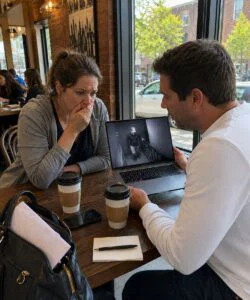
Two days later, we sat in a coffee shop with his laptop open between us.
The security footage was black and white.
A man appeared at 1:45 a.m.
Cap low.
Mask on.
Loose jacket.
Right foot steady.
Left foot dragging.
Left shoulder dipping.
I knew that walk.
I had watched it cross our kitchen, our bedroom, our life.
The man reached apartment 504, pulled out a key, opened the door, and walked inside like he belonged there.
Dante showed me footage from the month before.
Same man.
Same hour.
Same limp.
Same key.
Always right after I delivered the envelope.
Marcus was alive.
His parents had helped him hide.
And for five years, I had been paying the people who stole my grief and turned it into income.
I didn’t scream.
The anger that came over me was colder than that.
I wanted proof.
Complete proof.
So I went back to the building with a Macy’s box and knocked on 504.
I told Elijah I had brought a foot massager for his legs. I said I wanted to come in and light a candle for Marcus.
He barely opened the door.
“Leave it here,” he said. “Your mother’s sick.”
Then I heard a cough from inside.
Not Viola’s cough.
Marcus’s.
That was the last confirmation I needed.
Dante and I began digging faster.
Within a day, he found Darius Brown, Marcus’s old best friend. Darius had cried at the funeral, then vanished. Now he was running a mechanic shop in Gary, Indiana.
In one of his photos, he wore a watch with a blue face and a scratch near the clasp.
My watch.
The one I had bought Marcus for our anniversary.
The one with our initials engraved on the back.
That night, Dante and I drove to Gary.
At 11:15, Darius arrived at a warehouse on a motorcycle. He knocked on the metal shutter in a pattern. Three taps, one tap, three taps.
Part 3
The door rose.
A man stepped into the yellow light.
Thinner.
Rougher.
Older.
But it was him.
Marcus Gaines.
Alive.
Breathing.
Standing twenty yards away from me.
I held a pen recorder near a gap in the wall and listened.
Marcus said he was leaving in a month.
His parents only needed to collect the last payment from me.
Then he laughed.
He said I paid every month like a clock.
Darius said I was a saint.
Marcus replied that I had always wanted to be the noble wife, so he let me.
Then he explained everything.
The gambling debts in North Dakota.
The dangerous people after him.
The fake death.
His parents’ help.
The twelve-thousand-dollar lie that kept me obedient and distracted.
When Darius mentioned Malik, Marcus only shrugged.
“Kids grow,” he said. “She can find somebody else.”
I turned off the recorder.
On the drive home, I finally cried.
Not because I wanted him back.
Because I realized I had been carrying a dead man who had never died.
The next morning, Dante took me to an attorney.
We laid everything on his desk: the security footage, the warehouse recording, the photo of Darius wearing Marcus’s watch, my payment records, and the fake debt documents.
The attorney listened carefully.
When the recording ended, he looked at me and said, “This is fraud. Long-term, coordinated fraud.”
“I want them all held responsible,” I said. “Marcus. His parents. Darius. The man who delivered the urn. Everyone.”
Two nights later, Marcus was detained at the warehouse.
Darius was arrested.
Elijah and Viola were brought in too.
It didn’t feel like victory.
It felt like breathing after being held underwater for five years.
The hearings took months.
Marcus confessed once the recording was played.
His parents claimed they had only acted out of love for their son.
Darius cooperated.
Mr. Tate, the man who delivered the urn, was also implicated.
At sentencing, Marcus never looked at me.
Elijah and Viola avoided prison because of their age and health, but they were ordered to repay what they had stolen.
They looked at me like I had betrayed them.
I looked back and thought of Malik asking why they didn’t love him.
After everything was over, I moved Malik and myself into a small condo on a quieter street.
Two bedrooms.
A balcony.
Morning light in the kitchen.
The first week there, Malik stood in his new room and smiled.
“Can I put my trophies on that shelf?”
“Every one,” I said.
“And my books over there?”
“Those too.”
One afternoon, he ran out of school holding a paper over his head.
“Mama! I got an A in math!”
I pressed it to my chest.
“That’s my boy.”
He asked if we could celebrate.
I asked what he wanted.
“Fried chicken.”
So we walked hand in hand beneath the spring trees, with the city smelling like rain, food, and something new beginning.
Behind us was the apartment door that never opened wide enough.
Behind us was the envelope.
Behind us was the man who thought my loyalty meant I was stupid.
By the time my fingers turned numb and blue, my family was sitting only a few feet away, laughing over Christmas gifts.
I was outside in the snow, wearing thin dinner shoes, with the temperature at ten degrees below freezing, because my father had decided that speaking up made me dangerous.
“You want to act grown?” he had snarled as he shoved me through the back door. “Then survive like one.”
Then the lock clicked behind me.
Through the frosted kitchen window, I could see my stepmother, Brenda, filling crystal glasses with wine. My half-brother, Mason, was ripping open a gaming console. My father lifted a gold watch from its velvet box and kissed Brenda like he was the perfect family man in a Christmas movie.
I knocked once.
Brenda looked toward the window, smiled, and pulled the curtain halfway shut.
That hurt more than the cold.
At dinner, I had made only one mistake.
I asked why the envelope from my school counselor had already been opened before I ever saw it.
My acceptance letter to Waverly Academy, a private arts program in Boston, had been missing for three days.
Dad told me I was being dramatic about scholarships.
Brenda said girls like me should be thankful they even had a roof over their heads.
Then Mason laughed and waved my letter above the mashed potatoes.
“Dad already turned it down for you,” he said. “Somebody has to watch the twins next year.”
When I reached for the letter, Dad grabbed my wrist so hard the fork dropped to the floor.
“You don’t embarrass me in my house,” he hissed.
His house.
That had always been his favorite phrase.
But as snow gathered in my hair, I remembered something he did not know.
My late mother had never trusted him.
Before she died, she gave me a tiny silver key and a warning.
“When you turn eighteen, call your grandmother. Not before. Your father is afraid of her for a reason.”
At midnight, I would turn eighteen.
My phone was inside.
My coat was inside.
But the silver key was still hanging on a chain beneath my dress, colder against my skin than the winter wind.
The minutes passed slowly and painfully.
My teeth chattered.
I stopped knocking because I refused to beg.
Then, at 11:47 p.m., headlights appeared along the private road.
They were not from a pickup truck.
They were not police lights.
A black limousine glided through the snow like a shadow.
The driver stepped out first.
Then an older woman in a white cashmere coat placed one polished boot into the snow.
My grandmother looked at me.
Then she looked at the glowing windows of the house.
Her expression did not move.
She said one word.
“Demolish.”
Part 2
The driver wrapped his coat around my shoulders while my grandmother, Eleanor Vale, walked to the back door and pressed the bell once.
Inside, the music stopped.
My father opened the door, and his smile disappeared the moment he saw her.
“Mother,” he said.
She looked past him at the fireplace, the tree, the gifts, and the family pretending there was not a half-frozen girl standing on the patio.
“Why is my granddaughter outside?”
Dad’s jaw tightened.
“She was being disrespectful.”
“In the snow?”
“She needed discipline.”
Grandmother’s eyes moved to Brenda.
“And you watched?”
Brenda forced a polite smile.
“Teenagers exaggerate. Come in, Eleanor. We were just—”
“No.”
The word was quiet.
But it cut through the room like glass.
My father stepped onto the porch.
“You cannot just show up here and judge how I raise my child. This is my home.”
For the first time, Grandmother smiled.
It was terrifying.
“No, David. It is not.”
Dad gave a loud, nervous laugh.
“What are you talking about?”
She pulled a folded document from her coat pocket.
“This property was purchased by Vale Holdings sixteen years ago and placed in an irrevocable trust for Lila Rose Vale. You were allowed to live here as her guardian until her eighteenth birthday, on the condition that you maintained the property, protected the beneficiary, and did not misuse the trust funds.”
Brenda stared at him.
Mason stopped recording.
My father’s face went blank.
I did not understand every legal term at that moment.
But I understood his fear.
He had never been the king of the castle.
He had only been a temporary tenant in mine.
Grandmother turned to her driver.
“Call Mr. Hayes. Tell him we are activating the emergency removal clause tonight. Notify the sheriff and the trustee auditor.”
Dad lunged toward her.
“You vindictive old witch.”
The driver stepped between them like a wall.
Grandmother did not even flinch.
“Careful. The cameras on my car are recording.”
That was the first sign she had come prepared.
The second arrived ten minutes later.
Two black SUVs.
A lawyer.
And a county deputy who took one look at my bare feet and stopped caring about my father’s excuses.
“This is family discipline,” Dad snapped. “She is dramatic.”
The deputy looked down at my feet.
“Sir, this is evidence.”
Brenda whispered, “David, fix this.”
But Dad only made things worse.
He shouted about ungrateful daughters, greedy old women, and stolen houses.
Then Mr. Hayes opened a tablet and displayed the bank records.
Trust maintenance funds.
Tuition checks.
Medical reimbursements.
All signed by my father.
All spent on Brenda’s jewelry, Mason’s truck, and vacations I had been told we could never afford.
Grandmother crouched beside me.
“Lila, did he decline your scholarship?”
I pulled the silver key from beneath my dress.
Her eyes softened.
“My mother told me to call you when I turned eighteen,” I whispered. “I am twelve minutes early.”
She covered my shaking hand with hers.
“Then I am twelve minutes early to keep my promise to her.”
Inside, my father shouted, “You cannot take everything from me on Christmas!”
Grandmother stood.
“You took from my granddaughter for sixteen years. I am only taking back what was never yours.”
Part 3
At midnight, my birthday arrived with blue lights flashing across the snow.
My father was not dragged away like some villain in a movie.
Real justice was quieter than that.
It came with signed documents and a deputy saying, “David Carter, step away from the minor.”
“I am her father!” he roared.
Grandmother answered before anyone else could.
“Not her owner.”
Brenda tried to cry her way out.
“Lila, sweetheart, tell them this is all a misunderstanding. We are family.”
I looked through the open door at the Christmas tree and the presents I had wrapped for them with hands they had left outside to freeze.
“Family opens the door.”
Her face fell.
Mason muttered, “She is ruining Christmas.”
I laughed once.
“No, Mason. You filmed me outside for your friends. You ruined the evidence.”
He went pale.
The lawyer turned his tablet toward the deputy.
Mason’s video had been uploaded to his private story.
In it, my father’s voice was clear.
“Let her learn. Do not let her in until I say so.”
Brenda’s laughter could be heard in the background.
The deputy’s expression hardened.
“That helps.”
Dad finally stopped shouting.
His cruelty had become a timestamped confession.
Grandmother pointed toward the house.
“Everyone not named in the trust has thirty minutes to collect medication, identification, and essential clothing. Everything else will be inventoried.”
Dad stared at her.
“Where are we supposed to go?”
Her answer was colder than the snow.
“Somewhere you own.”
They had nowhere.
By dawn, contractors had fenced the property.
The house was not destroyed that night.
My grandmother was too intelligent for childish destruction.
But she demolished everything that had protected him.
His lies.
His access to my trust.
His reputation.
His control.
And the fantasy that my silence meant I had no one powerful enough to answer it.
Within weeks, the audit became a civil lawsuit.
The video became part of a child endangerment case.
Brenda lost the boutique my trust money had secretly supported.
Mason lost his truck.
My father lost his job after the board learned he had stolen from his own daughter.
The house came down in March.
I stood on the sidewalk as the excavator tore into the roof where I had once watched them unwrap gifts while I froze outside.
Grandmother stood beside me.
“Are you sad?” she asked.
I thought I would be.
But instead, I felt fresh air rush through the broken walls.
“No,” I said. “I am free.”
Six months later, Waverly Academy accepted my late appeal after Grandmother sent them the evidence and funded a scholarship in my mother’s name.
I moved into a bright dorm room and spent my first peaceful Christmas looking out over Boston Harbor.
A card arrived from my father.
There was no apology.
Only one sentence.
You destroyed this family.
I watched the card burn into ash.
Then I touched the silver key on my necklace and smiled.
It belonged to a safe deposit box my mother had left for me, filled with letters, photographs, and proof that I had been loved long before I learned how to fight.
That year, when the snow began falling again, I watched it from the warm side of the glass.
Eleanor Vance did not purchase the Malibu beach house simply because she had money.
She bought it because her grief needed a place to settle.
At fifty, newly widowed and worn down from sewing dresses for other women in Chicago, she stood on an overgrown lot above the Pacific and saw what everyone else had missed.
A future.
Her husband had died before they ever became the retired couple they used to laugh about becoming.
Robert was twenty-five at the time, old enough to be building his own life, but still young enough to phone her when the check engine light came on.
Eleanor owned nothing grand in those days.
She had a sewing machine, a strict habit of saving, a back that hurt by nightfall, and a stubborn unwillingness to let widowhood push her into a corner.
The house took years to become real.
Every tile meant something because she had paid for it stitch by stitch.
Every plant meant something because she had carried it home with her own hands.
Each weekend in Malibu became another quiet piece of evidence that she had survived the thing that should have destroyed her.
Robert had understood that once.
He called the house “Mom’s miracle” the first summer the porch was completed.
He helped her carry two wicker chairs out to the terrace and promised he would never forget how much effort had been poured into the place.
When Jessica entered his life, Eleanor tried to welcome her with an open heart.
She invited her there for birthdays.
She made dinners.
She showed her where the spare towels were stored and which cupboard held the good plates.
In time, Robert had the spare key because he was her son, and Jessica had learned enough about the house to locate whatever she wanted.
Entitlement almost never storms into a home at the beginning. It slips in through a door you once opened because of love.
That Friday morning, Eleanor drove the familiar coastal road expecting quiet.
The air carried the scent of salt and eucalyptus.
The sky was clear and brilliant, almost painfully so, the kind of California morning that made the ocean look polished.
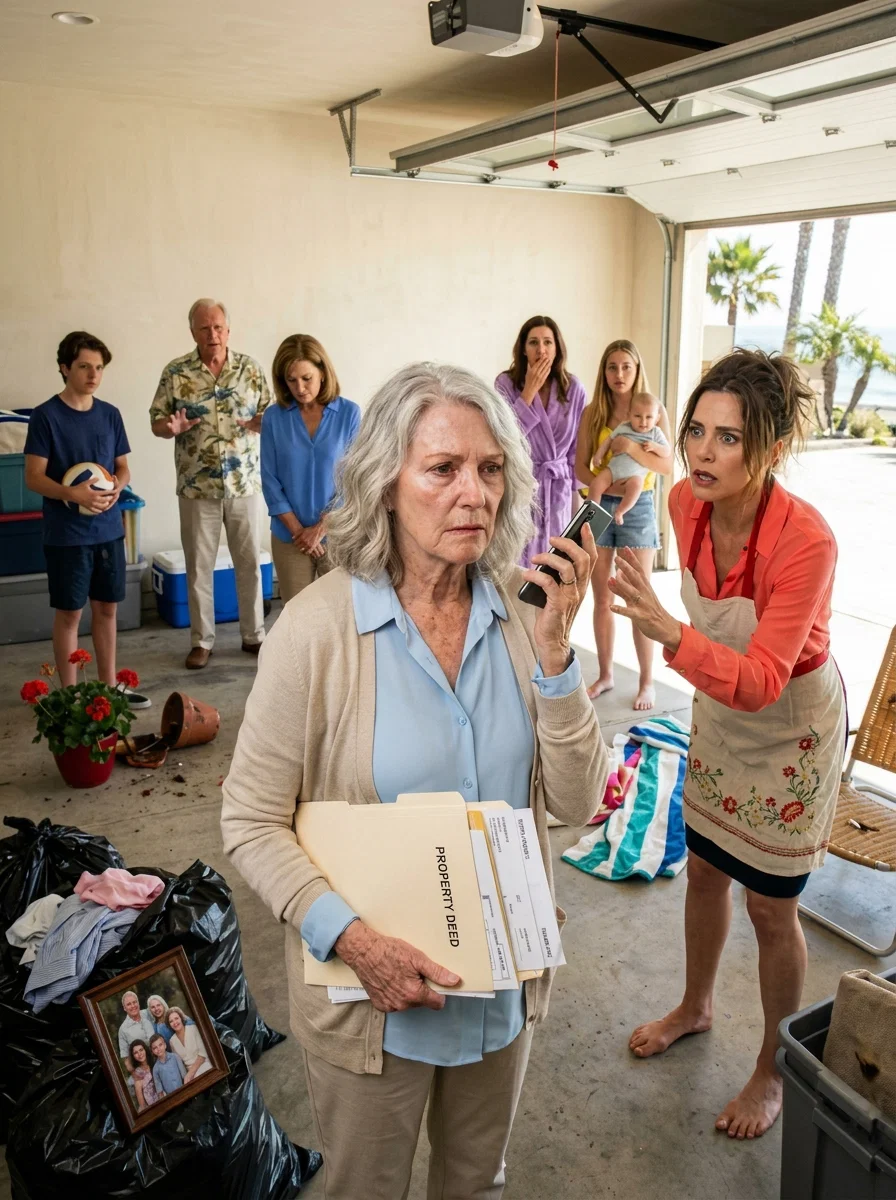
Then she pulled into her driveway and saw unfamiliar cars packed into her garage.
Music pounded from inside the house.
Beer cans lay scattered across the lawn.
The red geraniums she had carefully trimmed by hand had been knocked over, soil spilled across the terrace like something thrown in anger.
Children were running across the patio with a ball.
Wet towels had been draped over her wicker chairs.
Someone had turned the porch into an ashtray.
Eleanor sat in her car for several seconds, keys clenched in her hand, waiting for her mind to reshape the scene into something less cruel.
It did not.
When she got out, the sound of the ocean seemed distant beneath the music.
Jessica appeared in the doorway wearing Eleanor’s embroidered apron.
That particular detail wounded her more deeply than the cars.
Eleanor had made the apron herself ten years earlier, stitching it during the winter after Robert moved into his first apartment.
It was not valuable.
It was personal.
Jessica was wearing it as if it were a costume.
“Jessica,” Eleanor said, “I didn’t know you were here.”
Jessica looked at her the way someone looks at an inconvenience standing in the way.
“What is this old parasite doing here?” she said. “There’s no place for you.”
The terrace went still.
Veronica, Jessica’s sister, froze with a drink in her hand.
Two teenage boys stood beside the destroyed geraniums and stared.
Jessica’s mother gave Eleanor a look of disdain so casual it almost seemed practiced.
A man in a Hawaiian shirt kept one hand resting on a cooler.
A young woman adjusted a baby against her hip.
No one said, “This is her house.”
No one said, “Jessica, stop.”
Nobody stepped forward.
Eleanor felt the teeth of her key press into her palm.
For one second, she pictured herself walking up, ripping the apron from Jessica’s body, and commanding every single person to leave before the next wave struck the rocks.
Instead, she breathed in through her nose.
Cold anger is much quieter than people imagine.
It begins by taking inventory.
“This is my house,” Eleanor said.
Jessica laughed.
She claimed Robert had said they could use it whenever they liked.
She said they were putting the house to good use.
She said Eleanor only ever came around to complain and ruin family plans.
Then Jessica’s mother remarked that Eleanor seemed rather common.
The snickering came quietly.
Quiet cruelty can cut deeper than yelling because it expects you to help make yourself smaller.
Eleanor looked from one face to another and realized the room had already chosen its side before she ever arrived.
She asked where Robert was.
Jessica said he was working, as usual, unlike people who had no real responsibilities.
Then she said the words that destroyed any remaining possibility that this had been a misunderstanding.
“Look, Eleanor, there’s no room for you here. The bedrooms are all occupied. The kitchen is being used for the whole family. Your presence is only going to create unnecessary tension.”
Eleanor thought about the upstairs bedroom where she kept an extra cardigan hanging in the closet.
She thought about the blue quilt spread across the bed.
She thought about the drawer in the nightstand where she kept a photograph of her husband standing inside the unfinished frame of the house, smiling like a man who still believed there would be time.
“This house is mine,” she said.
Jessica rolled her eyes.
She said Robert was Eleanor’s son, and what belonged to Eleanor belonged to him too, and what belonged to him also belonged to Jessica.
“That’s how normal families work,” Jessica said.
One teenage boy suggested that Eleanor go stay in a hotel.
That was when Eleanor smiled.
“All right, dear,” she said. “I understand the situation perfectly.”
Jessica confused that smile for defeat.
That was her first mistake.
Eleanor drove to the Pacific View Inn and paid $285 for a room she never should have needed.
The lobby smelled like lemon cleaner and coffee.
The woman at the front desk asked if she was in town for the weekend, and Eleanor almost laughed because the honest answer sounded ridiculous.
Yes, she was visiting her own town because strangers had occupied her bed.
Inside the hotel room, she sat on the edge of the mattress without removing her shoes.
From the balcony, she could see the warm glow of her house in the distance.
It looked welcoming from there.
That offended her more than the insults had.
At 9:17 p.m., she opened the notebook she always kept in her travel bag.
She wrote down every car she could remember.
She listed the broken pots, the beer cans, the cigarette burn, the faces she recognized, and the exact words Jessica had said.
Then she opened the property folder she always brought with her when she traveled to Malibu during tax season.
Inside were copies of the deed, mortgage papers, utility bills, insurance policy, and recent Los Angeles County property tax records.
Paper remembers what people cannot bully out of existence.
Eleanor barely slept.
At 6:00 the next morning, she woke before the alarm rang.
She drank bitter hotel coffee and placed the folder in her bag.
At 8:00, she returned to the house.
The front door was locked.
Her own front door.
She pressed the doorbell like a guest.
Veronica opened the door in pajamas, already looking annoyed.
“What do you want now?” she asked.
Eleanor said she needed to gather some personal belongings and speak to Jessica.
Veronica told her Jessica was asleep.
Then she added that Eleanor’s things had been moved to the garage so they would not be in the way.
The sentence reached her slowly.
In the way.
Her clothes.
Her photographs.
Her handmade linens.
The pieces of a life that had paid for every inch of that house.
Eleanor walked past Veronica.
In the garage, she found black garbage bags lying near the storage shelves.
Her travel clothes had been stuffed inside without being folded.
Her framed wedding photograph leaned crookedly against a bin.
The old sewing ledger from Chicago had one corner bent.
The embroidered pillowcases she had made when Robert was twenty-five were crushed beneath a damp towel.
For a moment, her hand hovered over the wedding photograph.
Then she took out her phone and began taking pictures.
One photo of the garbage bags.
One photo of the broken pot visible through the garage door.
One photo of the cigarette burn on the wicker chair.
One photo of the hotel receipt laid beside the deed.
When Jessica entered the garage, she was still wearing the apron.
“What are you doing with those papers?” she snapped.
Eleanor answered Robert’s call on speaker.
“Robert had not given her permission at all,” she said.
The silence that followed was not the same silence that had fallen over the terrace.
This silence had fear inside it.
Robert asked what was happening.
Eleanor told him his wife had moved her whole family into the house, packed Eleanor’s belongings into garbage bags, damaged the garden, and told her there was no place for her.
Jessica reached toward the phone.
Eleanor stepped away.
Her hand was steady.
Then she laid out the printed screenshot of Robert’s Thursday text.
He had asked if Jessica could stop by Malibu for one afternoon.
Eleanor had replied that there were to be no overnight guests and that she would be arriving Friday.
Jessica had not mistaken permission.
She had disregarded a refusal.
Veronica saw the printout and went pale.
“Jess,” she whispered, “you said she knew.”
Jessica’s mother looked down at the floor.
The man in the Hawaiian shirt placed the cooler on the ground as though it had suddenly become dangerous to hold.
Robert’s voice came through the speaker, low and stunned.
“Jessica, tell me you didn’t throw my mother out of her own house.”
Jessica tried to answer and could not.
Eleanor placed the deed, the hotel receipt, the printed message, and the insurance policy in a clean line across the top of the storage bin.
Then she told Robert there was one more document he needed to hear.
It was the emergency access agreement he had signed years before when she gave him the spare key.
It was straightforward.
The key was meant only for emergencies, repairs, and pre-approved family visits.
It did not give him permission to occupy the property.
It did not give his wife the right to bring guests.
It did not give anyone permission to remove Eleanor’s possessions.
Robert remembered signing it.
Of course he did.
He had laughed then and told her she was being too formal.
She had told him that love and paperwork could exist under the same roof.
Now paperwork was the only thing standing between love and theft.
Robert arrived in less than an hour.
He walked into the garage without his work jacket, his face pale, his hair still damp from the rushed shower he must have taken before driving over.
For one second, he looked like the young man who had helped her carry chairs onto the terrace.
Then he saw the bags.
His face crumpled.
“Mom,” he said.
Eleanor did not comfort him.
Some apologies only become useful after the damage has been cleaned up.
Jessica began speaking quickly.
She said Eleanor was making too much of it.
She said families were supposed to share.
She said the house was empty most of the time anyway.
She said the children needed space.
She said Eleanor had humiliated her in front of everyone.
Robert looked at the bags again.
Then he looked at the apron.
“Take it off,” he said.
Jessica blinked.
“What?”
“My mother’s apron,” Robert said. “Take it off.”
That was the first moment Jessica looked truly frightened.
Not because of the apron itself.
Because Robert’s voice was different.
Eleanor told them everyone had until noon to get out.
If they were not gone by then, she would call the sheriff, and her attorney would file a formal trespass notice using the documentation she had already prepared.
Jessica’s mother muttered that Eleanor was being cruel.
Eleanor looked at the broken geraniums, the trash across the lawn, and her wedding photo propped against a garbage bag.
“No,” she said. “I am late.”
Nobody laughed.
By noon, every car was gone.
The music was gone.
The wet towels were gone.
The house smelled like spilled beer, sunscreen, cigarette smoke, and humiliation.
Robert remained behind.
He picked up cans from the yard without being asked.
He swept the dirt from the terrace.
He carried Eleanor’s belongings back into the house one bag at a time.
He cried once, silently, when he saw the bent sewing ledger.
Eleanor allowed him to cry.
She did not save him from the weight of it.
That afternoon, she called her attorney.
She had the locks replaced.
She reset the alarm code.
She revoked Robert’s spare key access in writing and sent the notice through email and certified mail.
Then she filed a property damage claim with photographs attached.
The documents were clear.
The timeline was clear.
Friday arrival.
Pacific View Inn receipt for $285.
Saturday 8:00 a.m. entry attempt.
Photographs showing damaged property.
Printed text exchange.
Emergency access agreement.
Deed under the name Eleanor Vance.
Jessica’s nightmare did not begin with yelling.
It began with evidence.
Within one week, Robert reimbursed Eleanor for the hotel room, the broken pots, the cleaning, the locksmith, and the damaged furniture.
Eleanor did not ask whether the money had come from him or from Jessica.
She accepted the check only after it cleared the bank.
Jessica called once.
Eleanor let the call go to voicemail.
The message opened with anger, softened into explanations, and ended with something trying to sound like an apology without fully becoming one.
Eleanor saved it.
Not because she intended to use it.
Because she had learned, painfully, that people who rewrite history should never be left alone with the only pen.
Robert came to Chicago two weeks later.
He brought the repaired wedding frame wrapped carefully in paper.
He apologized without making excuses for Jessica.
That mattered.
He said he should have guarded the boundary before Eleanor had been forced to defend it like a battlefield.
That mattered too.
Eleanor told him she loved him.
Then she told him love did not unlock the door again.
The Malibu house would stay hers.
The spare key would remain gone.
Every visit would have to be requested beforehand, approved in writing, and treated as a privilege rather than an inheritance.
Robert nodded.
He looked older when he left.
Maybe that was necessary.
Some children do not become adults simply because they get married.
They become adults when their mothers stop carrying the cost of their cowardice.
The following month, Eleanor went back to Malibu alone.
She replanted the geraniums.
She scrubbed the porch clean.
She washed the apron twice and folded it into a drawer.
For a while, every room still felt marked by other people’s entitlement.
Then, slowly, the house began to sound like itself again.
The refrigerator hummed.
The waves moved below the cliff.
The wind slipped through the curtains with the same gentle insistence it always had.
One evening, Eleanor sat on the terrace with coffee and opened her old sewing ledger.
Inside the front cover, Robert had once written, “Mom’s miracle,” in blue ink.
She traced the words with her thumb and felt grief, love, anger, and relief pass through the same tired heart.
They had mistaken her quietness for surrender.
They had been wrong.
Eleanor had not won because she was the loudest person in the room.
She won because every brick, every receipt, every signature, and every hard-earned boundary told the truth before Jessica had a chance to twist it.
At seventy years old, Eleanor Vance learned something she wished she had understood much earlier.
A home is not protected by blood.
It is protected by the woman who refuses to let anyone call her a parasite while standing beneath the roof she built.
Not the peaceful kind that comes before someone blows out birthday candles. This silence spread across the dining room like a storm cloud, swallowing every conversation and every laugh.
It was my husband Daniel’s thirty-eighth birthday. His mother, Patricia, had insisted on hosting a family dinner.
“Just close family,” she had told us sweetly over the phone. “The people who matter most.”
I should have recognized the warning hidden inside those words.
Daniel had two children from his first marriage—sixteen-year-old Mason and thirteen-year-old Chloe. I had never tried to replace their mother. I treated them with kindness and respect, and over time we built a comfortable relationship.
My daughter Lily was seven. She was from before Daniel and me, but Daniel had been helping raise her since she was three years old. He packed her lunches, attended school events, read bedtime stories, and loved her as completely as any father could.
To Patricia, however, Lily was always something different.
She was simply “Emma’s daughter.”
Never family.
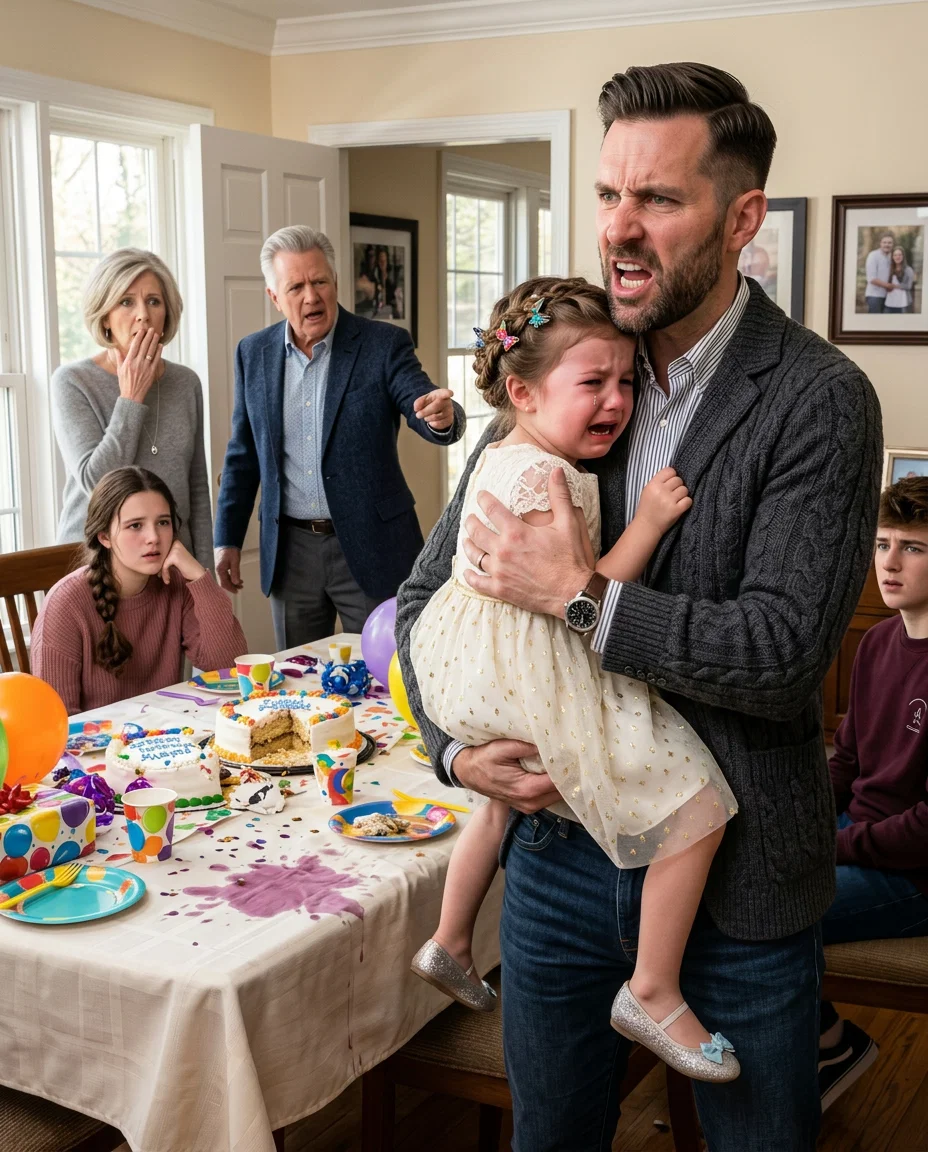
The dining room was full of relatives, balloons, gifts, and a large chocolate cake waiting on a side table. Lily sat beside me wearing a bright blue dress Daniel had bought for her because she said it made her feel like a princess.
She looked happy.
Then Patricia walked over.
She bent down and whispered something in Lily’s ear.
Instantly, Lily’s smile disappeared.
“Grandma Patricia says I need to sit in the den,” she said quietly.
I frowned.
“Why?”
Patricia straightened.
“We need these seats for Daniel’s real children and his family.”
My hand froze around my fork.
“She is his family,” I said.
Patricia ignored me completely.
Instead, she placed a hand on Lily’s shoulder and began steering her toward the hallway.
“Patricia,” I said sharply, “don’t touch her.”
Lily looked confused.
“Mommy?”
I stood up immediately.
But before I could reach them, Patricia pushed Lily through the doorway into the den.
The entire room fell silent.
At that exact moment, Daniel walked back inside after taking a work call.
He saw Lily crying.
And something changed in his face.
Not anger.
Something colder.
More final.
He walked directly to Lily, knelt beside her, wiped away her tears, and took her hand.
Then he returned to the dining room.
He looked at every person sitting at the table.
Finally, he looked at his mother.
“My real children?” he asked calmly.
Nobody answered.
“Let me make something very clear.”
His voice remained steady.
“Lily is my daughter.”
Patricia went pale.
Daniel continued.
“She became my daughter the day I chose to love her, protect her, and show up for her. Anyone who believes blood matters more than love is welcome to leave my birthday dinner right now.”
PART 2
The room froze.
His parents looked stunned.
Even his relatives seemed uncomfortable.
But Daniel wasn’t finished.
When Patricia tried to defend herself, claiming Lily wasn’t really his child, Daniel’s expression hardened.
“She is my child,” he said. “And because you refuse to respect that, this dinner is over.”
Harold, Daniel’s father, attempted to calm the situation.
“Your mother didn’t mean anything by it.”
Daniel pointed toward two empty chairs leaning against the wall.
“There was room for everyone.”
Nobody could argue with that.
“There just wasn’t enough kindness.”
To everyone’s surprise, Mason spoke next.
“She’s seven years old,” he said, staring at his grandmother. “What’s wrong with you?”
Then Chloe stood up.
She walked over to Lily and offered her own chair.
“Sit with me.”
Lily’s eyes filled with tears again.
For the first time, Patricia realized nobody was supporting her.
Not even her grandchildren.
Before leaving, Lily handed Daniel the birthday gift she had made herself.
Inside was a small wooden picture frame she had painted by hand.
The photo showed the three of us at the county fair.
At the bottom, she had written two simple words:
**My Family.**
Daniel held the frame against his chest.
Then he turned toward his parents.
“You wanted my real family at this table,” he said quietly.
“You just tried to throw her out.”
We left without cutting the cake.
Without opening presents.
Without saying goodbye.
Later that night, as we drove home, Lily sat in the back seat holding Daniel’s hand.
After several minutes she whispered:
“Are you still my daddy?”
Daniel immediately pulled the car over.
Tears filled his eyes.
“I was your daddy yesterday,” he said softly. “I’m your daddy today. And I’ll be your daddy tomorrow.”
Lily wrapped her arms around him.
Neither of them let go for a long time.
The following week, Patricia tried to rewrite what happened.
According to her version, she had merely been arranging seats.
She never pushed Lily.
She never excluded her.
She never used the words “real children.”
But nobody believed her.
Not Daniel.
Not Mason.
Not Chloe.
Not even Daniel’s ex-wife Rachel.
When Rachel heard the story, she was horrified.
“Patricia should be ashamed of herself,” she told us.
That support meant more than she probably realized.
A few weeks later, Patricia arrived at our house carrying cupcakes and pretending she wanted peace.
Daniel gave her one chance.
“Apologize to Lily.”
Patricia reluctantly looked at my daughter.
“I’m sorry if your feelings were hurt.”
Daniel immediately handed the cupcake box back.
“That’s not an apology.”
PART 3
Patricia grew frustrated.
Then Lily surprised everyone.
She stood up, looked directly at Patricia, and said:
“I’m not holding a grudge. I just remember.”
The room went silent.
Then Patricia lost control completely.
She admitted she still didn’t consider Lily one of Daniel’s real children.
That was the moment everything finally ended.
Daniel asked his parents to leave.
Mason opened the door for them.
Chloe said she no longer wanted to visit their house.
And for the first time, Patricia realized she was losing far more than an argument.
She was losing her family.
Months later, Daniel made a decision.
He filed adoption papers.
When he sat down to discuss it with Lily, he explained that he already considered himself her father. The adoption would simply make it official.
Lily thought for a moment.
Then she smiled.
“You picked us,” she said.
The adoption hearing was simple.
No dramatic speeches.
No grand celebration.
Just a judge, some paperwork, and a little girl who already knew the answer.
“Do you want Daniel to become your legal father?” the judge asked.
Lily grinned.
“He already is. We’re just telling everyone else.”
There wasn’t a dry eye in the room.
Afterward, we took photos outside the courthouse.
For the first time, everything felt complete.
Patricia found out through social media.
Her only response was a text message accusing us of destroying the family.
Daniel deleted it without replying.
“She doesn’t get to stand in the doorway anymore,” he said.
That Thanksgiving, we hosted dinner ourselves.
Rachel joined us.
Mason burned the dinner rolls.
Chloe laughed at him.
Lily made handmade place cards for everyone.
The house was loud, messy, and happy.
As we gathered around the table, Daniel looked at all three children and smiled.
“I’m thankful,” he said, “for the people who taught me that family isn’t biology. It’s behavior.”
Lily immediately raised her hand.
“Yes?” Daniel asked.
“Can we eat now?”
Everyone burst out laughing.
Later that night, Daniel told me something I’ll never forget.
“I used to think peace meant staying quiet.”
“And now?” I asked.
He smiled toward the living room where the children were arguing over a blanket.
“Now I think peace means knowing nobody at your table has to earn their seat.”
And in that moment, I realized something important.
Patricia could keep her perfect table, her traditions, and her narrow definition of family.
In our home, every chair was filled by someone who belonged.
Her tears slipped down her face as she answered, “Your mother and your brother made me sign everything away.”
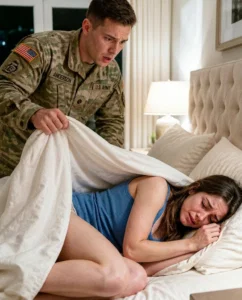
I came home from duty with a medal in my bag and a bad feeling in my chest. My wife looked at me as though even my shadow had learned how to hurt her.
For six months, I had been stationed overseas, surviving on weak coffee, brief video calls, and the thought of holding Elena again. But the woman waiting in our house was not the Elena who used to run barefoot down the hallway when she heard my key in the door. She stood in the kitchen, thinner than before, pale, with her hands hidden inside the sleeves of her sweater.
“Welcome home, Alejandro,” she said.
Not my love.
Not husband.
Alejandro.
Before I could respond, my mother, Doña Victoria, swept into the room, shining in pearls I had never bought for her. Behind her stood my younger brother, Ricardo, wearing my watch, my jacket, and the smug smile of a man who had grown comfortable living inside another man’s life.
“Elena has been very sensitive while you were away,” Mother said, gripping my shoulder too tightly. “Try not to take it personally.”
Ricardo chuckled. “Loneliness can do strange things to women.”
Elena dropped her gaze.
That night, she slept on the very edge of the bed, wrapped tightly in the blanket, her body turned away from mine. When I reached for her hand, she jerked back so sharply that something inside me broke.
“Are you seeing someone?” I asked, hating myself the moment the words left my mouth.
Her face crumpled, but she did not answer.
The next day, I found deleted messages on her old phone. Money transfers. Legal appointments. A photo of a document signed with her shaky signature. My name was on it too, but I had signed nothing.
The family house.
My investments.
The small company Elena and I had built before I enlisted.
Everything had been transferred to a shell company controlled by Ricardo.
That night, I lifted the blanket, searching for proof of betrayal.
Instead, I found dark bruises across her ribs, finger-shaped marks on her arms, and healing wounds along her back.
The air left my lungs.
“Who did this to you?” I whispered.
Her tears fell silently.
“Your mother and your brother forced me to sign everything over.”
The room seemed to turn to ice.
Outside the window, I could hear Mother laughing with Ricardo in the garden over champagne.
I gently pulled the blanket back over Elena’s shoulders and kissed her forehead.
“Then they didn’t steal from my wife,” I said quietly. “They declared war on the wrong man.”
Part 2
I did not rush downstairs.
I did not swing at Ricardo, even though every part of me wanted to.
I stayed beside Elena until her trembling eased. Then I asked one question.
“Do you trust me?”
She looked at me as if trusting anyone hurt. “I tried to call you.”
“I know.”
“They said if I disturbed your mission, you would lose everything. Then they told me if I refused to sign, they would accuse me of fraud. Your mother said no one would believe a lonely wife over family.”
My mother had always been graceful in public and cruel in private, but I had mistaken her poison for ambition. Ricardo had mistaken my restraint for weakness.
At dawn, I made three calls.
The first was to Lieutenant Harris, my commanding officer and the only person who understood why my last deployment had not been ordinary patrol duty.
The second was to Grace Lin, a federal prosecutor I had once helped during a joint military financial crimes case.
The third was to Dr. Patel, a forensic physician who documented Elena’s injuries before they could disappear.
By breakfast, I was calm enough to sit across from my mother.
She poured coffee into my cup as if the house belonged to her. “Elena seems fragile. Perhaps you should think about having her evaluated.”
Ricardo smirked. “Or divorced. I know attorneys.”
Elena sat beside me in silence, her hand hidden in mine beneath the table.
I smiled. “How thoughtful.”
Ricardo leaned back in his chair. “While you were off playing hero, we kept everything together here. The company needed leadership. Mother needed security. Elena needed guidance.”
“Guidance?” I repeated.
Mother’s eyes hardened. “Don’t be dramatic. She signed willingly.”
“Did she?”
Ricardo tapped his fingers on the table. “Careful, brother. You’ve been gone a long time. The papers are legal.”
That was their first mistake.
They believed paper meant power.
Their second mistake was planning a family dinner that Friday to “celebrate the restructuring.” They invited investors, lawyers, cousins, and my father’s old business partners. Mother wanted applause. Ricardo wanted witnesses for his victory.
So I helped them prepare.
I ordered the wine.
I confirmed the guest list.
I even stood quietly while Ricardo showed my study to guests as his “new office.”
“You’re much calmer than I expected,” he said, pouring my whiskey into my glass.
“I learned patience in places where panic gets people killed.”
He laughed, missing the warning entirely.
On Friday morning, Grace called.
“The forged signatures are enough to freeze the transfers,” she said. “The medical report supports coercion. And the shell company?”
“What about it?”
“It connects to three offshore accounts. Ricardo has been moving money for years.”
I looked through the glass doors and saw my mother ordering Elena to rearrange flowers with shaking hands.
“Good,” I said. “Bring everything tonight.”
Grace paused. “Alejandro, are you sure you want this to happen in public?”
I watched Ricardo put my medal against his chest as a joke and salute himself in the mirror.
“Yes,” I said. “They wanted an audience. Give them one.”
Part 3
By seven, the house was filled with silk dresses, polished shoes, and expensive laughter. Ricardo stood near the fireplace beneath my grandfather’s portrait, acting as though legacy could be stolen with the right suit.
Mother placed a hand on Elena’s shoulder in front of everyone.
Elena went rigid.
“My dear daughter-in-law has been under so much stress,” Mother announced sweetly. “But tonight marks a new beginning. Ricardo will lead the company into a stronger future.”
Applause moved through the room.
Ricardo lifted his glass. “And Alejandro can finally rest after his service. Some men are made to follow orders. Others are born to command.”
A few guests laughed.
I waited until the room quieted.
“Before the toast,” I said, “I need to correct something.”
Mother frowned. “Alejandro, not now.”
“Now is perfect.”
The front door opened.
Grace Lin stepped inside with two federal agents and a court officer. Dr. Patel followed with a sealed folder in his hands.
Silence fell so quickly the chandelier seemed loud.
Ricardo’s face went pale. “What is this?”
“The end,” Elena said.
Her voice trembled, but she stood tall.
Grace laid the documents on the table. “A temporary restraining order has frozen all asset transfers connected to this household, Mendoza Development, and Ricardo Mercer Holdings. There is also probable cause for forgery, coercion, assault, extortion, and financial fraud.”
Mother’s smile twitched. “Ridiculous. Elena signed those documents.”
I pressed a button on the remote.
The wall screen lit up with their own security footage.
Mother trapping Elena in the hallway.
Ricardo shoving papers against her chest.
Elena crying.
Ricardo gripping her arm.
Mother’s voice, clear as glass: “Sign it, or Alejandro comes home to nothing.”
Gasps spread across the room.
Ricardo lunged toward the remote, but an agent stepped in front of him.
“You recorded us?” he snapped.
“No,” I said. “You did. Your smart home system backs everything up to a cloud account registered in my name.”
Mother whispered, “Alejandro, we are family.”
I looked at Elena.
“Family doesn’t bruise the woman I love.”
Ricardo was restrained first, shouting threats and promises of lawsuits. Then Mother, still trying to command the room, until the officer read the assault complaint and her pearls slipped crooked against her throat.
As they were led away, Ricardo looked back at me.
“You ruined us.”
I shook my head. “You created the evidence. I only opened the door.”
Final Part
Six months later, Elena and I stood on the porch of a new lake house. The old estate had been sold under court supervision to repay the stolen money. Ricardo accepted a plea after investigators uncovered offshore accounts and forged loans. Mother’s friends stopped answering her calls before sentencing ever began.
Elena’s injuries faded more slowly than the headlines.
But they did fade.
She reopened our company under her own name, and I became the man who brought her coffee, reviewed contracts, and never touched her without asking.
One evening, she leaned against my shoulder while the sunset turned the lake gold.
“I thought you came home too late,” she whispered.
I kissed her hand.
“No,” I said. “I came home in time to prove you were never alone.”
Six days after my C-section, my father tried to take $2,300 from my bank account to pay for a cabin upgrade on their cruise. What I did next turned every secret my family had buried into evidence.
While holding my newborn son in the hospital, I texted my parents:
*Please, can someone come help me?*
My mother read the message and never replied.
Thirty minutes later, she posted a smiling photo from the deck of a luxury anniversary cruise. Her arm was wrapped around my sister Chloe, the daughter who had always been treated like gold.
I stared at that picture from my hospital bed while my baby slept against my chest. My incision burned every time I moved. My husband Daniel was deployed overseas. My best friend was out of state.
I had no one.
The next morning, Mom finally replied.
*You’re a mother now, Nora. Figure it out.*
Two minutes later, Chloe sent a photo of herself beside a champagne bucket.
*Don’t be dramatic. Mom and Dad deserve joy too.*
I didn’t answer.
I signed my discharge papers alone, paid for a ride home, and carried my son into an empty house.
By the sixth day, I had learned how to stand without crying. I had learned how to warm bottles with one hand. I had learned the sound of loneliness was a phone that never rang back.
Then my banking app flashed red.
**Attempted withdrawal: $2,300** **Location: Caribbean Sea ATM** **Cardholder: Arthur Vance**
My father.
A second alert appeared.
**Security question failed. Second attempt pending.**
I looked at my sleeping son and whispered, “Not this time.”
My parents still thought I was the daughter who stayed quiet when they stole from my college fund. They thought I was still the girl who apologized when Chloe opened store cards in my name.
They forgot what I did for a living.
I was a fraud compliance analyst for Meridian National Bank.
So I opened my laptop and started building a file.
I saved the failed withdrawal details.
The terminal ID.
The time stamp.
The card record.
The old emails from Chloe that contained copies of my license, Social Security card, and blank authorization forms they had always called “family paperwork.”
I called it evidence.
At noon, Mom texted:
*Your father said your card declined. Why are you embarrassing us on vacation?*
I replied:
*Why was Dad using my card?*
Chloe answered first.
*Because you owe them. They raised you.*
Then Dad called and left a voicemail.
“Nora, unlock the account. We need the upgrade today. Don’t start your nonsense while your mother is trying to enjoy herself.”
Then he said the sentence that sealed everything.
“And don’t forget, I still have access to the trust documents. If you cause trouble, you’ll never see a dime from your grandmother’s house.”
My grandmother’s house.
The one she left to me.
The one my parents claimed had been sold years ago to pay family debts.
But during my pregnancy, a property-tax notice arrived by mistake with my name listed as a beneficiary under the Vance Family Trust.
My mother called me paranoid.
But I had already requested certified copies, hired an estate attorney, and learned the truth.
My parents had forged trust amendments, rented out the house, and sent the income to Chloe’s boutique account.
Their cruise had been paid for with stolen rent.
That night, Chloe posted a video from the ship’s dining room.
“To family who chooses happiness,” she toasted. “Not guilt.”
Dad leaned toward the camera.
“Some people always play victim. This family rewards loyalty.”
I saved the video.
Then I sent three emails.
One to my attorney.
One to Meridian’s fraud escalation team.
One to the trust department named in my grandmother’s original documents.
At 9:14 p.m., Dad tried the ATM again.
This time, the account did not just decline.
It froze.
The next morning, they called me on video.
Mom appeared first in a cruise robe, furious.
Chloe stood behind her.
Dad shoved into the frame.
“What did you do?” he snapped.
I sat in the nursery with my son asleep against my shoulder.
“I reported unauthorized access to my account.”
Dad laughed.
“You reported your own father?”
“I reported a man who tried to steal from a woman six days after surgery.”
Mom sneered.
“Always dramatic.”
I clicked a key.
“I also reported identity theft, forged documents, and trust fraud.”
The cabin went silent.
Chloe spoke first.
“You have no proof.”
“I have the ATM logs, Dad’s voicemail, your emails with my identification documents, the store cards opened in my name, the forged trust papers, the rental deposits from Grandma’s house, and your cruise video.”
Dad’s face turned gray.
Mom grabbed the phone.
“Nora, stop. We can talk when we get home.”
“No,” I said. “You had six days to talk. I asked for help while I was bleeding through bandages and holding your grandson. You chose champagne.”
Chloe tried to laugh.
“You’re tired. Emotional. You just had a baby.”
Then my attorney, Claire Benton, joined the call.
Chloe stopped smiling.
Claire said, “The court has suspended your control over the Vance Family Trust. The rental accounts are frozen. Chloe’s boutique account is under review due to traceable trust funds. Meridian has opened a fraud case. Authorities have been notified. Do not contact my client except through legal channels.”
Dad shouted, “She is our daughter!”
I held my son closer.
“No. I was your source of money. There’s a difference.”
Three weeks later, they returned home to changed locks on my grandmother’s house and a legal notice on the door.
The rent was redirected back to the trust.
Chloe’s boutique lost its lease after the frozen funds exposed unpaid loans and false income reports.
Dad was pushed into early retirement after his employer learned about the complaint.
Mom sold jewelry for legal fees and still called me cruel.
At the hearing, Dad would not look at me. Chloe cried until the judge told her to stop performing. Mom stared at my baby like she had only just remembered he existed.
The judge restored control of the trust to me, ordered repayment, and referred the forged documents for prosecution.
Six months later, I stood on the porch of my grandmother’s house with my son on my hip. Daniel was finally home, his hand warm against my back.
My phone buzzed with one message from Mom.
*We’re still your family.*
I looked at my son laughing in the sunlight and typed back:
*Family comes when you ask for help.*
Then I blocked her, stepped inside, and closed the door on the quietest peace I had ever known.
My parents handed my sister $80,000 so she could study in Paris, then looked me straight in the face and said, “You don’t deserve any help.” So I walked away and created a life without them. Four years later, my sister drove past my $5 million home, sobbing into the phone, “Dad, why does she have that?” I smiled from the window—because they were about to understand exactly what they had discarded.
My parents gave my younger sister, Lily, eighty thousand dollars to study art history in Paris, then told me I was not worthy of help with community college.
My name is Hannah Reed, and I was twenty-four when I finally understood my exact place in my family. We were sitting in my parents’ kitchen in Seattle, the same kitchen where I had cooked meals, wiped counters, and watched Lily receive every expensive opportunity I had been taught not to request.
Dad pushed a folder across the table toward Lily and smiled. “Your tuition, apartment deposit, and living expenses are covered.”
Lily screamed, hugged Mom, and began crying tears of happiness.
I smiled because that was what I was expected to do.
Then I asked, carefully, “Would you be able to help me with my final year? Just part of it. I can keep working nights.”
Mom’s expression shifted immediately.
“Hannah,” she said, “you need to be realistic.”
Dad leaned back in his chair. “Lily has talent. Paris can change her life.”
“And my degree can’t change mine?” I asked.
Mom sighed as though I had embarrassed her. “You chose a practical path. You should be able to handle practical problems.”
I looked at Lily. She would not meet my eyes, still clutching the folder.
Then Dad said the words I never forgot.
“You don’t deserve any help just because your sister got some.”
The kitchen fell silent.
I slowly stood up. “Then I guess I know what I deserve.”
Mom frowned. “Don’t be dramatic.”
But I was finished begging them to value me. That weekend, I packed my belongings, blocked their numbers after sending one final message, and moved into a tiny basement room near campus. I worked, studied, saved, and built a career in real estate development one exhausting step after another.
Four years went by.
I purchased my first luxury property at twenty-eight, then another one. By thirty, I owned a modern five-million-dollar house overlooking Lake Washington.
One Saturday morning, I was drinking coffee by the window when a familiar rental car slowed down outside my gate.
Lily got out, stared at my house, and called someone while crying.
Through the open window, I heard her say, “Dad, why does Hannah have that?”
Then my phone, silent for four years, lit up with Dad’s name.
Part 2
I looked at the screen until the call stopped.
Then it rang again.
Dad.
Mom.
Unknown number.
Lily stayed outside my gate, pacing as if my success personally offended her. She kept looking up at the house, then down at her phone, then back to the house. Four years earlier, she had stepped into a paid apartment in Paris while I worked double shifts and lived on peanut butter sandwiches to finish my degree. Now she was crying outside the home I had built without one dollar from them.
I did not pick up.
Instead, I watched her through the security camera while she wiped her face and typed angrily. A message came in from Dad.
“Hannah, call me. We need to talk about how you bought this house.”
Not congratulations.
Not I’m sorry.
Not we missed you.
Only suspicion.
Then Mom sent a text.
“Your sister is very upset. You should have told us you were doing this well.”
I laughed so sharply that I startled myself.
Doing this well. As though my life was a secret I owed them. As though they had not made it perfectly clear that they wanted no part of the difficult years.
Lily pressed the gate bell.
I touched the intercom. “Can I help you?”
Her head jerked up. Her face went still when she heard my voice.
“Hannah?”
“Yes.”
“You live here?”
“I do.”
Her mouth opened, then shut again. “How?”
“Work.”
She looked insulted by how simple the answer was. “Dad said this neighborhood was only for tech founders and old money.”
“Then Dad was wrong.”
Her eyes narrowed. “You could have told us.”
“You could have asked how I was during the last four years.”
She flinched, but recovered quickly. “Mom and Dad are freaking out. They think you hid money from them.”
“Hid money from people who told me I deserved nothing?”
Lily’s cheeks turned red. “That was years ago.”
“Funny. I still remember it perfectly.”
My phone buzzed again. Dad had sent another message.
“Open the gate. We are coming over.”
A cold calm settled inside me.
I typed back:
“You are not invited. Do not come onto my property.”
Ten minutes later, a black SUV stopped behind Lily’s rental car.
My parents got out, staring at my house like they had found stolen treasure.
Dad walked up to the gate and pressed the buzzer.
“Hannah,” he said through the speaker, “open this gate right now.”
I looked into the camera and answered, “No.”
Then he said, “After everything we sacrificed for you, you owe us an explanation.”
That was when I started recording.
Part 3
Dad’s face twisted when he realized the camera was active.
Mom stood beside him with the same wounded expression she always used when she wanted guilt to do the work of an apology. Lily hovered behind them, still crying, though now her tears looked more like anger.
“You owe us an explanation,” Dad repeated.
I opened the intercom again. “No, Dad. I owed my bank mortgage payments. I owed my clients results. I owed myself the life I built. I don’t owe you access to it.”
Mom stepped closer. “Hannah, we were your parents. We did our best.”
“No,” I said. “You did your best for Lily. You gave her eighty thousand dollars and told me I didn’t deserve help.”
Lily snapped, “Why do you keep bringing that up?”
“Because it was the day I stopped waiting for this family to love me fairly.”
Dad pointed toward the house. “So what, now you think you’re better than us?”
I looked at the smooth stone driveway, the glass balcony, the quiet lake behind me, and remembered the basement room with the leaking ceiling where I used to study past midnight.
“No,” I said. “I think I’m better without begging you.”
Mom’s voice broke. “We want to come in and talk.”
“You want to come in because the house impressed you.”
No one denied it.
That silence felt like the most honest conversation we had ever had.
Dad tried one last time. “Family should share success.”
I almost smiled. “Funny. Family didn’t share opportunity.”
After that, I told them to leave before I called security. Dad cursed under his breath. Lily shouted that I was cruel. Mom cried all the way back to the SUV. But I never opened the gate.
That night, messages poured in from relatives I had not heard from in years. Apparently, my parents had told everyone I had “changed” and “forgotten where I came from.” So I posted one photo of myself holding the deed to my house with a simple caption:
Built with no inheritance, no family money, and no apology required.
The comments shifted quickly.
Some people called me cold. More people called me strong.
A week later, Mom sent a long text saying she was sorry “if I felt unsupported.” I did not reply. An apology with an escape hatch is just another insult dressed in nicer clothes.
I still live in that house. I still drink coffee by the window. And every morning, I remind myself that rejection hurt deeply, but it also set me free.
So tell me honestly: if your family gave everything to your sibling, then came back only after seeing your success, would you open the gate—or leave them outside with their regret?
My mother-in-law dumped something foul all over my wedding dress and left a note: “Know your place.” In front of 200 guests, I wore it anyway, took my father’s arm, and walked down the aisle without crying once. Then I smiled at the groom and whispered, “Your mother forgot one thing — I know the secret that will destroy you both.”
My mother-in-law ruined my wedding gown three hours before I was meant to marry her son. She poured black, rancid garbage water over the silk bodice, tucked a note into the lace, and wrote, “Know your place.”
For ten seconds, I only stared.
The dress hung from the closet door like an injured ghost. Pearl buttons. Hand-stitched sleeves. My mother’s veil placed carefully beside it. The stain had spread across the front in a dark, hideous burst, dripping down onto the hardwood floor of the bridal suite.
Behind me, my maid of honor, Tessa, sucked in a breath. “Maya… who did this?”
I picked up the note with two fingers.
I recognized the handwriting.
Eleanor Whitmore wrote every insult as though she were sending a thank-you card.
For two years, I had been smiled at, corrected, evaluated, and dismissed by that woman. She called me “sweetheart” when she meant servant. She asked whether my father was “comfortable” paying for his suit. She told her friends I was “pretty enough, for someone without background.”
And Daniel, my fiancé, would always kiss my forehead and say, “She’s just protective.”
Protective.
That was his word for cruelty whenever it wore pearls.
Tessa grabbed her phone. “We’re calling security.”
“No,” I said.
She stared at me. “No?”
I looked at myself in the mirror. My hair was pinned perfectly. My makeup was gentle, expensive, flawless. My hands did not shake.
The woman looking back at me did not seem shattered.
She looked done waiting.
My father knocked once and stepped inside. He saw the dress. His face turned pale, then red. “Maya.”
“I’m wearing it,” I said.
“No, baby.”
“Yes.”
Tessa whispered, “You can’t walk in front of two hundred people like that.”
I turned toward her. “That’s exactly why I can.”
Downstairs, the string quartet had begun playing. Guests were being seated beneath white roses and crystal chandeliers. The Whitmores had invited judges, bankers, donors, senators, people who adored spotless reputations and filthy secrets.
They believed I was a fortunate girl marrying above myself.
They had no idea I had spent six months marrying beneath myself with my eyes wide open.
I stepped into the ruined dress. The cold stain pressed against my skin. My father’s jaw tightened, but he gave me his arm.
At the chapel doors, he whispered, “Tell me what to do.”
I squeezed his hand.
“Walk slowly.”…
Part 2
The doors opened, and every conversation stopped.
Two hundred guests turned toward me. First came the smiles. Then confusion. Then horror.
The stain could not be ignored. It stretched from my chest to my waist like a wound displayed in public. Someone dropped a program. Someone whispered, “Oh my God.” Cameras rose, then lowered, then rose again.
At the altar, all the color left Daniel’s face.
Beside him, Eleanor Whitmore smiled.
Not openly. She was far too practiced for that. It was small, sharp, triumphant.
She thought I would sob. She thought I would flee. She thought my humiliation would prove her point in front of her entire world.
I kept walking.
My father’s arm shook beneath my hand, but I did not. Step after step, under the chandeliers, through the white roses, toward the man who had lied to me in restaurants, in bed, and in front of my dying mother’s photograph.
Daniel leaned forward when I reached him. “Maya,” he hissed, “what the hell are you doing?”
I smiled like a bride.
“Your mother forgot one thing,” I whispered. “I know the secret that will destroy you both.”
His eyes darted toward Eleanor.
Good.
Fear knew fear.
The priest cleared his throat. “Dearly beloved—”
“Wait,” I said.
A ripple passed through the room.
Daniel caught my wrist. “Don’t embarrass yourself.”
I looked down at his hand until he let go.
Then I turned toward the guests.
“I apologize for the delay,” I said, my voice even, carrying through the microphone hidden in the floral arch. “Before we begin, I’d like to thank Eleanor Whitmore for the note she left with my dress.”
A murmur lifted.
Eleanor’s smile disappeared.
I raised the stained paper. “Know your place,” I read.
Daniel whispered, “Maya, stop.”
I didn’t.
“For a long time, I thought my place was beside Daniel. I ignored the warnings. The secret calls. The missing money from our joint account. The way his mother answered questions meant for him.” I looked at him. “But then I remembered my actual place.”
I reached into my bouquet and took out a small silver flash drive.
“My place is senior forensic accountant for the state attorney’s financial crimes division.”
The room went silent enough for Eleanor’s inhale to be heard.
Most people knew I worked in finance. Very few knew exactly where, because Daniel had always introduced me as “doing numbers for the government,” as though my career were only a pastime.
I nodded to Tessa.
At the back of the chapel, the projection screen came down. It had been prepared for a sweet childhood slideshow. Instead, the first image appeared: bank transfers, shell companies, signatures, dates.
Daniel stepped toward me. “Turn it off.”
Tessa called from the sound booth, “Touch her and I send the full file to every phone in this room.”
I faced the guests again.
“Daniel and Eleanor used Whitmore Foundation charity funds to pay personal debts, hide gambling losses, and bribe a zoning official for their new hotel project. They also planned to marry me into signing liability documents next week.”
Eleanor rose. “She’s lying.”
I clicked a small remote.
The screen changed to security footage from the bridal hallway.
Eleanor entered. Eleanor opened my closet. Eleanor poured the filth down my dress. Eleanor tucked the note into the lace.
The room exploded.
Part 3
“Turn it off!” Eleanor screamed, and in that moment everyone saw the real woman beneath the pearls.
Daniel lunged for the projector remote, but my father stepped between us. He was sixty-four, gentle, and a retired boxing coach who still knew how to make a man rethink his decisions with one look.
“Sit down, son,” he said.
Daniel froze.
Two men in dark suits entered through the side doors. They were not hotel security. They were investigators.
Eleanor recognized one of them. Her knees nearly gave out.
I had not arrived at my wedding hoping to create a spectacle. I had come with signed affidavits, copied records, a protected evidence packet, and a warrant set to be executed after the ceremony began. The dress had not been part of the plan.
It was only the wrapping paper.
An investigator walked up to Daniel. “Daniel Whitmore, we need you to come with us.”
Daniel looked at me as if I were the one who had betrayed him.
That almost made me laugh.
“You set me up,” he said.
“No,” I answered. “You committed crimes in emails you copied me on because you thought I was too stupid to understand them.”
Eleanor pointed a trembling finger at me. “You disgusting little opportunist. You wanted our name.”
I stepped closer, so only the first few rows could hear.
“Eleanor, your name is about to be printed under the words charity fraud.”
Her mouth opened, but nothing came out.
Then the phones began buzzing.
Tessa had sent the evidence summary to every guest, with a link to the full legal filing that had already been submitted that morning. Not rumors. Documents. Transfers. Voicemails. Messages between mother and son.
Daniel’s best man stepped away from him. A judge in the third row stood and left. The mayor’s wife covered her mouth. The donors began whispering like blades.
Daniel tried one last performance. He lowered his voice, soft and pleading. “Maya, please. We can fix this. I love you.”
I looked down at my destroyed dress.
Then at the man who had watched his mother crush me for years because her cruelty benefited him.
“You don’t love me,” I said. “You loved the signature you thought I’d give you.”
The investigator took his arm.
Eleanor pushed past a row of chairs. “You can’t do this to my family!”
“My family,” I said, turning toward my father, “is standing beside me.”
The chapel doors opened again. This time, Daniel and Eleanor were the ones led through them, not me. The guests watched as their flawless dynasty walked out beneath white roses, stripped of power by a bride they had mistaken for decoration.
I removed the veil and handed it to my father.
“Ready to leave?” he asked.
I looked around the chapel, at the flowers, the cameras, and the ruined expressions of people who had once looked straight through me.
“No,” I said. “I paid for the reception.”
So I changed into the simple ivory dress Tessa had hidden in her car, entered the ballroom, and danced with my father while the cake stood untouched behind us. By dessert, half the guests had apologized. By midnight, three donors had offered statements. By morning, every major paper had the story.
Six months later, the Whitmore Foundation was dissolved. Eleanor pled guilty to fraud and obstruction. Daniel’s hotel project collapsed, his accounts were frozen, and his charming smile became a mugshot everyone shared for weeks.
As for me, I kept my mother’s veil, sold the wedding gown to an evidence collector, and bought a quiet house with windows full of light.
Sometimes people ask whether I regret walking down that aisle in a ruined dress.