The conference room at Sterling and Associates smelled of polished wood, old leather, and wealth that had been protected for generations.
I sat quietly at the long oak table, wearing the same black suit I had bought years ago for a wedding. Across from me, my stepmother Elena looked as if she had come to a cocktail party instead of a will reading. Her son Brad leaned back with sunglasses on, already talking about buying a red sports car. Her daughter Tiffany flipped through a Maldives brochure, discussing penthouses in New York.
My father had been buried only four days earlier.
Elena turned to me with a sweet, poisonous smile. “I hope you didn’t miss work for this, Zachary. Hourly wages must be important to you.”
I said nothing. I had promised my father I would wait.
During our last secret meeting, when I slipped into his room through the garden gate, he had held my hand and whispered, “Let them think they’ve won. Let them show who they really are.”
So I waited.
Jonathan Harrison, my father’s longtime lawyer, finally entered. Elena wasted no time.
“Let’s make this quick,” she said. “Read the important part and give us the account access.”
Harrison lifted the document. “This is the last will and testament of Robert Sterling, dated six years ago.”
Elena smiled at me. “See? It leaves everything to me. Zachary gets nothing.”
Brad laughed. “Tough luck, bro.”
For one painful second, even though I knew there was more, the words still hit me hard.
Then Harrison began to laugh.
Elena’s smile disappeared. “How dare you? My husband is dead.”
Harrison wiped his eyes. “Forgive me, Mrs. Sterling. But you truly believed that old will was the whole story.”
Her face tightened.
Then he placed another folder on the desk.
“Yes, Robert did sign a will six years ago,” Harrison said. “But the estate was never controlled by that will. It was controlled by a trust.”
Elena went still.
Harrison explained that a will only distributes assets a person owns at death. But my father had placed nearly everything—houses, cars, accounts, investments—inside the Sterling Family Trust years ago.
Then came the blow.
“Fifteen months ago,” Harrison said, “Robert restated the trust, resigned as trustee, and appointed Zachary as the sole trustee.”
Elena stared at me as if I had become a stranger.
“He’s a construction worker,” she snapped. “He doesn’t understand money.”
“He has controlled the entire estate for more than a year,” Harrison replied. “And the sole beneficiary is also Zachary.”
The room went silent.
My father had not left me money after death.
He had given me everything before he died.
PART 2: The Trap Closes
Elena shook her head. “Impossible. I watched Robert every day. I monitored his mail, his visitors, everything.”
“You monitored the front door,” Harrison said. “Not the garden entrance. Not the private notary.”
Her face drained of color.
She immediately tried another attack. “He was sick. He wasn’t mentally competent.”
Harrison was ready. He produced a cognitive evaluation from a respected neurologist, completed the same day the trust was signed. My father had scored twenty-nine out of thirty. There was also a video recording of him explaining every decision clearly.
Then I stood.
“Dad gave you one final year,” I said. “He wanted to know if you would care for him because you loved him, or because you wanted his money.”
I looked at Brad. “You charged a forty-thousand-dollar watch while he was in the ICU.”
Then at Tiffany. “You missed his birthday for a music festival.”
Then at Elena. “And you treated my dying father like a problem that wasn’t disappearing fast enough.”
Elena screamed that she had rights as his wife.
Harrison opened another ledger. In the fifteen months after the trust had transferred to me, Elena, Brad, and Tiffany had spent over two million dollars from accounts that legally belonged to the trust.
Then I opened the black folder my father had prepared.
Inside were three piles.
The first showed Brad’s gambling debts in Las Vegas. The second showed Elena’s affairs during her marriage to my father. The third was far darker: an old investigation into the death of Elena’s first husband, along with pharmacy records and new evidence suggesting she had overmedicated him.
My father had also tested his own blood after feeling unusually confused. The lab found sedatives he had never been prescribed.
Elena stopped breathing for a moment.
“We haven’t taken this to the district attorney,” I said. “That is not mercy. It is a choice. My father wanted peace. He wanted you gone.”
Harrison then placed three one-dollar bills on the desk.
“The will leaves Elena one dollar. Brad one dollar. Tiffany one dollar. This proves you were not forgotten. You were remembered exactly.”
I placed three envelopes beside them.
“Eviction notices,” I said. “You have twenty-four hours. Security is already at the house. You may take your clothes, toiletries, and anything you can prove you bought with your own money. Everything else stays.”
Tiffany burst into tears. “Where are we supposed to go?”
“I don’t know,” I said. “But not there.”
Elena stood, trying to look powerful one last time.
“Robert would be ashamed of you.”
I looked directly at her.
“Robert planned every part of this. I’m only carrying it out.”
She left without taking her dollar.
PART 3: What My Father Really Left Me
That evening, I parked across from the house and watched them leave.
Brad carried boxes of expensive shoes. Tiffany dragged bags across the lawn. Elena shouted orders until she noticed my car. For the first time, I saw fear on her face.
By night, they were gone.
Inside, the house still looked like Elena’s cold museum—white furniture, marble, empty beauty. But the air already felt lighter.
On the kitchen counter, Elena had left a note.
Hope you rot in this big empty house.
I threw it away.
The next morning, I went to see Maria, our former housekeeper. Elena had fired her years earlier, accusing her of stealing. Maria had been part of my family since childhood. When she opened the door, we both cried.
I brought her home with double her old salary and a real pension.
Within two days, the house changed. It smelled like garlic, oregano, and warmth again. Thomas, the gardener, tore out Elena’s gravel meditation space and replanted my mother’s yellow roses.
A week later, Harrison sent news. The insurance company had reopened the case involving Elena’s first husband. Her assets were frozen. Her wealthy friends vanished. Brad was later seen working valet at the same country club he once visited with my father’s money.
But by then, I had stopped caring about them.
In my father’s final letter, he told me to check the false bottom in the third drawer of his desk. Inside, I found my mother’s engagement ring and a leather notebook.
The notebook was not about revenge.
It was a secret record of kindness.
My father had quietly paid tuition for Maria’s granddaughter. He had helped Thomas’s son start a business. He had supported former employees, neighbors, and people Elena had pushed aside.
At the back, he had written:
Use the Sterling Education Initiative. Keep it going. Elena wanted to be a queen. I preferred to be a neighbor. Don’t let the money make you hard. Use it to make life softer for people who have it hard.
I pressed the notebook to my forehead.
“I promise, Dad.”
That night, Sarah came over. Maria cooked dinner. The house filled with laughter for the first time in years.
Later, in the garden, beneath the yellow roses, I gave Sarah my mother’s ring.
“My father saved this for someone who understood loyalty,” I said.
She said yes.
A year later, Sarah and I visited my father’s grave. She was six months pregnant with our son. We had already chosen his name.
Robert.
I placed Thomas’s yellow roses beside the stone and whispered, “Hey, Dad. I brought the family.”
The trust, the money, the house—those were not his real gifts.
On Christmas Eve, Margaret Whitmore stood outside her son’s house in Maplewood, New Jersey, holding a covered platter of roasted turkey and a red gift bag containing a blue sweater.
Snow settled across her gray wool coat. Through the front window, she could see the Christmas tree shining, children darting around, champagne glasses raised in celebration. She spotted her son, Daniel, laughing beside his wife, Claire.
Margaret rang the doorbell.
The music inside dipped. Footsteps came closer. The door opened only partway.
Daniel looked out at her.
For one brief second, his face went still. Then his mouth pressed into a hard line.
“Mom?” he said quietly.
Margaret smiled, even though her hands were shaking from the cold. “Merry Christmas, sweetheart. I brought dinner. And gifts for the kids.”
Behind him, Claire appeared with a wine glass in her hand. Her smile vanished.
Daniel stepped onto the porch and pulled the door almost closed behind him.
“You shouldn’t have come,” he whispered.
Margaret blinked. “You invited everyone. I thought—”
“I didn’t invite you.”
The words struck harder than the icy air.
From inside the house, a child called out, “Dad, who is it?”
Daniel turned his head slightly and called back, “Wrong house.”
Margaret stared at him. “Wrong house?”
He would not meet her eyes. “Please leave.”
“I’m your mother.”
“And this is my home,” he said. “Don’t make this embarrassing.”
Margaret looked over his shoulder. She saw the long dining table, the silver candles, the wrapped presents. She saw Claire’s parents seated near the fireplace. She saw her grandchildren wearing matching pajamas.
Then the door shut.
For nearly a full minute, Margaret stood there while the turkey dish grew heavier in her arms. After that, she turned carefully, made her way down the icy steps, and drove home without crying.
At 10:47 p.m., her phone rang.
Daniel’s name lit up the screen.
For a second, hope rose inside her. Maybe guilt had reached him. Maybe he was calling to say he was sorry.
She answered.
Before she could speak, she heard laughter. Claire’s voice in the background said, “Did she really bring a turkey?”
Then Daniel’s voice came through, loose and cruel with alcohol.
“Mom, listen,” he said. “Don’t start with the victim act tomorrow. You embarrassed yourself.”
Margaret sat in the darkness of her kitchen without saying a word.
Daniel continued, “Money can’t buy her a spot here.”
Claire laughed.
Something inside Margaret became completely still.
For fourteen years, she had covered Daniel’s mortgage shortages, his children’s tuition, his car insurance, his business loans, and his vacations disguised as “family emergencies.” On the first day of every month, money moved from her account into his.
That night, Margaret opened her laptop. One by one, she stopped every automatic payment.
Mortgage assistance: canceled.
Private school payment: canceled.
Business account support: canceled.
Emergency family fund: closed.
At 12:16 a.m., she closed the laptop.
The next morning, she woke to twenty-five missed calls and one voicemail.
Daniel’s voice trembled.
“Mom. Please call me. The bank declined everything. Claire’s losing her mind. The mortgage payment bounced. What did you do?”
Margaret listened to it once.
Then she made coffee.
PART 2
By noon on Christmas Day, Daniel had called forty-one times.
Margaret did not pick up.
She sat at her kitchen table in Princeton, watching steam rise from her mug, while the house stayed spotless, quiet, and painfully calm. Her husband, Robert, had been gone for six years, and ever since his death, Christmas had become something Margaret survived rather than enjoyed.
Daniel had known that for years.
He had used it.
When he needed $9,000 for “a temporary payroll issue,” Margaret paid. When Claire wanted the children moved to a private academy because “public school was affecting their confidence,” Margaret paid. When Daniel said he could not sleep because the mortgage rate adjustment would destroy them, Margaret paid.
At first, she called it love.
Then she called it habit.
Then she understood it was fear.
Fear that if she refused the money, she would lose her only child.
Now she knew the truth. She had lost him long before Christmas Eve. She had only been paying rent on an illusion.
At 1:30 p.m., her sister Eleanor arrived carrying a casserole and wearing a sharp expression.
“You didn’t come to my house yesterday,” Eleanor said, stepping inside. “So I assumed either you were dead or Daniel had done something unforgivable.”
Margaret accepted the casserole. “The second one.”
They sat in the living room while Margaret told her everything. She did not exaggerate. She repeated Daniel’s exact words.
“Wrong house.”
“Money can’t buy her a spot here.”
Eleanor’s expression hardened.
“That boy has been spoiled past the point of recognition,” she said.
“He’s forty-two,” Margaret murmured.
“Then he’s a grown man spoiled past the point of recognition.”
At 2:05 p.m., Margaret’s phone rang again. This time, it was Claire. Eleanor lifted one eyebrow. Margaret answered and put the call on speaker.
Claire did not bother with hello.
“Margaret, I don’t know what kind of stunt you think you’re pulling,” she snapped, “but Daniel is having chest pains.”
Margaret’s face did not change. “Then call 911.”
A pause followed.
“That’s not what I meant.”
“I know.”
Claire inhaled sharply. “The tuition auto-pay failed. The mortgage company sent a notice. Daniel’s business card was declined at the hotel.”
“The hotel?”
Another pause.
Claire lowered her voice. “We were supposed to take the kids to Vermont tomorrow.”
“With my money.”
“It was already planned.”
“So was my Christmas,” Margaret said.
Eleanor looked down to hide her smile.
Claire’s voice turned cold. “You’re punishing your grandchildren.”
“No,” Margaret replied. “I’m ending my son’s allowance.”
“He’s your child.”
“He is a married man with a house, a business, two cars, and a wife who laughed while he humiliated me.”
Claire said nothing.
Margaret continued, “Tell Daniel I will speak to him when he can do it without threats, panic, or performance.”
Then she ended the call.
For the first time in years, Margaret felt frightened and free at once. That evening, Daniel arrived at her house.
He came without warning, wearing the expensive sweater from the night before and no coat. His hair was uncombed, his eyes red. He knocked hard enough to shake the glass.
“Mom! Open the door!”
Margaret stood in the hallway with Eleanor beside her.
“Don’t open it,” Eleanor said.
Margaret opened it anyway, but kept the chain locked.
Daniel stared through the narrow gap.
“Are you serious?” he demanded. “You’re locking me out now?”
Margaret looked at him steadily.
“Yesterday you taught me how it feels.”
His anger cracked for half a second. Beneath it, she saw fear.
“Mom, please. I need you to reverse the transfers. I’ll apologize, okay? I’m sorry.”
“For what?”
He rubbed his face. “For Christmas.”
“What about Christmas?”
“For saying what I said.”
“What did you say?”
Daniel’s jaw tightened. Margaret waited.
Finally, he muttered, “Wrong house.”
“And?”
He looked away. Margaret’s voice remained gentle. “And what did you say on the phone?”
His face flushed.
“I was drunk.”
“That was not my question.”
Daniel gripped the doorframe.
Eleanor stepped closer. “Answer your mother.”
Daniel swallowed.
“I said money couldn’t buy you a spot here.”
Margaret nodded slowly.
“And you were right,” she said. “So I stopped trying.”
Daniel’s eyes widened.
“Mom…”
She closed the door quietly. This time, Daniel was the one left standing outside in the cold.
PART 3
The following morning, Daniel returned before sunrise.
Margaret saw his car from the upstairs window. It was parked crookedly along the curb, the engine running, exhaust fogging in the pale December morning. He stayed inside for twenty minutes before he finally got out.
This time, he did not pound on the door.
He knocked once.
Then again, softer.
Margaret came downstairs already dressed. She had barely slept, but she did not feel weak. For years, exhaustion had followed every conversation with Daniel because every call required mental arithmetic: how much he needed, how much she could give, and how much guilt she would have to swallow.
Now the arithmetic was gone.
Eleanor had slept in the guest room and was standing at the bottom of the stairs in a robe, arms crossed.
“You don’t owe him a meeting,” Eleanor said.
“I know.”
Margaret opened the door. This time, there was no chain.
Daniel stood on the porch holding a folder. His face looked older than it had two days earlier. Panic had stripped away the polished confidence he usually wore like a tailored coat.
“Can I come in?” he asked.
Margaret studied him. “Are you here to talk or to collect?”
He lowered his eyes.
“To talk.”
She stepped aside.
Daniel entered the house where he had grown up. The hallway still held the narrow table where he used to drop his backpack after school. Above it hung a framed picture of him at twelve, smiling with braces beside Robert during a fishing trip in Maine.
Daniel glanced at the photograph, then quickly looked away.
They sat in the kitchen. Eleanor stayed near the counter, making it obvious she was not going anywhere.
Daniel opened the folder and took out several papers.
“I didn’t realize how much was connected to your accounts,” he said.
Margaret gave a small laugh without humor. “That is exactly the problem.”
He winced. “The mortgage is two months behind.”
Margaret raised her eyebrows. “Two?”
“I moved money around.”
“From where?”
His mouth tightened.
Margaret already knew.
“The business account,” she said.
Daniel nodded.
Robert had left Margaret financially secure, but not foolish. After he died, she had taken classes in estate planning, investments, and tax law. She knew what panic looked like when it was written on paper.
“Daniel,” she said, “how bad is it?”
He stared down at the table.
“The business is failing.”
Eleanor muttered, “Of course it is.”
Margaret lifted one hand slightly, and Eleanor went quiet.
Daniel continued in a low voice. “It started during the pandemic. We lost contracts. Then I took loans. Then interest rates changed. I kept thinking one big client would fix it.”
“And the vacations?”
His face burned.
“Claire said we had to keep appearances. The kids’ school, the club, the house… everyone knows us a certain way.”
Margaret leaned back.
Everyone knows us a certain way.
There it was. The sentence beneath everything.
Not need. Not survival. Appearance.
Daniel had not been feeding his children with her money. He had been feeding an image.
“Do the children know?” Margaret asked.
“No.”
“Does Claire know everything?”
Daniel hesitated for too long.
“She knows enough.”
Eleanor gave one cold laugh.
Margaret folded her hands. “Why did you turn me away?”
Daniel’s eyes filled quickly, but Margaret no longer trusted tears as evidence of truth.
“Claire’s parents were there,” he said. “And her brother. They think we’re doing better than we are. Claire told them we paid for the Vermont trip ourselves. She said if you came in, you might mention money or make things awkward.”
“I brought turkey and sweaters.”
“I know.”
“No,” Margaret said. “You knew I was useful. You forgot I was human.”
Daniel flinched.
The kitchen fell silent except for the ticking of the wall clock.
For a moment, Margaret saw him as a little boy again, five years old, holding a broken toy truck and asking her to fix it because he believed mothers could repair anything. But the man seated across from her had broken things deliberately, then handed her the pieces as though repair were still her duty.
“I can’t lose the house,” Daniel whispered.
Margaret looked out the window at the snow-covered yard.
“You may lose it.”
His head snapped up. “Mom.”
“I am not saying that to be cruel. I’m saying it because it is true.”
He pushed the papers toward her. “There has to be something you can do.”
“There is.”
Hope flashed across his face.
Margaret said, “I can help you meet with a bankruptcy attorney. I can pay directly for a financial advisor for three months. I can pay for a therapist for you and Claire, separately or together. I can set up a small education fund for the children that you cannot touch.”
His hope faded.
“But I will not pay your mortgage. I will not rescue your business. I will not fund vacations, private clubs, luxury cars, or lies.”
Daniel stared at her as if she had switched languages.
“That’s not help,” he said.
“It is the only help I am offering.”
His old anger tried to surface. She saw it in his jaw, in his shoulders, in his eyes. But then he looked at Eleanor, who stared back like a locked gate, and something inside him gave way.
“I don’t know how to tell Claire,” he said.
“Start with the truth.”
“She’ll leave me.”
Margaret did not answer immediately.
“Maybe,” she said at last. “Or maybe she will finally have to live in the same reality as you.”
Daniel covered his face with both hands.
For once, Margaret did not reach across the table to comfort him. She let him sit inside the consequences of his own life.
At 9:12 a.m., Claire called.
Daniel looked at the screen and did not answer.
It rang again.
Then Margaret’s phone rang.
Claire.
Margaret answered.
“Is he there?” Claire demanded.
“Yes.”
“Put him on.”
Margaret handed the phone to Daniel.
Claire’s voice was loud enough for everyone in the kitchen to hear.
“Daniel, what did she say? Did she fix it?”
Daniel closed his eyes.
“No.”
A sharp silence followed.
“What do you mean no?”
“She’s not paying anymore.”
Claire exploded. “Then make her! Daniel, the mortgage company called again. My mother is asking why the Vermont booking was canceled. The school sent an email. Do you understand how humiliating this is?”
Margaret watched Daniel closely.
He looked at his mother, then toward the old photograph in the hallway.
And for once, he did not blame her.
“Claire,” he said, “we’re broke.”
The words landed like glass shattering.
Claire’s voice dropped. “Don’t say that.”
“We’re broke,” he repeated. “The business is failing. The house is behind. Mom has been covering us for years.”
“She offered. That’s what mothers do.”
Margaret’s eyes narrowed, but she said nothing.
Daniel swallowed hard. “No. That’s what I let her do.”
Claire said something fast and furious that Margaret could not fully make out. Then one sentence came through clearly.
“If your mother loved her grandchildren, she wouldn’t do this.”
Daniel’s expression changed.
It was not dramatic. There was no shouting, no sudden transformation. Just a tired man finally hearing his own tactics from someone else’s mouth.
“She set up money for the kids,” he said quietly. “Money we can’t touch.”
Claire stopped speaking.
Daniel went on, “She’s offering to pay for an attorney and financial counseling. That’s it.”
“That’s it?” Claire snapped. “So we’re supposed to become some sad little middle-class cautionary tale?”
Margaret took the phone from Daniel’s hand.
“Claire,” she said.
“What?”
“You are already a cautionary tale. The only question is whether the children have to become part of it.”
Claire breathed hard into the phone.
Margaret continued, “You laughed when my son humiliated me. You enjoyed it because you thought I had no dignity left. You were wrong. From today forward, any money I spend on my grandchildren will go through an attorney-managed trust. You and Daniel will not access it.”
“You can’t do that.”
“I already called my lawyer this morning.”
That was true. At 7:30 a.m., Margaret had left a message for Samuel Price, the estate attorney who had handled Robert’s affairs. At 8:15, he called her back. By 8:40, Margaret had instructed him to revise her estate plan.
Claire’s voice sharpened. “So this is revenge.”
“No,” Margaret said. “Revenge would be letting you continue until everything collapses on the children. This is structure.”
Claire hung up.
Daniel sat very still.
“You called a lawyer?” he asked.
“Yes.”
“Are you cutting me out of the will?”
Margaret looked at him for a long moment.
“I’m changing it.”
His face went pale.
She said, “You will not receive a lump sum. Not now. Not when I die. Anything left for you will be placed in a controlled trust with conditions.”
“What conditions?”
“Employment verification. Debt counseling. No business loans against trust assets. No access for Claire. No withdrawals for luxury expenses.”
Daniel stared down at the table.
Years earlier, those words would have made him shout. That morning, he only looked ashamed.
“And the kids?” he asked.
“They will be protected. Tuition support, medical care, college funds. Paid directly. Not through you.”
He nodded slowly.
Margaret expected anger. Instead, Daniel whispered, “Dad would be disgusted with me.”
Eleanor said, “Yes.”
Margaret shot her a look, but Eleanor did not apologize.
Daniel accepted it.
Perhaps that was the first real sign that something had shifted.
Over the next two weeks, the beautiful life Daniel and Claire had shown the world began to crack in public.
The Vermont trip vanished from Claire’s social media with no explanation. The black Mercedes was returned to the dealership. Daniel’s company website went offline for “restructuring.” The children were quietly removed from the winter equestrian program.
Claire’s parents learned the truth during a tense dinner that ended with Claire crying in the driveway while her father, a retired accountant, asked Daniel why he had allowed “a fantasy household” to run on his mother’s bank account.
Daniel had no answer.
Margaret did not go to that dinner. She heard about it from Daniel three days later when he called—not to ask for money, but to ask for Samuel Price’s number.
That was new.
By February, Daniel had filed for business bankruptcy protection. He listed the Maplewood house for sale before the bank could force the matter. Claire fought him for eleven days, then stopped when her own father refused to help maintain a lifestyle built on debt.
They moved into a smaller rental townhouse twenty minutes away.
It had no guest suite, no marble island, no heated driveway.
It did have three bedrooms, a working furnace, and bills Daniel could almost afford.
Almost.
He accepted a salaried operations position at a logistics company. It paid less than the image he had been selling, but more than the failing business had truly earned in years. Claire began working part-time at a real estate office after her parents made it clear they would not bankroll her pride.
The first time Daniel invited Margaret to the townhouse, he did it by text.
Mom, the kids want to see you. No pressure. Dinner is simple. I understand if you say no.
Margaret read the message three times.
Then she replied: I’ll come Saturday at six.
When she arrived, the porch light was on.
Daniel opened the door himself.
Not halfway.
All the way.
“Hi, Mom,” he said.
Behind him, her granddaughter Sophie ran forward and wrapped her arms around Margaret’s waist.
“Grandma! Dad said you’re helping me with my science fair project!”
Margaret bent down and kissed her hair. “I would love to.”
Her grandson Ethan appeared from the kitchen holding a wooden spoon. “We made spaghetti. Dad burned the first garlic bread.”
Daniel gave a weary smile. “Only slightly.”
Claire stood near the stove. Her posture was stiff, her face carefully controlled.
“Margaret,” she said.
“Claire.”
There was no hug.
No fake warmth.
That was acceptable.
Dinner was ordinary. The sauce was too salty. The salad came from a bag. The children talked over each other. Daniel gently corrected Ethan when he interrupted Margaret. Claire said very little, but she did not insult anyone.
After dinner, Sophie brought out a pile of old family photographs Margaret had given Daniel years earlier.
“Grandma, is this Dad?” she asked, pointing at a picture of Daniel at eight, missing two front teeth.
Margaret smiled. “Yes. He used to hide peas in his napkin and think I didn’t notice.”
Ethan gasped. “Dad!”
Daniel laughed quietly. “I was a criminal.”
For a moment, the room almost felt natural.
Then Sophie asked, “Why didn’t you come for Christmas?”
The adults froze.
Margaret looked at Daniel.
That question belonged to him.
Daniel set down his fork.
“Because I made a bad decision,” he said. “I hurt Grandma’s feelings, and I was wrong.”
Claire stared down at her plate.
Sophie frowned. “Why?”
Daniel’s voice roughened. “Because I cared too much about what other people thought.”
Ethan looked confused. “That’s dumb.”
Daniel nodded. “It was.”
Margaret felt something loosen in her chest—not forgiveness, not completely, but the first small inch of space where forgiveness might someday stand.
After the children went to bed, Claire finally spoke.
“I don’t know how to apologize to you,” she said.
Margaret looked at her across the small living room.
“Start by not making it about how difficult it is for you.”
Claire’s face reddened.
Daniel glanced at his wife, but he did not rescue her.
Claire clasped her hands together.
“I laughed,” she said. “When Daniel called you. I laughed because I was angry you showed up and scared you’d expose us. That was ugly.”
“Yes,” Margaret said.
“I’m sorry.”
Margaret nodded once.
“I hear you.”
It was not forgiveness. It was acknowledgment.
Claire seemed to understand the difference.
Months passed.
The children’s trust was finalized. Margaret’s estate plan was changed. Daniel attended financial counseling every Tuesday and therapy every other Thursday. He complained once about the trust restrictions. Margaret ended the call. He never complained about them again.
Their relationship did not mend like a movie.
There was no single tearful embrace that erased years of entitlement. There were uncomfortable dinners, cautious conversations, and long silences. There were days when Margaret grieved the imagined version of the son she thought she had. There were days when Daniel sounded truly humble, and days when she heard old selfishness trying to creep back in.
But one important thing had changed.
Margaret no longer paid to be tolerated.
One December later, Daniel called her three weeks before Christmas.
“Mom,” he said, “we’re having dinner at our place this year. Nothing fancy. Claire’s parents are coming. Eleanor too, if she doesn’t insult my mashed potatoes.”
“She probably will,” Margaret said.
“I know.”
He paused.
“I’d like you to come. Not because of money. Not because we need something. Just because you’re my mother.”
Margaret stood near the window, watching snow begin to fall over her quiet street.
“What time?” she asked.
“Four o’clock.”
On Christmas Eve, she arrived carrying a pie and no fear.
Daniel opened the door before she could ring the bell.
The house was smaller, louder, warmer. Sophie and Ethan had made paper snowflakes and taped them crookedly to the windows. Claire’s mother was setting plates on a folding table. Eleanor was already in the kitchen criticizing the gravy.
Daniel took Margaret’s coat.
Then, in front of everyone, he said, “I’m glad you’re here.”
Margaret studied him carefully.
There was no performance in his voice.
No polished charm.
No hidden request tucked inside affection.
Only a man trying, imperfectly, to become decent after finally being forced to face himself.
When my son’s teacher phoned and asked why he returned from school with an empty lunchbox every single day, I immediately imagined another child was stealing his food. The reality was far more emotional than I could have expected, and it forever changed the way I understood my seven-year-old boy.
The house was still wrapped in darkness when I started the coffee maker. Outside, the windows reflected only shadows, and the small light above the sink felt like the only source of warmth left in the world.
Since Daniel passed away six months earlier, mornings had become quiet rituals. I moved carefully through the house, trying not to disturb the grief that seemed to live in every room.
On the counter sat a small pile of coins. I counted them one more time before dropping them into the old coffee tin where I kept our grocery money.
Forty-three dollars.
That was all I had until payday.
The stack of unpaid bills beside the toaster had grown again. I turned them around so I wouldn’t have to look at the envelopes.
For Noah’s lunch, I packed the last slices of bread into a sandwich, added a bruised apple from the fruit bowl, and tucked a handful of crackers into a folded napkin. It wasn’t much, but it was what I could manage.
As I zipped the lunchbox closed, Noah appeared in the doorway, still wearing his pajamas.
“Did you eat yet?” he asked.
I smiled.
“I’ll eat after you leave.”
“You said that yesterday.”
“I did eat yesterday.”
He didn’t look convinced.
Lately he had been watching me differently—more carefully, almost as if he was trying to solve a puzzle.
I made him toast and reminded him to eat everything because he was growing. He laughed softly and repeated the phrase back to me.
When it was time for school, he held his lunchbox against his chest as if it contained something precious.
At the bus stop, just before climbing aboard, he looked up at me and asked a question that felt strange at the time.
“Mom, you’re going to eat lunch today, right? A real lunch?”
I promised him I would.
The truth was, I had no idea if I would.
After the bus disappeared around the corner, I sat on a bench for a while, lost in my thoughts. My phone rang around 7:30.
The caller was Noah’s teacher, Mariella.
Her voice sounded gentle but serious.
“Via, could you come to school today? I need to talk to you about Noah.”
My stomach dropped instantly.
“Is he okay?”
“He’s fine,” she said. “It’s about his lunch.”
I frowned.
“What about it?”
There was a pause.
“Do you know why Noah keeps bringing home an empty lunchbox every day?”
I felt the air leave my lungs.
“That can’t be right,” I said. “I pack his lunch every morning.”
“I know,” she replied. “That’s exactly why I wanted to speak with you.”
When I arrived at the school, Mariella led me into a small conference room.
She explained that for nearly three weeks Noah had returned from lunch with an empty lunchbox. At first she assumed he was simply eating everything. Then she noticed something odd.
He always declined free cafeteria meals.
He insisted he wasn’t hungry.
And whenever anyone asked questions, he politely changed the subject.
“He’s hiding something,” she said gently. “I just don’t think he’s the one eating that food.”
My mind immediately jumped to the worst possibilities.
Maybe another student was taking his lunch.
Maybe he was being bullied.
Maybe he was too scared to tell anyone.
But Mariella wasn’t convinced.
“I think he’s giving it away,” she said.
The thought stunned me.
That afternoon I picked Noah up from baseball practice.
I watched him from the parking lot before he noticed me.
Another parent handed out pretzels and juice boxes. Noah accepted his snack gratefully and ate it very slowly, as if every bite mattered.
My heart ached.
On the drive home, I finally asked him.
“Sweetheart, has someone been taking your lunch?”
His face immediately turned pale.
“No.”
“Then what happened to it?”
Part 2
He stared at his shoes and twisted the strap of his backpack.
I pulled the car to the side of the road.
“You’re not in trouble,” I told him softly. “I just need the truth.”
After a long silence, tears gathered in his eyes.
“Will Eli get in trouble?” he whispered.
“Who’s Eli?”
“My friend.”
And then everything came spilling out.
Eli’s mother had lost her job.
He often came to school with no lunch at all.
One day Noah found him crying in the bathroom because he was hungry.
So Noah made a decision.
Every day for nearly three weeks, he had secretly given Eli his entire lunch.
The boys would eat in the bathroom where nobody could see.
Eli pretended he brought food from home.
Noah pretended he wasn’t hungry.
Together they hid the truth from everyone.
I sat there speechless.
“Why didn’t you tell me?” I finally asked.
“I knew we didn’t have much money,” Noah said quietly. “If you packed extra food for Eli, you’d have to buy more groceries.”
My heart broke.
Then he told me something I’ll never forget.
Months earlier, he had overheard me crying during a phone call with the bank. He heard me say I didn’t know how we would make it through the month.
Ever since then, he had been carrying that worry around with him.
He wasn’t just trying to help his friend.
He was trying to help me too.
That was the moment I realized the problem wasn’t a bully or a thief.
The problem was the burden my son had quietly taken upon himself.
He had decided that going hungry was easier than asking for help.
I pulled him into my arms.
“I’m proud of you,” I whispered through tears. “I’m proud of your kindness. But worrying about money is not your job. Your job is to be seven years old. Your job is to eat lunch, grow, and be a kid.”
“But what about Eli?” he asked.
“We’ll help Eli,” I promised. “Together.”
And for the first time in months, I understood that I couldn’t keep carrying everything alone.
The following Monday, I met with Teacher Mariella.
Part 3
I offered to pack two lunches every day—one for Noah and one for Eli.
Instead, she introduced me to community resources I had been too proud to accept before.
The school arranged meal assistance for Eli’s family. Local programs connected his mother with employment support. Other parents quietly donated to a student fund that helped children facing food insecurity.
Nobody judged anyone.
People simply helped.
For the first time since Daniel’s death, I felt like we weren’t alone anymore.
A few weeks later, I stopped by the school during lunch.
Through the cafeteria window, I saw Noah and Eli sitting together, laughing over crackers and trading stories the way only seven-year-old boys can.
Our bills hadn’t magically disappeared.
Life was still difficult.
But I had gained something more valuable than financial security.
I had learned that accepting kindness is just as important as giving it.
And as I watched my son share a meal with his friend, I realized the proudest moment of my life wasn’t surviving hardship alone.
It was raising a little boy whose first instinct was compassion.
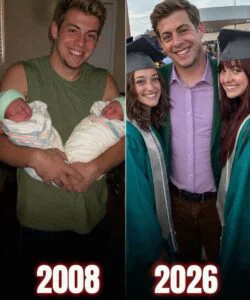
My wife walked away three days after our twin daughters were born and never came back. Eighteen years later, she appeared at their graduation with expensive gifts and a polished explanation for her absence. What she did not expect was that our daughters already knew the truth.
There was a box hidden in the back of my closet.
Lily and Grace did not know about it until they were sixteen.
Remember that.
They were only six hours old when Claire looked across the hospital room and said, “I can’t do this.”
At first, I thought she meant the exhaustion. The fear. The shock of suddenly being responsible for two tiny lives.
I reached for her hand and said, “We’ll figure it out.”
But Claire pulled away.
“You’re not listening,” she said.
Then she told me she wanted freedom. Travel. A career. A life that did not include motherhood.
“I’m not made for this, Daniel.”
Three days later, I came downstairs and found her suitcase gone. Her coat was gone too. The front door was unlocked.
She had left without saying goodbye to our daughters.
Not once.
I will never pretend raising twins alone was easy.
I was twenty-nine, working full-time, learning how to warm bottles, change diapers, survive sleepless nights, and hold two crying babies when I only had two arms.
My mother helped for the first few weeks. My sister took the girls on some weekends so I could sleep.
But most nights, it was just me.
Me and two little girls who needed everything.
As they grew, the hard moments changed.
Fevers.
School concerts.
Braided hair that looked terrible no matter how many tutorials I watched.
And questions.
Grace was seven when she asked, “Daddy, does Mommy ever think about us?”
I told her the only honest thing I could.
“I don’t know what she thinks, baby. But I know what I think about every morning.”
“What?”
“That you and Lily are the best thing I ever did.”
Whenever they struggled, I would remind them, “You were chosen this morning.”
They rolled their eyes as teenagers do.
But they always heard me.
When they asked about Claire, I never called her cruel. I told them, “Your mother made a choice she believed she needed to make. I made a different one.”
What I did not tell them was that, for years, I had written to her.
I sent photos.
Report cards.
Updates from school.
Part 2
A note when Grace won a spelling bee.
Another when Lily played violin at her concert.
I did it because I never wanted to be the reason they had no connection to their mother.
Some letters came back unopened.
Eventually, they all did.
I saved every returned envelope in that box.
When the girls turned sixteen, I showed it to them.
“I tried to keep the door open,” I said. “She never walked through it. That is not your fault.”
They said almost nothing.
But they understood.
Two years later came graduation night.
I was ready to cry in public.
The auditorium was full. My mother sat on one side of me, my sister on the other.
Then the principal announced that a generous donor had helped fund the celebration and wanted to surprise two graduates.
A woman in a dark suit walked onto the stage.
Everyone clapped.
I stopped.
Claire.
Eighteen years older, polished, confident, and still able to command a room.
She took the microphone and spoke about mistakes, growth, and second chances.
Then she looked toward the graduates.
“I want to invite two very special young women to the stage,” she said. “Lily and Grace. My daughters.”
The room murmured.
The girls stood.
Lily took Grace’s hand, and together they walked to the stage.
Claire held out two beautifully wrapped gift boxes.
Then she said the sentence that changed everything.
“Their father spent eighteen years keeping them from me. Tonight, that ends.”
The auditorium went silent.
Claire opened her arms.
Neither girl moved.
Then Grace took the microphone.
“Our father never turned us against you,” she said calmly.
The room froze.
“He sent you photos, school reports, letters, and pieces of our lives. He kept the ones that came back unopened. When we were old enough, he showed us—not to make us hate you, but so we would know the truth.”
Then Lily stepped forward.
“He never called you names,” she said. “When we asked about you, he said you made a choice. Then he made a different choice every day.”
She looked toward me.
“He raised us.”
Grace continued, “You gave birth to us. Dad stayed.”
Lily picked up the gift boxes and placed them back on the podium.
“We don’t need these,” she said. “You missed eighteen years. Gifts can’t fill that space.”
Neither of them cried.
Neither of them trembled.
They walked down from the stage and came straight to me.
One sat on each side.
Grace linked her arm through mine.
For a long moment, nobody spoke.
Then someone in the back began clapping.
The rest of the ceremony felt unreal.
Claire left before diplomas were handed out.
Part 3
I stopped watching the stage and watched my daughters instead.
Five days later, I helped them move into their dorms. Their colleges were close enough for visits but far enough for them to build separate lives.
That evening, I drove home alone for the first time in eighteen years.
In the passenger seat, they had left a card.
Inside was one sentence:
“You chose us every morning. That was everything. Love, Lily and Grace.”
I read it again and again.
Eighteen years of ordinary days do not feel heroic while you are living them.
Fevers.
Cereal bowls.
School concerts.
Bad braids.
Late nights on the kitchen floor.
But all those small moments build something.
They build children who can stand in front of hundreds of people and tell the truth without shaking.
I was still wearing my combat boots when my father made it painfully clear that my leg was not worth five thousand dollars to him.
The military clinic smelled like harsh bleach and old linoleum. It felt cold, sterile, and final — like the perfect place for a career to end.
The doctor had just said the word disability.
Not as a possibility.
As a warning.
If I did not get reconstructive surgery outside the base within the week, the damage to my knee could become permanent.
I sat on the narrow exam bed with my phone pressed against my ear. One boot was half unlaced. My knee was swollen so badly that the fabric of my fatigues stretched tight against my skin.
The injury had happened during a routine tactical movement.
No gunfire.
No heroic moment.
Just one wrong step under heavy gear, followed by a sickening pop and a flash of pain so bright I nearly passed out.
The medic had dropped beside me and ordered, “Do not move.”
Now the military doctors were telling me the earliest approval for the surgery would be six weeks away.
Six weeks meant a limp.
A discharge.
The end of everything I had built.
But a civilian surgeon could operate that Thursday.
The cost was five thousand dollars upfront.
My father, Richard, answered on the fourth ring.
Before he spoke, I heard champagne in the background. Glasses clinking. People laughing. My mother’s voice calling for more Bollinger.
“Hey, kiddo,” Dad said cheerfully. “You’re on speaker. We’re in the middle of a toast.”
“Dad,” I said, forcing my voice to stay steady. “I got hurt today. It’s serious.”
I explained everything.
The torn ligaments.
The risk of permanent damage.
The military delay.
The civilian surgery.
I told him I would pay him back with interest. I only needed help right now.
For one second, the noise behind him faded.
Then he sighed.
“Sweetheart,” he said in that calm, businesslike voice he used when rejecting people, “we just closed on the new yacht today. The Nautical Heritage. The timing is terrible.”
I closed my eyes.
“Dad. It’s my leg. If I don’t do this by Thursday, I may never walk normally again.”
“Well,” he said, taking a sip of his drink, “you’re young. You’ll adjust. There are plenty of desk jobs.”
Then my sister Chloe cut in.
Chloe, the golden child. The one whose failed boutiques and wellness businesses my parents always funded.
“Oh my god, Sarah,” she groaned. “Can’t you just take some painkillers? You’re ruining the mood. You’re the tough one. You always figure things out.”
Then she laughed.
I stared down at my bruised, swollen knee.
Permanent.
That word echoed in my head.
“I understand,” I whispered.
And I did.
I hung up without crying, without arguing, and sat alone in the humming silence of the clinic.
Two days later, I was trapped in my tiny apartment, moving on heavy crutches and trying to calculate my way out of disaster.
Credit cards.
Loans.
Selling my car.
Nothing was enough.
Then someone knocked on my door.
When I opened it, my older brother Marcus stood there in his grease-stained jacket. His eyes were tired, and his hands looked rough from years of mechanic work.
He looked at my braced leg.
“They didn’t help you,” he said.
It was not a question.
I shook my head.
Marcus stepped inside, reached into his jacket, and pulled out a thick bundle of cash.
“Eight hundred and forty dollars,” he said quietly.
My chest tightened.
“Marcus… where did this come from?”
He looked away.
“I sold Grandpa’s old Snap-on tool set. And I emptied the garage fund.”
“No,” I said immediately. “You need that money. You need those tools. That’s your dream.”
His eyes snapped back to mine.
“I need my sister walking. I can buy tools again someday. I can’t buy you another leg.”
On top of the cash was a lottery ticket.
“I bought it with the change from the pawn shop,” he said with a tired smile. “Maybe fate owes us one miracle.”
After he left, I sat there holding the cash and the ticket, feeling something hard and cold ignite inside me.
I would get the surgery.
But this was no longer only about saving my leg.
It was about balancing the debt.
PART 2
The loan office smelled like cheap coffee and desperation.
The man across from me wore a cheap suit and a smile that looked practiced. He explained the terms calmly, as if he were not asking me to trade my future for the right to walk.
The interest rate was brutal.
The repayment plan was a trap.
But I signed.
The next morning, I had the surgery.
When I woke up, my leg was wrapped in bandages and locked inside a heavy brace. The pain was sharp and deep, but it felt clean — like something broken had finally been put back in place.
The surgeon stood at the foot of my bed and said, “We got it just in time. If you commit to therapy, you can regain full mobility. No limp.”
Relief hit me so hard I almost cried.
Then reality followed.
I was financially ruined.
Three weeks later, the first loan payment drained almost my entire military paycheck. I had forty-seven dollars left. I ate rice and beans. I rationed medication. My apartment felt like a cage.
One night, while searching for a medical bill, I found Marcus’s lottery ticket in a drawer.
I had forgotten about it.
I smoothed it out on the kitchen counter and opened the lottery app.
The first number matched.
Then the second.
Then the third.
Fourth.
Fifth.
Powerball.
Every number.
For a moment, I thought the pain medicine was making me see things.
But the numbers were real.
It was not the massive national jackpot, but it was a secondary prize.
Two point four million dollars.
I sat in the dark for hours, listening to the refrigerator hum.
The universe had not only given me a miracle.
It had handed me power.
I did not call my parents.
I did not even call Marcus yet.
The next morning, I put on my uniform, strapped on my brace, grabbed my crutches, and went to the most ruthless corporate law firm downtown.
The attorney, Mr. Vance, had calm eyes and a shark’s patience.
I placed the winning ticket on his desk.
“I have two goals,” I said. “First, I want this claimed anonymously through a blind trust. My assets must be protected.”
He nodded.
“And the second?”
“I want a full forensic investigation into my parents’ finances. I want to know exactly how strong their empire really is.”
Three days later, his report arrived.
The truth was pathetic.
My parents were not rich.
They were pretending.
Their big colonial house was buried under debt. They had refinanced it multiple times to support Chloe’s failing businesses. They were behind on the mortgage. The yacht had been bought with a dangerous loan. Chloe’s wellness studio was bleeding money.
They refused me five thousand dollars to save my leg while burning tens of thousands to look wealthy.
I called Mr. Vance.
“Can we buy their distressed debt?”
“Yes,” he said. “Through your LLC, we can purchase the mortgage and commercial credit lines for far less than their face value.”
“Good,” I said, looking at the scar on my knee. “I don’t want to rescue them. I want to own the roof over their heads.”
Within days, Apex Holdings LLC was created.
Through intermediaries, we bought the debt on the house, the yacht, and Chloe’s business.
Then came the trap.
A private representative approached my father with a solution: a sale-and-leaseback agreement. My parents could keep living in the house, keep using the yacht, and receive a small cash injection.
In exchange, Apex Holdings would own everything.
They would simply lease it back.
For people obsessed with appearances, it was irresistible.
They could avoid public foreclosure.
They could keep pretending.
On page forty-two of the contract, Mr. Vance included the clause I requested.
Any late payment over twelve hours, any misuse of the credit line, any breach of terms — immediate termination.
No grace period.
No appeal.
No mercy.
I watched the digital document from Vance’s office.
My father signed.
Then my mother signed.
They had handed their lives to the daughter they had abandoned.
And they had no idea.
Over the next months, I rebuilt myself.
Physical therapy was brutal. My therapist, Davis, was a veteran who pushed me past every excuse.
“You have to teach your body not to protect the injury,” he told me. “You have to make the muscle remember who you are.”
So I did.
Every painful step reminded me of champagne glasses on the phone.
Every lunge reminded me of Marcus selling his dream for me.
I pushed harder.
Meanwhile, my parents acted as if nothing had changed.
They told their country club friends they had “strategically restructured” their assets.
Chloe posted photos from the yacht.
They looked proud.
They thought they had won.
They did not know they were tenants living on my time.
Then Thanksgiving approached.
In my family, Thanksgiving was not about gratitude. It was a performance of money, status, and superiority.
That year, my parents planned a huge gala to celebrate their “financial comeback.”
My father even called me.
“We’re having a gathering,” he said. “A gala, really. You should hobble on over.”
Hobble on over.
“I’ll see if I can make it,” I replied.
Two days before the party, Chloe used the restricted business credit line to pay a huge catering bill.
That was a direct violation.
Then my father missed the lease payment deadline.
At 12:01 a.m., the system flagged both breaches.
The trap closed.
Mr. Vance called me the next morning.
“We can send the eviction and asset seizure notices immediately.”
I looked out at the gray sky.
“No,” I said. “Print them on heavy legal stock. Put them in a leather folio.”
“Where should they be delivered?”
“They won’t be delivered,” I said. “I’ll serve them myself. Tomorrow night. At the gala.”
PART 3
On Thanksgiving evening, I drove to my childhood home in a black sedan.
The estate glowed with expensive lights. Valets rushed between luxury cars. Jazz music floated through the open doors.
I sat for a moment and placed my hand on my reconstructed knee.
No brace.
No crutches.
No limp.
Only strength.
Then I picked up the leather folio and stepped out of the car.
I wore a midnight-blue silk gown and four-inch heels.
I walked up the stone path like a soldier entering a battlefield she already owned.
Inside, the house smelled of flowers, roasted food, perfume, and money.
My mother stood near the fireplace, covered in diamonds.
Chloe posed near the bar.
And my father stood on a small platform, tapping a spoon against his glass.
“Friends, family, esteemed guests,” he announced. “This year has proven our resilience. Our family legacy is stronger and more prosperous than ever.”
Applause filled the room.
Then I spoke.
“That is a fascinating view of value, Richard.”
My voice was not loud, but it cut through the room.
Everyone turned.
I walked down the center of the ballroom, my heels striking the marble floor.
Click.
Click.
Click.
My family stared.
They had expected a broken daughter.
They saw a woman standing perfectly straight.
“Sarah?” my mother gasped. “How are you walking like that?”
I ignored her and looked at my father.
“I recovered, Dad. No thanks to you.”
Then I placed the leather folio on the table.
“I came to discuss your strategic growth.”
My father’s face darkened.
“You are embarrassing yourself.”
“No,” I said. “I am the intermediary.”
I opened the folder.
“Five months ago, you signed a sale-and-leaseback agreement with Apex Holdings. You sold this house. You sold the yacht. You leveraged Chloe’s business.”
The room began to whisper.
My mother stepped forward, panicked.
“This is private family business.”
“It stopped being private when you missed your lease payment yesterday,” I said. “And when Chloe illegally charged fifty thousand dollars of catering to a restricted commercial credit line.”
Chloe dropped her champagne glass.
It shattered on the marble.
“How do you know that?” she whispered.
I smiled.
“Because I am Apex Holdings.”
The room went silent.
“I bought your debt when the banks were ready to foreclose. I own this house. I own the yacht. I own the business.”
My father stared at me, finally understanding.
Then his mask shattered.
“You ungrateful little—”
He lunged at me, raising his hand to strike.
Gasps erupted.
But I was a soldier.
I caught his wrist in midair.
I did not flinch.
I twisted, shoved his arm back, and sent him stumbling into the table.
White roses scattered across the floor.
He looked up at me in terror.
“You don’t get to touch me anymore,” I said quietly. “You don’t get to decide my worth. You thought my leg wasn’t worth five thousand dollars. So I bought your entire life for pennies.”
I dropped the eviction notice onto his chest.
“You have until 8:00 a.m. Monday to leave my property.”
Then I walked out.
No one stopped me.
The next morning, I drove to Marcus’s repair shop.
It was early. The air was cold. The shop smelled like oil, metal, and honest work.
Marcus rolled out from under a truck and froze when he saw me standing without crutches.
A smile spread across his tired face.
“Look at you,” he whispered.
He hugged me so tightly I nearly broke.
“It worked,” I said. “The surgery worked.”
“I knew it would,” he said. “You’re the strongest person I know.”
I handed him coffee.
“Come with me. I want to show you something.”
We walked two blocks to a newly renovated automotive building with glass bay doors, fresh brick, and an empty sign waiting above the entrance.
Marcus stared.
“Some chain bought the old warehouse,” he said. “Places like this will put guys like me out of business.”
“It’s not a chain,” I said.
I pulled a heavy set of keys from my pocket and handed them to him.
“Read the tag.”
His thumb moved over the engraved metal.
“Sterling & Grandson Automotive,” he whispered.
He looked at me, stunned.
“That lottery ticket you bought with the change from Grandpa’s tools,” I said, tears finally slipping down my face. “It won. Two point four million.”
“You won?” he breathed.
“We won,” I corrected. “I bought you this garage. Fully equipped. The deed is in your name. You will never have to sell your dream for anyone again.”
Marcus dropped to his knees on the sidewalk, crying into his hands.
I knelt beside him.
“You showed up when I was bleeding,” I said. “You were the only one.”
He looked at me.
“What about Mom and Dad?”
I thought of the mansion, the eviction notice, the empire collapsing under its own lies.
“They know,” I said softly. “But they don’t live in our world anymore.”
By Monday morning, there were no loopholes left.
My parents were evicted.
The yacht was seized.
Chloe’s business collapsed.
Their social circle learned the truth.
They called me, first angry, then desperate, then begging.
I did not answer.
I sold the house to a family who wanted to fill it with warmth.
I sold the yacht.
I invested more into Marcus’s garage, which became the best independent auto shop in the county within six months.
I finished my military contract and left honorably, walking off base without a limp.
Now I work from the office above Marcus’s busy garage, helping run the business.
The smell of oil and metal rises through the floorboards.
It smells like loyalty.
It smells like home.
That year taught me one truth I will never forget.
Family is not blood.
Family is who stands beside you when you are broken.
Family is who sells his tools so you can walk again.
I did not ruin my parents.
I simply held up a mirror.
And let them collapse beneath their own reflection.
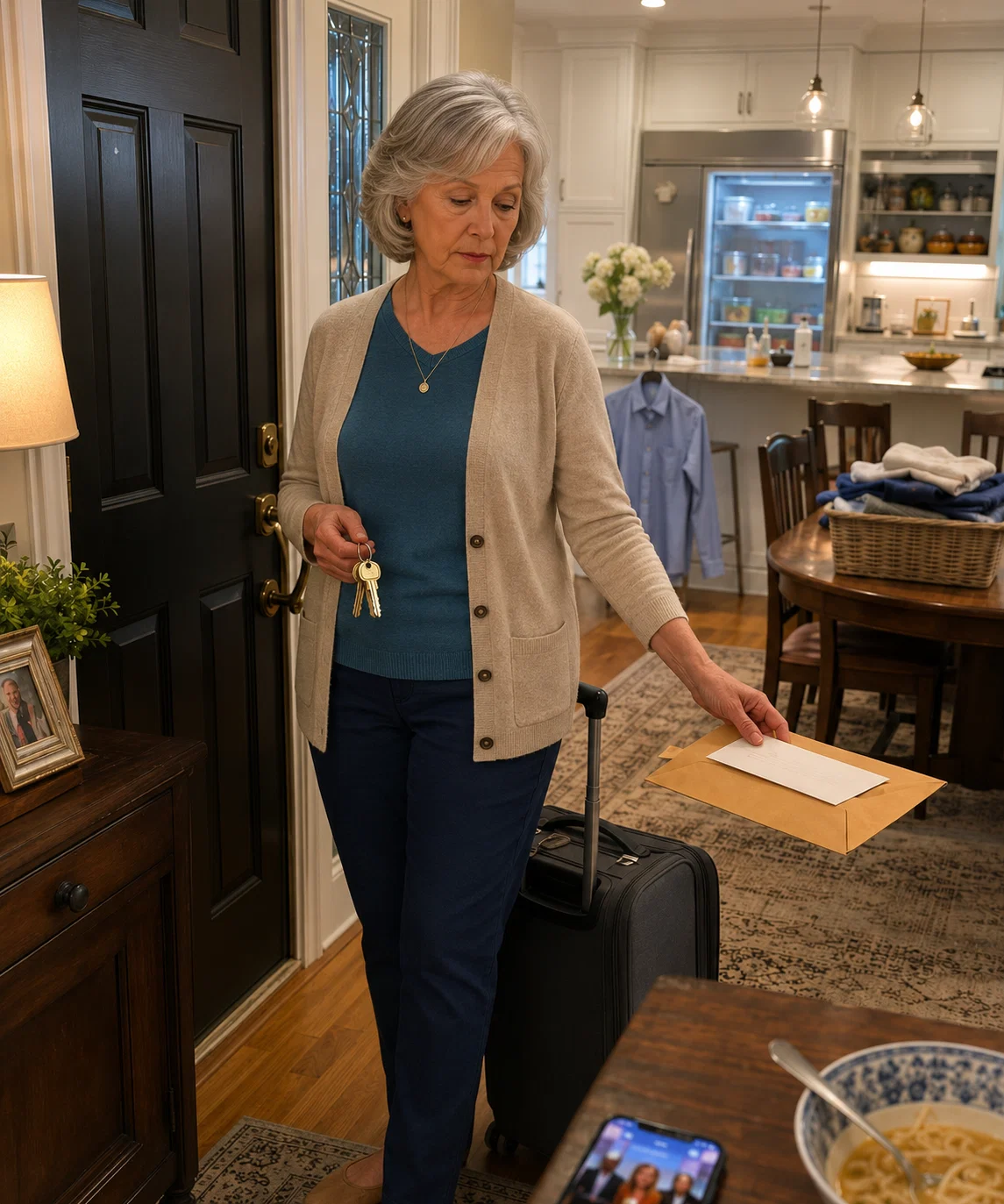
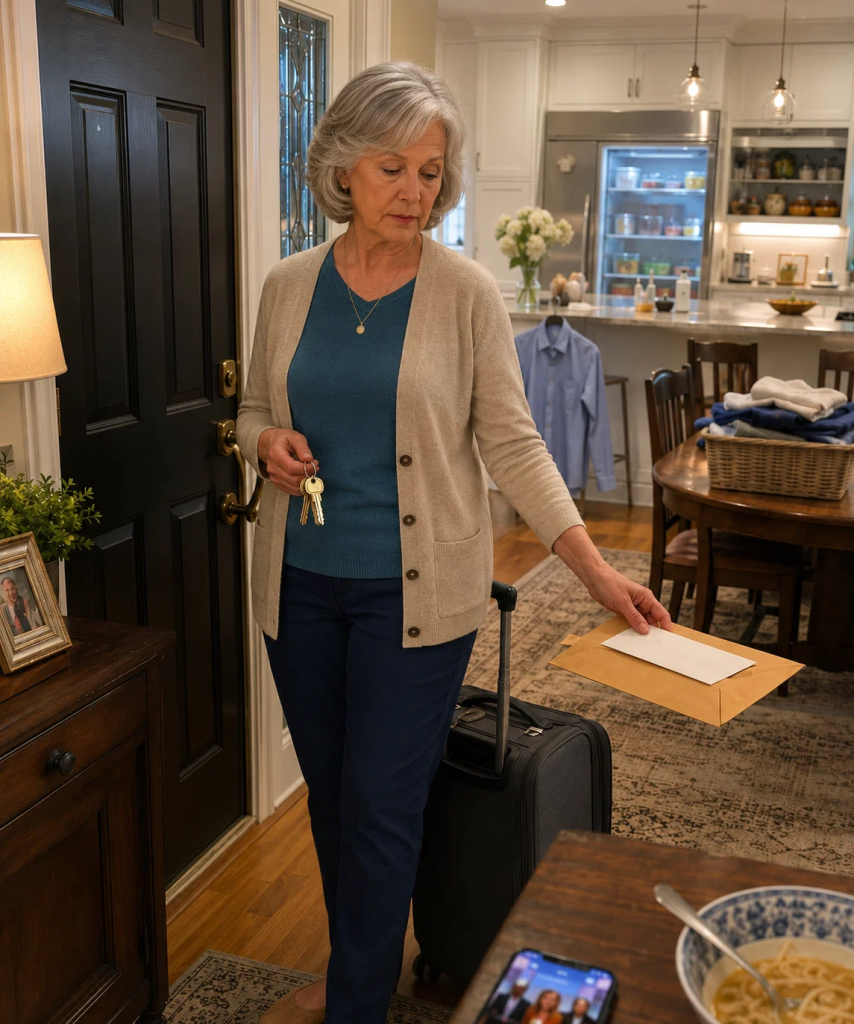
The message arrived at 9:30 p.m. while I sat alone at the kitchen table, staring at a bowl of soup I no longer wanted.
The house smelled sharply of cleaner. I had spent the whole afternoon scrubbing floors, washing counters, ironing my son’s shirts, folding my grandchildren’s clothes, and sweeping the patio twice because the wind kept blowing leaves across it.
When my phone buzzed, a foolish part of me hoped it was Daniel saying they had saved me a seat.
Instead, it was Emily.
*Don’t forget to heat the leftovers in the fridge. Don’t let them go bad.*
I read the message again and again.
The words looked harmless, but I knew what they meant.
While I sat alone with instant soup, they were somewhere bright and expensive, celebrating without me. The only thought they spared for me was whether I would reheat their food.
I opened Instagram, even though I knew I shouldn’t.
There they were.
My son in the shirt I had ironed that morning. Emily in a red dress, smiling with champagne in her hand. My grandchildren eating shrimp. Emily’s mother, her sister, and several relatives were gathered around a restaurant table set for nine.
The caption praised “queens who never stop.”
I closed the app.
And strangely, I did not cry.
A cold clarity settled over me.
I stood, walked to my bedroom, and opened my closet.
Because what they did not know was that I had been preparing for this moment for months.
And I was not going to spend that night heating their leftovers.
I was going to leave.
Part 2
Three years earlier, my husband David died of pancreatic cancer. It happened so fast that I barely had time to understand I was losing him. After more than forty years of marriage, I was left alone in the house where we had built our life.
Two weeks after the funeral, my son Daniel and his wife Emily came to see me.
They said they needed a bigger house for the children but were short on the down payment.
“If you sell this place, Mom, you can live with us,” Daniel said. “You won’t be alone anymore.”
Emily smiled and called it a family arrangement.
I wanted so badly to believe them.
So I sold the home David and I had shared for decades.
I gave Daniel most of the money for the new house and kept only a small amount for myself. What I failed to do was insist that my name be placed clearly on the deed in a way everyone respected.
The new house was beautiful, modern, and cold.
At first, I tried to make the best of it.
I woke early, cooked breakfast, helped the children get ready, cleaned the kitchen, did laundry, and kept the house running.
But Emily never treated me like family.
She called me “Mother-in-law,” never Betty.
She inspected my cleaning, criticized the way I folded clothes, complained about mirrors and detergent, and spoke to me like I was hired help.
The children loved me, and that was the only part of the house that felt real.
Sarah fell asleep against me while I read to her. Michael hugged me after school.
But Emily hated seeing that closeness.
One night, I heard her call me “the maid who doesn’t pay rent.”
I waited for Daniel to defend me.
He did not.
That silence hurt more than Emily’s words.
Over time, I disappeared inside that house.
Family photos no longer included me. At Christmas, Emily handed me the camera instead of inviting me into the picture. She introduced me as “Daniel’s mother who helps around the house.”
I became a ghost who cooked, cleaned, and kept everything together.
Then came Emily’s promotion dinner.
That morning, she announced she had been made regional operations manager. I congratulated her sincerely. Daniel said they would celebrate at Skyline Grill, an expensive restaurant downtown.
I asked what time I should make the reservation.
The silence told me everything.
Emily explained it would be an intimate dinner for “direct family only.”
Daniel said nothing.
They left me behind to watch the house.
That night, after seeing the photos online and receiving the leftovers text, something inside me finally broke.
But my leaving was not sudden.
For six months, I had been keeping records.
Receipts.
Bank transfers.
Mortgage contributions.
Furniture payments.
Appliances.
Renovations.
Every dollar I had put into that house.
When I added it all up, the total was $136,800.
Almost everything I had left from selling my old home.
And then there was the deed.
When the house was purchased, the notary had advised that because I had provided the down payment, the property should initially remain in my name for protection.
Daniel agreed at the time.
We never transferred it.
So the house Emily treated me like a servant in was legally mine.
That night, I called my niece Megan, a family lawyer. I called Hector, the notary who had handled David’s affairs for years. Then I called my old friend Linda and asked whether her spare room was still available.
By midnight, my suitcase was packed.
I took my clothes, David’s photos, my mother’s rosary, and a few things that truly mattered.
I left the furniture, the appliances, and the expensive things behind.
On Daniel’s pillow, I placed a letter explaining that I would no longer be the invisible woman holding their household together while being excluded from it.
Beside the letter, I placed the deed and proof of every dollar I had paid.
Then I locked the door and left with the key.
When they came home after one in the morning, they called my name and found silence.
Daniel discovered my empty room, the letter, and the documents.
Emily went pale when she realized what they meant.
They called me more than twenty times that night.
I did not answer.
For the first time in years, I slept peacefully at Linda’s house.
The legal process moved quickly because the truth was clear.
Megan helped me organize everything: the deed, receipts, bank records, and even recordings I had made when Emily thought I was not listening.
In those recordings, Emily called me a free maid. She joked about sending me to a cheap nursing home once I was no longer useful.
When Daniel heard those words, something in him collapsed.
He finally understood what his silence had allowed.
I could have evicted them.
I could have demanded repayment and damages.
But I did not want revenge.
I wanted respect.
Part 3
With Megan’s help, we reached an agreement. I kept majority ownership of the house. Daniel and Emily kept a smaller share. I also rented part of the home to a widowed teacher named Teresa and her two teenagers, giving them a stable place to live.
Daniel and I began therapy together.
Emily started therapy too.
Slowly, things changed.
Daniel called me to ask how I was, not just about bills or the house. He brought me flowers one afternoon and told me he loved me. In therapy, he admitted that keeping peace with Emily had felt easier than protecting me.
Emily later came to me with a plan to buy back my share of the house fairly over five years.
I accepted.
Now I live in a small apartment in the old part of town. I teach knitting at the community center and walk with Linda every morning.
Daniel visits every Sunday, sometimes with the children, sometimes alone.
Things are not perfect.
Some cracks never fully disappear.
But what I have now is honest.
One day, my grandson asked if I regretted leaving that night.
I told him no.
Leaving was not revenge.
It was the moment I remembered I was not disposable.
Sarah later drew me a picture. In it, I was standing outside a house with a suitcase in my hand and a smile on my face.
Underneath, she wrote that I was the bravest woman she knew.
I framed it and hung it on my wall.
It is the first picture of myself I have displayed in years.
Every morning, I look at it and remember this:
Staying where you are invisible is not loyalty.
Sometimes the bravest thing you can do is leave.
And the night I walked out, with their leftovers still sitting in the fridge, was the night I finally became visible again.
My mother told me that if I was going to live under her roof, I needed to pay rent. Instead of arguing, I silently left. She thought she had taught me a lesson, but within seven days, everything she relied on began falling apart.
My mother told me to start paying rent on a Tuesday evening while I was standing at the stove cooking dinner for the whole family.
I was twenty-nine and had moved back into our house just outside Nashville after my father passed away. My mother, Linda, said she needed support raising my fifteen-year-old brother, Owen, and keeping the home from falling into chaos. For two years, I bought food, covered the electric bill, drove Owen to school, and managed every appointment related to his epilepsy.
I never described any of it as rent.
That night, my older brother, Tyler, sat at the table scrolling on his phone while Mom listed all the things she claimed he contributed. She said he paid the mortgage, handled repairs, and helped with Owen’s medical expenses.
None of it was true.
Tyler had not had a job in eight months. The mortgage was paid from my account. So were the insurance, utilities, and most of the groceries.
“If you live here, you pay rent,” Mom said. “Seven hundred dollars a month, starting Friday.”
I looked over at Tyler. He said nothing to correct her.
“How much do you think I already pay?” I asked.
Mom laughed. “Buying groceries sometimes does not make you a provider.”
I switched off the stove.
“Okay.”
She was waiting for a fight. Instead, I packed two suitcases, my work laptop, and the folder that held every household bill. My friend Rachel had offered me her spare bedroom months before. I called her and left that same night.
Before I walked out, Owen wrapped his arms around me and whispered, “Who will remember my medicine?”
I promised him I would keep checking in.
Mom crossed her arms at the front door. “You’ll be back when you realize how expensive the real world is.”
Seven days later, she called me twenty-three times.
The electricity had been disconnected. The mortgage payment had failed. Owen had missed an appointment with his neurologist, and no one had submitted his prescription refill. Tyler’s truck had been repossessed because the payment he claimed he made himself had actually been coming from my account.
Then Mom left a voicemail.
“Come home now. Everything is falling apart.”
I called Owen before anyone else. He was safe at our aunt’s house.
Then I opened my banking app and removed my card from every account connected to the household.
That was when a fraud alert appeared.
Someone had just attempted to take out a twenty-five-thousand-dollar loan using my name.
The application used my mother’s address.
And Tyler’s phone number was listed as the main contact…..
Part 2
The loan application had been filed less than an hour after Mom’s last voicemail.
I froze my credit, contacted the lender, and called Detective Sarah Nguyen, whose phone number was included in the confirmation email from the fraud department. She asked if Tyler had access to my Social Security number, tax documents, or electronic signature.
He had access to all of them.
When I moved back home, I had placed my important papers in a locked file cabinet in my bedroom. Tyler knew where the spare key was because Mom had once asked him to get Owen’s insurance card during an emergency.
The detective told me not to confront anyone.
The following morning, I met attorney Daniel Brooks and brought two years of bank statements with me. He looked through the payments and told me something I had never fully understood: I was not an adult dependent living in the house for free. I was the person financially holding the household up.
Over twenty-four months, I had paid more than forty-eight thousand dollars toward the mortgage, utilities, groceries, repairs, and Owen’s care. Tyler had paid almost nothing. Still, Mom had regularly moved money into his account and marked those transfers “mortgage reimbursement.”
The pattern made it appear as if Tyler was the one covering the household expenses.
Then Daniel discovered another issue.
The house had been jointly owned by my parents. After Dad died, his will left his half to all three children: Tyler, Owen, and me. Mom had never told us. She had continued acting as if the property belonged only to her.
My share of ownership was small, but legally important. She could not take out a new home-equity loan, sell the property, or change the title without proper consent.
Two months earlier, a document had been filed claiming that I had transferred my interest to Mom for one dollar.
The signature was forged.
Tyler had not only attempted to open a personal loan under my name. He and Mom had been preparing to borrow against the house while relying on my income history to qualify.
When Detective Nguyen questioned them separately, their stories fell apart.
Mom said Tyler had handled the documents and promised her everything was legal. Tyler said Mom told him I had agreed to give up my share because I “owed the family” for living there.
Neither one of them could explain why the transfer form was dated on a day when I was at a work conference in Denver.
Meanwhile, Owen’s school counselor called me. Since I had left, Mom had forgotten his medication twice and blamed him for not reminding her. My aunt Karen had taken him in temporarily, but Mom wanted him back because his disability benefit helped pay household expenses.
That benefit was another hidden truth.
For years, Mom had been receiving a monthly payment intended for Owen’s medical and educational needs. Very little of it had actually been used for him. Bank records showed repeated transfers to Tyler for gambling apps, truck payments, and credit card debt.
I asked Daniel what options I had.
He helped me file a petition for temporary guardianship of Owen and a full accounting of the benefit money. Aunt Karen agreed to give him a stable home until the matter was resolved.
Mom showed up at the hearing furious.
“You left us with nothing,” she said in the hallway.
“No,” I answered. “I left you with everything you claimed you were paying for.”
Then Detective Nguyen stepped out of the courtroom holding an arrest warrant for Tyler.
Part 3
Tyler was arrested for attempted identity theft, forgery, and submitting fraudulent loan paperwork.
At first, Mom blamed me for everything.
She called relatives and claimed I had abandoned the family, taken Owen away, and sent my brother to jail over a simple misunderstanding. Several people believed her version and repeated it without ever asking for mine.
Then the lender released the recorded verification call.
Tyler had pretended to be a financial adviser assisting me with the loan. In the background, Mom could be heard confirming my date of birth and telling him to use my work email because it “looked more reliable.”
The recording destroyed her claim that she had known nothing.
Investigators searched Tyler’s apartment and found copies of my tax returns, the forged property transfer, and a notebook filled with passwords to my banking and credit accounts. They also found paperwork showing he had tried to secure another loan by using Owen’s disability benefit as income.
Mom was charged with conspiracy, forgery, and misuse of benefit funds.
The guardianship case revealed the full extent of the damage.
Over four years, almost thirty-six thousand dollars from Owen’s benefit account had been used for expenses that had nothing to do with him. His therapy appointments had been reduced, his medical equipment had not been replaced, and his school support services had gone unpaid while Mom covered Tyler’s debts.
She cried when the judge asked her why.
“He needed more help,” she said, pointing toward Tyler.
Owen sat beside Aunt Karen and stared down at the floor.
That answer ended any possibility of the court returning him to her care.
Karen was granted permanent guardianship. I continued handling Owen’s medical schedule and set up a supervised account for his benefits. He started therapy and joined an after-school music program he had wanted to attend for years.
The house went into foreclosure because Mom could not keep up the payments without my money. Daniel helped me protect my inherited share, but after the hidden loans and unpaid bills were settled, there was not enough equity left to save the property.
I did not buy it back.
For years, I had mistaken saving the house for saving the family. That building had become a place where my work vanished, Tyler’s lies were treated as truth, and Owen’s needs were always pushed aside.
Tyler took a plea deal that required restitution, probation after jail, and treatment for gambling addiction. Mom also pleaded guilty. She avoided a lengthy prison sentence but received supervised probation, financial restrictions, and an order requiring her to repay Owen’s account.
At sentencing, she looked at me and said, “You could have prevented all of this by coming home.”
The judge answered before I had the chance.
“Her refusal to continue financing fraud did not cause this. Your decisions did.”
Six months later, I signed a lease for a small two-bedroom apartment near Karen’s house. Owen stayed with me on weekends. The second bedroom belonged to him, decorated with music posters and a locked cabinet for his medication.
One Sunday, while we were making pancakes, he asked if I regretted leaving.
I thought about the shutoff notice, the forged documents, and Mom’s twenty-three calls demanding that I fix a life she claimed I did nothing to support.
“No,” I said. “I regret waiting so long.”
Mom had told me adults had to pay for the privilege of having a home.
She had been right about one thing.
A real home did require contribution.
But contribution was not just money. It was honesty, care, responsibility, and respect.
I had given all four until there was nothing left in me.
Leaving did not destroy the household.
It only revealed who had been keeping it standing.
On the second day after our wedding, I told my sister-in-law to wash the dishes. My husband slapped me and said, “How dare you order her around!” What I did next made his entire family fall to their knees and beg me to forgive them.
The slap landed before the wedding flowers even had time to droop. On the second morning of my marriage, my husband hit me across the face because I asked his sister to clean the dishes she had used.
For one frozen second, the kitchen went completely quiet.
Then Vanessa, my brand-new sister-in-law, rested against the marble island and smiled.
“How dare you order her around?” Daniel shouted. His palm was still lifted, his gold wedding band catching the chandelier light. “She is my sister. You are the wife. Know your place.”
My cheek stung, but the humiliation cut deeper. Daniel’s mother, Margaret, sat at the breakfast table and watched without the slightest surprise. His father folded his newspaper with a tired sigh, as if I had merely disturbed his morning routine. Vanessa lifted her coffee cup and slowly poured what remained inside onto the floor.
“Clean that too,” she said.
Only forty-eight hours earlier, they had raised glasses and welcomed me as family. Now the masks were gone.
Daniel had persuaded me to hold our wedding at his family’s enormous lakefront estate. He told me they were traditional but affectionate. He also urged me to take a full month away from work, silence my business notifications, and “learn how to be part of a real family.”
What he did not know was that I had learned long ago how to identify a trap.
I did not cry. I did not scream. I touched my lip slowly, tasted blood, and looked straight at the security camera above the pantry door.
Margaret followed my eyes and laughed. “Those cameras belong to us.”
“No,” I said quietly. “They don’t.”
Daniel caught my wrist. “What did you say?”
I freed my hand and set my wedding ring on the wet countertop.
“I said nothing important.”
His family mistook my calm for defeat. Vanessa asked for pancakes. Margaret instructed me to mop the floor. Daniel warned me that if I embarrassed him again, the next lesson would be worse.
I picked up my phone and sent a single message to a contact saved only as Evelyn Shaw.
Activate the marital protection protocol. Preserve all recordings. Freeze every discretionary transfer connected to Daniel Cole and Cole Hospitality.
The reply came back eleven seconds later.
Confirmed, Ms. Vale. Counsel, security, and the bank are moving now.
Daniel believed I was a mid-level consultant who had somehow married above her station. His family believed the mansion, their restaurants, and the comfortable life they enjoyed belonged to them.
They had never bothered to learn the legal name of the private investment company that owned all three.
Vale Meridian Holdings.
My company.
I had concealed my identity after years of watching wealthy men perform kindness in front of investors and cruelty in front of employees. Daniel had passed every public test. That morning, behind closed doors, he finally showed me the truth I needed.
Completely.
Part 2
By noon, Daniel’s confidence had turned almost theatrical.
He called the household staff together, fired the housekeeper for “encouraging my attitude,” and declared that I would handle every household chore until I learned respect. Margaret took my car keys. Vanessa posted a photo from our wedding with the caption, “Some women marry into class but never acquire it.”
I watched them grow careless.
When Daniel left the kitchen, I quietly apologized to the housekeeper, Rosa, and asked if she would be willing to give an honest statement about what she had seen. Tears filled her eyes.
“Mrs. Cole, this is not the first time,” she whispered. “His former fiancée left after he broke her wrist. They paid her.”
That was the sign I had feared and needed at the same time.
I sent Rosa’s statement to Evelyn, my general counsel. Then I took a picture of the bruise forming under my eye and called the police from the library. I did not request an immediate public spectacle. I asked for documentation, a medical exam, and an escort in case the family became violent again.
Daniel found me before the officers arrived.
“You called someone?” he demanded.
“My lawyer.”
He laughed so loudly that Margaret and Vanessa rushed in. “Your lawyer? With what money?”
Margaret snatched my phone, but before she could throw it, the screen lit up. A banking notification appeared.
I held Daniel’s gaze. “The company that owns this house.”
His laughter stopped.
For three years, Vale Meridian had quietly kept Cole Hospitality from collapsing. Daniel’s father had borrowed against failing restaurants, exaggerated revenues, and spent company funds on personal luxuries. My acquisition team had purchased the debt through intermediaries, then taken control of the properties when the family defaulted. They were allowed to continue operating under strict conditions.
Daniel knew an investment group controlled the business. He simply had no idea that I controlled the investment group.
His father rushed into the room, clutching his laptop. “Our accounts are frozen.”
“Only the accounts funded with company money,” I said. “Your personal funds remain available, assuming they are truly personal.”
Margaret’s voice fell to a whisper. “Who are you?”
Before I could respond, the front gates opened. Two police vehicles came up the drive, followed by a black sedan carrying Evelyn and three members of my corporate security team.
Daniel’s face hardened. Panic made him dangerous.
“You planned this,” he snarled, advancing on me. “You married me to steal my family’s company.”
“The company was already mine.”
He raised his hand again.
This time, Rosa stepped between us, and the security camera recorded every second. Officers entered just as Daniel shoved her aside.
He was in handcuffs before his mother even finished screaming.
Still, Margaret believed money could undo anything. As Daniel was led away, she pointed at me and hissed, “We will destroy your reputation.”
Evelyn opened her leather folder.
“Then tomorrow’s board meeting,” she said, “should be unforgettable. For your family.”
Part 3
The next morning, the Cole family entered the boardroom expecting to negotiate.
Instead, they found twelve directors, two forensic accountants, outside counsel, and a wall-sized screen showing years of unauthorized transfers. I sat at the head of the table with the bruise on my cheek uncovered.
Daniel had been released while charges were pending. He arrived beside his parents and Vanessa, still convinced that consequences were for other people.
Then Evelyn began.
She presented evidence proving Daniel’s father had diverted restaurant payroll funds to support the lake house, luxury cars, and Vanessa’s failed fashion boutique. Margaret had submitted false consulting invoices. Vanessa had charged vacations to employee training budgets. Daniel had sold supplier contracts to companies owned by his friends and collected kickbacks.
Every claim was backed by bank records, approvals, emails, and camera footage preserved from company systems.
Daniel pointed at me. “She obtained this illegally. She was spying on us.”
“The audits began eighteen months before your marriage,” Evelyn replied. “Ms. Vale delayed enforcement because she believed you might help reform the company.”
I looked directly at him. “I loved the man you pretended to be.”
For the first time, a flicker of shame crossed his face. Then Evelyn played the kitchen recording.
The slap rang through the speakers.
Vanessa’s voice followed: Clean that too.
No one in the boardroom moved.
I stated the consequences calmly. Daniel and his father were terminated for cause. Civil recovery proceedings would begin that afternoon. Their company housing and vehicles had to be surrendered within seventy-two hours. Margaret and Vanessa were permanently barred from all Vale Meridian properties. Evidence of fraud would be forwarded to prosecutors, while Rosa’s assault complaint and my battery complaint would continue separately.
Margaret’s arrogance collapsed.
She hurried around the table and dropped to her knees. Daniel’s father followed. Vanessa began sobbing, then knelt beside them.
“Please,” Margaret begged, gripping my sleeve. “We are your family.”
“You watched your son hit me,” I said. “Then you ordered me to clean the floor.”
Daniel knelt last.
“I made a mistake,” he whispered. “Withdraw the complaint. Save the business. We can start again.”
I removed his hand from my chair.
“No. You made a choice because you thought I was powerless.”
I filed for annulment that afternoon.
Eight months later, Daniel pleaded guilty to assault and commercial bribery. His father received a prison sentence for fraud. Margaret sold her jewelry to satisfy part of the civil judgment, while Vanessa shut down her boutique and found work under a name no longer protected by influence.
Rosa became the director of employee welfare for the rebuilt restaurant group.
As for me, I moved into a home overlooking the ocean and transformed Cole Hospitality into Vale House, a company with protected wages, independent reporting channels, and zero tolerance for abuse.
On my first morning there, I washed one coffee cup, set it beside the sink, and watched sunlight stretch across the water.
No shouting. No fear. No one ordering anyone to kneel.
Valeria Salgado found the wedding invitation on a Tuesday, at the exact moment she was putting away the dress she had never had the chance to wear.
The envelope was cream with gold lettering, and it carried a sugary perfume that made her feel sick.
“With joy, we invite you to celebrate the marriage of Camila Salgado and Mauricio Ledesma…”
Valeria read the two names again.
Camila was her little sister. Mauricio was the man who used to be her fiancé.
The same Mauricio who, one year earlier, had asked her to marry him at an expensive restaurant in Polanco, with live music, champagne, and their entire family clapping as though they were witnessing the start of a flawless future. The same Mauricio who, only four months later, invited her to a café in Santa Fe so he could destroy her heart without even looking uncomfortable.
“Valeria, don’t take this the wrong way,” he had said, fixing his watch. “But my career is taking off. I’m entering highly influential circles now. I need a wife who properly projects my image.”
She had stared at him, completely lost. “Your image?”
Mauricio released a sigh, pretending the truth was hurting him too, acting as though he was being painfully “honest.”
“You’ve gained weight. You don’t dress up the way you used to. Camila understands that environment better. She’s just more… presentable.”
That word struck her like a slap.
But losing him was not the part that wounded her most. The worst part was realizing her own family had already known.
That night, at her parents’ home in the Del Valle neighborhood, Valeria walked in and found Camila seated beside Mauricio, calmly drinking coffee with her mother, Doña Beatriz, as though nothing had happened at all.
“Don’t make a drama out of this, mija,” her mother said with a careless wave of dismissal. “Camila is young, beautiful, and has opportunities ahead of her. You’ve always been the strong one. You can handle this.”
Valeria did not scream. She did not throw anything. She simply took off the engagement ring in front of all of them, slammed it onto the table, and walked out with fire burning in her throat.
For weeks afterward, she ignored messages. She buried herself in work, silence, and humiliation.
Then the invitation came.
The wedding would take place at an elegant hacienda in Valle de Bravo, with three hundred guests, mariachis, fireworks, and a private mass.
Her mother sent a voice note: “Valeria, please attend. People will gossip if you’re not there. Besides, it’s time to get over it, mija.”
That evening, Valeria left her apartment without knowing where she was going. Somehow, she ended up in the bar of a luxury hotel on Reforma, dressed in a simple black dress, her eyes full of tears she refused to let fall.
She ordered mezcal.
She had not even lifted the glass when a man in a blue suit walked up to her table.
“Hey, doll, mind moving?” he said with a smug little smirk. “I need this table for some important people. You can go sit over there, out of the way.”
Valeria looked up at him. “I was here first.”
The man gave a short laugh. “Oh, don’t be so dramatic. With a body like that, you’re taking up extra space anyway, don’t you think?”
Valeria felt everything around her turn still. It was Mauricio again. It was Camila. It was her mother. It was every humiliation she had swallowed, returning in another man’s voice.
Before she could respond, another voice came from behind him.
“Apologize.”
The voice was deep, controlled, and dangerously calm.
The man turned, clearly irritated, but the instant he saw who stood behind him, all color drained from his face.
It was Damián Robles.
Valeria recognized him at once. He was a private security magnate, the owner of luxury hotels, construction companies, and elite clubs. He was the sort of man people in Mexico discussed in lowered voices. Some claimed he was a billionaire. Others murmured that he was far more dangerous than wealth alone.
“Mr. Robles… I didn’t know you—”
“Now you know,” Damián interrupted. “Apologize to the lady.”
The man stumbled through a panicked apology and practically fled the bar.
Valeria drew in a steady breath. “I didn’t need you to defend me.”
Damián looked at her without flinching. “I didn’t do it because you couldn’t. I did it because cowards bore me.”
A sad laugh escaped her. She did not understand why, but she ended up telling him everything. Mauricio. Camila. Her mother. The wedding only five days away.
Damián listened in silence, his face growing darker with every sentence. When Valeria finished, he placed his glass down with quiet force.
“You are going to that wedding.”
“I’d rather die.”
“You are going,” he replied. “And you won’t walk in as a victim. You will walk in as the woman they all thought they destroyed.”
Valeria shook her head. “And what do you get out of this?”
Damián’s smile was faint. “Sometimes, watching an arrogant man fall in front of everyone is reward enough.”
Valeria said nothing. But that night, for the first time in months, she felt that perhaps her story had not ended after all. She had no way of knowing that accepting his offer would turn her sister’s wedding into the greatest scandal her family would ever try—and fail—to bury.
PART 2
The following five days changed something inside Valeria at the root. Damián did not flatter her with meaningless promises or tell her she was beautiful just to soothe her pain. He gave her something far more powerful: absolute confidence.
He sent his personal chauffeur for her and brought her to an exclusive Mexican designer in Roma Norte, a woman known for dressing actresses, politicians, and businesswomen without ever suggesting they had to shrink themselves before they deserved to look extraordinary.
“I don’t want to look like I’m wearing a costume,” Valeria said, staring into the mirror.
The designer smiled. “Then we won’t disguise you. We are just going to remind you who you are.”
The dress was a deep wine-red: refined, structured, and perfectly fitted, falling with a discreet slit that made every step feel commanding. It did not hide her body. It honored it.
On the wedding day, Valeria stood before the mirror and felt a knot rise in her throat. She was no longer the shattered woman Mauricio had left crying in a café. She was not the obedient sister her mother wanted to display in order to quiet the gossip. She was someone else. Or maybe she had always been this woman, only now she was finished asking permission to take up space.
Damián arrived to collect her in a flawless black suit, wearing a tie that matched the exact shade of her dress. When he saw her, he went silent for a few seconds.
“What?” Valeria asked, suddenly uneasy.
“Nothing,” he replied smoothly. “I’m just thinking that today, someone is going to deeply regret being such an absolute idiot.”
She could not stop herself from laughing.
The drive to Valle de Bravo passed mostly in silence. When they reached the hacienda, the falling bougainvillea, golden lighting, and white floral arrangements looked like something from a luxury magazine. Everything was flawless. Too flawless.
Valeria felt her hands start to tremble. Damián noticed and offered his arm.
“Chin up. You aren’t here to beg for love. You’re here to collect a debt.”
They entered just as the reception was starting. The tall ballroom doors opened wide.
And every sound disappeared.
Three hundred guests turned at once. First, their eyes fell on Valeria—the dress, the posture, the fierce certainty in her stare. Then they noticed the man walking at her side.
The silence changed immediately. It was no longer simple surprise. It became cold, paralyzing fear.
At the head table, Camila’s bridal smile vanished. Mauricio froze with his champagne glass suspended in mid-air. Doña Beatriz rose in fury, gripping her designer purse so hard she looked as though she might throw it.
“What are you doing here with that man?” her mother hissed under her breath as they came closer.
Valeria met her eyes without lowering her own. “I came to the wedding. I was invited, wasn’t I?”
Damián gave the smallest mocking nod. “Good evening.”
Not one person dared to speak out of turn to him.
Mauricio desperately tried to recover his usual charm. “Valeria… what a surprise. You look… really good.”
“How curious,” she replied smoothly. “You used to say I was an embarrassment.”
Several guests nearby heard her. Camila’s jaw tightened, her voice trembling with anger. “Don’t you dare come here to ruin my wedding.”
Valeria looked her younger sister up and down. “Don’t worry. I don’t need to ruin something that was already born rotten.”
Dinner began beneath crushing tension. They served sweet corn bisque, beef tenderloin with almond mole, and fresh bread still warm from the oven. Valeria ate slowly and without guilt, very aware that Mauricio’s eyes followed every movement she made. Camila noticed too, and the mask of the perfect bride began to fracture completely.
Halfway through the evening, Valeria stepped into the courtyard gardens for air. The night smelled of wet flowers and expensive tequila. She expected herself to tremble, but instead, an unfamiliar calm settled over her.
Then she heard footsteps.
Mauricio emerged from the shadows, his tie loosened, his eyes wild with desperation.
“Valeria, I need to talk to you.”
“We have absolutely nothing to say to each other.”
“I made a mistake,” he blurted. “Camila is nothing like you. She’s vain, shallow, and empty. Your mother pressured me constantly. Everyone did. But I still feel something for you, Vale.”
Valeria released a dry, hollow laugh. “Wow. You really are shameless, aren’t you?”
Mauricio moved one step nearer. “We can leave right now. We can fix this. I haven’t even signed all the paperwork for the civil marriage yet. I can halt the whole thing.”
She stared at him with naked disgust. “You left me because you claimed I didn’t fit into your prestigious world. Now I show up on the arm of a man far more powerful than you, and suddenly I have value again?”
Mauricio’s expression hardened. “Don’t be naive, Valeria. A man like Damián Robles doesn’t actually care about women like you. He’s just using you to make a fool out of me.”
“No,” a deep voice said from behind them in the dark. “You did a spectacular job of that all on your own.”
Damián stepped out of the shadows. Mauricio’s face turned almost translucent.
“This… this is none of your business,” Mauricio stammered.
“It became my business,” Damián answered coldly, “the exact moment you started embezzling funds from my construction firms to pay for this pathetic farce.”
Valeria froze. Mauricio opened his mouth, but nothing came out.
Damián took out his phone. “Let’s head back inside. It’s time for everyone to hear the toast.”
When they returned to the grand salon, the mariachi band had just finished a romantic ballad. Damián lifted a glass and tapped it lightly with a spoon. The sound was soft, but the entire ballroom dropped into silence.
“Apologies for the interruption,” Damián announced to the room. “I simply want to congratulate the newlyweds on such an expensive celebration. Incredibly expensive, in fact.”
Mauricio whispered in a panic, “Please, don’t do this.”
Damián did not even look at him.
The projector screen, which had been showing romantic photos of Camila and Mauricio in Cancun, suddenly changed. Bank transfers, corporate contracts, fake invoices, and a network of shell companies filled the screen.
The crowd broke into furious whispers. Camila went white. “Mauricio… what is that?”
Damián spoke with perfect control. “Three months ago, my audit team detected highly irregular movements in an internal investment fund. The person responsible was an ambitious young executive who falsely assumed no one would bother double-checking the metrics. That executive is your groom.”
Chaos erupted through the room. Doña Beatriz clutched her chest and gasped. Valeria’s father, Don Ernesto, tried to rise from his chair. “This… this must be a massive misunderstanding!”
“No,” Damián said, his voice cutting easily through the panic. “The only misunderstanding here was believing that an expensive wedding can turn a thief into a gentleman.”
Camila spun toward her new husband. “You paid for my dream wedding with stolen money?!”
Mauricio was sweating through his suit. “I did it for us! You demanded this lifestyle! Your mother kept saying we needed to impress everyone!”
Doña Beatriz shrieked, “Leave me out of your crimes!”
Watching everything fall apart, Valeria felt something release inside her chest. It was not pain. It was a deep, sharp clarity.
For months, her family had trained her to believe that she was the problem—her body, her personality, her grief. But now the truth lay exposed before everyone: Mauricio had not wanted love; he had wanted an accessory. Camila had not wanted happiness; she had wanted victory. Her mother had not wanted peace; she had wanted status.
And Valeria had been carrying shame that had never belonged to her.
She stood slowly, her voice steady and powerful. “For months, you all demanded that I stay quiet. You told me to be mature, to accept that my sister was marrying my fiancé because she ‘fit the part better.’ You made me feel inferior because of my appearance, my pain, and for not being the kind of daughter you could boast about.”
The room became so silent a pin could have been heard falling. Valeria turned her eyes directly toward Camila.
“I don’t hate you, Camila. I just feel incredibly sorry for you. You honestly thought that beating me meant taking what I loved. Instead, you won a man who steals, lies, and blames everyone else but himself.”
Camila burst into tears, but it was not a delicate, wounded cry. It was a collapse made of rage, humiliation, and the sudden knowledge that her white dress had been stained forever by a massive lie.
Mauricio shouted wildly, “This is a setup! Valeria is just bitter because I dumped her!”
At that exact second, the heavy oak ballroom doors burst open again. Federal financial crimes investigators entered with state police officers on either side. The background music stopped completely. Somewhere, a child dropped a glass, and it shattered on the floor.
One of the lead agents walked straight toward the head table. “Mauricio Ledesma, you are under arrest for grand fraud, embezzlement, and illicit financial operations.”
Camila screamed with all her strength. Doña Beatriz fell back into her chair. Don Ernesto tried to interfere with the officers, but they ignored him completely. Mauricio attempted to run toward a side exit, but two of the hacienda’s security guards blocked him.
They handcuffed him directly in front of the five-tier wedding cake. The sight was merciless: the “perfect groom,” arrested beneath glittering gold chandeliers while his own guests filmed everything on their phones.
“You did this to me!” Mauricio roared at Valeria as they dragged him away.
She shook her head gently. “No, Mauricio. You did this to yourself. I just stopped covering up your shame.”
After the officers cleared the room, Camila collapsed into her chair, her makeup destroyed, her bridal bouquet crushed between her hands. Valeria expected a rush of vindictive satisfaction. But it never came. What she felt was a profound and overwhelming peace, as if an enormous weight had finally been lifted from her chest.
Damián came to stand beside her. “Ready to go?”
Valeria nodded.
Before she could step through the venue doorway, a weak voice called after her. “Vale…”
Valeria stopped and turned around. Camila looked up at her, stripped of the armor of the perfect sister, completely broken by her own vanity.
“I’m sorry,” Camila whispered hoarsely. “I knew I was destroying you… and I did it anyway.”
Valeria felt a small ache in her chest. It was not enough to create instant forgiveness, but it was the first time in her entire life that Camila had spoken the truth without dressing it up.
“I hope one day you realize that you never needed to tear me down just to be worth something,” Valeria replied quietly. “When you’re ready to actually change, we can talk.”
Camila broke into sobs as Valeria turned away and walked out of the hacienda into the cool, crisp night of Valle de Bravo. Behind them, flashing police lights and panicked murmurs faded into the distance.
Inside the SUV, Damián did not try to kiss her or pretend to be the victorious hero. He simply kept both hands on the wheel and asked, “Where to?”
Valeria looked out the window at the landscape sliding past. She thought of the ring she had abandoned at her parents’ house, the wedding dress still packed away unworn, and every time she had made herself smaller so other people would not feel uneasy about her existence.
“To my apartment,” she said firmly. “I want to get a good night’s sleep.”
Damián smiled softly. “Then let’s go home.”
Six months went by.
Mauricio remained in custody while awaiting his federal trial. Camila moved out of the family house and quietly began intensive therapy. Doña Beatriz sent eighteen frantic messages begging to speak, but Valeria answered only when she truly felt ready—not for a magical reconciliation, but to set clear, unmovable boundaries.
Valeria used her savings to open a specialized communications agency for women entrepreneurs—women who had been dismissed, minimized, or labeled “too much” by insecure, mediocre people.
On the day of the grand opening, she wore a sharp custom white suit, bold red lipstick, and held her head high. Damián arrived with a simple bouquet of flowers, offering no dramatic promises and no flashy jewelry.
“I didn’t come here to rescue you,” he said with an amused tilt of his head.
Valeria smiled beautifully. “I know. I rescued myself.”
He lowered his head respectfully. “Then I’m just here to celebrate that fact.”
That evening, Valeria lifted her glass while standing among real friends, successful clients, lively music, and honest laughter. She did not need to humiliate anyone to feel powerful. She did not need a man’s last name to know who she was. She did not need her mother’s approval to feel whole.
All she had needed was to stop believing she was worth less just because other people lacked the ability to truly see her.
As she crossed the floor of her brand-new office, every eye in the room followed her. But this time, it was not because she was walking beside a feared man.
They stared because they finally understood the truth. Valeria was no longer the abandoned woman. She was the woman who walked right back into the fire meant to destroy her… and walked out owning the entire place.
After giving birth, I purchased the home I had always dreamed of so I could recover there with my baby. On the first night, Mom called: “We’re moving in tomorrow. I don’t do rules for my grandchild.” She even added: “Your sister’s family is coming too. Don’t like it? Leave.” I did not argue. When they forced their way in, they froze at who was already waiting inside….
Three weeks after I gave birth to my daughter, Ava, I signed the closing documents for a pale blue craftsman house on a quiet street just outside Columbus, Ohio. I had bought it using the life insurance my father had left me, the savings I had protected while working two jobs, and a mortgage that carried only my name. After a brutal delivery, a broken marriage that had ended before Ava was even born, and years of being treated like my mother’s emergency bank account, that house was meant to be the first place where no one could call me selfish for needing peace.
On our first night in the house, Ava slept in a white bassinet next to my bed, her tiny fist tucked against her cheek. I was still sore enough to move as if my body were made of glass, but I remember standing in the nursery doorway and feeling, for the first time in my adult life, that the walls around me belonged to me. Then my phone rang. It was my mother, Sylvia Hart, and before I even had the chance to say hello, she said, “We’re moving in tomorrow. I don’t do rules for my grandchild.”
For a moment, I thought exhaustion had made me misunderstand her. “Moving in where?”
“Your house,” she said, as though she were correcting a child who was slow to understand. “Brooke’s family is coming too. They’re giving up their rental tonight. You have three bedrooms, and a baby needs family. Don’t start your dramatic boundaries again.”
Brooke was my older sister, the favored child who had never managed to pay rent for more than six months without my mother inventing some crisis to excuse her. She had a husband, two sons, a dog, and a gift for turning every favor into something permanent. My mother went on, “Don’t like it? Leave. You can stay in the guest room at my place until you calm down.”
I looked down at Ava, at the tiny person I had promised myself I would protect better than anyone had ever protected me. My voice came out oddly steady. “Okay, Mom. Be here at nine.”
She laughed, delighted by what she believed was my surrender. “Finally, you’re being reasonable.”
The moment she ended the call, my hands began shaking so violently I nearly dropped the phone. I did not cry. I did not call her back. I called Grace Miller, the real estate attorney who had handled my closing, and then I called Deputy Aaron Pike, the officer who had taken my report two months earlier when my mother stole a spare key from my hospital bag and insisted she was “only helping.”
At 8:17 the following morning, before the moving truck showed up, three people were already sitting in my living room.
When my mother pushed through the front door with Brooke’s family behind her, smiling as though she had won, she stopped cold at the sight of my attorney, a uniformed deputy, and the county clerk holding a folder with her name on it….
Part 2
For several seconds, no one moved at all. My mother stood in my entryway, her hand still closed around the stolen key. Brooke was behind her with a laundry basket in her arms, her husband Trevor carried a box labeled kitchen, and my nephews stared at the deputy with the frightened look children get when adults have been lying too loudly for too long.
Sylvia was the first to recover. “Hannah, what is this ridiculous performance?”
“It is not a performance,” Grace said, standing from my couch with a stack of papers in her hand. “I represent Hannah Reed, the sole owner of this property. You do not have permission to enter or occupy this home.”
My mother laughed, but the sound broke in the middle. “She just had a baby. She is emotional. She needs family.”
Deputy Pike looked at the key in her hand. “Mrs. Hart, did Ms. Reed give you that key?”
“She is my daughter.”
“That was not my question.”
The room became quiet enough that I could hear Ava breathing through the baby monitor clipped to my robe. I stood near the hallway with one arm pressed against my stomach because the incision still pulled whenever I moved, but I kept my spine straight. Sylvia looked at me then, truly looked, and realized that the old version of me—the one who apologized before anyone even accused her—was not going to appear and rescue her.
Brooke lowered the laundry basket. “Mom said Hannah wanted us here. She said the house was bought with Dad’s money, so it belonged to the family.”
Grace set the deed on the coffee table. “The house belongs to Hannah. The funds came from a life insurance policy her father left directly to her, plus her personal savings and her mortgage. There is no family ownership, no lease, and no agreement allowing any of you to live here.”
Trevor’s face reddened. “Sylvia, you told us she begged you to come help.”
My mother pointed toward Ava’s closed nursery door. “That baby needs stable adults. Hannah is alone, divorced, and clearly unstable if she thinks calling the police on her own mother is normal.”
That was when Grace opened the second folder. “Since you mentioned stability, we should discuss the emergency guardianship petition you filed yesterday afternoon.”
My mother went pale, though only for a moment. “I did what any grandmother would do. She was exhausted, hormonal, and making terrible choices.”
“Your petition claims Hannah is unable to care for Ava, has no safe housing, and is refusing family support,” Grace said. “Yet you attempted to move into the safe housing you claimed did not exist.”
Deputy Pike stepped closer. “Mrs. Hart, you are being formally warned that you are not allowed to enter this property again without permission. If you refuse to leave today, you may be arrested for trespassing.”
My mother turned toward me, and for the first time in my life, her fury did not make me shrink. “You would destroy your family over a house?”
I looked at the moving truck outside, at my sister’s stunned expression, and at the folder proving my mother had not come only because she wanted a bedroom. She had come for my daughter.
“No,” I said. “You did that when you tried to take my baby and call it love.”
PART 3
The moving truck drove away carrying the same furniture it had arrived with. Brooke cried on my porch while Trevor called their landlord and begged for another two weeks. I did not ask them to come inside. I handed my nephews juice boxes through the door because none of this was their fault, but I would not allow pity to become another lock my family could learn how to pick.
My mother refused to leave until Deputy Pike told her he would put her in handcuffs in front of everyone. Even then, she did not apologize. She stepped backward down my porch like a queen being removed from her throne and hissed, “You will regret humiliating me.”
“I already regret trusting you,” I said.
The hearing took place six days later. I entered Franklin County Probate Court with Grace beside me, Ava strapped in a carrier against my chest, and a folder filled with medical records, mortgage documents, text messages, and the police report about the stolen key. My mother arrived wearing a navy dress and pearls, performing heartbreak for anyone willing to look at her. She told the judge I had pushed my family away during a fragile postpartum period and that she had been forced to act because she was afraid for Ava.
Grace never raised her voice. She simply presented the call log, the messages where Sylvia said she was moving in whether I liked it or not, the deed, and the petition claiming I had no stable home. Then she played the voicemail my mother had left after the deputy escorted her off my porch: “You think a deed makes you a mother? I can still prove you are unfit.”
The judge’s expression shifted before the recording was even finished. He dismissed the guardianship petition, warned my mother about false statements, and granted a temporary protective order preventing her from coming onto my property or contacting Ava through doctors, daycare, or relatives. It was not the kind of dramatic ending people see on television. No one screamed. No one collapsed. But when the gavel came down, something inside me finally loosened.
Brooke called me two weeks later. She admitted that Mom had promised her the largest bedroom, free childcare, and “access to Hannah’s savings until she gets her head right.” Brooke said she was sorry. I believed she regretted the embarrassment, but I was not sure she understood the harm. I gave her the number of a housing nonprofit and wished her boys well. I did not offer her my guest room.
In the months that followed, my house became quiet in exactly the way I had dreamed of. My neighbor, Mrs. Bellamy, brought soup without asking for anything in return. A postpartum support group helped me admit that being strong did not mean doing everything by myself. Grace helped me create a legal plan for Ava, naming my father’s sister, Aunt Meredith, as emergency guardian if anything ever happened to me.
My mother mailed one letter before the order became permanent. It began with, “I am sorry you misunderstood my intentions,” so I did not read the rest.
On Ava’s first birthday, I hung paper stars in the backyard and watched her smear cake across her cheeks while people who respected my peace laughed around us. The house was not big, but it was mine. More importantly, the life inside it belonged to me.
My mother once told me, “Don’t like it? Leave.”
So I let her leave. And for the first time, I stayed.