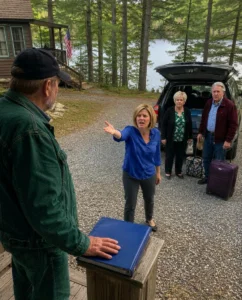
I had been retired for less than two days when my daughter-in-law decided my new lake cabin should no longer belong to me in any meaningful way.
My name is Frank Whitlock. After forty-one years working in a steel mill, I finally retired at sixty-four. All I wanted was peace.
I bought a modest cabin on a quiet Wisconsin lake. It wasn’t luxurious. The dock needed repairs, the chimney had cracks, and the screen door slammed too hard. But every flaw felt honest. After decades of noise, overtime shifts, and sore knees, it was exactly what I wanted.
I had raised my son, Elliot, alone after his mother left when he was thirteen. I worked endless hours but never missed a game, a school event, or a moment that mattered. I taught him responsibility, respect, and the importance of telling the truth.
When he married Sienna, I welcomed her into the family.
At first, I ignored her comments.
The dining table I restored by hand was called “rustic.” My apartment was criticized for not being “curated.” My work clothes were apparently outdated. Her parents, Gordon and Beverly, often acted as if everything in life needed improvement.
I kept my mouth shut.
Then, on my second day of retirement, Sienna called.
No greeting.
No congratulations.
Just an announcement.
“Your son and I have decided my parents are moving into your cabin for the summer.”
I sat frozen on the dock.
She explained that her parents needed space. My cabin had three bedrooms. I was only one person.
Then she delivered the sentence that echoed in my head all night.
“If that’s a problem, sell the place and move back somewhere you can actually be useful.”
Useful.
After spending forty-one years being useful to employers, bills, schedules, and everyone else’s needs, I had finally bought myself peace.
And Sienna looked at that peace and saw empty space she could give away.
I didn’t argue.
Instead, I started preparing.
I printed the deed.
The property tax records.
The insurance paperwork.
Every document showing one simple fact:
The cabin belonged to me.
Then I texted Elliot.
“Did you agree that Sienna’s parents were moving into my cabin for the summer?”
Hours passed before he answered.
His reply changed everything.
“No, Dad. She told me she was only going to ask if they could visit for a week.”
I printed that message too.
And waited.
PART 2
The next afternoon, an SUV rolled into my driveway.
Inside were Sienna, her mother Beverly, and her father Gordon.
The trunk opened before anyone even said hello.
They weren’t visiting.
They were moving in.
Suitcases.
Boxes.
Files.
Everything.
Sienna stepped out smiling confidently.
“Good,” she said. “You’re ready.”
I opened the blue folder sitting on the porch railing.
Her smile immediately weakened.
“What’s that?” she asked.
“The deed,” I replied calmly.
“The tax records. Insurance documents. And your text message telling me not to embarrass everyone over empty rooms.”
Gordon paused while unloading a suitcase.
Beverly looked confused.
Sienna forced a laugh.
“This is ridiculous. Nobody is stealing your cabin.”
“No,” I said. “You’re moving people into it without permission.”
Then Beverly quietly spoke.
“Sienna told us you offered.”
The silence that followed was heavy.
Sienna immediately corrected her mother.
“I said Frank understood.”
“No,” I replied. “You said you and Elliot had already decided.”
Then I pulled out the final page.
Elliot’s text message.
The color drained from Sienna’s face.
At that exact moment, my phone rang.
It was Elliot.
I put him on speaker.
“Dad,” he said, “before she says anything else, there’s something you need to know.”
Sienna whispered urgently, “Elliot, don’t.”
That was all anyone needed to hear.
“She told my parents you were lonely,” Elliot continued. “She said you were thinking about selling the cabin because it was too much for you. She told them they’d be helping you by moving in.”
Beverly covered her mouth.
Gordon stared at his daughter.
“And she told me they were only visiting for one week,” Elliot added. “She said you had already agreed.”
The entire story collapsed.
Every version Sienna had told to different people suddenly collided.
And none of them matched.
PART 3
For the first time since I had known her, Sienna had nothing to say.
Finally, she looked at me and snapped.
“You’re humiliating me.”
I shook my head.
“No. I’m correcting the record. Accuracy only feels humiliating when someone has been relying on confusion.”
The driveway fell silent.
Then I slid another document forward.
A rental agreement.
“If your parents need a place to stay,” I said, “these are the terms.”
Market rent.
Security deposit.
Fixed dates.
No access to the master bedroom.
Everything in writing.
Gordon read the page carefully.
Suddenly this wasn’t a family favor anymore.
It was a business arrangement with real costs.
And that changed everything.
Beverly looked at her daughter.
Then at me.
Finally, she spoke.
“We should leave.”
“Mom—” Sienna began.
“No,” Beverly interrupted. “I’m not staying in a home where the owner was pressured into giving it away.”
Even Gordon began loading the luggage back into the SUV.
Then Elliot spoke through the phone again.
“Sienna. Get in the car.”
She stared in disbelief.
“You’re taking his side?”
A long pause followed.
Then my son answered.
“I’m taking the side of the person who told the truth.”
In that moment, I felt the same pride I had felt years ago watching him graduate.
He had listened.
He had learned.
And now he was standing up for what was right.
Sienna climbed into the SUV without another word.
Beverly gave me an apologetic nod.
Gordon quietly admitted, “We were told something different.”
“I know,” I replied.
Then they left.
When the dust settled, I sat alone on my porch while Elliot remained on the phone.
“Dad,” he said quietly.
“I’m here.”
“I’m sorry.”
Just two words.
No excuses.
No explanations.
Exactly the kind of apology I had taught him to give.
That evening, I put the folder away and walked down to the dock with a cup of coffee.
The lake reflected the sunset.
The dock still needed sanding.
The chimney still needed repairs.
The screen door still slammed too hard.
But those were honest problems.
Problems I had chosen.
As darkness settled across the water, I realized something important.
Sienna had looked at my retirement and seen wasted space.
She had looked at my peace and seen an opportunity.
She had looked at a man who had spent his entire life taking care of others and assumed his needs no longer mattered.
She was wrong.
The cabin wasn’t empty.
It was filled with every sacrifice, every overtime shift, every year I had worked to earn this moment.
And for the first time in forty-one years, every room belonged exactly where it should.
At 9:08 on a cold, gray Monday morning in Boston, Claire Ashford’s marriage ended with nothing more dramatic than the quiet scrape of a pen on paper.
She had expected the moment to destroy her. For years, she had imagined sitting across from Carter Bellamy and breaking apart under the weight of everything they had once shared: Christmas mornings, school events, sleepless nights with sick children, and all the times she had chosen patience over anger.
But when she signed the final document, she did not fall apart.
She only felt tired.
Clear.
Free.
Carter sat across from her in an expensive navy suit, looking calm, polished, and almost pleased. To him, the divorce was not a tragedy. It was a clean removal. Claire, the wife who had become inconvenient, was finally out of his way.
His phone buzzed before the mediator had even finished organizing the papers.
Carter answered without apology.
“Hey, sweetheart. I’m almost done here. Tell Dr. Keene I’ll be at the clinic in twenty minutes. My mother is already there, and Kendall brought the gift basket.”
Claire kept her hands folded in her lap.
The woman on the phone was Sloane Avery, the younger woman Carter had once claimed was “just helping with a renovation.” Eventually, Sloane became the reason he came home late, then the reason he stopped coming home at all.
His family had welcomed Sloane so quickly that Claire sometimes wondered if they had been waiting for any excuse to replace her.
Carter hung up and leaned back.
“There’s really nothing to divide,” he said. “The condo was mine before the marriage. The car is mine. The company is mine. Claire can take the kids full-time if she wants. Honestly, it makes everything easier.”
His sister Kendall laughed softly from the corner.
“It’s better this way,” she said. “Carter deserves a fresh start. And Sloane is giving this family something to look forward to.”
Claire understood what she meant.
That morning, Sloane had an appointment at a private clinic. Carter’s mother, Vivian, was already there with tiny champagne-colored baby booties, ready to celebrate what they believed would be the Bellamy heir.
Claire opened her handbag and placed the condo keys on the table.
Carter smiled.
“Finally. Some common sense.”
Claire nodded once.
“I’ve learned not to argue with people who only listen to themselves.”
Then she reached into her bag again and pulled out two thick navy folders stamped with the crest of a private academy in Seattle. Beneath them were three one-way boarding passes.
Carter’s smile faded.
“What is that?”
“Miles and Annie were accepted for the spring term,” Claire said calmly. “The house is ready. We leave this afternoon.”
Kendall sat forward.
“Seattle? With what money?”
Claire looked at her.
“Not Carter’s.”
Outside, a black Lincoln Navigator stopped at the curb. A driver stepped out and opened the rear door.
Carter stood abruptly.
“Claire, what game are you playing?”
Claire took Annie’s backpack, held Miles’s trembling hand, and looked at Carter for the last time that morning.
“No game. From this moment on, the children and I will not interfere with your new life.”
Then she walked out before he could find another way to hurt her.
PART 2
The driver’s name was Mr. Bell. He worked for Claire’s attorney, Rosalie Whitaker. Once the children were safely inside the car, he handed Claire a sealed legal folder.
“Ms. Whitaker asked me to give you this after you left the building,” he said.
Claire opened it, though she already knew what was inside.
For months, while Carter called her paranoid, bitter, and “not built for business,” Claire had been quietly collecting proof. Before she became Carter Bellamy’s wife, she had worked as a compliance auditor for a regional bank. She knew how money moved when someone was trying to hide it.
Inside the folder were wire records, property transfers, invoices, screenshots, shell company details, and photographs of Carter and Sloane signing papers for a waterfront townhouse in Marblehead.
The same week Carter had told Miles that soccer camp was too expensive, he had moved a large amount of marital money into that property through a company account.
Annie leaned against Claire as Boston blurred outside the window.
“Mommy, is Dad coming to Seattle later?” she asked.
Claire brushed hair from her daughter’s cheek.
“No, sweetheart. Not with us.”
Miles stared out the window, trying to look stronger than an eleven-year-old should have to be.
“Is he mad?”
Claire looked down at the folder.
“He might be,” she said. “But that is not yours to carry.”
Then her phone vibrated.
Rosalie had sent a message:
The filings were accepted. The accounts are under temporary court restriction. Clinic appointment has begun.
Claire read it twice.
She was not happy. She was not celebrating. She had not collected evidence because she wanted revenge. She had done it because her children were watching, and she refused to teach them that love meant standing still while someone destroyed your life.
Across town, Carter was walking into the clinic believing his new life was about to begin.
Vivian sat in the waiting room wearing pearls, looking more like a charity chairwoman than a woman celebrating the end of her son’s family. Kendall stood nearby, fussing over gift bags and talking too loudly about legacy, schools, and “a proper Bellamy heir.”
Sloane sat at the center of it all, one hand resting on her stomach, accepting their attention as if it had always belonged to her.
When the nurse called her name, Carter stood.
“I’m going in with her.”
The room was dim and quiet. Dr. Keene began the exam, studied the monitor, took measurements, then checked them again.
Carter laughed lightly.
“Everything looks strong, right? He’s ahead already, I bet.”
The doctor did not smile.
Sloane’s hand tightened.
“Is something wrong?”
Dr. Keene looked at the forms.
“I need to clarify the timeline you provided.”
Carter frowned.
“What timeline?”
“The measurements suggest the pregnancy began several weeks earlier than the date listed here,” the doctor said carefully.
Silence filled the room.
Carter turned to Sloane.
“What is he talking about?”
Sloane shook her head too quickly.
“It has to be wrong. Machines can be wrong, right?”
The doctor replied calmly.
“Not by this much.”
Outside the door, Vivian stopped speaking. Kendall’s gift bag slipped from her wrist.
Then Carter’s phone began vibrating.
At first, he ignored it. When it rang again, he answered sharply.
“What?”
It was his company controller.
Three major accounts had paused their contracts. Company cards were being declined. The bank had received notice of a court order. A federal financial review team had arrived at Carter’s office to secure records.
“That’s impossible,” Carter said.
Then the controller said Claire’s name.
And Carter finally understood.
Claire had not walked away empty-handed.
She had walked away prepared.
PART 3
By the time Carter reached his office, Claire was already in the air, seated between her sleeping children as the plane carried them toward Seattle.
Annie slept with her head in Claire’s lap. Miles pretended to watch a movie, one hand resting on the soccer ball he had insisted on bringing.
Claire looked at them and felt the weight of everything they had endured.
But beneath that pain, there was something new.
Space.
Space to breathe. Space to make breakfast without fear. Space for her children to laugh loudly, spill cereal, argue about dinner, and simply be children.
In Seattle, Claire’s late father’s cousin, Maren Ashford, met them at the airport with warm coats and tearful eyes.
“You made it,” Maren whispered, hugging her.
“Barely,” Claire said.
Maren held her tighter.
“Barely still counts.”
The house near Green Lake had a blue front door, a maple tree in the yard, and small bedrooms the children could make their own. It was not as impressive as the Boston condo, but it felt warmer than anything Claire had known in years.
Miles chose the room facing the tree. Annie asked for yellow curtains.
That night, after the children fell asleep, Rosalie called.
“Carter’s board suspended him pending review,” she said. “The court restriction will hold. We have the townhouse records tied directly to the company transfers.”
“And the clinic?” Claire asked.
Rosalie paused.
“There will be a paternity test. But the timeline problem already caused chaos.”
Claire closed her eyes.
“I don’t want my children dragged through this.”
“They won’t be,” Rosalie said. “That is why we did everything properly.”
Carter called Claire twenty-six times that first week.
She did not answer.
Then came emails. Angry ones first. Then commanding ones. Then polite ones, as if manners could rebuild what cruelty had destroyed.
Two weeks later, Carter met Rosalie in a conference room overlooking Boston Harbor. He looked smaller, she later told Claire. Not truly sorry, but shaken.
The board had removed him from executive control. The townhouse was tied to improper transfers. His assets were restricted. His mother’s trusts were under review. Kendall’s outrage had helped no one.
Rosalie placed a settlement packet in front of him.
“Claire is willing to resolve the marital portion cleanly,” she said. “You sign over the disputed equity, release any claim against the Seattle move, and agree to court-structured support for the children.”
Carter stared at the papers.
“She planned this.”
Rosalie answered calmly.
“No. She documented what you did.”
Then Carter’s phone lit up.
The clinic results had arrived.
Rosalie did not read them, but Carter’s face told her enough.
He signed before leaving the room.
Not because he had become a better man. Not because he understood the damage. He signed because consequences had finally found him.
Months later, Carter came to Seattle. Claire never saw him, but a neighbor later told her that a thin man in an expensive coat stood across the street in the rain, staring at the blue door.
He never knocked.
What he saw was ordinary life: Miles coming home from practice, Annie running in a yellow raincoat, and Claire laughing on the porch.
A life that had continued without him.
Later, Annie found one of her drawings near the steps. It showed the little blue house, the maple tree, and three people standing under a bright orange sun.
Across the top, in uneven letters, she had written:
WE ARE SAFE HERE.
Two years later, Seattle was no longer a hiding place.
It was home.
Claire built a consulting firm helping nonprofits clean up their finances. Miles grew taller and kinder. Annie got her yellow curtains and a rescued terrier named Biscuit.
One rainy Sunday, Claire was making soup while her friend Reid chopped carrots at the counter. He was gentle, steady, and never tried to own the room.
Then the doorbell rang.
Reid returned with a cautious expression.
“Claire, there’s a woman here. She says her name is Sloane.”
Claire opened the door.
Sloane stood under a black umbrella, older around the eyes, her makeup softened by rain.
“I don’t deserve your time,” Sloane said. “I just wanted to say I’m sorry. Carter left me when the test came back, and his family turned on me too. I’m not asking for anything.”
Claire looked at her and realized there was no anger left.
“I hear your apology,” she said. “I hope you build a better life than the one you tried to enter.”
Sloane nodded and walked back into the rain.
When Claire closed the door, she noticed an envelope on the hall table. Carter’s handwriting was on the front.
For one second, she held it.
Then she placed it unopened beside the recycling bin and returned to the kitchen, where Annie was laughing, Miles was trying not to smile, Biscuit was stealing a carrot, and Reid was asking whether soup still counted as dinner if he had already eaten half the bread.
Claire did not need Carter’s version of the ending.
She had children to feed, rain to listen to, work to finish, and a life that finally belonged to her.
My Family Told Me To Leave Grandma’s Lake Geneva Anniversary Trip Because A Preschool Teacher Couldn’t Afford A Five-Star Resort, Then My Father Tried To Cancel My Room While My Brother’s Wife Laughed At My Old Subaru In The Valet Line. They Said I Would Embarrass Everyone By Counting Pennies During Spa Days, Golf Tournaments, And Dinners On The Lake. I Drove Away Like They Asked, Stopped At A Coffee Shop One Mile Down The Road, And Called The Regional Director Of Grand View Luxury Resorts.
The first time my sister called me a hopeless failure, she was standing before a room packed with investors, holding a champagne flute filled with something that cost more than my weekly groceries. Seven days later, she was frozen in the center of an abandoned gas station, staring at a corroded steel door concealed behind a wall no one had ever known was there. In that instant, she understood something that would eventually bring down everything she had worked for years to create.
My name is Jennifer Hayes. I am 36 years old, a major in the United States Army. And for nearly my entire life, my family treated me like the disappointing option they had to settle for. Not because I had failed, but because I refused to become the version of me they wanted.
If you have ever been the child who had to work twice as hard just to earn half the respect, then you will know exactly where this story begins.
Eighteen months before everything collapsed, I was serving overseas. During that deployment, I slept in prefabricated housing, worked 14-hour shifts, ate more military rations than I ever want to remember, and saved almost every extra dollar I earned. While other officers used their leave to travel, I stayed focused on watching my savings grow. I had a plan. I wanted financial independence. I wanted something that belonged only to me.
More than anything, I wanted a life that did not rely on my family.
The Hayes family had made a name for itself across central Arizona as successful real estate developers. My father, Richard Hayes, liked presenting himself as a self-made businessman. My mother, Diane, cared about image nearly as much as she cared about money. And my older sister, Melissa—Melissa was the favorite. She always had been.
When we were growing up, if Melissa got a B, everyone celebrated. If I got an A, my parents wanted to know why it was not an A+. Melissa could make mistakes and be given another chance. I made mistakes and got lectures.
Eventually, I stopped trying to compete.
The army gave me something my family never had. Merit. No one cared whose daughter I was. No one cared who my parents knew. Either you performed, or you did not. That suited me perfectly.
Three weeks after I came home from deployment, Melissa invited the whole family to a private event at a luxury hotel in Scottsdale. She called it a business presentation. I knew what it really was—a fundraising pitch.
The ballroom was filled with polished marble, crystal chandeliers, and people wearing watches that probably cost more than cars. Melissa stood on the stage beside a massive screen showing the logo of her newest company, Hayes Horizon Development Group.
The presentation went on for almost an hour. Luxury residences, commercial growth, mixed-use development, projected returns, future expansion. Every slide promised huge profits. Every slide seemed more optimistic than the one before it.
When she finally finished, applause filled the room. My father practically beamed with pride.
Then Melissa looked straight at me and smiled.
Jennifer, she said, “Tell everyone what you think.”
Every face turned in my direction.
I placed my glass down on the table.
It is ambitious.
Her smile widened.
Ambitious sounds good.
It depends.
The room grew quieter.
Melissa crossed her arms.
What does that mean?
It means the debt exposure is extremely high.
A few investors glanced at one another.
The projected timelines also seem unrealistic. Her smile tightened, and the company would need almost perfect market conditions to reach these numbers.
The silence became awkward.
Melissa laughed.
Oh, please. You sound like a risk analyst.
I am.
No, she said. You are a soldier.
The room chuckled.
I stayed calm.
She continued. Which is exactly why you do not understand how real wealth is created.
That drew more laughter.
My father smiled.
My mother smiled.
No one stood up for me.
The presentation ended shortly after that. About an hour later, the family gathered in a private dining room. That was when the real pressure started.
My father leaned forward.
Melissa needs strong family support.
I already knew where the conversation was heading.
How much?
250,000.
I almost laughed.
That is most of my savings.
Exactly, Melissa said.
It is not an investment I am comfortable making.
The mood shifted immediately.
My mother lowered her wine glass.
You do not trust your own family.
This is not about trust.
Then what is it about? Melissa asked.
I looked directly at her.
It is about numbers.
The room went quiet.
I reviewed the documents.
Melissa’s jaw tightened.
The debt load is too aggressive.
My father frowned.
You are being negative.
I am being realistic.
Melissa shook her head.
No, you are being scared.
I am being careful.
Then she said the sentence I would remember for months.
You know what your problem is, Jennifer?
I did not answer.
You have spent so much time taking orders that you have forgotten how successful people think.
I felt my pulse climb, but I kept my face neutral.
You asked for my opinion.
I asked for support.
You got honesty.
Her eyes went cold.
You have always been jealous.
That actually hurt. Not because it was true. Because she truly believed it.
I stood up.
I am not investing.
My father looked furious.
My mother looked disappointed.
Melissa looked entertained.
Then what are you going to do with all that money?
I picked up my purse.
Something else.
Three days later, I found it.
The property was located along an aging stretch of highway outside Phoenix. The gas station had been empty since 1995. Broken windows, rusted pumps, cracked asphalt, weeds pushing through concrete. Most people would have seen a disaster.
I saw possibility.
Truck traffic still moved through the area every day. The location sat close to several distribution routes, and most importantly, the price was low enough for me to purchase it outright.
The closing took less than two hours. As I signed the final paperwork, I felt something I had not felt in years.
Freedom.
When my family found out, their reaction was immediate.
Melissa called first. She laughed so loudly that I had to move the phone away from my ear.
You bought a gas station?
Yes.
The abandoned one?
Yes.
You are serious?
Very.
She laughed again.
You actually spent your entire military savings on a dead business.
It is my money.
You are a hopeless failure.
The words came out easily, as if she had been waiting years for the chance to say them.
You are throwing your life away.
I ended the call.
Two days later, I moved into the old manager’s office and started cleaning.
The work was exhausting. Dust coated everything. The building smelled of mildew, motor oil, and decades of neglect. I hauled out broken shelves, tore away rotting drywall, and filled dumpster after dumpster.
Every night, I collapsed onto a folding cot with sore muscles and blistered hands. But for the first time in my life, every bit of effort belonged to me.
On the seventh day, I began clearing the storage room behind the convenience store. Most of the back wall had serious water damage. The drywall nearly fell apart when I touched it.
I grabbed a sledgehammer, lifted it over my shoulder, and swung.
The wall burst outward.
Dust filled the room. Chunks of plaster hit the floor.
I swung again.
This time, something felt wrong.
Instead of drywall, I struck metal.
A deep metallic clang rang through the room.
I slowly froze.
I cleared away more of the damaged wall. The dust settled. My heartbeat quickened, because hidden behind decades of rotting drywall was a massive steel door.
And whatever waited on the other side was about to change everything.
For several seconds, I just stood there, staring at the steel door. The storage room was completely quiet except for the faint hum of my portable generator outside and the sound of my own breathing inside the respirator mask.
The door looked completely out of place. Nothing about the abandoned gas station suggested that anything like this should exist. The steel surface was thick and industrial.
Rust covered parts of the hinges, but the structure itself was surprisingly intact. Someone had deliberately sealed it behind that wall decades earlier.
I stepped closer and brushed away layers of dust. There was no company logo, no identifying marks, no explanation—only steel. Heavy steel. The kind built either to keep people out or to keep something valuable inside.
My first thought was money.
My second thought was records.
My third thought was that I was probably letting my imagination get out of control.
After all, abandoned properties attract stories. People always imagine hidden fortunes. Most of the time, they find only mold and disappointment.
Still, this felt different.
I spent the next hour tearing out the remaining drywall. The hidden structure was much bigger than I had first thought. The steel door filled almost the entire center of the wall. A heavy locking wheel sat near the middle.
The mechanism looked old but professionally made.
I wiped sweat from my forehead and stepped back.
Whoever had installed this had spent real money.
That meant whatever was inside had mattered.
I took photos and sent them to a Phoenix locksmith who specialized in old commercial vaults. His name was Frank Donnelly.
He arrived the next afternoon.
Frank was in his 60s, broad-shouldered, and carried himself like a man who had spent decades solving strange problems. The moment he stepped into the storage room, he stopped.
“Well,” he muttered that bad.
“No,” he walked toward the door. “It’s actually the opposite.”
“What do you mean?”
Frank ran his palm across the steel.
This was not built for a gas station.
What was it built for?
He looked at the locking wheel.
Protection.
That answer did not make me feel better.
For three hours, Frank worked with care. He inspected the hinges, tested the lock, and used specialized tools to examine the internal parts.
Meanwhile, I paced around the room, imagining every possible outcome. Maybe there was cash. Maybe there were old deeds. Maybe there was nothing at all.
By the fourth hour, my nerves were worn thin.
Then I heard it.
A loud metallic click.
Frank smiled.
There we go.
The wheel turned slowly. The hinges groaned. And after what felt like forever, the door finally opened.
A cool rush of stale air drifted out. Air that had been sealed inside for years, maybe decades.
I turned on my flashlight. My pulse sped up.
Then I stepped inside.
The room was not large, maybe 15 feet wide and 20 feet deep. Concrete walls. Metal shelves. Dust. No treasure. No piles of cash. No gold bars.
For one brief moment, disappointment hit me.
Then I looked more closely.
The shelves were full.
Not with valuables.
With boxes.
Dozens of them.
Cardboard boxes, metal filing cases, document tubes, storage containers. Every shelf was packed.
Frank looked around.
Well, he said, “At least somebody really liked paperwork.”
I laughed, but my attention had already moved to the closest box.
I opened it.
Inside were carefully organized files. Thousands of pages. Property records, maps, survey reports, engineering documents, legal agreements.
Most were dated between 1978 and 1994.
One name appeared again and again.
Charles Whitmore.
Over and over.
Everywhere.
I sat cross-legged on the floor and began reading.
Hours vanished. Sunlight disappeared outside. The generator switched on automatically.
Still, I kept reading.
Charles Whitmore had apparently owned the gas station for decades. But that was not what caught my attention.
It was the surveys.
There were hundreds of them. Detailed topographical maps, land assessments, boundary studies, water access diagrams, infrastructure reports.
The level of detail was astonishing.
Whoever Charles Whitmore had been, he had not simply owned a gas station.
He had been obsessed with land.
Around midnight, I finally forced myself to stop. The next morning, I started reading again. Then the next day. And the next.
The deeper I went, the stranger everything became.
Many of the documents referred to parcels of land around the property. Large parcels. Massive parcels. Entire sections of valley terrain.
Some reports had handwritten notes attached. Others included legal stamps and county signatures.
The information felt important, but I still could not see the whole picture.
On Friday afternoon, I called a local land use attorney. His name was Michael Renshaw, a former military lawyer. That made me trust him more immediately.
I carried three banker boxes full of documents into his office.
Michael spent 15 minutes reviewing the first set.
Then his expression changed.
Where did you get these?
From the gas station.
The abandoned gas station?
Yes.
His eyes narrowed.
Did you purchase the property legally?
I almost laughed.
Of course.
Good.
Why?
He did not answer right away.
Instead, he kept reading.
Another 10 minutes passed. Then 20.
The silence became more and more uncomfortable.
Finally, he stood up and shut his office door.
That was not reassuring.
When he sat down again, his face looked completely different than it had when I arrived—sharper, more focused, more serious, almost stunned.
He spread a map across his desk.
The map showed my gas station, the highway, and an enormous valley extending behind it.
Jennifer, he said carefully. Have you ever looked into the land around your property?
Not much.
You should.
Why?
He tapped the map.
Because this is not just a gas station.
My stomach tightened.
What is it?
He looked straight into my eyes.
That is what I am trying to confirm.
For the next hour, he went through document after document. His office grew completely silent except for the sound of pages turning.
At one point, he took off his glasses, put them back on, and reread the same page twice.
That worried me.
Finally, he stopped.
His chair creaked softly as he leaned back.
For several seconds, he just stared at me.
Then he asked the question that made every nerve in my body come alive.
Jennifer.
I swallowed.
Yes.
Do you have any idea what you actually bought?
The way he asked it sent a chill through me.
Because for the first time since discovering the hidden room, I realized the answer might be much bigger than I had ever imagined.
I did not answer Michael’s question immediately. Partly because I had no answer. Partly because I was not sure I wanted to hear it.
The attorney stood and walked to a large cabinet on the side of his office. He pulled out several county zoning maps and spread them across the conference table.
Then he gestured for me to come closer.
I stepped beside him.
He pointed to a red dot.
That is your gas station.
I nodded.
Then he moved his finger outward. Far outward, across a massive valley stretching for miles.
Everything here matters.
I stared at the map.
The valley looked huge. Dry land. Empty land. Nothing special.
At least, that was what I thought.
Michael picked up one of Charles Whitmore’s original documents.
You know what most people see when they look at this land?
No.
Dirt.
He tapped the paper.
Charles Whitmore saw leverage.
I folded my arms.
What exactly did he own?
Michael took a deep breath.
Then he explained, “30 years earlier, local officials had desperately tried to encourage development in the region. Large sections of land were sold cheaply. Developers ignored them.
Investors ignored them. Most people assumed the area had little value. But Charles Whitmore had been a surveyor. He understood something others didn’t. He
understood access. He understood infrastructure. And he understood water.”
Michael slid another document toward me.
The legal language was dense, but one phrase immediately stood out.
Exclusive easement rights.
My pulse quickened.
What does that mean?
It means Charles secured permanent access control.
Access control to what?
The entire valley.
I blinked.
I am sorry. What?
Michael nodded.
Anyone who wanted large-scale development behind your property would need legal access through routes connected to your parcel.
I looked down again.
The numbers were staggering.
Hundreds of acres.
Then Michael handed me another document.
This one mattered even more.
Water rights.
Extensive water rights.
My stomach tightened.
Even I knew enough about Arizona real estate to understand what that meant.
In the desert, water was not just valuable. It was everything.
Without water, development stopped. Without water, investors walked away. Without water, billion-dollar plans became useless drawings on paper.
Michael leaned against the table.
Jennifer, these rights were not separated from the property.
I stared at him.
What does that mean?
It means when you bought the gas station.
He paused.
You bought all of it.
For several seconds, I could not speak.
My mind struggled to understand the size of what he was telling me.
I had purchased what everyone believed was a worthless abandoned gas station. But legally, I had acquired something far larger, something hidden, something powerful.
Michael continued, “Charles Whitmore was brilliant. Why hide it?
Probably because nobody paid attention.
That answer made sense.
Most people never read old records. Most people never opened forgotten vaults. Most people definitely never spent days studying decades-old land surveys.
I left Michael’s office with copies of the documents.
The Arizona sun seemed unusually bright.
The entire world looked different somehow.
Not because anything had changed.
Because I had.
For the first time since buying the property, I understood why something about it had felt unusual from the beginning.
The gas station had never been the true asset.
It was the key.
The gateway.
The legal anchor holding everything together.
That night, I sat by myself inside the manager’s office. Maps were spread across my folding table.
Documents were piled all around me. The scent of fresh coffee filled the small room. I barely slept. Instead, I kept reading, studying, learning, and connecting the scattered pieces together.
Then, 48 hours later, everything blew open.
I was eating a microwave dinner while going over contractor estimates when my phone vibrated. A local business journal had posted breaking news. Usually, I ignored those notifications. This one immediately stopped me.
Because Melissa’s face was in the thumbnail.
I opened the article.
A live stream started playing.
My sister was standing on a stage inside a luxury resort ballroom. Behind her, a huge digital screen glowed brightly. The audience was packed. Investors, developers, bankers, politicians.
My father sat in the front row, looking proud. My mother looked as though she were attending the Academy Awards.
Melissa smiled with absolute confidence.
Then she started speaking.
Ladies and gentlemen, the crowd applauded.
She clicked a remote.
A massive 3D rendering appeared across the screen.
The exact valley connected to the documents sitting on my folding table.
I sat completely still.
Melissa kept describing the project.
$200 million. Hundreds of planned homes. Luxury development. Future expansion.
The audience loved it.
Investors looked ready to throw money at her.
But as I listened, one thing became painfully obvious.
They had no idea.
None of them knew.
Not Melissa. Not my father. Not the investors. Nobody.
They had bought the surrounding land. They had secured financing. They had sold future lots. They had launched marketing campaigns.
But they had missed the most important piece.
The one thing the entire project depended on.
The thing currently locked inside my fireproof vault.
Access rights. Water rights. Infrastructure control.
I slowly leaned back in my chair.
For years, my family had treated me like the least valuable person in every room. The backup child. The dependable worker. The daughter who was useful, but never impressive.
Now I owned something they desperately needed.
And they did not even know it yet.
I should have felt triumphant.
Instead, I felt oddly calm.
Military service teaches patience. Emotional reactions rarely solve anything. Information does. Preparation does. Timing does.
So I waited.
Three days later, exactly what I expected happened.
A black luxury SUV rolled onto my property.
I recognized it at once.
Melissa’s vehicle.
I watched through the office window as she stepped out wearing designer sunglasses and expensive heels that made no sense for an active construction site.
She already looked annoyed before she reached the door.
I met her outside.
She looked around at the dumpsters, the contractors, and the construction equipment. Then she looked directly at me.
Jennifer.
Melissa.
She forced a smile.
It looked painful.
What are you doing here?
She crossed her arms.
I’d like to make you an offer.
My heartbeat stayed completely steady, because in that exact moment, I knew she had finally found the problem.
And I knew this conversation was about to change everything.
Melissa stood on my cracked asphalt as if the property had personally insulted her. Her sunglasses covered her eyes, but I could still see the tightness in her jaw.
She tried to look casual, almost generous, like she had driven all the way out here because of sisterly concern instead of panic.
But Melissa had never been skilled at hiding fear.
She turned it into irritation, dressed it in expensive clothes, and expected everyone to mistake it for confidence.
I wiped my hands on a shop towel and waited.
She looked past me toward the old canopy, where two contractors were measuring support beams. The faded red paint had peeled away in long strips, revealing rust beneath.
Wind dragged dust across the lot in thin brown sheets.
“You’re really doing this,” she said.
“Yes, renovating this place.”
“Yes.”
She gave a short laugh, but there was no amusement in it.
Jennifer, come on. You do not belong out here.
I glanced down at my work boots, then back at her heels.
One of us dressed for the location.
Her mouth tightened.
I am trying to be reasonable.
That would be new.
She slowly removed her sunglasses.
Her eyes were sharp, tired, and colder than I remembered.
I know we have had disagreements.
That is a soft way to put it.
And I know things became emotional.
You called me a hopeless failure.
She looked away for half a second.
I was angry.
No, I said calmly.
You were honest.
That hit harder than I expected.
For one brief moment, the polished mask slipped. I saw my sister beneath it. Not the CEO. Not the golden child. Just the girl who had been taught from childhood that winning mattered more than kindness.
Then the mask came back.
She reached into her leather bag and took out a folder.
I want to buy the property.
I did not move.
The gas station, she clarified, as though I might not understand my own deed.
How much?
500,000.
The number was supposed to impress me. A month earlier, maybe it would have.
Now it felt almost insulting.
No.
Her eyebrows lifted.
You did not even consider it.
I considered it for half a second.
Less.
She exhaled through her nose.
Jennifer, you paid a fraction of that.
That is irrelevant.
It is extremely relevant. I am offering you a huge profit.
You are offering me silence.
Her expression shifted.
There it was.
Confirmation.
She knew enough to be afraid, but not enough to understand how serious her danger really was.
Melissa stepped closer and lowered her voice.
Listen to me carefully. This development is bigger than either of us.
There are investors involved. Banks. Contractors. City officials. You have no idea how complicated this is.
I understand complicated.
This is not the army.
No, I said. In the army, people are expected to know where their supply lines are before announcing a mission.
Her eyes flashed.
You always do that.
Do what?
Act superior.
I almost smiled.
For 36 years, my family had called my discipline stiffness, my caution fear, and my competence arrogance.
They turned every strength into a flaw because it made them feel less guilty for needing me.
I am not selling.
Melissa stared at me for a long moment, then slid the folder back into her bag.
Dad said you would be difficult.
Dad usually says that when I do not obey.
Her voice hardened.
This is not over.
I assumed not.
She walked back to her SUV without another word. The driver opened the door for her. Before getting in, she looked back at the property one more time.
Not with disgust this time.
With calculation.
Two days later, my father called.
I let it ring three times before answering.
Jennifer, he said, using the firm, controlled tone he saved for negotiations and family punishment.
Dad.
Your sister tells me you turned down a very generous offer.
She told you correctly.
That was foolish.
You have been using that word often lately.
Because you keep making foolish choices.
I sat at my folding table, with the old land maps spread before me like battle plans.
He continued, “Melissa is trying to help you exit this embarrassing situation with dignity.”
I looked around the office.
The walls were stained. The floor was scuffed. The air still carried the faint smell of oil and sunbaked dust.
But it was mine.
I am not embarrassed.
You should be.
That old sentence might have wounded me years earlier. It used to settle under my skin.
Now it passed straight through me.
Goodbye, Dad.
Do not hang up on me.
I hung up.
By the end of the week, the second offer arrived through an attorney.
$1 million. Clean purchase. Fast closing. Confidentiality agreement.
I read the terms twice.
The confidentiality clause was longer than the purchase agreement.
That told me everything.
Michael Renshaw read it and laughed quietly.
They are not buying land, he said.
They are buying your cooperation.
They will not get it.
Then expect pressure.
He was right.
The first city inspector arrived Monday morning. Then two more followed.
They cited me for temporary fencing placement, dumpster clearance, signage height, old underground tank documentation, and one cracked section of sidewalk that had been there since before I was born.
By lunch, a stop-work notice was taped to the front door.
My contractors stood around, unsure what to do.
One of them, a foreman named Luis, took off his hard hat and looked at me.
You want us to pack up?
I looked at the paper.
No. They shut us down for now.
That afternoon, I installed cameras.
Not obvious cameras.
Small ones. Motion-activated. Weatherproof.
I mounted them near the old pumps, the fence line, the utility box, and the back entrance.
Military service had taught me one thing very well.
Never complain about a hostile environment before you document it.
Three nights later, the first incident happened.
At 2:17 in the morning, a truck with covered plates pulled up near my rear fence. Two men got out. One cut the chain. The other smashed three newly repaired windows with a tire iron.
They left in under four minutes.
The cameras captured everything.
Clear faces. Clear vehicle shape. Clear timing.
I sent the footage to Michael.
His reply came at 6:04 a.m.
Do not confront them. Keep recording.
So I did.
Another inspection came.
Another citation.
Then a utility crew arrived and claimed my water connection needed emergency review.
The next day, power access suddenly became an issue.
Every obstacle looked official.
Every excuse sounded rehearsed.
But the pattern was too precise to be random.
They were trying to suffocate me slowly, hoping I would run out of money, energy, or patience.
By the time my mother finally came to the property, I had already backed everything up in three separate places.
Diane Hayes stepped out of a white sedan wearing pearls and a pale blue blouse, looking like she had arrived to save a child from a terrible mistake.
“Oh, Jennifer,” she said softly, taking in my dusty jeans and scraped knuckles. “Look what you’ve done to yourself.”
“I said nothing.”
She reached for my hand.
I stepped back.
Her face folded just enough to look hurt.
You are not well.
There it was.
Not concern.
Strategy.
You have been under terrible stress since deployment, she continued. Your father and I think this fixation on the gas station may be your way of acting out.
I stared at her.
You are trying to make me sound unstable.
We are trying to protect you.
No. You are trying to control the story.
Her eyes sharpened.
Then she pulled a document from her purse.
A petition.
My stomach tightened.
Michael had warned me this might happen.
My family was preparing to challenge my judgment and freeze any further action involving the property until a court could review my mental fitness.
My mother softened her voice into something almost tender.
Sign the sale agreement, sweetheart. Let Melissa handle this.
Come home before this gets worse.
I looked at the petition, then back at my mother.
And for the first time, I understood how far they were willing to go.
Not because they hated me.
Because they needed me erased.
The second my mother left the property, I called Michael.
I did not wait.
I did not think.
I simply picked up the phone and dialed.
Twenty minutes later, I was sitting across from him in his office. The petition lay on the table between us.
Michael read every page carefully.
Then he leaned back in his chair.
They are desperate.
I nodded.
I know.
No, he said quietly.
I do not think you do.
That caught my attention.
He folded the document closed.
Jennifer, wealthy families do not usually accuse their own daughter of being mentally unstable.
I looked away.
The words still hurt more than I wanted to admit.
Not unless they are terrified.
The room went silent.
Outside, traffic moved through downtown Phoenix. Inside, everything felt strangely still.
Michael slid another folder across the table.
This arrived this morning.
I frowned.
What is it?
Something you are going to want to see.
I opened it.
The first page contained internal financial statements from Hayes Horizon Development Group, Melissa’s company.
The second page made my stomach tighten.
The third page nearly stopped my breathing.
Projected cash reserves. Actual cash reserves. Debt obligations. Investor disclosures.
The grand vision Melissa had unveiled on stage vanished almost overnight.
My father’s reputation suffered enormous damage.
For the first time in my life, people stopped treating him like the smartest man in every room.
My mother stopped attending charity galas.
Country club invitations suddenly became less frequent.
And Melissa—Melissa disappeared from public view entirely.
I wish I could say I celebrated.
I did not.
Victory does not always feel the way people imagine.
Sometimes it feels quiet.
Sometimes it feels sad.
Sometimes it feels like standing alone in an empty parking lot, realizing the war is finally over.
Six months later, the gas station looked completely different.
The broken windows were gone. Fresh paint covered the buildings. Modern fuel pumps stood where rusted relics had once been.
The convenience store was open. Truck drivers stopped every day. Local businesses partnered with us.
The property had become exactly what I had imagined.
A thriving roadside service center.
Profitable.
Growing.
Mine.
One afternoon, I was reviewing inventory reports when a familiar pickup truck pulled into the lot.
My father’s truck.
I watched him park.
For a moment, neither of us moved.
Then he stepped out.
He looked older.
Not dramatically older.
Just tired.
The kind of tired that comes from losing something you never believed could disappear.
He walked toward me slowly.
No entourage. No lawyers. No investors.
Just Richard Hayes.
My father.
When he reached me, he removed his cap.
Something I had never seen him do before.
Not once.
Not in 36 years.
I was wrong.
The words hung between us.
Simple.
Honest.
Painful.
I said nothing.
He nodded slowly.
I should have listened.
The Arizona wind moved gently across the property. In the distance, a diesel engine rumbled.
Life continued the way it always does.
I cannot change what happened, he said.
I know.
He looked around at the customers, the trucks, the renovated buildings, the employees, the future.
Then he smiled sadly.
You built something remarkable.
For the first time in years, I believed he meant it.
We talked for almost an hour.
Not about lawsuits. Not about money. Not about Melissa.
Just life.
When he finally left, I stood alone beside the fuel pumps, watching the sun begin to set.
Orange light stretched across the desert.
The same desert everyone had once called worthless.
The same property everyone had mocked.
The same decision they had called foolish.
I thought back to the night Melissa laughed at me. The night my parents called me an idiot. The night they were completely certain I had ruined my future.
What none of them understood was that the gas station had never truly changed my life.
The decision changed my life.
For the first time, I stopped chasing their approval.
And that freedom turned out to be worth more than any development project, any inheritance, or any amount of money.
If there is one thing I have learned, it is this.
The people who underestimate you often reveal more about themselves than they reveal about you.
Sometimes the greatest investment you will ever make is not in land, business, or money.
It is in believing yourself when no one else does.
And if you have ever had to walk away from people who refused to recognize your worth, I would love to hear your story.
Leave a comment below and tell me where you are watching from. We share stories like this every day. Stories about resilience, courage, and finding strength when life pushes back.
If this journey meant something to you, subscribe so you do not miss the next one.
Until next time, take care of yourselves and never let someone else decide what you are capable of.
Six days after I gave birth, my father tried to take money from my account while my mother posted vacation pictures instead of coming to help me.
While I held my newborn after a C-section, I texted my parents, “Please, can someone come help me?” My mother saw the message, did not respond, and thirty minutes later uploaded a smiling photo from the deck of a luxury anniversary cruise, one arm wrapped around my sister, Vanessa, the golden child.
I stared at that picture from my hospital bed while my son slept against my chest, his tiny fist tucked beneath his chin. My incision burned every time I took a breath. My milk still had not fully come in.
The nurse had just told me I was not allowed to lift anything heavier than the baby, which almost felt funny, because there was no one there to lift anything else.
My husband, James, was deployed overseas. My best friend was out of state. So I had done the thing that made me feel humiliated. I had asked my parents for help. My mother, Patricia, replied the following morning with one sentence: “You’re a mother now, Rachel. Figure it out.” Two minutes later, Vanessa sent a photo of herself in a white swimsuit beside a champagne bucket: “Don’t be dramatic, Rachel. Mom and Dad deserve joy too.”
I did not respond. I changed my son’s diaper with trembling hands, signed my discharge papers by myself, and paid for a ride home because my father, Robert, had “forgotten” I was leaving the hospital that day. By the sixth day, I had learned how to get out of bed without crying out. I had learned how to warm bottles one-handed. I had learned that loneliness had a sound: the soft buzz of a phone no one answered.
Then my bank app flashed red. Attempted withdrawal: $2,300. Location: Caribbean Sea ATM. Cardholder: Robert Mitchell. My father. For a few seconds, all I could do was stare.
Then another alert appeared. Security question failed. Second attempt pending. My son whimpered from his bassinet. I leaned over him, kissed his forehead, and whispered, “Not this time.”
Because my parents still believed I was the daughter who apologized when they stole from her college fund. They believed I was still the girl who stayed quiet when Vanessa used my name to open store cards.
They believed giving birth had made me weak. They had forgotten what I did for work. I was a fraud compliance analyst for Atlantic National Bank. For seven years, I had traced stolen identities, forged signatures, false hardship claims, and families who smiled in public while draining one another dry. And three months before my son was born, I had copied every document they thought I would never understand.
I did not call my father. I did not scream at my mother. I did not send Vanessa an angry message she could screenshot and use to make me look unstable. I opened my laptop at the kitchen table, still moving carefully from surgery, and started building a file.
First: the attempted withdrawal, time, terminal ID, failure code, and location.
Second: the card my father had no legal right to have. Third: the old emails Vanessa had sent me while pretending to “help” with family taxes. Hidden inside those emails were scanned copies of my driver’s license, my Social Security card, and my signature on blank authorization forms. My parents had always called it “family paperwork.” I called it evidence.
At noon, Mom finally texted: “Your father said your card declined. Why are you embarrassing us on vacation?” I replied, “Why was Dad using my card?” The answer came from Vanessa: “Because you owe them. They raised you. Don’t act rich just because you married a soldier and got a bank job.”
Then Dad called. I let it go to voicemail. His voice came through loud and annoyed. “Rachel, unlock the account. We need the upgrade today. Don’t start your nonsense while your mother is trying to enjoy herself. You have money sitting there. We only need twenty-three hundred.” He paused, then added the sentence that sealed him. “And don’t forget, I still have access to the trust documents. If you make trouble, you’ll never see a dime of your grandmother’s house.”
PART 2
My grandmother’s house. The house she had left to me. The house my parents said had been sold years earlier to cover “family debts.” I had suspected the truth for months. During my pregnancy, a county property-tax notice had arrived by mistake with my name listed as beneficiary under the Mitchell Family Trust. When I asked Mom about it, she snatched the envelope from my hand and said, “Pregnancy brain makes you paranoid.”
But pregnancy brain had not stopped me from requesting certified copies.
It had not stopped me from hiring a discreet estate attorney with overtime money. It had not stopped me from discovering that my parents had forged trustee amendments, rented out the house, and deposited the income into an account Vanessa used for her boutique. The cruise was not an anniversary present. It was paid for with stolen rent.
That night, Vanessa posted a video from the ship’s dining room. “To family who chooses happiness,” she toasted, lifting her glass. “Not guilt.” Dad leaned toward the camera. “Some people always play victim,” he said. “But this family rewards loyalty.”
I saved the video. Then I sent one email to my attorney, one to Atlantic’s fraud escalation team, and one to the trust department listed in my grandmother’s original documents. At 9:14 p.m., my father tried the ATM again. This time, the account did not merely decline. It froze.
The confrontation happened over video call the next morning. Mom appeared first in a cruise robe, her face tight with fury. Vanessa stood behind her. Dad shoved himself into frame last.
“What did you do?” he snapped. I sat in the nursery with my son asleep against my shoulder. “I reported unauthorized access to my bank account.” Dad laughed. “You reported your father?” “I reported a man who tried to steal from a woman six days after surgery.” Mom’s mouth twisted. “Always dramatic.” I clicked a key. “I also reported identity theft, forged documents, and trust fraud.”
The cabin went quiet. Vanessa’s face changed first. Not with guilt. With calculation. “You have no proof,” she said. “I have the ATM logs, Dad’s voicemail, your emails with my identification documents, the store cards opened under my name, the forged trust amendments, and rental deposits from Grandma’s house going into your business account.” I paused. “And your cruise video.”
Dad’s skin turned gray. Mom grabbed the phone. “Rachel, stop. We can talk when we get home.” “No,” I said. “You had six days to talk. You read my message while I was bleeding through bandages and holding your grandson. You chose champagne.”
Vanessa tried to laugh. “You’re exhausted. Emotional. You just had a baby.” That was when my attorney joined the call.
PART 3
Diana Hayes’s name appeared on the screen, and Vanessa stopped smiling. Diana’s voice was lethal. “The court suspended your control over the Mitchell Family Trust. The rental accounts are frozen. Vanessa’s boutique account is under review because it received traceable trust funds.” Mom whispered, “Boutique account?” Vanessa looked away. Diana continued, “Atlantic opened a fraud case. Authorities have been notified. Do not contact my client except through legal channels.”
Dad erupted. “She is our daughter!” I held my son closer. “No. I was your source of money. There’s a difference.”
Three weeks later, they returned home to changed locks on my grandmother’s house and a legal notice taped to the door. The rent was redirected into the trust account.
Vanessa’s boutique lost its lease after the frozen funds revealed unpaid loans and false income statements. Dad was pushed into early retirement after his employer learned about the complaint. Mom sold jewelry to cover legal fees and still called me cruel.
At the hearing, my father would not look at me. Vanessa cried until the judge told her to stop performing. My mother stared at my baby as if she had suddenly remembered he existed. The judge returned control of the trust to me, ordered repayment, and referred the forged documents for prosecution.
Six months later, I stood on the porch of my grandmother’s house with my son on my hip.
James was home, his hand warm against my back. My phone buzzed with one message from Mom: “We’re still your family.” I looked at my son, laughing in the sunlight. I typed back one sentence: “Family comes when you ask for help.”
Then I blocked her, stepped inside, and closed the door on the quietest peace I had ever known.
One year after my divorce, my ex-mother-in-law saw me at the clinic and smiled with that smug satisfaction I knew too well. She told me her son had been right to leave me and that he was now raising a daughter with my former friend. I stayed composed, smiled back, and said, “Is that what you think?” Then a man walked in, and every trace of color drained from her face.
A year after the divorce, my ex-mother-in-law spotted me in the waiting room of Westbridge Fertility Clinic in Denver.
Patricia Parker wore pearls, heavy perfume, and the same self-satisfied smile she had worn in court when my ex-husband, Ryan, claimed our marriage had been “emotionally empty.” I had not seen her since the divorce hearing, when she embraced Megan Ellis, my former best friend, right in front of me.
Now Patricia stopped next to my chair and looked me over from head to toe.
“Well,” she said, loud enough for the receptionist to hear, “isn’t this interesting?”
I closed the folder resting in my lap. “Hello, Patricia.”
Her smile widened. “I heard you were still alone.”
I did not answer.
Her eyes gleamed with satisfaction. “Leaving you was the best choice my son ever made. Now he’s raising a beautiful daughter with Megan. A real family. Something you could never give him.”
My throat tightened, but I kept my expression still.
Ryan and I had spent years trying to have a child. We endured injections, failed transfers, debt, grief, and two frozen embryos kept at that clinic. After our last miscarriage, Ryan started pulling away. Megan became supportive. Then supportive turned into late-night phone calls. Then late-night phone calls became a divorce.
Six months after the divorce, Megan announced she was pregnant.
Patricia told everyone it was a miracle.
I believed that too, until a clinic billing notice accidentally arrived at my old email. It listed an embryo transfer date two weeks after my divorce had been filed.
My embryo.
My consent form.
My signature.
Except I had never signed it.
So when Patricia leaned closer and whispered, “That little girl is proof my son chose right,” I finally smiled.
“Is that what you think?”
Before she could respond, the clinic door opened.
A tall man in a navy suit entered, carrying a sealed evidence envelope. Patricia turned, and all the color left her face.
She knew him.
Everyone in the Parker family knew him.
Detective Andrew Cole had once investigated Ryan’s business partner for insurance fraud. Now he walked straight toward us, nodded to me, and then looked at Patricia.
“Mrs. Parker,” he said, “good. You’re here too.”
Patricia tightened her grip on her handbag. “Why would I need to be here?”
Detective Cole raised the envelope.
“Because your son’s daughter was created using Mrs. Bennett’s frozen embryo,” he said. “And the consent form appears to have been forged.”
The waiting room fell silent.
I looked at Patricia and said, “Still think he made the best choice?”….
Part 2
Patricia sank into a chair as if her legs had simply given out.
For once, she had no insult prepared. No cutting remark. No cruel little smile. Her mouth opened, shut, then opened again, but no words came.
Detective Cole set the evidence envelope on the chair beside me. Inside were copies of the consent form, the transfer record, the storage authorization, and the preliminary handwriting report my attorney had requested. The signature at the bottom was supposed to be mine.
It was close.
That was what made it so terrifying.
Someone had studied my signature long enough to copy the general shape of my name, the curve of the C in Claire, the long underline beneath Bennett. But they had missed one detail. I always signed legal medical forms with my middle initial because the clinic had required it after our first IVF cycle.
The forged form did not have it.
Patricia stared at the envelope. “This is a private family matter.”
“No,” I said. “It stopped being private when someone used my embryo without my permission.”
Her face twitched at the word my.
For a year, she had displayed that child like a prize. She had posted photos of baby Lily with captions about blessings, second chances, and real love. She had called Megan the daughter-in-law she had always deserved. She had called me barren without ever saying the word directly.
But Lily was not proof that Megan had won.
Lily was proof that Ryan had stolen the last piece of me he had not already destroyed.
Detective Cole asked Patricia whether she had driven Megan to the clinic on the day of the transfer. Patricia immediately said no.
Then he pulled a photo from the envelope.
It came from the clinic’s parking lot camera. Patricia’s silver Lexus was parked two spaces from the entrance. The timestamp matched the transfer date.
Her lips turned white.
“I only gave her a ride,” she whispered.
“You knew Ryan was using an embryo from his previous marriage,” Detective Cole said.
“I knew they had embryos stored here,” she snapped, then caught herself a second too late.
I felt the room tilt beneath me.
For months, I had wondered whether Patricia had known. Ryan was capable of selfishness, but Patricia had always been the strategist. She was the one who pushed him to leave me. She was the one who told him I had become “too damaged” after the miscarriages. She was the one who welcomed Megan to Sunday dinners before my divorce was even final.
Now I had my answer.
The clinic director, Dr. Samuel Reed, stepped into the waiting room and asked us to follow him. His expression was grave. He would not discuss details in public, but he confirmed that the clinic had already suspended access to the remaining embryo storage account and notified their legal department.
Patricia stood slowly. “Claire, listen to me.”
I turned around.
“That baby is Ryan’s daughter,” she said.
I looked at her, and my voice stayed steady.
“She is also mine.”
That was when Patricia finally looked scared.
Part 3
Ryan arrived twenty minutes later, already angry before he even saw me.
He stormed through the clinic doors in a gray suit, with Megan behind him carrying a diaper bag and wearing sunglasses indoors. Patricia hurried to him at once, whispering quickly, but I watched his expression change as she spoke. First irritation. Then confusion. Then panic.
Megan saw Detective Cole and stopped walking.
That told me enough.
Dr. Reed led us into a conference room. My attorney, Angela Morris, joined by video call because she had been waiting for this moment since the first billing notice appeared. She told Ryan not to speak unless his lawyer was present.
Of course, he spoke anyway.
“You abandoned the embryos,” he said.
Angela’s voice came through the speaker, calm and sharp. “No, Mr. Parker. The consent agreement required both parties’ written approval for any transfer.”
Ryan looked at me. “You never wanted to use them again.”
Something cold moved through my chest. “I said I could not survive another loss right away. That is not the same as giving you permission to hand my embryo to Megan.”
Megan finally removed her sunglasses. Her eyes were red.
“He told me you agreed,” she said.
I almost laughed, but there was nothing left in me that found any of it funny.
“You wore my friendship like a mask for three years,” I said. “Do not pretend you cared about my consent.”
The hardest part was not the betrayal.
It was the child.
Lily was innocent. She had done nothing except exist. Somewhere in Ryan and Megan’s house was a baby girl with my genetics, my late mother’s dimple, possibly my blood type, and maybe even my laugh one day. She had been born from theft, but she was not stolen property. She was a person.
That was why I had not gone to the police first.
I had gone to a family attorney.
Angela explained the process clearly. There would be a civil case against Ryan and Megan. There would be a criminal investigation into the forged medical documents. There would be a custody and parentage petition, not because I wanted to tear a baby away from the only home she knew, but because I had the right to be legally recognized and Lily had the right to know the truth.
Patricia cried when she realized what that meant.
Her perfect family story was falling apart.
Ryan might lose his license as a financial advisor. Megan could face charges if she knowingly used forged consent. Patricia could be called as a witness, or worse, investigated for helping them.
But none of that mattered as much as what happened two weeks later.
I met Lily in a supervised visitation room with soft blue walls and a basket of toys. She was nine months old, round-cheeked and serious, staring at me as though she was trying to remember a dream.
I did not touch her at first.
I simply sat on the carpet and let her crawl toward me by herself.
When she reached my hand, she wrapped her tiny fingers around mine.
That was when I cried, quietly, for everything that had been taken and everything that still might be saved.
A year after my divorce, Patricia thought she had found me alone in a clinic.
She thought she had come there to remind me that I had lost.
But when that man walked through the door, the truth walked in with him.
The crying began at three in the morning, just like it had so many nights before.
A thin, desperate sound cut through the quiet of a house that had never truly felt like mine.
For two months, I had been staying in the guest room of my daughter Mia’s home. By then, I knew every sound in that house—the creak of the third stair, the strange way voices carried through the hallway, the soft hum of the nursery monitor.
So I was already out of bed before I fully realized I had woken up.
But when I reached the nursery doorway, I froze.
Mia was on her knees beside the rocking chair, both arms reaching toward the crib where her baby, Noah, cried beneath a slowly turning mobile.
Her husband, Caleb, stood between her and the crib.
He was not touching her.
He did not need to.
His stillness was the threat.
“Let him cry,” Caleb said, his voice low and controlled. “Maybe next time you’ll think twice before ruining my dinner.”
Mia’s voice trembled.
“Caleb, please. He’s hungry.”
“He can wait.”
I stood silently in the doorway, my thumb already opening the camera on my phone.
Some instinct deeper than thought told me this moment needed to exist somewhere outside memory. Memories can be questioned. They can be twisted. They can be talked away by people skilled at rewriting reality.
I had seen men like Caleb before.
Polite in public.
Controlled in private.
Cruel without ever raising their voices.
It took him three seconds to notice me.
The change was immediate.
The coldness vanished.
A polished smile appeared.
“Eleanor,” he said, stepping away from the crib. “This isn’t what it looks like.”
I walked past him and lifted Noah into my arms. His tiny body shook against my chest, and his crying softened into hiccups.
“It looks exactly like what I saw.”
Caleb laughed lightly, as if I were being unreasonable.
“You don’t understand marriage. Mia is exhausted. New mothers get emotional.”
Mia said nothing.
She only stared at the floor.
That silence told me everything.
My daughter, who once argued with referees at soccer games and corrected professors in lecture halls, had learned to make herself small in her own home.
Caleb’s eyes moved to my phone.
“Delete that.”
“No.”
His smile thinned.
“Careful, Eleanor. You’re living in my guest room.”
I rocked Noah gently.
“Your guest room?”
“My house. My rules.”
“Mom, don’t,” Mia whispered.
That whisper hurt more than Caleb’s threat.
My brave daughter was trying to protect me instead of herself.
Caleb stepped closer.
“You’re a retired widow on a teacher’s pension,” he said softly. “Don’t start something you can’t finish.”
I looked at him then.
At the silk robe.
The confidence.
The arrogance of a man who believed nothing in his life could truly be challenged.
Then I kissed Noah’s forehead and smiled.
“Caleb,” I said calmly, “you have no idea what I can afford.”
PART 2
By morning, Caleb had decided fear would fix everything.
When I came downstairs, he was sitting at the marble kitchen island drinking coffee. Mia stood by the stove with a split lip she had tried to hide beneath makeup.
Before eight, Caleb’s parents arrived.
Richard and Vanessa Voss entered like lawyers summoned for damage control.
Vanessa air-kissed Mia’s cheek.
“Darling, motherhood doesn’t excuse chaos.”
Richard looked at me as if I were an inconvenience.
“Caleb tells us you had an episode last night.”
“Did he?” I said.
Caleb leaned back, perfectly relaxed.
“She filmed a private family moment. She’s unstable.”
Mia flinched.
Vanessa sighed.
“Eleanor, grief can make women intrusive. Caleb has been very generous letting you stay here.”
That was the story they wanted.
A fragile widow.
A dependent mother-in-law.
A confused old woman who misunderstood everything.
Then Richard slid a folder across the counter.
Inside was a nondisclosure agreement and a check for fifty thousand dollars.
A threat dressed as generosity.
Caleb smiled.
“Take it and go back to your little condo.”
“My condo sold two years ago.”
For the first time, Caleb blinked.
“What?”
I closed the folder.
“You didn’t know?”
Of course he didn’t.
They had never bothered to learn who I really was.
To them, I was just an old widow in a guest room.
They had no idea that before my husband Daniel died, we had spent years building a private family foundation.
They did not know Daniel had once founded a compliance software company used by law firms across the state.
They did not know I had inherited far more than memories and a teacher’s pension.
I had inherited leverage.
But I said none of that.
Not yet.
Revenge taken too early is only anger.
Done correctly, it requires evidence, timing, and witnesses.
So I lowered my eyes.
“I’ll pack,” I said quietly.
Caleb looked victorious.
That afternoon, while he played golf and his parents congratulated themselves over lunch, I made three calls from the guest room.
First, to my attorney, Lila Grant.
Second, to a domestic violence advocate whose organization I had quietly funded for years.
Third, to Detective Alvarez, whose wife ran a shelter supported by our foundation.
Then I backed up the nursery video to three encrypted accounts.
By evening, Caleb had become careless.
Later, I watched the footage from the small camera hidden inside Noah’s white noise machine.
Caleb had cornered Mia near the nursery.
“You think your mommy can save you?” he hissed. “If you leave, you get nothing. No house. No money. No baby. My father knows judges, Mia.”
Mia’s voice was barely audible.
“I just want Noah safe.”
Caleb laughed.
“Then obey.”
I watched the recording twice.
Then a third time.
And for the first time since moving into that house, I smiled.
Not from joy.
From certainty.
They had not trapped a helpless widow.
They had cornered a mother who had spent decades teaching frightened children how to use their voices—and quietly funding the lawyers who knew how to make men like Caleb regret every silence they had counted on.
PART 3
The next morning, I asked everyone to gather in the living room.
Because arrogance is predictable, they came without suspicion.
Caleb arrived freshly shaved in a navy suit.
Richard stood near the fireplace like a patriarch surveying a small inconvenience.
Vanessa sat on the sofa, diamonds glittering at her throat.
Mia sat beside me, pale and silent, with Noah asleep against her chest.
Caleb glanced at my suitcase by the door.
“Finally ready to be reasonable?”
“Yes,” I said. “Very.”
Then the front door opened.
My attorney, Lila Grant, walked in first.
Caleb’s smile slipped.
“Who the hell is this?”
“My attorney.”
Detective Alvarez entered next, followed by two uniformed officers who stood near the doorway.
Vanessa shot up from the sofa.
“This is outrageous.”
“No,” Lila said, placing a tablet on the coffee table. “Outrageous is assaulting your wife, threatening custody, and trying to buy a witness’s silence with an NDA.”
Richard’s face hardened.
“You have no proof.”
I leaned forward and tapped the tablet.
Caleb’s voice filled the room.
Cold.
Controlled.
Cruel.
**Let him cry. You need to learn your lesson for ruining my dinner.**
Mia covered her mouth.
Vanessa went rigid.
Richard stared at his son as if seeing him clearly for the first time.
Then the hallway recording played.
**You leave, you get nothing. No house. No money. No baby. My father knows judges.**
Detective Alvarez stepped forward.
“Caleb Voss, stand up.”
Caleb’s composure cracked.
He turned to Mia.
“Tell them this is nothing. Mia, tell them.”
Mia looked at him for a long moment.
Then she stood, holding Noah closer.
“No,” she said.
One quiet word.
Final.
Caleb lunged toward her, but the officers moved faster.
The sound of handcuffs closing made the entire room go still.
Richard turned on me.
“You planned this.”
“Yes,” I said. “I did.”
“You vindictive old woman.”
I stepped closer.
“You raised your son to believe women were things he could control. I simply gave him the chance to prove it on camera.”
Then Lila handed Richard another document.
The Mercer Foundation had frozen its pending investment in his downtown development project because of the criminal investigation.
His face went blank.
That project was the centerpiece of his career.
Without the foundation, the loans would collapse.
Without the loans, the investors would disappear.
Vanessa whispered, “The Mercer Foundation?”
Caleb stared at me from between the officers.
“You?”
“Me,” I said.
By noon, the arrest was on the local news.
By the end of the week, Richard’s development deal had collapsed, Vanessa had been pushed off her charity board, and Caleb’s friends suddenly stopped answering calls.
Mia filed for divorce and received emergency custody after the judge reviewed the recordings.
But the real ending did not come with handcuffs.
It came slowly.
Mia moved with Noah into the lake house Daniel and I had bought years before.
She started therapy.
She cried at night for the version of herself she had lost.
I made coffee in the mornings.
I watched Noah so she could sleep.
I never said, “I told you so.”
Slowly, my daughter came back.
She began painting again.
Noah took his first steps across the lake house floor.
One evening, Mia asked if I had been scared that night in the nursery.
“Terrified,” I admitted.
“You looked calm.”
I took her hand.
“That’s what mothers do, sweetheart. We shake later, after it’s safe.”
Now, the house is quiet in the right way.
Noah sleeps safely in his crib.
Mia rests without fear.
No one stands over them demanding silence and calling it love.
That is the only justice that ever truly mattered to me.
Not the headlines.
Not the collapsed deal.
Not even the handcuffs.
Just this house by the water, where my daughter can raise her son free from fear.
And the quiet woman in the doorway—the one everyone dismissed—turned out to be the only person paying close enough attention to end it.
My sister asked for my credit card as if she were asking me to pass the salt.
No hesitation.
No shame.
No real question.
Just an assumption that my money, my credit, and my future were available whenever hers ran out.
I had been home for less than eighteen hours.
After fourteen months away at Fort Carson, I only wanted ten quiet days with my family. I wanted my mother’s kitchen, the old porch, the same worn floors I remembered from childhood, and coffee I didn’t have to account for on any form or report.
For six years in Army logistics, my life had been built around responsibility. Every signature mattered. Every number had to match. One careless decision could become a career problem.
So when I came home, I wanted to be a son and a brother again.
Not the responsible one.
Not the family’s emergency fund.
That hope lasted until breakfast.
Britney was already at the kitchen table when I came downstairs, which should have warned me something was wrong. My mother stood by the stove in that tense silence she used whenever she expected me to fix whatever Britney had ruined.
I poured coffee.
Then Britney said she needed my credit card.
“For what?” I asked.
She rolled her eyes.
Her bank had denied her car loan, she said. It was unfair. Her credit score was only low because of “one thing” from last year.
But it had never been only one thing.
There had been years of unpaid bills, late accounts, and emergencies I had helped clean up quietly.
“My credit is good,” she said. “It’ll only be for a little while. I’ll pay it back.”
“No,” I said.
She blinked like the word had never occurred to her.
“What do you mean, no?”
“I mean I won’t put a car loan on my credit. I won’t co-sign. I won’t attach my name to anything in your name.”
My mother sighed.
“Family helps family.”
“I have helped,” I said.
Britney laughed and muttered something about an Army martyr speech.
My father finally looked up.
“No one’s asking you to do anything crazy. You make good money.”
“It’s not about money,” I said. “It’s about risk.”
In the military, financial instability is not private. Bad credit, fraud, or debt can affect your clearance, your advancement, and whether people trust you with responsibility.
Britney didn’t care.
“It’s only for a little while.”
“That’s what you said in 2019.”
The kitchen changed when I said the year.
In 2019, I wired Britney four thousand dollars to stop an eviction. I did it quietly because my mother cried and my father said everyone made mistakes.
I thought helping would create gratitude.
It didn’t.
It created expectation.
Then there was the store card situation, where my name had been used as a financial reference without my permission. I spent weeks fixing it before it damaged me.
I never brought it up at Christmas.
I never demanded an apology.
And my silence taught them the wrong lesson.
“That was different,” Britney snapped.
“It’s always different,” I said. “That’s the problem.”
PART 2
My mother carried the skillet to the table like the weight of it was supposed to become part of her argument.
“You don’t have to be so cold.”
“I’m not being cold,” I said. “I’m saying no.”
“To your sister.”
“Especially to my sister.”
Britney shoved her chair back so hard it scraped across the tile.
For a second, I thought she would storm down the hall like she did when we were teenagers.
Instead, she grabbed her coffee mug.
I saw the movement before I understood it.
A quick snap of her wrist.
Hot coffee flew across the space between us.
It hit my cheek first.
Then my jaw.
Then my neck.
Heat spread under my collar, and the smell of bitter coffee mixed with laundry detergent rose from my shirt.
The mug clanged against the sink and somehow did not break.
The kitchen froze.
My mother stopped reaching for the napkins.
My father’s fork hung halfway to his mouth.
The television kept cheerfully reporting traffic.
Britney stood there breathing hard, eyes bright, as if she had finally found a language she thought I would understand.
Nobody moved.
Then my mother picked up a towel and said Britney’s name the way you scold a child for spilling juice.
My father said, “Everybody calm down.”
That was the moment I understood.
He was not going to stand up for me.
He was not going to name what had happened.
He was going to treat the conflict as the problem, not the person who caused it.
So I took my keys.
I didn’t yell.
I didn’t give them a scene they could use later to blame both of us equally.
I drove myself to urgent care.
The nurse examined my cheek, jaw, neck, and shirt. At 9:18 a.m., my chart recorded a minor thermal burn caused by hot liquid.
Then she asked if I felt safe going home.
That question hurt more than the coffee.
I almost said yes automatically.
Instead, I said, “I’m going back to get my bag.”
In the parking lot, I took photos of my cheek and shirt. Then I saved the medical paperwork into a folder on my phone.
Documentation is not cold.
Documentation is what remains when people start rewriting the story.
When I returned, the kitchen had been cleaned.
The towel was gone.
The chair was back in place.
The room had been reset, as if nothing had happened.
My mother stood there waiting.
“She lost her temper,” she said.
“She threw hot coffee at my face.”
“You know how she gets when she’s stressed.”
I stopped in the hallway and looked at her.
“Do you hear yourself?”
Her mouth tightened.
“Don’t speak to me like I’m the enemy.”
I packed my bag.
Socks.
Uniform pieces.
Laptop.
Charger.
Documents.
My father came to the doorway.
“We shouldn’t let something small split the family.”
I stared at him.
“Small?”
“You know what I mean.”
“I do,” I said. “That’s why I’m leaving.”
Britney appeared at the end of the hall.
She did not apologize.
She only asked if I was really going to punish everyone over money.
There it was.
Not the coffee.
Not the burn.
Not what she had done.
Just money.
In her mind, the real harm was still that I had refused to fund her next mistake.
By the time Denver was behind me, I had frozen my credit with all three bureaus, removed Britney from my phone plan, saved every text, downloaded my urgent care record, and screenshotted every missed call.
I wasn’t acting out of rage.
I was acting with method.
PART 3
Back at Fort Carson, I created a folder on my laptop and labeled it with the date.
I knew my family.
I knew how quickly a thrown mug could become “a misunderstanding.”
How a burn could become “being sensitive.”
How financial fraud could become “a favor gone wrong.”
For the first week, my mother sent small messages.
Checking in.
Mentioning my father missed me.
Saying Britney was under stress.
The second week, my father tried using the old hook: my mother wasn’t sleeping well.
For years, her worry had functioned like a leash. If she was upset, someone had to apologize.
Usually me.
I deleted the message.
The third week, Britney texted from a new number.
She said I didn’t need to remove her from my phone plan.
She said I had made everything worse.
She said she hoped my credit score kept me warm.
I saved all of it.
Six weeks after the kitchen incident, I was eating lunch at Fort Carson when my phone lit up.
My mother wrote:
**Your sister needs to speak with you right now. It’s serious.**
Seconds later, my father texted:
**Call us. The bank is asking questions.**
I sat very still.
I had expected something like this.
That was why I froze my credit the day I left.
When I answered, my mother didn’t say hello.
She said, “Please don’t be cruel.”
That was how I knew they were in real trouble.
My father said the bank had called about applications.
More than one.
Britney claimed it was a mistake.
I opened my laptop while he was still talking.
The credit freeze had worked.
Every bureau had flagged suspicious activity.
There were lender names, timestamps, partial application IDs.
My old home address.
My phone number.
My employer information.
Then another email arrived.
**Credit inquiry blocked.**
Timestamp: 12:47 p.m.
The applicant name was mine.
I read it out loud.
The phone went silent.
Then my mother whispered, “Britney. Tell me you didn’t.”
For once, my sister had no speech ready.
No eye roll.
No excuse.
Only crying.
I looked at the urgent care record.
The photos.
The hostile texts.
The blocked inquiry notice.
“I saved everything,” I said.
My mother started crying then.
Not when coffee hit my face.
Not when I left early.
Not when Britney sent cruel messages.
She cried when she realized I could tell the truth without needing their permission.
Britney finally spoke.
“Please. I need the car.”
Not “I’m sorry.”
Not “Are you okay?”
Just that.
I need the car.
I hung up and began organizing everything.
Medical record.
Photos.
Texts.
Credit freeze confirmations.
Blocked inquiries.
I called the fraud department and followed every instruction.
By evening, my mother was already trying to rewrite the story.
Britney was scared.
It was a terrible mistake.
Police reports ruin lives.
I replied once:
**So does throwing coffee and committing fraud.**
Then I stopped responding.
By the end of the week, the applications were dead.
Britney did not get the car.
And my family lost something they had relied on for years: access to the version of me who fixed problems quietly, absorbed costs silently, and chose peace over accuracy.
Months later, the mark on my cheek faded.
My credit stayed clean.
The folder remained backed up in two places.
Britney eventually sent an apology through my father, but it carried more fear than accountability.
I read it in my car after work and realized something had changed.
I no longer felt responsible for turning her panic into my obligation.
She had asked for my credit card like it already belonged to her.
By the end, she learned what my family should have understood long before anyone threw anything.
My no was final.
My silence was not consent.
And the person they called cold, difficult, and dramatic was the only one quietly keeping the real disaster from reaching the table.
That is the truth.
Not clean.
Not triumphant.
But documented.
And honesty holds up because it does not need anyone else to remember it correctly.
The first thing Mallory Hayes heard after almost dying was the steady beep of a hospital monitor.
When she opened her eyes, Ethan was sitting beside her, exhausted and holding her hand. He told her she had collapsed at work and had been unconscious for most of nine days.
Mallory looked around the room and noticed two empty visitor chairs.
No flowers from her mother.
No card from her father.
No message from her sister.
When she asked where they were, the nurse gently explained that the hospital had called every emergency contact. Her parents had been told her condition was critical, but they said they would visit “when their schedule allowed.”
Her family lived less than an hour away.
Not one of them came.
PART 2
During recovery, Mallory slowly realized who had truly cared for her.
Ethan had slept in a hospital chair.
Her coworker Jenna brought socks, books, and comfort.
Nurse Carla treated her with kindness and dignity.
But her own family only returned when they needed money.
A month after Mallory came home, her father texted:
“We need $12,000 for your mother’s surgery.”
No hello.
No concern.
Just a demand.
Mallory sent him one dollar and wrote:
“Good luck.”
Her father exploded, called her selfish, and said she owed the family.
Then he filed a false police report, claiming she had stolen money from them.
When the officers arrived, Mallory showed them everything: the texts, the $1 transfer, the hospital records proving her family had ignored calls, and a voicemail where her father threatened to accuse her unless she sent money.
The officers told her to save every piece of evidence.
PART 3
Mallory began documenting everything.
She saved hospital logs, bank transfers, texts, voicemails, and the police case number. For the first time, she stopped trying to protect people who had never protected her.
She sent one final message to her parents and sister, telling them not to ask for money again and not to come to her home uninvited.
Her mother replied:
“You have changed.”
Mallory knew she had.
She had finally stopped confusing being useful with being loved.
Over the following months, she grew stronger. She returned to work. She spent peaceful holidays with Ethan. Her family’s silence still hurt, but it also healed her.
In the end, Mallory understood one painful truth:
You can owe people kindness, honesty, and gratitude.
But you do not owe your life to people who only notice you when the money stops.
My daughter disappeared on prom night, and for eleven months, I blamed the boy I had forbidden her to love.
Then I found her prom dress hidden inside my son’s room — along with letters that revealed the truth was far more painful than anything I had imagined.
The last photo I had of Livia was taken at 5:12 p.m. on our front porch.
She stood there in a pale blue dress, her arm linked with her twin brother Liam’s, wearing the impatient smile only an eighteen-year-old girl could manage.
“Stay together tonight,” I told them.
Liam smiled. “We always do, Mom.”
Livia rolled her eyes. “Mom, we’re eighteen, not little kids.”
“I know,” I said, brushing a curl away from her face. “That’s exactly why I’m worried.”
Then I added the warning that changed everything.
“And stay away from Mitchell.”
Her smile vanished.
“Mom.”
“I mean it.”
“You don’t even know him,” she said. “You only know his mother, and that’s not the same thing.”
Liam tugged gently on her arm. “Liv, come on. We’re going to be late.”
She looked at me one last time.
“Can I have one night where you trust me?”
“Trust isn’t the problem.”
She stared at me, hurt hardening into anger.
“It never is with you.”
Then she walked down the porch steps with Liam.
That was the last time I heard my daughter’s voice.
At 11:47 p.m., the phone rang.
When I saw the school’s number, my hand began to shake.
“Camila?” Mr. Thomas said. “You and John need to come to the school right now.”
“What happened?”
His voice trembled. “It’s Livia. She stepped outside, and no one has seen her since.”
John was already reaching for the car keys.
But my fear chose a name before the truth had a chance.
“Where’s Mitchell?” I demanded.
Mr. Thomas hesitated. “We don’t know that he has anything to do with this.”
“Of course he does.”
When we arrived, prom decorations still hung from the gym doors. Liam sat outside the office in his tuxedo, his bow tie loose, his face broken.
I ran to him.
“Where is she?”
His eyes filled with tears. “She said she needed air. I thought she’d come right back.”
“You promised me you would stay together.”
“I know,” he whispered.
Then I asked the only question I wanted answered.
“Where’s Mitchell?”
Liam flinched.
I saw it.
But I misunderstood it.
Mr. Thomas told us the police had been called. Her purse was gone. Her phone was off. Because she was eighteen, there was a chance she had left by choice.
I grabbed onto the detail I could understand.
Her purse was gone.
Her phone was off.
Mitchell was missing too.
So in my mind, the story was already written.
He had taken her.
The next morning, I found Mitchell’s mother, Natalie, in the school parking lot speaking with an officer.
I stormed toward her.
“Where did your son take my daughter?”
Natalie turned slowly. Her face was pale, but her voice was calm.
“I don’t know where they are.”
“Don’t lie to me.”
“They love each other, Camila.”
I stepped closer. “Don’t you dare say that.”
Liam grabbed my arm. “Mom, please.”
Natalie looked at him with pity.
That only made me angrier.
“My daughter is gone,” I said. “And your family did this.”
For eleven months, I lived inside that sentence.
PART 2
The police searched the school, the woods, and the river.
Weeks later, they told us Livia had contacted them. She was safe. But because she was an adult, she did not have to reveal her location.
I refused to accept it.
In my mind, she had been manipulated. Taken. Turned against us.
After that night, Liam changed.
He stopped laughing. He locked his bedroom door whenever he was inside. If I knocked, he answered through the wood.
“Please, Mom. Just don’t come in.”
I thought it was grief.
So I respected it.
Around Christmas, John tried to say what I refused to hear.
“Camila, she was eighteen.”
I looked up from Livia’s empty stocking. “Don’t.”
“Maybe she left.”
“She would never do that to me.”
John looked exhausted.
“Maybe that sentence is part of the problem.”
By August, Liam left for college.
At his car, I tried to hug him.
He let me, but barely.
“Don’t disappear on me too,” I whispered.
His eyes filled. “I’m trying not to.”
A month later, I smelled smoke coming from under his bedroom door.
Liam was away. John was at work. I was upstairs alone when the smell reached me — sharp, burnt, wrong.
His door was locked.
I used a small screwdriver until the lock gave way, then pushed it open.
There was no fire, only a scorched power strip beside his desk. I yanked the cord from the wall.
Then I saw the photo.
The prom picture.
Livia smiling beside Liam, already hiding a secret.
My legs weakened, and I sank onto his yellow beanbag chair.
Something underneath me felt strange.
Too soft in one spot.
Too hard in another.
I flipped it over.
A long seam ran across the bottom, stitched with bright red thread.
Liam had never known how to sew.
But Livia had.
My hands trembled as I pulled the thread loose.
The fabric tore open.
First came pale blue satin.
Then my daughter’s prom dress slid into my lap.
After that came envelopes. Dozens of them. All addressed to Liam.
Then photographs. A courthouse picture. A sonogram. A hospital bracelet. A tiny photo of a baby in yellow.
Finally, one sealed envelope fell near my foot.
On the front, Livia had written:
Mom — only if she can listen.
I screamed.
John found me on the floor twenty minutes later, surrounded by letters.
I held up the dress.
“She wasn’t taken,” I whispered.
John picked up the courthouse photo.
“Mitchell?”
“They’re married,” I said.
I opened the first letter with shaking hands.
Livia had written to Liam, asking him not to hate her. She had changed out of her dress after prom and begged him to hide it before I saw it. She wrote that she knew I would assume the worst.
But she had chosen to leave.
Another letter said Mitchell had begged her to call me.
He had told her I loved her.
But Livia wrote:
That’s the problem. She loves me like a locked door.
I kept reading.
Natalie had opened the door to Livia in the middle of the night and taken her in without blame, without judgment, without demanding answers.
I wanted to hate Natalie.
Instead, shame burned through me.
The sonogram was dated six weeks after prom.
The hospital bracelet showed that Livia’s baby, Rose, was already three months old.
In one letter, Livia wrote that after giving birth, she wanted me so badly she dialed half my number. Then she remembered something cruel I had once said about another pregnant girl, and she hung up before the call went through.
John whispered, “Open the one for you.”
I didn’t want to.
Which meant I had to.
In the letter, Livia asked me not to punish Liam. She said she had a daughter named Rose, named after my mother, because she wanted one piece of home that did not hurt.
Then she wrote the line that broke me:
I need to know if you can love me without owning me.
If yes, ask Liam where I am.
If no, please let me stay gone.
PART 3
I grabbed my phone to call Liam.
John stopped me.
“Don’t call him like you’re about to put him on trial.”
The words hurt because they sounded exactly like Livia.
So I waited until I could breathe.
Then I called.
Liam answered on the second ring.
“Mom?”
I looked at the torn beanbag, the prom dress, the letters, and the photo of the granddaughter I had never held.
“Come home,” I said.
The line went silent.
“You know what I found,” I whispered.
He arrived just after dark.
His backpack slid from his shoulder when he saw the letters on the table.
“You knew she was alive?” I asked.
His eyes filled. “Yes.”
I pressed the letters against his chest.
“You let me mourn her every day.”
His face changed.
“No, Mom. You kept digging the grave because it was easier than asking why she left.”
“I am your mother.”
“And she is my twin.”
“You hid my grandchild from me.”
“Rose isn’t a prize you lost,” Liam said. “She is a baby Livia was afraid to bring near you.”
The room seemed to tilt beneath me.
“I loved her. I gave her everything.”
“Everything except room to disappoint you.”
John stood in the doorway, silent.
I turned to him. “Tell him I only wanted to protect her.”
John looked down at the letters.
“Camila,” he said quietly, “sometimes you don’t give people room to be themselves.”
Liam wiped his face with his sleeve.
“You both made this house feel like a courtroom,” he said. “Mom judged. Dad settled. And Livia and I waited for the sentence.”
For a long time, no one spoke.
Finally, I picked up Livia’s letter.
“Where is she?”
Liam shook his head.
“No. Not if you’re going there to drag her home.”
“I need to see my daughter.”
“Then don’t arrive like the reason she left.”
I hated him for saying it.
And I loved him for saying it.
I sat there among the letters and asked the first honest question I had asked in almost a year.
“Tell me how not to scare her.”
Liam’s voice softened.
“Start by not making the first sentence about you.”
The next morning, he gave me the address.
John drove. I held Livia’s letter the entire way.
Natalie opened the door before I could knock twice.
“Camila,” she said.
“You knew.”
“Yes.”
Old anger rose in me.
“You had no right.”
Natalie stayed in the doorway.
“Your daughter was eighteen, pregnant, and crying on my porch. I had every reason to close the door because of you. But she wasn’t you. So I opened it.”
“You should have called me.”
“She begged me not to.”
“And you listened?”
“Yes,” Natalie said. “Because someone needed to.”
Then Mitchell appeared behind her with a baby bottle in his hand.
For eleven months, I had turned him into a villain.
But he only looked tired.
“I asked her to call you,” he said.
“Then why didn’t you?”
“Because I married Livia. I don’t make choices for her.”
A baby cried inside the house.
Then Livia stepped into the hallway.
Her hair was shorter. Her face was thinner.
But it was her.
My daughter.
Holding a baby wrapped in yellow.
“Livia,” I whispered.
I stepped forward.
She stepped back.
“Please don’t yell,” she said.
Those three words hurt more than any accusation.
I almost said, “How could you do this to me?”
But Liam’s warning echoed in my head.
So I stopped.
“No,” I said. “That’s the wrong question.”
Livia stared at me.
“What did I do that made leaving feel safer than telling me the truth?”
Her mouth trembled.
“You made everything a test,” she said. “My grades. My clothes. My friends. Mitchell. Even my tone.”
“I thought I was guiding you.”
“When I found out I was pregnant, I wanted you. But I could already feel your disappointment.”
I looked at Rose.
Then at Livia.
Then at every person I had blamed.
“I was wrong,” I said. “I made you believe you had to disappear to be loved safely.”
I turned to Liam.
“And I made you carry a secret no son should have had to carry.”
Livia wiped her cheek with Rose’s blanket.
“If we try this,” she said, “Mitchell stays my husband. Natalie stays Rose’s grandmother. Liam is not punished. And you don’t get to be cruel to Mitchell because you’re hurt.”
I nodded.
“Yes.”
“And you don’t get to tell this story like I broke your heart for no reason.”
“I won’t,” I said.
Rose fussed softly.
For the first time, I did not reach out as if love gave me the right.
I asked.
“May I meet her?”
Livia looked at Mitchell. He nodded, but she took another moment before stepping forward.
“Her name is Rose,” she said, placing the baby in my arms.
I looked down at my granddaughter’s tiny face.
“Hi, Rose,” I whispered. “I’m Camila. Your grandma.”
A week later, I called Livia.
“Would dinner at our house feel okay?” I asked. “You can say no.”
“Who’s coming?” she asked.
“Whoever you want.”
She came with Mitchell, Rose, and Natalie. Liam sat beside her. I asked Natalie if she wanted coffee. John cooked because I knew I would try to control every plate.
When Rose fussed, I stopped myself.
“Livia,” I asked, “do you want me to take her, or would you rather Mitchell?”
She looked at me.
Then she smiled a little.
“You can take her, Mom.”
Before she left, she hugged me.
Carefully.
But it was real.
I had spent almost a year searching for my daughter, only to learn she had been waiting for me to become safe enough to find her.
I came home from my sister’s funeral still wearing the same black dress I had worn at the graveside. Dust from Phoenix was still beneath my nails, and the sound of Grace’s sons crying still felt trapped inside my chest.
Then I found my entire life scattered across the lawn.
Suitcases lay open on the grass. My clothes spilled out. Photos of my late husband, Samuel, leaned against the bougainvillea I had planted years earlier. My grandmother’s old shawl sat folded on top of a trash bag, and my children’s baby albums were tossed into a cardboard box.
I stood at the gate, unable to move.
Then Danielle stepped onto the porch.
“Oh, Mom, you’re back!”
I looked at her, then at my belongings.
“What is all this?”
She smiled as if she had done me a favor.
“We decided to do a deep clean while you were gone. Those old things were taking up space.”
“Danielle,” I said, “those are my family photos. My documents. That shawl is seventy years old.”
She waved my words away.
“We need your room. Didn’t Robert tell you? I’m three months pregnant. We’re turning it into a nursery.”
I learned about her pregnancy while standing in my own yard, surrounded by my life in bags, right after burying my sister.
“Where am I supposed to sleep?” I asked.
She led me to the utility room at the back of the house.
Inside was a folding bed with a stained mattress, one bare bulb, no closet, no dresser, and a small window facing the alley.
“It’s small,” Danielle said, “but you only need somewhere to sleep, right?”
I looked at the room.
Then I looked at her.
“You’re right,” I said quietly. “It is time for a deep clean. Of everything that no longer serves me.”
PART 2
I closed the utility room door and sat on the folding bed.
For a long time, I cried.
I cried for Grace, for Samuel, for the boy Robert used to be, and for the son who had allowed his wife to pack my life into bags while I was at a funeral.
Then the tears stopped.
I wiped my face, straightened my back, and took out my phone.
I photographed everything.
The room. The mattress. The gray window. The suitcases. The photos. The shawl. The baby albums.
Then I opened the notebook I had kept since Robert and Danielle moved in eight months earlier.
More than $45,000 was gone from my emergency savings. The account I had built over forty years was nearly empty.
And my mother’s antique furniture was gone too.
The walnut cabinet.
The cedar chest.
The dining chairs Samuel had refinished by hand.
Miss Lucy next door had already told me she saw men loading them into a truck while Danielle counted cash in the driveway.
That night, Robert never knocked on my door.
He knew I was home.
He knew where they had put me.
And still, he stayed silent.
The next morning, I put on the same black dress and drove to my lawyer, Andrew Kim.
He looked through the photos, the notebook, and the documents.
Then he asked, “Carol, do you understand the deed is still completely in your name?”
I nodded.
“Then,” he said, “you are in a very strong position.”
Two hours later, I left with three documents in a folder.
PART 3
When I returned home, Danielle’s parents were sitting in my living room.
They had planned a family meeting about my house without me.
Patricia talked about how Robert and Danielle needed stability. Harold said someone my age should simplify. Danielle sat smiling like everything had already been decided.
They even had a brochure for a senior living community.
I let them finish.
Then I placed both hands on the table.
“This house is legally mine,” I said. “Every room in it. Including the one you tried to turn into a nursery and the one you put me in last night.”
Danielle laughed.
“Robert said the house was basically going to be ours.”
“Basically is not a legal concept,” I said.
Her smile disappeared.
I opened the folder.
The first paper was a thirty-day notice to vacate.
The second demanded receipts and repayment for every dollar taken from my account.
The third offered them one civil option: repay the money, leave peacefully, and I would not file reports for financial exploitation, theft, and elder abuse.
Harold said I would not dare.
I showed them the photos, bank records, messages, Miss Lucy’s statement, and the deed with only my name on it.
“I already dared,” I said.
Robert began to cry.
He said he was sorry.
But sorry did not erase what he had allowed.
They signed.
They moved out on day twenty-six.
Over the next months, the money came back in installments. Some furniture was recovered. My grandmother’s walnut cabinet returned to the dining room. Samuel’s cedar chest was gone forever.
I repainted my bedroom pale blue and put Samuel’s photograph beside Grace’s.
When Robert’s baby was born, he sent me a photo. They had named him Samuel.
One year later, Robert came to my gate holding the baby.
“I know I don’t deserve this,” he said.
“No,” I answered. “You don’t.”
He nodded.
“But Samuel does.”
So I opened the door.
Not all the way.
Just enough.
They thought old things were useless.
They were wrong.
Old things remember. Old things survive. And sometimes, old women finally stop making room for people who only came to take.