I was cradling my newborn when my uncle stepped into the hospital room and noticed the dark fingerprints pressed into my neck. My husband leaned back in the chair and smiled smugly. “Just showing her who the boss of this new family is.” My uncle quietly drew the hospital curtains closed and removed his hearing aids, setting them on the tray. “Close your eyes, kiddo,” he told me softly. But the moment my intimidating father-in-law saw the faded military tattoo on my uncle’s forearm and began vomiting from sheer terror, I knew my husband had made the last mistake of his life.
The first time my baby boy cried, my husband laughed over the sound. He sat back beside my hospital bed, stared at the purple handprints spreading across my throat, and said, “Now she knows who runs this family.”
I pulled my newborn closer to my chest, hoping the nurse in the hallway would catch the fear hidden inside my silence. But Caleb had already fooled everyone on the maternity floor. Bouquets from his company filled the room. A silver balloon read BEST DAD EVER. His father, Martin Price, stood by the window in a leather jacket, his heavy arms folded, smiling the way men smile when they think fear is something passed down through blood.
“Don’t look so dramatic, Nora,” Martin said. “Women get emotional after birth.”
Caleb’s mouth curved. “She tried to argue about the name. My son carries my name. My rules.”
My baby’s tiny hand unfurled against my hospital gown. I forced down the pain, the fury, and the metallic taste of shame. “His name is Eli,” I whispered.
Caleb’s chair dragged against the floor. “What did you say?”
Before he could get up, the door swung open.
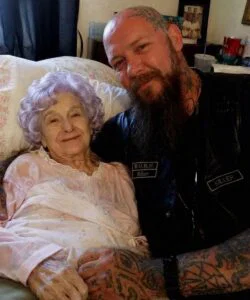
My uncle Ray entered with a paper bag of apple muffins and his old brown coat on his shoulders. He was seventy-two, partially deaf, limping because of a bad knee, and looked as gentle as a retired librarian. To Caleb, he seemed harmless.
To me, he had always been safety.
Ray paused at the end of my bed. His gaze moved from my face to my throat. Something in the room shifted. Not louder. Quieter. Like the air disappearing right before a storm breaks.
“Who did that?” he asked.
Caleb gave a low laugh. “Uncle, relax. Just showing her who the boss of this new family is.”
Martin laughed once, then went silent.
Ray placed the muffins on the table. Slowly, with eerie calm, he closed the hospital curtains. Then he took out both hearing aids and set them on the tray beside my untouched soup.
“Close your eyes, kiddo,” he told me softly.
But I kept them open. I watched Martin Price’s face turn colorless when Ray’s sleeve moved and exposed the old military tattoo on his forearm: a black dagger piercing a broken crown.
Martin made a wet gagging noise. Then the brutal man who had frightened half the county bent forward and vomited all over the spotless hospital floor.
Caleb yelled at him, humiliated. “Dad, what’s wrong with you?”
Martin could not speak. His stare remained locked on Ray’s arm, on that faded ink, on some buried past he had clearly believed would never rise again.
That was when I understood. Caleb had not married a powerless woman.
He had married the only niece of the man his father still saw in nightmares….
Part 2
Ray did not raise his voice once. That was what made the hospital room feel so dangerous.
He looked at Martin. “You know me.”
Martin wiped his mouth with a trembling hand. “Raymond Voss.”
Caleb glanced between his father and my uncle, irritated that fear had entered the room without asking him first. “What is this? Some old army reunion?”
Ray’s eyes moved to him. “No. This is the last decent warning your family will ever receive.”
Caleb rose to his feet. “You don’t threaten me in my son’s room.”
That was the mistake he made. He still believed shame could control me after fear had burned every trace of it away.
Ray reached inside his coat and pulled out a phone. Just a phone. He passed it to me and gave a small nod.
I understood immediately.
For months, while Caleb had tightened his control over my bank account, my friends, my passwords, and even my breathing, Uncle Ray had told me to keep records. He never forced me before I was ready. He only told me, “Predators count on silence. Give their silence a timestamp.”
So I did. Photos buried in hidden cloud folders. Audio files saved under grocery-list names. Emails Caleb had sent from his work account ordering me to “behave.” Screenshots of Martin texting, A wife learns faster when she’s scared.
And that morning, before Caleb came in, I had already signed a report with the hospital social worker. I had asked the nurse to take pictures of my neck. I had agreed to let security preserve the hallway footage.
Caleb had no idea. Martin had no idea.
Ray did.
The nurse knocked on the door. “Everything okay?”
Caleb gave her his flawless smile. “Family moment.”
I looked straight at her. “No.”
One word. Small. Precise. It sliced the room wide open.
Security arrived in less than a minute. Caleb tried to turn it into a joke until the head nurse saw my throat and her expression hardened. Martin seized his son’s arm and whispered harshly, “Shut up.”
But Caleb was wealthy, entitled, and far too accustomed to women giving in. “Do you know who my father is? Do you know how many people owe us favors?”
Ray put his hearing aids back into place. “I do.”
The hospital administrator came next, followed by two police officers. Caleb’s confidence returned when he recognized one of them. “Denny, thank God. Tell them this is private.”
Officer Denny did not move. His eyes kept flicking toward Ray.
Ray said, “Is Captain Morales still in charge of Internal Affairs?”
Denny’s jaw tightened.
Martin murmured, “Ray, please.”
That please was worth every bruise I had ever hidden.
Ray turned to me. “Your aunt left you something besides recipes, Nora. Her shares. Her trust. Her voting rights.”
Caleb blinked. “What shares?”
I raised my chin. “The Price Logistics shares your father stole from her after she died. The ones he thought nobody could trace.”
Martin reached for the wall.
Ray smiled, but there was no kindness in it. “I traced them.”
For the first time, Caleb looked truly scared. Not of Ray’s hands. Of documents, witnesses, and a woman lying in a hospital bed who had already signed every necessary paper.
Part 3
The collapse started before the pain in my throat had even faded.
Caleb was escorted out of the room while shouting about attorneys. Martin tried to go after him, but two officers stopped him when Ray quietly asked if they wanted federal investigators examining every favor the Price family had purchased from their department. Suddenly, no one was eager to assist.
I gave my statement while Eli slept.
Ray sat beside me, lifting a paper cup of water to my lips because my hands would not stop trembling. “You did the hard part,” he said.
“No,” I whispered. “I survived the hard part. Now I want him stopped.”
Ray nodded once. “Then we do it clean.”
Clean was Ray’s favorite word. It meant no revenge that could be twisted against me. No fury that handed Caleb a defense. No theatrical errors. Only law, evidence, and consequences arriving in neat pressed suits.
Within forty-eight hours, my emergency protective order was approved. Caleb was barred from the maternity ward, our home, and me. After the hospital photographs, recordings, and witness accounts were submitted, the court granted temporary custody of Eli to me alone.
Then the second strike landed.
Ray’s lawyer filed a civil case against Martin Price and Price Logistics, backed by old transfer documents, falsified signatures, and a trail of shell accounts leading directly to Martin. My aunt, Ray’s wife, had once owned thirty percent of the company. After she died, Martin buried the shares beneath forged paperwork and assumed Ray would stay shattered.
Ray had not been shattered. He had been waiting.
At the custody hearing, Caleb appeared immaculate and furious, dressed in a navy suit and wearing the expression he used for donors. “My wife is unstable,” he told the judge. “My father and I have been trying to protect the baby.”
The judge opened a folder. “Mr. Price, are you referring to the baby you threatened to remove from his mother unless she stopped documenting assault?”
Caleb froze.
My attorney played the recording. His voice filled the courtroom: “No one believes bruises on a hysterical postpartum woman. My father owns this town.”
Martin shut his eyes.
The judge did not. “Apparently,” she said, “not anymore.”
By sundown, Caleb was facing criminal charges. Martin’s accounts had been frozen. Price Logistics’ board suspended him pending investigation, and when Ray’s claim became public, three former employees stepped forward with allegations of intimidation, bribery, and fraud.
The empire did not blow apart all at once. It fell the proper way, level by level, beneath the crushing weight of receipts.
Six months later, Eli laughed for the first time on my uncle’s porch beneath the morning sunlight. The marks on my throat had disappeared. My wedding ring had disappeared. My fear had disappeared too.
Caleb was waiting for trial and supervised visitation he almost never received. Martin had sold his lake house to pay lawyers who could not rescue him from forged documents carrying his own signature.
Ray bounced Eli softly on his knee. “Boss of the family, huh?”
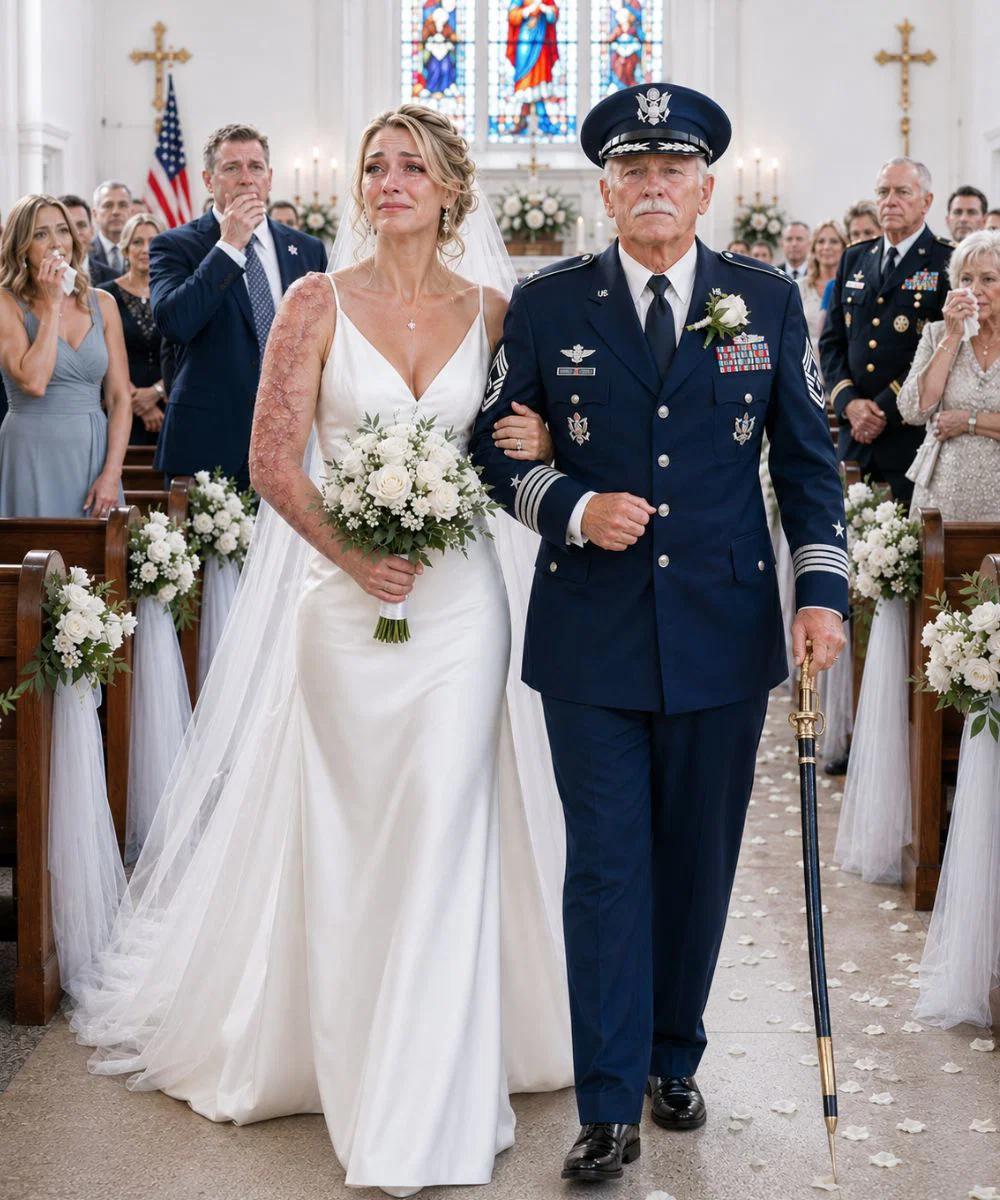
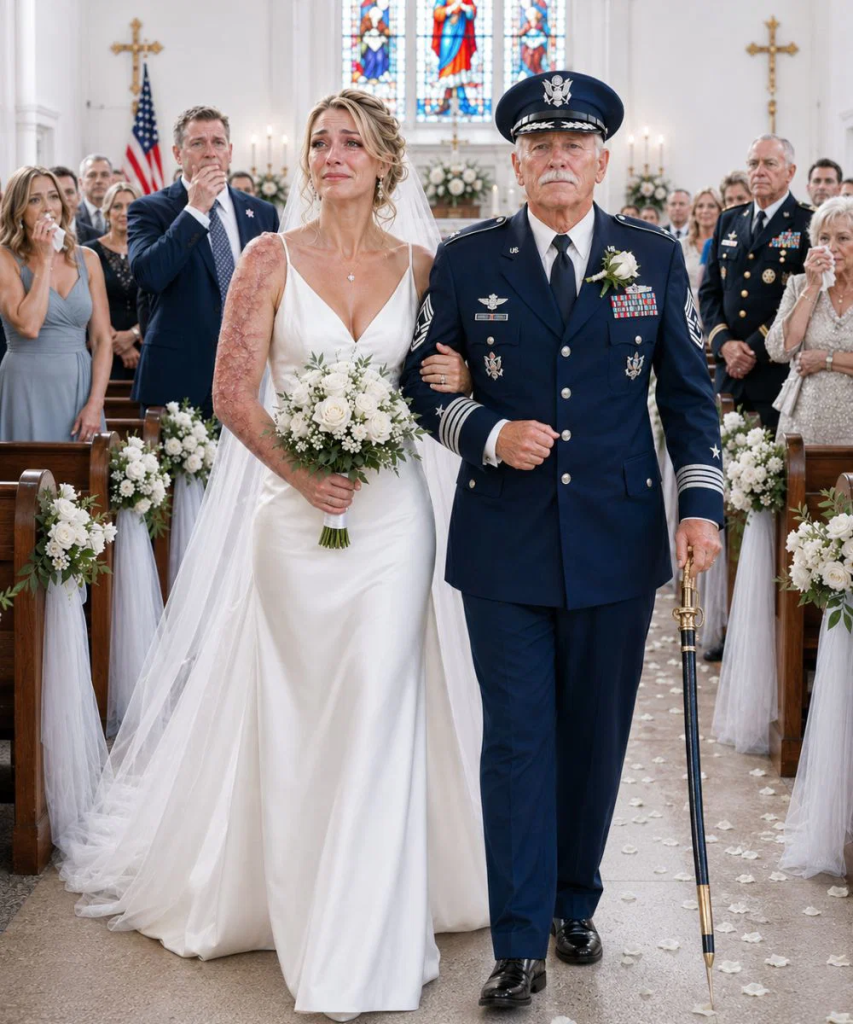
Three minutes before the wedding music began, my father refused to walk me down the aisle.
Richard Vale stared at the scars stretching across my neck and shoulder, then took a step back as though they were something shameful.
“I won’t be remembered escorting a damaged bride,” he whispered.
For a moment, the chapel faded away. All I could hear was the familiar ringing in my ears, the same sound that had haunted me since the explosion aboard a Navy destroyer in the Arabian Sea.
Dad straightened his cuff links and glanced toward the guests—politicians, admirals, executives, and longtime business partners.
“Those wedding photos will last forever,” he said coldly. “I’m not standing beside… that.”
To him, I wasn’t Lieutenant Evelyn Vale.
I wasn’t the daughter who had helped save his struggling company years ago by sending home nearly every extra paycheck.
I wasn’t the naval officer who had carried injured sailors through burning steel while flames consumed the engine room.
I was only the scars.
They burned beneath his stare, but I refused to hide them. Those marks reminded me that I had survived fire, months of surgeries, and endless rehabilitation. I would survive my father’s cruelty too.
Behind him, my younger sister Camille adjusted her champagne-colored dress.
“Dad is only protecting the family’s reputation,” she said softly. “You could still change into the high-neck gown I suggested.”
“I’m wearing the dress I chose.”
“Then postpone the wedding.”
Before I could answer, my fiancé, Daniel Mercer, stepped between us, anger flashing across his face.
“That’s enough.”
I gently touched his arm.
“Please… not today.”
My father mistook my calmness for weakness.
He leaned closer.
“If you walk in there without me, everyone will remember exactly what happened to your face.”
The chapel doors suddenly opened.
Every naval officer inside the room stood at attention.
Four-star Admiral Helena Cross walked through the entrance in full dress uniform, commanding instant silence. She was the Chief of Naval Operations, one of the most respected leaders in the Navy—and someone my father had spent years trying to impress because her office approved defense contracts worth hundreds of millions.
The color drained from his face.
The admiral stopped beside me, studying my scars with calm eyes before turning toward my father.
“Your daughter earned those scars saving American sailors,” she said firmly.
Then she offered me her arm.
“If you’re ashamed to walk beside her, Mr. Vale, I would consider it an honor.”
The chapel remained silent for one heartbeat.
Then applause began among the uniformed officers.
Within seconds, nearly every guest joined in.
My father stood frozen near the entrance while the attention he craved disappeared completely.
Daniel smiled as tears gathered in his eyes.
Together, Admiral Cross and I walked toward the altar.
Just before stepping away, she quietly spoke so only I could hear.
“The investigation file reached my desk this morning.”
I kept smiling for the guests.
“Is it enough?”
She nodded.
“Enough to bring down an entire corporation.”
Across the chapel, my father watched us with growing uncertainty.
At last, he realized the admiral hadn’t attended my wedding simply as an honored guest.
She had come because of him.
PART 2
The reception was held beneath glittering crystal chandeliers inside the exclusive Vale Maritime Club, a venue my father proudly called the symbol of his success.
He arrived late, smiling as though nothing unusual had happened during the ceremony.
Lifting a champagne glass, he addressed the guests without waiting for permission.
“To family,” he announced. “Even when certain people mistake public drama for real honor.”
A few executives laughed politely.
Camille raised her glass in support.
My mother quietly stared at her plate.
Daniel started to respond, but I gently squeezed his hand.
“Let him finish.”
My father grew even more confident.
“Evelyn has always loved attention,” he continued. “Fortunately, Vale Dynamics remains focused on serving this country. Tomorrow we’ll receive final approval for our newest naval contract.”
Applause spread across the ballroom.
Then he turned toward me.
“Considering today’s embarrassment, your position in the family trust and your voting shares may need to be reconsidered.”
Camille smiled, clearly pleased by the idea.
“You should have hidden those scars,” she said. “Instead, you embarrassed Dad in front of the admiral.”
I calmly cut another piece of wedding cake.
“Did I?”
Before anyone could answer, my father’s phone vibrated.
He ignored it.
Then Camille’s phone rang.
Moments later, nearly every executive at the head table looked down at their own screens.
The smiles disappeared one by one.
“What is this?” my father muttered after reading the message twice.
“Contract review suspended?”
Admiral Cross remained perfectly calm.
“That’s standard procedure whenever credible evidence suggests a defense contractor endangered American service members.”
My father slowly turned toward me.
“What have you done?”
I placed my fork on the plate.
“Sixteen months ago, the fire suppression system aboard the USS Resolute failed during an engine-room explosion.”
“It worked exactly as designed,” he snapped.
“It didn’t.”
“The system your company certified as military-grade nickel alloy was actually built with inferior steel.”
For the first time that evening, fear flashed across his face.
That tiny expression confirmed everything investigators already suspected.
I still remembered the fire.
The heat.
The collapsing metal.
Carrying one unconscious sailor to safety.
Going back for a second.
Then a third.
Those rescues left scars across my neck and shoulder that would never disappear.
After my surgeries, my father visited the hospital only once.
Instead of asking whether I would recover, he begged me never to mention which company had manufactured the failed equipment.
Back then, I believed he wanted to avoid bad publicity.
Months later, I learned the truth.
A senior engineer named Rosa Kim secretly contacted federal investigators after discovering internal test reports had been altered.
According to the documents, Richard Vale personally ordered failed safety results to be replaced with fabricated ones.
Camille, serving as the company’s legal director, approved false compliance certificates and helped conceal the changes.
My father laughed too loudly.
“Anyone can forge paperwork.”
I looked him in the eye.
“The damaged manifold couldn’t be forged. I photographed its serial number before investigators removed it. The laboratory analysis, supplier invoices, and your internal emails all point to the same conclusion.”
Camille suddenly stood.
“Those emails are protected legal communications.”
“They stopped being protected the moment they became instructions for fraud.”
Before anyone spoke again, the ballroom doors opened.
Four federal agents entered alongside two attorneys from the Department of Justice.
Every conversation instantly stopped.
The lead investigator walked directly toward my father.
He forced a nervous smile.
“This is my daughter’s wedding.”
The agent met his eyes without hesitation.
“No, Mr. Vale.”
“This is the day your company begins answering for millions of dollars in fraudulent defense contracts.”
Silence swept across the ballroom as every guest realized the celebration had just become the beginning of a federal criminal investigation.
PART 3
Richard pointed directly at me.
“She stole confidential company records! Arrest her!”
The lead federal agent didn’t even glance in my direction.
“Lieutenant Vale provided no stolen documents,” she replied. “Your senior metallurgist cooperated under federal whistleblower protection.”
Camille’s face turned white.
“Rosa signed a confidentiality agreement.”
Admiral Cross calmly answered before anyone else could.
“No agreement protects criminal conduct or fraud against the United States.”
My father shook his head in disbelief.
“You’re destroying an entire company over one defective component.”
The admiral stepped forward.
“One defective component injured seven sailors.”
She looked at me.
“This officer entered a burning engine room three separate times to save lives. Those scars represent courage.”
Then she turned back to Richard.
“They also represent the consequences of your decisions.”
Around the ballroom, every naval officer rose to their feet once again.
No one applauded this time.
Their silence carried far more weight.
Richard’s phone continued buzzing without pause.
Banks had frozen credit lines.
The Navy had suspended every pending payment.
Board members were demanding an emergency meeting.
His business empire was collapsing by the minute.
Camille rushed toward me and grabbed my arm.
“Please stop this,” she whispered. “Tell them there’s been a misunderstanding.”
I calmly looked down until she released my sleeve.
“You approved false safety certificates after learning those parts could fail.”
“I was protecting the company.”
“You were protecting profits.”
Panicking, Camille pulled out her phone and hurriedly typed a message.
An FBI agent immediately stepped beside her.
“Please place the phone on the table.”
“It’s private.”
The agent turned the screen toward everyone nearby.
The unfinished message read:
DELETE ALL RESOLUTE FILES. ERASE THE BACKUPS. NOW.
One of the Justice Department attorneys gave a faint smile.
“Attempting to destroy evidence in the middle of a federal investigation usually makes our job much easier.”
Camille burst into tears.
Richard remained silent.
For the first time in my life, he looked small.
Not like the powerful businessman everyone admired.
Just a frightened man watching everything he had built disappear.
As agents escorted them toward the ballroom doors, hundreds of guests stepped aside without saying a word.
No one defended them.
No one followed them.
I thought I would feel victorious.
Instead, I felt something far lighter.
Relief.
Years of carrying anger finally slipped away.
Daniel gently took my hand.
“We can cancel the reception if you want.”
I looked around the room.
At the sailors whose lives had been changed forever.
At my friends.
At Admiral Cross.
At my mother, who slowly walked toward me with tears in her eyes.
“I’m sorry,” she whispered. “I should have stood beside you long ago.”
It wasn’t enough to erase the past.
But it was an honest beginning.
I smiled.
“No.”
I squeezed Daniel’s hand.
“We’re finishing our wedding.”
The music started again.
Guests returned to the dance floor.
For the first time in years, I celebrated without pretending to be someone else.
Eleven months later, Richard Vale pleaded guilty to procurement fraud, conspiracy, and witness tampering. He was sentenced to nine years in federal prison.
Camille admitted her role in falsifying compliance documents and attempting to destroy evidence. She received a four-year sentence.
Vale Dynamics was dismantled, while its legitimate divisions were sold to protect innocent employees from losing their jobs.
Rosa Kim received federal whistleblower recognition for exposing the fraud.
The injured sailors were compensated through the recovery fund.
Daniel and I moved to a quiet home overlooking Chesapeake Bay.
I accepted command of a Navy safety unit dedicated to ensuring that no contractor could ever place profit above the lives of service members again.
On our first wedding anniversary, I wore the same sleeveless wedding dress by the water.
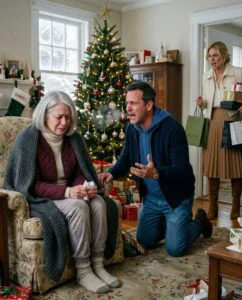
On Christmas morning, my millionaire son asked whether Amanda’s $5,000 monthly support had finally made life comfortable for me. I pulled my blanket closer and told him I had been living without heat since November. Then his elegant wife walked in with gifts in her arms, and the truth began tearing everything apart.
On Christmas morning, my millionaire son knelt beside the tree and asked, “Mom, has the $5,000 Amanda sends you each month finally made you comfortable?”
I clutched the blanket tighter around myself and whispered, “Son, I haven’t had heat in this house since November.”
For a moment, the only sound in the room was the old wall clock ticking above the mantel. Outside, snow piled against the windows in thick white layers. Inside, my breath left my mouth in small clouds.
My son, Daniel Whitmore, stared at me as though I had spoken in a language he did not understand. He was forty-two, successful, polished, the kind of man who made other people straighten their backs when he entered a room. His wool coat likely cost more than my monthly pension. Yet in that moment, kneeling beside my artificial Christmas tree with its cracked ornaments and flickering lights, he looked like the little boy who used to ask why the power went out when the bills were late.
“What do you mean you haven’t had heat?” he asked.
I tried to smile. “The furnace broke. I didn’t want to worry you.”
His gaze moved slowly around the room. The plastic taped over the windows. The space heater beside my chair, unplugged because I could not afford the electric bill. The cans of soup stacked on the kitchen counter. The unopened medical letters lying near my Bible.
“Mom,” he said slowly, “Amanda told me she set up automatic payments. Five thousand dollars every month. For over a year.”
My fingers tightened around the blanket. “Amanda told me you were struggling with the new hotel project. She said I shouldn’t bother you. She said you and she were sending what you could.”
Daniel stood so abruptly that the ornaments trembled. “What you could? Mom, that money was for you. Your heat, your groceries, your medication.”
Before I could respond, the front door opened.
Amanda entered carrying gifts wrapped in silver paper, her blonde hair perfectly smooth beneath a white cashmere hat. She smiled brightly, then stopped when she saw Daniel’s face.
“Merry Christmas,” she said, her voice cautious.
Daniel turned toward her. “Where is the money?”
Amanda blinked. “What money?”
“The $5,000 a month I’ve been sending my mother through your account.”
Her smile tightened. “Daniel, not here.”
“Yes. Here.”
The room felt even colder than before. Amanda placed the gifts down one at a time, as though trying to buy herself a few extra seconds. Her diamond bracelet flashed beneath the weak yellow light.
I looked at my son, then at his wife, and suddenly remembered every time Amanda had said, “Your mother is proud. She doesn’t want charity.”
Daniel’s jaw hardened. “Did my mother receive one dollar of it?”
Amanda’s face shifted. Not into guilt. Into irritation.
“That money was being managed,” she said. “Your mother wouldn’t know what to do with that much.”
Daniel went completely still.
And that was the moment Christmas stopped being a holiday in my house and became the morning my son finally saw the woman he had married.
PART 2
Daniel did not raise his voice. That was what frightened Amanda the most.
My son had always been most dangerous when he grew quiet. As a boy, when anger took hold of him, he did not throw toys or slam doors. He sat still, thought carefully, and decided what would happen next. That morning, standing inside my frozen living room while snow tapped gently at the windows, he looked at his wife with that same silent focus.
“Managed,” he repeated.
Amanda slowly removed her gloves. “Daniel, your mother is elderly. She lives alone. She forgets things. I was protecting the money.”
“I am sixty-eight,” I said, my voice rough. “I remember my own hunger.”
Her eyes cut toward me. “Evelyn, please don’t dramatize this.”
Daniel’s head turned slightly. “Don’t speak to her like that.”
Amanda gave one sharp, nervous laugh. “Are you serious? You believe this? Look around, Daniel. Your mother chooses to live like this. I offered to help her move.”
“You offered to put me in a senior facility two counties away,” I said.
“A very nice one,” Amanda replied.
Daniel took out his phone. “Show me the account.”
Amanda’s face hardened. “No.”
He looked at her for a long moment. “Then I’ll call my attorney.”
That changed the entire atmosphere in the room.
Amanda stepped closer and lowered her voice. “Think carefully. It’s Christmas morning. Your mother is emotional. You’re tired. Don’t turn a misunderstanding into a scandal.”
Daniel gave a smile without humor. “A misunderstanding doesn’t leave my mother sleeping in a coat.”
He walked into my kitchen and opened the cabinet under the sink. Frost clung to the old pipes. Then he opened my refrigerator. Beneath the dim bulb sat half a carton of milk, two eggs, a bowl of rice, and a jar of pickles.
For the first time, his face broke.
“Mom,” he whispered.
I looked away because I could not stand the shame in his eyes. “I didn’t want you to think I failed.”
“You raised me alone after Dad died,” he said. “You cleaned offices at night so I could take SAT prep classes. You sold your wedding ring so I could make my first tuition payment. You never failed me.”
Amanda sighed. “This is exactly the kind of guilt I was trying to prevent.”
Daniel turned back. “Where did the money go?”
She folded her arms. “Household expenses.”
“What household?”
“Our household. The Palm Beach renovation. The charity gala tables. Your company image. My image is part of your success, Daniel.”
I slowly sat down, gripping the armrest of my chair.
Daniel’s face went pale with rage. “You used money meant for my mother to decorate a vacation house?”
Amanda’s lips trembled, but her chin lifted. “I used it where it would do the most good.”
The sentence seemed to hang in the air.
Daniel nodded once. “Get out.”
Amanda stared at him. “Excuse me?”
“Get out of my mother’s house.”
“You don’t mean that.”
“I do.”
She glanced at the silver gifts beneath the tree. “Fine. But when you calm down, you’ll realize I saved you from being manipulated.”
Daniel picked up one of the presents and read the tag. “To Evelyn, with love, Amanda.”
He tore off the wrapping paper.
Inside was a designer candle.
My son stared at it. Then he let out one broken laugh. “She has no heat, and you brought her a candle.”
Amanda’s face flushed red. She grabbed her purse, walked to the door, then turned back.
“You’ll regret humiliating me.”
Daniel looked at her with empty eyes. “No, Amanda. I regret trusting you.”
The door slammed behind her.
One minute later, my son knelt in front of me again, but this time he held both of my cold hands in his.
“Mom,” he said, “by tonight, this house will be warm.”
I wanted to believe him.
But I had lived long enough to know money could repair pipes, furnaces, and bills.
It could not always repair betrayal.
PART 3
Daniel made three calls before breakfast.
The first went to a heating company in Albany that advertised emergency service. When the woman on the line told him there were no technicians available until the following week, he did not shout. He simply said his name, mentioned that his construction group held commercial contracts across the state, and asked whether the company owner would rather speak with him directly.Women’s health products
A technician arrived forty-seven minutes later.
The second call went to his private attorney, Leonard Brooks, a careful man with a dry voice and a habit of repeating important facts twice. Daniel placed him on speaker.
“My wife has had control of an account used to distribute personal support funds to my mother,” Daniel said. “My mother has received none of it.”
Leonard was silent for a moment. “How much?”
“Five thousand a month for fourteen months.”
“Seventy thousand dollars,” Leonard said. “Daniel, do not discuss this further with Amanda without counsel present.”
The third call was to his bank.
That one lasted the longest.
I sat in my old recliner beneath three blankets while the heating technician went into the basement. I heard tools clanking, valves hissing, and Daniel’s low voice from the kitchen. He was pacing. I knew because the floorboards creaked in the same rhythm each time he turned.Family law services
When he came back, he looked ten years older.
“Mom,” he said, “I need to ask you something, and I need the truth. Did Amanda ever ask you to sign anything?”
My stomach tightened.
“She brought papers last spring,” I said. “She told me they were for medical emergencies. She said you wanted her to be able to help if something happened.”
Daniel sat across from me. “Did you read them?”
I looked down. “The print was small. I trusted her because she was your wife.”
His hand moved to his mouth.
Suddenly, I felt foolish, old, and exposed. “Daniel, what did I sign?”
“I don’t know yet.”
But his eyes told me he was afraid he did.
By noon, warmth began moving through the vents. It did not blast or roar. At first, it came softly, a faint warm breath against the frozen bones of the house. I cried when I felt it touch my hands.
Daniel pretended not to notice. He went into the kitchen and began throwing expired food out of my refrigerator. Then he ordered groceries, medication refills, and arranged for a nurse to visit the next morning for a wellness check.
I wanted to tell him not to spend so much.
But then I looked at the designer candle Amanda had left on the coffee table.Patio, Lawn & Garden
I said nothing.
At three o’clock, a black SUV pulled into my driveway. Amanda stepped out, no longer wearing her white cashmere hat. Her hair was pinned back tightly, and her mouth was pressed into a thin line. Behind her walked a man in a navy coat carrying a leather folder.
Daniel opened the door before she could knock.
“We need to talk,” Amanda said.
Daniel looked at the man behind her. “Who is he?”
“My attorney.”
Daniel stepped aside. “Good. Mine is on video.”
Amanda entered as if she still controlled the room. Her eyes swept over the technician’s tools, the grocery bags, the pharmacy delivery, and the fresh invoice on the table.
“You’re making this theatrical,” she said.
“No,” Daniel replied. “I’m documenting it.”Coats & Jackets
The man in the navy coat introduced himself as Peter Langford. He did not smile. He placed the folder on the dining table and said, “Mrs. Whitmore would like to resolve this privately.”
I noticed he called her Mrs. Whitmore, not Amanda.
Daniel’s laptop sat open on the table. Leonard Brooks appeared on the screen, glasses low on his nose.
“Mr. Langford,” Leonard said. “Before anyone discusses resolution, I want copies of every document Mrs. Evelyn Harper signed in the presence of Amanda Whitmore.”
Amanda’s eyes flicked toward me.
There it was. A burst of anger so fast another person might have missed it. But mothers notice things. We notice when a child lies about a broken vase. We notice when a husband hides pain. We notice when a woman looks at us as though our existence has become inconvenient.
Peter opened the folder.
“There was a limited financial authorization,” he said. “For assistance purposes.”Surveillance camera systems
Leonard leaned closer to the camera. “Send it.”
Peter hesitated.
Daniel said, “Now.”
The document was emailed. Leonard read in silence. The room grew heavy as he scrolled.
Then his expression changed.
“Daniel,” he said, “this is not merely a financial authorization. This document appointed Amanda as fiduciary manager over support funds designated for Evelyn. It also gave her access to communicate with service providers on Evelyn’s behalf.”
Daniel stared at Amanda. “You had legal access to help my mother pay for heat.”
Amanda raised her chin. “And I would have, had she cooperated.”
I almost laughed. “Cooperated? I called you when the furnace stopped working.”
“You called me during a charity luncheon.”
“I called you because I was cold.”
Amanda turned toward Daniel. “She exaggerates. She always has. She wanted attention.”Parenting advice books
Daniel’s voice lowered. “Careful.”
But Amanda had moved past caution. Her perfect mask had cracked, and bitterness was spilling through.
“You want the truth?” she snapped. “Your mother never accepted me. From the day we married, she looked at me like I was temporary. She kept reminding you of where you came from, what you owed her, what she sacrificed. Every dinner, every holiday, she sat there like a monument to your guilt.”
I felt the words land, but they did not shock me. Sometimes hatred does not arrive like a storm. Sometimes it sits at your table for years, smiling over dessert.
Daniel said, “So you punished her?”
“I protected our life,” Amanda said. “You were sending thousands to this house while she refused to move, refused help, refused anything sensible. Do you know how that looked? A man of your position with a mother living in this neighborhood? This house is embarrassing.”
The room went completely still.Women’s health products
My house was small. The porch sagged. The wallpaper had yellowed. But my husband, Robert, had painted the nursery himself before Daniel was born. My son had learned to ride his bike in the driveway. I planted tulips along the front walk after Robert died because I needed proof that beautiful things could come back.
Daniel looked around, and I knew he was seeing all of it.
“Embarrassing,” he said.
Amanda seemed to realize she had gone too far. “I didn’t mean it like that.”
“Yes, you did.”
Peter cleared his throat. “Mr. Whitmore, emotions are high. Mrs. Whitmore is prepared to reimburse a portion of the funds.”
“A portion?” Daniel asked.
Peter opened another page. “Some expenditures may be classified as shared marital image maintenance.”
Leonard let out a cold laugh through the laptop. “That phrase is nonsense.”Patio, Lawn & Garden
Daniel leaned over the table. “Every dollar. Today.”
Amanda’s face tightened. “You can’t order me like an employee.”
“No,” Daniel said. “But a judge can order records. A forensic accountant can trace transfers. And if any signature was obtained through misrepresentation, this becomes much larger than a family argument.”
For the first time that day, Amanda looked frightened.
Not remorseful.
Frightened.
That difference mattered.
She slowly sat down. “Daniel, listen to me. We have built a life together.”
“You built a life using my blind spots.”
“I am your wife.”
“And she is my mother.”Family
Amanda’s eyes shone, but the tears looked summoned rather than real. “You would destroy our marriage over money?”
Daniel looked at me.
I thought of November nights when I slept in my coat. I thought of holding my prescription bottle and counting pills because I could not afford the refill. I thought of Amanda’s soft voice telling me Daniel was too busy, Daniel was under pressure, Daniel needed me not to burden him.
“It was never only money,” Daniel said.
Amanda wiped a single tear carefully from her cheek. “Then what do you want?”
Daniel stood straight. “You will return the full seventy thousand dollars to an account in my mother’s name by end of business tomorrow. You will provide every record connected to those funds. You will resign any authority over her affairs immediately. And then you and I will discuss our marriage through attorneys.”
Amanda stared at him. “You’re leaving me?”
Daniel answered quietly. “I think you left me a long time ago. I just didn’t notice.”Family law services
She looked at me then, and all the elegance drained from her face.
“You must be pleased,” she said.
I shook my head. “No. I’m warm. There’s a difference.”
That was the final thing I said to her in my house.
Peter collected his documents. Amanda stood, but she did not move toward the door immediately. Her eyes traveled to the Christmas tree, to the old ornaments made from felt and glue, to the photograph of Daniel at seven years old with his two front teeth missing.
For one second, I wondered whether she understood what she had tried to freeze out of him.
Then she turned and left.
The weeks that followed were not simple. Real life rarely ends neatly on Christmas morning.
Amanda did return the money, but only after Leonard filed emergency petitions and Daniel froze several shared accounts. The papers I had signed were challenged. My name was removed from anything she could access. Daniel hired a financial advisor for me, a kind woman named Marisol Grant who spoke slowly, explained every line, and never made me feel foolish for asking questions.Coats & Jackets
The furnace was replaced completely.
The first time the house reached seventy degrees, I stood in the hallway and listened to nothing. No teeth chattering. No groaning pipes. No fear humming under my skin. Only ordinary warmth.
Daniel came over every evening for two weeks. Sometimes he brought dinner. Sometimes he sat quietly answering emails while I watched television. He did not say much about Amanda, but one night I saw the divorce papers in his briefcase when he bent down to pick up his keys.
“I’m sorry,” I told him.
He looked confused. “For what?”
“For being the reason.”
He shut the briefcase and sat beside me. “Mom, you were the truth. The truth is not the reason something breaks. It is the reason we finally see the crack.”
That was my son. Still polished. Still wealthy. But beneath all of that, he was still the boy who once promised me he would buy me a warm house when he grew up.Women’s health products
In February, he did something I never expected.
He did not buy me a mansion. He did not force me into a luxury apartment. He asked me what I wanted.
I told him I wanted my house repaired. Not replaced. Repaired.
By spring, the porch was rebuilt, the windows sealed, the roof patched, and the kitchen painted pale yellow like it had been when Robert was alive. Daniel argued with me about the cost until I told him mothers should be allowed to win some arguments. He laughed then, truly laughed, for the first time since Christmas.
Amanda’s name appeared in the local society pages less often after that. Some friends vanished from her side once the court filings became public. Others remained. That was their choice. I did not follow her life closely. I had spent enough cold nights with her shadow inside my home.
One afternoon in April, a package arrived without a return address.
Inside was the designer candle she had brought me on Christmas morning.
There was no note.
Daniel wanted to throw it away. I told him no. I placed it on the mantel beneath the wall clock. Not because I forgave Amanda. Not because I wanted to remember her.
Because every time I saw it, I remembered the exact morning my son returned to me completely.
The candle was never lit.
By the next Christmas, my house smelled of cinnamon, roasted turkey, and fresh pine. Daniel arrived early, wearing jeans instead of a tailored suit, carrying firewood even though my heat worked perfectly well. He set the logs beside the fireplace and kissed my forehead.
“Merry Christmas, Mom,” he said.
I looked at the tree. The same cracked ornaments hung from the branches. The same old angel leaned slightly left at the top. But the room was warm, the table was full, and my son was no longer looking past me.Patio, Lawn & Garden
“Merry Christmas, Daniel,” I said.
He handed me an envelope.
I narrowed my eyes. “What did we say about expensive gifts?”
He smiled. “Open it.”
Inside was not money. It was a copy of a legal document creating a protected trust for my care, managed by Marisol and overseen by Daniel, with every statement sent directly to me. No one could intercept it. No one could speak on my behalf without my written consent. No one could decide that I was too old, too proud, or too inconvenient to be heard.
My hands trembled.
Daniel sat beside me. “You get control. You get dignity. And you get to stay home.”
I touched the paper, then looked at my son.
For years, I had believed comfort meant heat, food, medicine, and paid bills. Those things mattered. They mattered more than pride.
But comfort also meant knowing that when I whispered the truth, someone finally listened.
Outside, snow began falling again over Albany. It covered the repaired porch, the sleeping tulip beds beneath the ground, and the driveway where Daniel’s car rested under a dusting of white.
Inside, the furnace hummed steadily.
And for the first time in a long time, Christmas morning felt like Christmas morning again.
My parents announced they were bringing 20 guests to my lake house and ordered me to fill the fridge. When I said no, Mom laughed and asked if I really thought I could stop them. By Friday morning, Dad was screaming, “What did you do to the house?”
I had just finished a twelve-hour shift at St. Mercy Medical Center, most of it spent on my feet, most of it spent watching people fight for one more breath beneath fluorescent lights. By the time I pulled up outside my apartment in Portland, Oregon, my scrubs smelled like disinfectant and coffee, and my phone had been buzzing for twenty minutes straight.
Family group chat.
Dad had tagged me three times.
Dad: We’re using your lake house this weekend—20 guests.
Mom: Fill the fridge and behave.
My younger brother, Kyle, added a line of laughing emojis.
I stared at the messages until the letters started to blur.
My lake house was not “family property.” It belonged to me. I bought it after six years of double shifts, overtime, and living with roommates who stole food from my shelves. It was a quiet place near Devils Lake where I could sleep, breathe, and not listen to my mother judge every part of my life.
I typed one word.
Me: No.
Mom answered immediately.
Mom: 😂😂😂 You really think you can stop us?
Dad sent a voice message, but I did not open it. I already knew the voice he would use: an order dressed up as family love.
So I did not argue.
I showered, changed, and made one call to my neighbor, Mrs. Harper, who lived across the gravel road from the lake house.
“Margaret,” I said, “if any cars show up this weekend, they do not have permission to enter.”
She paused. “Your parents again?”
“Yes.”
“Good. I’ll keep an eye out.”
Then I opened my laptop and signed into the smart security system. I changed every door code. I disabled the old garage keypad. I shut off the guest Wi-Fi. I turned on the cameras and called the local locksmith, the same man who had helped me after my father “borrowed” the place the previous summer and left beer cans in the hot tub.
By noon, the locks had been replaced.
By three, I had emailed the sheriff’s office non-emergency line with a written statement: no one had permission to enter the property.
Then I slept.
Friday morning, my phone exploded.
Forty missed calls.
Dad’s name filled the screen over and over.
I answered the forty-first call.
“What did you do to the house?” he screamed.
His voice came through windy and furious. In the background, I heard Mom shouting, “Tell her to stop acting crazy!”
I sat up slowly. “Good morning.”
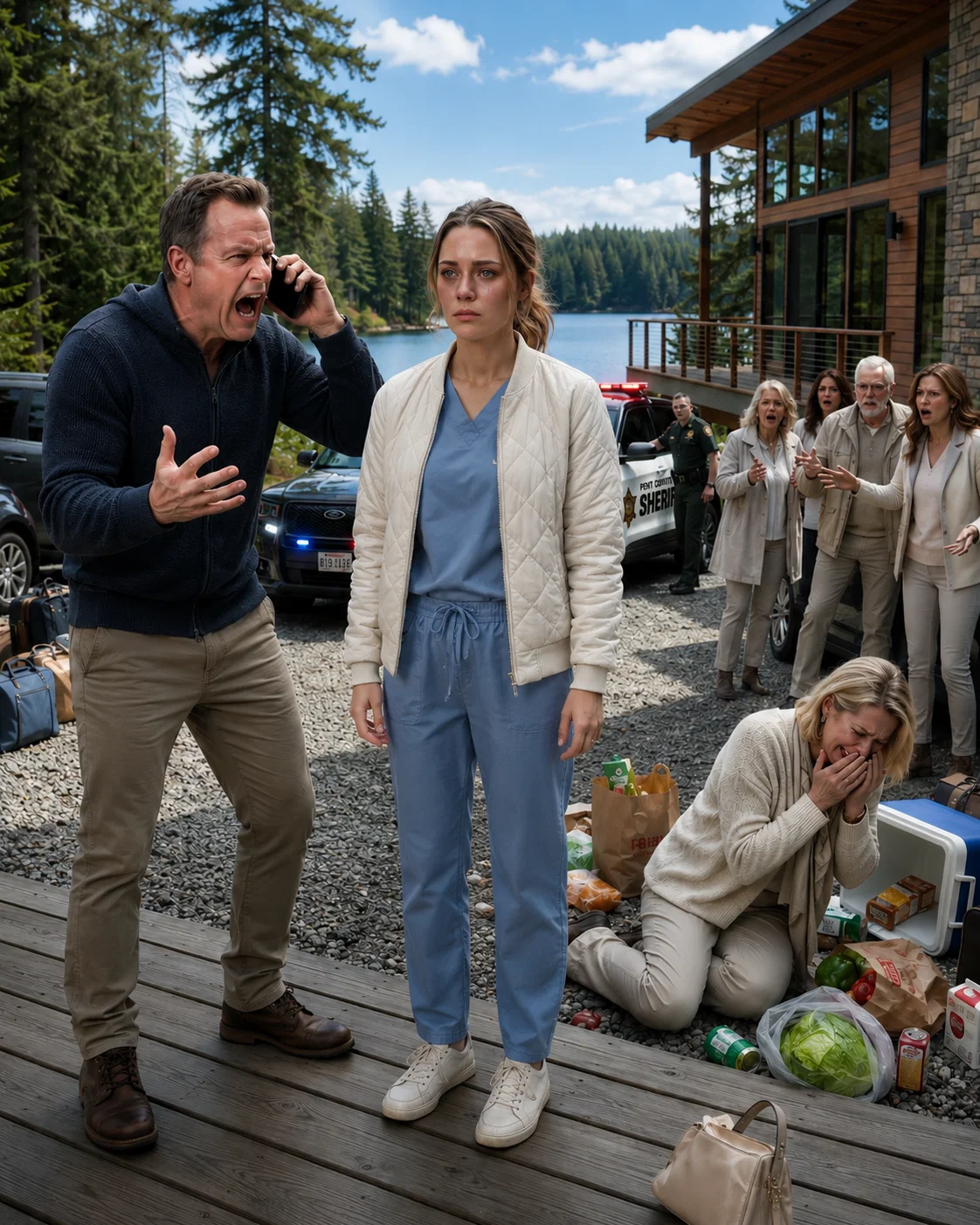
“Don’t you good morning me! The front door code doesn’t work. The garage is locked. There are cameras everywhere. Your mother is standing outside with groceries melting, and everyone is staring at us!”
“Then everyone should leave.”
“This is a family weekend!”
“No,” I said. “It was a break-in attempt with witnesses.”
For once, silence followed.
Then Dad lowered his voice. “Open the door, Claire.”
I looked at the live camera feed.
Twenty people were standing on my porch.
And behind them, a sheriff’s cruiser was pulling into the driveway.
PART 2
Dad saw the cruiser at the exact same moment I did.
On camera, his face shifted from rage to panic so fast it almost looked practiced. He turned away from the Ring camera and barked something at Kyle, who stood there holding a cooler and pretending not to hear him.
Mom moved closer to the door camera, her lipstick too bright beneath the morning sun.
“Claire,” she said, suddenly sweet, “this is enough. You’re embarrassing your father.”
I almost laughed.
For thirty-one years, embarrassment had been their favorite weapon. When I got accepted into nursing school, Mom told relatives I had chosen “a practical little job” because medical school was too difficult. When I bought the lake house, Dad said it was selfish to own a second property when Kyle was still renting. When I refused to lend Kyle ten thousand dollars after his sports bar failed, they called me cold.
But now I had embarrassed them.
A deputy stepped out of the cruiser. Tall, calm, sunglasses on. I recognized him from the email signature: Deputy Aaron Miles.
He looked at the crowd, then at my father. “Morning. Who’s in charge here?”
Dad straightened his shoulders. “I’m her father.”
“That wasn’t my question.”
Mom crossed her arms. “Our daughter is having some kind of episode. She’s tired from work.”
I pressed the speaker button through the security app.
“Deputy Miles, this is Claire Bennett, owner of the property. No one there has permission to enter.”
Every head turned toward the camera.
Dad’s jaw tightened. “Claire, hang up.”
The deputy looked directly at the camera. “Ms. Bennett, can you confirm you requested a trespass notice?”
“Yes. I emailed the documents yesterday. I can forward the deed and my ID again.”
“No need. I have them.” He turned back to my family. “You all need to leave the property.”
Kyle scoffed. “For standing outside?”
“For refusing to leave after the owner denied access.”
Aunt Denise, who had not spoken to me in two years but apparently believed she was entitled to my lake view, lifted both hands. “We drove four hours.”
Deputy Miles nodded. “Then you have a four-hour drive back.”
Dad’s face flushed red. “This is ridiculous. I paid for part of that house.”
The lie was so bold that even Mom glanced at him.
I spoke again. “You didn’t pay a dime.”
Dad pointed at the camera. “I raised you.”
“And I repaid that by not pressing charges last summer when you used my emergency key without permission.”
The porch fell quiet.
A cousin whispered, “Wait, what?”
Mom edged closer to Dad. “Claire, stop.”
“No. You told them I invited everyone, didn’t you?”
No one answered.
That was enough of an answer.
Deputy Miles gave them ten minutes to collect their coolers, folding chairs, bags, and grocery boxes from my porch. Across the road, Mrs. Harper appeared in her pink gardening hat, pretending to water flowers while watching the entire thing.
Dad called me six more times after they drove away.
I answered none of them.
Then Mom texted me privately.
Mom: You humiliated us in front of everyone. I hope you’re proud.
I typed back:
Me: I am.
Three dots appeared.
Disappeared.
Appeared again.
Then the message came that told me the real fight had barely begun.
Mom: Fine. Since you love ownership so much, we’ll discuss what you owe this family.
PART 3
I stared at Mom’s message for a long time.Family
What you owe this family.
It was a sentence I had heard in many forms since I was a child.
You owe your brother patience.
You owe your father respect.
You owe me gratitude.
You owe us help.
You owe us because we raised you.
It never mattered that I had started paying my own phone bill at sixteen, bought my own car at nineteen, covered Kyle’s rent twice in my twenties, paid for Mom’s dental surgery when Dad said money was tight, and let them use my lake house “just one time” the summer before.
One time had turned into three weekends.
Three weekends had turned into them telling relatives it was “our family lake place.”
And now twenty people had arrived because my parents had promised them access to something I owned.
I did not respond to Mom right away.Emotional support services
Instead, I got dressed, made coffee, and drove to Devils Lake.
The house was quiet when I arrived. Peaceful. The cedar siding glowed in the afternoon light, and the water beyond it was deep blue beneath a silver sky. On the porch, I found two crushed plastic cups, a torn grocery bag, and one package of hot dogs someone had dropped in the gravel.
I picked everything up slowly, letting the anger settle into something colder and more useful.
Mrs. Harper crossed the road with a covered dish in her hands.
“You all right, honey?”
“I am now.”
She handed me the dish. “Peach cobbler. You looked like a woman who might need sugar and silence.”
I smiled for the first time that day. “You’re an angel.”
“No. Just old and nosy.”
Inside, I checked every room. Nothing was broken. No windows were forced. No back door damage. The locksmith had done his job. The cameras had done theirs. The sheriff’s notice had done the rest.
My phone buzzed again.
This time, it was my cousin, Megan.
Megan: Hey. I didn’t know you said no. Your mom told everyone you asked us to come because you felt bad the house sat empty.
I sat down at the kitchen island.
Then another message arrived.
Uncle Rob: Your dad said you were “being dramatic” but that the house was basically family-owned. Is that true?
Then Aunt Denise.
Aunt Denise: I’m sorry. We should have checked with you.
Within an hour, the story my parents had created began to crack.
So I did something I had never done before.
I sent one message to the entire family chat.Family
Me: To clarify: I did not invite anyone to my lake house. I told Mom and Dad no. They brought twenty people anyway. The house is legally mine. I paid for it alone. Last summer, they entered without permission using an emergency key and left the property dirty and damaged. I changed the locks because they refused to respect a clear answer.
For once, I did not soften it.
I did not add, “I love you guys, but…”
I did not add, “Sorry for the confusion.”
There had been no confusion. There had been entitlement, performance, and a lifetime of assuming I would fold if enough people were watching.
Kyle answered first.
Kyle: Wow. You’re really making Mom cry over a house.
I replied publicly.
Me: Mom lied to twenty people over a house.Emotional support services
No one responded for several minutes.
Then Dad called.
I let it ring.
He called again.
I declined.
Then he sent a voice message.
I almost deleted it, but curiosity won.
His voice was lower now, rougher.
“You think you’re so smart, Claire? You think because you’ve got a deed and some cameras, you can treat your parents like criminals? Fine. Keep your house. But don’t come asking us for anything when you need family.”
I looked around my quiet kitchen.
The counters I had paid for.
The windows I had chosen.
The lake I had watched through sleepless mornings after hospital shifts that left me hollow.
I pressed record.
“Dad, I have not asked you for anything in years. But you have asked me for money, access, favors, and silence. That stops now. Do not come to this property again. Do not send anyone else here. Do not claim ownership of my home. If you do, I will handle it legally.”
I sent it before my courage could fade.
Mom replied ten seconds later.
Mom: You are cruel.
I typed:
Me: I am clear.
That evening, I ate Mrs. Harper’s peach cobbler on the back deck while the sun sank behind the trees. My phone kept buzzing, but less often now. The family chat had split into private conversations without me. I knew because Megan texted again.Family
Megan: Your mom is saying you’ve changed.
I replied:
Me: I have.
Because I had.
Not all at once. Not dramatically. Not because of a single weekend.
I had changed every time I worked a double shift and still answered Mom’s calls about Kyle’s problems. I had changed every time Dad talked over me at dinner and called it humor. I had changed when they used my house without asking and I cleaned up after them with shaking hands. I had changed when I finally understood peace was not something they would give me. It was something I had to protect.
The next morning, I drove back to Portland for another night shift. Before I left, I placed a printed notice inside the front window.
PRIVATE PROPERTY. NO TRESPASSING. OWNER PERMISSION REQUIRED. CAMERAS IN USE.
It looked harsh.Emotional support services
It also looked honest.
Three days later, a certified letter arrived at my apartment.
For one wild second, I thought Dad had hired an attorney.
But the letter came from the county sheriff’s office. It confirmed that the trespass warning had been documented and that any future unauthorized entry could result in a citation or arrest.
I scanned it. Saved it. Printed two copies.
Then I went to sleep without checking my family messages.
A week passed.
Then two.
The first real test came on a Sunday afternoon.
Kyle showed up at my apartment.
I saw him through the peephole in a hoodie, a baseball cap, and the guilty expression he had worn since childhood whenever he wanted something.
I opened the door but kept the chain locked.
He looked offended by the chain.
“Seriously?”
“Yes.”
He pushed his hands into his pockets. “Mom’s been crying.”
“I’m sure.”
“She says you’re tearing the family apart.”
“No. I stopped lending out pieces of myself.”
He rolled his eyes. “You always talk like a therapy pamphlet now.”
“And you always show up when you need something.”
That landed. His mouth tightened.
“I came to talk.”
“Talk.”
He glanced down the hallway, then lowered his voice. “Dad screwed up, okay? He told everyone you were fine with it. Mom backed him up. I didn’t know.”
“You laughed when she asked if I thought I could stop you.”
He looked away.
“I thought it was just family drama.”Family
“It became sheriff’s-office drama.”
Kyle rubbed the back of his neck. “Yeah. That was messed up.”
I waited.
Apologies in my family usually came with hooks.
Sure enough, Kyle added, “But you didn’t have to make it so public.”
I almost closed the door.
Instead, I said, “They made it public when they brought twenty people to my porch.”
He had no answer.
Behind his irritation, I saw something else: discomfort. Not regret exactly, but the beginning of awareness. Kyle was twenty-eight, old enough to know better, young enough to hide behind our parents when it benefited him.
“I need to ask you something,” he said.
“There it is.”
“No, not money.” He swallowed. “Did Dad ever pay you back for my rent?”
I stared at him. “What?”
“When I was twenty-three. I was behind two months. Dad said he covered it, then later said you helped him a little.”
I laughed once, without humor. “Kyle, I paid all of it. Twenty-four hundred dollars. He told me you knew.”
Kyle’s face changed.
For once, he looked truly ashamed.
“He said he paid.”
“He didn’t.”
The hallway felt smaller.
Kyle removed his cap and twisted it in his hands. “I didn’t know.”
“I believe you.”
That seemed to surprise him more than anything else.
He leaned against the wall. “How much stuff like that happened?”
“A lot.”
He nodded slowly, eyes fixed on the floor.
“I’m not saying I was great to you,” he said. “I wasn’t. I let them make you the responsible one and me the screwup. It was easier.”
That was the first honest thing he had said to me in years.
I kept my hand on the door.
“Being honest now doesn’t erase it.”
“I know.”
“And I’m not opening the lake house to you.”
“I know.”
He looked up. “But maybe we could get coffee sometime.”
I studied him. The chain stayed on the door. The boundary stayed in place.
“Maybe,” I said. “Not today.”
He nodded. “Okay.”
After he left, I sat on the floor beside the door for a few minutes, not crying, not smiling, just breathing.
That was the strange thing about finally standing up for yourself. At first, it did not feel like victory. It felt like leaving a loud room and realizing your ears were still ringing.
Months passed.
Summer shifted into fall. The lake turned steel-gray. I used the house on my own terms. Sometimes I invited friends from work. Sometimes I invited no one. Mrs. Harper and I created a routine: I brought her fresh coffee beans from Portland; she brought me baked goods and neighborhood intelligence.
My parents did not apologize.
Dad sent two angry texts, then stopped.
Mom sent the occasional dramatic message.Emotional support services
Mom: I hope your empty house keeps you warm.
Mom: Family should matter more than property.
Mom: One day you’ll regret pushing us away.
I answered none of them.
Then, in November, Aunt Denise hosted Thanksgiving in Salem. I almost skipped it. Megan convinced me with one sentence.
“Come for me, not for them.”
So I went.
I arrived with a pie and my own car keys in my pocket, parking where no one could block me in.
The room changed when I walked inside.
Mom sat on the couch in a cream sweater, looking fragile in the carefully arranged way I knew too well. Dad stood by the fireplace with a drink in his hand. Kyle was in the kitchen helping Megan.
Mom looked at the pie.Family
“How nice that you could make time for us.”
I handed it to Aunt Denise. “Thanks for hosting.”
Dad snorted. “Still doing the ice queen routine?”
The old Claire would have flushed. The old Claire would have tried to make the room comfortable again.
I set my purse on my shoulder.
“Happy Thanksgiving, Dad.”
“That’s it?”
“That’s it.”
He stepped closer. “You embarrassed me in front of my family.”
“You embarrassed yourself in front of a deputy.”
The room went silent.Sofas & Armchairs
Aunt Denise coughed into her wine.
Dad’s eyes narrowed. “Careful.”
I looked at him, really looked at him. He was not as huge as he had seemed when I was a child. He was a man with thinning hair, a red face, and a lifetime of getting his way by raising his voice first.
“No,” I said. “You be careful. I’m done pretending your anger is authority.”
Mom stood. “Claire Bennett, do not speak to your father that way.”
I turned to her. “And I’m done pretending your tears are evidence.”
Her face went pale.
For a moment, nobody moved.
Then Kyle entered from the kitchen, wiping his hands on a towel.
“Dad,” he said quietly, “drop it.”Emotional support services
Dad turned toward him. “Excuse me?”
Kyle’s voice trembled, but he did not step back. “You lied about the lake house. You lied about paying my rent. You’ve been lying to everybody.”
Dad’s mouth opened.
No words came out.
Mom looked betrayed, not because Kyle was wrong, but because he had said it where others could hear.
Megan stepped beside him.
Aunt Denise sat down slowly.
Something changed in that room. Not everything. Not magically. This was real life, not a movie. Dad did not confess. Mom did not cry into my arms. The family did not heal over turkey and pie.
But the old pattern cracked.
Dinner was tense. Dad barely spoke. Mom dabbed at her eyes twice and received less attention than usual. Kyle sat beside me, not too close, not asking for forgiveness, just present.
When I left after dessert, Mom followed me onto the porch.
The air was cold. Her sweater looked too thin for it, but she crossed her arms and stared at me.
“You really are different,” she said.
“Yes.”
“I don’t know who taught you to be this hard.”
I unlocked my car.
“You did.”
She flinched as if I had slapped her.
I did not stay to comfort her.
On the drive home, rain tapped against the windshield. I thought about the lake house waiting in the dark, locked and quiet. I thought about the woman I had been, exhausted in scrubs, reading those laughing emojis. I thought about how small the word “no” had looked on my phone screen and how much weight it had carried.
By December, the family chat was different.Family
Less loud.
Less certain.
People asked before assuming.
Megan visited the lake house in January. She brought soup, wine, and a board game. Kyle came once in March, after asking two weeks ahead of time. He slept on the pullout couch, washed every dish he used, and left a thank-you note on the counter.
My parents were not invited.
Not because I hated them.
Because access was not love.
Obedience was not respect.
And a house built from my labor was not a family trophy to be claimed by whoever shouted the loudest.
One Sunday morning, almost a year after the attempted weekend takeover, I woke at the lake house before sunrise. The water was still. Mist hovered above it in pale ribbons. I made coffee and stood barefoot on the deck, wrapped in a blanket.Sofas & Armchairs
My phone buzzed.
A message from Dad.
Dad: Your mother wants to know if we can come by sometime.
I looked at the lake.
Then at the door behind me.
Then at the cameras tucked beneath the eaves, silent and watchful.
I typed back:
Me: You can ask me directly when you are ready to acknowledge what happened.
Three dots appeared.
Disappeared.
No reply came.
That was fine.Emotional support services
For the first time in my life, silence did not feel like punishment.
For years, my Sundays had the same quiet rhythm, and I never thought twice about it. I believed I was simply lending a hand to an elderly neighbor, never realizing how deeply those ordinary mornings would come to matter.
The street was still that Sunday morning, the kind of quiet you only find in a suburb where everyone is still working through their first cup of coffee. I was 28 years old, standing in my driveway beside the recycling bin, watching maple leaves fall two houses down.
It was the most normal moment of my entire life, which is probably why it stayed so sharp in my memory.
—
Ezra had lived next door for years. We had waved from our driveways, exchanged brief hellos, and then returned to our separate lives. I could not have told anyone what color his front door was without looking.
That morning, I noticed Ezra struggling with four grocery bags in his trunk. One slipped, caught against his elbow, and nearly dropped to the ground. Before I could think it through, I was already walking over.
“Let me grab those,” I said.
“Oh, you don’t have to,” my neighbor said.
“I know. Come on.”
After that, he did not argue. I carried the bags up his porch and into a kitchen that smelled like old wood and instant coffee. The old man moved with slow care, the way people do when they have been alone for too many years.
“Sit down for a minute,” Ezra said. “The least I can do is pour you a cup of coffee.”
I nearly refused because I was not exactly the kind of man who drank coffee with strangers. But there was something in the way he asked, as though he already expected me to leave, that made me pull out a chair.
“One cup,” I said. “Then I’ve gotta go check on my gutters.”
My neighbor laughed. It was a small sound, surprised and warm.
—
We ended up talking for almost an hour!
Ezra told me about the neighborhood when cornfields still stood where the elementary school is now. I told him about my own life and how I had moved in thinking I would only stay for two years.
“Funny how that works,” he said. “I told my wife the same thing about this place in 1971!”
My neighbor mentioned a nephew once, somewhere in the middle of the conversation. Marcus, I think. He said the name the way someone says the name of a relative they used to know well, with a small pause afterward.
“He calls sometimes,” Ezra said. “When he needs something.”
The old man gave a little shrug like it did not matter, but his eyes rested on his cup for a second too long. I did not press him. It was not my business, and he did not seem eager to make it mine.
When I got up to leave, I tapped the doorframe.
“Hey, next time you get groceries, just call me. Save your back,” I joked.
“I wouldn’t want to bother you.”
“Then don’t think of it as a bother.”
My neighbor smiled at that, slowly and a little crookedly.
I walked back across the narrow strip of grass between our homes with my hands in my pockets, thinking I had done one small, decent thing on a quiet Sunday, nothing beyond that. I had no idea that one cup of coffee had started a clock that would keep running for the next 12 years.
—
Twelve years. That was how long one helpful Sunday slowly became a quiet ritual neither of us ever needed to name.
Ezra’s health began to fade in little ways at first. A slower walk to the mailbox. A hand that shook slightly when he poured coffee. Then driving became too difficult, and I started picking up his groceries every Sunday without either of us ever making an official arrangement.
During the first few weeks, Ezra tried to press money into my hand at the door.
“Anthony, take it. I’m not a charity case.”
“Ezra, I’m already going to the store. It’s the same trip.”
“Then take it for the gas.”
“Next week,” I’d say, knowing I had no intention of taking it then either.
Eventually, he stopped trying, and we settled into something better. I would put the milk in the refrigerator, set the bread on the counter, and then we would sit at his small kitchen table with two mugs between us.
Some Sundays, we talked about his late wife, Margaret, and the garden she used to care for. Other Sundays, Ezra asked about my job, my marriage, and whether my wife, Claire, and I had made up our minds about children. And on some Sundays, we barely spoke at all and simply watched the birds gather at his feeder.
I did not think of it as anything remarkable. It was just what my Sundays had become.
—
Claire and I married when I was 38, and she noticed right away that my Sundays with Ezra meant more than I admitted.
“You’re going over there again?” she asked one morning, half teasing and half serious.
“It’s an hour. Maybe two.”
“You’re really going to keep doing this every week? For years?” my wife asked.
“Ezra doesn’t have anyone else,” I protested.
Claire softened then, the way she always did, and handed me a tin of cookies she had baked the night before.
“Take these to him. And tell him I said hello.”
I did.
—
Ezra held the tin as though it were something valuable and asked me three separate times to thank her.
That was the Sunday he brought up Marcus again, the nephew who only called when his car, his rent, or some new scheme required a small loan.
“Marcus came by last month,” Ezra said, stirring his coffee in slow circles. “Asked me what I was planning to do with the house.”
“What did you tell him?” I asked.
“I told him I was planning to keep living in it.”
He smiled when he said it, but the smile never reached his eyes. I let the subject rest.
I left that afternoon thinking I should bring Claire over and properly introduce her. Ezra would have liked that, but I never got the chance.
—
The porch light was the first thing I noticed.
It was the next Sunday, a bright October morning, and my neighbor’s porch light was still on at 9 a.m. Ezra never left it burning after sunrise. He was particular about things like that, those small habits of a man who had lived alone for too long.
I stood in my driveway with the newspaper in my hand, staring at that yellow bulb glowing against the daylight. Something felt wrong, but I told myself he had probably just forgotten and that I would mention it when I brought the groceries over.
I went back inside to finish my coffee and read the headlines, but I could not focus.
—
By noon, an ambulance was parked in front of Ezra’s house. When I stepped outside, a neighbor from across the street told me what I already knew. Ezra had died in his sleep. Peacefully, they said. He was 84 years old, and I was 40.
I stood on his lawn for a long time after everyone had gone, looking at the porch light someone had finally turned off. Claire found me there an hour later and said nothing. She only took my hand.
The funeral was smaller than I had expected. Much smaller.
A few distant acquaintances stood near the back, a tired pastor read from a worn book, and I kept thinking that Ezra had deserved a room filled with more people than that.
Across the aisle, one man stood out. He wore a sharp dark suit and kept checking his phone, his thumb moving across the screen as if the service were interrupting something important.
When the service ended, I was about to leave, but the man came straight toward me.
“You must be the grocery guy,” he said, offering a hand that felt more like a transaction than a greeting. “I’m Marcus, Ezra’s nephew.”
“Anthony,” I replied. “I’m sorry for your loss.”
He gave me a thin smile.
“Sure. Over a decade of Sunday visits, huh? That’s a lot of free time to invest in an old man.”
I felt my jaw tighten, but I kept my tone steady.
“He was my friend.”
“Right,” Marcus looked past me toward the casket. “Well, friend or not, the house is going on the market fast. I’ve already got someone interested. No point in letting it sit.”
I said nothing. I could not tell whether grief or anger was making my hands feel cold, but I knew Ezra would not have wanted a scene at his own funeral.
His nephew leaned in a little.
“You know, people get attached to lonely old folks for all kinds of reasons. I hope your reasons were the good kind.”
“I never took a dollar from him,” I said quietly.
“That’s what they all say.”
My late neighbor’s nephew walked away before I could answer, already lifting his phone to his ear as though our conversation had meant nothing.
I stood there watching the last few mourners drift toward the parking lot. I was about to leave again when another man stepped into my path, holding something at his side.
“Are you Anthony? The neighbor who used to help Mr. Harrison?”
I nodded.
“I am Mr. Whitman. I was Ezra’s lawyer.”
He lifted his other hand, and I saw what he was carrying. It was an old battered suitcase, the leather faded at the corners and the latches dulled with age.
“Mr. Harrison specifically instructed me to give this to you,” Mr. Whitman said. “His words were very clear. It had to be private and for you only.”
I took it carefully. It weighed more than I expected.
“Did he say what’s inside?”
“He said you’d understand when you opened it.”
Before I could ask anything else, I felt someone come up beside me.
“What’s that?”
Marcus had crossed the parking lot quickly, his earlier boredom replaced by something sharper.
“Whatever it is belongs to the estate,” Marcus insisted.
Mr. Whitman did not flinch.
“It actually doesn’t, Marcus. Your uncle’s instructions were specific and notarized. This item was set aside from the estate years ago.”
“Years ago?” Marcus’s voice rose. “He was being manipulated! That suitcase stays!”
“It doesn’t,” the lawyer said, calm as stone. “And if you have concerns, you’re welcome to file them in writing.”
Ezra’s nephew turned toward me, and something ugly settled behind his eyes.
“Whatever’s in there, I’ll find out. Don’t get comfortable!”
I held the suitcase more tightly and walked past him without saying a word.
In the car, I placed it on the passenger seat and sat there for a long moment, both hands resting on the steering wheel. My chest hurt in a way I did not know how to explain.
I started the engine. Whatever Ezra had left behind for me, I owed it to him to learn what it was.
I carried it home, confused and heavy with grief.
I set the suitcase on the kitchen table and stared at it for a full minute.
Claire, who had not been able to attend the funeral because of work, stood in the doorway with her arms crossed, watching me quietly.
“Open it,” she said.
The latches clicked open.
Inside, there was no cash or gold, only a thick stack of envelopes, two photo albums, and a worn leather journal.
I picked up the top letter. It was written in Ezra’s handwriting and dated 12 years earlier, the Sunday we first shared coffee.
There was one for every Sunday after that. Hundreds of them. But he had never mailed any of them.
I opened the journal next, and my hands began to shake.
Ezra wrote about a son he had lost decades before, a boy named Daniel. Once, when the subject of children had come up at the table, my neighbor had gone quiet and eventually said, “Margaret and I had a boy, a long time ago. I don’t talk about it much.”
I had not pushed him.
In the journal, he wrote that at some point, he had quietly begun to think of me the way he used to think of Daniel. At the bottom was a sealed envelope with my name on it and a notarized note from the lawyer.
Ezra had left instructions years earlier that the suitcase should come to me. He had updated its contents himself and taken it to Mr. Whitman last month! There was also a modest savings account that had been set aside years before. It was separate from the estate and could not be touched.
Claire sat down beside me and read along, her eyes filling with tears.
“The love the two of you shared was truly a thing to behold. It got to me sometimes, I won’t lie, but I’m glad you guys found each other.”
We held each other, both of us crying.
Three days later, Marcus appeared at my door.
Mr. Whitman had called him that morning to formally inform him that the savings account was excluded from the estate.
“You manipulated my uncle,” Ezra’s nephew snapped. “That account should’ve been mine!”
I went inside and came back with a single letter from the suitcase.
When he read it, his jaw tightened.
“As you can see, your uncle wrote that you only called when you wanted something,” I said quietly. “I didn’t make him write that.”
Marcus began to speak, stopped, and read the letter a second time.
The fight drained out of him little by little.
“He never told me he felt that way,” he muttered, almost to himself.
Then, without another word, he turned around, walked back to his car, and drove away.
—
I used part of the gift Ezra left me to begin something small: a Sunday grocery delivery and visiting program for elderly people living alone. I named it the Harrison Sunday Circle.
Every Sunday morning, before leaving the house, I read one of Ezra’s letters.
I came to understand that the suitcase had never really been about what was inside it. It was about a man who remembered every single Sunday and a quiet reminder that showing up for someone is never wasted.
I miss my friend dearly. May he rest in eternal peace.
When my brother proudly told everyone that his wife was pregnant with their fifth baby, my parents celebrated as though a blessing had been handed to the entire family. Dad grinned and said, “Great job, son,” but Mom’s gaze moved straight to me. “You’ll handle the kids,” she said, as if my life already belonged to them. I said, “Absolutely not.”
That was when my sister-in-law snapped, “You have no family. This is your training.” I walked out without another word and let them think they had won. But the following morning, the police called me. “Hello, ma’am,” the officer said. “This is Officer Daniels.”
The Call They Never Expected
When my brother, Ryan, announced baby number five at Sunday dinner, my parents reacted as if he had just been elected president.
Dad was the first to stand, clapping Ryan hard on the back. “Great job, son,” he said, smiling across the dining room as though Ryan had personally protected the family legacy.
Mom dabbed at her eyes with a napkin. “Another blessing.”
Across the table, my sister-in-law, Madison, rested one hand over her stomach and smiled like a queen accepting praise. Their four children were racing through the hallway, shrieking over a broken toy, while I seemed to be the only person who heard the crash from the living room.
Then Mom looked at me.
“You’ll handle the kids,” she said.
Not asked. Declared.
I set down my fork. “Absolutely not.”
The room fell silent so quickly I could hear the refrigerator buzzing.
Ryan frowned. “Don’t start, Olivia.”
“I’m not starting anything,” I said. “I’m ending something.”
For eight years, I had been the emergency babysitter, the weekend babysitter, the unpaid tutor, the school pickup, the birthday organizer, the sick-day backup, and the person everyone blamed whenever one of Ryan’s children forgot a permission slip. I was thirty-one, single, working full time, and somehow still treated like extra furniture inside my parents’ home.
Madison’s smile disappeared. “You have no family. This is your training.”
The words struck colder than I had expected.
My mother turned her eyes away. My father stayed silent. Ryan only sighed, as if I were humiliating him.
I got to my feet, laid my napkin beside my plate, and picked up my purse.
Mom followed me to the door. “Olivia, don’t be dramatic.”
I looked back at the room, at the people who had decided my life was available simply because I had not had children.
“I’m not dramatic,” I said. “I’m done.”
I walked out without another word.
The next morning, my phone rang at 7:42.
I nearly let it go, but the number was local and unfamiliar.
“Hello?”
A steady male voice answered. “Ma’am, this is Officer Daniels with the Brookhaven Police Department. Am I speaking with Olivia Carter?”
My stomach clenched. “Yes.”
“Your brother and sister-in-law listed you as the responsible caregiver for four minor children this morning.”
I sat upright in bed.
“They what?”
There was a pause.
“Ma’am,” he said carefully, “we need you to come to the station and make a statement. The children were found alone.”….
Part 2
The Lie They Put My Name On
For several seconds, I could not move.
Officer Daniels repeated what he had said, more slowly this time, as though he had already dealt with enough panic that morning and knew mine was about to arrive.
“The children are safe,” he said. “A neighbor called after seeing the youngest child outside near the driveway without an adult. We responded to the home. Your parents arrived shortly after. Your brother and sister-in-law are being contacted.”
My mouth went dry. “I was not watching them.”
“That is why I’m calling,” he said. “Your name and number were written on a note left on the kitchen counter.”
I stared at my bedroom wall, still in the same sweatpants I had worn to bed after crying harder than I wanted to admit.
“What note?”
He cleared his throat. “It said, ‘Olivia has the kids until noon. We’ll be at the clinic.’”
I closed my eyes.
Of course.
Ryan and Madison had taken my refusal, erased it, and decided they could forge my obedience onto paper.
“I never agreed to that,” I said. “I left my parents’ house last night before nine. I have not spoken to any of them since.”
“I understand,” Officer Daniels said. “We need that documented.”
Thirty minutes later, I entered the Brookhaven Police Department with trembling hands and a folder I had started keeping two years before. I used to feel ashamed of that folder. It held screenshots, texts, voicemails, and calendar invitations from every time Ryan and Madison had abandoned their children with me without warning.
At first, I saved them because I thought that someday they might apologize if I showed them how often it happened.
Now I understood that apologies were for people capable of shame.
Officer Daniels met me in a small interview room. He was younger than I had imagined, maybe in his late thirties, with gentle eyes and a worn-out face.
“I need to ask you directly,” he said. “Were you asked to watch the children today?”
“No.”
“Did you agree to watch them today?”
“No.”
“Did you have access to the house this morning?”
“No. I left last night, and I slept at my apartment.”
He nodded, writing with care. “Your mother told us there was a misunderstanding.”
I almost laughed. “My mother calls everything a misunderstanding when Ryan causes it.”
He looked up.
So I opened the folder.
There was Madison’s text from last Thanksgiving: We’re leaving the kids with you for the weekend. Don’t make it weird.
There was Ryan’s message from March: You don’t have a husband or kids, so stop acting busy.
There was Mom’s voicemail from April: Family helps, Olivia. You should be grateful they need you.
Officer Daniels read in silence. His expression shifted with every page.
When he reached the screenshot from the previous night, he stopped.
It was Madison’s message, sent after I had left dinner.
You’ll learn one way or another. Don’t think you can walk away from family.
Officer Daniels looked at me.
“Ms. Carter,” he said, “this is no longer just a misunderstanding.”
And for the first time in years, someone outside my family saw exactly what they had been doing to me.
Part 3
The Morning My Family Had To Answer
By noon, my parents were at the station.
Mom entered first, pale and furious, gripping her purse like it was a shield. Dad came in behind her, red-faced, his jaw tight. Ryan arrived ten minutes later with Madison, who looked less like a radiant pregnant mother and more like someone who had expected sympathy and discovered paperwork instead.
The moment Madison saw me, her eyes narrowed.
“You called the police on us?” she snapped.
Officer Daniels stepped between us before I could respond. “No, ma’am. A neighbor called after finding your child outside unattended.”
Madison opened her mouth, then shut it.
Ryan pointed at me. “She was supposed to be there.”
I stood up slowly. “No. You wanted me to be there. That is not the same thing.”
Mom turned toward me and whispered sharply. “Olivia, stop making this worse.”
I looked at her. “Worse than four children being left alone?”
Her face tightened, but she said nothing.
Ryan started speaking quickly. He said Madison had a morning appointment. He said they thought I would calm down and come over. He said I always helped eventually. He said family arrangements were casual and everyone understood that.
Officer Daniels listened without cutting him off.
Then he placed the note on the table.
“Who wrote this?”
Madison looked away.
Ryan swallowed.
I knew right then.
Officer Daniels asked again. “Who wrote the note saying Olivia had the children until noon?”
Madison’s voice came out thin. “I did.”
“And did Olivia agree?”
“She should have,” Madison said.
The room went completely still.
Officer Daniels leaned back slightly. “That was not my question.”
Madison’s face flushed. “No.”
That single word changed everything.
No, I had not agreed.
No, I was not responsible.
No, they could not keep using me and calling it love.
The legal consequences were not cinematic. No one was hauled away screaming. Child protective services opened an inquiry. Ryan and Madison were warned, questioned, and required to arrange confirmed childcare. My parents had to admit they had never actually checked whether I was coming before assuming I would. The neighbor gave a statement. The note became part of the file.
But the real consequence happened inside that room.
For the first time, my family had to say aloud what they had always buried beneath guilt.
They had never asked me to help.
They had assigned me.
Two weeks later, Madison sent a long text saying stress had made her say things she did not mean. Ryan sent one sentence: We need to move forward.
I replied to both of them with the same answer.
I am moving forward. Without being your childcare plan.
Then I blocked their numbers for a month.
My parents were more difficult. Mom cried. Dad apologized in pieces, not fully at first. But when I told them I would no longer attend family gatherings where my time was treated like public property, they finally understood that I was not threatening them.
I was informing them.
Baby number five arrived six months later.
I sent a gift. A soft blanket, a card, and nothing more.
No offer to babysit. No emergency availability. No silent permission.
For the first time in years, I held my own life without feeling guilty for refusing to hand it over.
And when the phone rang after midnight one Saturday, I saw Ryan’s name flash across the screen, watched it glow, and let it go unanswered.
For twelve years, Margaret’s entire world had centered on caring for her bedridden mother. But when a strange man suddenly appeared beside her mother’s bed, Margaret realized the woman she thought she knew better than anyone had been hiding a secret that could change their family forever.
The kettle screamed at 5:45 in the morning. I poured two cups of tea—one for myself and one for Brenda—and listened to the soft mechanical creak of Mom’s hospital bed down the hall. Pale morning light stretched across the kitchen tiles.
Brenda came in without knocking.
Twelve years of working all day and caring for Mom all night had left permanent marks on my face.
“You didn’t sleep again, did you, Margaret?” Brenda asked, hanging her coat near the door.
“I slept enough.”
“So that means no.”
I smiled into my cup.
“How was she last night?”
“Peaceful,” Brenda said. “She ate half her toast. But she asked me to leave her alone for an hour with her phone.”
I looked up.
“Her phone?”
Brenda shrugged, confused too.
“She’s been doing that more lately. Little moments alone with the door closed. I don’t pry.”
“Mom barely knows how to send a text.”
“Well, apparently she’s learning.”
I laughed softly. Mom had been bedridden since I was twenty-eight. Her whole world was the one I had built around her.
I carried her tea down the hallway and opened her bedroom door.
“Morning, Mama.”
“There’s my girl,” she whispered.
Her thin hand found mine on top of the blanket.
“Brenda says you’ve been keeping secrets.”
“A woman my age is allowed a few,” Mom said, her eyes crinkling the way they used to before life became so heavy.
I kissed her forehead. She smelled like lavender soap and the lotion I rubbed into her hands every night.
Then I glanced at the clock.
8:12.
The bus came at 8:20.
“I love you,” I said.
“More than you know, Margaret.”
“I’ll be late tonight,” I called as I grabbed my bag. “Big meeting.”
As I passed Brenda in the kitchen, she lowered her voice.
“She really has been different lately. Quieter. Watching the door.”
“She’s tired, Brenda. We all are.”
Then I stepped outside into an ordinary morning.
Two months later, Brenda called while I was buried in invoices at work. Her voice shook so badly I barely recognized it.
“Margaret, you need to come home. Right now.”
I gripped the phone.
“Brenda, what happened? Is Mom okay?”
“Your mother fired me.” A sob broke through. “There’s a man there. I don’t know who he is, but she chose him over me. Twelve years, Margaret, and she chose him.”
“What are you talking about? Slow down.”
“Just go home. See it yourself. I can’t be there when you do.”
The call ended.
I grabbed my keys and drove home in a blur. Twelve years of Brenda. Twelve years of trust. And now there was some stranger in Mom’s room?
I pushed through the front door.
The house was silent.
Too silent.
I marched down the hall and threw open Mom’s bedroom door.
Then I froze.
Part 2
Sitting beside her bed was a huge man in a black leather vest. His beard reached his chest, and tattoos climbed up his neck and covered both of his massive hands. One of those hands held a spoon of chicken soup, carefully raised toward my mother’s mouth.
And Mom—my frail, exhausted, bedridden mother—was smiling at him like he had brought the sun into the room.
“Mom?”
She turned toward me, and her smile faded slightly.
“Margaret. You’re home early.”
“Yes, I am.”
I kept my eyes on the stranger.
“Can I speak with you alone?”
The man set the spoon down, wiped a drop of soup from Mom’s chin, and stood.
“I’ll be in the garden, Miss Margaret,” he said quietly.
He walked past me. I waited until I heard the back door close.
Then I turned on my mother.
“Who is that?” I hissed. “Where did you find him? Brenda is devastated. She said you fired her.”
“His name is Louis.”
“That is not an explanation. Mom, look at him. The tattoos, the vest—he looks like he just walked out of—”
“Margaret.”
“What if he steals from you? What if he hurts you? What were you thinking, letting a stranger into this house while I was at work?”
“He is not a stranger to me.”
I stopped.
“What does that mean?”
She didn’t answer. She only turned her face toward the window, toward the garden, toward him.
“Mom, please. Brenda has cared for you for more than a decade. You can’t just replace her with some biker off the street.”
“He is staying,” Mom said.
Her voice had iron in it, a strength I had not heard in years.
“I want Louis to care for me. Do you understand, Margaret? No matter what.”
I opened my mouth, then closed it.
In twelve years of bathing her, feeding her, lifting her, and holding her through pain, I had never heard her speak to me like that.
Like I was the outsider.
Through the window, Louis knelt in her flower beds, pulling weeds like he had always belonged there.
The weeks that followed felt like a quiet war.
Louis moved through our house with calm purpose. He refilled Mom’s water, adjusted her pillows, read old gardening magazines aloud, and seemed to know exactly what she needed. Mom had handled everything herself before I even knew he existed—the paperwork, the payment, even the spare key.
By the time I thought to demand references, the arrangement was already done.
I watched him from doorways and hallways, waiting for something wrong.
A greedy glance.
A suspicious phone call.
A mistake.
But nothing came.
“You don’t have to watch me so closely, Miss Margaret,” he said one afternoon. “I’m not going anywhere.”
“That’s what worries me.”
He only nodded, as if my dislike was weather he had prepared for.
Mom, meanwhile, began to bloom.
She laughed at his stories. She ate more. Her cheeks filled out a little.
But every time I entered the room, their conversations stopped.
One evening, I asked, “What were you talking about?”
“Old songs,” Mom said sweetly.
Louis slipped something into his vest pocket.
A small leather notebook.
I had seen him writing in it before, always when he thought I wasn’t looking.
That night, I called Brenda.
“Please,” I whispered. “Tell me what you know.”
There was a long silence.
“I don’t know who he is, Margaret. That’s what hurts. She wouldn’t tell me. After twelve years, she just told me she had chosen him and that I should mind my business.”
“That’s all?”
“That’s all I have.”
Then she hung up.
I did something I’m not proud of.
That night, while Louis slept in the guest room, I searched his jacket where it hung over a chair.
I found the notebook.
And beneath it, a photograph.
It was old and cracked around the edges. A young woman in a hospital gown held a newborn baby, her face turned away from the camera.
Something about her shoulders seemed familiar, but I could not place it.
I put everything back exactly as I found it.
Three days later, Mom had the attack.
The ambulance came at four in the morning. Louis carried her down the hall and out to the paramedics himself, holding my mother like she weighed nothing, tears running down his face.
At the hospital, the doctor was firm.
“This is the illness, Margaret. It is progressing. This was not caused by anything someone did or failed to do.”
I heard him.
I did not believe him.
Louis never left her bedside.
Part 3
He held her hand through the IV lines. He whispered to her when the machines beeped. He brushed her hair back with the tenderness of someone who had been doing it his whole life.
It unsettled me.
The way he acted like he had the right to love her.
Like he was her son.
When Mom finally slept, I stood.
“Louis. Outside.”
He followed me into the corridor without argument.
“I want you to quit,” I said. “I’ll pay you triple what she’s paying. Tonight. Walk away and don’t come back.”
He looked at me for a long moment.
Then he turned and walked toward the elevator.
“Louis,” I called, following him. “Answer me.”
He didn’t stop until we were outside in the cold hospital parking lot, fluorescent lights buzzing above us.
Then he turned, pulled the leather notebook from his vest pocket, and held it out.
“She asked me to stay silent,” he said. “But I can’t anymore.”
My chest tightened.
“What did she hide?”
He took a deep breath.
“Sixty years ago, before you were born, your mother had a baby. A boy. She was nineteen, unmarried, and her family would not let her keep him.”
The parking lot seemed to tilt beneath me.
I knew before he said the rest.
“She gave him up for adoption,” Louis said. “Years later, she put her name in an adoption registry, just in case. A year ago, that boy found her.”
The photograph.
The shoulders.
The way Mom looked at him.
“You,” I whispered.
“Me.”
His enormous hands hung at his sides.
“She didn’t want to die without knowing me, Margaret. And she didn’t want to lose you while trying.”
Every wall I had built inside myself collapsed at once.
Later, I opened the notebook and found pages of questions Louis had saved for her.
What songs did she sing when she was young?
Did she love the sea?
What color were her mother’s eyes?
What had he looked like in the few minutes she held him?
By then, I was already running back inside.
Mom was awake, her fragile hand resting on the blanket.
I sank into the chair beside her.
“Why a stranger, Mom?” I asked, my voice breaking. “Why not me? Why couldn’t you tell your own daughter?”
She closed her eyes for a long moment.
“Because I was ashamed, Margaret. Sixty years of shame. I gave him away before you were ever born.”
“And you thought I would hate you for that?”
“I thought you would feel replaced,” she whispered. “I taught myself to use the phone so I could write to him without anyone knowing. I just wanted a little time with him before the truth came out.”
A shadow moved in the doorway.
Louis stood there, jacket over his arm, notebook tucked beneath it.
“I’ll go, Miss Margaret,” he said quietly. “If that’s what you want, I’ll go and you’ll never see me again.”
I looked at him.
This huge tattooed man who had been feeding my mother soup with more tenderness than I had allowed myself to see.
Then I looked at Mom, whose eyes were begging without words.
I stood, walked to Louis, and took the notebook from his hand.
Then I picked up the soup container from the tray.
“Sit down, Louis,” I said. “She likes it when you tell her about your daughters.”
His shoulders dropped.
Mom released a breath that sounded like she had been holding it for sixty years.
Weeks later, the three of us sat together in the garden on a Sunday afternoon. Brenda came by with bread, awkward but forgiven. Mom laughed at something Louis said, and the sound floated across the lawn.
For twelve years, I thought I had been my mother’s whole world.
I was wrong.
She had been carrying another world quietly beside mine.
And I learned that family is not only the people you have always known.
Sometimes, family is the person brave enough to come home.
I came home two days earlier than anyone expected, carrying a bottle of red wine and a box of pastries I thought would make my wife smile.
My conference in Columbus had ended ahead of schedule, so instead of wasting two more nights alone in a hotel room, I booked the earliest flight home. I didn’t call Sarah. I didn’t text our son, Michael. After twenty-three years of marriage, I still loved surprising my wife.
But the moment I pulled into our street, that warm feeling disappeared.
Michael’s SUV was parked outside.
The porch lights were on though the sun had not gone down. The front door was slightly open. Inside, the house smelled like lemon cleaner, but beneath it was something sharper.
Then I saw Sarah.
She was on the living room floor, leaning against the sofa, one hand pressed to her eyebrow. Blood had run down her face and stained the collar of her cream shirt.
The wine slipped from my hand. The pastries fell to the floor.
“Sarah,” I whispered, dropping beside her. “What happened?”
Before she could answer, laughter came from the kitchen.
My wife was bleeding ten feet away, and they were laughing.
Then Sarah whispered, “I tried to make them leave. I wouldn’t sign.”
That was when I saw the folder on the coffee table.
Property documents.
A deed draft.
Papers for the beach house her mother had left her.
PART 2
For weeks, Michael had been pressuring Sarah to sell that house.
He said David’s restaurant only needed temporary money. He called the beach house an “asset.” He told her she was being emotional because it had belonged to her mother.
But to Sarah, that house was not an asset.
It was her mother’s garden. Her mother’s kayak. Her mother’s kitchen. Her childhood memories.
Michael knew that. And he used it against her.
Sarah told me he had grabbed her arm. When she pulled away, she hit the corner of the coffee table.
For one moment, I wanted to storm into the kitchen.
Instead, I took out my phone.
I photographed Sarah’s injury, the blood on the rug, and the open folder. Then I called 911.
When Sarah grabbed my sleeve, I thought she was trying to stop me.
But she only whispered, “Don’t let them take it.”
I squeezed her hand. “They won’t.”
Then I walked into the kitchen.
Michael’s face changed the second he saw me. He wasn’t shocked because his mother was hurt. He was shocked because I had come home too soon.
I placed my phone on the counter with the 911 call still active.
“Nobody moves,” I said.
David tried to call it a family matter.
I told him to sit down.
Then Sarah called from the living room, “Check the second page.”
Under the deed, I found another document. It directed the money from the sale into a business account.
Sarah had not been told that part.
Michael snapped at Olivia when she said she didn’t know.
Then the sirens arrived.
PART 3
The police separated everyone. The EMTs treated Sarah. Michael tried to say it was an accident. David claimed he never touched her. Olivia cried, but not for Sarah — for herself.
At the hospital, Sarah needed stitches, but no serious damage was found. Still, what hurt most was what she said while waiting behind the curtain.
“I almost let him make me feel rude for saying no.”
The next morning, we read every page in that folder.
Nothing had been signed. Nothing had been filed. The beach house was still Sarah’s.
We changed the locks.
Taking Michael’s old key off the ring made Sarah cry harder than the stitches had.
“He grew up here,” she said.
“He is welcome here,” I told her. “That doesn’t mean he gets a key.”
Weeks passed. Michael sent excuses first, then anger, then blame. Finally, he wrote that he had only been desperate.
Sarah replied with one sentence:
“You can’t call it desperation when the plan required my silence.”
Months later, the restaurant closed. Michael moved away. The beach house remained in Sarah’s name.
In December, Sarah visited it alone. In April, she went again.
This time, she called me from the porch and said, “It feels like mine now.”
One evening, after the bruises had faded, Sarah stood on our front porch and said quietly:
“I’m not signing anything I don’t want to sign. Not now. Not ever.”
My children were on their knees on the cold floor when my mother tossed two sleeping bags at us like we were strangers asking for charity.
One hit my ankle. The other slid across the polished tile and stopped near Mateo, my six-year-old son. He looked at it with sleepy confusion, clutching his dinosaur pajamas to his chest. Beside him, my nine-year-old daughter Lucía quickly opened her backpack.
“Sorry, Grandma,” she whispered. “I didn’t know we had to sleep here.”
Something inside me cracked.
My mother, Marta, pulled her shawl tighter and pointed down the hallway.
“Vanessa’s family will take the guest room. You and the children can sleep in the living room.”
My sister Vanessa stood by the guest room door with a glass of wine, smiling as her children jumped on the bed my mother had promised to us.
“Oh, Clara,” she said lightly. “You should have booked a hotel.”
I had driven nearly seven hours from Mexico City because my mother had asked me to come. She said she wanted both daughters home for the holiday.
“Mom,” I said, “you told me that room was for us.”
“Vanessa came with four people,” she replied. “You only came with two children.”
“My children are not luggage.”
My father sat in his armchair, staring at the television. When I spoke, he turned the volume up. He always disappeared into noise when my mother hurt me.
“Don’t start your drama,” my mother said. “You should be grateful I invited you.”
Then I saw everything clearly: my children humiliated on the floor, Vanessa smirking, my father pretending not to hear, and my mother judging us like we were a burden.
The flowers on the table had been paid for by me. So had the turkey, the groceries, the cake, and half the food in her refrigerator.
But I didn’t feel rage.
I felt cold.
I knelt in front of my children.
“Pack your things, my loves.”
Lucía looked scared. “Are we in trouble?”
“No,” I said, stroking her hair. “We’re going somewhere people know how to treat us.”
My mother laughed. “Clara, it’s eleven at night.”
Vanessa lifted her glass. “Good luck finding somewhere now.”
I handed the sleeping bags back to my mother.
“Keep them.”
Her eyes hardened.
“If you leave, don’t come crying tomorrow.”
I looked at the house where I had spent years being told I was strong enough to accept less. Less attention. Less care. Less love.
I opened the door.
The night wind hit our faces as I buckled Mateo into the car. Lucía held her tears until I closed the trunk.
Then she asked, “Mom, doesn’t Grandma love us?”
My hands tightened on the steering wheel.
“I love you,” I said. “And tonight, that is enough.”
I drove away without looking back.
I didn’t know that by leaving, I had also stopped funding the life my family had built on my silence.
Part 2
I couldn’t find a hotel.
Every place I called was full because of the holiday weekend and a convention in town. Mateo fell asleep against the window. Lucía pretended to sleep so I wouldn’t worry.
I parked outside an Oxxo, bought hot chocolate, sandwiches, and terrible coffee, then called an old college friend, Inés.
She answered sleepily.
“Clara?”
“I’m sorry for calling so late,” I said. “I’m in Querétaro with my kids, and we have nowhere to sleep.”
A short silence followed.
“Send me your location.”
Thirty minutes later, Inés arrived in sweatpants, carrying a blanket. She took us to her small house near the Escobedo market. The room she gave us barely fit a mattress and a cot, but to my children, it felt like safety.
Mateo fell asleep holding my hand. Lucía stayed awake.
“Mom,” she whispered, “did we do something wrong?”
“No, sweetheart. Sometimes adults behave badly and want children to think it’s their fault.”
I didn’t sleep that night. I stared at the ceiling and thought about every insult I had swallowed to keep the family together. But that night, the family didn’t break.
My silence did.
By morning, my phone was full of messages.
“Come back. You’re making a scene.”
“Your father is worried.”
“Vanessa says you ruined dinner.”
Then Vanessa wrote:
“You’re always desperate for attention.”
I didn’t answer.
I opened my banking app.
First, I canceled the family banquet my mother had booked for Sunday. Then I canceled the Christmas cabin in Valle de Bravo. After that, I called the accountant and stopped the payment for my parents’ overdue property tax.
Finally, I opened the scheduled transfer of eighteen thousand dollars meant to rescue Vanessa’s boutique in Polanco.
My finger hovered over the cancel button.
I wasn’t hesitating because of them.
I was hesitating because of the version of me who had believed that if I gave enough, they might finally love me properly.
Then Mateo woke up.
“Are we having breakfast with Grandma?”
“No, my love,” I said. “Today we’re going to the market with Aunt Inés.”
So we went.
Among tamales, sweet bread, orange juice, and crowded stalls, my children smiled again.
But the peace didn’t last.
That afternoon, my mother called. Then my father. Then Vanessa. By Sunday night, my phone would not stop vibrating.
One voice message from my mother sounded furious.
“What did you do, Clara? The restaurant canceled. The cabin reservation is gone. Your father got a tax notice. Vanessa is crying because the bank rejected her payment.”
I sat on the bed, holding the phone.
I didn’t feel victorious.
I felt sad.
Because they weren’t calling to ask if my children were safe. They weren’t sorry. They didn’t care that two children had been left on the floor.
They only cared that the money had stopped.
On Monday morning, I had ninety-eight missed calls.
The ninety-ninth came while I was taking the children for breakfast near the market.
Before I could decide whether to answer, a message from my father appeared:
“Your mother is in the emergency room. General Hospital. She says she can’t breathe.”
The noise of the market faded.
For a moment, my anger fell silent.
Part 3
I arrived at the General Hospital of Querétaro holding my children’s hands.
The emergency room smelled of bleach, coffee, and fear. My father paced near the entrance, looking older than I had ever seen him.
“Clara…”
“What happened?”
“High blood pressure. A nervous collapse. The doctor says she’ll stabilize, but she asked for you.”
Vanessa sat near a soda machine, makeup smeared, phone clutched in her hand. When she saw me, she stood.
“Are you happy now?” she snapped. “Look what you caused.”
Lucía hid behind me.
“Don’t speak like that in front of my children,” I said.
“All this because you wouldn’t sleep on the floor for one night?”
My father closed his eyes.
Then, for the first time, he spoke.
“Enough, Vanessa.”
She froze.
“It wasn’t one night,” he said slowly. “It was years of us making Clara feel small.”
I said nothing.
A nurse came out and called for Marta Ríos’s relatives. Only my father and I went in.
My mother lay on a stretcher, pale, with an IV in her arm. She no longer looked powerful. She looked tired and human.
“Clara…”
“The children are outside. They’re fine.”
Her eyes closed tightly.
“I didn’t ask about them, did I?”
I didn’t answer.
That was answer enough.
She began to cry quietly.
“I always thought you could take more,” she whispered. “You were the strong one. So I gave you less. Less care. Less space. Less love.”
“My children will not inherit that,” I said.
My father sat beside her.
“I did nothing,” he murmured. “And that hurt you too.”
My mother looked at me.
“Forgive me.”
The words didn’t fix everything. They didn’t erase my childhood or the memory of my children on the floor. But for once, they didn’t sound like an order.
“I don’t know if I can yet,” I said. “But I can start by not hating you.”
I did not return to her house that day. I took my children back to Inés. That night, I explained that loving someone does not mean letting them hurt you.
In the following weeks, my mother started therapy. My father began calling every Wednesday, not for money, but to ask how the children were. At first, the calls were awkward. Then he began telling me small things: he had learned to cook rice, fixed Mateo’s chair, and no longer raised the TV volume when someone cried.
Vanessa’s boutique closed. She sent cruel messages, then stopped.
Two months later, she came to my apartment with sweet bread and swollen eyes.
“I’m not here for money,” she said. “I got a job. I came to apologize for laughing.”
I didn’t hug her that day.
But I let her speak.
In April, my mother invited the children for a Saturday visit. I agreed with clear rules: no yelling, no comparisons, no making them feel unwanted.
When we arrived, the guest room had two new beds, soft blankets, and children’s books. On each pillow was a handwritten card.
Lucía’s said: “This place is yours whenever you want to come.”
Mateo’s said: “You should never have slept on the floor.”
Mateo looked at my mother.
“Can I jump on the bed?”
She pressed a hand to her chest.
“Yes, my love. Just a little.”
He jumped once. Lucía laughed. My father walked in with hot chocolate and nearly spilled it.
I stood in the doorway watching them.
We were not a perfect family. Maybe we never would be.
But that afternoon, as sunlight filled the room and my children laughed on beds that finally belonged to them, I understood something.
Sometimes a house doesn’t change because someone opens a door.
Sometimes it changes because someone finally has the courage to close one.
I woke on Thanksgiving morning to a silence that felt wrong.
At seventy-three, I had learned that quiet could be peaceful, lonely, or comforting. But that morning, in my son Michael’s house outside Columbus, Ohio, the silence felt empty in a way I could not explain.
I called for Michael. Then Amanda. No one answered.
The grandchildren’s room was untouched. Their beds were made, their stuffed animals gone. In the kitchen, the coffee maker was cold. Both cars were missing from the driveway.
Then I saw the note on the counter, held down by a small turkey magnet.
Amanda had written:
“Mom, don’t worry. We decided to spend Thanksgiving in Hawaii this year. You wouldn’t have liked the flight. We thought it would be better for you to rest at home. Back in a week.”
I read it three times.
I didn’t cry. I only felt strangely calm.
I made coffee, sat at the kitchen table, and finally let myself face the truth. My son and his family had planned an entire vacation and left me behind with a note. Not a call. Not an invitation. Not even the respect of telling me face-to-face.
The phrase that hurt most was, “You wouldn’t have liked the flight.”
They had decided for me.
I looked around the kitchen. The refrigerator I bought. The curtains I sewed. The table where I had cooked hundreds of meals, always serving everyone else first.
Four years earlier, after Harold died, Michael had convinced me to move in. He said it would be good for me, good for the grandchildren, good for everyone. He needed help with a bigger house too, so I gave him money for the down payment.
At first, it felt like family. I helped with the kids, cooked meals, paid bills, bought appliances, and covered expenses when they struggled.
They called me a blessing.
Then slowly, gratitude became expectation.
If I wanted to visit a friend, Amanda asked, “But who will watch the kids?”
If I was too tired to cook, Michael said, “We were counting on you, Mom.”
Six months earlier, I overheard Amanda on the phone.
“We can’t ask her to leave,” she said. “She helps with the bills and kids. Honestly, we’d be lost without her money. Not her. Her money.”
That sentence stayed buried in me.
Until Thanksgiving morning.
Sitting alone with that note, I finally understood.
They had not brought me into their home because they loved me.
They had brought me in because I was useful.
So I went upstairs, opened my nightstand, and pulled out my blue folder.
Inside were receipts for everything I had bought: the television, sofa, refrigerator, washer, dryer, patio furniture, espresso machine, blender, curtains, utilities, and more.
Harold used to tease me for keeping records.
That morning, I silently thanked him.
I searched for a moving company and called one with good reviews.
“Can you move me tomorrow?” I asked.
“It’s Thanksgiving weekend, ma’am. There’s an extra fee.”
“That’s fine,” I said. “I can pay.”
Then I took out a notepad and wrote:
Items to move.
And I listed everything that belonged to me.
PART 2
The moving crew arrived Friday morning at exactly eight.
Three young men in blue shirts stood at the door, their breath visible in the cold air. I had coffee ready and cookies waiting.
The tallest one introduced himself as Jason. The others were Marcus and Tyler.
“Most people are stressed on moving day,” Jason said.
“I’m not,” I replied. “I’ve planned this carefully.”
I handed him the blue folder. He scanned the receipts and understood quickly.
“These are all yours?”
“Every item,” I said. “My name is on every receipt.”
They started with the television, then the sofa, coffee table, lamps, refrigerator, blender, stand mixer, washer, dryer, and everything else I had paid for.
With every item that left the house, I felt lighter.
By noon, the truck was full.
In the kitchen, Amanda’s note was still on the counter. I left it there. Beside it, I placed the utility bills I had transferred back to Michael’s name. Then I removed my house keys from my key ring, tied them together with red ribbon, and set them beside the note.
A gift, in its own way.
Then I walked out and did not look back.
My new apartment at Meadowbrook Senior Living was small, bright, and completely mine. Sunlight covered the wood floors. The kitchen was simple and clean. A balcony looked over a quiet courtyard.
The building manager smiled and handed me the keys.
“Welcome home, Mrs. Patterson.”
For the first time in years, those words felt true.
By afternoon, my furniture was in place. Harold’s photo stood where I could see it from the sofa. His blue-and-white teapot rested on the counter.
A neighbor named Ruth knocked with a casserole and introduced herself. She stayed half an hour and told me about book club, movie nights, and the garden.
That evening, I ate dinner on my own sofa while the sunset turned orange and pink.
My phone buzzed in the kitchen again and again.
I ignored it.
The next few days told the story without my help. Amanda’s texts went from confused to furious. Michael’s went from worried to panicked.
They had returned from Hawaii to an almost empty house.
I watched part of it through the Ring camera. Michael had added me to the account years ago and never removed me.
Amanda walked inside tan and laughing.
Then she saw the living room.
Her laughter stopped.
Michael ran to the kitchen.
“The refrigerator,” he said. “They took the refrigerator.”
I turned off the video and picked up my book.
Two days later, the police came to my apartment.
I invited them in, offered coffee, and handed over the blue folder.
The older officer read through the receipts.
“Mrs. Patterson, these records are very detailed.”
“Thank you,” I said. “I believe in keeping good records.”
He looked at me.
“You bought all of these items?”
“Yes. Every one.”
“When I moved out,” I said calmly, “I took what belonged to me.”
The younger officer said carefully, “Your son said you abandoned them on Thanksgiving.”
“They abandoned me,” I replied. “They went to Hawaii without telling me and left a note saying I wouldn’t have liked the flight.”
The room went quiet.
The older officer closed the folder.
“I don’t see a crime here,” he said. “You had the right to take your own property.”
Then voices rose in the hallway.
Michael and Amanda rushed out of the elevator.
“She stole from us!” Amanda shouted. “She emptied our house!”
The officer raised a hand.
“We reviewed the documents. Your mother purchased the items. No crime was committed.”
Amanda stared at me.
“Is this who you are?”
I looked at her calmly.
“I hope you enjoyed Hawaii.”
Then I closed the door.
PART 3
Three weeks later, Michael and Amanda took me to small claims court.
They wanted twelve thousand dollars for emotional distress and financial hardship.
I made tea, read the summons twice, and put it beside my blue folder.
The court date came on a gray December morning. I wore my charcoal coat with pearl buttons, the one Harold always loved.
Amanda arrived in a navy suit. Michael’s tie was crooked. They sat across from me and did not speak.
The judge listened as Amanda explained how difficult it had been to replace the appliances and furniture.
Then he turned to me.
I stood and said, “I do not deny taking the items. I deny that I had no right to take them. I purchased them with my own money, and I have proof.”
The judge read through my folder.
“These receipts are very thorough, Mrs. Patterson.”
“Thank you, Your Honor.”
He turned to Michael and Amanda.
“Do you have proof that you purchased these items?”
Michael shifted in his seat.
“We lived with them,” he said.
“But did you pay for them?” the judge asked.
Silence.
Amanda argued that the items had been contributions to a shared home.
The judge shook his head.
“That may be how you viewed it. Legally, the items belong to the person who purchased them.”
He dismissed the case.
Outside, snow began to fall. I stood on the courthouse steps, breathing in the cold air.
I thought I would feel lonely.
Instead, I felt free.
Over the next four months, winter turned into spring. At Meadowbrook, I built a new rhythm. Tuesdays were book club with Ruth. Wednesdays I helped seniors learn how to use smartphones. Thursdays I painted watercolors in the art room.
My apartment filled with little joys: flowers from the market, new pillows, my paintings, Harold’s photograph beside the television.
Michael did not call. Amanda did not text. I missed my grandchildren, especially at night, but I did not fall apart.
I had finally learned that you cannot force people to value you.
You can only choose to value yourself.
The next Thanksgiving, I woke at 5:30 again.
This time, the silence did not hurt.
I had invited Ruth, Bernard, and Louise for dinner. Bernard brought rolls. Louise brought cranberry sauce. I made a small turkey, mashed potatoes, and set the table with my good china.
For a moment, I placed an extra plate at the head of the table. Not because I expected Michael to come, but because hope still deserved a place.
Dinner was simple and warm. No one demanded anything from me. No one treated me like a servant. We passed dishes, laughed, and shared stories.
After they left, I made tea in Harold’s pot and carried it to the balcony.
I thought of the Thanksgiving when my family left me behind. I thought of the note, the cold kitchen, and the pain of realizing I had been useful instead of loved.
Then I thought about what came after.
The moving truck.
The receipts.
The courtroom.
This small apartment.
My peace.
I was still sad about Michael sometimes. He was my son. That kind of love does not vanish.
But I was not sorry.
Because here, surrounded by things I had chosen and a life I had reclaimed, I had found the woman I used to be.
She had not disappeared.
She had only been waiting.
That Thanksgiving night, I went to bed in my own home, under my own roof, with my own peace.
They had left me behind, thinking silence meant weakness.