I took my nine-year-old son on a short hike during a family cabin trip. When we returned, the cabins, vehicles, food, and every person we trusted had vanished. Only one note remained: “This had to happen. Don’t come looking for us.”
My name is Daniel Mercer. I was thirty-eight when my parents invited us to what they called a “family reset weekend” in Colorado’s San Juan Mountains.
There were two rental cabins, three vehicles, and enough food to feed twelve people for four days.
My parents, Richard and Elaine.
My older sister Melissa, her husband Troy, and their two daughters.
And me with my nine-year-old son, Noah.
My wife, Claire, had died eighteen months earlier. Since then, my family had treated my grief as though it were a burden they were tired of carrying.
Melissa called me “too sensitive.”
My father told me I needed to “act like a man again.”
My mother only seemed to cry when someone else was there to witness it.
Still, I accepted the invitation.
I did it for Noah.
On the second morning, Noah asked to hike to a creek we had spotted from the road.
I told everyone we would be gone for less than an hour.
Melissa stood over a pan of pancakes. Troy was splitting wood. My father sat on the porch drinking coffee.
“Don’t get lost,” Dad called.
Those were the last ordinary words I ever heard from him.
The trail was easy, but Noah kept stopping to collect rocks and ask about animal tracks.
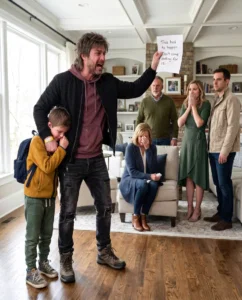
When we returned ninety minutes later, the clearing was empty.
Not peaceful.
Empty.
Both cabins had disappeared.
At first, my mind refused to understand what I was seeing.
Where the cabins had stood, there were only flattened patches of soil, deep tire marks, and scattered pine needles.
The cars were gone.
The coolers were gone.
So were the camp chairs, lanterns, blankets, firewood, and sleeping bags.
Noah whispered, “Dad?”
I ran toward the larger patch of dirt, dropped to my knees, and clawed at the ground.
Fresh drag marks crossed the clearing.
The cabins had been prefabricated rentals mounted on skids.
Someone had deliberately hauled them away.
Then I noticed an envelope nailed to a pine tree.
My name was written across it in my mother’s careful handwriting.
Inside was a single sheet of paper.
Daniel,
This had to happen. Don’t come looking for us. Noah is your responsibility now. You have taken enough from this family. We are done paying for your mistakes.
There was no signature.
No apology.
No map.
No food.
No water.
And no phone signal.
Noah began crying without making a sound. His mouth trembled, but he was trying not to frighten me.
That broke something inside me.
I searched the clearing until my hands bled.
The only things I found were half of a crushed plastic bottle beneath the bushes and a granola-bar wrapper Melissa’s youngest daughter had dropped the previous night.
The access road looked identical in both directions.
We were far from the highway, much deeper into the mountains than I had realized. Troy had driven the final section while I followed his dust and brake lights.
When evening came, the temperature dropped sharply.
I built a shelter from branches and gave Noah my jacket.
Then I promised him we were going to survive.
Nine days later, a rescue helicopter finally spotted us.
I had lost thirty pounds. I had a fever, and the skin on my feet had been torn open.
But Noah was alive.
And the people who abandoned us were about to discover what that survival meant.
PART 2
The deputy who reached us was named Carla Reyes.
She jumped from the helicopter before the rotors had fully slowed, ducking beneath the blades with a medical bag in one hand.
Noah was wrapped in my shirt and shaking so violently that his teeth clicked together.
I remember trying to tell Deputy Reyes not to give him water too quickly. I had read somewhere that it could be dangerous.
Or perhaps I only thought I had.
My lips were split, my tongue swollen, and my voice sounded like stone scraping against concrete.
“He’s nine,” I said. “His name is Noah. His mother was Claire. Don’t let him die.”
Deputy Reyes looked directly into my eyes.
“He is not dying today.”
It was the first statement I had believed in nine days.
The hospital in Durango smelled of disinfectant and warm plastic.
Doctors treated Noah for dehydration, exposure, malnutrition, infected cuts, and early kidney stress.
I had an infection in my calf, two fractured ribs from a fall, and nerve damage in two toes.
For the first twenty-four hours, I did not fully understand what had been done to us.
I assumed my family had left after some kind of cruel argument or sudden panic.
I thought they had returned home and lied about what happened.
Then Sheriff Andrew Voss entered my room with Deputy Reyes and a representative from child protective services.
He closed the door.
“Daniel,” he said, “we found the company that moved the cabins.”
My throat tightened.
The sheriff placed a printed receipt on the rolling table beside my bed.
The relocation had been arranged three weeks before the trip.
It had been paid in full by Troy Whitaker, my brother-in-law.
Scheduled collection time: 10:30 a.m. Saturday.
Special instructions: remove all structures and refuse from site. No customer contact necessary.
“Refuse,” I repeated.
No one corrected me.
The vehicles had not mysteriously vanished either.
My family had driven them out in a planned convoy.
Food, water, and emergency supplies were loaded into Troy’s truck and my father’s SUV before Noah and I returned from the creek.
The only fingerprints on my mother’s note belonged to her.
Sheriff Voss asked whether I understood why my family might have done it.
I looked toward the curtain separating my bed from Noah’s.
He was sleeping, one small hand wrapped around a stuffed fox a nurse had given him.
“Yes,” I said.
Claire had left me a life-insurance policy after a drunk driver killed her.
Most of the money went toward medical bills, therapy, and our mortgage.
My parents believed I should have sold the house and given them part of the money because they had loaned me twenty thousand dollars during college.
Melissa agreed.
Troy had more serious problems.
Gambling losses.
Business debts.
Unpaid taxes.
All weekend, he had been smiling far too hard.
“They wanted custody rumors,” I told the sheriff. “They wanted me unstable. Dead would have been easier. If Noah died too, they could say I wandered off with him.”
Sheriff Voss did not react visibly.
By my third day in the hospital, Troy had been arrested.
The next day, police detained Melissa and my father.
My mother surrendered through an attorney.
They expected sympathy.
They believed everyone would accept their story that I was grieving, unstable, reckless, and suicidal.
They did not expect Noah to remember Troy whispering into his phone before breakfast.
“They’re leaving now. Be ready.”
They did not expect my mother’s note to survive.
And they did not expect me to keep walking.
PART 3
The trial began eleven months later in La Plata County District Court.
By then, Noah and I had relocated to Oregon near Claire’s sister, Mara.
We lived in a small blue house three blocks from an elementary school and five blocks from the ocean.
Noah slept with a light on.
I stored bottled water in every room.
Neither of us tolerated silence well anymore.
Prosecutors charged my father, Richard Mercer; my mother, Elaine Mercer; my sister, Melissa Whitaker; and my brother-in-law, Troy Whitaker, with attempted murder, serious child abuse, conspiracy, reckless endangerment, evidence tampering, fraud, and false statements.
Their defenses were insulting from the beginning.
Troy claimed it was intended as “a lesson.”
Melissa insisted she believed we had a satellite phone.
My mother said the note had been “misinterpreted.”
My father said I had always exaggerated everything.
But evidence replaced every excuse.
The cabin company testified first.
Their records showed Troy repeatedly called to confirm the removal time.
He asked whether both cabins could be cleared quickly and emphasized that “nobody would be on-site except authorized family.”
He even paid extra for a weekend pickup.
Then the trailer company presented its records.
Troy had rented a flatbed under his landscaping business and removed supplies before the cabin crew arrived.
A gas-station camera captured my father’s SUV, Troy’s truck, Melissa’s van, and my mother’s sedan leaving the mountain road together at 11:46 a.m.
Noah and I returned to the clearing around 12:12.
Twenty-six minutes.
That was all that separated abandonment from attempted murder.
The prosecutor, Helen Park, rarely raised her voice.
She did not need to.
She presented the timeline with such calm precision that every excuse sounded smaller.
“At 8:57 a.m.,” she said, “Daniel Mercer and his son left for a short hike. At 9:03, Troy Whitaker sent a text message that read: They’re gone. Start now. At 9:14, Richard Mercer moved the first cooler into the truck. At 9:31, Elaine Mercer wrote the note. At 10:28, the cabin removal crew arrived. By 11:46, all four defendants drove away.”
She paused beside an enlarged photograph of the note.
“This had to happen,” she read. “Don’t come looking for us.”
Then she faced the jury.
“Those are not the words of people expecting a father and child to walk safely out of the woods.”
My mother cried during that testimony.
Not honestly.
Not privately.
She dabbed her eyes while glancing toward the jury, arranging grief across her face as carefully as makeup.
Then Noah testified.
He was ten by then, still small for his age after what those nine days had done to him.
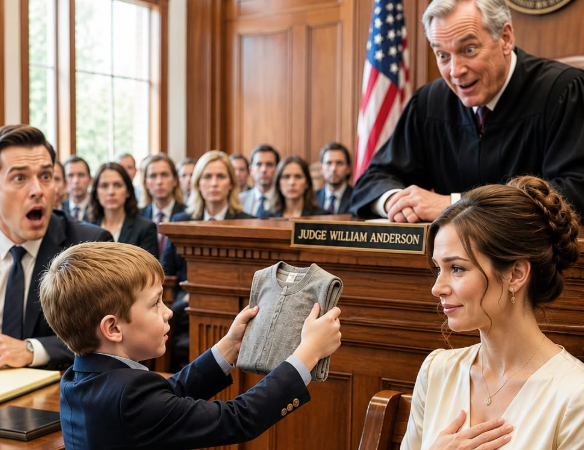
He wore a navy blazer Mara had purchased and held a smooth gray stone in his left hand.
It was one he had collected at the creek on the morning we were abandoned.
The judge spoke gently.
Helen Park spoke even more softly.
Noah answered every question clearly.
He remembered the pancakes.
He remembered Aunt Melissa appearing nervous.
He remembered Uncle Troy walking behind the cabin with his phone.
He remembered Grandpa saying, “Once it’s done, it’s done.”
Then Helen asked, “What happened when you and your dad came back?”
Noah looked at me.
Everything inside me wanted to stand, take his hand, and carry him out of the courtroom.
I wanted to shield him from the attorneys, the cameras, and the strangers watching our suffering become public evidence.
But Noah had chosen to speak.
So I remained still.
“When we came back,” he said, “everything was gone. I thought we were in the wrong place. But my rock pile was there. I made it before we left. So I knew.”
“What did your father do?”
“He looked for everyone. Then he found the note.”
“What did he tell you?”
Noah swallowed hard.
“He said nobody was coming right then, but he was there, and he would not leave me.”
The courtroom became silent.
“And did he leave you?”
“No.”
“What did he do during those nine days?”
Noah closed his fingers around the stone.
“He gave me the food first when we found berries. He made me drink first when we found water. He let me sleep against him because I was cold. He told stories about my mom so I wouldn’t forget her voice.”
Melissa lowered her head.
For the first time, I saw shame on her face.
It meant nothing.
Shame was not restitution.
The most difficult day came when prosecutors played Troy’s recorded police interview.
He had spoken freely after his arrest, convinced he could explain his actions.
On the recording, he sounded irritated rather than frightened.
“Look, Daniel always lands on his feet,” Troy said. “He’s dramatic. He wanted everyone to pity him after Claire died. This was supposed to snap him out of it.”
A detective asked, “By removing shelter, transportation, food, and water from a remote area?”
“He knew the general direction of the road.”
“Did Noah know?”
There was a long pause.
Then Troy answered, “That wasn’t my problem.”
Noah’s breathing changed beside me.
I placed my arm around him, and he leaned against my shoulder without looking away from the screen.
The detective continued.
“Why leave the note?”
Troy laughed once.
“Elaine wanted closure.”
Closure.
My mother wanted closure from her son and grandson.
When I testified, the defense attorney tried to portray me as unstable.
He questioned me about my grief after Claire’s death, my therapy appointments, and a Thanksgiving argument when I had shouted at my father.
He asked whether I might have misunderstood their intentions.
“No,” I said.
Then he asked if I hated my family.
I looked at all four defendants.
My father stared at me with the same cold expression I had feared since childhood.
My mother looked wounded, as though I had embarrassed her.
Melissa appeared hollow.
Troy looked angry that consequences were taking so long.
“I don’t know what I feel for them anymore,” I said. “But I know what they did.”
The prosecutor asked me to describe the ninth day.
I told the truth.
By then, hunger no longer felt normal.
It had become a vibration inside my bones.
Noah had a fever.
I used my belt to secure branches together so I could drag him when he became too weak to walk.
We followed the slope downward because I believed water might lead toward people.
On the eighth night, rain began falling.
I opened my mouth toward the sky.
Noah could barely sit upright, so I soaked my shirt and squeezed drops between his lips.
The next morning, we heard the helicopter.
“I thought I was hallucinating,” I told the jury. “Then Noah heard it too. He tried to wave, but he couldn’t lift his arm. So I took off my shirt and climbed onto a rock.”
Earlier, the defense had implied I might have found help sooner if I had made better decisions.
Helen asked, “Why didn’t you leave Noah and search faster alone?”
I answered before she finished.
“Because I promised his mother I would protect him. Because he was nine. Because people had already left him once.”
Two jurors began crying.
Six weeks after opening statements, the jury returned its decision.
Guilty.
On nearly every charge.
My father received twenty-eight years.
Troy received thirty-five because prosecutors proved he had organized the plan.
Melissa received twenty-two.
My mother received eighteen.
At sentencing, each defendant was permitted to speak.
Troy blamed debt and stress.
Melissa blamed Troy.
My mother blamed confusion.
My father blamed me.
“You destroyed this family,” he said, pointing at me with a shaking hand.
For the first time in my life, his anger did not shrink me.
When the judge allowed my victim-impact statement, I stood.
“No,” I said. “You destroyed it the morning you watched your grandson walk into the trees and decided he was acceptable damage.”
My father looked away.
I continued.
“For nine days, Noah asked me why. I had no answer that would not break him. I still don’t. But I can tell him this now: what happened was real, what you did was deliberate, and the law saw it clearly.”
Then I turned toward my mother.
“You wrote, ‘This had to happen.’ You were right about one thing. Something did have to happen. Just not what you planned.”
The judge imposed every sentence without sympathy.
Outside the courthouse, reporters surrounded us with questions.
I ignored all but one.
A young reporter asked, “Mr. Mercer, do you feel like you got justice?”
I held Noah’s hand.
He was looking toward the mountains rather than the cameras.
“No,” I said. “Justice would be my son never learning what betrayal feels like. This is accountability.”
Then we went home.
Life did not become perfect after the trial.
Stories like ours do not truly end in courtrooms.
Noah still had nightmares.
I still woke reaching for supplies that were not there.
Both of us panicked when someone left without saying goodbye.
But our lives slowly became ours again.
Noah joined a robotics club.
He learned to surf badly and proudly.
The gray creek stone remained on his desk beside a photograph of Claire.
On the anniversary of our rescue, we only discussed the mountains if Noah wanted to.
Some years, he did.
Other years, we ordered pizza and watched old monster movies.
I returned to work as a civil engineer.
Quiet work suited me.
Bridges, drainage systems, foundations—structures that failed when people ignored pressure or lied about what they could bear.
Mara became family in every way that mattered.
She showed up.
She listened.
She never told us to move on.
Three years after the trial, Noah asked whether we could hike again.
My instinct was to say no.
Instead, I packed food, water, emergency blankets, two maps, a satellite messenger, whistles, medical supplies, and enough backup equipment to survive an entire week.
Noah watched me load the car.
“Dad,” he said, “we’re going for two hours.”
“I know.”
He smiled.
“Mom would laugh at you.”
“She would,” I replied.
We chose a coastal path rather than a mountain trail.
The ocean remained visible through the trees.
Noah walked ahead of me, taller and stronger now, carrying his own backpack.
At a viewpoint, he stopped and looked across the gray water.
“Do you think they’re sorry?” he asked.
I knew who he meant.
For a moment, I considered giving him a gentle lie.
The kind adults tell children when they want them to sleep peacefully.
But Noah survived because I gave him truths in pieces he could carry.
“I think they’re sorry they got caught,” I said. “I don’t know if they’re sorry they hurt us.”
He nodded slowly.
Then he said, “I’m glad we came back.”
I looked at my son standing alive in the wind, sunlight shining through his hair.
“So am I,” I said.
Those nine days in the mountains took things from us that no sentence could restore.
Trust.
Ease.
The simple belief that family always meant safety.
But they also revealed something stronger than the people who abandoned us.
Noah survived.
I survived.
And the people who left us there to die had spent every day since wishing we had not.
Sophie believed she had found the ideal partner in Jacob. But one strange request exposed a pattern of manipulation, pushing her toward self-discovery and a confrontation with the unsettling beliefs hidden inside his family.
Looking back on everything that brought me to where I am now, I often think about the period when my life seemed filled with companionship, shared interests, and the promise of something lasting.
My name is Sophie. I was thirty-two when I became deeply involved with Jacob, a man whose intelligence, discipline, and steady career first attracted me. Our relationship developed through common interests and meaningful experiences that quickly brought us closer.
We met at a gathering hosted by a mutual friend, in a way that felt almost scripted for a romantic story. Jacob took pride in his stable career and carefully organized life, qualities I respected and found reassuring.
The connection between us was immediate. Before long, we discovered that we both loved spending time outdoors, experimenting with food, and watching old films.
I looked forward to our weekends together.
We often escaped into nature, hiking along quiet trails surrounded by broad views and peaceful landscapes. Those trips were not only about exercise. They gave us time to share silence without discomfort, creating an intimacy that did not always require words.
During the week, cooking together became one of our favorite rituals. The kitchen turned into our shared playground. We tried unfamiliar recipes, laughed when something went wrong, and enjoyed the results even when they were imperfect.
There was something satisfying about working side by side. Even an ordinary meal felt special because we had made it together.
Most evenings ended with us sitting close on the couch while old movies flickered across the screen. Wrapped in the comfort of each other’s presence, we debated performances, criticized plotlines, and laughed at scenes that had aged badly.
At the time, our relationship felt complete.
It was built from both ordinary routines and memorable adventures. The activities mattered, but what mattered more was the sense of partnership developing beneath them.
That was why the conversation that changed everything caught me completely off guard.
One quiet evening, we were sitting in our usual places. I was curled up with a book while Jacob worked on his laptop. The apartment felt peaceful, and I assumed the night would pass like many others.
We talked casually about our day and exchanged a few jokes.
Then Jacob closed his laptop and turned toward me.
Something in his expression had changed.
He looked unusually serious, and for once, he seemed unsure how to begin. Jacob was normally confident and direct, so his hesitation immediately made me uneasy.
“Sophie,” he started, his voice lower than usual, betraying a hint of awkwardness, “I’m struggling to fully commit to you because there’s something that bothers me.”
My heart tightened.
For several seconds, I imagined every possible explanation. Maybe he was unhappy. Maybe he no longer wanted the relationship. Maybe he had been hiding doubts for months.
Then he continued.
“It’s a bit awkward, but would you be willing to shower more often?”
I stared at him.
The request made no sense.
I showered every day and had always taken personal hygiene seriously. I could not understand why he would suggest otherwise.
Seeing my confusion, Jacob explained that he had unusually high standards for cleanliness and could not compromise on them. He believed showering twice a day would make him feel more comfortable in the relationship.
His request left me embarrassed and uncertain.
Still, because he spoke so earnestly, I reluctantly agreed.
That night, I lay awake replaying the conversation.
It seemed like such a small and strange thing to focus on, yet Jacob had presented it as a serious obstacle between us. I wondered whether it was a warning sign or simply an unusual preference I should accept.
Wanting to trust him, I decided to follow his request.
I had no idea that this minor change would become the beginning of a much larger unraveling.
Adding another shower to my daily routine was not something I ever expected to do for a relationship.
Yet I began restructuring my days around Jacob’s concern.
My mornings started earlier so I could shower before work. I became more careful about choosing clothes, hoping everything about my appearance would meet his approval.
In the evenings, I showered again.
What had once been a refreshing routine became a stressful obligation.
I bought different body washes, deodorants, powders, and scented products, searching for anything that might remove the odor Jacob claimed to notice.
Even though I was doing everything he asked, I became increasingly self-conscious.
I constantly wondered whether I smelled strange, whether other people noticed, and whether Jacob was silently judging me.
Several weeks later, during another quiet evening, he asked to speak with me again.
The tension in his face told me the conversation would not be easy.
“Soph, I really like you, but the showering isn’t helping,” he confessed.
Then he hesitated before saying what he claimed he had been avoiding.
“I didn’t want to hurt your feelings, but I asked you to shower more because you have a body odor issue.”
The words were humiliating.
No one had ever mentioned such a problem before. I had never noticed anything myself. Yet hearing it from someone I trusted made me doubt my own senses.
I had already changed my routine, spent money on new products, and become anxious about my body.
Now Jacob was telling me none of it had worked.
After that conversation, I became obsessed with finding an explanation.
I researched possible causes of body odor, medical conditions, treatments, and specialized products.
My bathroom shelves filled with increasingly expensive soaps, sprays, and powders. I bought anything that promised complete odor protection.
But the more effort I made, the more disconnected I became from my own perception.
I no longer trusted what I smelled or did not smell.
I trusted Jacob.
That period drained me emotionally.
What began as a concern about hygiene became a deeper question about my worth and how far I was willing to change myself to satisfy someone else.
Eventually, I reached a breaking point and scheduled an appointment with Dr. Lewis.
Sitting in her office, I felt both anxious and hopeful. After months of changing my behavior around Jacob’s complaints, I needed a professional opinion.
I described everything.
I explained the extra showers, the products, the constant anxiety, and Jacob’s repeated claim that I had an odor problem.
As I spoke, Dr. Lewis’s expression shifted from professional concern to genuine confusion.
“Sophie, I can’t detect any odor,” she stated frankly.
Her words should have reassured me.
Instead, they made me cry.
I had become so dependent on Jacob’s version of reality that even a doctor’s confirmation was difficult to accept.
Desperate for certainty, I asked her to run tests.
I wanted to know whether there was a hidden medical condition causing something I could not detect.
Dr. Lewis agreed.
The tests covered several possibilities, including hormonal issues, metabolic disorders, and other conditions that might affect body odor.
Waiting for the results was miserable.
Part of me hoped something would be found because at least then Jacob’s claims would make sense.
Another part feared that something was seriously wrong with me.
When the results came back, they were clear.
I was completely healthy.
There was no medical reason for an odor.
The news brought relief, but it also created a more disturbing question.
If there was nothing physically wrong with me, why had Jacob insisted there was?
Was it a problem with his perception?
Or was there something more deliberate behind his behavior?
Dr. Lewis’s office became the place where I first seriously considered that the issue might never have been mine.
That realization shifted something inside me.
For the first time, I began moving away from self-blame and toward suspicion.
Not long after that appointment, Jacob suggested that I meet his parents.
“We should have dinner with my parents,” Jacob said one evening.
He sounded casual, but I could hear anticipation in his voice.
Normally, meeting a partner’s family would have been exciting, even if slightly intimidating. But after everything that had happened, the invitation filled me with anxiety.
Jacob seemed unaware of how deeply his comments had affected me.
He spoke about the dinner as though it were a positive step forward.
“They’re really looking forward to meeting you,” he assured me.
His reassurance did little to calm me.
I kept wondering what he had already told them about me.
The dinner took place at Jacob’s childhood home.
He had always described it fondly, and when we arrived, I could see why. The house was warm, traditional, and filled with signs of long family history.
As we approached the front door, Jacob changed.
His usual confidence faded, replaced by the nervous eagerness of a son trying to please his parents.
His mother, Nancy, greeted us politely.
She was poised and observant, with a smile that felt cordial but evaluative.
Her eyes moved over me carefully before she spoke.
Soon after the introductions, she made a suggestion that stunned me.
“Why don’t you freshen up before dinner? We have some time.”
Her tone was pleasant.
The meaning was not.
The phrase echoed Jacob’s earlier comments almost perfectly.
The implication that I needed to clean myself immediately after arriving made my humiliation return all at once.
Before I had even been allowed to make an impression, Nancy appeared to have already judged me through Jacob’s version of events.
The welcoming house suddenly felt hostile.
The comfortable furniture and family photographs seemed to belong to a room silently examining me.
I excused myself and went to the guest bathroom, desperate for a moment alone.
Dinner continued with stiff politeness.
Everything felt rehearsed.
At some point, Jacob’s sister, Eloise, quietly invited me to step away from the table.
She had always seemed different from the others, carrying a subtle sense of independence and resistance.
Grateful for an excuse to escape the strained atmosphere, I followed her upstairs.
Her bedroom felt like a refuge.
Books, personal belongings, and soft lighting made it feel calmer and more genuine than the rest of the house.
Once the door closed, Eloise looked at me with concern.
“Sophie,” Eloise began, her voice steady yet filled with a hint of frustration, “what you experienced tonight isn’t about you or any real issue with hygiene. It’s about them.”
She gestured toward the dining room.
Then she explained.
Jacob and Nancy believed they possessed unusually powerful senses.
“They have this strange notion of possessing super senses,” she confided.
According to Eloise, they believed they could detect smells, flaws, and subtle details that ordinary people could not perceive.
They treated this belief as evidence of their superiority.
Over time, it had separated them from reason and made them increasingly convinced that their perceptions were always correct.
As Eloise described the family’s beliefs, I felt two emotions at once.
Relief.
And anger.
Relief because someone was finally confirming that I did not have a hygiene problem.
Anger because I realized how completely Jacob had manipulated me.
His comments had not been harmless.
He had made me question my body, my senses, and my health, all because he and his mother shared an irrational belief they treated as fact.
What they described as concern had been control.
The decision to end the relationship did not happen impulsively.
It came after months of discomfort, confusion, and self-doubt.
I thought about how easily I had changed my life around Jacob’s demands.
I had altered my routine, bought expensive products, visited a doctor, undergone tests, and questioned my own reality.
The realization was both humiliating and freeing.
The manipulation had been subtle enough to disguise itself as care, but it had slowly damaged my confidence.
Leaving Jacob felt like removing a blindfold.
Telling him was painful, but also liberating.
It hurt because I was ending a relationship that had once seemed full of affection and possibility.
But it also meant I was stepping away from the control and confusion that had taken over my life.
After the breakup, my days initially felt empty.
I grieved what I had believed the relationship could become.
But slowly, the fog lifted.
I returned to activities I had neglected.
I reconnected with old friends and began accepting invitations I once would have declined.
Spending time with people who did not criticize or examine me reminded me how much of myself I had lost.
Rebuilding my life was difficult, but energizing.
I tried new experiences and met people who appreciated me without forcing me to prove my cleanliness, worth, or acceptability.
Each sincere conversation and shared laugh helped restore my confidence.
Little by little, I learned to trust myself again.
My phone buzzed while my newborn rested quietly against my chest, his tiny fingers tucked beneath my collarbone. The name on the screen made me sigh.
It was my ex-husband.
His voice carried the smug confidence of someone convinced life had rewarded him.
“Claire, tomorrow’s the wedding,” Ethan said, loud music and laughter echoing behind him. “Bianca insisted we invite you. Come watch us celebrate our victory.”
I glanced through the nursery window. Noah had entered the world seven weeks too soon, but each day he grew a little stronger, breathing without assistance now.
“Sorry,” I replied. “I’m busy taking care of someone you never even thought to ask about.”
The line fell silent.
After a long pause, Ethan asked quietly, “What did you just say?”
I disconnected without answering.
Half an hour later, Ethan rushed into St. Matthew’s Hospital wearing an expensive suit with his tie missing, panic replacing his earlier arrogance. Bianca hurried after him in her white rehearsal outfit, clearly furious that their evening had been interrupted.
“Where’s the baby?” Ethan demanded. “Is he mine?”
Dr. Elena Reyes stepped calmly in front of him.
“Mr. Cole, lower your voice.”
“I deserve to know.”
“You had nine months to ask,” I answered.
His eyes settled on Noah through the nursery glass. For a brief instant, genuine emotion crossed his face before calculation quickly replaced it.
“If he’s my son, I want a DNA test.”
Dr. Reyes flipped through Noah’s medical file.
“There’s no need. The prenatal DNA screening already confirmed paternity. Noah is your biological child.”
Bianca stared in disbelief.
The doctor continued before either of them could respond.
“Ms. Bennett required emergency surgery after suffering a placental abruption triggered by blunt-force trauma.”
Ethan slowly turned toward Bianca.
I watched her grip tighten around the jeweled purse in her hands.
Dr. Reyes looked directly at Ethan.
“Hospital security footage captured your fiancée pushing Ms. Bennett in the parking garage three days before delivery.”
Bianca immediately protested.
“She threatened me first!”
“I simply asked you to stop following me,” I said.
Ethan grabbed my arm.
“You’re not making this public.”
I lowered my eyes to his hand until he finally let go.
Throughout our divorce, Ethan constantly described me as weak, unstable, and incapable of surviving without him. He forged my signature, shifted company money into hidden accounts, and abandoned me with mounting medical debt while enjoying his new life beside Bianca.
He assumed I signed every document because I was defeated.
What he failed to remember was that I had spent an entire decade designing the financial systems that powered his company. I knew every account, every password habit, every concealed transaction.
My attorney was already in the hospital, accompanied by a financial-crimes detective.
While Ethan mistook my silence for surrender, I had quietly preserved account records, encrypted backups, voicemail recordings, and trust agreements proving the business he proudly claimed had legally belonged to me all along.
He thought he had divorced a helpless woman.
Instead, he had picked a fight with the forensic accountant who built his empire.
I smiled.
“Your wedding is tomorrow,” I said. “I wouldn’t miss what happens next.”
PART 2
The following morning, Ethan returned carrying flowers and accompanied by two attorneys.
The bouquet never left the windowsill.
“We can settle this quietly,” he said. “I’ll pay every expense for Noah. You sign a confidentiality agreement, withdraw the assault complaint, and confirm you voluntarily transferred your company shares.”
Bianca remained behind him wearing oversized sunglasses.
“Accept it, Claire,” she said smugly. “You already lost your husband, your house, and your business.”
I tucked Noah’s blanket around him.
“Then why do both of you look so nervous?”
One of Ethan’s lawyers slid paperwork toward me.
Before I could touch it, my attorney, Maya Chen, entered from the adjoining room carrying a much thicker file.
“My client won’t be signing anything,” Maya said evenly. “Your clients, however, should expect subpoenas.”
Bianca laughed.
“For what exactly?”
“Assault, evidence tampering, forgery, embezzlement, and conspiracy.”
Ethan’s confidence wavered for only a second.
“You have nothing.”
Maya opened the folder.
The first document listed wire transfers from Cole Dynamics into shell companies linked to Bianca’s brother.
The second showed wedding expenses paid directly from employee pension funds.
The third compared Ethan’s forged version of my signature with the authentic specimen stored by our bank.
I had uncovered the fraud four months earlier after noticing an oddly consistent decimal pattern in quarterly reports. Ethan always rounded personal transfers to figures ending in seventeen because he believed perfectly random numbers attracted suspicion.
It was a habit he had never broken.
Rather than confronting him, I quietly copied company servers, hired an independent auditor, and worked alongside the state financial-crimes investigators.
Every extravagant purchase created another trail of evidence.
Even then, Ethan refused to back down.
“The board answers to me.”
“No,” I replied. “The board answers to whoever controls the majority.”
He smiled confidently.
“That would be me.”
Maya produced the original Bennett Family Trust agreement.
Years before our marriage, my grandmother had financed the company’s first patent. The trust retained fifty-one percent ownership of Cole Dynamics, and I was its only beneficiary with full voting authority.
The forged transfer Ethan relied on had never been approved by the trustee.
His face instantly lost its color.
Bianca ripped off her sunglasses.
“You told me she signed everything over.”
“He told everyone that,” I answered.
Ethan leaned closer.
“If you destroy me, you destroy our son’s inheritance.”
“Noah’s future has already been protected from you.”
His fist slammed onto the table, startling the baby awake.
A nearby nurse immediately called security.
As officers escorted them toward the exit, Bianca glared at me.
“We’re getting married tonight. Nobody will believe your pathetic story.”
I gently kissed Noah’s forehead.
“Go ahead,” I replied. “Invite the board, every investor, and every reporter you can find.”
They mistook my confidence for defeat.
By evening, the ballroom was packed.
Ethan had rushed the ceremony forward, convinced marriage would somehow shield Bianca through spousal privilege.
It wouldn’t.
While Bianca proudly uploaded photos captioned, “Finally victorious,” Maya secured emergency court orders freezing the shell-company accounts and preserving every company device.
I signed the board resolution stripping Ethan of executive authority.
Dr. Reyes discharged me later that afternoon. My mother safely brought Noah home under private security while I changed into formal clothes.
Then I headed to the ballroom alone.
PART 3
Crystal chandeliers sparkled above white roses purchased with money stolen from people who had trusted Ethan.
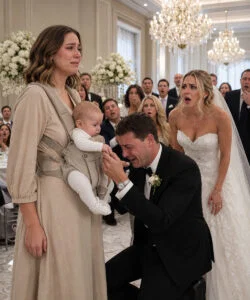
The moment I stepped into the ballroom, the string quartet stumbled into silence.
Bianca waited at the altar beneath a cathedral-length veil.
Ethan looked straight at me.
“You actually came.”
“You invited me.”
Guests slowly turned toward us.
Three board members stood first.
Two detectives Ethan had mistaken for investors followed.
Bianca tightened her grip on the bouquet.
“Get her out of here.”
Before anyone moved, Maya appeared beside the projection booth.
“Not until the shareholders finish their emergency meeting.”
The enormous screen behind the altar switched from engagement photographs to hospital security footage.
Bianca appeared on-screen blocking my path inside the parking garage.
Her recorded voice echoed throughout the ballroom.
“You should have disappeared when Ethan left you.”
The footage showed her shoving me backward before I struck the concrete barrier and collapsed.
A wave of shocked whispers spread across the room.
“That video is fake!” Bianca shouted.
Detective Ramirez stepped forward.
“The recording was obtained directly from the hospital’s security server. Ms. Vale, you’re under arrest for assault and endangering an unborn child.”
Bianca tried to run.
Her veil snagged on a chair before officers stopped her near the wedding cake.
Ethan slowly retreated.
“Claire… I didn’t know she was going to hurt you.”
“You knew she was following me,” I replied. “I saved your messages.”
The projection screen changed again.
One message appeared for everyone to read.
Scare her. Make sure she signs before the baby complicates everything.
The ballroom became completely silent.
Ethan rushed toward the control console, but Detective Ramirez blocked his path.
Maya handed a signed resolution to the chairman of the board.
He addressed the room.
“Effective immediately, Ethan Cole is removed as chief executive for fraud, breach of fiduciary duty, and theft of protected employee funds.”
Investors quietly began leaving.
Moments later, federal agents entered through the rear doors.
Because the pension money had crossed state lines, the case now involved federal wire-fraud charges.
They handcuffed Ethan beneath the floral archway his company had unknowingly paid for.
The guests watched in silence as the celebration transformed into a criminal investigation.
Looking completely defeated, Ethan met my eyes.
“What about my son?”
“He needed you long before there was an audience.”
His voice broke.
“Please.”
I stepped closer, calm enough to hear champagne bubbles fizzing inside abandoned glasses.
“You taught me that love without loyalty becomes nothing more than leverage,” I said. “So I took yours away.”
Six months later, Bianca pleaded guilty after the security footage and text messages destroyed every defense she attempted. She received a four-year prison sentence.
Ethan accepted a federal plea agreement that brought seven years in prison, full restitution, and a permanent ban from managing public funds.
Their marriage—lasting only twelve minutes—was annulled before sentencing.
Cole Dynamics was renamed Bennett Systems.
I promoted the employees Ethan had pushed aside, restored every dollar stolen from the pension fund, and introduced paid emergency leave for new parents.
Noah continued growing stronger every week.
On his first birthday, we sat beneath my grandmother’s apple tree, watching sunlight dance across his smiling face.
Maya asked softly if I had ever regretted attending Ethan’s wedding.
I lifted Noah into my arms as flower blossoms drifted around us.
“No,” I answered.
“That was the day they celebrated winning.”
I smiled at my son.
“And the day I finally collected everything they owed me.”
At my son’s wedding, I found my seat outside beside the trash cans. The bride smirked and said, “Guess you don’t count.” I quietly took back my wedding gift and walked away without saying a word. Minutes later, they realized what I had done—and came running after me.
At my son’s wedding, I found my seat outside, next to the trash cans.
For a moment, I thought it had to be a mistake.
The reception hall in Charleston, South Carolina, glowed through tall glass doors behind me. Inside, white roses climbed gold stands, crystal chandeliers glittered over polished floors, and laughter rolled warmly from table to table. Every guest had a place card written in silver ink.
Mine was balanced on a folding chair beside two black garbage bins.
“Margaret Hale,” it read.
My name.
I stood there in my navy dress, holding the cream envelope that contained the gift I had saved for three years to give my son, Daniel, and his new wife, Vanessa.
The October air smelled like wet leaves and sour wine from the trash. A waiter pushed past me with a bag of empty bottles and froze when he saw my card.
“I’m sorry, ma’am,” he whispered. “I can ask someone—”
“No,” I said softly. “Thank you.”
That was when Vanessa appeared.
She wore a fitted lace gown and a smile sharp enough to cut ribbon. Her bridesmaids hovered behind her, pretending not to listen.
“Oh, good,” Vanessa said. “You found it.”
I looked from the chair to her face. “This is my seat?”
She tilted her head. “Well, we had limited space inside. And honestly, Margaret, you’ve never really supported us.”
My chest tightened. “I paid for the rehearsal dinner.”
“And reminded everyone you did,” she said, though I had not mentioned it once.
Behind the glass doors, I saw Daniel laughing with his college friends. My only child. The boy I had raised alone after his father left when he was seven. The boy whose tuition I paid by working double shifts at the hospital. The man who had stopped answering my calls whenever Vanessa was near.
Vanessa stepped closer and lowered her voice.
“Guess you don’t count.”
Something inside me went still.
Not angry. Not broken.
Still.
I looked once more at the trash cans, then at the envelope in my hand. Inside was not a toaster, not a check for a honeymoon, not jewelry. It was the deed to the small lake house my parents had left me, transferred into Daniel’s name as a wedding gift.
I slid the envelope back into my purse.
Vanessa’s smile flickered. “What are you doing?”
I did not answer.
I turned, walked down the stone path, passed the valet stand, and handed my ticket to the young man outside. My heels clicked evenly against the pavement.
Behind me, the music kept playing.
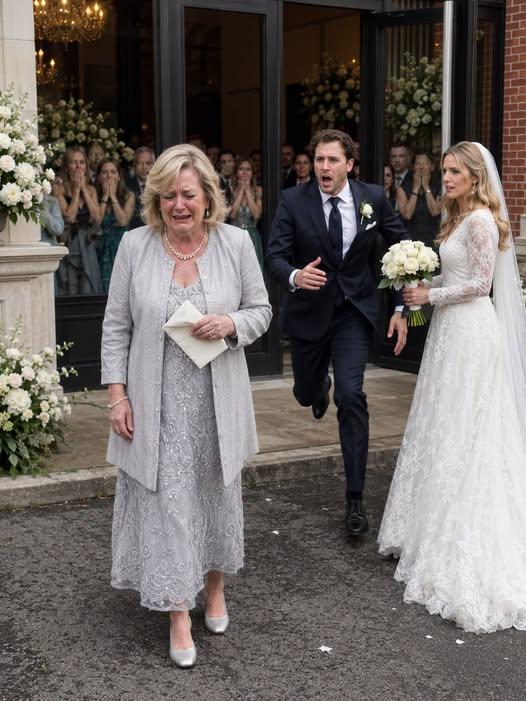
Then, just as my car door opened, I heard shouting.
“Mom!”
Daniel’s voice cracked through the cold air.
I looked over my shoulder.
He was running toward me, Vanessa stumbling after him in her wedding dress, her face no longer smug but pale with panic.
Daniel reached my car before I could sit down.
“Mom, wait,” he said, breathing hard. His bow tie hung loose, and his face was flushed with confusion. “Please, just wait.”
Vanessa caught up seconds later, gripping the front of her dress with both hands. One of her bridesmaids trailed behind her, holding a phone, eyes wide with the thrill of drama.
I stood beside the open car door and looked at my son. “Daniel, go back inside. It’s your wedding.”
He swallowed. “Why are you leaving?”
I almost laughed, but there was no humor left in me.
“Ask your wife.”
Daniel turned to Vanessa. “What did you do?”
Vanessa’s mouth opened, then closed. She looked at me with warning in her eyes, as if she still believed she could manage the room, manage my son, manage me.
“It was a seating issue,” she said quickly. “Your mother is overreacting.”
Daniel frowned. “A seating issue?”
I reached into my purse, took out the place card, and handed it to him.
He stared at it.
Then he looked past me toward the side patio, where the folding chair still sat beside the trash cans under a yellow security light.
His face changed slowly.
First disbelief. Then shame.
Then something harder.
“Vanessa,” he said quietly. “Tell me that wasn’t Mom’s seat.”
Vanessa folded her arms. “Daniel, don’t do this here.”
“Tell me.”
She glanced toward the glass doors. Guests had begun gathering inside, watching. His best man stood near the entrance. My sister, Caroline, had one hand over her mouth.
Vanessa’s voice tightened. “Your mother has been difficult since the engagement.”
I blinked. “Difficult?”
“You questioned everything,” she snapped. “The venue, the flowers, the guest list—”
“I asked why Daniel’s aunt wasn’t invited,” I said. “And why your cousin, who Daniel had never met, was giving a speech.”
Vanessa’s cheeks reddened. “This is exactly what I mean. You always make it about you.”
Daniel looked at me. “Mom, what was in the envelope?”
I held it against my purse. “A wedding gift.”
“What gift?”
I hesitated.
Vanessa answered before I could. “Probably another guilt check.”
Something in Daniel’s expression sharpened. “Mom?”
I met his eyes. “The lake house.”
The silence that followed felt bigger than the whole parking lot.
Daniel whispered, “Grandma and Grandpa’s lake house?”
“Yes.”
“I thought you said you could never sell it.”
“I wasn’t selling it,” I said. “I was giving it to you.”
Vanessa’s entire posture changed. Her arms dropped. Her lips parted.
“The lake house?” she said. “The one on Marion Lake?”
I looked at her. “Yes.”
Daniel stepped back as if the ground had shifted beneath him. “Mom…”
I shook my head. “I came here ready to bless your marriage. I came here ready to give you the place where you learned to swim, where your grandfather taught you to fish, where we spread your grandmother’s ashes under the maple tree.”
My voice stayed calm, but Daniel’s eyes filled.
“And I was seated beside garbage,” I continued. “Not by accident. Not because of limited space. Because your wife wanted me humiliated.”
Vanessa grabbed Daniel’s sleeve. “This is ridiculous. She’s manipulating you.”
I looked at my son, not at her.
“For years, I made excuses for you pulling away,” I said. “I told myself you were busy. In love. Starting your life. But tonight, Daniel, you let me arrive alone, sit alone, and be treated like something unwanted.”
“I didn’t know,” he said.
“You didn’t ask.”
The words landed between us.
Inside, the music stopped.
Daniel turned toward the hall, then back at Vanessa. “Who approved the seating chart?”
She stiffened. “Daniel—”
“Who?”
Her silence answered.
His face drained.
I got into my car.
Daniel put one hand on the door before I could close it. “Mom, please. Don’t leave like this.”
I looked at the man he had become and the boy I still remembered.
“I’m not leaving to punish you,” I said. “I’m leaving because I finally understand my place here.”
Then I pulled the door closed.
Through the window, I saw Vanessa crying now, but not from sorrow. From calculation. From loss.
Daniel stood in the headlights, frozen.
And for the first time in his life, I drove away from my son without looking back.
PART 2
I drove for nearly twenty minutes before realizing I was not heading home. My hands had turned the steering wheel automatically, carrying me through Charleston’s quiet streets toward my younger sister Caroline’s house near the river.
Caroline opened her front door before I reached the porch. She was still wearing the burgundy dress she had chosen for the reception, although her shoes were gone and mascara streaked beneath both eyes.
“I left five minutes after you,” she said, pulling me inside. “I couldn’t sit there pretending that what they did was normal. Half the room couldn’t believe it, Margaret.”
I placed my purse on her kitchen table and sat down carefully. Until that moment, I had felt strangely calm, as though my body had protected me by locking every emotion behind glass.
Then Caroline touched my shoulder, and the glass shattered.
I covered my face and cried harder than I had cried when my husband left, harder than I had cried at my mother’s funeral, harder than any humiliation deserved.
Caroline knelt beside my chair and held me without speaking. She understood that I was not grieving a folding chair or Vanessa’s cruelty. I was grieving the son who had stopped seeing me.
When I finally lifted my head, Caroline pushed a glass of water toward me. “Daniel is calling everyone,” she said. “He wants to know where you went.”
My phone had been vibrating inside my purse since I left the venue. There were seventeen missed calls from Daniel, nine from Vanessa, and three messages from numbers I did not recognize.
The first message from Daniel said, “Mom, please answer. I swear I didn’t know.” The second said, “I stopped the reception.” The last simply said, “I need you.”
I placed the phone facedown.
For thirty-four years, I had answered whenever Daniel needed me. I had left hospital shifts, canceled appointments, borrowed money, crossed state lines, and swallowed my disappointment whenever he called.
That night, I needed him to understand what silence felt like.
Caroline looked toward my purse. “Was the deed really signed?”
“Yes,” I said. “But it was never delivered or recorded. Henry prepared everything, and I intended to hand it to Daniel after their first dance.”
Henry Whitmore had been my parents’ attorney before becoming mine. He had warned me against transferring the lake house outright, especially after meeting Vanessa only once.
I had accused him of being suspicious because lawyers were trained to expect trouble. Now, sitting in Caroline’s kitchen, I wondered whether experience had simply taught him to recognize hunger behind a smile.
At eight the next morning, I called Henry.
He listened without interrupting while I explained the chair, the trash cans, Vanessa’s words, Daniel’s reaction, and the envelope now lying unopened beside Caroline’s sugar bowl.
“Do not sign anything else,” he said. “Do not hand anyone that envelope. Bring it directly to my office, and come through the private entrance.”
His urgency startled me. “Why the private entrance?”
“Because Daniel called me six weeks ago asking questions about how quickly a gifted property could be borrowed against. He said Vanessa was helping him plan renovations.”
The room seemed to tilt.
Daniel had never mentioned renovating the lake house. During our last conversation about it, he had said he hoped I would keep it forever because it was the only place that still felt like childhood.
Henry continued carefully. “I refused to discuss your property without your authorization. Yesterday afternoon, someone from a development company contacted my assistant and requested a copy of the current deed.”
“What company?”
“Bell Coastal Development.”
Vanessa’s father owned Bell Coastal Development.
Gregory Bell had spent the wedding rehearsal boasting about luxury waterfront communities, private docks, and investors from Atlanta. I had assumed his confidence came from success.
By nine-thirty, Caroline and I were sitting across from Henry in his downtown office. He removed the deed from the envelope, examined every page, and locked it inside a fireproof cabinet.
“The property remains yours,” he assured me. “A gift requires more than intention. This deed was never delivered, accepted, or recorded. Legally, Vanessa has nothing.”
Caroline leaned forward. “Then why was her father requesting it?”
“That,” Henry replied, “is what concerns me.”
Before he could continue, his receptionist called through the intercom. Daniel was downstairs, alone, begging to see me. Henry looked at me rather than granting permission automatically.
Part of me wanted to refuse. Another part needed to hear whether my son would tell the truth without Vanessa standing beside him. I nodded once.
Daniel entered wearing yesterday’s trousers and a wrinkled white shirt. His eyes were swollen, his hair uncombed, and the gold wedding band remained on his finger.
He stopped several feet from me. “Mom, I’m sorry.”
I had imagined those words throughout the night. Hearing them brought no relief because regret after consequences was not the same as courage before cruelty.
“Tell me everything,” I said.
Daniel sat opposite me and stared at his hands. He explained that Vanessa had shown him a seating chart placing me beside Caroline near the front.
He had approved it without studying the details because Vanessa repeatedly told him that questioning wedding decisions meant he did not trust her.
“Did you know she disliked me?” I asked.
He closed his eyes. “I knew she thought you judged her. I told myself it was normal tension between a wife and her husband’s mother.”
“Did you ever ask why I stopped calling?”
Daniel looked confused. “You didn’t stop. Vanessa said you called constantly.”
I took out my phone and showed him my recent call history. During the previous four months, I had called Daniel seven times. None of those calls lasted longer than thirty seconds.
Daniel pulled out his own phone, searched my contact, and frowned. My number was blocked. Several text conversations had disappeared, including the messages I sent after his promotion and birthday.
“I didn’t block you,” he whispered.
Caroline’s expression hardened. “Then who had access to your phone?”
Daniel’s silence answered her.
He told us Vanessa knew his password and often replied to messages while he worked. She said she was protecting him from distractions and managing wedding stress.
“Managing you,” I corrected.
Daniel flinched but did not argue.
I asked about the lake house. His face reddened as he admitted mentioning the gift after finding a draft letter inside a folder when he visited my home in June.
He said Vanessa had become unusually affectionate afterward, asking about the property’s size, shoreline, taxes, insurance, and whether I owned the surrounding wooded acreage.
“She said we could renovate it,” Daniel explained. “Maybe rent it during summers. I thought she was excited about building our future there.”
Henry folded his hands. “Did she discuss borrowing against it?”
Daniel hesitated. “Her father said a small loan could fund renovations. He claimed the rental income would cover everything within five years.”
“How small?” I asked.
Daniel looked at the floor. “Nine hundred thousand dollars.”
Caroline let out a sharp breath.
My parents had bought the lake house when the surrounding area was mostly farmland. Decades of development had increased its value dramatically, but I had never considered it an investment.
It was where my father carved Daniel’s initials into the dock. It was where my mother taught him to make peach cobbler. Vanessa saw only collateral.
Henry asked Daniel whether he had signed anything. Daniel said Gregory had presented several documents during the rehearsal dinner, describing them as preliminary renovation estimates and insurance applications.
“I signed where he marked,” Daniel admitted. “Vanessa said we needed everything ready so we could begin after the honeymoon.”
Henry’s face became unreadable. “Do you have copies?”
Daniel shook his head.
For the first time, genuine fear replaced embarrassment in my son’s eyes. He reached for his wedding band, twisting it as though it had suddenly become too tight.
Before anyone spoke again, my phone rang. The caller was Paige Nolan, one of Vanessa’s bridesmaids, the young woman who had followed them into the parking lot holding her phone.
I almost ignored it, but Caroline recognized the name and urged me to answer. I placed the call on speaker while Henry quietly closed his office door.
Paige’s voice trembled. She apologized for filming the confrontation, explaining that she originally expected harmless wedding drama and planned to send the video privately to another bridesmaid.
Instead, her recording had captured Vanessa speaking with Gregory near the glass doors before Daniel ran outside. Their conversation had been faint, but Paige enhanced the audio overnight.
“I think you need to hear it,” Paige said.
A file arrived seconds later.
Henry played it through his computer speakers. Music and voices filled the background. Then Vanessa’s whisper emerged, impatient and unmistakable.
“She took the envelope back,” Vanessa said. “You told me she would be too embarrassed to cause trouble. What are we supposed to give the lender now?”
Gregory answered, “Get Daniel to bring her inside. Make her feel guilty. We only need the deed long enough to record the transfer.”
My son’s face went white.
The recording continued.
Vanessa said, “Once the loan closes, I don’t care if she never speaks to us again. Daniel will forgive anything eventually. He always does.”
No one moved when the audio ended.
Daniel stared at the computer as if waiting for another voice to explain that the woman speaking was not his wife.
Paige remained on the line. “There’s more,” she said. “Vanessa told us months ago that Daniel’s mother was giving them valuable waterfront property. She said the wedding would finally make her family solvent.”
“Solvent?” Henry repeated.
Paige explained that Bell Coastal Development was struggling. Gregory had borrowed heavily for a resort project that lost permits after environmental complaints.
Vanessa had insisted her marriage would provide enough collateral to satisfy creditors. She joked that Daniel came with “a sentimental mother and a profitable inheritance.”
Daniel stood so abruptly that his chair struck the wall.
“She said she loved me,” he whispered.
I wanted to comfort him. Every instinct developed across thirty-four years urged me to stand, hold him, and tell him none of this was his fault.
But some of it was.
Vanessa had deceived him, yet he had rewarded that deception by dismissing every person who warned him. Love had blinded him, but pride had kept his eyes closed.
“You loved the version of her that required you to distrust everyone else,” I said. “She built that version carefully, and you defended it whenever reality became inconvenient.”
Daniel’s eyes filled with tears. “What do I do?”
Henry answered before I could. “First, we determine exactly what you signed. Then we revoke any authority you may have given her.”
Paige agreed to send the original video and provide a statement. She also mentioned that Vanessa had canceled the honeymoon after discovering the deed was gone.
“She told everyone the airline lost the reservation,” Paige said. “But I heard her tell her mother they couldn’t afford to leave until Margaret surrendered.”
The word surrendered settled heavily inside me.
Vanessa had not intended to welcome me into her family. She intended to break me into obedience, using humiliation as a tool and my son as leverage.
At noon, Daniel received a message from Vanessa demanding that he return to the hotel suite. She wrote that Gregory’s attorneys were waiting and that his mother was “emotionally blackmailing everyone.”
Henry instructed him not to answer until copies of the signed documents were produced. Daniel forwarded the request. Vanessa responded with photographs of several signature pages.
Henry enlarged the images and studied them.
One document appeared to authorize Bell Coastal Development to negotiate financing connected to property Daniel expected to receive. Another granted Vanessa broad financial authority as Daniel’s spouse.
The final page carried a description of my lake house, including parcel numbers that Daniel had never known.
“That information came from an existing deed,” Henry said. “Someone obtained a copy, either from county records or directly from your files.”
County deeds were public, but the document contained a handwritten notation my father had added decades earlier. That notation existed only on the copy stored in my study.
I remembered Vanessa wandering through my house during Daniel’s birthday dinner. She claimed she was searching for the upstairs bathroom, although the bathroom was beside the staircase.
My humiliation at the wedding had not been the beginning. It had been the final step in a plan already unfolding beneath my roof.
Henry arranged an emergency meeting for that afternoon. Vanessa, Gregory, and Gregory’s attorney arrived together. Daniel sat beside me rather than beside his wife.
Vanessa had changed from her wedding gown into a cream suit. Her makeup was flawless, but the skin around her mouth tightened when she saw Paige’s recording listed among Henry’s files.
“This misunderstanding has become absurd,” she began. “Margaret promised us the house. We made reasonable financial plans based on that promise.”
“You placed me beside garbage,” I said.
Vanessa sighed. “The seating arrangement was symbolic. I wanted you to understand that marriage changes family priorities. Daniel needed to choose his wife.”
Daniel looked at her. “You blocked Mom’s number.”
“I reduced unhealthy interference.”
“You deleted her messages.”
“You were overwhelmed.”
“You lied about the seating chart.”
Vanessa’s calm expression cracked. “Because you never make difficult decisions. Someone always has to make them for you.”
Gregory interrupted, claiming emotions were distracting everyone from contractual obligations. He argued that reliance on my promised gift had caused his company significant financial exposure.
Henry slid the unrecorded deed across the table but kept one hand on it. “Your company has no agreement with Margaret. You relied on property belonging to someone who never authorized you.”
Gregory’s attorney began speaking about verbal commitments, wedding expenses, and anticipated damages. Henry responded by playing the recording.
Vanessa’s face lost its color.
Her attorney stopped taking notes. Gregory leaned back slowly, his confidence replaced by calculation. Daniel removed his wedding band and placed it on the table.
Vanessa stared at it. “What are you doing?”
“I’m choosing,” Daniel said. “You demanded that I choose between my wife and my mother. I should have rejected that demand the first time you made it.”
She reached for him, but he pulled away.
Then Henry’s assistant entered carrying an urgent message from Daniel’s bank. Someone had attempted to activate a line of credit using the lake house as security.
The application had been submitted forty minutes earlier.
Daniel looked from Vanessa to Gregory. “You tried to borrow against property we do not own while we were sitting here discussing fraud?”
Gregory stood, declaring the meeting finished. His attorney immediately told him to sit down.
Vanessa’s composure disappeared. “We were going to repay it,” she shouted. “My father needed temporary funding. Once the development opened, everyone would have benefited.”
“You humiliated my mother for temporary funding?” Daniel asked.
“I did what was necessary because you were too weak to secure our future.”
Daniel’s pain hardened into clarity. “No. You confused cruelty with strength because cruelty was the only power you ever had.”
Vanessa turned toward me. “You planned this. You never intended to give us anything.”
I stood slowly.
“I intended to give my son the most precious place my family owned,” I said. “You are the person who taught me why love should never require surrendering judgment.”
Henry gathered the documents and announced that every financial authorization would be challenged immediately. He also warned Gregory that any further attempt to use my property would be reported.
The meeting ended without a handshake.
Outside the office, Daniel asked whether he could come home with me. I told him he could stay at Caroline’s guesthouse temporarily, but not because everything was forgiven.
“You must learn the difference between being deceived and refusing to see,” I said. “Vanessa is responsible for her choices. You remain responsible for yours.”
He nodded, crying quietly.
That evening, Henry called again. He had discovered that the financial authority Daniel signed was broader than expected and had already been used to move money.
Nearly one hundred eighty thousand dollars had vanished from Daniel’s savings and retirement accounts during the previous three months.
The destination was Bell Coastal Development.
Daniel sat beside me in Caroline’s living room when Henry delivered the news. He did not speak until the call ended.
Then he looked at his bare ring finger and whispered, “She didn’t marry me yesterday.”
I understood what he meant before he finished.
“She collected me.”
PART 3
The following morning began before sunrise. Henry had arranged appointments with Daniel’s bank, a forensic accountant, and an attorney specializing in financial fraud and contested marital agreements.
Daniel moved through each meeting like a man watching someone else’s disaster. Every new document revealed another decision made in his name and another warning he had ignored.
Vanessa had transferred money through a consulting company registered to her mother. The payments were labeled wedding reimbursements, property assessments, and development deposits.
Daniel had approved none of them knowingly.
The forensic accountant discovered that Vanessa began withdrawing money two weeks after their engagement. Small amounts became larger once Daniel gave her access to his accounts.
“She tested the locks before emptying the house,” Caroline said when we explained the pattern.
Henry also learned that Gregory had submitted my lake house as anticipated collateral to three lenders. Two rejected the application because Daniel lacked ownership.
The third requested additional documentation, creating the pressure that apparently led Vanessa to stage the wedding humiliation.
Her plan had been simple. Isolate me, embarrass me, then force Daniel to demand the gift publicly before I recovered enough dignity to refuse.
Instead, I walked away.
By afternoon, the bank froze the disputed transfers and suspended Vanessa’s financial authority. Daniel signed formal revocations while Henry notified every lender connected to Bell Coastal Development.
The missing money could not be recovered immediately, but the flow had stopped.
Vanessa called Daniel constantly. Her messages moved from rage to affection, from threats to apologies, then back to accusations.
She claimed her father had manipulated her. Minutes later, she insisted Gregory had done nothing wrong. She promised to return everything, then demanded half of Daniel’s remaining assets.
Daniel read each message without replying.
On the third day, he asked whether I wanted to see something. He opened a hidden folder Vanessa had created on their shared laptop.
Inside were photographs of my study, my filing cabinet, and the folder containing the deed draft.
One image showed Vanessa holding my father’s handwritten property map against the desk. The date indicated it was taken during Daniel’s birthday dinner.
“She said she had a migraine and needed somewhere quiet,” Daniel whispered. “I told her your study would be empty.”
I looked at him until he lowered his eyes.
He had opened my home to someone who treated privacy as weakness. Yet blaming him alone would have allowed Vanessa’s deliberate choices to disappear behind his carelessness.
“Send everything to Henry,” I said. “Then stop explaining her behavior to yourself. An explanation can become another hiding place.”
The photographs revealed something Vanessa had overlooked. In the corner of one image, a small security camera reflected faintly in the glass door of my bookcase.
Daniel looked up. “You have a camera in there?”
I had installed it after a contractor misplaced several family documents during repairs. It activated whenever the study door opened while I was away.
At home, I accessed the archived footage.
The recording showed Vanessa entering my study alone. She photographed files, removed the deed folder, and called someone while searching through my desk.
Her voice was perfectly clear.
“I found the shoreline map,” she said. “There’s more land than Margaret mentioned. Dad can combine it with the eastern parcel and control the entire inlet.”
She paused, listening.
“No, Daniel doesn’t know. He thinks we’re renovating a cottage. Let him keep believing that until the papers are recorded.”
The footage continued for fourteen minutes.
Vanessa photographed my parents’ wills, insurance documents, and tax records. Before leaving, she returned everything carefully and wiped the desk handle with her sleeve.
Daniel watched beside me, silent and pale.
Then another figure appeared near the study doorway.
Vanessa’s mother, Elaine, stepped inside and whispered that guests were asking questions. Vanessa told her the property would rescue the entire family.
Elaine replied, “Then make certain Margaret signs before she understands what it is worth.”
Until that moment, I had believed Vanessa and Gregory created the scheme together. The recording proved Elaine was involved as well.
The Bell family had not merely hoped for a generous wedding gift. They had entered my home looking for an asset capable of saving themselves.
Henry submitted the footage with the bank records and lender applications. Investigators began reviewing whether forged statements and false collateral descriptions had crossed beyond civil wrongdoing.
I did not celebrate.
Justice sounded satisfying when imagined from a distance. Up close, it looked like my son sitting at my kitchen table, realizing his marriage had been designed around extraction.
Daniel filed to end the marriage immediately. His attorney warned that the process could become public and ugly because Vanessa would likely claim she acted with Daniel’s knowledge.
“She has photographs of me signing papers,” Daniel said. “She’ll say I approved everything.”
“Then tell the complete truth,” I replied. “Including the parts that make you look foolish. Shame survives by convincing people to hide the evidence.”
He nodded.
For years, Daniel had protected his image as a successful, independent man. Vanessa understood that weakness and used embarrassment to keep him obedient.
His first real act of courage was admitting how thoroughly he had been controlled.
The wedding guests began contacting us. Several apologized for staying seated when they saw my chair outside. Others shared photographs, messages, and conversations revealing Vanessa’s behavior before the ceremony.
The venue coordinator provided the original seating chart. My name had been placed at the family table beside Daniel.
Vanessa had changed it less than two hours before the reception.
A handwritten instruction beneath my replacement seat read, “Do not relocate her, regardless of complaints.”
The coordinator had questioned the request. Vanessa responded that I suffered from emotional episodes and needed distance from guests.
When Daniel read that message, he left the room and became sick.
I found him outside later, sitting on the back steps. “Every lie worked because it sounded close enough to something I already feared,” he said.
“What did you fear about me?”
“That you were disappointed in me,” he answered. “Vanessa said your questions proved you didn’t respect my choices. I wanted to prove I didn’t need your approval.”
I sat beside him.
“I was disappointed sometimes,” I admitted. “Mothers are human. But disappointment was never abandonment. You treated disagreement as rejection because that made Vanessa’s control feel like loyalty.”
Daniel wiped his face. “Can you forgive me?”
“Eventually, perhaps. But forgiveness is not pretending trust was never broken. You will have to rebuild what you helped destroy.”
For once, he did not ask how long rebuilding would take.
Five days after the wedding, Gregory’s primary lender withdrew from the resort project. The false collateral application triggered a full review of his company’s finances.
Investors discovered that Bell Coastal Development had hidden unpaid contractors, delayed taxes, and exaggerated presales.
Gregory publicly blamed a “vindictive family dispute.” Privately, he offered to return part of Daniel’s money if we withdrew the recordings.
Henry refused.
Vanessa’s attorney then requested a private meeting at the lake house. She claimed several personal items had already been delivered there and needed retrieval.
No items had been delivered. Henry advised me not to attend alone, but I wanted to understand why she had chosen that location.
We arrived together the following morning with Daniel, Caroline, and a property officer. Vanessa was already standing beside the locked gate.
A black vehicle waited nearby with Gregory inside.
Vanessa wore jeans, boots, and the soft blue sweater Daniel once told me was his favorite. Even her clothing was selected to awaken a memory.
She approached him first.
“Daniel, please,” she said. “Your mother and these lawyers have turned a marriage problem into a criminal spectacle.”
Daniel’s expression remained still. “You stole from me before we were married.”
“I moved money to protect our future.”
“You photographed private documents.”
“My father was desperate.”
“You seated my mother beside trash.”
Vanessa’s eyes flashed toward me. “Because she never respected me. She looked at me like I was temporary.”
“You made yourself temporary,” I said.
Gregory climbed from the vehicle and demanded access to the property. He claimed his company had already commissioned surveys based on Daniel’s promised ownership.
Henry reminded him that trespassing and unauthorized surveys would create additional problems. Gregory laughed and said we did not understand the property’s development potential.
That was when I realized the Bell family still believed the lake house represented my entire advantage.
They did not know what my parents had done twenty-two years earlier.
I unlocked the gate but did not invite them through.
“My parents owned forty-one acres around this lake,” I said. “The house occupies less than two. The remaining land includes the eastern inlet your company needs.”
Gregory’s confidence returned. “Exactly. Which is why a reasonable settlement benefits everyone.”
“The land cannot be sold to you.”
His smile faded.
After my father became ill, my parents placed thirty-nine acres into a permanent conservation trust. No resort, private marina, or luxury rental complex could ever be constructed there.
The trust allowed only limited family use, environmental research, and charitable programs approved by its board.
Gregory stared at Henry. “That restriction would appear in public records.”
“It does,” Henry replied. “Had your company completed a lawful title review instead of relying on stolen family papers, you would have discovered it.”
Vanessa turned toward her father. “You said the entire inlet could be developed.”
Gregory snapped that the map was incomplete. Their alliance fractured in front of us, each blaming the other for failing to investigate properly.
Then Henry revealed the final detail.
The conservation trust held a contractual option to absorb the lake house parcel if anyone attempted to use it for prohibited commercial development.
Even if I had transferred the house to Daniel, Gregory could never have used it as his resort’s entrance.
Vanessa had destroyed her marriage, stolen Daniel’s savings, and humiliated me publicly for collateral that could never support her father’s plan.
The absurdity struck Caroline first. She covered her mouth, but a laugh escaped.
Gregory called the trust illegal. His own attorney, speaking through his phone, apparently disagreed because Gregory ended the call by throwing the device into his vehicle.
Vanessa looked at Daniel. “We can still fix this. We could keep the house, rent it quietly, and repay everyone.”
Daniel shook his head. “There is no ‘we.’”
Her face collapsed. For the first time, I saw fear without calculation. The future she had engineered had disappeared, and no performance remained capable of restoring it.
She turned toward me.
“I made one mistake,” she said. “I panicked because my family was losing everything. Haven’t you ever done something desperate for someone you loved?”
“Yes,” I answered. “I worked nights. I sold my wedding ring. I went hungry so Daniel could eat. Desperation explains sacrifice, Vanessa. It does not excuse choosing another person as the sacrifice.”
She began crying.
“I can apologize publicly,” she said. “I’ll tell everyone the chair was my fault. I’ll restore your place in the family.”
“You never had the authority to remove it.”
Vanessa stared at me, perhaps expecting anger, revenge, or satisfaction. What she saw instead was certainty.
“You told me I did not count,” I continued. “You were correct about one thing. I no longer count myself among the people you can humiliate, frighten, or use.”
I closed the gate.
Within two weeks, Bell Coastal Development entered court-supervised restructuring. Several contractors filed claims, and investigators examined the company’s loan applications.
Elaine returned jewelry and wedding gifts after her attorney advised cooperation.
Vanessa disputed Daniel’s account until Paige’s recording, my security footage, and the altered seating instructions became impossible to explain away.
She eventually signed a settlement surrendering any claim to Daniel’s remaining savings and agreeing to repay part of the transferred money through the sale of her condominium.
The legal process continued, but her access to us ended.
Daniel moved into Caroline’s guesthouse and began therapy. He also accepted responsibility for debts connected to documents he had signed without reading.
I did not rescue him financially.
That choice hurt more than refusing the lake house deed. I had spent my life protecting Daniel from consequences, then wondered why he confused rescue with love.
He took a second job teaching evening certification classes at the hospital. Every month, he showed me another payment made toward the disputed accounts.
He never asked me to praise him.
During winter, Daniel visited the lake house alone and repaired the damaged dock. He replaced warped boards, cleaned my father’s old fishing shed, and repainted the kitchen without requesting ownership.
Sometimes I joined him. Sometimes I declined.
We spoke carefully at first, avoiding Vanessa’s name. Later, we discussed everything: my loneliness, his resentment, his embarrassment, and the years of silence both of us had allowed.
Trust returned slowly, not like lightning, but like daylight entering a room through narrow curtains.
The conservation board approved my proposal to convert the lake house into a seasonal retreat for exhausted nurses, single parents, and families caring for seriously ill relatives.
I named it Hale Haven.
My parents had spent their lives opening that house to people who needed rest. Transforming it into a place of recovery felt more faithful than transferring it as private wealth.
Daniel helped without placing his name on the project.
One year after the wedding, we held Hale Haven’s opening dinner beneath the maple tree where my mother’s ashes had been scattered.
Caroline arranged long tables beside the lake. Hospital colleagues brought food, children chased fireflies, and lanterns reflected across the water.
Daniel arrived early carrying folding chairs.
When he placed one beside me, he paused and asked, “Is this seat all right?”
The question held an apology deeper than any speech. I touched his hand and told him it was perfect.
After dinner, I gave him a small envelope.
His face tightened when he saw it, but inside was not a deed. It contained a brass key to the caretaker’s cabin he had restored near the northern trail.
The cabin still belonged to the trust. Daniel could use it when volunteering, provided he followed the same rules as everyone else.
He read the conditions twice.
“Thank you,” he said. “For trusting me with a key.”
“Not the property,” I reminded him.
He smiled faintly. “A key is more than I earned last year.”
That answer told me he finally understood.
Later, as guests gathered for photographs, Daniel stood beside me rather than positioning me wherever appearance demanded. He introduced me to every volunteer as the woman who created Hale Haven.
I corrected him.
“My parents created the possibility,” I said. “Many people protected it. I simply stopped giving it away to someone who did not value what it meant.”
The lake darkened beneath the evening sky. Somewhere along the shore, a child laughed while another guest began singing softly.
I remembered the cold parking lot, the trash cans, and Vanessa’s smile when she believed humiliation had made me powerless.
She had mistaken silence for surrender.
Walking away from my son’s wedding had not destroyed my family. It exposed what was already destroying us and forced Daniel to decide whether he wanted comfort or truth.
He chose truth, eventually.
I did not regain the obedient son I once imagined I had. I gained an imperfect man willing to repair what he damaged without demanding that forgiveness erase the evidence.
More importantly, I regained myself.
For years, I measured my worth through invitations, returned calls, holiday seats, and whatever affection remained after everyone else had been satisfied.
Now I understood that belonging was not something another person could assign with a place card.
At the wedding, Vanessa placed my name beside the garbage because she believed dignity depended on where she allowed me to sit.
She never understood that dignity was what stood up, reclaimed the envelope, and walked away.
As lanterns glowed around Hale Haven, Daniel pulled out the chair beside him and waited until I sat down.
This time, I was not included because someone feared losing my property.
I was there because I had protected it.
I was there because I had protected myself.
And at last, I knew without anyone’s permission that I counted.
I married a dying man because it was his final wish — after his funeral, his lawyer knocked on my door and said: “”He made me wait until today to tell you WHO HE REALLY WAS.””
Three times a week, I volunteered with a local hospice support program. Most of the people I visited were elderly or seriously ill and needed a little help around the house.
A few months ago, I started visiting a new patient.
His name was Carl. He was around forty, had stage four cancer, and lived completely alone.
Carl was sweet, kind, and easy to talk to. We became friends almost immediately.
I brought him meals, helped clean his house, and often we simply played board games over a cup of tea.
Then one day, Carl looked at me and said:
“”Marry me. I know how this sounds, but I’d like to die knowing I’m not alone.””
I was caught off guard and said:
“”Carl, we haven’t known each other for very long…””
He replied:
“”I know. But that’s been enough time for me to understand what kind of person you are. It would truly mean everything to me. It’s the ONE THING I’d like to do before I die.””
I agreed.
I don’t know how to explain it, but I felt some kind of connection between us.
The very next day, a priest came to Carl’s house and married us.
I simply put on a white T-shirt because it was the only white thing I had in my closet. Standing there in his living room, with no guests, flowers, or music, we became husband and wife.
I could see how happy he was in that moment.
Carl died ten days later.
I truly grieved for him.
After his funeral, I was at home when someone suddenly knocked on the door.
A man was standing there. He introduced himself as Carl’s lawyer and said:
“”Carl made me wait until today to tell you the TRUTH about who he really was.””
He handed me an envelope and said that once I read the LETTER inside, I would understand everything.
My hands were shaking as I began reading the first line:
“”Our meeting was NOT an accident. I’ve known you your entire life and quietly watched over you.””
When I moved on to the SECOND LINE, my legs gave out, and I collapsed to the floor.
PART 2
The second line read, “My real name is Charles Rourke, and your father died because he refused to help my family steal the company we built together.” The room tilted violently around me.
I remember the lawyer catching the envelope before it slipped from my fingers. He guided me toward the couch, but I could barely breathe. My father had supposedly died in an ordinary highway collision.
“Carl was Charles Rourke?” I whispered. Even saying the name felt impossible. Rourke Medical Systems owned hospitals, laboratories, and cancer centers across the country. Its founders appeared in business magazines and university buildings.
The lawyer, Daniel Mercer, nodded carefully. “Charles disappeared from public life nineteen years ago. His family announced that he had suffered a breakdown, surrendered his shares, and left the country voluntarily.”
I looked down at Carl’s uneven handwriting. He had struggled to hold a pen during his final days, yet every sentence was deliberate. He wrote that my father, Thomas Hale, had been his closest friend.
Together, they had designed an inexpensive diagnostic device that later became the foundation of Rourke Medical Systems. Thomas handled engineering, while Charles secured funding and fought his ruthless older brother, Adrian, for control.
According to the letter, Thomas discovered that Adrian had been falsifying research costs, bribing regulators, and moving company patents into private shell corporations. Thomas planned to expose everything during an emergency board meeting.
He never reached that meeting. His car crossed a median during a storm and struck a concrete barrier. The police blamed worn tires, and my grieving mother accepted the explanation because no one offered another.
Carl wrote that he had been following behind my father that night. He saw another vehicle force Thomas toward the barrier, but before he could identify the driver, someone struck Carl’s car from behind.
Carl survived with broken ribs and a fractured skull. While he remained unconscious, Adrian’s attorneys produced documents claiming Carl had resigned. By the time he recovered, the board, police, and newspapers had accepted Adrian’s story.
“Why didn’t he go to the authorities later?” I demanded. My grief twisted into anger. “Why did he let my mother and me believe my father died because of some mechanical failure?”
Daniel did not defend him. He only handed me another page. Carl admitted fear had ruled him. Witnesses disappeared, records vanished, and a private investigator warned that anyone helping him would endanger my mother and me.
So Carl became ordinary. He used the shortened name on his birth certificate, moved between small towns, and quietly rebuilt his ownership through trusts and minority investors Adrian never connected to him.
He also watched over me. The anonymous scholarship that paid my university tuition came from Carl. The emergency fund that covered my mother’s final surgery came from him. Even my hospice position had been gently arranged.
That revelation hurt more than the fortune surrounding his name. I remembered thanking invisible charities, believing strangers had saved us. All along, a man living nearby had carried the truth and never trusted me enough to speak.
Carl anticipated my anger. “You have every right to hate me,” he wrote. “I confused protection with silence, and silence became another form of betrayal. Meeting you was my last chance to stop hiding.”
He had asked the hospice director to assign me only after learning his cancer was terminal. He expected kindness, not marriage. But after our first conversations, he saw my father’s stubborn honesty and my mother’s compassion together.
The proposal, he confessed, served two purposes. He did not want to die alone, and an obscure clause in the company charter allowed his restored voting shares to pass only to a legal spouse.
Without a spouse, those shares would automatically return to Adrian. A normal will could transfer Carl’s money, houses, and investments, but not the controlling interest Thomas had helped create decades earlier.
I stood abruptly. “So I was a legal strategy.” My voice cracked. “He tested whether I was kind, married me without telling me anything, and turned my grief into a corporate weapon.”
Daniel’s expression tightened. “He knew you might see it that way. That is why he left you the choice. You may reject every asset. But you must decide before tomorrow afternoon’s board meeting.”
He placed a thick folder on my table. Inside were marriage records, stock certificates, trust documents, and a photograph of Carl and my father laughing beside a crude prototype in my childhood garage.
On the back, my father had written, “For Claire, someday. Build things that help people, and never let powerful men convince you kindness is weakness.” I had never seen his handwriting outside birthday cards.
My anger did not disappear, but it changed direction. Someone had stolen my father’s work, frightened my mother, erased Carl, and built a celebrated empire over a death everyone had been trained to forget.
Daniel warned me that Adrian already knew about the marriage. Carl’s funeral announcement had triggered automatic legal notices, and Rourke security had confirmed my identity before the burial service ended.
As if summoned by his words, a black sedan stopped outside my modest duplex. A silver-haired man stepped out with a younger woman whose perfect posture made the narrow walkway look like a courtroom aisle.
Daniel moved toward the door, but I stopped him. “Let them in.” My hands still trembled, yet fear had begun hardening into something steadier. I wanted to see the people Carl had spent nineteen years avoiding.
The older man introduced himself as Adrian Rourke without offering condolences. The woman beside him was his daughter, Sabrina, the company’s chief legal officer. She studied my furniture as though cataloging evidence.
Adrian placed a check on my coffee table. The amount was five million dollars. “Sign an annulment, surrender any claim to Charles’s shares, and this unpleasant misunderstanding ends tonight,” he said calmly.
I stared at the check, remembering the secondhand refrigerator Carl and I had joked about fixing. Five million dollars could transform my life, yet Adrian presented it with the confidence of someone purchasing silence again.
“Did you offer my mother a check too?” I asked. Sabrina’s face changed for half a second. Adrian’s remained smooth, but his right thumb pressed sharply against the silver head of his cane.
He called my father unstable, dishonest, and dangerously ambitious. Then he called Carl manipulative. Finally, he described me as a lonely volunteer who had exploited a dying patient for wealth and attention.
The accusation struck exactly where he intended. I had questioned my own motives since the wedding. But Daniel quietly opened Carl’s folder and slid the photograph of my father’s prototype beside Adrian’s check.
“Your brother filed this design under Thomas Hale’s name before your company altered the records,” Daniel said. “We also possess the original partnership agreement and twenty years of concealed ownership documentation.”
Sabrina turned toward her father. “You said those originals were destroyed.” The words escaped before she could stop them. Adrian’s expression finally cracked, revealing something colder beneath his practiced dignity.
He snatched the check from the table and warned that I would be humiliated publicly. The marriage would be investigated, my hospice conduct questioned, and every private detail of my life handed to reporters.
“Then they’ll also learn why Charles Rourke spent nineteen years hiding,” I replied. My voice sounded unfamiliar, stronger than I felt. “And they’ll ask why you are terrified of a woman wearing borrowed funeral shoes.”
Adrian left without another word. Sabrina followed, but at the doorway she glanced back and whispered, “Do not open anything he gives you at the board meeting unless Daniel verifies it first.”
After the sedan disappeared, Daniel admitted Sabrina’s warning could be genuine. She had challenged several questionable company transactions recently, but she remained Adrian’s daughter and had defended him in every public dispute.
Before we could discuss it further, my aunt Deborah called. She had raised me after my mother’s death and rarely contacted me unless she needed money, sympathy, or an audience for her complaints.
Her first words were not condolences. “What have you done, Claire? A reporter says you married some rich dying man. People will think I raised you to chase money like this.”
Carl’s letter contained one final handwritten warning beneath his signature: “Before the meeting, ask Deborah what she received on October fourteenth, nineteen years ago. Do not let her answer by telephone.”
Daniel drove me to Deborah’s house. She opened the door wearing the pearl necklace she claimed had belonged to my mother. I noticed immediately that it matched jewelry pictured in old Rourke charity photographs.
When I mentioned the date, Deborah’s face drained of color. She tried to laugh, then accused Carl of poisoning me against family. I repeated the question until her shoulders collapsed.
Nineteen years earlier, Adrian’s attorney had paid Deborah two hundred thousand dollars to sign a statement claiming my father drank heavily, threatened Carl, and stole company research. None of it was true.
My mother had refused the money. Deborah accepted it secretly, forged my mother’s signature, and later became our financial guardian after my mother grew ill. She used most of the payment to buy property.
Worse, Carl had sent monthly support for me through Deborah, believing direct contact would expose us. She kept nearly everything, while telling me we were poor because my father had left only debts.
I wanted to scream, but the sound would not come. The woman who counted every grocery receipt had stood between me and the person trying to help, profiting from both my father’s death and Carl’s guilt.
Daniel recorded Deborah’s confession with her permission after explaining the legal consequences. She begged me to protect her from prison, insisting she had been frightened and that Adrian’s people knew where we lived.
“You were frightened once,” I said. “Then you stayed comfortable for nineteen years.” I removed my mother’s necklace from her throat, placed it in my pocket, and walked outside without promising anything.
That night, I read Carl’s letter again. Near the end, he wrote, “I did not marry you because you were useful. I made the legal choice because I had already come to love the person you became.”
He described our board games, my terrible tea, and the way I never spoke to him differently after learning he needed help bathing. Those ordinary memories broke through my anger more effectively than any apology.
I decided to attend the board meeting, not for Carl’s wealth, but for my father’s name. If I walked away, Adrian would own the story forever, and kindness would again be mistaken for surrender.
The next afternoon, Daniel escorted me into Rourke Medical Systems headquarters. Reporters crowded the marble lobby, shouting questions about seduction, inheritance, and whether I had known Carl was a billionaire.
I wore a dark suit over the same white T-shirt from our wedding. It felt foolish and defiant at once. Adrian watched me enter the boardroom with eleven directors, three attorneys, and a camera crew.
He began by describing me as an opportunist and presenting a psychiatric report that supposedly proved Carl lacked capacity. Daniel immediately noted the doctor had never examined Carl and worked for an Adrian-controlled clinic.
Then Daniel filed the marriage certificate, medical evaluations, and Carl’s restored stock records. Together, the documents legally transferred fifty-four percent voting control to me at the exact moment Carl died.
The boardroom erupted. Adrian demanded security remove me, but the company secretary refused. Under the charter, I was now majority shareholder, acting chair, and the only person authorized to call the emergency vote.
Daniel handed me the final envelope. Inside was a small drive and one sentence: “Play this before they persuade you that grief makes you weak.” I inserted it into the boardroom computer.
Carl appeared on the screen, thinner than during our wedding but unmistakably alert. He named Adrian’s shell companies, described Deborah’s payment, and confirmed Thomas Hale had created the technology behind their fortune.
Then Carl looked directly into the camera. “Claire, there is one more truth. My cancer was terminal, but it did not progress naturally. Someone inside this company accelerated it to stop me from returning.”
The video ended. Silence filled the room until Daniel’s phone vibrated. He read the message, turned toward me, and said, “The independent toxicology report just arrived. Charles was telling the truth.”
PART 3
The report identified a medication interaction that could not have occurred accidentally. Carl’s prescribed treatment had been repeatedly replaced with a counterfeit compound that weakened his heart, damaged his liver, and shortened his remaining time.
Adrian called the findings fabricated, but two directors immediately demanded his suspension. I looked around the table and understood that every person was waiting to learn whether I would retreat or use the authority Carl left.
“Effective immediately, Adrian Rourke is removed from all executive duties pending an independent investigation,” I said. “No records leave this building, no servers are altered, and no employee is punished for cooperating.”
The company secretary recorded the motion. Seven directors supported it, two abstained, and Adrian voted against his own removal while shouting that I had stolen the company through a fraudulent bedside wedding.
Security escorted him from the room he had controlled for decades. As the doors closed, Sabrina remained seated. Her hands were folded, but tears had collected beneath eyes that had looked almost emotionless yesterday.
“My father will destroy evidence before sunset,” she said. “He has emergency access through outside vendors. You need to freeze every account and send investigators to Charles’s house before his people reach it.”
Daniel contacted federal investigators while the technology director isolated the company’s systems. I wanted to distrust Sabrina, yet Carl’s video included a private note confirming she had secretly helped him during his final year.
Sabrina explained that she discovered unusual payments while reviewing research contracts. Each transfer led to a clinic owned through three shell companies, and that clinic controlled the pharmacy delivering Carl’s medications.
She confronted Adrian months earlier. He claimed the payments funded confidential patient care, then removed her access. Soon afterward, someone broke into her apartment and left photographs of her young son beside his school.
Fear silenced her until Carl contacted her through Daniel. He promised protection if she gathered proof. She agreed, but only after learning Adrian had concealed similar medical records before her mother’s death.
Sabrina’s mother, Elise, had died six years earlier after threatening to expose manipulated cancer trial results. Adrian told everyone she drove after drinking. Sabrina now believed the crash had been arranged.
The boardroom victory suddenly felt smaller. We were not fighting over money or titles. We were standing inside a machine that had protected itself by turning every frightened person into either an accomplice or a casualty.
Daniel and I drove toward Carl’s cottage with two investigators. Smoke was not rising, windows were not shattered, and nothing looked disturbed from outside. The front door, however, opened before Daniel touched it.
Drawers had been emptied, cushions sliced, and Carl’s books scattered across the floor. Someone had even broken the teacups we used together, as though ordinary memories were evidence requiring destruction.
I rushed toward the bedroom, but Daniel stopped me until investigators cleared the rooms. Nothing dangerous remained inside. Whoever searched the cottage had left minutes earlier through the rear garden.
Carl’s letter mentioned no safe or hidden archive. Then I noticed our favorite board game lying beneath the overturned table. Its box had been opened, but the cheap cardboard insert remained unusually heavy.
During our final game, Carl had laughed when I accused him of hiding extra pieces. “The most valuable thing is usually under what everyone thinks matters,” he had said. I had mistaken preparation for humor.
Beneath the false bottom rested a blue ledger, three flash drives, and an old mobile phone wrapped in plastic. The investigators photographed everything before allowing Daniel to inspect the handwritten index.
The ledger traced decades of bribes, patent theft, and secret payments. One entry directly connected Adrian to the company that serviced my father’s car two days before his fatal collision.
Another linked the same company to Elise’s vehicle. Sabrina stared at the pages without speaking. When she finally looked up, she no longer resembled Adrian’s polished attorney. She looked like a grieving daughter.
The old phone held a voicemail recorded on the night my father died. Static covered the first seconds, then his voice emerged, breathless and frightened, speaking to Carl from inside the damaged car.
“Charles, Adrian knows about the files,” my father said. “If I don’t make it, protect Ellen and Claire. Tell my daughter this company began with her name on the first drawing.”
I pressed both hands against my mouth. My mother’s name had been Ellen. Hearing my father speak of us from the wreckage erased every remaining distance between the past and my body.
The recording continued. My father identified the vehicle that forced him from the road and named Adrian’s security chief as the driver. He ended with seven words that would later silence an entire courtroom.
“Do not let them make Claire afraid.” The message stopped abruptly. For nineteen years, Carl had carried my father’s final request, failing imperfectly, hiding too long, yet ultimately placing the truth in my hands.
Investigators secured the evidence, but Adrian struck first publicly. By evening, news programs displayed my hospice photograph beside headlines calling me the “deathbed bride” who inherited a medical empire after ten days.
Anonymous sources claimed I had isolated Carl, pressured him, and invented murder allegations. Deborah appeared outside her house, crying for cameras and saying she had always feared I was emotionally unstable.
Her performance ended when Daniel released the recording of her confession to investigators, not the media. She was arrested the next morning for fraud, forgery, theft, and obstruction related to my guardianship funds.
I did not celebrate. Watching Deborah enter a police vehicle felt like losing the last damaged piece of family I possessed. But grief was no longer permission for someone else to escape consequences.
The company’s public relations team urged me to remain silent until the marriage hearing. Instead, I scheduled a press conference in the same lobby where reporters had mocked my borrowed shoes one day earlier.
I stood before them wearing Carl’s favorite gray sweater over our wedding T-shirt. “I did not know his surname, his wealth, or his plan,” I said. “I knew he was dying and afraid of being alone.”
I described our meals, tea, games, and ten quiet married days. Then I displayed my father’s original design and announced an independent investigation into every trial, patent, patient death, and executive payment.
“Should the marriage be invalidated, I will surrender every personal asset,” I concluded. “But I will not surrender evidence, patient safety, or my father’s name to people who believe money can rewrite memory.”
Public opinion did not become kind overnight, but questions changed. Reporters began investigating Adrian instead of my clothing. Former employees contacted Daniel with documents, recordings, and stories they had buried for years.
The hospice director provided Carl’s assignment request, proving he had sought me intentionally but never instructed anyone to encourage romance. Every nurse who visited him confirmed his mind remained clear until his final hours.
The priest who married us testified that he questioned Carl and me separately. Carl understood the legal consequences, and I had been offered no money, property, or promise before saying yes.
Adrian’s attorneys argued that concealment made consent impossible. My attorney admitted Carl deceived me about his identity, but explained that a person may marry without disclosing wealth, especially when no financial bargain exists.
Three weeks after the funeral, the judge upheld the marriage. She criticized Carl’s secrecy but found no coercion, incapacity, or fraud by me. His voting shares and estate legally remained mine.
Outside the courthouse, Adrian approached despite an order keeping him away. Cameras surrounded us as he leaned close and whispered that people like me always surrendered once the cost became personal.
I remembered my father’s final words. “You have spent nineteen years teaching everyone to be afraid,” I replied loudly. “Now you are going to learn what happens when frightened people finally compare notes.”
That afternoon, Sabrina delivered the final evidence. She had recorded Adrian during their confrontation months earlier. On the audio, he ordered her to stop examining Carl’s clinic and said, “The treatment only needs to keep him weak.”
He also threatened to repeat what happened to Elise if Sabrina involved regulators. The recording, combined with pharmacy logs, payment records, and the blue ledger, connected Adrian directly to Carl’s shortened life.
The clinic director was arrested first. Facing charges and decades in prison, he admitted Adrian paid him to substitute Carl’s medication and falsify lab results so the decline would appear consistent with advanced cancer.
He also confirmed older coverups involving unsafe trials. Several patients had died after executives concealed contamination data, and families were pressured into confidential settlements that prevented them from warning others.
Adrian attempted to leave the country using a private aircraft. Federal agents arrested him before departure. The footage showed the man who once entered my home with a five-million-dollar check being led away without his cane.
At the preliminary hearing, he blamed employees, Sabrina, Carl, my father, and eventually me. Then prosecutors played my father’s voicemail. Even Adrian’s attorneys stopped taking notes when those final seven words filled the courtroom.
The criminal case lasted eleven months. Adrian ultimately received a lengthy prison sentence after convictions for conspiracy, financial crimes, evidence destruction, and offenses connected to Carl’s medication and the fatal crashes.
Deborah returned the property purchased with stolen money. She pleaded guilty and received prison time followed by restitution. I refused her request to write the judge, because mercy without truth had already cost my family enough.
Sabrina resigned as company counsel and testified against her father. I did not make her a hero, and she did not ask me to. She had protected him for years before choosing to help.
Still, I understood the threat against her son. After the trial, she joined an independent patient advocacy organization and spent her days helping families challenge the secrecy she once defended.
My first major vote as chair blocked Adrian’s planned sale of the company’s most important cancer patents. The buyer intended to triple prices and close assistance programs serving uninsured patients.
Instead, we reorganized Rourke Medical Systems as a public-benefit corporation. Executive bonuses became tied to safety, affordability, and transparent trial reporting rather than quarterly profit alone.
We restored Thomas Hale’s name to every patent he created and paid compensation to families harmed by manipulated research. The company established a permanent outside ethics board where patient representatives held veto power over dangerous decisions.
Carl’s personal estate was larger than I could comprehend, but I did not move into his city mansion. I sold it and used most proceeds to build residential hospice centers where no patient would die alone.
The first center opened beside the hospital where my mother received her final treatment. Above the entrance were two simple names: Thomas Hale Patient House and the Charles Rourke Family Room.
I kept Carl’s cottage, repaired the broken windows, and replaced our shattered teacups with mismatched ones from a thrift store. Wealth had entered my life, but the small kitchen remained the place where truth felt human.
On the first anniversary of our wedding, Daniel visited with a sealed envelope Carl had instructed him to hold for one year. For once, I did not collapse when I recognized the handwriting.
Carl wrote that he hoped the company, money, and scandal had not buried the ten days we shared. He apologized again for making choices on my behalf, even choices he believed would protect me.
“The shares were never the greatest thing I gave you,” he wrote. “I gave back the question your father left unfinished: What will you build when no powerful man is allowed to choose your limits?”
Inside the envelope was no final account number or secret property. There was only the missing blue game piece from our last board game and a photograph Daniel had taken after our wedding ceremony.
In the picture, Carl wore pajamas beneath his jacket, and I stood beside him in a white T-shirt, laughing at something forgotten. We looked neither wealthy nor tragic. We simply looked chosen.
I placed the photograph beside my father’s original drawing. One represented the life stolen from us; the other represented the brief, imperfect love that returned my voice and forced the thieves into daylight.
I had married a dying man because I believed no one should face death alone. In the end, Carl ensured I would never face the truth alone—and together, we changed what his family thought they owned forever.
My Ex-Husband Stared at My Five-Year-Old Triplets and Whispered, “They Look Just Like Me.” Then He Demanded to Know If They Were His. I Didn’t Answer. Instead, I Played the Phone Recording His Fiancée Had Buried for Five Long Years—and the Truth Changed Everything.
“They have my eyes.”
Sebastian Carter’s voice cut through the elegant dining room as he stared at the three children seated around my table.
“Hannah… tell me the truth.”
“Who is their father?”
Conversations throughout the luxury Chicago restaurant faded into silence.
Sebastian stood beside his fiancée, Olivia Bennett, one arm comfortably around her waist. The diamond on her finger glittered beneath the chandelier lights as though nothing in the world could shake her confidence.
Across the table, my five-year-old triplets looked up together.
Ethan tilted his head.
Sophie frowned.
Lucas pointed directly at Sebastian.
“He makes the same funny face I do when Mommy says I can’t have dessert.”
A ripple of uneasy laughter passed through the nearby tables.
For one brief second…
Five years of memories crashed back into me.
But I refused to let them show.
Quietly, I unlocked my phone, started recording, and slipped it inside my open purse.
I had only come to The Grand Oak because its owner wanted to meet about hiring my company, Little Harvest Kitchen, to create nutritious meal plans for local schools and childcare centers.
Running into my former husband had never crossed my mind.
Five years earlier, I had walked away from the Carter estate carrying one suitcase…
A high-risk pregnancy…
And the certainty that I would have to rebuild my life alone.
Since then, I had done exactly that.
I paid every bill myself.
Built a successful business.
Created jobs for fourteen employees.
Most importantly…
I raised three incredible children who had never needed a billionaire’s surname to know they were loved.
Sebastian slowly approached our table.
He still looked like the man featured on magazine covers every few months.
Polished.
Powerful.
Untouchable.
Yet as he looked at the children…
His confidence seemed to disappear.
“How old are they?”
“They’re five,” I answered calmly.
Olivia’s face lost its color.
She knew exactly what that meant.
The timeline left little room for doubt.
Sebastian swallowed hard.
“Triplets?”
Sophie answered before I could.
“We’re people,” she said seriously.
“Not a package deal.”
Several nearby diners exchanged uncomfortable smiles.
“Hannah,” Sebastian said quietly, “please… can we talk somewhere private?”
I ignored the request.
Instead, I folded the children’s drawings, zipped their jackets, and began gathering our things.
“If they’re my children,” he insisted, “I deserve to know.”
“They’re children,” I replied evenly.
“Not another business asset you can claim whenever it suits you.”
Olivia forced a pleasant smile.
“Maybe Hannah should explain why she vanished without telling anyone.”
I met her eyes.
“I called Sebastian eleven times from the maternity ward.”
“I sent emails.”
“I mailed copies of my ultrasound.”
“I even wrote him a handwritten letter.”
“Every single message disappeared before he ever saw it.”
Sebastian slowly turned toward Olivia.
Then back to me.
“My mother told me…” he whispered.
“…that you lost the babies.”
A short laugh escaped me.
Cold.
Empty.
“Your mother brought a lawyer into my hospital room while I was still recovering.”
“She pressured me to sign paperwork.”
“Before I was discharged…”
“Every lock at the house had already been replaced.”
Silence settled over the restaurant.
No one nearby even pretended to continue eating.
Sebastian stepped closer.
“Please.”
“You can’t leave again.”
I smiled quietly.
“You still think my life requires your permission.”
Little Ethan instinctively moved in front of me.
His tiny hands shook as he stood protectively between us.
Restaurant staff immediately called security.
Only then did Sebastian finally step aside.
The drive back to our apartment on Chicago’s North Side passed almost entirely in silence.
Halfway home…
My phone buzzed.
Sebastian.
**Don’t leave Chicago. We need to finish this conversation.**
A second notification arrived almost immediately.
Olivia.
**Those children deserve stability—not a mother obsessed with revenge.**
Without responding, I quietly saved screenshots of both messages.
In the rearview mirror, I noticed Sophie wiping tears from her cheeks.
Ethan wrapped an arm around Lucas.
None of them understood why a stranger had suddenly insisted he might be their father.
What they didn’t know…
Was that five years earlier…
Olivia had answered one of Sebastian’s phone calls while I lay alone in the hospital.
She deleted every voicemail.
Intercepted every letter.
And kept one recording she believed no one would ever hear.
She never imagined…
That I had secretly recovered a copy.
Or that the recording would soon expose the lie that had held our lives apart for five years.
That night, all three children fell asleep together in Hannah’s bed.
Before turning off the lights, she sat beside them and gently told them the truth.
“Sebastian is probably your biological father.”
Sophie looked worried.
“So… can he take us to live at his house?”
“No,” Hannah answered immediately. “No one is taking you anywhere.”
Ethan hesitated before asking the question that hurt the most.
“Does he love us?”
Hannah closed her eyes for a moment.
“Loving someone isn’t showing up years later and making demands.”
“It’s protecting them.”
“Listening to them.”
“Staying.”
“If he wants to know you, he’ll have to prove it.”
Within minutes after the children fell asleep, Hannah called her attorney, Julia Morgan.
For five years she had carefully preserved everything…
PART 2
For five years, I had carefully preserved everything: hospital records, certified mail receipts, unanswered emails, photographs of the children, and the copy of a phone recording Olivia believed she had erased forever.
Julia arrived before midnight carrying two laptops, a portable scanner, and the expression she wore whenever someone powerful had mistaken my patience for weakness. She listened without interrupting while I described the restaurant confrontation.
When I finished, she placed both hands on my kitchen table. “Do not contact Sebastian tonight. Do not answer Olivia. We preserve evidence first, protect the children second, and decide what truth deserves daylight third.”
I removed an old silver flash drive from a locked recipe tin. The file had been recovered years earlier from my damaged hospital phone by a technician who accepted payment in twelve monthly installments.
The recording began with my exhausted voice asking a nurse to call Sebastian again. Then Olivia answered his private line, speaking softly enough that I initially believed she intended to help me.
Instead, Olivia said, “He cannot know those babies survived. His mother already prepared the separation papers. Once Hannah signs, change the locks, intercept everything, and let Sebastian believe grief made her disappear.”
A second voice entered the call, colder and older. Victoria Carter, Sebastian’s mother, replied, “The trust transfers voting power to the first living grandchildren. Three children would destroy every arrangement we made.”
Julia stopped the audio and stared at me. I had heard those words dozens of times, yet speaking them aloud inside my children’s home made the betrayal feel newly violent.
The Carter family had not merely rejected me. They had erased three newborns because my children’s existence threatened control of Carter Holdings, a company worth more than anyone in that restaurant could imagine.
Julia immediately contacted a forensic audio specialist and arranged independent authentication. She also filed emergency notices preventing anyone from approaching the children’s school, medical providers, apartment building, or childcare program without my written consent.
At six the next morning, Sebastian appeared downstairs with no driver, no security team, and no polished statement. He stood beneath freezing rain, holding three identical stuffed bears and looking completely unprepared.
I watched from the lobby camera while Julia spoke through the intercom. “Mr. Carter, this is private property. Any attempt to enter will be documented and included in our protective filing.”
He lifted both hands. “I’m not here to take them. I need Hannah to hear what I learned after she left the restaurant. My mother lied, and Olivia disappeared overnight.”
I went downstairs only because Julia remained beside me and the building manager positioned himself nearby. Sebastian’s face looked gray, as though five years had finally reached him in a single sleepless night.
He handed Julia his phone. It contained archived messages from Victoria instructing household staff to reject deliveries from me, delete security footage, and send every envelope bearing my handwriting directly to her office.
“There’s more,” Sebastian said. “My former assistant confessed that Olivia paid him to reroute calls during your pregnancy. He thought they were protecting me from a messy divorce and protecting the company from scandal.”
I wanted to scream that nothing had been messy until wealthy people rearranged my life. Instead, I asked the only question that mattered. “Why did you believe them without looking for me?”
Sebastian lowered his eyes. “Because believing the miscarriage allowed me to remain angry instead of admitting I abandoned you during the hardest months of your life when you needed me most.”
That answer was not forgiveness, but it was finally honest. He had not known our children lived, yet he had accepted a convenient story because it protected him from examining his own failures.
I told him the children would not meet him again until professionals created a safe plan. He nodded, left the bears with Julia, and walked back into the rain without asking for anything.
By noon, Carter Holdings released a statement claiming Sebastian had been targeted by “a private family dispute involving unverified allegations.” Victoria’s fingerprints were visible in every carefully polished sentence they released publicly.
An hour later, Little Harvest Kitchen lost its largest pending contract. The school district director apologized, explaining that an anonymous donor had threatened to withdraw funding if my company remained under consideration.
Julia traced the threat through a charitable foundation controlled by Victoria. The move was supposed to frighten me financially, but it gave us direct evidence that the Carter family was retaliating against my business.
My employees gathered in our commercial kitchen expecting panic. Instead, I told them the truth: someone powerful wanted us frightened, but payroll would continue, contracts would be honored, and no one would lose work.
Fourteen people stayed after closing to prepare emergency meal boxes for families affected by a winter power outage. Watching them work reminded me that my company had been built from service, not inheritance.
That evening, Sebastian called Julia rather than me. He offered to restore the lost district funding personally, but I refused. Accepting his money would let Victoria describe my children as leverage in a financial negotiation.
Instead, Julia filed a civil complaint alleging fraud, interference with parental communication, document tampering, economic retaliation, and conspiracy. She attached only enough evidence to secure immediate court review, keeping the recording sealed.
The filing changed everything. Reporters surrounded Carter Tower, board members demanded explanations, and shareholders questioned why a family foundation had threatened school meals during a private dispute involving living grandchildren.
Victoria summoned Sebastian to the estate and expected obedience. He secretly recorded their conversation, following Julia’s instructions, while she accused me of “breeding heirs” to seize control of the company.
Sebastian asked whether she had known the triplets survived. Victoria answered, “I knew what I needed to know. You were too emotional to protect the family, so Olivia and I protected it for you.”
When Sebastian demanded proof that I had supposedly agreed to disappear, Victoria produced a notarized waiver bearing my signature. Unfortunately for her, I had been undergoing emergency surgery at the recorded signing time.
Hospital operating logs, anesthesia records, and surveillance footage proved I could not have signed anything. The notary listed on the document had died eight months before the triplets were born.
Julia called me after receiving Sebastian’s recording. “This is no longer merely cruelty,” she said. “We now have evidence suggesting forgery, financial motive, and coordinated concealment of living heirs for corporate control.”
Before sunrise, federal investigators requested preservation of Carter Holdings records connected to the family trust. The inquiry remained confidential, but Victoria noticed restricted files and realized someone inside the company had turned against her.
She responded by filing an emergency petition claiming I was unstable, vindictive, and financially exploiting the children. Her lawyers requested temporary guardianship evaluations and immediate genetic testing under Carter supervision.
Julia nearly laughed when she read it. “They just put their theory, motive, and intimidation strategy into a sworn document. We will request independent testing and an independent evaluator chosen by the court.”
I agreed because truth did not frighten me. Still, when I explained the cheek swabs to the children, Sophie asked whether scientists could test whether someone would become a good father.
“No,” I told her gently. “That part cannot be measured in a laboratory. It is measured by choices, patience, honesty, kindness, and whether someone consistently makes you feel completely safe.”
The independent tests confirmed Sebastian was their biological father with overwhelming certainty. He cried alone inside the courthouse consultation room, holding the report as though it were both a miracle and an indictment.
He asked to see the children through supervised visitation. Julia looked at me, but I requested time. Biology had answered one question; five missing birthdays, illnesses, school mornings, and bedtime fears remained unanswered.
Meanwhile, Olivia resurfaced through her attorney and denied everything. She claimed the recording was fabricated, Victoria had manipulated her, and I had invented the pregnancy timeline to destroy her upcoming marriage.
Then Julia received an encrypted email from someone identifying herself as Olivia’s former personal assistant. Attached were calendar entries, courier invoices, copied keys, hospital visitor logs, and photographs of unopened letters addressed to Sebastian.
The assistant, Maya Ellis, requested immunity and protection. She had spent years managing Olivia’s secrets, but after seeing the triplets online, she realized the “lost pregnancy” story had concealed living children.
Maya met us in Julia’s office wearing sunglasses despite the gray afternoon. Her hands trembled as she placed a storage drive on the table and admitted she had once destroyed evidence.
“Olivia kept one insurance file,” Maya whispered. “She recorded everything important because she never trusted Victoria. There are calls, payments, documents, and videos from the hospital corridor stored inside it.”
Among the files was footage showing Victoria’s lawyer entering my recovery room with separation papers while Olivia stood outside, texting Sebastian photographs from a charity gala to create an alibi.
Another video captured Olivia instructing a hospital clerk to mark my contact requests as “declined by spouse.” The clerk later received a consulting payment from a Carter-affiliated company under a false invoice.
The most shocking file concerned the trust. Sebastian’s grandfather had created a clause transferring sixty-one percent of family voting shares equally to Sebastian’s first living children upon their fifth birthday.
My triplets had turned five three weeks earlier. Legally, their combined trust interest had already vested, meaning Victoria’s control over Carter Holdings had expired before she ever entered the restaurant.
Julia sat back slowly. “That is why they are desperate. This is not about preventing future inheritance. They have been exercising voting power that already belongs legally to your children.”
I felt no triumph, only fury. Ethan, Sophie, and Lucas still needed help tying shoelaces, yet adults had treated their existence as a hostile corporate event before they could speak.
We petitioned the court to appoint an independent trustee and freeze disputed voting actions. The judge granted temporary restrictions after reviewing the forged waiver, hospital records, and authenticated portions of the recording.
Carter Holdings shares dropped sharply when the restrictions became public. Victoria blamed me during an emergency board meeting, but Sebastian interrupted and announced he fully supported the independent trustee request.
He also resigned as chief executive until investigators completed their work. “My ignorance does not erase the harm done in my name,” he told the board. “Accountability must begin with me.”
His resignation stunned everyone, including me. For the first time, Sebastian surrendered power without knowing whether doing so would restore his reputation, preserve his fortune, or earn access to our children.
That afternoon, he attended his first supervised meeting at a family counseling center. The triplets entered holding hands, while Sebastian sat on the carpet instead of waiting behind the adult-sized table.
Lucas asked, “Are you the man from the restaurant?” Sebastian answered yes. Ethan asked whether he owned the restaurant. Sebastian admitted he did not, which seemed to improve Ethan’s opinion considerably.
Sophie studied him longest. “Mommy says fathers stay.” Sebastian’s eyes filled, but he did not defend himself. “Your mother is right. I did not stay, and I am deeply sorry.”
He gave them no gifts. Following the counselor’s advice, he brought three blank notebooks and asked whether they might someday draw the moments he had missed so he could understand them.
The children remained cautious, yet Lucas eventually drew a purple dinosaur wearing Sebastian’s expensive watch. For the first time since the restaurant, laughter entered a room containing all five of us.
The moment ended when Julia called. Investigators had located Victoria at a private airport preparing to leave the country, while Olivia had withdrawn nearly eight million dollars from an account connected to the trust.
Authorities stopped Victoria before boarding. Olivia, however, vanished with the money, the original trust ledger, and evidence that could identify every person involved in concealing my children for five years.
Then my phone displayed a message from an unknown number containing a photograph of Sophie leaving school earlier that week. Beneath it, Olivia had written six words: “Withdraw the case, or lose more.”
PART 3
I did not answer Olivia’s threat. I forwarded the photograph to Julia, called the school principal, and spent the next hour confirming every door, camera, pickup code, and staff member protecting my children.
The photograph had been taken from a parked delivery van three days earlier. Security footage showed a man wearing a Carter Foundation jacket, but investigators discovered the jacket had been purchased online under a false name.
Sebastian learned about the threat from Julia and arrived at the courthouse before dawn. He looked furious, but I stopped him before anger could become another decision made without considering the children.
“You do not get to storm into rooms and fix this with power,” I said. “You help by following instructions, telling the complete truth, and accepting that I decide what keeps them safe.”
He nodded without argument. Then he provided investigators complete immediate access to every Carter property, aircraft record, corporate vehicle, private account, and security contractor previously controlled by Olivia or Victoria.
The children temporarily attended classes remotely from Julia’s secured guesthouse. I turned the dining room into a classroom, while Sebastian joined supervised video calls only when the counselor approved and the children requested him.
Ethan asked Sebastian why bad people wanted their names. Sebastian answered carefully, “Because some adults confuse money with importance. Your names matter because they belong to you, not because they appear in documents.”
That response surprised me. Five years earlier, Sebastian would have explained the company first. Now he understood that the children needed safety before information, reassurance before inheritance, and honesty before any relationship.
Olivia released a video claiming I had orchestrated the scandal after discovering the trust. She cried beautifully, displayed childhood photographs with Sebastian, and called herself another woman harmed by Carter family expectations.
Within hours, strangers accused me of hiding children for profit. Reporters appeared outside my kitchen, customers received anonymous messages, and one supplier suspended deliveries because he feared becoming publicly involved.
My employees answered by posting photographs of five years of community meals, scholarship lunches, and unpaid storm-relief work. They never mentioned the Carters; they simply showed who we had always been.
The restaurant owner from The Grand Oak publicly confirmed that our original meeting concerned a legitimate school nutrition contract arranged months before Sebastian encountered the triplets. Olivia’s story began collapsing under ordinary facts.
Then the forensic specialist completed authentication of my recording. Every voice, timestamp, device signature, compression pattern, and background sound matched the hospital environment and Olivia’s known phone records with certainty.
Julia asked whether I was ready to use it. I looked through the glass door at my children coloring beside three untouched stuffed bears and answered, “Use enough truth to protect them.”
At an emergency court hearing, Victoria appeared in dark glasses beside six attorneys. Sebastian sat behind Julia and me, deliberately choosing our side of the courtroom while leaving an empty seat between us.
Olivia participated remotely from an undisclosed location. Her attorney argued that releasing the recording would prejudice criminal proceedings, damage Carter Holdings, and expose private family communications unrelated to the children’s welfare.
The judge listened, then asked one unmistakably direct question. “Does the recording concern deliberate concealment of living children and interference with their mother’s repeated attempts to contact their biological father?”
Olivia’s attorney hesitated. That hesitation answered more clearly than any speech. The judge admitted the authenticated recording under seal, then permitted Julia to play the section directly addressing concealment and trust control.
My exhausted hospital voice filled the courtroom first. Then Olivia said Sebastian could never know the babies survived, and Victoria explained that three living grandchildren would destroy their control arrangements.
For five years, I had imagined this moment as victory. Instead, hearing newborn Sophie crying faintly in the recording broke something open inside me, and tears reached my face before I could stop them.
Sebastian covered his mouth. He had never heard his daughter’s first cry. Victoria stared forward without blinking, but the color disappeared from her face when the judge paused the audio.
The judge suspended Victoria from every trust-related role, ordered a full accounting, confirmed the independent trustee, and prohibited both women from contacting the children directly, indirectly, secretly, or through intermediaries.
She also rejected Victoria’s guardianship petition and criticized its unsupported attacks on my stability. “A mother who preserved evidence and protected three children alone does not appear unstable,” she said.
Outside, reporters shouted questions, but I made only one statement. “My children are not shares, evidence, bargaining tools, or symbols. They are five-year-olds, and every decision must begin with their safety.”
That sentence traveled farther than Olivia’s polished video ever had. Parents, former employees, hospital workers, board members, and shareholders immediately began sending information to Julia, investigators, and the independent trustee.
A retired Carter housekeeper produced a box of my unopened letters. A former driver provided logs showing repeated deliveries from the hospital. An accountant identified payments disguised as executive wellness consulting.
Most importantly, a telecommunications engineer recovered an archived voicemail routing table. It proved eleven maternity-ward calls had reached Sebastian’s private line, then been manually redirected to Olivia’s device within seconds.
Sebastian read the report silently. “I made her an authorized user because she said my mother’s staff was leaking information,” he admitted. “I handed her the door she used against you.”
He did not ask me to excuse that mistake. He signed a sworn statement accepting responsibility for negligent access, waived any claim to control the children’s trust, and supported permanent independent oversight.
Maya then remembered a lakeside property Olivia used under her grandmother’s surname. Investigators found recent utility activity, grocery deliveries, and a chartered car that had traveled there after leaving the airport.
Before authorities could enter, Olivia contacted Julia and demanded a negotiation. She offered the original trust ledger and stolen funds in exchange for immunity, sealed records, and Sebastian’s public promise to marry her.
Sebastian’s expression hardened when Julia repeated the demand. “She still thinks marriage is a corporate transaction,” he said. “Tell investigators I will cooperate with whatever lawful strategy protects the children.”
Law enforcement arranged a controlled exchange at an unused Carter conference center. I was not required to attend, but Olivia insisted the ledger would be released only after hearing me withdraw my accusations personally.
Julia opposed my presence until investigators designed a secure video connection. I appeared from a protected room, surrounded by officers, while Olivia believed I was sitting alone inside the darkened conference center.
Her face appeared on the screen, stripped of makeup and confidence. “You could have stayed gone,” she said. “You built a business. You had the children. Why did you need everything else?”
“I did stay gone,” I answered her firmly. “You brought yourself back into my life when you threatened my children, attacked my work, and tried to rewrite everything you did.”
Olivia laughed sharply. “Victoria planned it. She said Sebastian would lose the company if those babies lived. I only answered calls, moved papers, and protected the future we were promised.”
“No,” I said. “You heard three newborns crying and chose money. Victoria may have designed the cage, but you willingly closed and locked the door while I was trapped inside.”
Investigators traced the connection while Julia kept Olivia talking. She admitted storing the ledger, transferring trust money, paying the hospital clerk, and ordering someone to photograph Sophie as deliberate intimidation.
Then Olivia revealed one final secret. Victoria had planned to remove Sebastian as chief executive after their wedding and transfer operational control through a merger with Olivia’s family investment firm.
Sebastian had never been the protected heir. He had been another signature they intended to use. The realization devastated him, yet it also destroyed Victoria’s claim that everything had been done for her son.
Officers arrested Olivia at the lakeside house minutes later. They recovered the ledger, most of the missing money, my original letters, copies of forged documents, and three hospital identification bracelets sealed inside an envelope.
Seeing those tiny bracelets nearly brought me to my knees. Olivia had kept them as insurance against Victoria, while I had spent five years wondering whether every trace of that night had been destroyed.
The bracelets still carried Ethan’s, Sophie’s, and Lucas’s temporary newborn numbers. I placed them beside the children’s birth certificates, not as trophies, but as proof that their lives had always mattered.
Victoria was charged after the ledger connected her to fraudulent trust votes, concealed payments, document forgery, witness pressure, and attempted economic retaliation. Her attorneys could no longer describe everything as misunderstanding.
At the board’s special meeting, the independent trustee voided decisions made after the triplets’ fifth birthday and removed Victoria’s remaining authority. Several directors resigned before investigators could question them publicly.
The children’s sixty-one percent voting interest remained protected until adulthood, administered by professionals with no Carter family ties. I received guardian consultation rights but refused personal access to trust funds beyond verified child-related needs.
I also requested a binding social-purpose provision directing future dividends toward education, nutrition, employee pensions, and community health. The court approved exploration of the plan once independent financial experts confirmed sustainability.
Sebastian asked why I would use their wealth to help strangers after everything wealth had cost us. I told him, “Money becomes dangerous when people believe owning it means owning everyone nearby.”
Little Harvest Kitchen regained the district contract after an independent review. The director apologized publicly, and the supplier who abandoned us returned with reduced prices and three months of donated ingredients.
I accepted the ingredients but not the excuses. Trust, like parenthood, required consistent choices. Our first district menu launched with vegetable stew, whole-grain rolls, apple slices, and the triplets’ favorite cinnamon yogurt.
Months passed before Sebastian’s supervised visits moved beyond the counseling center. He learned which child hated loud hand dryers, which one collected smooth stones, and which one pretended fearlessness during thunderstorms.
He attended school events from the back row and never announced himself. When another parent recognized him and requested a photograph, he declined because Sophie was presenting her paper butterfly.
The children began calling him Sebastian, then occasionally Dad without prompting. Each time, he accepted the word quietly, understanding it was never a title he could demand, purchase, or schedule.
He rented an ordinary apartment nearby instead of returning to the Carter estate. The first furniture he bought was a battered kitchen table where the children could spill paint without anyone summoning staff.
One evening, he asked whether I imagined us becoming a family again. I answered honestly. “We already are a family because we share responsibility for them. That does not mean we restore our marriage.”
Pain crossed his face, but he nodded. Five years earlier, he might have negotiated. This time, he respected the boundary, and that respect became more meaningful than any dramatic declaration.
Olivia eventually pleaded guilty to several charges and agreed to testify against Victoria and others. Victoria chose trial, convinced wealth could still rearrange facts, but the recording and ledger spoke more clearly.
At sentencing months later, Olivia apologized to Sebastian and called herself frightened. She did not apologize to my children until the judge asked whether she understood whose lives she had altered.
I did not attend Victoria’s entire trial. I testified once, played the recording again, answered every question, and returned home before closing arguments because Lucas had a fever and wanted me nearby.
The jury convicted Victoria on multiple counts. News cameras captured her leaving the courthouse without the assistants, drivers, attorneys, security officers, and deference that had once made her appear untouchable.
Sebastian established a restitution fund using his personal assets, but independent administrators controlled it. Former employees, affected charities, and whistleblowers received compensation without requiring anyone to praise him publicly afterward.
A year after the restaurant confrontation, The Grand Oak hosted Little Harvest Kitchen’s expansion celebration. My fourteen employees had become thirty-two, and our meals now reached schools across three counties.
The triplets wore matching green aprons by their own choice. Sebastian arrived early, carried boxes, and asked the event coordinator where he could help rather than assuming the most important seat.
During dinner, Lucas studied Sebastian’s face and announced, “You still make my dessert expression.” Everyone laughed, including Sebastian, but this time no frightened silence followed and no one demanded ownership.
Later, Sophie asked me whether the recording had changed everything. I told her it had changed what powerful people could publicly deny, but truth alone had not rebuilt our lives.
“We changed everything,” I said, looking at all three children. “We kept loving each other while other people argued about power. That is what made us stronger than all of them.”
Sebastian heard me and lowered his eyes, not from shame alone, but from understanding. He had finally learned that resemblance could establish biology, while presence, humility, and patience slowly created fatherhood.
When reporters asked whether the triplets looked like Sebastian, I smiled and gave the answer I should have offered in that restaurant. “They look like themselves, and they know exactly who they are.”
Full part: I left work early on my son’s first birthday and came home to find my mother serving seafood to twenty relatives while my wife washed dishes with our sick baby in her arms. “I’m the one in charge in this house,”
I left work early on my son’s first birthday and came home to find my mother serving seafood to twenty relatives while my wife washed dishes with our sick baby in her arms. “I’m the one in charge in this house,” she declared. I set the birthday cake on the ground, pulled out my phone, and one hidden folder turned the celebration into a full-blown police investigation.
Part 1
“In this house, I’m the one who makes the rules. Your wife is only good for giving birth and washing dishes.”
I heard my mother say those words as she poured tequila and served pulled pork to nearly twenty relatives gathered in the backyard of my home in Nashville.
None of them knew I had come home early from work.
My name is Connor Bradley, and I’m a construction engineer.
That Friday was my son Frederick’s first birthday.
I’d arranged to leave work early so I could surprise my wife, Amy.
I had bought a birthday cake, a small pendant with the letter “F” for my son, and the blue dress Amy had been admiring online for weeks but never dared to order.
Every month, I transferred three thousand dollars to my mother, Teresa.
She had been living with us since Amy gave birth, and according to her, she took care of the groceries, paid the household bills, and helped look after the baby.
Whenever I called home from construction sites, Amy always told me everything was fine.
As I turned onto our street, I found pickup trucks and cars blocking the driveway.
Music could be heard from halfway down the block.
Inside, the backyard was packed with tables overflowing with grilled meats, seafood, expensive bottles of liquor, and trays of desserts.
Wearing a brand-new dress and sparkling jewelry, my mother proudly announced,
“My son earns excellent money. He gives it to me so I can treat the family the way they deserve.”
One of my aunts asked where Amy was.
“In the kitchen,” Betsy answered casually. “I ordered her to prepare everything. She thinks she’s fragile just because she had a baby. A woman who’s financially supported should earn the food on her plate.”
I walked around the side of the house and entered through the back door.
Amy was sitting on a plastic stool, surrounded by greasy pots and stacks of dirty dishes.
One arm cradled Frederick, who was burning with a high fever.
With her other hand, she scrubbed a large cooking pot.
Between her lips she held a dry piece of bread because she hadn’t even had time to eat properly.
Her shirt was soaked with sweat.
Her cheeks looked hollow.
Her wrists seemed painfully thin.
The moment she saw me, the piece of bread fell from her mouth.
“Connor… your mother said I couldn’t stop yet. I still have to serve the coffee.”
I gently took Frederick from her arms.
He was breathing rapidly, and his eyes were glassy with fever.
Then I reached for Amy’s hand.
“We’re leaving.”
She glanced fearfully toward the dining area.
“She’s going to be angry.”
Those words hurt me more than any in:sult ever could.
I escorted my wife and son out through the back door, settled them safely inside the car, and called 911.
I explained that people were inside my home without my permission, that my wife had been forced to work while caring for our sick baby, and that I feared for their safety.
I also requested an ambulance.
Within minutes, police officers and paramedics arrived.
From inside the car, I watched the party come to an abrupt stop.
My mother stormed outside, screaming that the house belonged to her.
She shoved one of the officers and refused to identify herself.
My cousin Mason tried to slip out through the front door with a folder hidden beneath his jacket.
The officers stopped him before he could leave.
When they searched the folder, they recovered the original deed to my house.
As I watched my mother being handcuffed, still hurling ins:ults at Amy, I realized the party had never been just another act of humiliation.
It had been part of a plan to steal everything we owned.
I couldn’t believe what was about to happen next.
Everyone, please TYPE “Yes” in the comments so Facebook can boost the post’s engagement, allowing us to share the FULL STORY right in the comments immediately.
For seven terrifying minutes, I was clinically dead while doctors fought to bring me back after the emergency birth of my tripleTS.
My heart had stopped.
My lungs had failed.
Blood soaked through surgical sheets as alarms screamed inside the operating room.
A nurse performed chest compressions while another doctor charged the defibrillator, refusing to accept that a thirty-four-year-old mother could die only moments after bringing three babies into the world.
“Clear!”
The shock lifted my body from the table.
Nothing.
“Again!”
Outside the ICU, my billionaire husband was not praying for a miracle.
He was signing divorce papers.
Grant Holloway stood beneath the cold fluorescent lights in a custom charcoal suit, calmly turning pages while my blood pressure disappeared from the monitor.
The pen in his hand was worth nearly four thousand dollars.
He used it to end our marriage while doctors were still trying to restart my heart.
His attorney glanced toward the ICU doors as another emergency team rushed past.
“Mr. Holloway,” he said uneasily, “your wife may not survive the next hour.
Perhaps we should postpone this.”
Grant continued signing.
“How fast can we finalize it?”
The attorney stared at him.
“Under normal circumstances, several weeks.
But with the emergency waiver you requested—”
“I asked how fast.”
The lawyer swallowed.
“Possibly today.”
“Then finish it today.”
A doctor emerged from the restricted corridor moments later.
His scrubs were stained, his face pale with exhaustion.
“Mr. Holloway, your wife has been resuscitated, but she remains unstable.
We may need authorization for further procedures.”
Grant closed the folder.
“You’ll need to find someone else.”
The doctor frowned.
“You are her husband.”
“Not anymore.”
Grant checked the expensive watch on his wrist.
“As of two minutes ago.”
The doctor looked from Grant to the lawyer, as though waiting for one of them to admit it was some cruel misunderstanding.
Neither did.
“What about the babies?” the doctor asked.
“Your children are in the neonatal unit.”
Grant’s expression did not change.
“They are the hospital’s responsibility until arrangements are made.”
Then he walked away.
He did not ask whether I would regain consciousness.
He did not stand beside the nursery window.
He did not touch the tiny knitted blankets volunteers had placed over our three newborn children.
As the elevator doors closed, Grant’s phone lit up.
A message from a woman named Vanessa appeared on the screen.
Is she gone?
Grant typed back:
Not yet.
But the marriage is.
He believed he had escaped everything—the wife whose medical crisis threatened his reputation, the premature babies he had never wanted, and the financial obligations that might interfere with the new life he was secretly planning.
He believed I would wake up powerless.
Or better yet, never wake up at all.
But Grant did not know that my apparent death had triggered an investigation.
He did not know that a nurse had overheard every word he said in the hallway.
And he had forgotten about the confidential clause my grandfather placed inside the Holloway family trust years before our wedding—a clause designed specifically to punish any spouse who abandoned an heir during a medical emergency.
The moment Grant’s divorce became official, the clause activated automatically.
His voting shares were frozen.
His access to the family accounts was suspended.
And temporary control of the entire Holloway empire transferred to the one person Grant believed would never open her eyes again.
Me.
Three days later, I woke beneath the steady rhythm of a heart monitor.
My body felt shattered.
My voice was barely a whisper.
But when the hospital attorney placed a sealed envelope in my hands and told me what Grant had done, something inside me became stronger than pain.
Grant had signed those papers believing he was setting himself free.
In reality, he had signed away everything he had ever owned.
PART 2
The first time Grant Holloway called after abandoning me, every nurse in my hospital room stopped what they were doing.
His name flashed across my phone screen while I was still connected to heart monitors, IV lines, and machines that reminded everyone—including me—that only three days earlier I had technically been dead.
The room became strangely quiet.
One nurse looked away.
Another slowly adjusted the blanket covering my legs, pretending not to notice.
They all knew who Grant was.
Not just because he was one of the country’s youngest billionaire CEOs, but because half the hospital had already heard the unbelievable story spreading through the staff.
The husband who signed divorce papers while surgeons were performing CPR on his wife.
The father who walked away before meeting his newborn tripleTS.
The man who smiled at another woman’s text message before leaving the hospital forever.
The phone continued vibrating.
Once.
Twice.
Three times.
Every ring felt heavier than the last.
Part of me wanted to throw it across the room.
Another part wanted to hear whether a human being capable of such cruelty could actually explain himself.
A nurse quietly asked, “Do you want me to decline the call?”
I stared at the screen.
Grant had ignored every update about my condition.
He never asked whether I survived.
He never visited the neonatal intensive care unit.
He never even signed a birthday card for the three children who had entered the world fighting for their lives.
Yet now…
He wouldn’t stop calling.
Something had changed.
Powerful men rarely begged unless they had already lost something they believed could never be taken away.
The phone rang again.
This time, a voicemail notification appeared almost immediately.
Then another.
Then a text message.
Claire… please answer.
A second message arrived only seconds later.
There has been a mistake.
We need to talk before this goes any further.
Mistake?
I almost laughed despite the pain pulling across my stitches.
Grant never believed in mistakes.
He believed in contracTS.
Calculations.
Winning.
Every decision in our marriage had been measured by profit and loss.
When I wanted another vacation together, he scheduled a board meeting.When I announced I was pregnant with triplets, he congratulated me through an email because he was “too busy” to come home.
And when my heart stopped on the operating table…
He treated our marriage like another business agreement waiting to be terminated.
So why was the man who never apologized suddenly desperate enough to beg?
Margaret Ellis, my attorney, walked into the room carrying a thick leather briefcase before I could answer.
She glanced once at the phone screen.
A slow, knowing smile crossed her face.
“So,” she said quietly, setting the briefcase on the table beside my bed, “it finally happened.”
I frowned.
“What happened?”
Margaret looked directly into my eyes.
“He knows.”
“He knows what?”
She opened the briefcase and removed a thick cream-colored folder bearing my late grandfather’s embossed family seal.
“The documents have been executed.”
She paused just long enough for my heartbeat to quicken beneath the monitor.
“And Grant Holloway has just realized that divorcing you while you were clinically dead may become the most expensive decision any billionaire has ever made.”
The phone began ringing again.
This time, neither of us reached for it.
The photographs changed everything.
Margaret spread the security stills across the tray beside my hospital bed one by one.
Every image carried a timestamp accurate to the second.
In one frame, surgeons were rushing into the operating room while Grant calmly signed another page of the divorce agreement.
In the next, a nurse sprinted past pushing the crash cart as my attorney’s courier handed him the final document.
The last photograph froze the exact moment my heart monitor flatlined inside the operating room while Grant stood only thirty feet away, checking his watch with complete indifference.
“There will be no jury in this country that overlooks these,” Margaret said quietly.
Before I could answer, another notification appeared on my phone.
Grant had left twelve voicemails.
Then twenty-three text messages.
Then came a single sentence.
Please… I didn’t know about the trust.
For the first time since our marriage began, he wasn’t apologizing for hurting me.
He was apologizing because he had lost his fortune.
I deleted every message without replying.
The following morning, Holloway Holdings held its first shareholder meeting without Grant in the building.
News helicopters circled overhead while reporters gathered outside the headquarters hoping to catch a glimpse of the billionaire who had fallen in less than twenty-four hours.
Instead, they filmed Grant arguing with security guards outside the front entrance.
“I built this company!” he shouted.
The elderly head of security, a man who had worked there longer than Grant himself, calmly answered, “No, sir.
You managed it.
The Holloway family built it.”
Grant’s access badge failed again.
The revolving doors never opened.
By afternoon, every major financial network was broadcasting the story.
Not the divorce.
Not the frozen asseTS.
The hospital footage.
A whistleblower from the hospital legal department confirmed that the timeline matched every surveillance camera in the maternity wing.
Public sympathy shifted overnight.
Investors who had once admired Grant’s ruthless business style now questioned whether someone capable of abandoning his wife during cardiac arrest should ever lead a public corporation again.
The board didn’t wait for public opinion.
They voted unanimously to begin proceedings removing him from every remaining affiliated company.
Meanwhile, I finally met my babies.
A nurse wheeled me into the neonatal intensive care unit where three tiny incubators stood side by side.
Three little faces.
Three tiny hands.
Three miracles who had fought just as hard as I had.
I reached through the opening of the nearest incubator and touched my daughter’s fingers.
She wrapped her tiny hand around mine.
In that instant, I realized something extraordinary.
Grant had walked away from the greatest fortune he would ever possess.
Not the company.
Not the money.
His children.
Weeks later, after I was discharged, Margaret accompanied me to my grandfather’s estate.
Hidden inside his private study was one final letter addressed only to me.
My hands trembled as I unfolded it.
“Claire,” it began.
“If you are reading this, someone has valued power more than your life.
Wealth can always be rebuilt, but character cannot.
Never fight to reclaim a man who abandons you in your darkest hour.
Fight instead to build a future where your children never mistake money for love.”
Tears blurred the final lines.
For the first time since everything happened, I wasn’t crying because I had been betrayed.
I was crying because my grandfather had protected me long after he was gone.
Six months later, the divorce hearings finally ended.
Grant entered the courtroom wearing a suit that looked expensive but no longer carried the confidence that once filled every room.
He had sold his sports cars.
His penthouse was gone.
Even the private jet had been auctioned to satisfy obligations created after the trust reclaimed its asseTS.
When the judge asked whether either party wished to make a statement, Grant slowly stood.
“I made the biggest mistake of my life,” he admitted.
He turned toward me.
“I thought money could replace everything.”
I looked at the three children sleeping in the stroller beside me.
Then I met his eyes.
“No,” I answered calmly.
“You thought money could erase everyone.”
The courtroom fell silent.
The judge finalized the proceedings within minutes.
Outside, reporters surrounded us.
Someone shouted, “Mrs. Holloway, do you hate him?”
I looked back once.
Grant stood alone at the courthouse steps while dozens of cameras captured the consequences of his own decisions.
“I don’t hate him,” I replied.
“I simply survived him.”
I walked toward the waiting car carrying my children.
Behind me, Grant remained frozen on the courthouse steps, watching the family he had abandoned disappear forever.
Years later, Holloway Holdings became one of the nation’s most respected family foundations, funding hospitals for mothers facing high-risk pregnancies and neonatal care for premature babies.
Every new maternity wing carried a small bronze plaque dedicated to my grandfather’s belief that compassion always outlives wealth.
My triplets grew up knowing the truth.
Not that their father had once been a billionaire.
But that their mother had been declared dead, fought her way back to life, and chose forgiveness without ever surrendering her dignity.
Because in the end, Grant Holloway did lose everything.
Not when he lost his company.
Not when he lost his fortune.
But the moment he walked away from the hospital believing love could be replaced by money.
He spent the rest of his life discovering that some signatures can never be undone.
My Ex-Husband’s Attorney Lifted My Eight-Year-Old Son’s Worn Shirt to Convince the Court I Wasn’t a Good Mother—But My Little Boy Opened the Shirt, Revealed the Hidden Words He Had Written Inside, Uncovered His Father’s Biggest Deception, and Changed the Entire Custody Hearing in One Unexpected Moment.
The Shirt They Thought Would Prove Their Case
The family courtroom in Knoxville, Tennessee, felt even colder than the January morning outside.
I sat at a small wooden table with my eight-year-old son, Nolan, beside me. His feet couldn’t quite touch the floor, so they gently swung beneath his chair whenever he became anxious.
That morning, I had dressed him in his cleanest pair of jeans, a navy-blue shirt with a tiny embroidered moon above the pocket, and the winter shoes I had carefully cleaned with a damp kitchen cloth.
The shirt wasn’t brand new.
Its collar had become soft after many trips through the washing machine, and a faint mark remained near the bottom. I had tried more than once to make it disappear, but some marks simply become part of a favorite piece of clothing.
Across the courtroom sat my former husband, Grant Bellamy, beside his attorney.
Grant wore a tailored charcoal suit, polished leather shoes, and the same silver watch he had bought not long after telling me he needed more time before sending financial support for Nolan.
He looked confident.
Successful.
Prepared.
I wore a cream-colored blazer I had purchased secondhand over a simple black dress.
I couldn’t afford an attorney.
Instead, I carried a worn folder filled with school records, medical appointment summaries, rent receipts, work schedules, and messages showing how many promises Grant had quietly failed to keep.
His attorney, Preston Carroway, stood and addressed the judge.
“Your Honor, today’s hearing isn’t about whether Mrs. Bellamy loves her son,” he said calmly. “The question is whether love alone can provide the stable environment every child deserves.”
My fingers tightened around the edge of the table.
Judge Harlan looked over his glasses.
“Go ahead, Mr. Carroway.”
The attorney raised a printed photograph.
It showed Nolan leaving school just three days earlier.
He was wearing the same navy-blue shirt.
“This photograph illustrates our concern,” Carroway continued. “The child is repeatedly seen wearing noticeably worn clothing. His mother works inconsistent hours, lives in a modest apartment, and relies heavily on an older family member for childcare.”
Beside me, Nolan’s feet stopped moving.
The attorney pointed toward the faint mark near the bottom of my son’s shirt.
“She cannot even provide consistently well-presented clothing for her child.”
Several people in the courtroom quietly turned to look at us.
Nolan lowered his eyes to his shirt.
In that moment, I understood this hearing wasn’t simply about parenting time.
Grant wanted everyone to believe that having fewer resources somehow meant loving our son less.
The Story Behind That Photograph
Grant walked away from our marriage two years earlier.
He packed his clothes, his expensive coffee machine, the television from our bedroom, and nearly everything he considered valuable before moving into a newer townhouse across the city.
He told me we could settle financial matters ourselves.
“We’re adults, Audrey,” he had said. “There’s no reason to make this more complicated than it needs to be.”
Within three months, most of my messages went unanswered.
Not long afterward, my mother, Ruth, moved into our apartment.
She arrived carrying one suitcase, her slow cooker, and enough determination to support all three of us.
She never asked if I wanted help.
She simply began helping.
“You’ll have time to heal later,” she told me on her first evening there. “Right now, Nolan needs dinner, and you need rest.”
Our apartment sat above a neighborhood bakery beside a small dental office.
Delivery trucks rattled the windows every morning.
The heater worked only when it decided to cooperate.
The kitchen barely had enough room for two people to stand together.
But it was our home.
I worked early breakfast shifts at a local diner.
Three evenings each week, I cleaned office buildings.
On weekends, I delivered groceries whenever my aging sedan agreed to start.
Some mornings, I left before Nolan woke up.
Some nights, I came home after he was already asleep.
Even so, I never missed a parent-teacher conference.
I packed his lunches the night before.
I tucked little notes beneath his sandwiches.
And after midnight, no matter how tired I felt, I checked every homework assignment.
Nolan noticed more than I ever wanted him to.
He knew when I ate cereal for dinner because there was only enough chicken for him and my mother.
He noticed every time I quietly lowered the thermostat.
He knew the crisp apple always went into his lunchbox while I kept the softer one for myself.
One evening, he found me sitting at the kitchen table surrounded by unpaid bills.
“Mom… are we okay?” he asked softly.
I quickly turned the papers over.
“Of course, sweetheart. I’m just deciding which one I should take care of first.”
He climbed onto the chair beside me.
“When I have a lot of homework,” he said, “I always start with the easiest one. Maybe bills work the same way.”
I smiled even as my eyes filled with tears.
That was Nolan.
He could always find hope where other people only saw problems.
The Little Moon on His Favorite Shirt
I bought that navy-blue shirt about four months before the hearing.
After a school trip to the science museum, Nolan became fascinated with the night sky.
He talked endlessly about planets, stars, and how light could travel across space for years before reaching us.
One evening, after finishing an office cleaning job downtown, I passed a department store preparing to close.
The shirt hung alone on a clearance rack.
It was simple, soft, and embroidered with a tiny silver moon.
I had only eighteen dollars left before payday.
The shirt cost twelve.
I knew groceries would have been the wiser choice.
But I imagined Nolan’s smile the moment he opened the bag.
For once…
I wanted to give him something that belonged only to him.
Thank you to all our wonderful readers for always supporting our stories. Every like, c0mment, and reaction means so much to us.
Ready for Part 2?
C0mment “NEXT” and LIKE this post.
Part 2 is waiting in the first c0mment below—tap “View all c0mments” if you don’t see it right away.
At my college graduation, my sister jumped to her feet and screamed, “She cheated her way through school!” in front of the whole auditorium, but instead of stopping, I kept walking toward the stage with one sealed envelope hidden beneath my gown and a truth she never believed I had finally learned how to carry in public.
My name is Nora Vance. I am twenty-four, and for most of my life, the safest thing I knew how to be was silent.
My sister Ariana had always been the center of every room. Louder. prettier. harder to overlook. In our house outside Portland, she was the daughter people gathered around. I was the one who learned to stay out of the way, clean up the mess, lower my voice, and wait until everyone else was finished needing something…
That arrangement worked as long as I stayed small.
Then I became good at school.
Not just good. Good enough to earn the kind of attention Ariana could sense from across the room like heat. Good enough to win scholarships, top grades, and eventually a place at the university I had dreamed about for years. My parents acted proud, but even then there was always that familiar warning tucked inside their smiles.
Don’t talk about it too much around your sister.
Don’t make her feel bad.
Don’t stir things up.
So I left for college with my head down and my plans held close to my chest. I thought distance would fix everything. I thought if I moved far enough away, I could finally become someone no one at home could keep making smaller.
For a while, it worked.
Then things began happening.
Money from my student account vanished after someone redirected it. A professor told me I had canceled an important meeting when I had not. My school login was flagged in the middle of finals after someone tried to erase the account completely. Then the rumors began spreading across campus. That I bought essays. That I plagiarized. That I was the kind of girl who smiled in class and cheated in secret.
Every time I tried to explain, I sounded more paranoid.
Every time I called home, my mother found a way to make it seem smaller.
You’re stressed.
You’re overthinking.
Ariana says you’ve always been sensitive.
But this was not stress. It was not bad luck either. It was targeted. Personal. Somebody knew too much about me. My old signatures. My school information. My security questions. My habits.
And deep down, I already knew.
I just did not want to say her name out loud.
A week before graduation, I finally hired a digital analyst with money I had been saving for my first apartment after college. I sat across from him in a small office that smelled like burnt coffee and overheated wires while he traced everything back piece by piece.
The fake requests. The impersonation. The login attempts. The smear trail.
When he turned the screen toward me, the source address on the report made my stomach drop.
My parents’ house.
Not a stranger.
Not some random scammer.
Home.
More specifically, Ariana.
I was not shocked the way people in movies are shocked. I think part of me had known for years that if Ariana ever believed I was stepping too far outside the shadow she had built for me, she would come for the light itself. What shocked me was how calm I felt afterward.
Like a lock had finally clicked.
I hired a lawyer. We organized everything. Dates. logs. records. messages. financial interference. impersonation attempts. False accusations. A clean, brutal stack of proof sealed inside one white envelope.
Two nights before graduation, my family took me to dinner near campus. Ariana wore red lipstick and a smile sharp enough to cut skin. She sipped her wine and kept dropping little lines across the table like bait.
“I’d hate for anything awkward to happen at the ceremony.”
“Hope all your little school problems are really cleared up.”
Then outside the restaurant, when my parents walked ahead, she leaned close enough for only me to hear and whispered, “I know you cheated, Nora. On Friday, everyone else will too.”
I did not answer.
I just went back to my dorm, slid that envelope into the hidden pocket of my dress, and slept with it close enough to feel.
Graduation morning was bright and cold. The campus was packed with families carrying flowers, phones, coffee, and the kind of happiness that always looks simple from the outside. I found my seat with the other graduates. Across the stadium, I spotted my parents in the VIP section.
Ariana was right beside them in a white dress, already holding up her phone.
My row was called.
I stood when they said my name.
I stepped into the aisle.
And just as I started toward the stage, Ariana rose to her feet and screamed, “Stop! She’s a fraud! She cheated her way through college!”
Three thousand people turned at once.
The band stopped in the middle of a note.
Phones lifted everywhere.
I could feel the entire room waiting to see if I would break.
But I did not stop.
I walked straight to the stage, reached inside my gown, pulled out the envelope, and placed it in the dean’s hand.
Then I leaned in and said one quiet sentence.
And when he looked up from the first page, his face changed so quickly even Ariana saw it. (I know you’re curious about the next part, so please be patient and read on in the comments below. Thank you for your understanding of the inconvenience. please leave a ‘YES’ comment below and give us a “Like ” to get full story )