Author: admin

  • On my wedding morning, his sister privately handed me my duties as a wife. I asked two questions — and walked out in my dress. I canceled it, kept the house i bought, and left with all $190,000. They called me 17 times that day…

    On my wedding morning, his sister privately handed me my duties as a wife. I asked two questions — and walked out in my dress. I canceled it, kept the house i bought, and left with all $190,000. They called me 17 times that day…

    On the morning of my wedding, his sister quietly handed me a list outlining my duties as a wife. I asked two questions — and walked out still wearing my dress. I called it off, kept the house I had purchased, and left with the full $190,000. They called me 17 times that day…

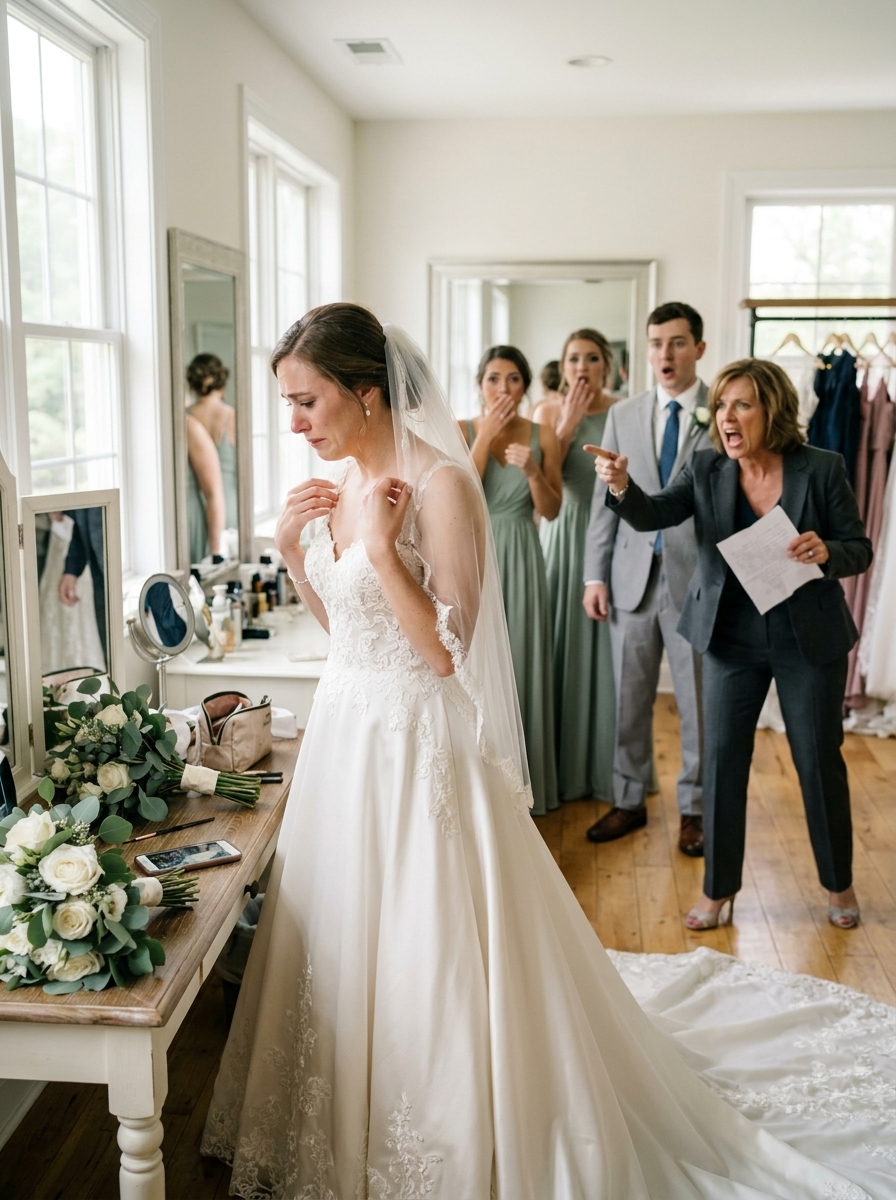
    On my wedding morning, I stood in a hotel suite in Charleston, dressed in an ivory gown that cost more than my first car, when my almost-sister-in-law placed a folder in my hands labeled Wife Duties.

    At first, I assumed it was a joke.

    Tessa Vale smiled as though she were presenting me with something valuable. She was my fiancé’s older sister—polished, graceful, and always just a little too comfortable speaking on his behalf.

    “Don’t look so scared, Audrey,” she said. “Every woman in our family gets one.”

    I looked down at the folder. “A wife duties list?”

    “It’s more of a transition guide.”

    My maid of honor, Paige, had stepped out to take a call. The photographer was downstairs. My mother had gone to check the flowers. For the first time that morning, I was alone with Tessa.

    The timing was intentional.

    I opened the folder.

    The first page read:

    Expectations for Audrey Vale After Marriage

    My name wasn’t even Audrey Vale yet.

    The list was neatly typed.

    Dinner prepared at least five nights a week.

    No overnight work trips unless approved by Nolan.

    Joint account access granted immediately after the honeymoon.

    Personal savings transferred into household reserve.

    Weekly Sunday lunch with Nolan’s parents.

    Children expected within two years.

    No major purchases without family discussion.

    Final decisions deferred to Nolan in financial disagreements.

    A ringing filled my ears.

    I slowly looked up. “Does Nolan know about this?”

    Tessa tilted her head. “Of course.”

    That was my first question.

    My second came out softer.

    “Was this written before or after I bought the house?”

    For the first time, her smile wavered.

    Six months earlier, I had purchased a three-bedroom house outside Savannah with my own money. Nolan loved telling people “we bought it,” but my name was the only one on the deed. I had also kept $190,000 in a separate account after selling my software consulting business. Nolan called it “our safety net,” even though he had never contributed a single dollar.

    Tessa crossed her arms. “Audrey, you’re marrying into a family. Assets need to be handled with maturity.”

    “Meaning transferred.”

    “Meaning shared.”

    “With Nolan?”

    “With the family structure.”

    There it was.

    Not love. Not partnership.

    A structure.

    I looked down at my wedding dress, at the lace sleeves my mother had cried over, at the shoes beside the bed, at the bouquet already delivered and sitting in water. Downstairs, one hundred and twenty guests were likely taking their seats beneath white roses and string lights.

    I thought about Nolan’s small comments.

    “You’re so independent it’s intimidating.”

    “My mom worries you won’t know how to be part of a family.”

    “After the wedding, we should simplify finances.”

    I had mistaken warnings for nerves.

    Tessa reached for my hand. “Don’t be dramatic. Every marriage has rules.”

    I pulled away.

    “No,” I said. “Every trap does.”

    Her expression hardened. “You’re emotional.”

    “No. I’m done.”

    I walked past her, opened the suite door, and found Paige in the hallway.

    She took one look at my face. “What happened?”

    I handed her the folder.

    Then I said the sentence that ended my wedding before it began.

    “Get my lawyer on the phone. I’m canceling it…

    Paige didn’t ask if I was sure. That’s why she was my maid of honor. She scanned the first page of the folder, her jaw tightening with each line. By the time she reached “final decisions deferred to Nolan,” she looked ready to throw something expensive through a window.

    “Oh, absolutely not,” she said.

    Behind us, Tessa stepped into the hallway. “Audrey is having a panic attack.”

    I turned around. “I’m having a realization.”

    Tessa’s eyes narrowed. “You cannot cancel a wedding because of a family document.”

    “I can cancel a wedding because the groom helped write a contract for my obedience.”
    “It’s not a contract.”

    “Then why does page four say I should sign acknowledgment after the honeymoon?”
    Paige looked at her sharply. “Page four?”

    Tessa went pale. I hadn’t even reached page four yet. That was enough.

    Within ten minutes, my suite turned into a command center. Paige called my attorney, Malcolm Reed, who had handled the sale of my consulting business. My mother returned, saw me holding the folder, and demanded the truth. I told her. She didn’t cry. She removed her earrings, set them on the dresser, and said, “Tell me what you need.”

    “I need to leave before Nolan gets here.”
    “Done.”

    My father was downstairs greeting guests. Mom called him and said only, “Come up now. Don’t bring anyone.”

    He arrived breathless, still wearing his boutonniere. He read two pages, then sat down as if his knees had given out.

    “Did Nolan give you this?” he asked.
    “Tessa did. She said he knew.”

    Dad looked at me, his eyes filled with the kind of hurt fathers try to hide because they think daughters need strength more than sadness.

    “You bought that house yourself,” he said.
    “I know.”
    “You earned that money yourself.”
    “I know.”
    He stood. “Then let’s make sure they don’t get near either.”

    My lawyer answered on speaker. His advice was immediate and practical. Do not sign anything. Do not meet Nolan alone. Do not discuss money. Inform the venue in writing that the wedding is canceled by the bride due to material misrepresentation. Secure the house. Move any shared wedding gifts into inventory. Keep the folder.

    Then he asked, “Did you and Nolan combine accounts?”
    “No.”
    “Is his name on the deed?”
    “No.”
    “Does he have access to the $190,000?”
    “No.”
    “Good,” Malcolm said. “Then today will be painful, but it will not be financially fatal.”

    That sentence steadied me. Downstairs, the ceremony was supposed to begin in forty minutes.

    Nolan started calling at 11:18 a.m. I watched his name flash across my phone once, twice, three times. Then came texts.

    Where are you? Tessa said you misunderstood something. Audrey, don’t embarrass us. Not don’t be hurt. Not I love you. Don’t embarrass us.

    At call number seven, Paige took my phone and turned it face down. My parents left to inform the guests. I stayed in the suite, still in my dress, while Paige helped me remove the veil. Somehow, that was when I started shaking. Not when I saw the folder. Not when I called the lawyer. When the veil came off.

    “I almost married him,” I whispered.

    Paige squeezed my shoulders. “Almost is the word doing God’s work today.”

    The hotel manager arranged a private exit through a service hallway. As I walked out, I passed a mirror and barely recognized myself: bridal makeup, red eyes, wedding dress gathered in both hands.

    At the side entrance, Nolan was waiting.

    He must have guessed where I would leave.

    He looked perfect in his navy tuxedo, handsome in the way that had once made me feel chosen. Now he just looked rehearsed.

    “Audrey,” he said, stepping toward me. “We need to talk.”

    My father stepped between us. “No, you need to step back.”

    Nolan ignored him. “This is insane. Tessa should not have given you that today, but you’re blowing it out of proportion.”
    “So you knew.”

    He hesitated. There it was again: the truth, arriving silently before the lie.

    “It was just a family tradition,” he said.
    “A tradition where I hand over my savings?”

    His face tightened. “We were going to discuss how to best manage resources.”
    “My resources.”
    “Our future.”
    I studied him carefully. “Did you plan to put your name on my house after the wedding?”

    He looked away. My mother made a small sound behind me. Nolan lowered his voice. “Audrey, I love you. But marriage means trust.”
    “No,” I said. “Marriage means partnership. You planned ownership.”

    He reached for my hand. I stepped back.
    “You’re really leaving?” he asked.

    I looked at the man I had almost promised my life to and felt grief, anger, and gratitude all at once. Grief for what I thought we had. Anger for what he had hidden. Gratitude that Tessa’s arrogance had saved me before a judge, a mortgage, and maybe children made leaving harder.

    “Yes,” I said. “And I’m taking everything I came with.”

    That afternoon, they called me seventeen times. I answered none of them.

    By evening, I was back in the house Nolan had called “ours.” For the first time since buying it, I walked through each room and said the truth out loud.

    “My kitchen.”
    “My stairs.”
    “My bedroom.”
    “My name on the deed.”

    It sounded childish at first, then necessary. I needed to hear ownership without apology.

    Paige stayed with me that night. My parents slept in the guest room. My lawyer had already sent formal letters to Nolan, Tessa, and the venue. The wedding gifts were cataloged and returned over the next two weeks. Anything purchased jointly for the ceremony was divided according to receipts. Anything I had paid for remained mine, and anything refundable was returned to the original account.

    Nolan tried every version of himself. First, the wounded fiancé. How could you humiliate me in front of everyone? Then, the romantic.

    I still believe we’re meant to be. Then, the practical man. We should talk about the house since I planned to live there. Finally, the angry one. You think money makes you better than us.

    I saved every message and responded only once, through Malcolm. Do not contact me directly again.

    Tessa sent a long email explaining that I had “misinterpreted tradition through a modern lens.” Nolan’s mother wrote that I had destroyed a good family. His father demanded repayment for deposits they had willingly contributed.

    Malcolm handled everything.

    Three weeks later, Nolan came to my house.

    I saw him on the doorbell camera holding flowers and wearing the gray sweater I used to love. My chest ached, but not with longing. With recognition. He had chosen the version of himself most likely to weaken me.

    I spoke through the camera. “Leave.”
    “Audrey, please. Five minutes.”
    “No.”
    “I made mistakes.”
    “You made plans.”

    He lowered the flowers. “My family pushed too hard.”
    “You let them.”
    He stared at the camera for a long moment. “So that’s it?”
    “That’s it.”

    He left the flowers on the porch. I threw them away. Healing wasn’t dramatic. It was paperwork, therapy, quiet breakfasts, and learning not to confuse calm with loneliness. I painted the guest room green. I changed the locks. I turned the room that was meant to be Nolan’s office into a studio where I could consult again without traveling as much.

    For months, I felt embarrassed by how close I had come. Then my therapist said something that stayed with me.

    “You are not foolish because someone hid the truth. You are wise because you believed it when it appeared.”

    That helped.

    Six months after the canceled wedding, I received a handwritten letter from Nolan’s younger cousin, Maribel. She had been twenty-two, newly engaged, and present at the wedding that never happened.

    She wrote that after I left, the family tried to label me unstable. Then someone uncovered why. Then the folder became impossible to justify. Her fiancé’s family had started making similar comments about money and obedience, and watching me walk out gave her the courage to pause her own wedding.

    I didn’t know a woman could simply say no and leave with her life intact, she wrote. Thank you for showing me.

    I cried over that letter longer than I cried over Nolan.

    A year later, I hosted dinner in my backyard. Not a wedding. Not an engagement party. Just dinner. My parents came. Paige came. Maribel came too, no longer engaged and much lighter in spirit. We ate under string lights I had hung myself, at a table I had bought myself, in a home no one could use to trap me.

    At one point, my mother looked around and said, “This turned out beautiful.”

    I smiled. “It did.”

    I did not hate Nolan forever. Hate is still a form of attachment. Eventually, he became a lesson with a name, a chapter I could revisit without bleeding.

    What stayed with me was not the humiliation of walking out in my dress.

    It was the sound of my own voice when I chose myself. No screaming. No begging. No performance. Just one clear decision. I had once believed love meant building a life with someone. Now I understand better.

    Love is not proven by how much of yourself you surrender. Love is proven by how safe you are allowed to remain while being fully yourself.

    And on the morning I canceled my wedding, I did not lose a husband.

    I kept my home, my future, my dignity, and the woman I had worked too hard to become.

  • King Charles takes “swipe” at Donald Trump in latest speech

    King Charles held a speech on what would have been his mother, Queen Elizabeth II’s 100th birthday on Tuesday. Yet, one royal expert has now claimed that a part of the speech was a “swipe” at president Donald Trump, just weeks before the royals are set to visit the White House.Last year, Donald Trump and his wife, Melania Trump, visited King Charles and the Royal Family. The meeting appeared to have been a success, when King Charles and Queen Camilla accepted an invitation to the White House in late April as a part of celebrating the U.S 250th Anniversary.

    The royals will meet the POTUS Donald Trump as Buckingham Palace has confirmed a state visit to the United States.The trip to the US has been expected for quite some time. However, visits like this are carried out on behalf of the UK government, and an official announcement appeared to be delayed until tensions surrounding the Iran war had eased, the BBC reports.

    Exactly how King Charles and Queen Camilla’s schedule in the U.S will look has not yet been revealed. Still, the monarch will reportedly address Congress.It will be the first UK state visit to the U.S since Queen Elizabeth visited in 2007. At that time, Barack Obama was the president.However while the visit might be “terrific,” one royal expert has now brought up some quite concerning words. On Tuesday, April 21, Queen Elizabeth II would have turned 100, and the celebration was held at Buckingham Palace.

    King Charles says late Queen would be ‘troubled’ by today’s world

    King Charles to visit Donald Trump at the White House

    Donald Trump made an announcement through social media that the U.S visit will be between April 27 and 30. A “a beautiful Banquet Dinner at the White House on the evening of April 28th” will be arranged, the president said, adding that he and First Lady Melania Trump “look forward to spending time with the King, whom I greatly respect.” He concluded that it will be “TERRIFIC.”

    Queen Elizabeth was Britain’s longest-reigning and longest-lived monarch, spending 70 years on the throne before her death in September 2022, at the age of 96.

    In a televised statement, Charles explained that his mother had shaped the world around her and touched many lives. However, with everything that is going on in the world, she would be concerned.

    “Today, as we mark what would have been my beloved mother’s 100th birthday, my family and I pause to reflect on the life and loss of a sovereign who meant so much to us all, and to celebrate anew the many blessings of her memory,” King Charles said.

    King Charles takes “swipe” at Donald Trump in emotional speech

    “Millions will remember her for moments of national significance; many others for a fleeting personal encounter, a smile, a kind word that lifted spirits, or for that marvelous twinkle of the eye when sharing a marmalade sandwich with Paddington Bear in the final months of her life.”

    He continued, “Much about the times we now live in, I suspect, may have troubled her deeply, but I take heart from her belief that goodness will always prevail and that a brighter dawn is never far from the horizon,” Charles said. “God bless you, darling mama. You remain forever in our hearts and prayers.”

    The fact that King Charles mentioned “troubled” times in the world prompted royal expert Kinsey Schofield to respond. Appearing on Sky News, Schofield claimed that the monarch’s tribute to his late mother was a “swipe” at Donald Trump and his war in Iran.

    “I’m going to be honest, maybe I’m just sensitive … but I felt like that was a swipe at what’s going on in the United States between Donald Trump and Iran,” Schofield said.

    “When he’s talking about global issues, I don’t think that’s a direct swipe at ex-prince Andrew, but I’d suggest she might be a little bit more worried about what’s going on at her back porch,” she added.

  • I “won” a 5-star vacation, and my husband brought his whole family along. The entire trip, they m0cked me for being “too provincial,” ordering me around like staff. I swallowed every insult—until his father forced my five-year-old son into the pool, knowing he was terrified of water.

    I “won” a 5-star vacation, and my husband brought his whole family along. The entire trip, they m0cked me for being “too provincial,” ordering me around like staff. I swallowed every insult—until his father forced my five-year-old son into the pool, knowing he was terrified of water.

    Chapter 1: The Two-Billion Dollar Secret

    The envelope felt heavier than paper should—because of the lie it carried. Inside was a gold-embossed voucher for a seven-night stay at Azure Sands, the most exclusive resort in the Maldives.

    “Mark!” I called, pretending excitement. “You won’t believe this!”

    My husband walked in, loosening his tie, looking drained from chasing a life he couldn’t quite afford. He glanced at the envelope.

    “What is it? Another bill?”

    “No,” I said, handing it over. “That sweepstakes I entered? We won. A full week. Everything covered.”

    Mark grabbed it fast. His eyes moved across the text, and I watched his mood change instantly. The exhaustion disappeared—replaced by something sharper.

    “Azure Sands?” he said. “Do you know how expensive this is? Finally… I get to live the life I deserve.”

    Not we. I.

    I smiled lightly. “I thought it would be good for us. And Toby would love the ocean.”

    “Yeah, sure,” he said, already texting. “I’ll call Dad and Beatrice. We can’t go alone.”

    A cold feeling settled inside me.

    He didn’t know the truth.

    The contest wasn’t real. And three months earlier, my grandfather—whom he believed was just a mechanic—had left me a two-billion-dollar empire. Including this resort.

    I kept it secret to see who he really was.

    Chapter 2: Hum:iliation in Paradise

    Azure Sands was breathtaking—floating villas, marble walkways, warm ocean air.

    At reception, the staff greeted us. Julian, the manager, met my eyes. I gave a slight shake of my head.

    He understood.

    “Welcome, Mr. Vance,” he said smoothly.

    Mark stood taller. “Nice place. Put my bags in the best villa. Get my father a drink.”

    They relaxed. I worked.

    For two days, I ran errands. Beatrice sent me for magazines. Frank complained about everything. Mark made me take photos of him posing.

    “Higher angle, Clara!”

    On the third night, we ate at the underwater restaurant. Fish drifted past glass walls.

    Beatrice smirked. “Still drawing little pictures?”

    “I’m an illustrator.”

    She laughed. “Same thing.”

    Frank added, “Mark needs someone ambitious. Not someone so… provincial.”

    The word lingered.

    Then Beatrice slammed her glass down. “This wine is bad.”

    It wasn’t.

    “It’s fine,” I said.

    She snapped her fingers. “Go fix it.”

    Mark didn’t defend me. “Just go.”

    I walked away under watching eyes.

    When I returned with another bottle, she sipped… then poured it onto the floor.

    “Better,” she said. “Clean it.”

    Chapter 3: The Breaking Point

    The next morning, everything changed.

    Toby played in the shallow pool.

    Frank approached. “Take those floaties off.”

    “I can’t swim yet…”

    “Nonsense.”

    Before I could react, he ripped them off and threw Toby into the deep end.

    Toby panicked. Struggled. Sank.

    Frank laughed. “Kick!”

    Mark watched, amused. Beatrice filmed.

    My son was drowning.

    I jumped in. Pulled him out. He clung to me, coughing.

    “You ruined it!” Frank shouted.

    “He was drowning!”

    “He’s fine,” Mark said.

    Something inside me snapped—quietly, completely.

    I stood up, soaked, holding Toby’s hand.

    For the first time, I felt in control.

    I pulled out my phone.

    “Julian. Bring security.”

    Mark laughed. “Ordering drinks?”

    I stared at him.

    “No. I’m taking out the trash.”

    Chapter 4: The Truth Revealed

    Within a minute, security arrived.

    Six guards. Silence.

    Julian walked forward… and bowed to me.

    “Ms. Sterling. Shall we proceed?”

    Mark froze. “What are you doing? She’s my wife!”

    “She is the owner,” Julian replied calmly.

    Shock spread.

    “I bought this resort,” I said. “I wanted to see how you’d treat me if I had nothing.”

    I looked at Frank. “You called me provincial.”

    At Beatrice. “You treated me like a servant.”

    At Mark. “You watched your son drown.”

    “Clara, wait—” he pleaded.

    A guard shoved him back.

    “Remove them,” I ordered.

    They yelled. Threatened. Begged.

    I smiled.

    “The cameras saw everything. Police are waiting.”

    Mark broke down. “Where will we go?”

    I turned away.

    “Try swimming.”

    Chapter 5: Resolution and Healing

    From the penthouse balcony, I watched them being thrown out.

    They looked small.

    My lawyer confirmed everything—divorce, custody, charges.

    Toby sat beside me.

    “Are they coming back?”

    “No.”

    “Was it my fault?”

    My heart broke.

    “No. You’re perfect.”

    We spent the rest of the week healing. Walking the beach. Learning to float.

    For the first time in years, I felt free.

    I wasn’t invisible.

    I wasn’t weak.

    I was Clara Sterling.

    Chapter 6: A New Legacy

    One year later, Azure Sands thrived. Still luxurious—but warmer, kinder.

    “Mom!” Toby ran toward me, laughing, confident, strong in the water.

    An email came about Mark. His life had fallen apart.

    I deleted it.

    I felt nothing.

    “Can we get gelato?” Toby asked.

    I smiled. “Anything you want.”

    As we walked, I noticed a man yelling at his wife.

    I turned to Julian.

    “Upgrade her room.”

    “And him?”

    “If he raises his voice again—remove him.”

    Julian nodded.

    In my world, kindness mattered.

    Cruelty had consequences.

    I wasn’t the woman they ignored.

    I was the one in control.

    And this was only the beginning.

  • After My Parents Di:ed, My Sister Got the Mansion, Jewelry, and Fortune—While I Got an Old Barn. She Laughed, “This Trash Suits You!” But Days Later, I Found a Hidden Staircase Underground

    After My Parents Di:ed, My Sister Got the Mansion, Jewelry, and Fortune—While I Got an Old Barn. She Laughed, “This Trash Suits You!” But Days Later, I Found a Hidden Staircase Underground

    The day after my parents were laid to rest, my sister Vanessa showed up to the will reading dressed in black silk, wearing our mother’s pearls like they were already hers.

    I came in the same simple dress I had worn to the funeral. The lawyer, Mr. Harlan, read everything in a steady voice—Vanessa received the Charleston house, the jewelry, the investment accounts, and nearly all the money. Then he turned to me.

    “Evelyn Carter will receive the old barn and two acres on Route 17.”

    Vanessa covered her mouth—but she wasn’t crying. She was laughing.

    “That junk fits you,” she whispered as we walked out.

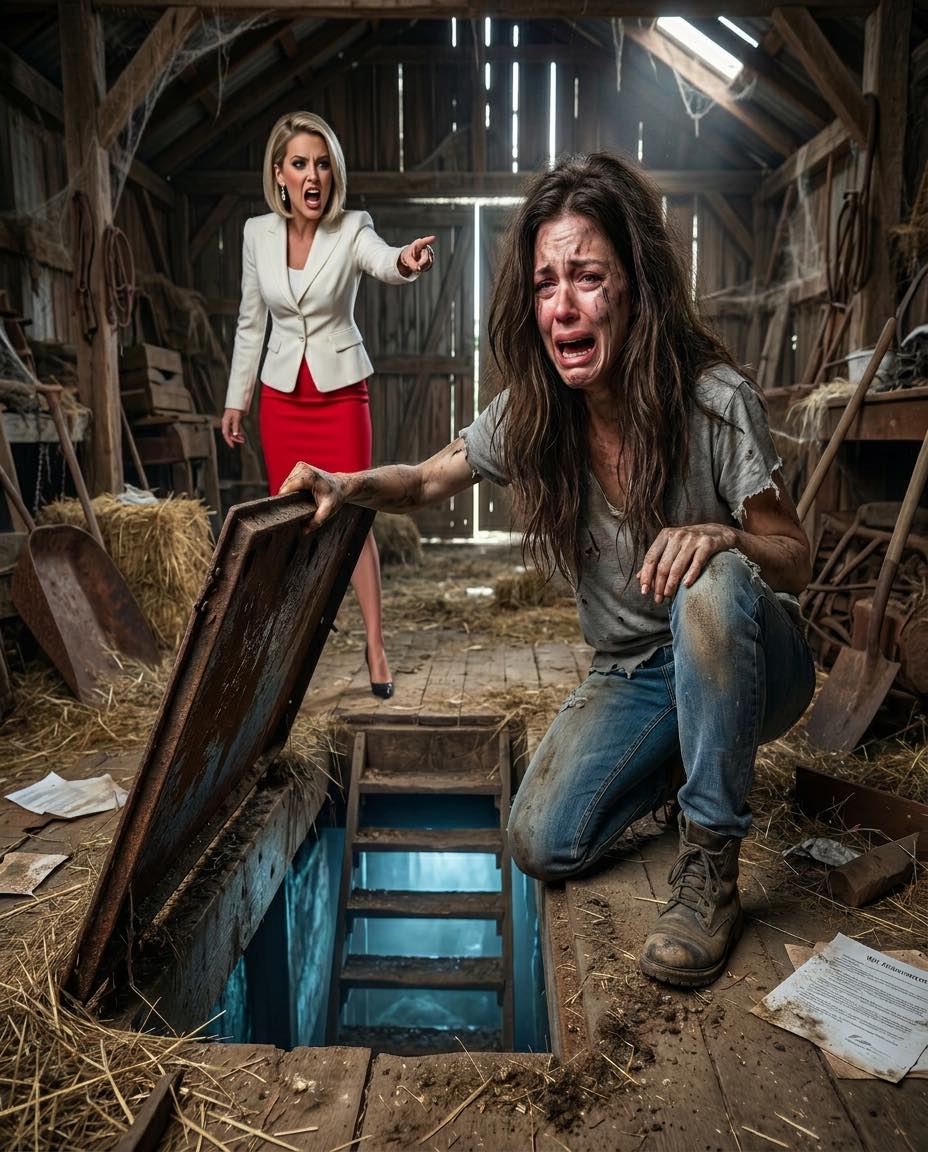
    I didn’t respond. I had spent years taking care of our parents—appointments, bills, repairs—while Vanessa only showed up when she needed money. But the will was signed. There was nothing to argue. Three days later, I went to the barn. It was worse than I remembered—dust, broken tools, rotting hay everywhere. I nearly cried, but I started cleaning anyway. Near the back wall, under warped boards, I noticed a metal plate bolted into the floor—too new to belong there. I cleared it off, found a hidden handle, and after struggling to lift it, cold air rushed up from below. A narrow staircase appeared. I called Mr. Harlan before going down. Something about it felt too important to face alone.

    When he arrived, we went down together. At the bottom, instead of treasure, we found a locked, climate-controlled room. Inside were files, sealed boxes, records, photos—and a letter addressed to me. My hands trembled as I opened it.

    “Evelyn, if you’re reading this, it means you came to the barn. We needed to know which daughter still valued work over appearances.”

    I looked at Mr. Harlan. Vanessa had taken what looked valuable. I had been given something else. As we opened the first cabinet, I realized she had celebrated too soon.

    The room was organized like a private office, with labeled files—PROPERTY, TAXES, TRUST, VANESSA, EVELYN. Mr. Harlan opened the trust documents first, and his expression changed immediately. My parents had created a separate trust years ago. The barn and land were only part of what I inherited—everything tied to it belonged to me. A map revealed the truth: the land sat on a critical access point for a future development project. What looked worthless was actually worth millions.

    Then we opened Vanessa’s file. Inside were records—checks, emails, and withdrawals. She had taken large amounts of money from our parents over the years, even after our mother’s health declined. I felt sick. My father had known. In another letter, he explained everything: Vanessa had pressured them to change the will, so they gave her what she cared about—things that looked impressive. But they protected the real value in the trust, leaving it to me because they trusted I would look deeper.

    I cried—not because of the money, but because they had seen me all along. I thought I had been overlooked. I hadn’t. They had simply been testing us. And Vanessa had already failed.

    When Vanessa called, she mocked me again.

    “So, have you cleaned your little dump yet?”

    “Yes,” I said calmly. “I found something.”

    Her tone changed instantly. She was nervous. I told her to speak with a lawyer and hung up. Two weeks later, she showed up at the barn, demanding answers. The next day, we met at Mr. Harlan’s office with lawyers. At first, she laughed. Then she cried. Then she blamed me.

    “You turned them against me.”

    “No,” I said. “You just assumed no one was keeping records.”

    The outcome was clear. She kept the house, jewelry, and remaining accounts—but the land, rights, and future value tied to the barn belonged entirely to me. Worse for her, the questionable money she had taken could not be ignored. She was forced to repay it—mostly by selling the very jewelry she had proudly claimed.

    Months later, a development company offered to buy access to my land. I didn’t sell. I leased it, keeping ownership. The first payment alone was worth more than everything Vanessa had inherited outright. I used part of it to restore the barn—not into something flashy, but into a community workshop named after our parents.

    One afternoon, Vanessa stood outside the fence, looking smaller than I remembered.

    “I didn’t know,” she said quietly.

    “That’s the problem,” I replied. “You never wanted to know anything that didn’t shine.”

    “I’m sorry.”

    I could have been harsh. I had every reason to. But I simply said,

    “I hope one day you mean that.”

    Then I walked back inside.

    My parents gave Vanessa everything she wanted.

    And they gave me something she never understood—a future.

  • I arrived late to Christmas dinner and froze when I saw my sister serving 20 people alone while her in-laws sat there laughing. When her mother-in-law threw a glass of wine over her head, I jumped up. “What did you just do to my sister?”

    I arrived late to Christmas dinner and froze when I saw my sister serving 20 people alone while her in-laws sat there laughing. When her mother-in-law threw a glass of wine over her head, I jumped up. “What did you just do to my sister?”

    I showed up late to Christmas dinner, still catching my breath from traffic and mentally rehearsing my apology. But the second I walked through the front door, I knew something was wrong. Laughter spilled out from the dining room, loud and careless, yet there was nothing warm about it—it carried an edge. Then I spotted my sister, Emily.

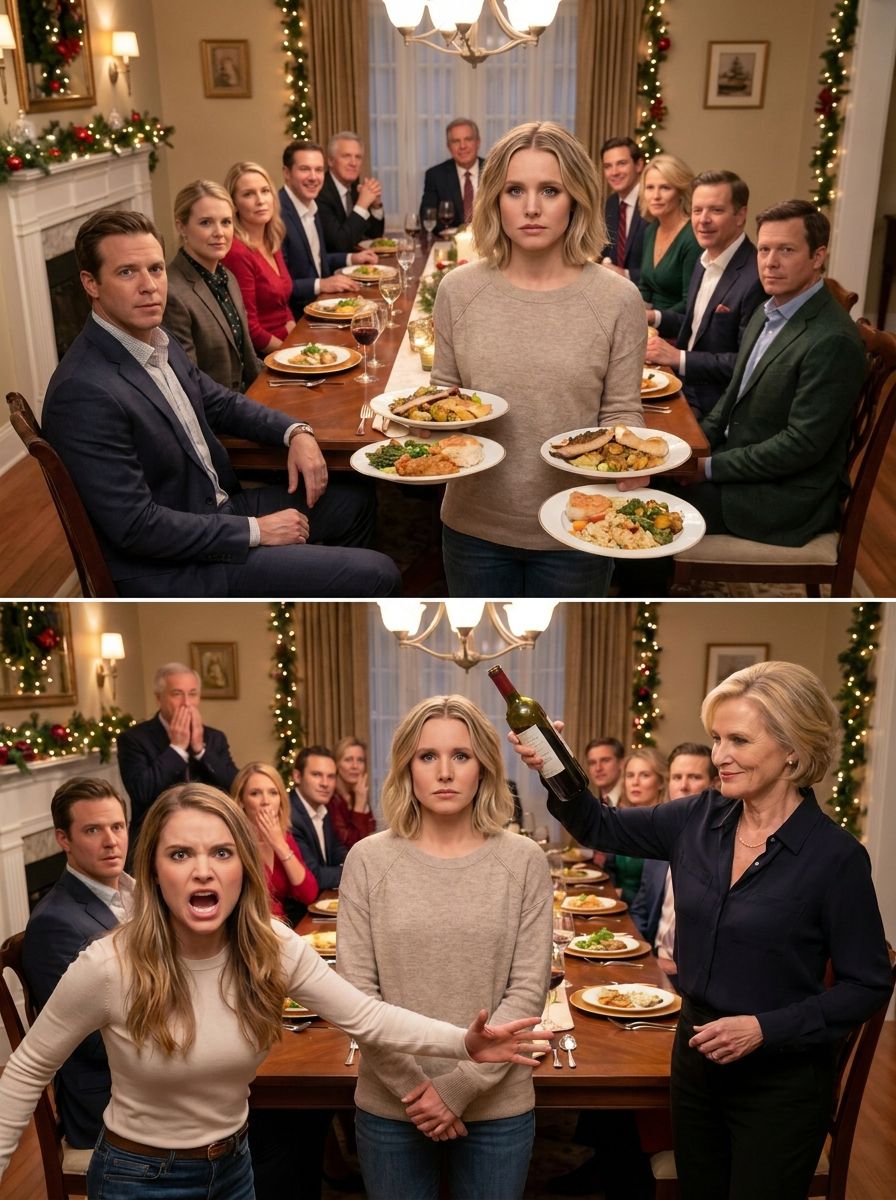
    She was rushing between the kitchen and the table nonstop, balancing heavy dishes in her arms, her cheeks red with exhaustion. Nearly twenty people sat comfortably around the table, and she was the only one waiting on everyone. Her husband, Daniel, lounged at the head of the table beside his mother and relatives, laughing as though this entire scene were perfectly normal.

    “Emily, do you want some help?” I asked as I moved toward her.

    She glanced at me briefly, tired eyes forcing a weak smile. “I’m fine. Just… almost finished.”

    But she wasn’t fine. That much was obvious to anyone looking at her.

    Before I could say another word, Daniel’s mother, Margaret, raised her wineglass and called across the room, “Emily! This wine is warm. Are you even paying attention tonight?”

    “I’m sorry, I’ll bring another bottle,” Emily answered quietly as she hurried over.

    Margaret suddenly rose from her chair, her face hard and icy. “No, you’ve already done enough.” Then, without any warning at all, she tipped the glass and dumped red wine straight over Emily’s head.

    The room exploded with laughter.

    My stomach dropped. For one stunned second, I couldn’t move. Emily stood completely still, wine dripping through her hair and down her dress, her hands shaking beside her.

    “What is wrong with you?!” I yelled, stepping toward them. “You can’t treat someone like that!”

    Margaret only shrugged, utterly unbothered. “She needs to understand her place.”

    Daniel stayed silent.

    I spun toward him in disbelief. “You’re seriously just sitting there?”

    Before he could respond, Emily suddenly spoke, her voice trembling yet louder than I had ever heard before.

    “Don’t,” she said.

    Every sound in the room disappeared.

    Then she lifted her eyes toward Margaret and Daniel, and I saw something in them I couldn’t fully identify—maybe fear… or maybe something stronger.

    “I already made the call,” she whispered.

    And just like that, everything shifted.

    …

    Part 2

    “What call?” Daniel asked, and for the first time all evening, his voice sounded uncertain.

    Emily didn’t answer immediately. She picked up a towel and carefully wiped the wine from her face, her hands no longer trembling. There was a strange calmness about her now, completely opposite from the chaos around us.

    “I called a lawyer this morning,” she said softly.

    The sentence hit the room like an explosion.

    Margaret let out a scoff. “A lawyer? For what? Don’t be absurd.”

    Emily looked directly at her, no longer shrinking into herself or apologizing. “For the divorce.”

    This time the room erupted with shock instead of laughter.

    Daniel shoved his chair backward. “Emily, stop. This isn’t funny.”

    “I’m not trying to be funny,” she answered. “I’ve been keeping records for months. The insults, the manipulation, the way all of you treat me like I don’t matter.” Her voice stayed steady. “Tonight was simply the final straw.”

    Margaret’s face flushed red with anger. “You ungrateful girl. We gave you a home!”

    Emily gave a quiet, bitter laugh. “A home? Or a place where I’m expected to cook, serve, and stay silent?”

    By then I had moved to stand beside her, and my anger was slowly being replaced with something else—pride.

    Daniel lowered his voice, trying to sound gentle. “Emily, let’s talk privately. You’re blowing this out of proportion.”

    “No,” she replied firmly. “I’m finally responding.”

    Silence stretched across the room. Nobody laughed. Nobody even moved.

    Then Emily added, “And there’s something else. I recorded tonight.”

    Margaret froze instantly. “You what?”

    “Everything,” Emily answered. “Including what you just did.”

    The air in the room tightened immediately.

    “You wouldn’t dare,” Margaret snapped.

    Emily held her gaze without flinching. “Just watch me.”

    Daniel dragged a hand through his hair, visibly shaken now. “Emily, think carefully about this. You’ll destroy everything.”

    She slowly shook her head. “No. I’m saving myself.”

    I finally understood what I was seeing. This wasn’t fear anymore. It was someone who had reached the end of her limit and decided she would never stay silent again.

    A phone vibrating shattered the silence. Emily glanced at the screen before looking back at them.

    “They’re here,” she said.

    “Who?” Daniel asked tensely.

    Emily inhaled deeply.

    “My lawyer… and the police.”

    Part 3

    The reaction was instant.

    Margaret stumbled backward like she’d been slapped. “Police? For what? This is a family issue!”

    Emily kept her voice calm. “It stopped being a family issue when months of humiliation and harassment became normal.”

    Daniel looked completely panicked now. “Emily, please. We can work this out. Don’t do this.”

    She turned toward him, calm but emotionally distant. “You had countless chances to work it out. You chose not to.”

    A knock echoed through the house.

    At first, nobody moved.

    Then I stepped forward and opened the door. Two police officers stood outside beside a sharply dressed woman carrying a folder.

    “Good evening,” the woman said politely. “I’m Ms. Carter, Emily’s attorney.”

    Behind me, I heard Margaret mutter under her breath, but all of her confidence had vanished.

    Emily walked past me and faced them directly. “Thank you for coming.”

    One of the officers nodded. “We received a report. Can you explain what happened tonight?”

    Emily didn’t hesitate. She told them everything—clearly, calmly, and without fear. The same room that had been filled with mocking laughter now felt unbearably silent.

    Daniel tried to interrupt, but the officer lifted a hand. “Sir, you’ll have an opportunity to speak.”

    Margaret slowly sank into her chair, the arrogance she’d worn earlier replaced by disbelief.

    I stood there watching my sister—this version of her I had never truly seen before. Strong. Certain. Free.

    For the first time in years, she wasn’t trying to protect everyone else’s comfort. She was finally choosing herself.

    As the officers continued asking questions and Ms. Carter prepared paperwork, Emily briefly turned toward me.

    “I’m okay,” she said quietly.

    I nodded, fighting the lump rising in my throat. “I know.”

    That Christmas dinner didn’t end with celebration. It ended with consequences.

    But it also ended with something else—truth.

    Emily walked out of that house not as someone defeated, but as someone who had finally reclaimed her life.

    And sometimes that’s what it takes. Not one dramatic moment, but the courage to finally say, “Enough.”

    So if you’ve ever stayed silent just to keep everyone else comfortable, ask yourself this—how much is your peace really worth?

    And if this story touched you, share it. Because somewhere out there, someone may still be trying to find the courage to make their own call.

  • At my parents’ funeral, my husband coldly placed the divorce papers in my hand and said, “Sign them. You have no one left to protect you.” Then he took my daughter and disappeared with a wealthy woman. Four years later, when I had become a millionaire, a call came in… and my daughter whispered, “Mom…”

    At my parents’ funeral, my husband coldly placed the divorce papers in my hand and said, “Sign them. You have no one left to protect you.” Then he took my daughter and disappeared with a wealthy woman. Four years later, when I had become a millionaire, a call came in… and my daughter whispered, “Mom…”

    PART 1

    “Sign the divorce papers. There’s no one left to stand by you.”

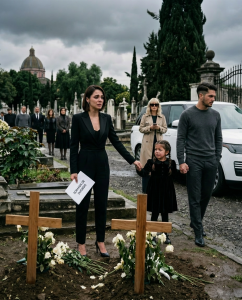
    That’s what my husband told me as we stood beside my parents’ freshly covered graves, while the last pieces of earth were still falling over their coffins.

    The sky was heavy and gray above San Andrés cemetery in Puebla, and I could barely stay upright. My parents had passed away just three days earlier in a highway accident on the Mexico–Puebla road. A truck had lost control and collided with their car as they were returning from visiting my aunt.

    My seven-year-old daughter, Camila, held my hand tightly, her small fingers cold. She didn’t fully understand what had happened, but she knew her mother was breaking.

    My name is Mariana Salazar, and that day I believed I had nothing left to lose.

    Then Alejandro—my husband—arrived.

    He was dressed in black, but he didn’t look like someone grieving. He looked like someone late for a meeting. He walked toward me without a hug, without a single kind glance, and placed a thick envelope into my hands.

    “What is this?” I asked, even though my heart already knew.

    “The divorce papers,” he said. “Sign them.”

    I stared at him as if he were a stranger.

    “Today? At my parents’ funeral?”

    He gave a short, dry laugh.

    “Your parents left debts, Mariana. The house, the loans… all of that is now yours. I’m not going down with you.”

    The world tilted.

    Before I could speak, a white luxury SUV pulled up near the cemetery entrance. A tall blonde woman stepped out, dressed in dark glasses and an expensive coat—as if she were arriving somewhere elegant, not a funeral.

    I recognized her instantly.

    Valeria Montemayor.

    The woman Alejandro always said he was “working late” with.

    Camila looked at her, confused.

    Alejandro reached down and took my daughter’s hand.

    “Where are we going, Dad?” she asked.

    “With me,” he said. “You’ll have a better life.”

    My chest tightened.

    “No,” I said, stepping between them. “Camila stays with me.”

    He leaned close and whispered:

    “You don’t even have enough to pay next month’s rent. I’ve already arranged everything.”

    He showed me documents—temporary custody papers, official seals, signatures I had never seen.

    “That’s not true,” I said, my voice shaking.

    But he had already lifted Camila into his arms.

    “Mom, I don’t want to go!” she cried, pressing her hands against the window.

    I ran after the car, slipping in the mud, begging, calling her name.

    But the car drove away.

    And there, beside my parents’ graves, I understood something that changed me forever.

    Alejandro hadn’t just left me.

    He had taken my daughter.

    And he had no idea how far I was willing to go to bring her back.

    PART 2

    For weeks, no one believed me enough to act quickly.

    I went to the prosecutor’s office. I searched for lawyers. I begged for help. But Alejandro had prepared everything while I was caring for my sick father and barely sleeping. Between confusing paperwork, signatures that looked like mine, and claims that I was “emotionally unstable,” he managed to take Camila away.

    My court-appointed lawyer told me the truth:

    “Mrs. Mariana, fighting this will be expensive. And he has money behind him.”

    Money.

    Valeria.

    I lost my apartment in Narvarte. I sold my furniture. I packed Camila’s clothes into a pink suitcase I couldn’t open without crying.

    I worked mornings as a waitress, afternoons doing bookkeeping for a mechanic shop, and nights studying financial management through free videos.

    My father had been an accountant.

    My mother always said a disciplined woman could survive anything.

    I was living through the test of that belief.

    At first, I cried every day.

    Then less.

    Then I learned to turn pain into something useful.

    I started helping small businesses organize their finances. Then I invested in an old house no one wanted in Atlixco, fixed it, rented it out.

    Then another.

    Then another.

    Four years later, I was no longer the woman Alejandro left behind at the cemetery.

    I had a real estate company.

    Properties in Puebla and Querétaro.

    Employees.

    Lawyers.

    Security.

    A life I had rebuilt from nothing.

    But every night, I saw the same image.

    Camila pressing her hands against the glass, calling for me.

    One rainy afternoon, my personal phone rang.

    Unknown number.

    I answered.

    Silence.

    Then—

    “Mom…”

    My heart stopped.

    “Camila?”

    A quiet sob.

    “Please don’t hang up.”

    I stood up so fast my chair fell.

    “I would never hang up on you. Where are you? Are you okay?”

    A door slammed somewhere in the background.

    “Dad says you left me,” she whispered. “But I found a picture of you… and a piece of paper with your number.”

    I covered my mouth.

    “Camila, tell me where you are.”

    “In a big house… near the sea. Valeria yells all the time. Dad says I can’t call you.”

    A woman’s voice shouted in the background:

    “Who are you talking to?”

    The call ended.

    I didn’t cry.

    I didn’t panic.

    I acted.

    I called Rubén—my head of security.

    “Track that number.”

    Within hours, we had the location.

    A mansion in Veracruz.

    Registered under Valeria Montemayor.

    And then came the truth:

    Valeria was bankrupt.

    Her hotels were gone.

    Alejandro was drowning in lawsuits.

    My daughter hadn’t called just because she missed me.

    She called because she needed me.

    PART 3

    We flew to Veracruz that same night.

    This time, I wasn’t asking for help.

    I had evidence.

    Resources.

    And four years of strength built from pain.

    When we arrived, the mansion looked perfect from a distance.

    But up close, it was falling apart.

    Peeling paint.

    Broken cameras.

    Neglected gardens.

    The life Alejandro chose… wasn’t real.

    We waited across the street.

    Then I saw him.

    Thinner.

    Tired.

    Nothing like the man who stood at the cemetery.

    Valeria followed him, shouting.

    “This is your fault! You said she would never recover!”

    They argued.

    Then the door opened.

    Camila stepped out.

    Eleven years old.

    Taller.

    Quiet.

    But still my daughter.

    She saw me.

    “Mom…”

    I ran.

    She ran.

    We met in the middle of the street and held each other like we were putting years back together.

    “I’m sorry,” I whispered. “I’m so sorry.”

    “I knew you didn’t leave me,” she cried.

    Alejandro rushed forward.

    “You don’t have the right!”

    Camila held onto me tighter.

    “You lied to me!” she shouted. “You said she didn’t love me!”

    Neighbors came out.

    Phones recording.

    Police arrived.

    Truth came quickly.

    Camila told everything.

    Neglect.

    Lies.

    Isolation.

    My lawyers proved the documents were forged.

    That night, I was granted immediate custody.

    Camila slept beside me, holding my hand.

    “I used to talk to you every night,” she whispered.

    “I’m here now,” I told her. “You’ll never be alone again.”

    The months that followed were not easy.

    We both needed healing.

    But we did it together.

    Alejandro eventually admitted to forgery and fraud.

    Valeria lost everything.

    Camila and I moved into a house with a yellow door—because she said it looked like happiness.

    We cooked.

    We laughed.

    We cried.

    We rebuilt.

    One afternoon, Camila asked me:

    “Mom… why didn’t you give up?”

    I smiled softly.

    “Because a mother can lose everything… except her love for her child.”

    Sometimes life breaks you before you can grow.

    I was betrayed on the worst day of my life.

    But they couldn’t destroy me.

    And if you ever feel broken, remember this:

    The one who walks away with everything…doesn’t always win.

    Sometimes, the one who stands back up, fights for what matters, and refuses to look back…wins everything.

  • Jessica told the whole family my beach house was in foreclosure and prepared to buy it cheap. Her plan backfired when the Bank VP called to ask who she was, confirming the owner had just settled the $1.2 million balance in full.

    Jessica told the whole family my beach house was in foreclosure and prepared to buy it cheap. Her plan backfired when the Bank VP called to ask who she was, confirming the owner had just settled the $1.2 million balance in full.

    Jessica announced to the entire family that my beach house was being foreclosed on and bragged that she was about to buy it for pennies on the dollar. Her entire scheme collapsed when the Vice President of the bank called to ask who she was, confirming that the owner had already paid the full $1.2 million balance ahead of schedule.

    The notification sound from the “Morrison Family Reunion” group chat echoed through my office like a warning siren. I didn’t even need to read the message to know Jessica was behind it. For the last six months, my cousin had been spreading stories that my architectural firm was failing and that I was buried in debt.

    She seemed obsessed with watching me lose the one thing our grandfather had left solely to me: a breathtaking glass beach house in Malibu. In Jessica’s mind, because she was the “golden” grandchild who married into a wealthy real estate family, the house should have belonged to her.

    “THE BANK FINALLY REPOSSESSED YOUR BEACH HOUSE,” the message read in huge capital letters, followed by champagne emojis. “My husband’s contacts confirmed it. The foreclosure auction is Monday, and I’m buying it for only $400k. At last, the house will be back in responsible hands. Sorry, Maya, but luxury isn’t meant for everyone.”

    The group chat exploded instantly.

    My relatives piled on with fake sympathy disguised as insults, while my father—who always trusted Jessica because she presented herself as some financial genius—responded almost immediately.

    “I won’t let our family property go to outsiders. Jessica, I just wired you $200k to help cover the bid. Make sure the house stays in the family.”

    I stared at the screen in disbelief.

    I had never missed a mortgage payment. In reality, for the past three years I had been funneling nearly every dollar of profit from my company into a high-yield offset account. I planned to surprise my father on his seventieth birthday by revealing that the Malibu house was fully paid off and protected for future generations.

    But Jessica had weaponized a misunderstanding.

    While house-sitting for me months earlier, she had spotted a “Notice of Default” letter in my mail—a banking error that had already been resolved—and she treated it like proof of my financial collapse.

    I never responded in the chat.

    I never defended myself.

    Instead, I picked up my phone and called my private banker at Pacific Heritage.

    “Mr. Sterling,” I said carefully, my voice tight with anger, “use the bridge fund to clear the remaining $1.2 million on the Malibu property. Pay the mortgage in full today. I want the title released before sunset.”

    Two hours later, Jessica was busy uploading Instagram photos posing with “her” new beach house keys—keys she secretly duplicated during her last visit—when her phone rang.

    It wasn’t family calling.

    It was the Vice President of Pacific Heritage Bank.

    I sat quietly in my car outside the beach house, watching through the glass walls as Jessica stood on the porch. Her face slowly turned ghostly pale as the voice on the other end spoke through her car’s Bluetooth speakers, loud enough for me to hear through the open window.

    “Ma’am,” the VP said calmly, “I have a Jessica Morrison asking about a foreclosure auction involving the Malibu pier property. This property is not in foreclosure. The owner just paid off $1.2 million early and cleared the title completely. Our records also show you attempted to submit a fraudulent bid for an auction that does not exist. Who exactly are you, and why are you trying to purchase a home that isn’t for sale?”

    The silence after the VP’s question felt endless.

    I stepped out of my car while waves crashed softly behind me along the shoreline. Jessica stood frozen on my porch, clutching her phone so tightly it looked painful. Her expensive sunglasses slid halfway down her face.

    At that exact moment, my father’s car pulled into the driveway. He looked confused as he climbed out, clearly expecting to witness the bank locking up the house. Instead, he found me standing calmly beside the front steps holding a bottle of sparkling cider instead of packing boxes.

    “Maya? What’s happening?” he asked nervously. “Jessica told me the bank was coming to secure the property.”

    I ignored the question and looked directly at Jessica.

    “Go ahead, Jess,” I said quietly. “Tell him what the bank VP just told you. Explain why you’re carrying copied keys you had no permission to make. Tell him about the imaginary foreclosure auction.”

    Jessica panicked instantly.

    “There was a notice!” she screamed. “I saw it myself! Maya’s lying. She probably borrowed money from some predatory lender to save herself. Dad, don’t believe her—she’s just embarrassed!”

    Without a word, I pulled my tablet from my bag and opened the official digital deed.

    “The house is fully paid off, Dad,” I said. “Every dollar. I cleared the remaining $1.2 million today. There was never any auction. Jessica lied to the family to humiliate me, and she lied to you to get your money.”

    I turned the screen toward him, displaying the official “Satisfaction of Mortgage” document timestamped less than an hour earlier.

    My father’s face lost all color.

    “You told me you had foreclosure paperwork,” he said slowly to Jessica. “You told me Maya was hiding everything from me. I transferred you $200k from my retirement account this morning.”

    “I was going to return it!” Jessica cried, but even she sounded unconvinced.

    The truth was obvious.

    She had hoped to exploit the panic of a fake financial crisis to manipulate my father into funding her lifestyle—or maybe even helping her fight for ownership of the house itself.

    She gambled on my downfall.

    She lost.

    “I already contacted the bank again, Jess,” I said calmly as I walked onto the porch. “And I sent screenshots of the VP’s call log into the family chat. Also, Dad? You should probably review your accounts immediately. If Jessica hasn’t already burned through that $200k on her fake ‘closing costs,’ you may still have time to recover it.”

    The family group chat, which had been overflowing with insults toward me only an hour earlier, suddenly became completely silent.

    One by one, the likes vanished from Jessica’s Instagram post.

    My father slowly lowered himself onto the porch steps and buried his face in his hands. I could tell the betrayal hurt him far more deeply than the financial loss itself.

    I sat beside him and rested a hand on his shoulder.

    “The house was never in danger, Dad,” I said softly. “I just wanted your birthday surprise to be special. I wanted you to know you’d never have to worry about this place again.”

    Jessica never apologized.

    She stormed to her car and sped away from the house she would never own, gravel flying beneath her tires.

    She tried to buy my life at a discount price, only to discover that my worth was far beyond anything her greed could measure.

    In the weeks after the “Foreclosure That Never Happened,” the entire Morrison family dynamic changed.

    My father eventually recovered his money, though it required legal threats before Jessica finally returned it. She became unwelcome at family gatherings, and her carefully crafted image as a brilliant real estate expert collapsed after everyone heard the recorded words of the bank VP.

    But the real victory was never about the money.

    And it wasn’t even about the beach house.

    It was about clarity.

    I finally understood that Jessica’s constant insults—and the family gossip surrounding me—were nothing more than noise. While they mocked my “tiny office” and assumed my quiet lifestyle meant failure, I was working sixteen-hour days building a respected architectural firm from nothing more than a laptop and determination.

    They mistook silence for weakness.

    They confused loud bragging for success.

    Meanwhile, I was building foundations while they focused on appearances.

    Today, my father spends most weekends at the Malibu house sitting on the deck watching dolphins cut through the Pacific waves. For an entire month, he apologized to me almost daily, but eventually I stopped him.

    “You didn’t fail me, Dad,” I told him gently. “You just believed the wrong version of my story. From now on, let’s make sure we write our own chapters.”

    The beach house means something entirely different to me now.

    It’s no longer just a property or an inheritance.

    It’s proof of boundaries, discipline, and self-worth.

    I’ve realized that being the quiet person in the family often just means you’re the one actually getting things done while everyone else is busy talking.

    I barely check the family group chat anymore.

    I’m too occupied designing new projects and living the life they all assumed was collapsing.

    Sometimes the best revenge isn’t yelling or public humiliation.

    Sometimes it’s a paid-off mortgage, a clear property title, and watching the sunset from a balcony you own outright.

    Jessica thought she could purchase my legacy for $400k.

    But she forgot one important thing:

    You cannot auction off a woman who already knows exactly how valuable she is.

    I smiled into my coffee as the Pacific shimmered outside the glass walls, finally realizing that the only person I ever needed to prove myself to was the woman reflected back at me in the window.

  • My family left no chair for me at my brother’s welcome-home dinner. Dad raised his glass and said, “Some people are born to command.” He never looked at me. To them, I was the daughter who quit military academy and disappeared. So I stayed quiet. Until the next morning, a drill sergeant saw me on my brother’s training base, snapped into a salute, and said one word that made his rifle hit the dirt: “General.”

    My family left no chair for me at my brother’s welcome-home dinner. Dad raised his glass and said, “Some people are born to command.” He never looked at me. To them, I was the daughter who quit military academy and disappeared. So I stayed quiet. Until the next morning, a drill sergeant saw me on my brother’s training base, snapped into a salute, and said one word that made his rifle hit the dirt: “General.”

    My family left no chair for me at my brother’s welcome-home dinner. Dad raised his glass and said, “Some people are born to command.” He never looked at me. To them, I was the daughter who quit military academy and disappeared. So I stayed quiet. Until the next morning, a drill sergeant saw me on my brother’s training base, snapped into a salute, and said one word that made his rifle hit the dirt: “General.”

    Part 1: The Chair They Forgot

    The porch light still flickered above my parents’ front door, just like it had when I was a teenager.

    I stood at the bottom step with my duffel bag cutting into my shoulder, watching that weak yellow bulb blink in the cold. On. Off. On. Like even the house was unsure whether I belonged there.

    Through the front window, the dining room glowed warm and golden. I saw people laughing around the table. My mother’s hands moved nervously near the good china. My father leaned back in his chair, wearing the proud smile he reserved for men he admired.

    A banner stretched across the room.

    Welcome Home, Lieutenant Noah.

    My brother’s name glittered in blue.

    Mine was missing.

    I opened the door.

    The smell hit me first: baked ham, cinnamon rolls, lemon polish, and melting ice in a punch bowl. The room stayed loud for two more seconds before anyone noticed me.

    My brother Noah sat at the center of the table in his ROTC uniform, hair perfect, collar sharp, looking like the son every father wanted to show off. My mother had placed a small American flag beside his plate.

    Every chair was taken.

    Aunt Lydia saw me first.

    “Oh,” she said. “You came.”

    Then everyone looked.

    My mother recovered quickly. “Mara, honey. We weren’t sure.”

    “I said I’d come.”

    There were name cards at every seat. Noah. Mom. Dad. Aunt Lydia. Uncle Frank. Grandma. Even Mrs. Parker from next door.

    No Mara.

    My father cleared his throat but did not stand. “Traffic from wherever you work must have been rough.”

    Wherever you work.

    That was what they called my life now. Something vague. Something unworthy of details.

    Mom glanced toward the porch. “There’s a folding chair outside.”

    Noah looked down at his plate.

    That hurt more than I wanted it to.

    I brought the chair in myself. Its metal legs screeched against the floor. No one moved to make room, so I placed it at the corner, half in the dining room, half blocking the kitchen path.

    I sat anyway.

    Dad resumed his toast. He spoke of discipline, leadership, and real strength. He said Noah had always been built for command. His eyes never touched mine.

    I folded my hands in my lap and felt the ridge of an old scar across my knuckle. It came from a bathroom in Prague, but no one in that room would ever know. They thought scars needed simple stories.

    Aunt Lydia leaned toward me later, flushed from wine.

    “Mara, are you still doing that private contracting thing?”

    “Something like that.”

    “Still dressing in black too?” she laughed. “Still in that phase?” I smiled. “Some uniforms don’t come in color.”

    She laughed because she thought I was joking. Later, I cleared plates I had barely eaten from. No one asked me to. They never had to. In this family, if I made myself useful enough, people forgot to be disappointed in me.

    In the kitchen, cold water ran over my wrists. The window above the sink reflected my face: thirty-one, tired, calm, unreadable. Behind me, the dining room laughed.

    My father’s voice rose. “Westbridge Academy was supposed to straighten Mara out,” he said. “Full scholarship. Top scores. Then she quit. Vanished. No explanation.”

    My mother sighed. “She was always sensitive.” Sensitive.

    That was what they called a girl who stopped sleeping. A girl who learned that footsteps in a hallway could mean danger. A girl who left because staying would have destroyed her.

    I set the coffee pot down.

    “Did you ever wonder why I left?” I asked quietly.

    The room froze.

    Dad’s jaw tightened. “We know why.”

    “No,” I said. “You know what you decided.”

    Mom whispered, “Mara, not tonight.”

    Of course.

    Not on Noah’s night. Not in the story where he was the success and I was the warning.

    I picked up my duffel.

    Mom frowned. “You’re leaving?”

    “I was never seated.”

    No one answered.

    At the door, I heard Noah’s chair move. For one breath, I thought he might follow.

    Then Dad said, “Sit down, son.”

    And Noah sat.

    Outside, my phone buzzed.

    No caller ID. Just one line.

    Observer clearance approved. Report 0600.

    The location was Noah’s training base.

    The name beneath it was one I had buried six years ago.

    Part 2: The Salute

    I slept in a motel off the highway where the carpet smelled like cleaner and old rain.

    At 4:40 a.m., I was awake before the alarm. I dressed in dark jeans, boots, and a black field jacket. From the hidden pocket of my duffel, I took out a plain gray badge. No name. No seal. Nothing visible unless you knew how to read it.

    Most people didn’t.

    That was the point.

    The base sat beyond a flat stretch of scrubland, perimeter lights glowing through fog. At the gate, a young private scanned my badge twice, frowned, then straightened so fast his cap shifted.

    “Ma’am.”

    I nodded and drove in.

    The training field smelled of diesel, wet canvas, dust, and bitter coffee. I took a seat in the second row of the bleachers, where I could see everything and leave quickly.

    Down below, recruits stood in staggered lines.

    Noah was easy to find. He had our father’s jaw, our mother’s brown eyes, and the family talent for appearing certain when he was not. But I recognized the tension in his shoulders. He was trying too hard.

    Sergeant Price paced before the formation like a storm in boots. I knew him by reputation. Voice like steel. Temper like a match. Integrity sharp enough to cut command itself.

    “Formation!” he barked.

    Boots struck dirt.

    The sound moved through my chest. Some people hear discipline in that rhythm. I hear ghosts.

    Noah performed well. Not perfect, but steady. When corrected, he recovered quickly. I felt a small, dangerous warmth in my chest and buried it.

    Pride was risky when attached to people who could still disappoint you.

    Then Price stopped.

    His eyes moved across the bleachers. Over the parents. Over the sleepy admin with a clipboard. Over a contractor with a tablet.

    Then they landed on me.

    Something in his body changed.

    His boots snapped together.

    Every recruit froze because Price had frozen.

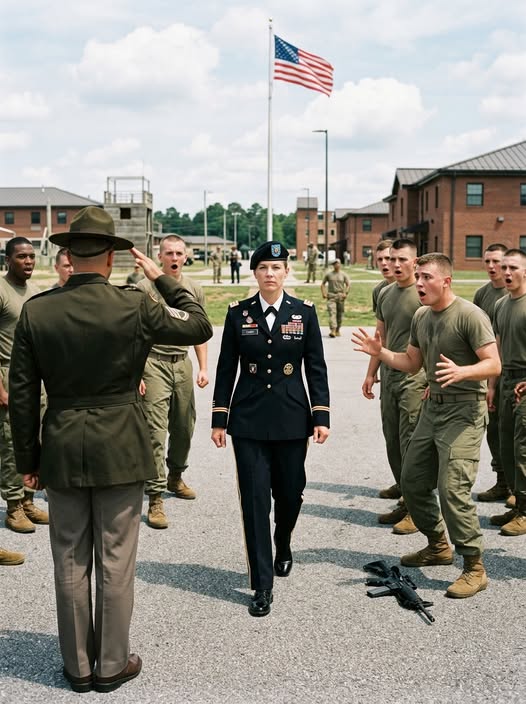
    Then he raised his hand in a perfect salute.

    “General.”

    He did not shout.

    He didn’t need to.

    The word crossed the field like lightning.

    A rifle clattered to the dirt.

    Noah’s.

    I stood, returned the salute, and said, “At ease, Sergeant.”

    “Yes, ma’am.”

    Whispers cracked through the formation. Noah stared at me as if a wall had opened into a door.

    I sat again and watched the rest of the drills without expression.

    Inside, something shifted.

    I had built my life around being underestimated. Around sealed records. Around my family’s belief that I had failed.

    Now my brother had seen a sergeant salute the sister he thought had quit.

    But that was not the worst part.

    The worst part was the man standing near the far fence in civilian clothes, pretending to check his phone, with one hand in his jacket pocket.

    I did not know his face.

    But I recognized the silver ring on his thumb.

    It belonged to a network that was supposed to be dead.

    Obsidian Cell.

    Part 3: The Device Wakes

    I left before the final whistle.

    Not quickly. Fear makes people rush. I moved like I had somewhere boring to be.

    The man by the fence did not follow at first.

    That bothered me.

    Professionals don’t chase. They wait to see what matters.

    At my car, the air smelled of rubber, dust, and something sharper.

    Ozone.

    Fresh electronics.

    I checked under the wheel well. Nothing obvious. No sloppy tracker. No wire.

    That made it worse.

    I slid in through the passenger side and started the engine. A tiny click sounded under the dash.

    Not a bomb.

    A listener.

    “You’re late,” I said to the empty car.

    Static hissed through the speakers.

    Then a distorted male voice said, “Still dramatic, Huxley.”

    My fingers stopped. No one had called me Huxley in years. Not Mara. Not General. Huxley. That was an old operational name, worn in countries where my passport had never existed. “Who is this?”

    A soft laugh.

    “Disappointed you don’t remember?”

    “I remember everyone who matters.”

    “Then remember what you stole.” The line died. Before I could move, someone knocked on the window.

    Noah stood outside in training gear, sweat darkening his collar. His eyes moved from my face to the dashboard to the badge on my jacket. “Open the door.” “No.”

    “What the hell was that?” “A salute.” “Don’t do that.” “Do what?” “Act like I’m stupid.”

    I rolled the window down two inches. “Go back to formation.” “They said you quit,” he said. “Dad said you couldn’t handle Westbridge. Mom said you needed help and refused it. I believed them.”

    “That was convenient for everyone.” He flinched. Then I saw the reflection in his belt buckle. A black SUV turning into the lot too slowly. “Get in,” I said. “You just told me—” “Noah.”

    He heard the difference and ran around the car. The rear window popped before his seat belt clicked. A neat hole opened in the glass. The sound came after. Suppressed.

    I drove hard toward the service road. The SUV followed. “What is happening?” Noah shouted. “Keep your head down.”

    I pulled a compact black case from under the seat. Inside was a small matte-gray device with a cracked corner and a dead screen. Noah’s face changed. Recognition.

    “You’ve seen this,” I said. He swallowed. Before he could lie, the device woke by itself. Four red words appeared: Shadow Protocol is active.

    Part 4: The Trap in Uniform

    We reached an old maintenance yard behind the warehouses. I crashed through a half-chained gate, braked behind a fuel shed, killed the engine, and pulled Noah out with me.

    We crouched behind concrete barriers.

    The SUV rolled past slowly.

    Two men stepped out. One had a shaved head. The other wore the cheap suit and silver thumb ring.

    Then a third man appeared behind us and pressed a pistol to Noah’s head.

    Everything inside me went quiet.

    “Come out,” he said.

    I stepped into view with my hands open.

    The ringed man smiled. “Huxley. Still collecting strays?”

    “Let him go.”

    “Give me the field unit.”

    “I don’t have it.”

    He tapped his phone.

    The device in my jacket pocket began to tone.

    Noah closed his eyes.

    Guilt.

    He knew enough now.

    The tracker I had hidden in his bag a year ago, disguised as a harmless fitness band, had been more than protection. It had been a key.

    Then a voice thundered across the yard.

    “Drop your weapons!”

    Sergeant Price stood twenty yards away with armed military police.

    For one second, hope flashed in Noah’s face.

    But the ringed man looked relieved.

    That was when I understood.

    The trap was not meant to make me run.

    It was meant to make me trust the uniform coming to rescue us.

    One of the MPs suddenly turned his rifle toward Price.

    I moved before the betrayal finished forming.

    Dust. Gunfire. Shouting. Concrete chips flying.

    I dragged Noah behind cover and sprinted toward my car. The ringed man was reaching for the field unit.

    We hit each other hard.

    He fought well. Too well.

    The unit skidded across the gravel.

    Its screen flashed:

    Transfer window: 00:54.

    Noah broke cover.

    “Noah, no!”

    He ran into open ground and grabbed it.

    A shooter lifted his weapon.

    Price fired first.

    Noah swung the device into the ringed man’s face. The man dropped to one knee, stunned. MPs moved in. The compromised soldier was cuffed.

    Then the field unit turned white.

    A calm female voice spoke from its speaker.

    “Authentication accepted. Hello, General Huxley.”

    Everyone stared at me.

    Then the device added:

    “Deadman archive preparing release.”

    My blood went cold.

    Because that archive only opened if someone inside my own command had marked me dead.

    Part 5: The Family Brought Into the Room

    They put us in a secure room with no windows, bad coffee, and a camera in the corner.

    Noah sat across from me with dried blood on his sleeve. Price stood by the door like a guard dog with rank. Colonel Iris Sloane from Joint Security arrived soon after, sharp-eyed and patient in the way dangerous people are patient.

    The field unit sat in a black evidence case between us.

    Noah stared at it.

    “I need you to explain.”

    “No,” I said. “You want me to.”

    “I almost got shot because of clearance.”

    “You almost got shot because you ran into open ground.”

    “You were trying to save everyone alone again.”

    That landed too close.

    The field unit glowed.

    Manual key required. Key holder: N. Ellison.

    Noah stopped breathing.

    “It means,” I said slowly, “someone found the part of my old file where I named you.”

    Years earlier, in a classified system, I had chosen Noah as my civilian anchor. Not Mom. Not Dad. Noah. The only person in my family I still trusted not to celebrate if I disappeared.

    Before I could explain further, Sloane’s phone rang.

    She listened, then looked at me.

    “Your parents are at the main gate. Someone told them Noah was involved in a classified breach and that you were impersonating an officer.”

    Obsidian didn’t just want the archive.

    They wanted pressure. Family panic. Sentimental mistakes.

    “Bring them in,” I said.

    When the door opened, my father, Victor Ellison, entered first. My mother, Ruth, followed behind him, pale and frightened.

    The first thing Dad saw was the field unit glowing between me and Noah.

    The second was Colonel Sloane standing beside me.

    The third made the color leave his face.

    Price saluted me again.

    Dad stared at that salute like it was designed to humiliate him.

    “What is going on?” he demanded.

    Sloane said, “You are civilians in a secure room. Follow instructions or leave.”

    Dad looked at me.

    “What did you do?”

    There it was.

    Not shock.

    Confirmation.

    He had been handed a story where I was the problem, and it fit too comfortably for him to resist.

    “You always believed the worst version of me,” I said.

    Before he could answer, the secure room door opened.

    A man in a dark suit entered.

    Silver hair. Perfect smile. Calm authority.

    Deputy Director Adrian Calder.

    My stomach sank.

    He looked at me warmly.

    Too warmly.

    “Mara Huxley,” he said. “After all this time.”

    Then he adjusted his cuff.

    There was no ring.

    But I saw the pale line on his thumb where one had recently been.

    And I understood.

    Obsidian had not infiltrated command.

    Obsidian had become command.

    Part 6: The Archive

    Calder claimed the device was federal property and that I was compromised.

    My father relaxed the moment he heard authority speak.

    Finally, someone official had arrived to confirm what he already wanted to believe.

    Calder turned to Noah.

    “Put your hand on the scanner.”

    “No,” I said.

    “This is not a request.”

    Dad stepped forward. “Noah, do what the man says.”

    I turned on him. “Do not.”

    “You don’t get to command him,” Dad snapped.

    The silence after that was brutal.

    Because in that room, I did.

    Noah looked between us. For once, he chose for himself.

    “No,” he said. “I’m done obeying people just because they sound certain.”

    Calder sighed.

    His two officers moved.

    Price moved faster.

    Chaos erupted. Sloane drew her weapon. I knocked one man down with a chair. But in the confusion, my father grabbed the field unit.

    The device scanned his thumb.

    Witness accepted.

    Alarms screamed through the base.

    Calder smiled.

    He had used my father’s panic as a key.

    Not to release the truth.

    To steal it.

    I grabbed the device and led everyone through the emergency dark into the laundry level, where old systems still had access points no modern officer cared about. I connected the unit to a hidden terminal and began stopping Calder’s reroute.

    Noah watched me work.

    “You really built an exit?”

    “I built several.”

    “Why?”

    “Because men like Calder think they are the only ones allowed to betray people.”

    The terminal flashed.

    Manual key required: N. Ellison.

    This time, the choice was truly Noah’s.

    Before he touched it, Calder’s voice came through the laundry door.

    “Noah, ask your sister what happened to Nadia.”

    The name struck like a blade.

    Nadia Reyes had been on my team during Operation Lantern Wake. We were sent to recover proof that Obsidian had collaborators inside allied command. The extraction route changed. Communications failed. We were surrounded.

    Nadia stayed behind so the archive could get out.

    For years, I believed my choice killed her.

    Now I knew Calder had moved the extraction point.

    Noah placed his palm on the scanner.

    Manual key accepted.

    Then another prompt appeared.

    Secondary witness required: V. Ellison.

    My father.

    Because he had touched the device. Because his need to prove control had made him part of the chain.

    “Put your hand on it,” I told him.

    Dad backed away.

    Then I saw it.

    Not confusion.

    Recognition.

    “Who called you this morning?” I asked.

    His face collapsed.

    Years earlier, after I left Westbridge, Calder had contacted him. Told him I was unstable. Told him that if I ever reached home, anything I sent should be reported for my own safety.

    I had sent one letter.

    Please don’t worry. I’m doing work that matters. Tell Noah I’m okay.

    Dad gave it to Calder.

    Mom knew. She stayed silent.

    Noah looked at them like he had never seen them before.

    “You helped keep her disappeared,” he said.

    The timer ran down.

    I dragged Dad’s hand to the scanner.

    This time, he did not fight.

    Secondary witness accepted.
    Public evidence release initiated.

    Files filled the screen: payment ledgers, altered orders, Calder’s signatures, protected names redacted, my father’s forwarded letter logged as civilian compliance.

    The family myth died without sound.

    Sloane’s phone exploded with alerts.

    “It’s out,” she said. “Oversight channels. Inspector General. Allied command. Press escrow.”

    The final prompt appeared.

    Archive owner confirmation required: M. Huxley.

    For years, I told myself I didn’t need the world to know I had not failed.

    Maybe I didn’t.

    But secrecy had kept monsters alive.

    I pressed my thumb to the screen.

    Confirmed.

    The lights came back on.

    Over the loudspeaker, a new voice said, “Deputy Director Calder, stand down. Federal arrest authority has been activated.”

    My father looked at me with awe.

    I looked away.

    It was too late to be wanted now.

    Part 7: The Legacy I Chose

    Calder tried to run.

    Men like him never believe consequences are real until they hear them wearing boots. They caught him in the vehicle bay trying to access a secure transport with stolen credentials.

    By noon, the base was full of black SUVs, federal badges, sealed laptops, and sweating officials saying things like procedural containment.

    The news did not get the full story.

    But it got enough.

    A senior intelligence official detained. A buried hostile network exposed. A classified operation reopened. General Mara Huxley cleared of wrongdoing after preventing a wider compromise.

    Preventing.

    Such a small word for the cost.

    They put me in a medical room because Price saw me touch my ribs and decided I was done arguing. A medic cleaned the cut on my forehead.

    Noah came in first.

    He stood awkwardly near the door in a plain gray T-shirt.

    “Can I sit?”

    I nodded.

    He sat and looked at his hands.

    “I read the letter,” he said. “The one you sent home.”

    My throat tightened.

    “You told them to tell me you were okay.”

    “I was optimistic.”

    “You weren’t okay.”

    “No.”

    He nodded slowly.

    “I’m sorry,” he said. “I believed them. I liked being the good kid. I didn’t ask harder questions because it was easier not to.”

    “That’s honest.”

    “It’s ugly.”

    “Most honest things are, at first.”

    He looked at me.

    “Do you forgive me?”

    I took my time.

    “I don’t know yet.”

    Pain crossed his face, but he did not argue.

    That mattered.

    “I want to earn whatever you’ll let me earn,” he said.

    “Start by becoming the kind of officer who never needs a lie to feel tall.”

    He nodded.

    My parents came after him.

    Dad’s eyes were red. Mom looked stripped of every dinner-party softness.

    “Mara,” Dad said. “I don’t expect you to forgive me today.”

    “No,” I said. “You don’t get to expect anything.”

    Mom whispered, “We love you.”

    The sentence arrived late and weak.

    I thought of the flickering porch light. The missing chair. The years of silence. My letter in Calder’s files. My name turned into a family warning while they ate around the place I should have occupied.

    “No,” I said quietly. “You loved a version of family where you never had to question yourselves.”

    Dad asked, “Can we fix this?”

    “No.”

    The word came from peace, not anger.

    “You can tell the truth when people ask. You can stop calling neglect confusion. You can stop using concern as a costume for cowardice. But you don’t get me back because the world finally proved I mattered.”

    Mom cried.

    “I survived without your belief,” I said. “I will not rebuild my life around earning it.”

    Two days later, I stood on the runway with one bag and sealed orders.

    The morning was clear. A transport plane waited with its ramp down. I wore no medals. No dress uniform. Just field black, practical boots, and a small compass pin tucked inside my jacket.

    Noah came alone.

    “They wanted to come,” he said.

    “I know.”

    “I told them not to.”

    I looked at him.

    He shrugged. “Figured I should practice not obeying the loudest person in the room.”

    That almost made me smile.

    He stood straight and saluted.

    Not because of rank.

    Because of respect.

    I returned it.

    Then I hugged him.

    Quick. Solid. Real.

    When I pulled back, his eyes were wet.

    “You coming back?” he asked.

    “Eventually.”

    “To them?”

    I looked toward the horizon.

    “No,” I said. “To myself.”

    Before boarding, I slipped an envelope into his bag. Inside was a copy of my first letter and a new note.

    Honor is not what people applaud. It is what remains when applause would cost someone else their life. Be better than the room that raised us.

    At the top of the ramp, I turned once.

    Noah stood on the tarmac with one hand resting on his bag.

    No banner.

    No crystal glasses.

    No porch light deciding whether I deserved to be seen.

    Just my brother, watching me leave without calling it failure.

    THE END!

  • “Please, Mommy. Don’t make me go with Dad,” my seven-year-old whispered as her father’s black police SUV waited outside, honking like an order. My ex-husband, the Deputy Chief of Police, had already warned me: if I questioned the fingerprint-shaped bruise she got in his mother’s “therapy room,” he would have me arrested. They had the badge. The money. The connections. They thought I was just a frightened ex-wife with no way to fight back. But the next move I made brought their untouchable little empire crashing down…

    “Please, Mommy. Don’t make me go with Dad,” my seven-year-old whispered as her father’s black police SUV waited outside, honking like an order. My ex-husband, the Deputy Chief of Police, had already warned me: if I questioned the fingerprint-shaped bruise she got in his mother’s “therapy room,” he would have me arrested. They had the badge. The money. The connections. They thought I was just a frightened ex-wife with no way to fight back. But the next move I made brought their untouchable little empire crashing down…

    “Please, Mommy. Don’t make me go with Dad,” my seven-year-old whispered as her father’s black police SUV waited outside, honking like an order. My ex-husband, the Deputy Chief of Police, had already warned me: if I questioned the fingerprint-shaped bruise she got in his mother’s “therapy room,” he would have me arrested. They had the badge. The money. The connections. They thought I was just a frightened ex-wife with no way to fight back. But the next move I made brought their untouchable little empire crashing down…

    Part 1: The Bruise on Her Arm

    I noticed the first bruise on a quiet Tuesday morning.

    The house was still, except for the refrigerator humming and the early spring wind tapping against the kitchen windows. It was a small mark above my daughter’s left elbow, already yellowing around the edges.

    It did not look like the messy scrape of a playground fall.

    It looked like a fingerprint.

    My daughter, Lily, was seven years old. She had skinny legs, missing front teeth, and the kind of bright, curious eyes that used to make the world seem kinder than it was. But recently, that light had begun to fade. She had grown cautious. Watchful. Too careful for a child.

    That morning, she stood at the kitchen island, trying to pour cereal into a bowl without looking at me. Her shoulders were hunched, as if she were protecting herself from something I could not see.

    “Sweetheart,” I said gently, “what happened to your arm?”

    Her whole body froze.

    Children are not supposed to freeze like that. Children wiggle. They hum. They ask whether dogs know their own birthdays before breakfast.

    Lily used to do all of that.

    “I fell,” she whispered.

    I set down my coffee.

    “Where did you fall?”

    “At Grandma’s.”

    My hand tightened around the edge of the counter.

    Grandma meant Dr. Vivian Cross, my ex-husband’s mother.

    Vivian was not the warm-cookie kind of grandmother. She was a respected child psychologist with books, awards, conference speeches, and framed degrees that impressed everyone who entered her office.

    And my ex-husband, Daniel Cross, was not just any father with visitation rights.

    He was the Deputy Chief of Police in our Ohio county.

    Together, Daniel and Vivian were untouchable.

    In court, he looked like authority. She looked like expertise. I looked like an anxious ex-wife who worried too much.

    That was why Lily had to go to their house every other weekend.

    “You fell where at Grandma’s?” I asked.

    “In the therapy room,” Lily mumbled, staring into her cereal.

    I waited until I dropped her off at school before calling Daniel.

    He answered with police radio noise in the background.

    “Rebecca,” he sighed. “What now?”

    “What is happening to Lily at your mother’s house? She came home with a bruise shaped like an adult’s grip.”

    Daniel gave a dry, patronizing laugh.

    “Mom already told me you’d overreact. Lily has spatial-awareness issues. It’s a documented developmental phase. Mom is working with her on structured discipline.”

    “Structured discipline should not leave bruises.”

    “And you have a medical degree now?” he snapped. “My mother is a nationally respected child psychologist. Stop turning normal clumsiness into some bitter custody fantasy.”

    “I know what a grab mark looks like.”

    His voice dropped.

    “Listen carefully. If you make baseless accusations, I’ll have social services at your door today. I know the director. I know the judges. Do not test me, Rebecca. You will lose.”

    He hung up.

    I sat in my minivan, gripping the steering wheel until my hands hurt.

    Daniel had the badge. Vivian had the credentials. Between them, they owned every system that was supposed to protect my daughter.

    All I had was instinct.

    And every part of me knew Lily was in danger.

    Part 2: “Please Don’t Make Me Go”

    By Friday evening, the air in my house felt thick enough to choke on.

    It was Daniel’s weekend.

    Lily was supposed to go back to Vivian’s estate.

    At 5:42 p.m., Daniel’s black county-issued SUV pulled to the curb. Vivian was driving. Daniel sat in the passenger seat in his tactical uniform, his badge catching the fading light.

    Inside the house, Lily stood frozen in the hallway, clutching her pink backpack straps so tightly her knuckles turned pale.

    “You ready, pumpkin?” I asked softly.

    Her face crumpled.

    “My tummy hurts,” she whispered. “Please, Mommy. Please don’t make me go.”

    Something inside me snapped.

    Not loudly.

    Completely.

    For years, I had tried to be reasonable. Tried to keep peace. Tried not to anger a family that used power like a weapon.

    Not anymore.

    “Okay,” I said. “Take off your backpack. You’re staying home.”

    The SUV honked twice.

    Sharp. Commanding.

    I opened the front door and stepped onto the porch alone.

    Vivian rolled down the window. She wore pearls and a cream cardigan, the picture of calm authority.

    “Where is she, Rebecca?” Vivian asked. “We have a behavioral mapping session scheduled. I need to establish her baseline.”

    “She’s sick,” I said. “She’s not going.”

    Daniel got out of the SUV. His hand rested casually on his duty belt near his firearm and radio.

    “Do not do this,” he warned. “You are violating a court order. I can have a patrol car here in two minutes. Do you want Lily to watch her mother get arrested?”

    “She’s throwing up,” I lied, looking him straight in the eye. “If you want to drag a sick, crying seven-year-old out of bed with armed deputies, call them. I’ll record the whole thing and send it to every news station before you reach the precinct.”

    Daniel’s jaw tightened.

    Vivian placed a manicured hand on his arm.

    “Let it go,” she said smoothly. “Rebecca is displaying maternal gatekeeping. We’ll document this non-compliance for court on Monday.”

    Then she looked at me with cold blue eyes.

    “You’re damaging your child, Rebecca. You will regret this when the judge removes custody.”

    “Goodnight, Vivian.”

    I stepped inside and locked the door.

    My legs were shaking, but I had won the night.

    Upstairs, Lily was curled between her bed and the wall, shaking hard. She clutched her stuffed bear like a shield.

    “Are the police coming?” she whispered. “Dad said if I’m bad, he can use handcuffs on me. He said he has special locks for bad kids.”

    My blood went cold.

    I sat on the floor, lower than her, making sure she did not feel trapped.

    “Nobody is coming into this house,” I said. “I’m your mother. My job is to protect you. But you have to tell me what happens at Grandma’s house.”

    At first, she only cried.

    Then the story came out in broken pieces.

    The “therapy room” was not a room with toys or books. It was a dark, soundproofed storage closet in Vivian’s basement. Vivian called it “sensory isolation.” She said Lily needed it when she cried, spoke too much, ate too slowly, or asked for me.

    “She says my tears are manipulative,” Lily whispered. “She says I have to stay in the dark until I’m compliant.”

    My stomach turned.

    “Does your dad know?”

    Lily nodded.

    “He opened the door once when I was crying. He told me to stop disrespecting Grandma’s methods. He said nobody would believe me because Grandma is a famous doctor and he is the police.”

    I held my daughter while she cried herself to sleep.

    Anger was not the right word for what I felt.

    Anger is hot.

    This was ice.

    I could not call local police. Daniel controlled them. I could not call local social services. Vivian advised their trauma board. If I reported it inside our county, they would bury it, label me unstable, and take Lily from me by Monday.

    I needed a bigger system.

    At 8:00 p.m., I locked myself in the bathroom and called my best friend, Nora, an ER trauma nurse two towns away.

    “I need help,” I whispered. “Turn off your location tracking. Don’t tell anyone where we’re going.”

    Nora did not ask questions.

    “I’m leaving now. Pack a bag.”

    I packed Lily’s clothes, her birth certificate, my passport, and every important document I could find.

    When Nora arrived, we bundled Lily into the backseat and drove fifty miles, crossing two county lines to the State Medical Center in Columbus.

    At the ER triage desk, I said clearly, “I am fleeing a high-ranking law enforcement officer in my county. My child has been abused, and the local authorities are compromised.”

    Everything changed.

    They did not send us to the waiting room. They moved us to a secure trauma room. A doctor documented Lily’s bruising. A social worker brought juice and coloring pages.

    Most importantly, the hospital did not call my county.

    They called the State Bureau of Investigation.

    Investigator Dana Reed arrived at 2:00 a.m. She wore a tailored blazer and had eyes that missed nothing.

    “My ex-husband is Deputy Chief Daniel Cross,” I told her. “His mother is Dr. Vivian Cross. If this goes back to my county, they will bury it.”

    Reed did not flinch.

    She took my statement, reviewed the medical photos, and looked at Lily sleeping on the hospital cot.

    “This is out of their jurisdiction now,” she said. “They don’t own the state of Ohio. You did the right thing. Tonight, she is safe.”

    By dawn, Daniel had called forty-seven times.

    I had started a war.

    But for the first time, I was not fighting alone.

    Part 3: The State Steps In

    The next seventy-two hours blurred together.

    Emergency protective orders. Medical reports. Statements. Fear.

    Investigator Reed moved fast. Because of the medical evidence and the conflict of interest, the state ordered Daniel to surrender his badge, service weapon, and county vehicle. His police powers were suspended pending investigation.

    Stripped of immediate control, Daniel attacked in the way he knew best.

    Through court.

    He filed for emergency full custody, claiming I was unstable and dangerous. Vivian supported him with pages of clinical language, suggesting I had fabricated Lily’s injuries to alienate her from her father.

    My lawyer, Helena Ward, read the filing across her desk and shook her head.

    “He’s using his badge and her doctorate to paint you as insane,” she said. “Classic DARVO. Deny, attack, reverse victim and offender.”

    Helena was a fierce family attorney with a mind like sharpened steel.

    “These people believe they’re untouchable,” she continued. “Arrogance always leaves a trail. We just have to find it.”

    The first hearing was a nightmare.

    Daniel wore his formal police uniform, trying to look like a heroic father wronged by a bitter ex-wife. Vivian sat behind him in pearls, taking notes and occasionally looking at me with clinical pity.

    His attorney argued that Daniel was a respected law enforcement officer, Vivian a renowned expert, and I was an unstable mother making dangerous accusations.

    Then Helena stood.

    “My client did not flee from a loving family,” she said calmly. “She fled from a police badge and a medical title being used as weapons against a child. We request immediate suspension of visitation while the State Bureau of Investigation executes forensic subpoenas.”

    The judge, clearly unsettled by the state’s involvement, granted the suspension.

    Daniel stared at the bench in disbelief.

    For the first time, his badge had not opened the door.

    The investigation moved slowly, but it moved.

    Weeks passed. Lily began trauma therapy. I slept badly, checked locks constantly, and carried fear everywhere.

    Then, two months later, Investigator Reed and Helena called me into the law office.

    Helena slid a thick folder across the table.

    “Daniel and Vivian thought they were too smart to be caught,” she said. “Daniel wiped his phone before turning it in. But he forgot cloud backups.”

    I opened the file.

    There were recovered text messages.

    Vivian: She cried for two hours today. Refused dinner. I had to use the isolation room again. Your ex has made her emotionally fragile.

    Daniel: Just handle it, Mom. I can’t deal with Rebecca’s drama this week.

    Vivian: I had to use physical restraint to get her into the closet. Rebecca may notice the bruises.

    Daniel: You know CPS protocols here better than anyone. Don’t leave marks she can photograph next time. If she reports it, I control dispatch. I’ll bury it.

    My hands went numb.

    Another exchange was from the night I refused visitation.

    Daniel: Rebecca locked us out. I think she knows about the closet.

    Vivian: Let her panic. I’ll draft a psychiatric evaluation stating she is having a paranoid episode. With my clinical signature and your rank, the judge will grant emergency custody. We can have Rebecca institutionalized if necessary.

    I pushed the papers away and ran to the trash can.

    The calculated cruelty was too much.

    Investigator Reed rested a hand gently on my back.

    “We have them,” she said. “Conspiracy, physical abuse, obstruction, misuse of office. It’s over.”

    Three weeks later, the story broke across local news.

    Deputy Police Chief Arrested by State Troopers; Prominent Child Psychologist Indicted on Child Abuse Charges.

    The town was stunned.

    People who had praised Vivian for years were horrified. People who respected Daniel’s authority suddenly saw the monster behind the uniform.

    In criminal court, the recovered texts and medical evidence were impossible to explain away.

    Vivian lost her license and was sentenced to prison for child endangerment, assault, and unlawful restraint.

    Daniel lost his badge, pension, and freedom. He was sentenced for conspiracy, obstruction of justice, and child endangerment.

    At the final family court hearing, Judge Morgan looked down at Daniel. He no longer wore a uniform. He wore an orange jumpsuit, wrists chained.

    “You used the shield meant to protect the public to terrorize your own daughter,” the judge said. “And Dr. Cross weaponized the science meant to heal children.”

    Then she granted me sole legal and physical custody.

    Daniel’s parental rights were permanently terminated.

    The gavel fell.

    The nightmare was legally dead.

    Part 4: Never in the Dark Again

    Trauma does not disappear when a judge speaks.

    A gavel cannot erase nightmares. It cannot make a child stop checking closets. It cannot return the years stolen by fear.

    Healing came slowly.

    The following spring, almost one year after we fled in the middle of the night, Lily and I planted a garden in our backyard.

    I was terrible with plants. I could kill a succulent in a week. But Lily had decided we needed tomatoes.

    “They need safe dirt,” she told me, holding the seed packet with serious hands.

    So we dug small holes near the fence.

    The spring air smelled of wet earth, grass, and new beginnings. Lily wore bright purple gardening gloves two sizes too big. She was eight now, and slowly, beautifully, the light was returning to her eyes.

    She had weekly therapy with a real, kind psychologist who let her draw, play on the floor, and sit beside a sleepy golden retriever named Max.

    “Do tomatoes need sun?” Lily asked, patting soil around a seedling.

    “Yes.”

    “Water?”

    “Lots.”

    “Do they like being yelled at?”

    I smiled gently.

    “No. Not at all.”

    “Good,” she said. “We won’t yell at them. And we won’t put them in the dark.”

    I stopped digging.

    My heart ached with love.

    “Never in the dark,” I promised. “Never again.”

    Lily looked up with dirt smudged across her nose.

    “Mom?”

    “Yeah, sweetheart?”

    “When I grow up, I don’t want to be a doctor anymore. I want to be a state police lady. Like Investigator Reed.”

    I smiled through tears.

    “You would be amazing at that.”

    “I’ll believe kids fast,” she said firmly. “Even if the bad people wear uniforms or have fancy degrees.”

    Two years earlier, I had almost allowed a badge and a doctorate to convince me I was imagining things.

    I had almost let their authority drown out my instinct.

    But watching Lily water the tomatoes in the afternoon sun, I understood the deepest truth of my life.

    Evil often dresses itself as authority.

    It hides behind titles, uniforms, diplomas, and influence.

    But a mother’s instinct—the fierce, undeniable need to protect her child from darkness—is stronger than all of it.

    Our life was not perfect. Lily still slept with her closet door open and a nightlight glowing. Some days were difficult.

    But the house was ours.

    The garden was growing.

    And the monsters who had tried to trap my daughter in the dark were finally locked inside cages of their own making.

  • On my seventy-first birthday, my granddaughter stood at the head of my table and announced, “Starting Monday, I’m taking over the company.” When I told her to apologize, she slapped me so hard my lip split. “You should have died years ago,” she hissed. Twenty-three guests watched in silence. But upstairs, hidden in a cedar box, was the one clause she never knew existed…

    On my seventy-first birthday, my granddaughter stood at the head of my table and announced, “Starting Monday, I’m taking over the company.” When I told her to apologize, she slapped me so hard my lip split. “You should have died years ago,” she hissed. Twenty-three guests watched in silence. But upstairs, hidden in a cedar box, was the one clause she never knew existed…

    On my seventy-first birthday, my granddaughter stood at the head of my table and announced, “Starting Monday, I’m taking over the company.” When I told her to apologize, she slapped me so hard my lip split. “You should have died years ago,” she hissed. Twenty-three guests watched in silence. But upstairs, hidden in a cedar box, was the one clause she never knew existed…

    Part 1: The Slap at My Own Table

    “You’re blocking everything, Grandma. You should have died years ago.”

    That was what my granddaughter, Natalie, shouted at me in front of twenty-three guests.

    Seconds later, her hand struck my face so hard my lip split against my teeth.

    I stumbled backward into the mahogany sideboard. My glasses fell and cracked beneath my foot. The ivory blouse I had chosen for my seventy-first birthday began to stain red at the collar.

    And the room froze.

    No one moved.

    Not Natalie’s husband.

    Not his parents.

    Not the elegant investors she had invited to impress.

    Not the women who drank champagne from crystal glasses paid for by my money.

    They simply stared.

    My name is Beatrice Alden, though most people in Pasadena call me Mrs. Alden. For forty years, I built Alden House Books from a rented office with two desks into one of the most respected independent publishing houses on the West Coast.

    My only daughter, Clara, died of cancer at thirty-nine.

    She left behind an eight-year-old girl with braids, a pink schoolbag, and a stuffed bunny she could not sleep without.

    That little girl was Natalie.

    From that day on, I became her grandmother, mother, father, home, shield, and future.

    I paid for her school. Her piano lessons. Her summer camps. Her college tuition. Her graduate program in London. Her Napa wedding. The down payment on her Pacific Palisades home.

    When she wanted to start a literary agency, I gave her seed money.

    When she said she wanted to “modernize” my publishing company, I made her vice president.

    When she cried that no one took her seriously because she was “just the granddaughter,” I gave her a chair at the table I had spent decades building.

    And on my birthday, she tried to take the head of that table.

    The dinner was in my Pasadena home, the same craftsman house where Natalie learned to ride her bike, where Clara used to sit on the porch eating peaches in summer, where every bookshelf still carried my daughter’s ghost.

    I had ordered salmon, prime rib, mushroom risotto, green beans, and a vanilla cake with raspberry filling.

    I wore pearls.

    I put on lipstick.

    I let myself believe that maybe, tonight, Natalie would remember I was not an obstacle.

    Maybe she would remember I was family.

    But Natalie arrived forty minutes late in a gold dress, a diamond bracelet glittering on her wrist—the one I gave her when she turned thirty. She did not hug me. She did not say happy birthday.

    Then she moved my place card.

    I was supposed to sit at the head of the table.

    Natalie sat there instead.

    She placed me near the kitchen.

    I said nothing, because I had spent a lifetime making peace out of broken things.

    Halfway through dinner, Natalie stood and raised her glass.

    “Graham and I have decided Alden House needs new leadership,” she announced. “Starting Monday, I’ll step in as CEO. Grandma did what she could, but she doesn’t understand publishing anymore.”

    My fork paused over my plate.

    “Natalie,” I said quietly, “this is not the time.”

    Her smile sharpened.

    “Actually, it is. Everyone here knows it. They’re just too polite to say it. You’re tired, outdated, and hurting the company by refusing to step aside.”

    I stood slowly.

    “You will apologize.”

    Her face changed.

    For one second, I saw the same fury she had shown at fifteen when I told her no for the first time.

    “As long as you’re alive,” she hissed, “I will never be anybody.”

    Then she slapped me.

    When I fell, I heard one gasp. Maybe from the caterer. Maybe from my neighbor, Mrs. Bell.

    But the people seated at my table did nothing.

    Natalie stared down at me, breathing hard.

    For a terrifying moment, she looked like a stranger wearing my granddaughter’s face.

    And lying there with blood in my mouth, I finally understood something worse than pain.

    The child I raised was gone.

    Or perhaps she had been gone for years, and I had been loving a memory.

    Part 2: The Cedar Box

    I did not cry in front of them.

    I pressed my palm to the floor, ignoring the broken glass beneath my hand, and pushed myself up.

    My knees shook.

    But they held.

    Graham, Natalie’s husband, finally stood.

    “Beatrice, maybe you should sit down.”

    He had never called me Grandma. Never Mrs. Alden. Always Beatrice, as if respect would cost him something.

    “I am standing,” I said.

    My voice was soft, but the room grew colder.

    Natalie gave a bitter laugh.

    “Oh, please. Don’t make this dramatic.”

    I touched my split lip.

    The blood came away bright red.

    “Dramatic,” I repeated.

    Then I looked around the dining room.

    Some guests stared at their phones. Some looked down. Some examined their wine glasses as if courage might be floating in the Merlot.

    I understood them all.

    They had come to watch the old queen fall.

    They just had not expected the sound to be so human.

    Without another word, I walked out of the dining room.

    Behind me, Natalie called, “Grandma, stop being ridiculous.”

    I kept walking.

    Up the stairs.

    Past the framed photo of Clara holding baby Natalie.

    Past the hallway where Natalie once taped crayon drawings to the wall.

    Into my bedroom.

    I closed the door.

    Locked it.

    Then I sat on the edge of my bed and let the first tear fall.

    Not because my face hurt.

    Because thirty seconds earlier, my granddaughter had told me the truth.

    She did not want my blessing.

    She wanted my absence.

    My phone buzzed.

    A text from Natalie.

    Stop embarrassing me. Come downstairs and say you slipped.

    Then another.

    Do not ruin this for me.

    Then one from Graham.

    Beatrice, let’s keep this private. Big emotions tonight. We can all calm down.

    I almost laughed.

    Big emotions.

    That was what men like Graham called violence when the violent person was useful to them.

    I set the phone down and went to my closet.

    On the top shelf sat a cedar box I had not opened in years. Inside were old contracts, trust papers, my daughter’s last letter, and documents my attorney had told me never to misplace.

    The key was in my jewelry drawer, beneath Clara’s pearl earrings.

    When I opened the box, the scent of cedar rose like memory.

    Inside were layers of my life.

    The deed to the Pasadena house.

    The original incorporation papers for Alden House Books.

    Clara’s birth certificate.

    Natalie’s guardianship documents.

    My will.

    My living trust.

    My late husband Henry’s fountain pen.

    And at the bottom, in a navy folder marked in my attorney’s handwriting, were the papers I had forgotten because love made me careless.

    Alden Family Trust — Contingency Control Clause.

    I sat down slowly.

    My attorney, Miriam Clarke, had insisted on it ten years ago when Natalie first joined the company.

    “She is ambitious,” Miriam had warned. “That can be beautiful. It can also be dangerous. Protect yourself.”

    I had waved her off.

    “She’s my granddaughter.”

    Miriam had looked at me over her glasses.

    “That is exactly why you need protection.”

    Now, with blood drying at my mouth, I opened the folder.

    The clause was still there.

    Signed.

    Notarized.

    Irrevocable unless amended by me.

    It stated that Natalie’s position, shares, executive authority, company access, agency funding, and future inheritance depended on the trust protector’s determination that she had not engaged in abuse, coercion, fraud, exploitation, or intentional harm toward me.

    The trust protector was not Natalie.

    Not Graham.

    Not anyone who could be charmed over dinner.

    It was Miriam Clarke.

    And if Miriam determined Natalie had violated the clause, all conditional benefits could be suspended immediately.

    No board vote required.

    No family permission required.

    No court order required to begin.

    My breath caught.

    For years, Natalie had believed everything was already hers because I let her move through my life like an heir.

    But it was not hers.

    Not legally.

    Not completely.

    And tonight, in front of twenty-three witnesses, she had done the one thing that could activate the clause.

    My phone buzzed again.

    This time from my company’s CFO, Adrian Wells.

    Mrs. Alden, sorry to text so late. Natalie sent instructions tonight for executive account transfers effective Monday. I wasn’t aware of a leadership change. Should I process anything?

    My body went still.

    Account transfers.

    Tonight.

    Before the dinner was even over.

    I typed with trembling fingers.

    Process nothing. Freeze all non-routine transfers. Call Miriam Clarke first thing in the morning. Confidential.

    Adrian replied immediately.

    Understood. Are you safe?

    That question broke something inside me.

    Are you safe?

    Nobody downstairs had asked that.

    Not my granddaughter.

    Not her husband.

    Not the guests.

    My CFO had shown more concern for me than the child I raised.

    I answered.

    I will be.

    Part 3: The Clause Wakes Up

    At 12:17 a.m., I called Miriam.

    She answered on the fourth ring, her voice thick with sleep but instantly alert when she heard mine.

    “Beatrice?”

    “I need you.”

    “What happened?”

    I tried to stay calm, but when I said, “Natalie hit me,” my voice cracked.

    Miriam did not waste time.

    “Are you injured?”

    “My lip is split. My glasses broke. There were witnesses.”

    “Photograph everything. Do not wash the blouse. Do not clean any blood. Do not respond to Natalie except to say you need space.”

    “She announced she was taking over the company.”

    “Did you authorize that?”

    “No.”

    “Did the board?”

    “No.”

    “Did she attempt transfers?”

    “Yes. Adrian caught it.”

    A pause.

    Then Miriam’s voice turned cold.

    “The contingency clause may now be active.”

    “I know.”

    “Are you prepared for what that means?”

    I looked toward the bedroom door.

    Downstairs, Natalie’s voice rose again, angry and embarrassed.

    I thought of the little girl with braids.

    The teenager who cried in my lap after her first heartbreak.

    The young woman who wore Clara’s veil at her wedding.

    Then I thought of her hand across my face.

    You should have died years ago.

    “Yes,” I said. “I am prepared.”

    At 1:05 a.m., I took photographs.

    My lip.

    My broken glasses.

    The blood on my blouse.

    The sideboard where my shoulder struck the corner.

    The place cards left on the dining room table after everyone finally left.

    My original card at the head of the table had been scratched out in Natalie’s handwriting.

    A new card had been placed near the kitchen door.

    Beatrice.

    Not Grandma.

    Not Mrs. Alden.

    Beatrice.

    A small paper demotion.

    At 1:42 a.m., I found the second secret.

    In my company email was a draft resolution prepared by Graham’s attorney.

    Resolution to Remove Beatrice Alden as Active Chair Due to Cognitive Decline.

    Cognitive decline.

    I read the phrase twice.

    The document claimed I had increasing confusion, emotional instability, and difficulty managing corporate matters. It recommended appointing Natalie as interim CEO and Graham as strategic advisor with signing authority over expansion funds.

    Expansion funds.

    Twenty-two million dollars in emergency reserves.

    Money meant to protect authors, staff salaries, printing contracts, and the future of Alden House Books after I was gone.

    At the bottom was a list of proposed supporting statements from “concerned family and colleagues.”

    Several dinner guests were named.

    They had not come to celebrate me.

    They had come to observe me.

    To provoke me.

    To witness my reaction.

    Tonight had not only been humiliation.

    It had been evidence gathering.

    Natalie wanted me emotional.

    Shaking.

    Unstable.

    The slap had not been the plan.

    But the trap had been.

    For one minute, I could not move.

    Then I began to laugh softly.

    Not with joy.

    With grief.

    Natalie thought cruelty made me weak.

    She forgot cruelty also clarifies.

    By sunrise, Miriam was at my kitchen table.

    So was Adrian, pale and furious.

    Mrs. Bell sat beside me with untouched tea. She had seen the slap, heard Natalie’s speech, and she was willing to say so.

    Miriam spread the documents across the table.

    Photographs.

    Emails.

    The draft resolution.

    The attempted account transfers.

    Screenshots of Natalie’s texts.

    Medical photos of my injury.

    The trust clause.

    “This is worse than I expected,” Miriam said.

    Adrian looked sick.

    “She tried to schedule reserve transfers for Monday. Three accounts. Different entities.”

    “Controlled by whom?” Miriam asked.

    Adrian hesitated.

    “Graham.”

    The room went silent.

    So that was the shape of it.

    Natalie wanted the title.

    Graham wanted the money.

    And I was the old woman standing between them and everything they had already spent in their minds.

    By nine o’clock, Natalie’s company email was locked.

    By nine fifteen, her agency funding was frozen.

    By nine thirty, her corporate cards were canceled.

    By ten, the board was notified that any leadership transition was fraudulent and unauthorized.

    By ten twenty-two, Natalie called me thirty-seven times.

    I did not answer.

    At eleven, she came to my front door.

    I watched from upstairs as she stormed up the walkway in sunglasses, hair perfect, mouth tight with rage.

    Graham followed behind her.

    Miriam stood beside me.

    “Do you want to speak with them?”

    “No.”

    “Good.”

    Mrs. Bell had already called a security company.

    Adrian had already arranged a forensic audit.

    Miriam had already prepared the letter that would change Natalie’s life before lunch.

    The doorbell rang.

    Then Natalie pounded on the door.

    “Grandma! Open the door!”

    I flinched.

    Grandma.

    Now she remembered.

    Miriam opened the door with the chain still latched.

    “Your conditional trust benefits are suspended,” she told Natalie. “Your executive access is revoked pending investigation. Your agency funding is frozen. You are barred from entering company offices without written authorization.”

    Silence.

    Then Natalie said, smaller now, “You can’t do that.”

    “She can,” Miriam replied. “And she did.”

    Graham snatched the papers.

    Then his voice changed.

    “Natalie…”

    “What?”

    “This includes the Palisades house.”

    Yes.

    The house.

    The down payment had come from the trust, structured as conditional support, not a gift. Miriam had insisted.

    I had resisted.

    Now her foresight felt like a hand pulling me out of a grave.

    “You are not to sell, refinance, transfer, borrow against, or encumber the property,” Miriam said.

    Graham cursed under his breath.

    That was when I understood.

    They had already tried.

    I stepped away from the banister.

    Not because I was afraid.

    Because I no longer needed to stand at doors waiting for people to choose decency.

    They had chosen.

    Now I would choose too.

    Part 4: The Boardroom Reckoning

    The first week was brutal.

    Natalie flooded the family with messages saying I was unstable. Graham told investors I was having “an episode.”

    Several dinner guests suddenly claimed they had not seen the slap clearly.

    One said I tripped.

    Another said I had been aggressive first.

    But Mrs. Bell told the truth.

    So did the caterer.

    So did a young agency intern Natalie had invited to make herself look important.

    Then Adrian found the records.

    Three months of emails between Natalie, Graham, and a consultant who specialized in “succession narratives” for family businesses.

    Succession narrative.

    That was what they called my erasure.

    The emails discussed making me appear emotionally erratic. Encouraging me to make a scene in front of credible witnesses. Using my age, grief, and occasional forgetfulness as leverage.

    One email from Graham made my blood turn cold.

    The old woman won’t step down unless she is cornered. Natalie needs to stop thinking of her as Grandma and start thinking of her as the asset blocker.

    Asset blocker.

    Not mother.

    Not elder.

    Not woman.

    Not human.

    I printed that email and placed it in the cedar box beside the trust clause.

    Some truths are too ugly to leave floating on a screen.

    Two weeks later, the board meeting was held.

    I attended in a navy suit, new glasses, and Clara’s pearl earrings. My lip had mostly healed.

    Natalie was there with Graham.

    She looked thinner. Angrier. Desperate.

    For the first time in her life, she faced a room she could not charm, because I owned the room’s foundation.

    Miriam presented the clause.

    Adrian presented the attempted transfers.

    A forensic accountant presented the agency irregularities.

    Money had been routed from Natalie’s literary agency into Graham’s consulting firm. Personal expenses were marked as client development. Travel was charged to publishing accounts. A “marketing retreat” in Aspen was actually a luxury anniversary trip.

    The total was $1.8 million over eighteen months.

    I did not look at Natalie when the number appeared.

    I looked at the board members.

    Some looked ashamed.

    Some looked afraid.

    A few looked calculating.

    Power reveals character because it forces people to choose quickly.

    Natalie stood before the vote.

    Her voice trembled beautifully.

    She had always known how to perform pain.

    “I made mistakes,” she said. “But everything I did was because I love this company. My grandmother is not well. Everyone knows it, but everyone is afraid to say it.”

    Then she turned to me.

    “Grandma, I love you. But you are confused. You are hurting everyone because you cannot let go.”

    For one second, my heart reached for the old rhythm.

    Protect her.

    Comfort her.

    End the tension.

    Then Miriam placed Graham’s email on the screen.

    Asset blocker.

    The room went still.

    Natalie’s tears stopped.

    Graham’s face went gray.

    I stood.

    “I raised Natalie after my daughter died,” I said. “I gave her every advantage I could afford, and many I could not afford emotionally. I mistook ambition for purpose. I mistook entitlement for confidence. I mistook dependence for love.”

    Natalie looked down.

    “On my seventy-first birthday, she told me I should have died years ago and struck me hard enough to split my lip. That broke my heart. But what broke something deeper was learning the slap was only the loudest part of a quieter plan.”

    I looked at Graham.

    “A plan to make me look unstable.”

    Then at Natalie.

    “A plan to take what I built.”

    Then at the board.

    “And some of you were willing to watch.”

    Nobody spoke.

    Good.

    Silence can be useful when it finally belongs to the guilty.

    The vote was unanimous.

    Natalie was removed from every position.

    Graham was barred from company matters.

    The agency funding was terminated.

    The forensic audit continued.

    The trust suspension remained active.

    For the first time in her adult life, Natalie left a room without getting what she wanted.

    She did not look back.

    Part 5: The Chair That Belonged to Me

    Three months passed.

    The Palisades house went on the market under legal supervision. Not because I wanted Natalie homeless, but because the structure was never hers to exploit.

    Natalie and Graham moved into a luxury apartment they could barely afford, then a smaller one after Graham’s investors backed away.

    Scandal has a smell.

    People who once loved their parties stopped answering their calls.

    Graham filed for separation before winter.

    I was not surprised.

    Men like Graham do not marry women like Natalie for love. They marry proximity to wealth and call it partnership.

    When the proximity disappears, so does devotion.

    Natalie sent letters.

    The first was angry.

    The second sounded like a lawyer.

    The third blamed me.

    I did not answer.

    Near Christmas, a fourth letter arrived.

    No attorney language.

    No thick envelope.

    Just my name written by hand.

    For three days, I left it unopened on the kitchen table.

    On the fourth day, I read it.

    Grandma,

    I keep trying to write this without making excuses, and I keep failing. Maybe that is the problem. I spent my life explaining why I deserved things instead of asking whether I had become worthy of them.

    I stopped reading for a moment.

    Then continued.

    I hated being seen as your granddaughter. I thought your love made me small because everyone knew where my opportunities came from. I wanted power of my own, but instead of building something real, I tried to steal what you built.

    What I said on your birthday was evil. What I did was worse. I do not expect forgiveness. I am in therapy. I am working at a small agency as an assistant. No title. No special treatment. I hate it. That is probably why I need it.

    I miss my mother. I think I turned that grief into resentment toward you because you survived and she didn’t. That was cruel and unfair. You were the one who stayed.

    I am sorry.

    Natalie

    I read the letter twice.

    Then I folded it and placed it back in the envelope.

    I did not forgive her that day.

    People love stories where forgiveness arrives like sunlight.

    Real forgiveness, if it comes at all, often crawls.

    Sometimes the healthiest answer is not forgiveness.

    Sometimes it is distance without hatred.

    I placed the letter in the cedar box beside Clara’s last letter, the trust clause, and a photo of Natalie at eight years old holding her stuffed rabbit.

    Because all of it was true.

    The child I loved.

    The woman who hurt me.

    The apology that might, someday, become a life.

    A year later, I did not host a birthday dinner.

    I hosted a reading.

    At Alden House Books, twenty-three chairs were arranged in neat rows. Not dinner guests this time. Employees.

    Editors.

    Assistants.

    Designers.

    Publicists.

    The people who kept the company alive while others plotted over champagne.

    I stood at the podium in a deep blue dress and Clara’s pearls.

    My lip had healed.

    My heart was still learning.

    That evening, I announced a new imprint.

    Clara House Books.

    It would publish emerging women writers over forty-five, caregivers returning to work, widows, late bloomers, and anyone the industry once called too old, too quiet, too difficult, or too late.

    When I said the name, my voice nearly broke.

    But it held.

    After the applause, Adrian brought out a vanilla cake with raspberry filling.

    One candle.

    Not seventy-one.

    One.

    For the first year of my life after I stopped begging to be valued.

    Later that night, I returned home.

    The house was quiet, but not empty.

    Books lined the walls.

    The porch light glowed.

    The dining room table had been polished.

    The head chair was exactly where it belonged.

    I sat there.

    At my own table.

    A small envelope waited beside the mail.

    Natalie’s handwriting.

    Inside was a birthday card.

    No request for money.

    No plea for a meeting.

    Just six words.

    Happy birthday, Grandma. I am still trying.

    I stared at the words for a long time.

    I did not call her.

    Not that night.

    But I did not throw the card away.

    The next morning, I drove to the cemetery where Clara was buried. The sky was pale blue. The grass was damp beneath my shoes.

    I set fresh white roses at my daughter’s grave.

    For a while, I said nothing.

    Then I whispered, “I tried, baby.”

    The wind moved through the trees.

    “I loved your daughter as hard as I knew how. Maybe too hard. Maybe not wisely enough. But I am still here. And I am finally protecting what you left me too.”

    Because Clara did not only leave me Natalie.

    She left me myself.

    The woman who could survive loss.

    The woman who could build from nothing.

    The woman who could be humiliated, betrayed, struck, and still rise before sunrise with blood on her blouse and legal papers in her hand.

    I returned home before noon.

    There was work waiting.

    Authors waiting.

    A company waiting.

    A life waiting.

    At my desk, I opened a manuscript from a sixty-two-year-old debut novelist who wrote in her cover letter that she almost did not submit because she feared it was too late.

    I smiled.

    Then I wrote back personally.

    It is not too late. Send the full manuscript.

    Sunlight filled the room.

    My phone was quiet.

    No one was trying to move me from my chair.

    No one was calling me outdated.

    No one was measuring my life by how quickly they could inherit it.

    I picked up Henry’s fountain pen from the cedar box and signed the first page of a new publishing contract.

    My hand was steady.

    Not young.

    Not unscarred.

    Steady.

    And that was enough.

    Natalie thought I was in the way.

    She was right about one thing.

    I was in the way.

    In the way of theft.

    In the way of greed.

    In the way of a lie dressed as succession.

    In the way of people who thought age made me invisible.

    But by sunrise, I remembered what they had all forgotten.

    I was not standing in their way.

    I was standing on what I built.

    And nobody gets to inherit a throne by striking the queen.

    THE END!